
















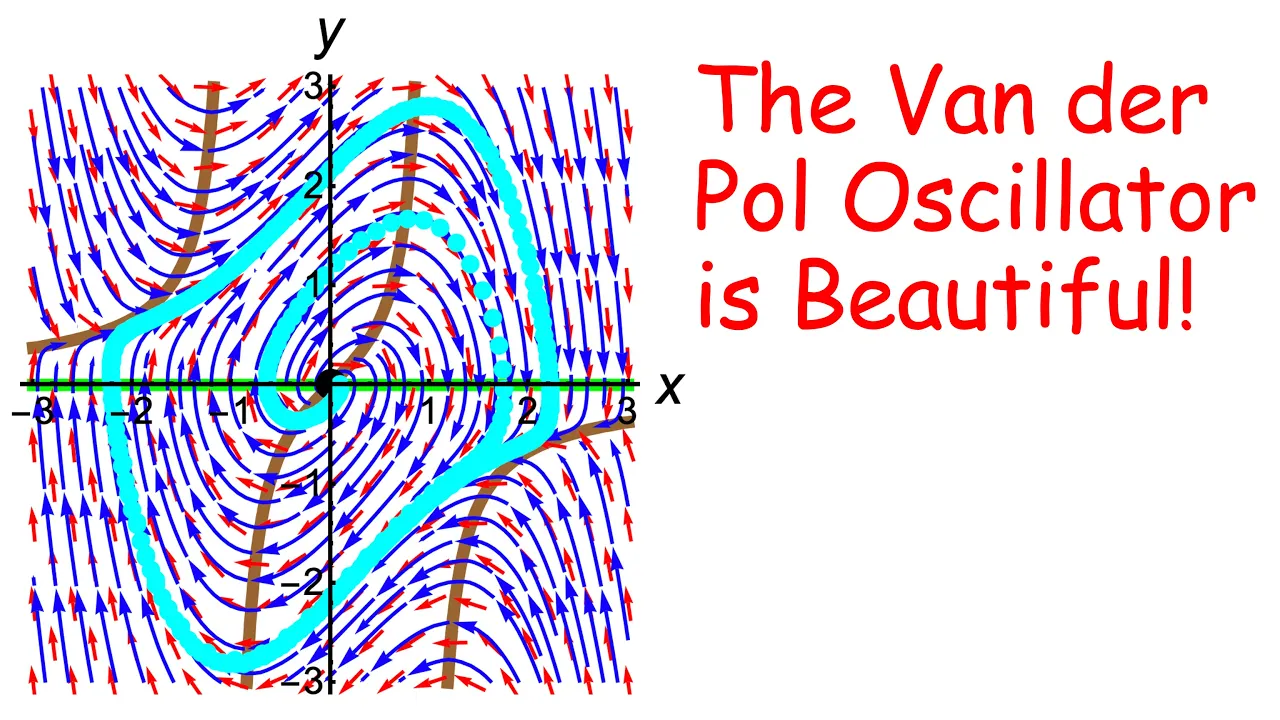

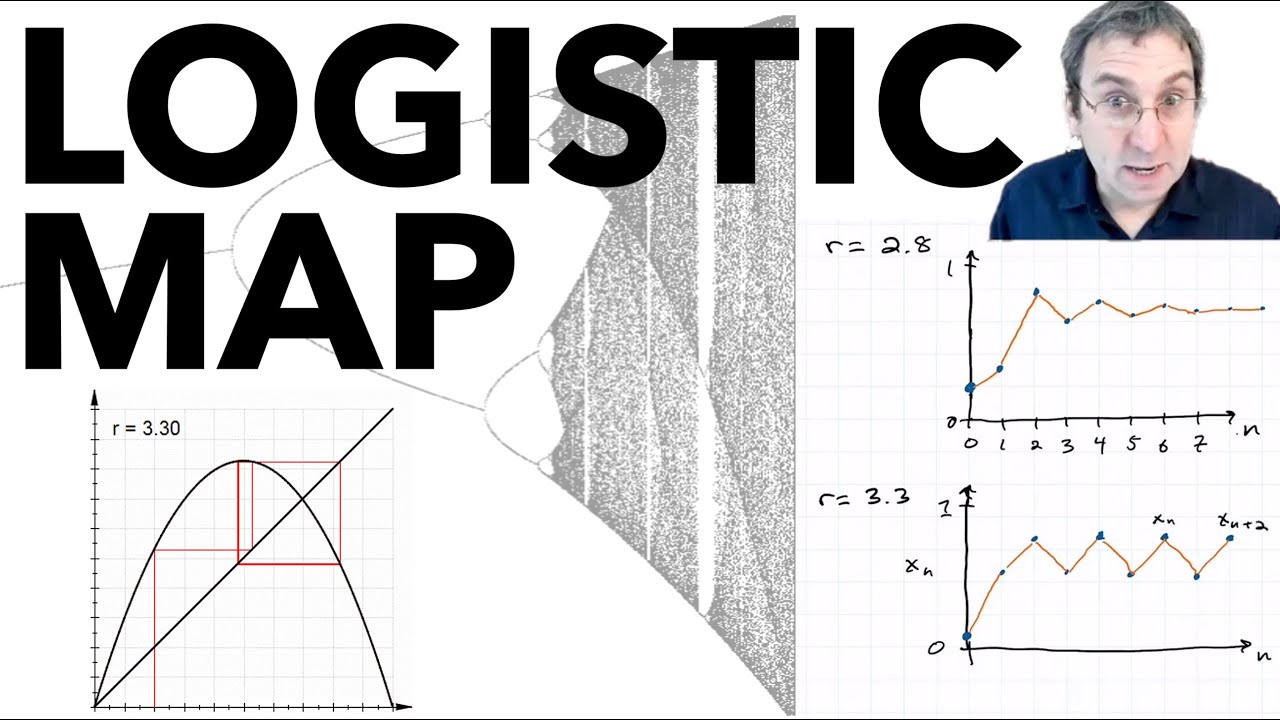










Nonlinear dynamics studies how systems governed by deterministic rules can exhibit seemingly unpredictable, complex behavior through sensitive dependence on initial conditions, where small changes lead to exponentially diverging outcomes; this field evolved from Newton's work on the three-body problem through Poincaré's geometric insights, Lorenz's discovery of chaotic weather models, and May's demonstration that simple systems like the logistic equation can display complex dynamics, ultimately revealing that chaos emerges in three-dimensional nonlinear systems and follows universal patterns across diverse physical, biological, and chemical systems.
Nonlinear Dynamics and Chaos: Course Introduction & Overview
Added:Basic calculus, particularly ordinary differential equations (ODEs), derivatives, and integration.
Fundamental linear algebra concepts, specifically eigenvalues, eigenvectors, and systems of linear equations.
An understanding of basic functions, graphing techniques, and algebraic manipulation.
Conceptual familiarity with limits, continuity, and basic physics/mechanics principles.
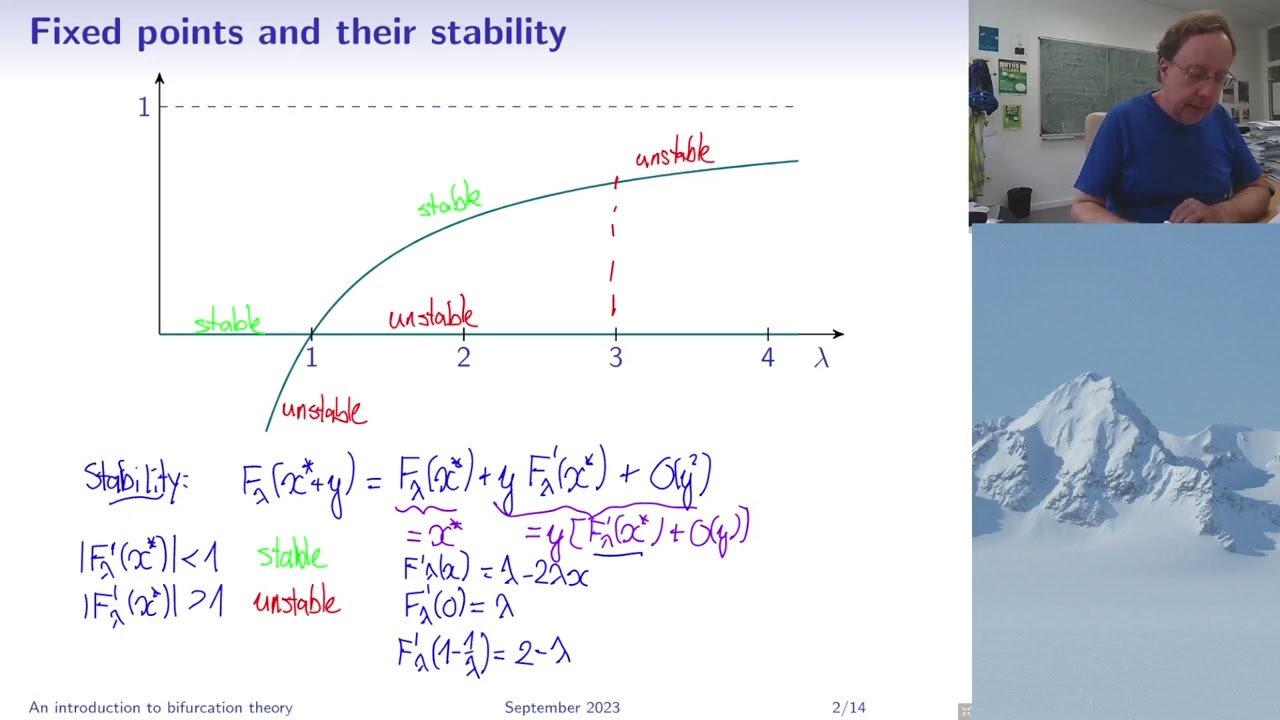
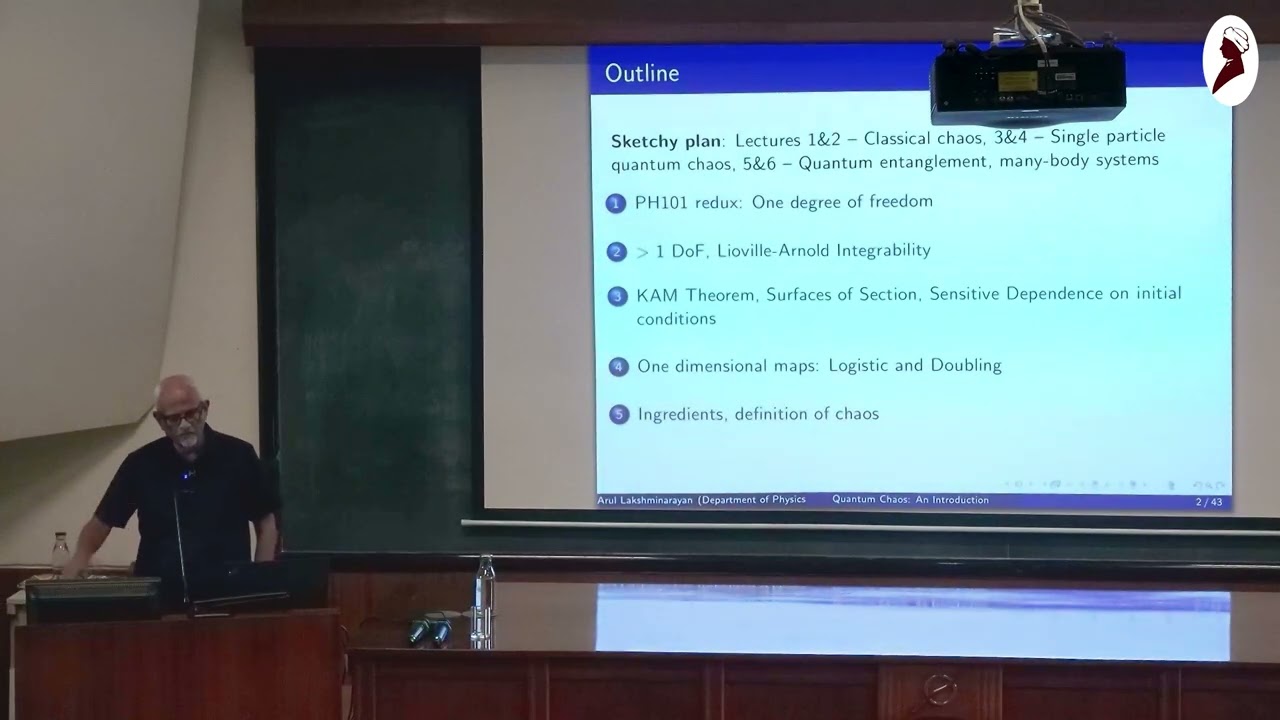
Analysis of bifurcations, such as saddle-node, transcritical, and pitchfork bifurcations in 1D systems.
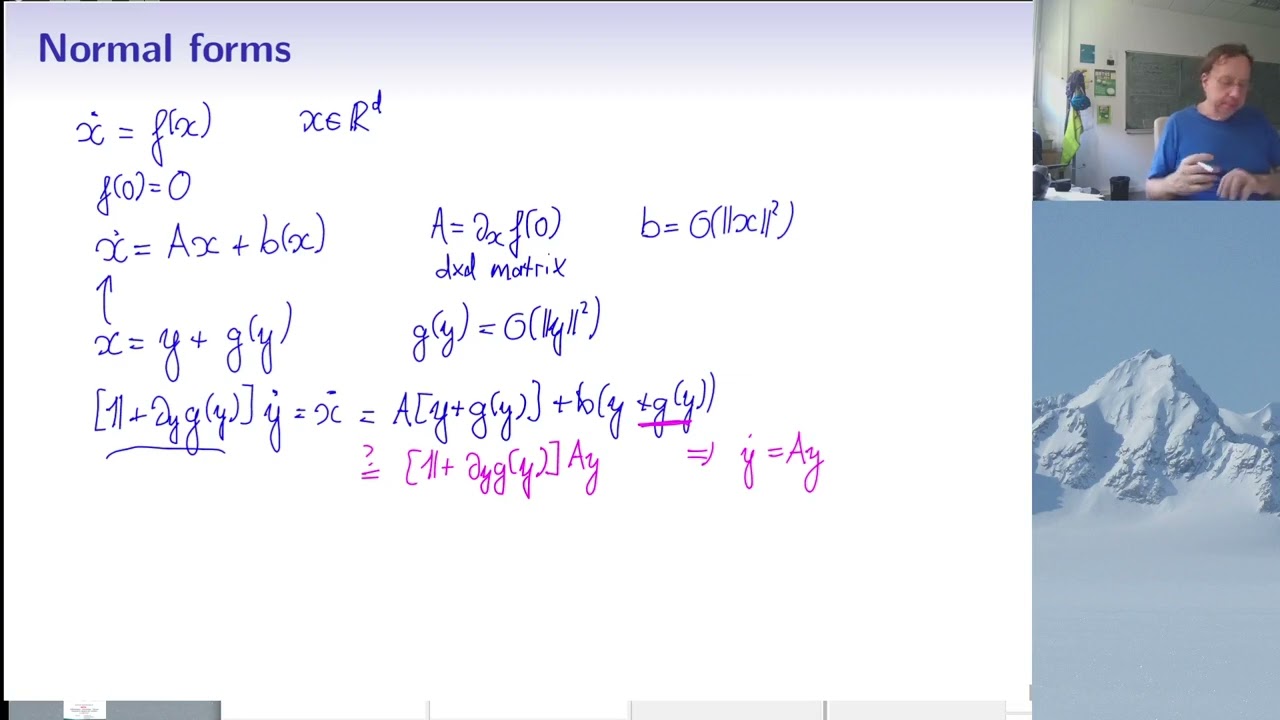
Two-dimensional flows, phase planes, limit cycles, and the Poincaré-Bendixson theorem.
Discrete dynamical systems, focusing on the logistic map, cobwebbing, and the period-doubling route to chaos.
Higher-dimensional chaos, strange attractors (e.g., the Lorenz attractor), and fractal dimensions.
Practical applications of nonlinear dynamics in fields like population biology, chemical kinetics, and mechanical oscillations.
422.8K views4.8Klikes1:16:31Original Release: 2014-05-27
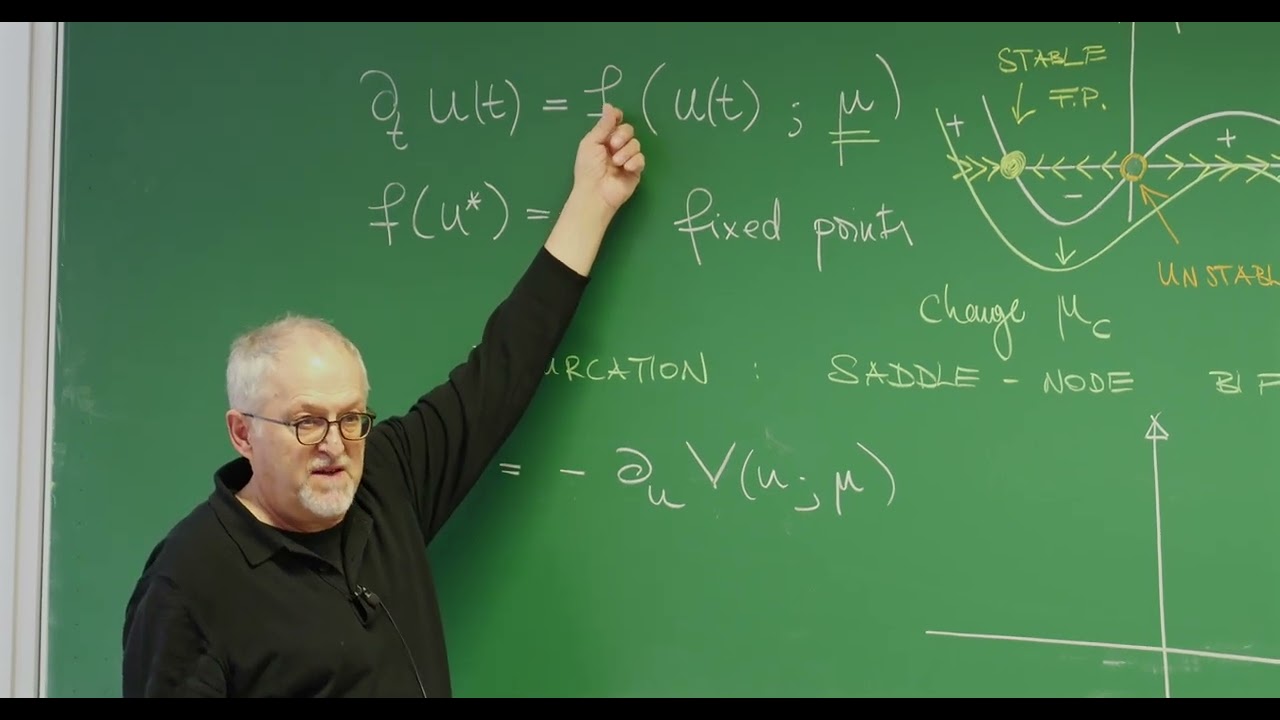
to Mae 5790 it's nonlinear Dynamics and chaos and um you are welcome to call me Steve a lot of grad students do my own grad students do that or you could say Professor or Professor stroat whatever feels most comfortable uh I have my office hours on Mondays 1:30 to 3:30 over in the math department mot Hall um 533 a lot so teaching assistant we are still working on that I'll let you know uh the textbook is a book I wrote some years ago did did people look in the campus store is it there it's still there all right so you should be able to get a copy if you want one there are pirated copies available for free on the internet I don't recommend that you do that but it's up to you um let's see what else so website uh we're going to use Patza this term and some of you probably received an email from me or from piatas yes if not you should enroll yourself in the course there um so I've listed the website on this handout and we're going to sort of live there if you have email questions you should post them there it'd be better to do that than writing to me directly because um other students might might answer you or you could help other students if you know the answer and all the homework and other information will be posted there uh we're being videotaped or at least I am by our friends at video note so that means that you can watch the lectures afterward if you miss them or if you just want to go over a point that was confusing and I think they'll be posted probably within a day or two after the lecture occurs with all kinds of other nice features like uh key topics are tagged and you can search them and so they're very valuable in handy okay we have grading you know in the course there's homework there's a midterm test and there's a final test the midterm will be in class which I see is going to be kind of tough conditions in terms of how crowded you are but I don't know I guess we'll do make the best of it the final exam will be a take-home I'll assign it uh so that it's due on the last day of the semester and you'll have a week to do it it won't take a week of work it'll probably take maybe like 10 hours of work but um you'll have a week so I I don't want there to be huge time pressure anyway we'll talk about the details of the final but that will be essentially everything goes except for working with someone else you can use the web you can use computers anything you want look look up stuff in books um homework I'll be assigning on Thursdays and it'll be do the next Thursday now the homework poses a little bit of a problem because there are answer manuals for the book all over the Internet and so it makes it hard for me to give you credit for doing the homework because in the past I have found that students copy the anwers off the internet and so rather than making that an academic Integrity violation I want to say that you're allowed to do that because some of you will do it anyway and I don't feel like you know trying to enforce a policy of honesty about that so if you think it's helpful to you to copy the homework from some other source including your best friend or off the internet go ahead and do that you're allowed to do it I think it's a poor way to learn the subject which presumably is why you're here so I would recommend working on it either by yourself or with a friend and and writing up your answers by yourself so as I've said here on the academic Integrity part for tests it's the usual thing you can't copy or work with someone but um you can do that on the homework and but I want you to write up the answers on your own the thinking being that it might be to some benefit even if you're copying to write it out in your own hand or to type it up that is do not hand in a photo copy of an answer manual that would really be ridiculous um and also if you do copy from someone else or you have collaborators please be honest and say say who they were and there's no as I keep saying there's no penalty for doing that so just tell the truth just like you would if you were writing an academic paper if you were quoting something you would cite that reference otherwise it's plagiarism so just get in the habit of saying who your helpers are and if you don't do that then that really is an academic Integrity violation and I will have to pursue that with you so we don't want to do that is there any question about anything so far uh the topics in the course well so I'm going to discuss that in a little more detail in a minute but just roughly speaking we start with um well you can read it here on the on the handout we're going to walk through the whole textbook so let me now try to give you um a little more information about what you might need for prerequisites I would say uh the absolutely indispensable thing is calculus you have to be good at Curve sketching that is when I um you know State some curve a function of X and it might have parameters in it you should feel comfortable drawing that curve by hand not on a graphing calculator you should be able to draw a family of Curves as a parameter changes you want to be able to feel comfortable with that part of calculus at some points we'll need some linear algebra about igen values and igen vectors uh you might need a little bit of advanced calculus to know what a Jacobian is um you certainly need to know how to take partial derivatives a little bit of multivariable tailor series but not much and that's about it at one point we use fua analysis but I won't assume you know that so that'll be described the it's very helpful if you have a good science background so if you know freshman physics uh a little biology some chemistry the more science you know the better engineering will be helpful too but you don't of it is strictly required we'll we're going to I mean it's a broad and diverse class and so I'll try to sketch any science that we need the level is um mostly first year grad students lot of good undergraduates ask if they could take the course yes you can traditionally sophomores have trouble with it but uh you know if you really work hard you can do it it's a surprisingly tricky course it will seem trivial but there are subtleties in it so you do have to pay that is the style of thinking is different from what you're used to it won't look like a math course with a lot of calculations or proofs it will involve a lot of visualizing and geometric thinking and intuition and so if you like that you'll love the course but um it will seem different I think than what you're used to so I think oh also we'll make frequent use of the computer you should feel comfortable either um solving differential equations in a program like Maple or mat lab or Mathematica or if you don't do those you could write your own code you could use Python I don't really care how you do it but um you got to use computers to solve nonlinear differential equations sometimes and so you should expect to be doing that there are things on the web that you can use to their applets that will be helpful that I'll refer you to okay so I think I'm ready to start unless there are any questions about anything does that cover it nothing okay I like an interactive class so feel free to ask or comment at any point uh let me start with giving you two overviews of the subject and then we will go into the nitty-gritty of how to calculate certain things or visualize certain things so first let's start with history that is what is this subject about and how did it evolve okay so the historical overview and and you know this is a very telegraphic overview I'm not going to give a comprehensive treatment but these are the high points I would say the beginning is 1666 Isaac Newton is at that point 24 years old and um he has a big year in 1666 more or less invents calculus figures out the laws of Optics discovers universal gravitation um it's good year for him he has a other results but anyway so as far as our concern I mean this is not really true to say that he invents ordinary differential equations but he goes much farther with them than anybody else up to that point and um for the first time in Humanity's history explains the um orbits of the planets that is Kepler has already calculated from Tao Bri's data that the planets move in ellipses and um he has his other two laws of planetary motion and Newton can explain all of them from universal gravitation plus calculus plus his three laws of motion so that's the beginning of Dynamics but then you know interestingly he has solved at that point what we think of as the two- body problem that is a planet being pulled by Earth's gra or sorry Earth or another planet being pulled by the Sun's gravity that's when he is able to explain elliptical orbits but um he's to do that he's had to neglect all the other planets in the solar system or all other objects in the universe so that's why we say two- body problem just just the sun and a planet but what about if there are more bodies which of course there are like moons or the other planets well that's then the three body problem or the nbody problem and Newton can't solve it and he actually writes to one of his friends that no problem has ever made his head ache like the problem of the three bodies although he calls it the problem of the moon but that's what he means the three body problem so he doesn't solve it and not neither does anybody else but people work on it for several hundred years years and so I'm going to fast forward to around the late 1800s so it's now like 1890 and still nobody has solved the three body problem everybody has tried Oiler all the greates gaus um and finally pan explains what the trouble is that is in fact you can't really solve the three body problem so pan care introduc produces a geometric approach as opposed to the analytical calculus based approach yes do you have a question um planker more or less proves that you can't solve the three body problem in the traditional sense of looking for closed form analytical Expressions he that is he uncovers a I mean I don't know if it's debatable whether it's a proof but he certainly recognizes what the difficulty is in a fundamental way that other people hadn't recognized and nowadays we would say that his arguments do can be made into a proof so yes I would say so but anyway through his um work where he uses geometry and visualization instead of calculus I mean or supplementing calculus he um sees the thing that we would Now call chaos for the first time so um that is his geometric approach Ro is based on a concept that we're going to call phase space and I hopefully show you a little bit about face space later in the lecture but his work gives us a glimpse of chaos so people like to say that pan discovered chaos and now you know you may be wondering what's the definition of chaos and we'll be discussing that in a lot of detail later in the course but for now you should think of the key ingredients as being um a phenomenon that occurs in deterministic systems uh so deterministic meaning governed by rules that have no Randomness in them there's nothing stochastic in them they're they're the present State determines the future state in such a system and so in these deterministic systems you can sometimes have AP periodic um seemingly unpredictable Behavior so in a deterministic system so AP periotic meaning it doesn't repeat it's um not just repetitive motion it's also not motion that just settles down to equilibrium so it's something that doesn't repeat doesn't settle down yet the system is deterministic and it has this quality that looks slightly random that is it seems hard to predict in the long run what it's going to do and it also has this property that um it displays what we're going to later call sensitive dependence on initial conditions so that's a key ingredient um sensitive dependence on initial conditions means that if you compare the behavior of the system starting from some initial condition and then you imagine slightly changing it just a little bit the behavior will stay the same for a while approximately the same but then very rapidly in fact exponentially fast the two solutions um will diverge and so that's what I mean by sensitive dependence that that small errors or small uncertainties get Amplified exponentially fast and that makes long-term prediction impossible but don't think of it as Randomness because short-term prediction still is possible before the errors get too big so anyway this is something that pan Kare can see in his work and um you might think that's the beginning of the chaos boom except it's not because nobody really understood what panare did and uh another thing that's sort of interesting is that he was very bad at drawing in fact he got a zero on the entrance exam when he went to college uh on the mechanical drawing part he was absolutely pathetic at drawing and so in his books and papers he tended not to draw pictures of what he was thinking about even though he was very Visual and so he described a certain thing a shape that was um the essence of the chaos he had discovered but he did not draw a picture and I really think that hurt the understanding of the subject that nobody really knew what he was saying the another thing that hurt is that if you remember this is the late 1800s now starting to be the early 1900s classical mechanics is not where the action is right what is the action in the early 1900s quantum mechanics is just getting started right Max plant the photoelectric effect and relativity is being invented so so physics is all not about the three body problem anymore people have been sick of that for 200 years at this point and um so Pan's work is just a big nothing except a few mathematicians notice it but anyway so there it is late 1800s and um meanwhile uh in like say from the 1920s to the 1950s you have sort of the Great era of nonlinear oscillators um in physics and Engineering so for example um things like radios are invented that are based on vacuum Tube Technology where a vacuum tube is a precursor to nowadays we use semiconductors transistors um the radio though uses this interesting vacuum tube uh that is a nonlinear oscillator and you could also view um radar and phase lock Loops for communications uh lasers these are all examples of things that rely on nonlinear Dynamics for their functioning so if you read books about nonlinear Dynamics from this era it will be all about nonlinear oscillations and nobody's talking about chaos because like I say that's sort of Forgotten meanwhile around 1950 the the computer as we know it today is invented um you know partly stimulated by World War II and also the Cold War so the high-speed computer the programmable computer is there and that gives Dynamics a tremendous new tool for for thinking about things and visualizing them and it's used very powerfully in the 1960s uh especially by one of the Heroes of this course Ed Loren who was a um meteorologist and mathematician at MIT so we'll be hearing about his work towards the end of the course he's known especially for um his work on a chaotic system in a model of convection in the atmosphere so he was interested in weather forecasting um and he was led to a very simplified fluid dynamical model of convection roles in the atmosphere that he found exhibited this kind of unpredictable behavior that you know he also didn't use the term chaos but he did write this very important paper in 1963 that we're going to go through with a fine tooth comb called um deterministic AP periodic flow or non-periodic flow something like that um and it's an absolutely beautiful and readable paper that should have started the chaos Revolution but he too was ignored partly because his work was published in a journal that physicists and mathematicians don't read the Journal of the atmospheric sciences and partly because his colleagues in fluid dynamics said this is a ridiculous model this is not a correct model of the atmosphere so this doesn't tell us anything and um so nobody really got what a tremendous breakthrough he had made until sort of the 1970s mid 70s this is the boom years for Chaos Theory so 1975 or so well actually I guess I should say one other thing in the 60s is that there's also um work by a mathematician named Steven smil and three others who always go by this abbreviation Kam korov Arnold and Moser um this is very deep work by by mathematicians pure mathematicians about sort of following up in the Stream that panare started and that was always kept alive through pure math but that the rest of the world wasn't aware of certainly not physicists um so this is very deep and interesting work that if you take a course a pure Math course in chaos it'll be all about these kind of tops topics and much less so the other things I've described uh we won't be talking about those much but you could take those if you want to take something like math um 6170 you could learn about these things anyway so in the 1970s everything starts happening you have uh a population biologist named Bob May who notices chaos in iterated mappings just simple dynamical systems of this form where time is this letter N discreet just Nal 1 2 3 4 like that and these are simplified models of populations um you could think of this as just a function that you could program in your calculator and you put in a number press that function button you get a new number apply that function again and just keep doing that you may have done such games on your calculator like pressing the cosine button over and over or the square root button these are iterated maps and so that's um probably the simplest model of chaos that we'll be studying after the Loren system Also may wrote a paper in 1976 called something like simple dynamical systems with very complicated Dynamics or no simple nonlinear systems with very complicated Dynamics which was published in nature where everyone could see it and it got many people realizing that there was a whole subject waiting to be studied and actually may made what he called an Evangelical plea that we should stop teaching only linear math to our college students and our graduate students and show them that once you allow systems to be nonlinear all bets were off and you could discover all kinds of things and we it was time to stop lying and to start doing that in our classroom so here we are trying to do that but anyway so may may really made the case and um in in particular he studied something that we call the logistic equation in population biology and that is one of the very simplest models of chaos about which a lot is known nowadays meanwhile there's uh Ben ju Mandel bro who um has his own way of looking at everything and roughly speaking starts the subject of fractals which turn out to be intimately related to kaaos and um so we'll see that connection later in the semester but so that started happening in the 7s uh a biologist named art Winfrey Cornell undergraduate in engineering physics um was working on biological rhythms from mathematical point of view so nonlinear oscillators in biology he was my mentor so I have a special affection for him in his memory but he really did extremely important and um influential work about bringing math and especially topology into biology and finally there's uh the work of Ruel and tokin who were pure mathematicians but who um had the idea that the chaos that people were seeing in say like lorenz's system or in these iterated maps that that might be relevant to the greatest unsolved problem in classical mechanics which is the problem of turbulence that is what is going on with turbulence in the navier Stokes equations or in real fluid systems and the question was could what we were learning about chaos shed light on this age-old problem of turbulence that is is turbulence just another name for chaos or are they different what's the relation so Ruel and tokin had some very uh suggestive ideas about that that stimulated many people and so this all these things help make chaos become also the subject got named around that time by Jim York a mathematician at Maryland so anyway it got to be a big story in the 70s I would say the high point of the whole thing is around 1978 when a young physicist named Mitchell Fen bam discovered a really startling connection between the work on the logistic map and other iter at maps and found well he discovered a connection between all that and work on phase transitions that was going on actually largely at Cornell through work by like Professor Ben whittam in chemistry or Ken Fischer who was in physics um and later won the Nobel Prize for his work on renormalization group in physics and so the connections were between uh phase Transitions and chaos and so what Feen bam noticed was um what has come to be called a universal root to chaos that is different totally different physical or biological or chemical systems could go chaotic in the same way quantitatively that there were mathematical laws about the the progression into chaos from order and Fen Bal discovered those and found as I say that they were Universal they occurred the same way in these systems that had nothing in common at a scientific level um and so that was really hard to understand and hard to believe but he explained it through connections to phase transitions in statistical physics and so that's a high point of this course as well as of the whole subject of chaos theory and we'll be looking at that um later in the semester what Fen bom did uh key point in his analysis was to use as I said the renormalization group which I don't assume you've taken a graduate statistical mechanics course so I'm going to give you a baby version of renormalization and try to explain what what it was that fean bound did then by the 1980s let's see so I should be thinking about when you guys are born because that's a very natural point in time for you to be interested in that would be I suppose something like the 1990s is that right yeah so we're not there yet okay so 1980s right this is the time when chaos and nonlinear Dynamics become fashionable in fact they're very hot at this point this is when the world becomes aware of them fractals too so hot hot hot and you have you know like a high point there is the James Glicks book on chaos called chaos making a new science uh gets published in 1987 and later translated into 25 languages sells millions of copies everybody's hearing about chaos you can buy T-shirts with fractals on them screen savers coffee mugs um Steven Spielberg makes Jurassic Park in the early 90s the hero one of the heroes is a chaos theorist who says I think there might be trouble if you have these dinosaurs in this uh Park maybe you can't maybe you it's hard to predict what will happen you've seen that movie movie right and he's trying to explain the butterfly effect on Laura D's hand Jeff Goldberg yeah gold Bloom I mean so anyway yeah it's that was in the early 90s but Jurassic Park I think was written a little before that anyway so um the pop culture becomes aware of it and meanwhile there's all kinds of experimental confirmations of these theoretical ideas so I'll describe those um in various physical and biological systems after we do some of the theory and then uh okay so then what happens well then you guys are born it's the 1990s and I would say by that point chaos theory has pretty much peaked and there's some work on um engineering applications of chaos like using chaos for encoding private Communications um that is what's chaos good for is it just a nuisance or can it when we use it can we exploit it in some way so that becomes a question but the this the the subject really sort of starts to drift into more complicated things that is um instead of systems with just a few variables which is really what chaos theory is about this complicated behavior in systems with three or four small numbers of variables interest starts to drift into what are now called complex systems which have millions or billions of variables and so um that becomes the hot subject of the 90s and then into the the years sort of 2000s to the present complex systems is where the action is and uh also Network Theory so I would say this is kind of mainly what we're interested in these days chaos you it'd be hard to get tenure being an expert in chaos and nothing else you could in a math department again but scientifically the field has moved on so that's a very quick overview of the whole story but um let me try to give you now the logic of it rather than the history do you want to ask anything or comment before we move on yes did anybody use work start uh so the question was did anybody use poner work on the three-body problem when the Space Race started up uh yes it turns out that there are some so the the trajectory planners who think a lot about orbits of satellites or spaceships um they certainly knew about Pan's work and work that followed from it I don't know that they needed it for for like the moon mission but it has been ideas of Chaos have been used in some surprising ways um to to do very low cost missions like sometime actually there was a famous case of a I can't remember whether it was a satellite I think it might have been a satellite or some other vehicle that was in trouble and the the trajectory Engineers needed to find a way to get it back to the Earth but it didn't really have any um had a very weak rocket on it I mean it just sort of had like little uh course correction Rockets not enough to bring it all the way back to Earth in the standard way but using Chaos Theory it was possible actually to plan a route that required almost no power where you could sort of use you sort of Surfing the solar system and using the sensitive dependence in a way that actually helped you get the get this injured satellite back with almost no fuel was kind of amazing so that was as big surprise to the more traditional Engineers of of trajectories who think of it in terms of you you need a powerful rocket to steer you through the solar system you can actually sort of cruise along on the gravity of the solar system and its chaotic trajectories if you know what you're doing that was that was kind of amazing so yeah I tell that story in some detail in my um course for the Teaching Company if you want to watch some of those videos yes motivated by chaos oh so the question is was mandal bro motivated by chaos I think his work is a parallel stream he was aware of it but I wouldn't say he was motivated by it he he was thinking about a lot of real world problems about the behavior of the stock market or language um the shape of clouds and galaxies I mean he was very interested in nature in the geometry of Nature and he did do something you know that now is called the mandal bro which is very closely related to iterated Maps it's an so he he um came close to working on chaos but that wasn't his main interest it just happens that some of the geometric shapes we encounter in studying chaos are fractals and so that's the main connection all right let me um leave the History part there and now try to talk about The Logical aspects of what we're doing that is what's the math in all of this and I want to end this part by showing you one big picture that is going to guide us for the whole semester so you'll know where we are after you have this picture in mind okay so the logical structure of Dynamics so I'm using Dynamics to refer to the whole subject here anything that changes in time I would consider part of Dynamics as opposed to the narrower view that you might have that it has to do with f equals ma or something like that it's it's much bigger than fals ma really what we're studying here are differential equations and we'll often write them like this x do = F ofx where my notation is that okay so the dot means time derivative and um x with an underline means a vector so this is some element of RN so that is if you want to write it in coordinates it's X1 to xn this is my my X and uh this space RN will frequently refer to as the phase space or sometimes we might call it the state space of our system and uh f is some given function typically a nonlinear function so if we write this in components we've got X1 dot is some function fub1 of X1 to xn and there are n such equations the last being xn dot is FN some other function of X1 to xn so it's a system of n coupled ordinary differential equations that we're thinking about and so these FS are some given functions that depend on what the problem is we're studying and we would say that the system is linear if all the XI on the right hand side if they only appear to the first Power only so by that I mean that there are no products or powers or function of the XI and so um that is nonlinear terms would be things like say X1 squar that would be a power that's a nonlinear term or X2 * X3 is nonlinear or something like sine of X4 or e to the X5 I mean these are all nonlinear terms so we don't want any of those if we want a linear system we just have X's by themselves times constants yes right hand side rhs right hand side so you've studied linear systems in linear algebra or linear differential equations courses yes yes now the question is are we only interested in autonomous systems so remember if the wri hand side doesn't depend on time which as I've written it it only depends on the X's not time then that's called autonomous and um I'm going to use I'm going to pretty much stick with autonomous systems in this course there are sometimes when we have problems with external forcing where it is natural to put in time on the right hand side but um for the most part we won't be dealing with those and on the few occasions when we do you can still make those into nonautonomous systems sorry you can make those into autonomous systems by introducing another variable you can always say t dot equals 1 and then you just regard the state space as X1 up to xn and T and then um it's now again an autonomous system the reason we like that I I guess I should clarify that when we get to this point but autonomous systems are the nice place for us to be doing uh the geometric work that we're going to do that is we want to visualize the phase space as having arrows in it Vector fields and those Vector Fields shouldn't be changing um for our geometric picture we want our picture to be Frozen and if you allow explicit time dependence the vectors are wiggling as a function of time and it messes up the geometry so I will not tend to consider non-autonomous systems and that that's pretty customary in this subject oops I guess all right well anyway so let me give you oh so by the way if if um well any system that's not linear is called nonlinear so let's do a few quick examples uh classic one would be say the simple harmonic oscillator which you're probably used to writing as something like MX dot + KX = 0 and right away you notice that doesn't exactly fit our framework because I said we're only going to write systems of first order equations and there's a second derivative the X double dot so but we can convert this into our framework by um this little trick so to put this in the form of x doal f ofx we'll introduce some new variables let's let X1 will be X and X2 will Define as x dot and with that choice then notice that X1 dot is just the same thing as X2 because they're both equal to x dot and X2 dot is well that would be X double dot which according to this formula would be minus K X1 / m so that is now a system of the type that we said we're always going to be considering two first order equations coupled notice it's linear because X1 and X2 only appear to the first power so we would consider this a linear second order system where is in contrast something like the pendulum which um ignoring the constants you know the pendulum can be written as uh x dot + sinx equals z using the same trick as what we just did with the X1 and the X2 this one would correspond to X1 dot is X2 X2 is minus sin X1 and this would be nonlinear and second order because of this nonlinear term s of X1 right X1 is not just appearing to the first Power uh you probably learned in some course that to think about the pendulum you use the so-called small angle approxim or you replace S of X by X but you recognize that that's just throwing out the essence of the problem now you're doing you're making the nonlinear system into this linear system which is okay for small angles but if you want to understand something like what happens when the pendulum goes over the top you know that's not going to work so you need some other mechanism or method for looking at this and that's the kind of thing we'll be learning how to do now how are we going to do that so if if you've ever actually studied the solution of the pendulum analytically you might know that it involves something called elliptic functions which almost nobody teaches anymore although Richard Rand does still teach them so you could learn about them in a course that he teaches um on hamiltonian Dynamics or nonlinear vibrations I think either of those he'll tell you about elliptic functions but that's not the approach we're taking we're not going to use tricky special functions instead we're going to be using pictures and here's our point of view so this is the the pan care idea I mentioned about geometry as the key to thinking about nonlinear systems so for us a solution of the problem that is suppose I knew X1 as a function of time and X2 as a function of time if I had a solution like that I could think of it as a point moving along a trajectory in this um space with coordinates X1 and X2 that is we would draw a picture X1 1 X2 as the axes and then you know at say the initial time X1 and X2 are at some place so that would correspond to being a point in this x1x2 space and then as time goes on that point moves to some other point which means that if you connect the dots you're going to get what I'm referring to as a trajectory so you could think of this as parametric equations for that trajectory so instead of thinking about Solutions in this sense we're going to try to think about trajectories in these phase spaces and here's Pan's great idea which is that um it's the big idea is that it's possible to run this Construction in reverse that is we can figure out what the trajectories look like and thereby gain information about the solutions and we can do it without solving the equation analytically that that's the trick we're going to use some kind of argument to figure out what the trajectories look like without actually solving them explicitly so we'll try to um find what people call the phase portrait where by phas portrait I mean a picture of all the qualitatively different trajectories and we'll try to do this without solving the differential equation analytically so we'll find it without solving the differential equation analytically and that then is the the essence of the whole course really uh all right one last thing before I start doing some math is I was saying that I wanted to give you the logical structure of the course and so now we're in a position to do it now that we have this concept of phase space and also the order of a system referring to how many equations there are in our um when we write it as a system let me try to give you what I think of as the dynamical view of the world where I map the whole of the universe onto two dimensions and see where everything fits you should be thinking to yourself a little bit about what's wrong with this picture because there are many things wrong with it but still I think it's helpful and kind of interesting to look at things this way even though it's imperfect that is um so let's make it give yourself some room uh put a big table of linear and nonlinear systems and then across the top classify things according to how many equations there are when you write the Govern ing equations as a system so we'll have things that have just one variable or two or three or more than three but not too many so I'll say like n greater than like these are moderate size systems then you could have gigantic systems with n much greater than one where here I'm kind of thinking of millions or billions or maybe avagadro number in of particles you know in a gas or something and then you could also think of a Continuum where n is infinite in the sense of a continuous infinity and so let's just go through things that we know about and see where they would fall in this crude way of looking at things we already talked about two here's so the simple harmonic oscillator in this approach would go right here under Nal 2 and linear whereas we said pendulum would go down here and equals 2 but nonlinear um something like you might have studied in electrical engineering or freshman physics is an RC circuit the RC circuit would go there it's first order linear uh anyone have any first order nonlinear things that have come to mind you might have seen somewhere there's lots yes logistic growth of a population would be one so yeah simple model say of bacteria growing on a petrie dish so as you say logistic growth um also the problem of a sky diver someone jumping out of an airplane if you ask what's their velocity as a function of time using the fact that air resistance is a nonlinear drag Force so skydiver Dynamics the velocity would be governed by first order nonlinear so you see these are the kinds of things you study in um early in your college education by Continuum but linear I'm thinking of things like the wave equation or um actually Maxwell's equations in electricity and magnetism are linear in the electric and magnetic fields actually the Schrodinger equation is um linear to you know in quantum mechanics you can use a whole Vector space formalism the Hilbert space is is the way you where the bras and the cats you know the state vectors live in in quantum theory so that's a linear Theory now you might wonder why am I putting it on this chart this has to do with partial differential equations and it's because I'm thinking you know if I wanted to describe the state of something governed by a partial differential equation i' have to give you let's say if it was the wave function in quantum theory I'd have to give you the value of the wave function at every point in a continuous space right to predict the next what the wave function is at the next moment you need a whole continuous Infinity of information about the wave function at the current all the current locations so in this sense you could think of partial differential equations as living in this column whereas the nonlinear ones would include something like general relativity or um the problem of turbulence or in the case of biology to understand fibrillation in a heart the most deadly kind of arhythmia that's governed by nonlinear partial differential equations uh what else so I don't know you could anyway you could sort of try to fill in the chart but here's here's the plan for the course um we're going to be starting down well okay first what's the usual topic I mean this is kind of like freshman physics these things up here that's the usual part of college education and then after doing that it's traditional to jump way over to here and learn about these kinds of things heat equation wave equation and so on so the linear pdes that you study in lots of different subjects so those tend to come next but we will mostly be starting down here and going this way from first order nonlinear systems to second order and then into third order which is where the Loren system lives so chaos first occurs here in the Nal 3 column for nonlinear systems we'll we'll prove a theorem or actually at least State the theorem and discuss it that shows that there's no chaos in one and two dimensional nonlinear systems you need three dimensions or more for top logical reasons so um and the Loren system is an example of such a thing where this starts to occur also the um fractals and iterated maps that I mentioned earlier although they don't really strictly belong here because I'm thinking of discrete time when I talk about iterated Maps rather than continuous ordinary differential equations in terms of their complexity they're comparable to the luren system so that's kind of our plan then is to start over here on the left and systematically March through the semester to the right and so this is our course here whereas um a lot of the hottest stuff in science today as I say is involves networks they're very large nonlinear this is where the realm of the complex systems down here and um this is really the edge of science I mean we don't know that much about what's going on in the lower right corner we know a little and that's that's where all the a lot of work is being done but um this part is now under good control and that's what our course is about okay so that's the overview of the whole subject and is there any question then before we start doing some actual work I hope that's helpful anyway to orient you realized it took a while to discuss but nothing okay so let's try to make this concrete now talk about phase space in an example what we just discussed is was chapter one in the book and so now we're in chapter two and chapter 2 just has to do with these very simple systems of the form X do equals F ofx where X is a real number just a single real number so these are 1D systems 1D because um I want to think about them geometrically as having to do with flow on a line just a one-dimensional line like the real axis the x axis so here's an example of how we would analyze such a system suppose we had this problem X do equals sin x which as you can see is first order but nonlinear because of the sign and now the traditional way you would do this if you were taking a differential equations course would be to think in terms of formulas like you would maybe do something where you separate variables you go DX over sinx is DT and then integrate both sides so this is a separable differential equation and this integral is no problem that's t plus a constant but the other one requires a little bit of memory um DX over sinx so this is the same thing as um that's called cosecant so searching your memory banks or wolf from alpha or Mathematica or whatever Maple for integral of cosecant of X or you know if you have a good m you'll remember that one way of writing it is U minus log of absolute value of cosecant of X Plus cotangent of X there there are other ways of writing it that are equivalent to this but this is at least one way and um okay so there's some nasty function and then if we have an initial condition say x = x0 at T Z then you can evaluate the constant and you find that t is the natural log of cosecant of x0 plus coent of x0 I'm skipping a little algebra here cosecant X Plus coent X and I'm writing this mainly to horrify you that is you're supposed to think that that's correct but not very Illuminating um in particular it's not so obvious how to solve for x in terms of T which is what you probably want to do if you're good with trig you can do it um so that you could get X of I mean you can invert this but it's a little bit of work but my my aim here is to say that e well first of all the sign function is pretty simple if I had given you a nastier nonlinear function you wouldn't even be able to do this integral so we're kind of at the outer edge of what's possible here with this example we could do this integral but even then it's not very helpful um like suppose I ask you just an easy question like uh say suppose x0 is pi over 4 then what what's the long-term behavior that is what is the limit as T goes to Infinity of X of T that that should be possible to just read off from that formula but I guess I claim it's not so obvious when you look at the formula whereas if you draw a picture it's much easier to see what's going on so I want to show you the way we're going to think about this problem rather than analytically we will draw a picture which is we draw x dot versus X and we regard X as the um think of X as the position of an imaginary particle and the part of IC is confined to move on the xaxis it can't get off there it's just moving on this one-dimensional thread and under that interpretation x dot would then be its velocity and the statement that X do equals sinx the differential equation we now think of as a vector field I mean really it's a velocity Vector field on the xaxis that is it gives us a rule that says when you're at X your velocity is sinx and that tells the particle how to move so if I draw s of X and this is where the curve sketching part is important you have to know how to draw s of X okay good you can do that so there's s of X something like that and and now what is this telling us x dot is positive under this hump so that means the particle would move to the right right the flow is to the right because when x dot is positive it means X increases as a function of time so a particle sitting here would tend to increase its X therefore moving to the right whereas here a particle sees a negative velocity and so it'll move to the left and likewise you could fill in these other regions over here we'd be going that way and here we're going this way and you might also notice there are places where x dot is zero so those are important um x dot equals z at what we call fix points and we'll use the notation xstar for fixed points because when you're at a fixed point you have no velocity and so you don't move when you're governed by a first order equation as we are here so that is Let's uh indicate those fixed points by um circling them let me draw this a little bigger okay so I've circled the fix points and notice that there's two types of fix points and so we're going to indicate that by the ones with the arrows pointing toward them I'll fill in and the ones where the arrows are pointing away I'll leave open this uh remember was xal Z here and so now you can see what the answer is to our little puzzle that if we started here at pi over 4 you can see what the particle would do it's just going to start moving to the right in fact you can see how fast it's moving to the right by just Consulting this function initially its velocity is this number s of < over 4 that's < TK of 2 over2 let's actually show this over here as we can graph qualitatively x as a function of time and notice of course I'm not using any cosecants or anything I'm just eyeballing it from the picture here we are at Pi over4 at time Z and we would initially go up with a slope of um sine of pi over 4 so < tk2 over 2 that's that then the particle moves to the right and at some point it gets underneath this maximum and now at the maximum the sign function is one so we don't know when this time is that's one weakness of this method it's not quantitative it's qualitative so at some time we're under the maximum and then we're going up with a slope of one so that's steeper than what I had drawn earlier then later we're still moving to the right and will at some point be like say at 3 pi over 4 this was at Pi / 2 then there's 3 pi over 4 and we're now going up again with this Square < TK of 2 over2 slope and then you notice that as we keep going we're now approaching this fix point and in fact we're going to ASM totically approach it and get there as you know never get there but approach it as time goes to Infinity so you can now see the answer is that the limit of x of t as T goes to Infinity for this initial condition will be Pi but we can also see the shape of the trajectory or the the time series that here is pi and so we're going to ASM totically approach that is the trajectory the the time series here I don't want to say trajectory because the trajectory is happening over here on the xaxis in the phase space but our um time series X as a function of T will be qualitatively like this that is we get some information that where initially uh X is growing concave up it's going it's accelerating it's going faster and faster until it crosses Pi / 2 then it's concave down it's decelerating as it approaches Pi Okay so so that's an example of the um the use of phase space arguments to draw something you know qualitatively right without doing much work I don't know if I used the the names but I meant to say that these kinds of fix points are called stable stable meaning that nearby trajectories are attracted to the point so if we perturb away from it will be drawn back whereas this kind of fix point is unstable the arrows are flowing away from it and so a little disturbance will get Amplified and grow it'll become bigger so the the notation will be that we'll always draw unstable points as open circles and stable as filled in is there any question about that example all right let me try one more I think uh I have just a couple minutes left so we mentioned earlier the logistic equ equation in population biology which is given by this uh differential equation x dot is rx 1 - x over K where R is a parameter that's positive and so is K and we can try to rationalize this equation a little bit that is where would this come from here's one way you can think about it the the biologists would say that a natural quantity to look at is x dot overx so if x is the size of the population I think of a lot of bacteria growing on a dish with some nutrient that's keeping them alive um and then there every 20 minutes they divide and make new bacteria so X is the size of the population and so x dot would then be the growth rate right number of organisms created per unit time and of course the more organisms there are the faster the growth rate the bigger the growth rate will be but what you want to do is normalize by the current population that is X do overx you can think of as a growth rate per bacterium right it's a per capita growth rate although that literally means growth rate per head and I don't know if it makes sense to speak about the head of the bacteria maybe it does but anyway this is the per capita growth rate and so in the logistic model the idea is that the per capita growth rate as a function of the population is is the simplest possible thing that decreases it's just a straight line that decreases from some um value of R when this would be the growth rate if there are very few bacteria around that would just lead to exponential growth and the reason for the logistic model is to say well exponential growth might be true when there aren't many bacteria but once there's a lot of them and they're crowding each other out on the dish then they're going to be competing for food and at some point um they're such overcrowding that the the growth rate should go down per capita and in fact at this place called the caring in capacity the growth rate will equal the death rate um and after if there's more bacteria than the carrying capacity k then actually you'd expect um now they're going to start dying faster than they're being born they're overcrowded so this is the the simplest model that includes the effect of overcrowding and if we want to analyze what it does we can just draw the analog of our picture and you can quickly come to a nice little conclusion that is um if we draw x dot versus X it's just a parabola right because R X1 - x over K is a graph of a parabola with roots at K and zero and notice this is positive here there's a fix point and there's a fix point and then it's negative on this side and so the prediction is that there's a stable fix point at the carrying capacity that is if you start this population of bacteria anywhere they will grow up till they eventually reach the level K so X of T will go to k as T goes to Infinity that is if the initial condition is positive if there's any number of bacteria to begin with they'll just eventually reach the quote carrying capacity that's how much the dish can support and if there were more than that then they would die out again till they get to the carrying capacity so um we that you can see took very little work to come to that conclusion but uh that's the power of this kind of method okay so let us quit there and I'll see you next time
Up Next
10:55
Enthalpy and Internal Energy Explained | Thermodynamics
@NAJAMACADEMY
295.8K views•2023-05-29

12:53
21cm Hyperfine Transition in Neutral Hydrogen: Radio Astronomy Basics
@AaronRobertParsons
12.4K views•2011-10-13

32:32
NMR Spin Physics I: Zeeman Effect, Resonance Condition & Larmor Frequency
@nptel-indianinstituteofsci8064
2.3K views•2024-01-17

27:14
Entropy and the Second Law of Thermodynamics Explained
@veritasium
27.5M views•2023-07-01
Related Study Plans & Knowledge Roadmaps
Structured learning paths in Physics
physics
Nuclear Physics (Decay, Fission & Reactors)
01Atomic Structure and the Binding Force
02Radioactive Decay and Half-Life
03Nuclear Fission Mechanics and Chain Reactions
+ 2 more learning modules
12h5 modules
Explore Roadmap
physics
Soft Matter (Polymers, Colloids & Rheology)
01Foundations of Soft Matter & Thermal Forces
02Polymer Physics and Macromolecules
03Colloids, Surfactants, and Self-Assembly
+ 2 more learning modules
38h5 modules
Explore Roadmap
physics
Analytical Mechanics: Lagrangian & Hamiltonian
01Mathematical Foundations: Calculus of Variations
02From Newtonian Mechanics to Constraint Dynamics
03The Principle of Least Action & Lagrangian Mechanics
+ 3 more learning modules
28h6 modules
Explore Roadmap
physics
General Relativity (Spacetime & Cosmology)
01Foundations of Relativity: Special Relativity
02The Geometry of Spacetime: Equivalence Principle & Curvature
03Einstein's Field Equations: The Mathematics of Gravity
+ 2 more learning modules
55h5 modules
Explore Roadmap