
















![Räumliche und zeitliche Summation [EPSP/IPSP - Verschaltung an Synapsen]- [Neurobiologie, Oberstufe]](https://i.ytimg.com/vi/r4ZSQcXSNtM/hqdefault.jpg)


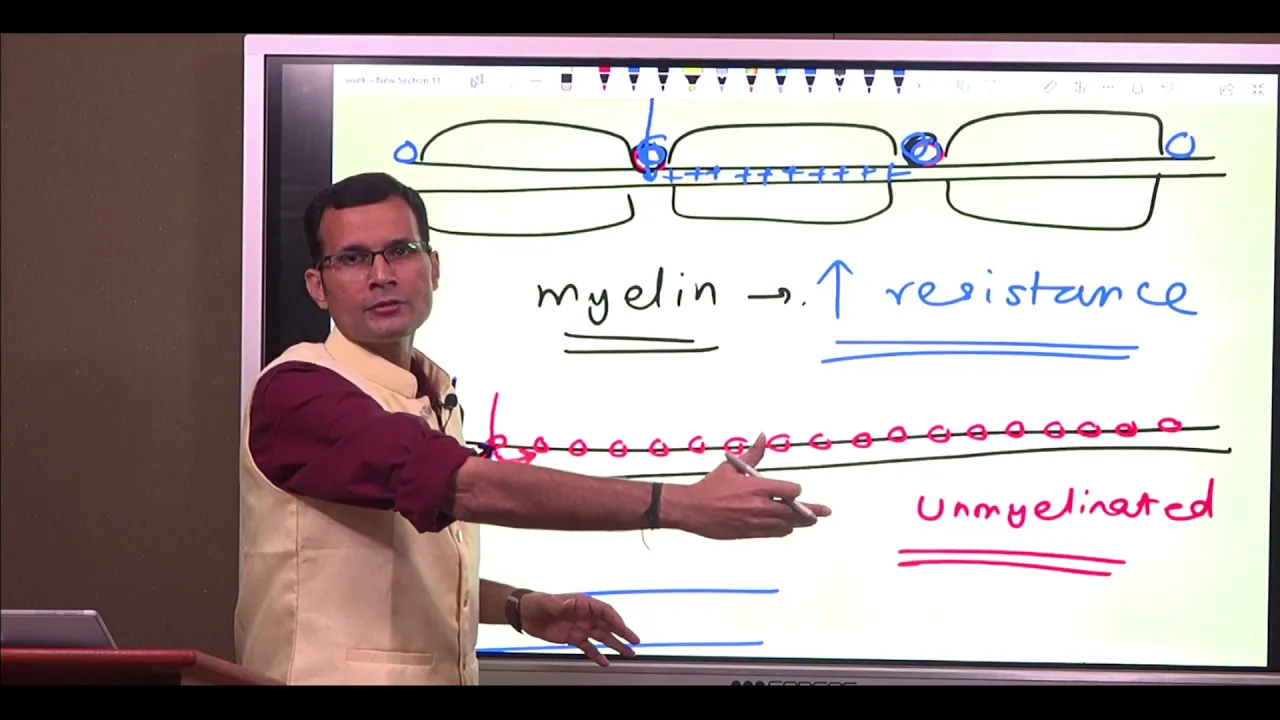
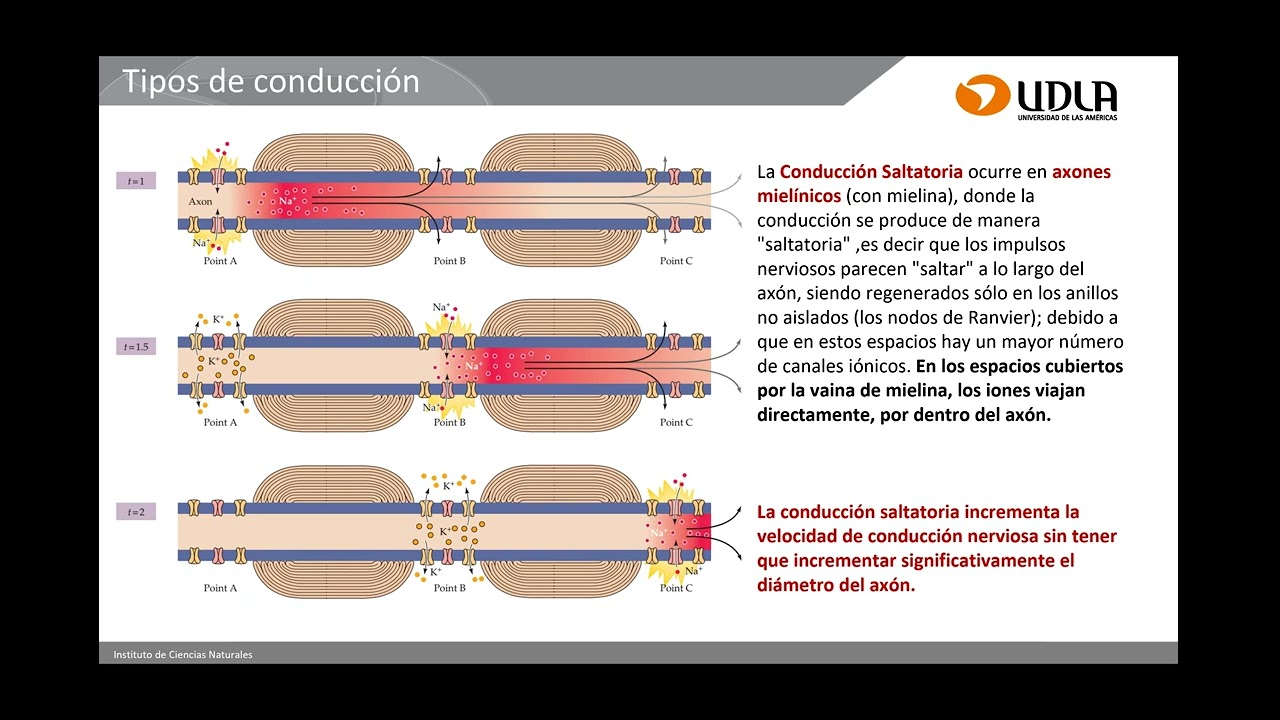


An action potential is an electrochemical signal transmitted along a neuron's axon, initiated when the membrane potential reaches threshold (-55 mV), causing voltage-gated sodium channels to open and sodium ions to rush in, depolarizing the membrane to +30 mV (overshoot); potassium channels then open, causing repolarization and brief hyperpolarization below resting potential (-70 mV), followed by the sodium-potassium pump restoring ionic gradients; this process follows the all-or-none principle where amplitude remains constant regardless of stimulus strength, but frequency varies, and myelination enables faster saltatory conduction.
Action Potential in Neurons: Ion Channels & Signaling
Added:Basic anatomy of a neuron, specifically the roles of the soma, axon, dendrites, and myelin sheath.
The concepts of passive and active cellular transport, including diffusion down concentration gradients.
The fundamental principles of electrical potential, voltage, and the behavior of ions like sodium (Na+) and potassium (K+).
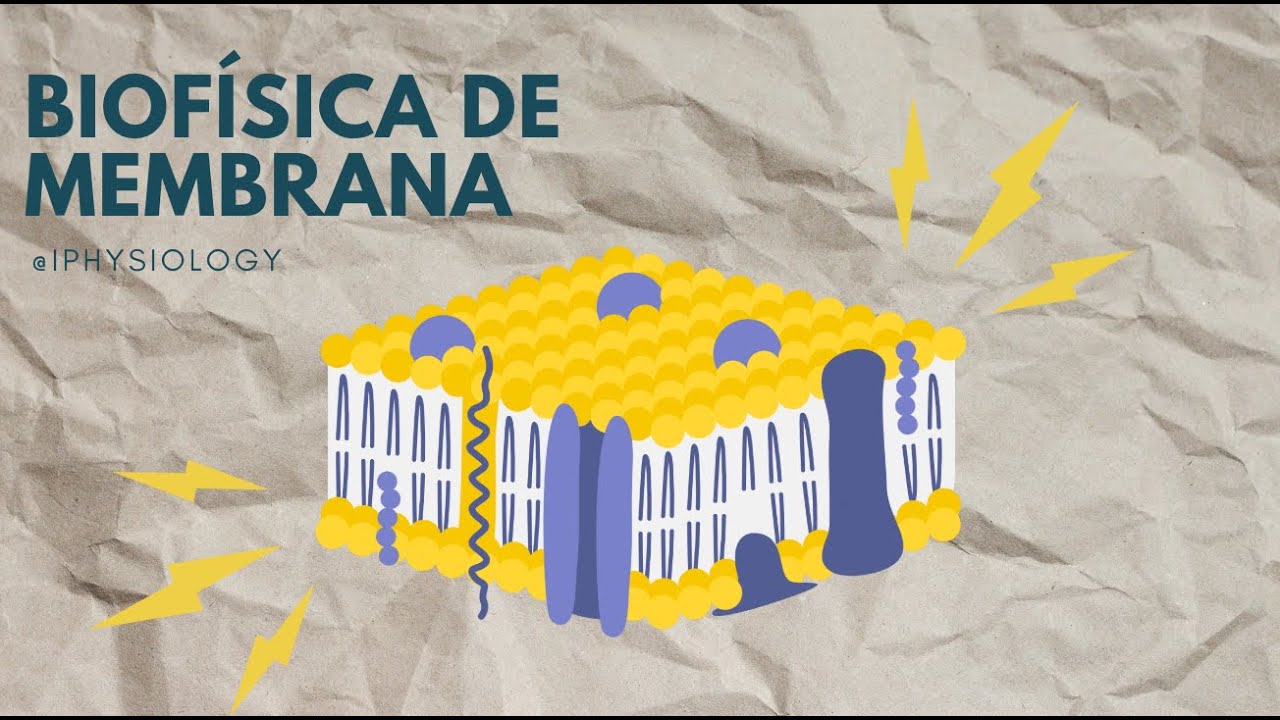
The basic structure of the phospholipid bilayer and how membrane-embedded proteins function.
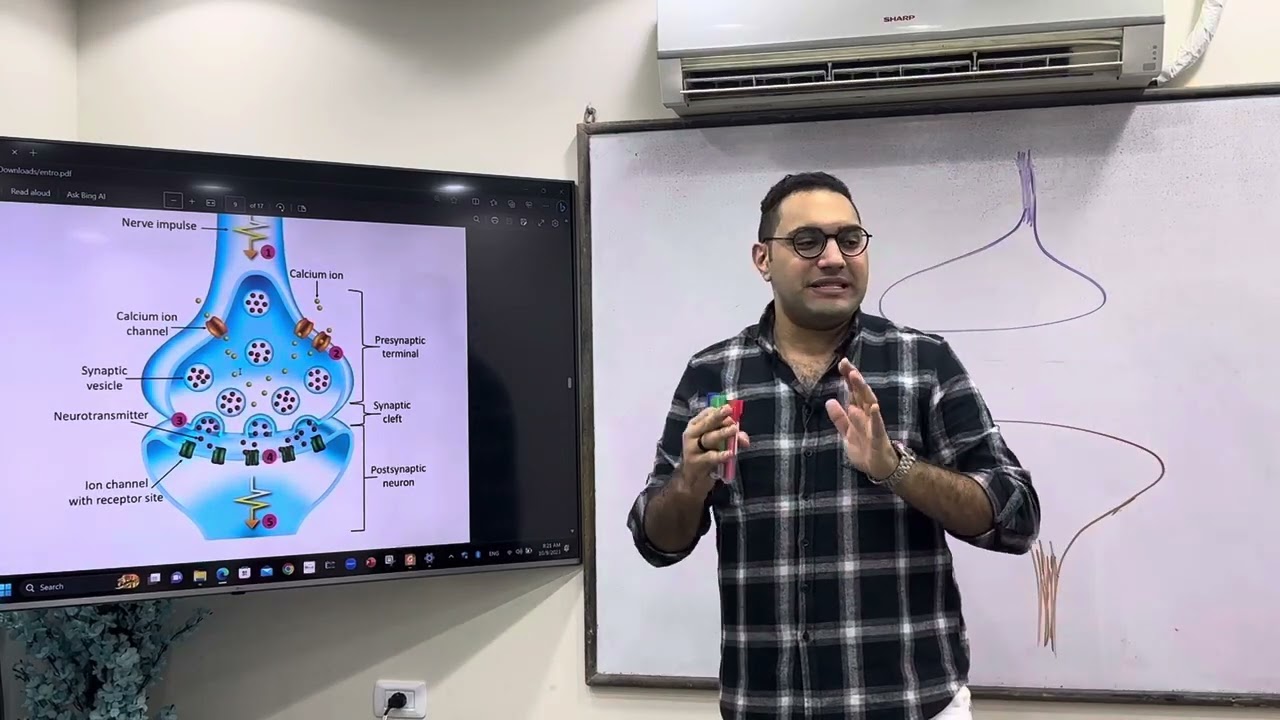
Synaptic transmission, including how the electrical action potential is converted into a chemical signal via neurotransmitters.
Saltatory conduction and the role of the Nodes of Ranvier in accelerating signal propagation along myelinated axons.
Postsynaptic integration, specifically how Excitatory and Inhibitory Postsynaptic Potentials (EPSPs and IPSPs) summate in the axon hillock.
The pathophysiology of channelopathies and demyelinating diseases, such as Multiple Sclerosis, or the effects of neurotoxins like tetrodotoxin.
3.4M views67Klikes13:11Original Release: 2018-03-26
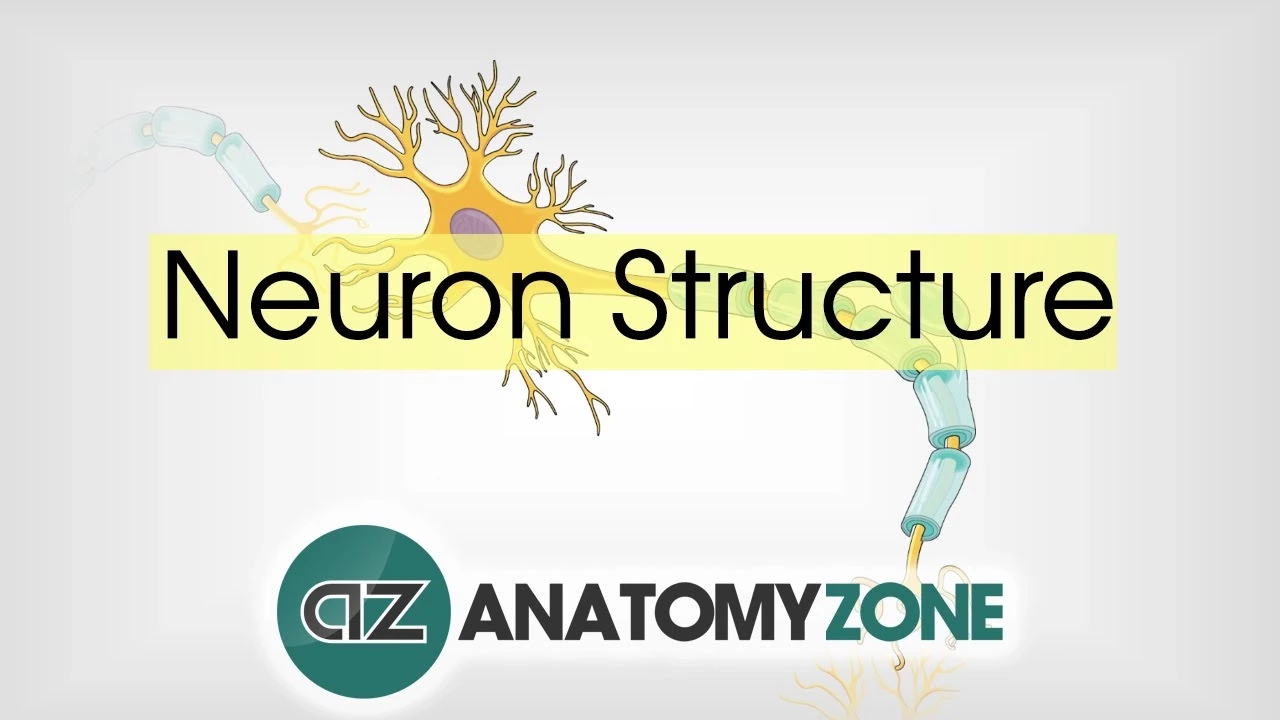
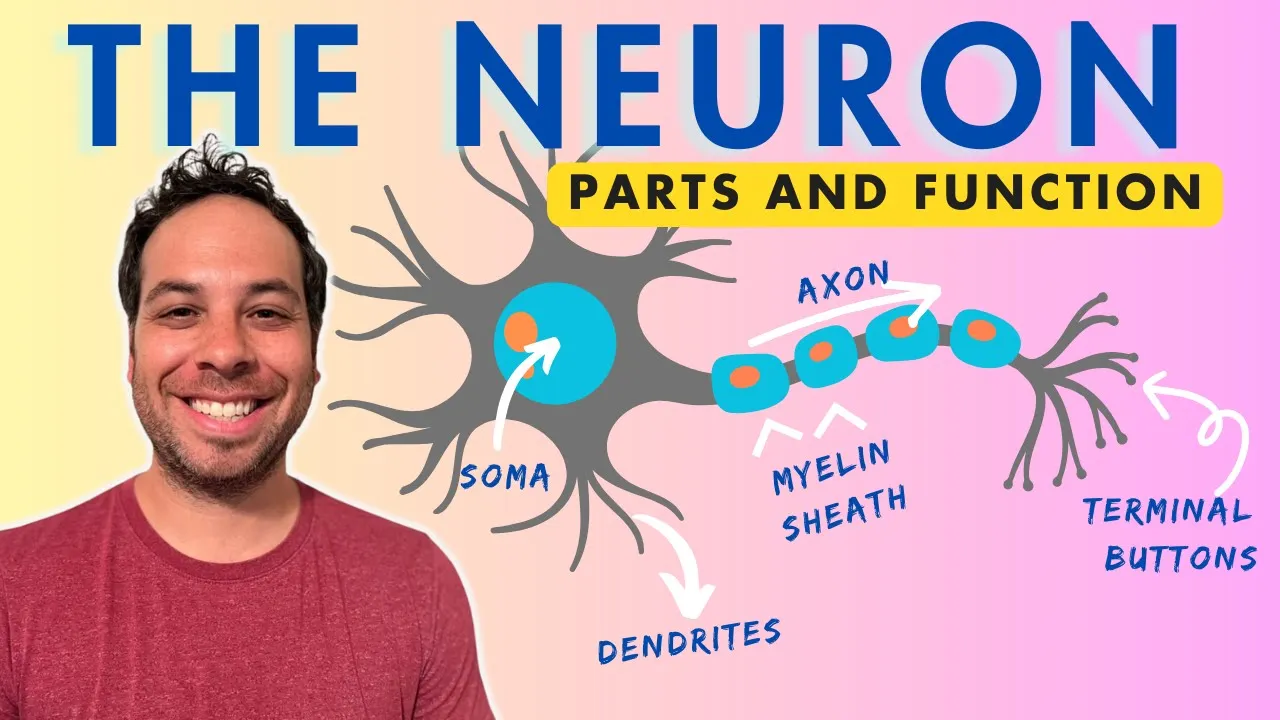
PROFESSOR: This is a neuron, which has four main parts.
The dendrites receive information.
The cell body processes and integrates that information.
The axon carries the information along long distances from one part of the neuron to another.
And the axon terminal transmits the information to the next cell in the chain.
A bundle of axons traveling together is called a nerve.
Nerves can be very long, as they often need to transmit information over long distances.
As we just saw, the dendrites are the part of the neuron that receives incoming signals.
Based on the strength of this incoming stimulation, the neuron must decide whether to pass that signal along or not.
If the stimulation is strong enough, the signal is transmitted along the entire length of the axon in a phenomenon called an action potential.
When this happens, we say the neuron fires.
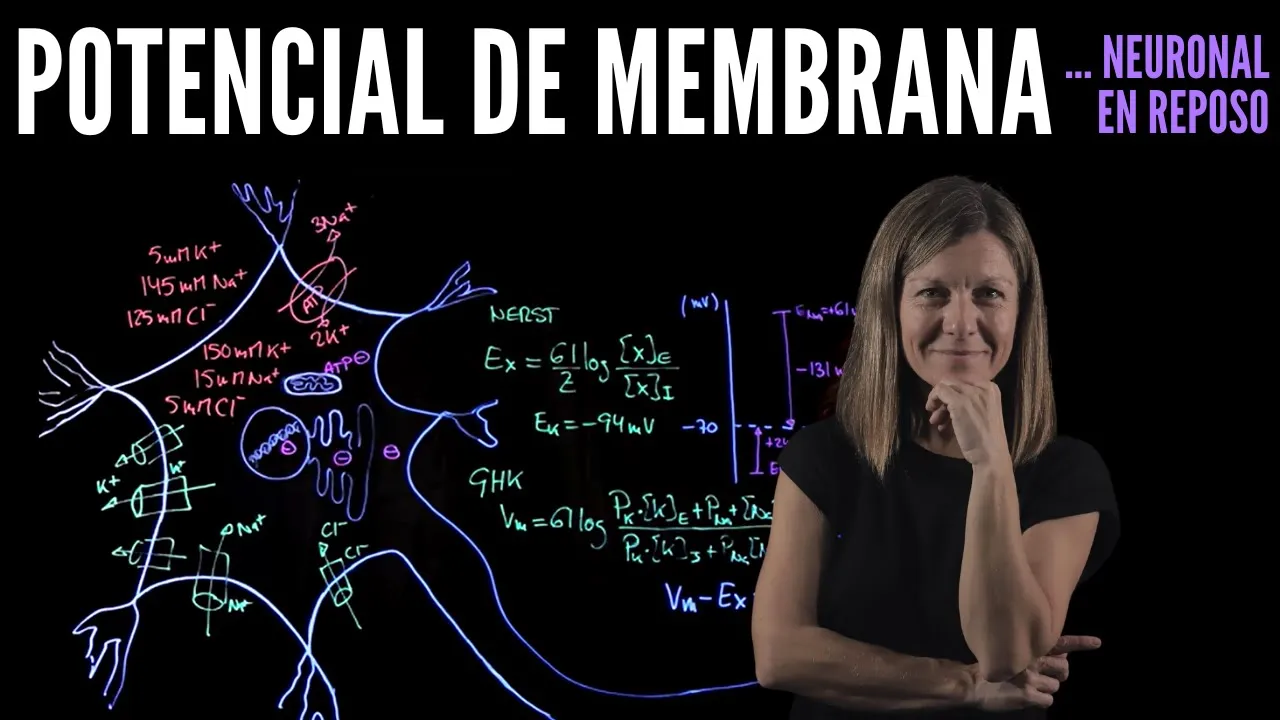
Transmission of a neuronal signal is entirely dependent on the movement of ions, or charged particles.
Various ions, including sodium, potassium, and chloride, are unequally distributed between the inside and the outside of the cell.
The presence and movement of these ions is not only important when a neuron fires but also at rest.
To start, let's think about the positively-charged sodium and potassium ions.
When a neuron is not sending a signal, it is considered to be at rest.
In a typical neuron in its resting state, the concentration of sodium ions is higher outside the cell than inside.
The relative concentration of potassium ions is the opposite, with more ions inside the cell than outside.
This ionic separation occurs right at the cell membrane and creates a chemical gradient across the membrane.
Because ions are charged particles, we also need to consider their charge when thinking about their distribution across the membrane.
At rest, there are more positively charged ions outside the cell relative to the inside.
This creates a difference in charge across the membrane, which is called an electrical gradient.
Together with the chemical gradient we already mentioned, we refer to this ionic imbalance as the electrochemical gradient.
The difference in total charge inside and outside of the cell is called the membrane potential.
At rest, when no signals are being transmitted, neuronal membrane has a resting potential of approximately minus 70 millivolts.
This means that the inside of the cell is approximately 70 millivolts less positive than the outside.
Both the chemical and electrical gradients we just discussed contribute to establishing this potential.
While the inside of the cell has a net negative charge and the outside of the cell has a net positive charge, the charges line up at the membrane.
And the bulk solution on either side is actually electrically neutral.
The resting-membrane potential is the point where the cell has achieved electrochemical equilibrium.
This means that the concentration gradient and the electro gradient for each ion is equal and opposite.
Ions cannot simply move across the membrane at will.
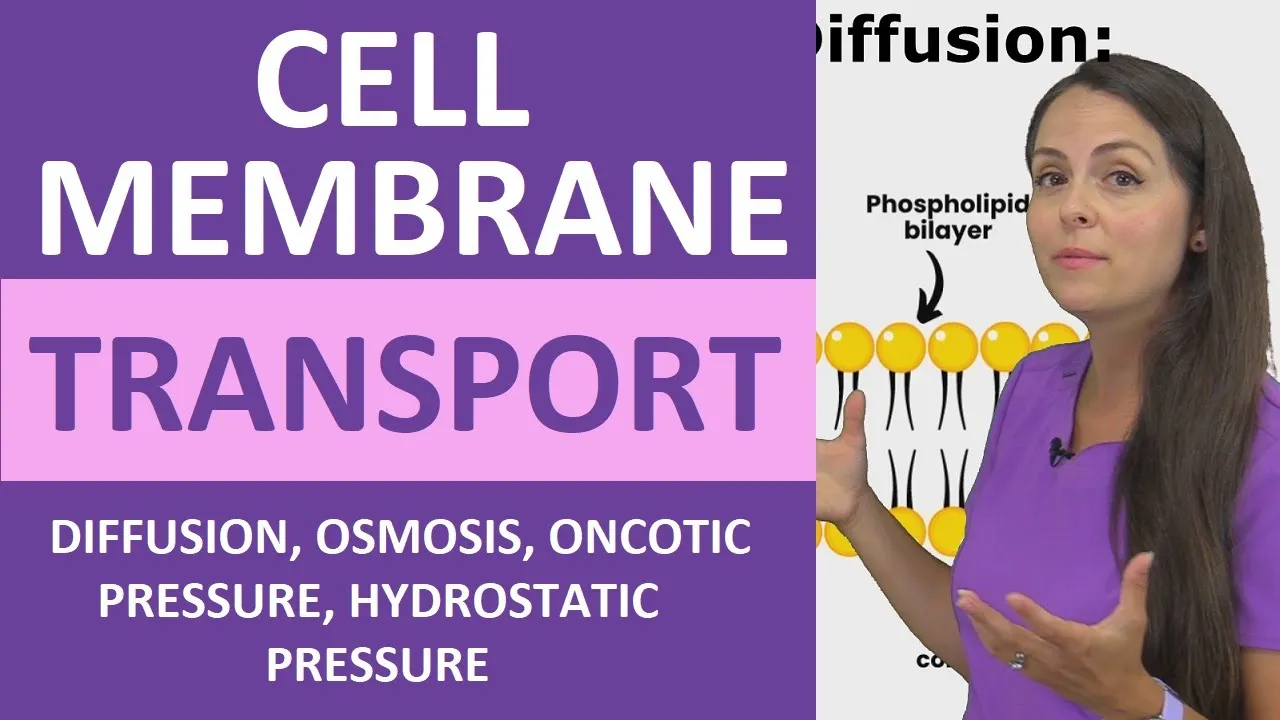
Instead, they need a protein embedded in the membrane to facilitate their movement.
Most ions cross the membrane through a structure called an ion channel.
Ions move through channels by passive diffusion along their concentration gradient.
Some ion channels are always open, but many require signal to tell them to open or close.
For example, voltage-gated channels only open when the membrane potential reaches a certain value.
On the other hand, ligand-gated ion channels are triggered to open when they are bound by a specific molecule.
Mechanically-gated ion channels open in response to physical forces, such as changes in length or changes in pressure.
Most ion channels are selectively permeable, meaning that they only allow one, or a small subset of ions, to pass through.
Voltage-gated ion channels, for example, typically only allow a single ion to cross the membrane when they open.
This means that we need separate channels for each ion, i.e. voltage-gated sodium channels, as well as voltage-gated potassium channels.
As ions move through a channel and cross from one side of the cell membrane to the other, they cause the membrane potential of the cell to move away from its resting potential.
If the resulting change in membrane potential is small, we call this a graded potential.
Graded potentials can vary in size, can be either positive or negative, are transient, and typically do not result from the opening of voltage-gated ion channels.
When ion channels open and a graded potential occurs, the neuron moves quickly to reset its membrane potential to resting values.
This is accomplished primarily by the use of the sodium-potassium pump, which uses the energy generated by ATP hydrolysis, to actively transport ions across the membrane against their concentration gradient.
In other words, sodium is transported to the outside of the cell, where its concentration is higher, and potassium is transported back into the cell, where its concentration is higher.
One cycle of this pump transports three sodium ions outside the cell and brings two potassium ions inside the cell.
This unbalanced charge transfer contributes to the separation of charge across the membrane and also to the ionic concentrations we see at rest, thus, restoring the chemical and electrical gradients to their resting levels.
Maintaining these ionic balance in neurons is so important that this process can account for 20% to 40% of the brain's total energy use.
Only when the resting membrane potential and ion distributions are maintained at precise levels, will the neuron be poised and ready to fire an action potential.
When the outside stimulation is large enough to bring the membrane potential in the neuron body up from minus 70 millivolts to the threshold voltage of minus 55 millivolts are higher, this triggers an action potential at the axon hillock, which then travels down the axon.
Voltage-gated sodium channels have three states-- open, closed, and inactivated.
At rest, the sodium channel is closed.
Once the cell membrane reaches the threshold voltage, the channel changes to an open position and sodium rushes into the cell because of the electrochemical gradient.
As positive-sodium ions enter the cell, the membrane potential becomes less negative and more positive as it approaches 0 millivolts.
This is called depolarization.
Eventually, the voltage gradient goes to zero and beyond 0 up to a positive 30 millivolts.
This is called an overshoot.
As the membrane potential becomes positive, the sodium channel inactivation gate shuts, making the channel inactivated.
This stops the flow of sodium ions into the cell.
The change in membrane potential also opens the voltage-gated potassium channels, though they open and close more slowly.
Because of the potassium-electrochemical gradient, potassium ions flow out of the cell, making it less positive and eventually negative.
This process is called repolarization.
Because the potassium channels are a little slow to close, for a brief period, the membrane potential is hyperpolarized.
It's more negative than the resting potential.
During hyper-polarization, the potassium channels close.
Throughout all of this, the sodium-potassium pump is still working.
The pump restores the chemical gradients by putting the sodium and potassium back in place.
And the pump re-establishes the potential gradient by moving more sodium ions out than potassium ions in.
This returns the membrane potential back to its resting potential.
During repolarization, the inactivated sodium channels won't respond to any stimulus at all.
During this time, the neuron is in its absolute refractory period, the period of time when a nerve cannot fire another action potential, no matter how strongly it's stimulated.
The absolute refractory period prevents action potentials from happening again too quickly and prevents action potential from traveling backwards along the axon.
During hyperpolarization the sodium channels are closed and the inactivation gate opens.
There is no change in sodium flow, but now they could be opened again.
This is called the relative-refractory period.
Because, while the sodium channels could open, it would take a larger than usual stimulus to reach threshold, because the cell is hyperpolarized due to the potassium still leaving the cell.
The amplitude of the action potential for a particular neuron, that is, the maximum voltage in one neuron during an action potential, never changes.
An action potential doesn't get bigger with a bigger stimulus.
It's all or nothing.
It either happens, or it doesn't happen.
What can change is the frequency of the action potential.
A neuron might fire many more times per second in response to, say, an intense pain and less frequently in response to a gentle breeze.
Some axons transmit action potentials faster than others.
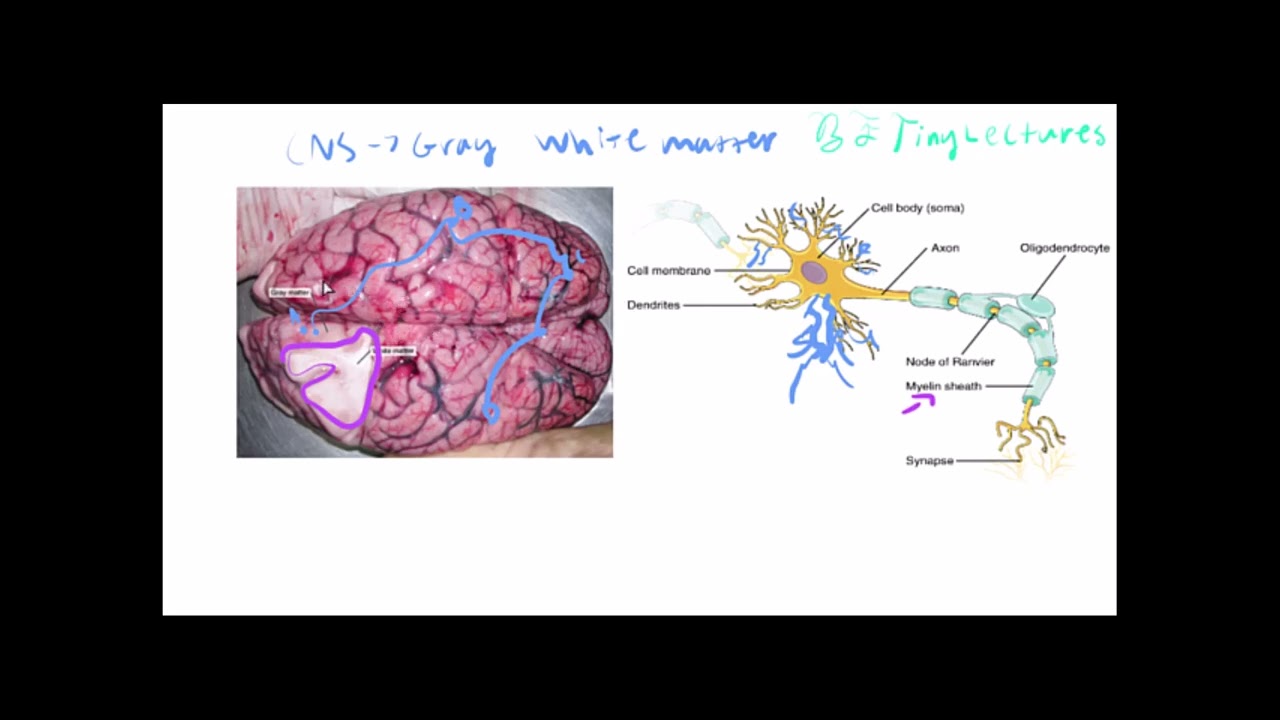
One variable that increases conduction velocity is the presence of myelin sheaths around axons.
Myelin speeds up transmission through a process called saltatory conduction, in which the action potential signal appears to jump along the part of the axon covered by the sheath.
In the peripheral nervous system, the sheaths are formed from glial cells known as Schwann cells.
There are small gaps between Schwann cells called the nodes of Ranvier.
The action potential appears to jump from node to node, speeding the transmission.
In the central nervous system, the sheets are made by cells known as oligodendrocytes.
To review, with no stimulus, the membrane is at its resting potential.
A small stimulus causes a graded potential.
And a stimulus above the threshold creates an action potential, and the neuron fires.
Up Next
12:56
Synaptic Transmission Explained: How Neurons Communicate
@PsychExplained
147.6K views•2024-04-22
21:55
Deciphering Neural Circuits Controlling Anorexia in Mice | Richard Palmiter
@AllenInstitute
2.3K views•2011-10-10

4:10
Vagus Nerve (CN X): Anatomy, Nuclei & Functions Explained
@Alilamedicalmedia
305.2K views•2022-10-31

13:03
How Exercise Benefits Your Brain: Science Explained
@TED
11.4M views•2018-03-21
Related Study Plans & Knowledge Roadmaps
Structured learning paths in Neuroscience
neuroscience
Appetite Regulation: Brain Circuits & Hormones
01Foundations of Endocrinology and Brain Anatomy
02Introduction to Energy Homeostasis
03Peripheral Signals: Leptin, Ghrelin, and Insulin
+ 2 more learning modules
14h5 modules
Explore Roadmap
neuroscience
Neuroeconomics: Value, Risk & Brain Mechanisms
01Foundations of Neuroscience and Brain Anatomy
02Introduction to Neuroeconomics and Subjective Value
03Dopaminergic Prediction Errors & Reinforcement Learning
+ 3 more learning modules
18h6 modules
Explore Roadmap
neuroscience
Spatial Navigation: Cells, Grids & Brain Maps
01Foundations of Brain Anatomy and Memory
02Place Cells and Head-Direction Cells
03Grid Cells: The Brain's Coordinate System
+ 2 more learning modules
12h5 modules
Explore Roadmap
neuroscience
BCIs: Neural Decoding & Prosthetic Control
01Neuroscience Foundations: How the Brain Signals Intent
02Signal Acquisition: Recording the Brain's Activity
03Neural Decoding: Translating Brain Waves into Data
+ 2 more learning modules
25h5 modules
Explore Roadmap