![Principles of AMERICAN GOVERNMENT [AP Government Review, Unit 1 Topic 6]](https://i.ytimg.com/vi_webp/JUiJhnx_K40/maxresdefault.webp)













![[FULL] Pidato Dahsyat Megawati, Emosi Gebrak Meja Sampai Teriak Provokator di Rakernas](https://i.ytimg.com/vi/z7Xoe0zRpKY/maxresdefault.jpg)






Democratic backsliding refers to the gradual erosion of democratic institutions through seemingly normal, legal actions by elected leaders, rather than through dramatic events like coups or martial law; this process is difficult to detect because individual actions often appear lawful and minor, yet collectively they undermine the rule of law and democratic norms, making it challenging for citizens and media to recognize until significant damage has already occurred.
Democratic Backsliding: The Silent Erosion of US Institutions
Added:The fundamental principles of liberal democracy, including the separation of powers and the system of checks and balances within the US government.
The concept of the 'rule of law' and how legal frameworks are designed to limit executive power and protect individual liberties.
The distinction between violent, sudden regime changes (such as military coups) and gradual, incremental systemic transformations.
The role of democratic norms—unwritten rules of political tolerance and institutional forbearance—in maintaining political stability.
Comparative analysis of global democratic backsliding, studying parallel case studies in nations like Hungary, Poland, and Turkey.
The theory of 'autocratic legalism,' exploring how illiberal leaders use existing laws and constitutional tools to dismantle democratic structures.
Policy proposals and constitutional reforms aimed at strengthening institutional resilience and protecting electoral integrity.
The socio-political drivers of polarization and how declining social trust contributes to the erosion of democratic institutions.
1.3M views35.4Klikes5:56Original Release: 2017-06-22
The problem with calling Trump a... is that we have a really narrow idea of what it looks like when democracies fail. We imagine democratic failure as being some spectacular event a military coup or an illegal power grab or the declaration of martial law.
To protect the Republic of the Philippines and our democracy.
We don't really imagine it looking like this.
This is a child's desk, but that's okay.
It's the smallest desk I've ever seen.
But political scientists do, because in a country like the US, the death of democracy is going to start off looking kind of normal.
So normal, you might not even notice it's happening until it's too late.
Well I respect the group but the entire thing has been a witch hunt and there is no collusion.
Trump's firing of former FBI director James Comey has gotten a lot of media attention, in part because it's really easy to explain why it matters.
If Trump fired Comey over the Russia investigation that would be obstruction of justice, which is a crime but a lot of what worries political scientists about Trump is tougher to explain in a soundbite like that. Because for the most part it's stuff that's totally legal.
It turns out that government officials can exploit weaknesses in the law in ways that are destructive to the rule of law as a whole.
This bearer of bad news is Aziz Huq.
He's a law professor at the University of Chicago and he's written a lot about a concept called "democratic backsliding", which kind of sounds like something Hillary Clinton does at a wedding.
Backsliding is what happens when a democratically elected government, starts attacking the institutions that make democracy work.
I know the dance thing was cooler.
And Huck argues that what makes backsliding so dangerous is that it's really hard to know when it starts.
In many other countries the way that we see democratic backsliding happening is through a series of discrete legal changes, each of which is on their own completely lawful.
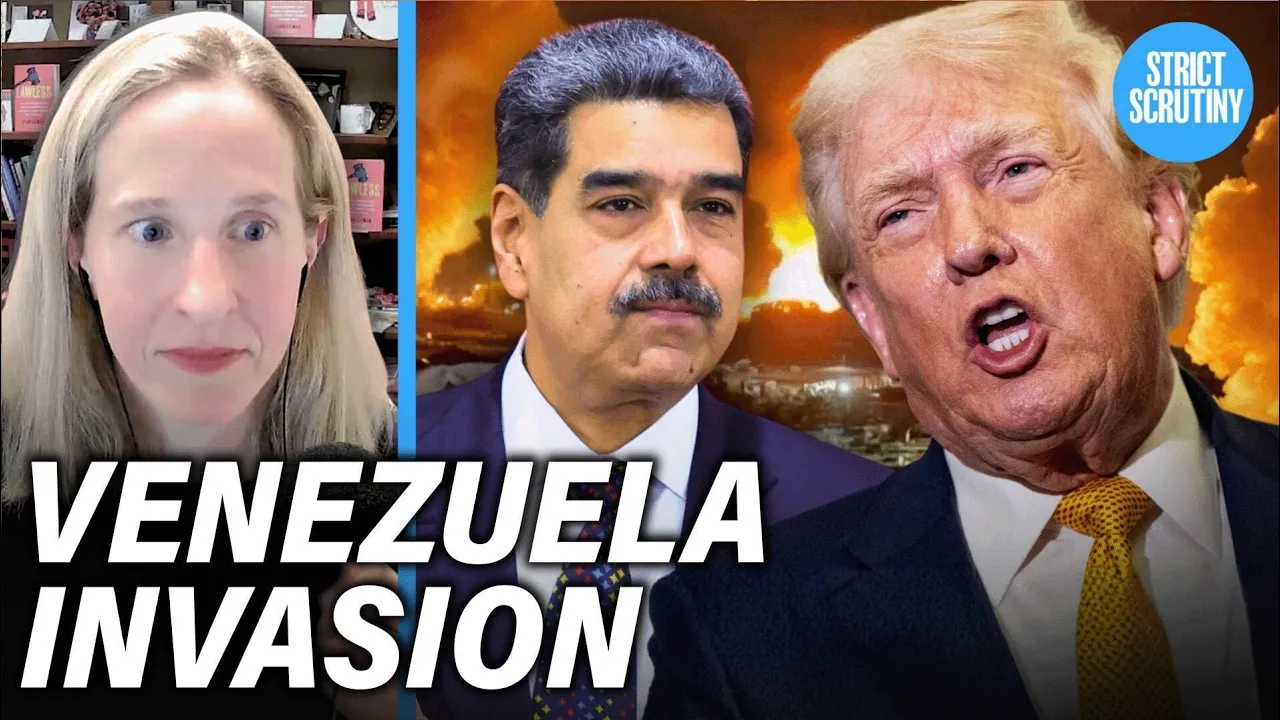
A great example of what backsliding looks like is Venezuela's former President Hugo Chavez.
Ah, the 90s.
Chavez was elected as a democratic populist, but over time he changed.
And while remaining popular Chavez has been anything but democratic.
He got frustrated with opposition from courts and the media, so he started doing things like firing judges, using anti-defamation laws to silence journalists, and even describing unfriendly news organizations as quote "enemies of the homeland".
What's scary about Chavez's story, is that he didn't need a military coup to screw up Venezuela's democracy.
The man who came to office by democracy, he's doing everything he can just snuff it out.
He did it legally, by slowly turning his supporters and political allies against the country's democratic institutions.
Autocrats in other parts of the world have gone after those institutions very early on in the process of backsliding.
And that's what worries political scientists about Trump.
Trump shows a deep distrust of America's democratic institutions. He lashes out at judges, calls journalists, the enemy of the people, accuses watchdog agencies of conspiring against him.
He questions the legitimacy of an election that he won.
His White House stonewalls reporters to avoid answering questions.
Off. It's off-camera. Off. It's off.
He's suspicious of the mechanisms that limit his authority.
This is an unprecedented judicial overreach.
And he encourages his supporters to be too.
that is a catastrophic thing to be happening in a democracy. It's how democratic backsliding starts, but the thing is none of this is illegal.
As long as Republicans in Congress go along with it, there's nothing to stop Trump from publicly criticizing basic democratic institutions.
Our Constitution just doesn't do a very good job of protecting us against certain kinds of democratic failure.
Whether you're in a moment of democratic backsliding really depends upon the character of our political leaders.
Which brings us back to Comey and why it's so hard to talk about Democratic backsliding without sounding paranoid.
We live in a media environment that is really bad at putting things in context, that is designed to bombard us with breaking news and discrete pieces of information and that makes it hard to identify democratic backsliding when it starts.
Because unless it clearly breaks the law, it's really tough to explain why any one Trump tweet or scandal poses a threat to democracy.
Wo when Trump calls a federal judge a "so called judge", it's just a one-off comment.
Does anyone honestly believe President Trump is going to ignore this judge's order because he's a quote so-called judge?
When Trump calls the press the enemy of the American people, it's all talk.
He sounds like a broken record it's just kind of like what else you got Donald Trump?
I don't think that new media are well designed to tell this kind of story, because those media are designed to convey information in very small chunks.
The real story is not the discrete action in a particular moment in time, there's some bigger picture.
Democratic backsliding is one of those things that you can't really see from up close.
It is only when you when you look at changes in the aggregate that one sees the effect upon democracy after, a set of institutions and practices.
That doesn't mean the Comey stuff isn't important.
Obstruction of justice is obviously a big deal. But some of the biggest threats to democracy are way less dramatic, way more normal looking.
And if you're waiting for the CNN chyron announcing that it's time to panic, you're going to be waiting for a long time.
Up Next

57:52
Hungary's Autocracy: A Blueprint for Illiberal Democracy
@SMN
579.9K views•2022-11-09

24:30
BRICS Pay and de-dollarization: A New Financial Order Emerges? | 55 chars
@DannyHaiphongYT
164.6K views•2024-10-22
10:19
Explaining the Saudi-Iranian Proxy Conflict in the Middle East
@Vox
18.2M views•2017-07-17
6:47
Single Transferable Vote Explained: Fair Multi-Winner Elections
@CGPGrey
7.2M views•2014-10-22
Related Study Plans & Knowledge Roadmaps
Structured learning paths in Political Science
political-science
Economic Statecraft: Sanctions & Chokepoints
01Foundations of Geoeconomics and Economic Statecraft
02The Mechanics of Weaponized Interdependence
03International Sanctions: Types, Implementation, and Efficacy
+ 2 more learning modules
12h5 modules
Explore Roadmap
political-science
Central Bank Independence: Politics & Policy
01Foundations of Central Banking and Monetary Policy
02The Time Inconsistency Problem & Inflation Bias
03The Delegation Model and Designing Independence
+ 2 more learning modules
12h5 modules
Explore Roadmap
political-science
Consociationalism: Power-Sharing & Stability
01Democratic Dilemmas in Divided Societies
02Introduction to Consociational Democracy
03The Four Pillars of Consociational Design
+ 2 more learning modules
12h5 modules
Explore Roadmap
political-science
Rebel Governance: Legitimacy, Economy & State
01Foundations of Rebel Governance and Statehood
02Establishing Political Legitimacy and the Rebel Social Contract
03Wartime Economies and Rebel Resource Management
+ 2 more learning modules
14h5 modules
Explore Roadmap