















![Ivan Illich - Sociedade sem Escolas [I - Por que devemos desinstalar a escola]](https://i.ytimg.com/vi/NLh9wbjeCaE/maxresdefault.jpg)



Educational achievement disparities between social classes in Britain stem from multiple external factors: cultural deprivation (working-class children lacking adequate socialization, reading habits, and appropriate speech codes for school), material deprivation (poverty affecting housing, nutrition, and access to educational resources), and marketization (systemic barriers that disadvantage working-class parents in navigating educational choices). Pierre Bourdieu's concept of cultural capital explains how middle-class families transmit advantageous cultural knowledge and skills through primary socialization, giving their children inherent advantages in the education system designed around middle-class values.
Social Class & Education: External Factors Explained
Added:A foundational understanding of social stratification and how social class is defined (e.g., working class vs. middle class).
The distinction in educational sociology between internal (within-school) and external (home and community-based) factors.
An introductory awareness of Pierre Bourdieu's sociological theories, particularly the general concept of non-financial capital.
Basic familiarity with how educational achievement and inequality are measured statistically (e.g., attainment gaps).
In-depth analysis of internal school factors, such as teacher labeling, setting/streaming, and pupil subcultures.
Critical evaluations of deprivation theories, including Nell Keddie's critique of 'cultural deprivation' as a victim-blaming myth.
Analysis of educational policies and compensatory education programs (e.g., Sure Start, Head Start) designed to mitigate external inequalities.
Exploration of intersectionality, examining how social class interacts with gender and ethnicity to shape educational outcomes.
50.7K views0likes27:32Original Release: 2016-08-04
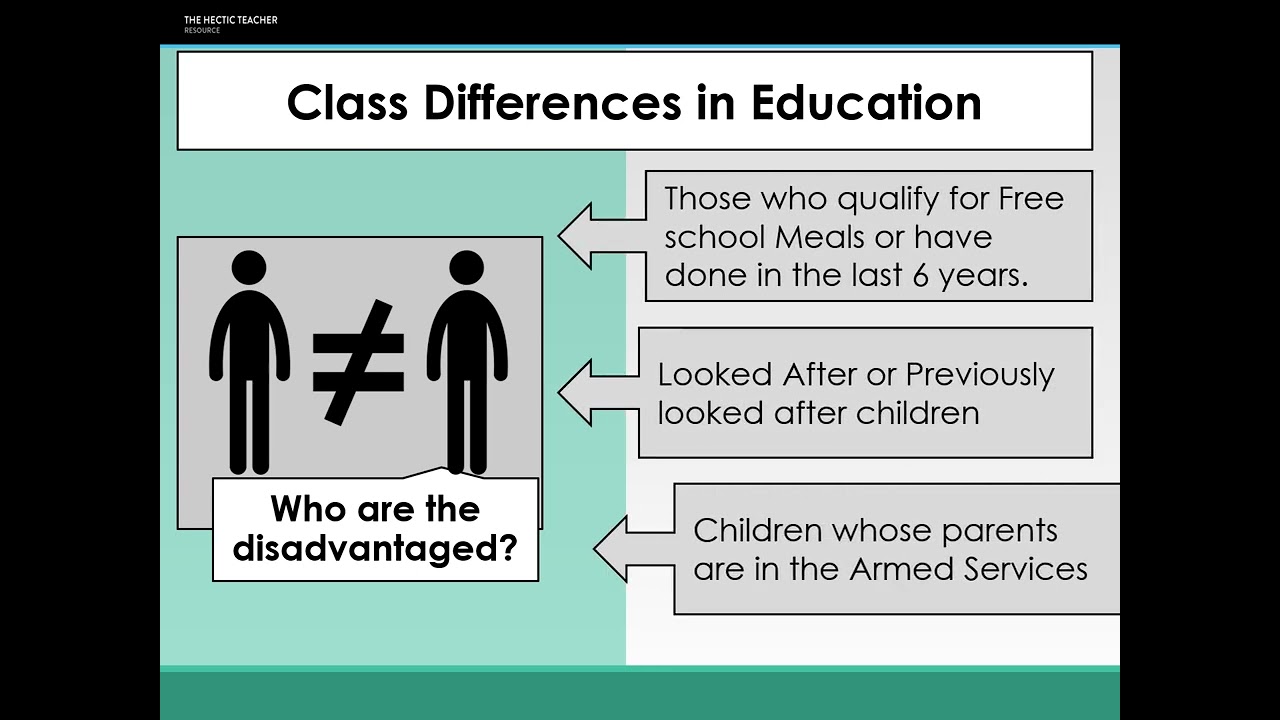
Hello and welcome to this video on social class and educational achievement external factors. One of the most striking features of education in Britain is the difference in achievement between pupils from different social classes. Most sociologists use parental occupation to determine a student's social class. So we would think of middle class students as having parents who work in non-manual professional occupations which are often referred to in the American sense as being white collar. So we're thinking about working in an office, perhaps being a lawyer, perhaps being a doctor, perhaps being a teacher or maybe working in the private sector. Whereas with regards to the working class, we're talking about children whose parents engage in more manual occupations. They may also work in the service industry, thinking here about retail, what are we often referred to as blue collar jobs in the United States. Children from middle-class backgrounds generally achieve more in education than those from workingclass backgrounds. Now, this is very general.
Of course, there will be some students who are from a workingclass background who will outperform those from middle-class backgrounds, but generally this is the trend that we find in the UK. And the question for us as sociologists is why? Well, firstly, it could be because middle-class parents can afford private schooling. So, they may be willing to pay fees for children to go to one of the top private schools in the UK. 7% of UK schools are private. So, that is the minority of schools. The majority who are privately schooled go to university. So, of that 7%, 90% of those will go to university.
Privately educated young people make up more than half of Oxford and Cambridge entrance. And we mention Oxford and Cambridge because these are the two elite universities in the United Kingdom.
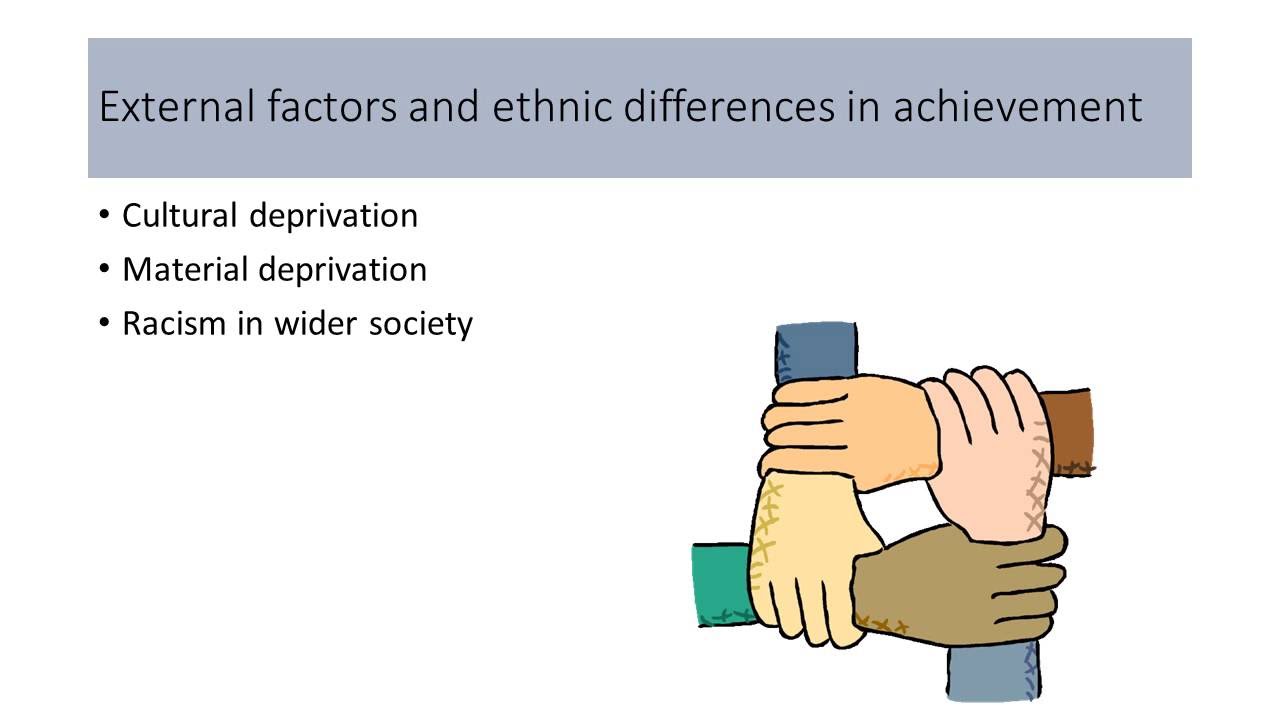
Therefore, as sociologists, whilst this is interesting, we are perhaps slightly more interested in what's going on in the state education sector, as this makes up the vast majority of education in the UK, or rather the vast majority of education that young people will receive in the UK today. In terms of the external factors that we're going to be looking at, we will be considering cultural deprivation, material deprivation, cultural capital, and marketization, and parental choice.
Cultural deprivation theorists argue that most of us acquire our values and attitudes through primary socialization.
So here we're talking about being brought up by our parents and guardians.
Being taught those real cultural basics, those things who are going to need to be able to survive in life. And it's through this that we gain the majority of our values and attitudes. This is the basic cultural equipment of language, selfdiscipline, and reasoning. So being able to communicate, being able to control oneself and being able to reason and puzzle things out. According to some theorists, the working classes do not socialize their children adequately and therefore by extension the middle class are better at socializing their ch children appropriately. This leads therefore to the working classes or working-class children to being culturally deprived.
Cultural deprivation theorists argue that workingclass homes and therefore working-class families often lack the books, educational toys, and activities that children need in order to be stimulated and prepared for the educational environment that school provides. Douglas argued that working-class pupils score lower on tests than middle-class pupils, or so he found in his research. And he said this was because workingclass parents do not read to their children. So one of the sort of common practices that parents would engage in and in particular middle-classing parents would engage in would be reading stories at bedtime to their children. Then maybe getting to the point where as the children can read themselves, they read to the parents and engaging in reading activities together.
And by doing that, they're stimulating their children, preparing them for school. And it may be that in working-class families, less of this is occurring. And this is going to potentially cause the children to be underprepared and therefore underachieve in education. Bernstein and Young went further and found that middle-class mothers spend more time thinking about and choosing the correct choice to stimulate their children uh than working-class mothers. So as uh was the case in 1967, it's still the case today for the most part that actually moms are the primary caregivers. Although increasingly parents are becoming more equal in the amount of time they spend with children, we still find that mom's a primary caregiver. And in that sense there it's going to be she's the one who's going to be deciding what books the children's going to read, what toys they're going to play with, what programs they're going to watch and so on. And it may be that they spend literally more time thinking about, you know, the educational quality of the materials they're providing to their children. And that's why we're seeing their children do better in education.
Bera and Engelman claimed that language used by the working classes in their homes was in fact deficient. That it tended to be made up of um bodily gestures um single words and disjointed phrases. Workingclass students therefore struggle to explain, describe, inquire or compare when in lessons. And these are all really important skills. And if you don't have the language to hand, it's very difficult to explain your thoughts and feelings and ideas.
Bernstein once again distinguish two types of speech code used by students.
So what this means is that while say workingclass and middle- class students are both speaking English for example the speech code of English they're using might be different. He identified the restricted code which was once again this uh code made up of gestures, single words, disjointed phrases and slang and the elaborated code used by the middle class which tended to be more erodite tended to be more verbose tended to be more um you know descriptive, explanatory, more analytical um essentially was you know longer words, longer sentences, polyelabic words, this sort of thing. What we find in education or rather what Bernstein found in education was that teachers tend to be middle class and therefore use the elaborated code. Textbooks tend to be written by middle-class academics who therefore use the elaborated code. And once again also the tests and exams are written by middle-class academics and teachers who use the elaborated code.
And so therefore for middle class students who are comfortable with the elaborated code they can get on they can really engage. They feel really infused and energized in using this type of speech code. But for workingclass students it can be very disorientating.
It can be almost scary. It can be quite weird because essentially the teachers and the middle class students and the textbooks and the tests are all speaking a form of English in our example which is alien and different and it can therefore put workingclass students off working. They may feel that they are disconnected, that education isn't for them, and they may therefore underachieve. Feinstein argued that the working class have a negative attitude towards education. He argued that middle-class parents are more likely to provide their children with the necessary motivation, support, and discipline. Now it may be that workingclass parents themselves didn't have a great experience of education and so when it comes to their children and socializing their children they may not have the impetus to motivate their children to work hard in school because they themselves empathize in fact if the children are having a hard time. Whereas middle- class parents who are likely to have a much better experience of education, they are probably more likely to be, you know, on their children's case, making sure they're doing their homework, making sure they're turning up on time, working hard on lessons, being polite to the teachers, and those sorts of things, which means that they're probably going to achieve more in education. Heyman argued that the working classes create for themselves a self-imposed barrier to educational and career success. So this means that essentially especially with the children, they're turning up in school and they're thinking this is not for me.
I'm not going to achieve the, you know, the teachers aren't my type of people.
They're not from the same social class as me. The students that do well, they're all middle class, too. I don't understand what they're talking about.
And so they place a barrier between themselves and educational success. They think it's not for me. I can't achieve.
There's no point trying. And so ultimately, if they don't try, they will fail. Uh and this ultimately feeds into later life as well and also perhaps career success. So when perhaps thinking about what jobs they can do, these children who then become young adults who they start apply for jobs may look for jobs that are similar to what their parents did or look for jobs which are uh more closely akin to the things that the working classes do. And so again they're almost limiting themselves and preventing themselves from perhaps breaking um the barrier and moving upwards and onwards and starting to aspire to become middle class and ultimately to pass on their knowledge and understanding to their children later on. So what we've got here is a self-imposed barrier. Sugarman then comes along and says that this barrier has four key features. Firstly, fatalism. That means that in particular working-class children, but the working class in general believe in a sense of fate that whatever will be will be. I cannot change it. This is my lot in life. I was born into the social class.
Education is not for me. I can't change it. It's almost predetermined. Next, collectivism.
Placing the group before the self. And the opposite of this would be individualism. So placing the group before themselves. Often working-class children prefer to be part of a of a group, a subculture, a gang, a squad, however you want to describe them. A people, a group of friends who are like themselves. And being part of that group and not being different uh is more desirable than being individualistic and trying to improve yourself and putting their hand up in lessons and answering questions and trying to get the best grades possible. Next, immediate gratification.
This is the idea of wanting the pleasure now rather than working hard to have greater pleasure later on. So if we think about how school works, one does not simply turn up and get their GCSEs or A levels on the first day. You have to work hard for two years. You need to revise, study, take notes and all the rest of it and then you get a much bigger reward at the end. Whereas often workingclass children, working-class young people would be far more inclined to say, "Oh, I won't do my homework. I'm going to play computer games because I'm going to find that fun now rather than perhaps, you know, working harder to get what I want later, which would be referred to as deferred gratification.
Finally, present time orientation, living in the moment, living for the now. Often described as yolo or you only live once. So the idea is you live in the moment. You can't think of the future. You don't think of the future.
You don't want to think of the future.
You'll sort it out when you get there.
And that's something that workingclass children, young people, or the working class in general were far more inclined to do. Whereas generally the middle classes are better at planning for the future and realizing to link this again to immediate gratification that you need to work for greater rewards later on. Culture deprivation theorists would say whilst middle-class values passed on via socialization prepare middle-class children for educational and career success the reverse is true for working-class children. So essentially once again workingclass parents are failing to socialize their children adequately to give them the correct attitudes, norms and values. In order to offset cultural deprivation, many governments around the world, but obviously we're focusing primarily on primarily on the West and on the UK, have sought to implement policies known as compensatory education to offset cultural deprivation. And famous examples include Operation Head Start in the United States in the 1960s, which is epitomized by the creation of Sesame Street, which was a children's program um put together by Jim Henderson, where you had the Muppets, and they would, you know, act out different scenes on television. And it was about teaching norms and values and teaching positive attitudes towards learning. And every episode was sponsored by a letter and a number. So it's for small children to get them ready for school because the belief was that working-class kids were working more watching more telly than middle-class kids and so therefore if the telly they were watching was educational more the better. In the 1990s there was education action zones in the UK. Okay, so these were areas of the UK which were identified as having poor educational facilities or the schooling wasn't very good and the government gave them more money in the hope to try and attract better teachers and to provide them better resources and this sort of thing. And in the 2000s under the new Labor government there was sure start and this meant that there were centers set up in areas around the UK where there was poverty uh or deprivation both cultural and material and uh parents could take their children there and they could do uh there would be homework clubs, there'd be breakfast clubs, there would be um a crash, there'd be a library, there'd be access to even a doctor and a nurse. And it was uh again it was about providing children with that extra boost that they might need to help them with their education if parents were unsure about what they needed to do. KDI however argues that cultural deprivation is a myth and that working-class children are actually just culturally different rather than culturally deprived. And so this is building on the idea that actually the the education system is very middle class. Um it's very ethnosentric. It focuses on middle class values. And if you're working class, you don't have those values. You have different values.
And so being measured against middle-class values might be unfair. And perhaps we need to change the way the education system works to value working-class values and working-class attitudes. Joiner and Williams said that there exists a speech hierarchy that needs to be challenged. Uh in particular, white middleclass speech codes and patterns are seen as being the most desirable. and all other speech codes and patterns, whether that be working class, whether that be black age minority ethnic speech codes or whatever, they are seen as inferior and therefore children are ignored or even punished if they use them at school or in lessons. Finally, Blackston and Mortimer argue that working-class parents are frozen out of the system, that is the education system, that isn't designed to fit their needs. And so, good examples of this could be that working-class parents tend to work long shifts that change regularly. think about the types of jobs they do that is.
And as a result, when the parents evenings come up or when the uh interview evenings come up or uh when opportunities come to visit the school and see what's going on, it might conflict with what uh hours they are doing and so therefore they can't attend and there's less opportunities therefore for them to show interest in their children's behaviors or children's work at school. And whereas for middle-ass parents often one parent will stay at home or if they do work because it tends to be more kind of uh white collar office based jobs it's a simple 9 to5 therefore they are able to attend dependence evenings and that sort of thing. Next let's look at material deprivation. Material deprivation refers to poverty and a lack of material necessities. So the things you need to either survive or to do very well in education, poverty and educational underachievement are closely linked. So for example, we often find that students or children or young people who live in poor housing, they tend they tend to come from a working-class background. Um that housing may be cramped, in which case there'll be no space for them to study, to do their homework and their research. Uh it may also mean that they're sharing a bedroom perhaps with a sibling which means that they might not be getting as much sleep. Uh we often find also that uh the poor housing may be badly ventilated which is going to affect uh their health. It may have mold, it may have a leak, it may be cold. Um and these things could lead to illnesses which mean that the student may lose days at school uh which ultimately is going to mean that they underperform.
We also find that poor diet and health can play a factor and the working classes and working-class children are more likely to suffer from poor diet and health. So food in particular, rich nutritious organic food uh which the middle classes are more likely to buy tends to be very expensive and so uh perhaps having less money coming in.
Working class parents have to work out, you know, what can they afford? What can they feed their children and it may be that the food they're buying may not have all the ne necessary sort of vitamins, minerals and nutrients that the children need to grow, be happy and healthy and to be able to achieve in school. And it may mean that they are tired. Perhaps they lack the energy in school to be able to learn. Could also lead to other health issues or health problems. There's been talk of issues such as tubercularosis and also uh ricketetts which are related to not only poor health but also perhaps poor access to sunlight um and other medical necessities. And if you are ill, if you're unwell in any way, shape or form, you're going to be missing school or the very least you're going to be underperforming in school. So underachchievement occurs. Next we have the hidden costs of education. Whilst in the UK we would argue that education is free in so much as that is paid for by parents through general taxation in reality there are a number of hidden costs that education incurs. So uh quite simply thinking about things like uniforms. Uniform is something which um has to be paid for by parents or sometimes there are hardship funds available by schools. If students are relying on either handme-downs from older siblings or perhaps secondhand clothing, this could be affecting not only how they view themselves and their self-confidence and therefore they end with school, but of course I mean that they attract the eye or derision of their peers and so could lead to bullying and therefore underachievement.
We also have un we also have hidden cost things like buying all of the equipment.
Now most education requires very basic equipment. we're talking you know stationary this sort of thing but the cost of that can spiral and grow over time and also depends on how many children there are in the family also there is an expectation now that young people will have access to a computer to the internet and possibly even a smartphone and these are all things which are taken for granted by most students but also by teachers and so these are hidden costs that the education system incurs finally we also need to think about educational trips some educational trips can be very expensive and again often schools do have hardship funds to help students who come from poorer backgrounds. But if students are unable to go, if parents are unable to pay for them, this could mean that they are missing out on vital learning, vital cultural opportunities to gain a better awareness of the world around them. Finally, fear of debt. We do tend to find that many working-class students are put off, for example, attending university because they look at the debt and begin to become concerned about paying it off, whether or not they will be able to pay it off.
is it going to affect their future with regards to applying for a job or applying for a mortgage and this sort of thing. And so they may decide soon as I finish full-time education at 18, I'm out. I'm done. Whereas for the middle classes, often their parents will help them out with university fees or else they have a decent understanding of the cost of education. They're willing to um you know go into debt knowing that they will have a good job eventually and be able to pay off. In terms of some statistics, only 33% of children in receipt of free school meals achieve five GCC's A star C. Um so free school meals are provided to children, young people who are um tested means tested or rather their families are mean tested. See how much money they have coming in and whether or not they can afford to feed themselves.
Next, 90% of failing schools are in deprived areas. Exclusion and truency are more likely in children living in poorer areas. And a third of all persistent truance, that is not turning up to school regularly, leave school with no qualifications. And so we find that it's those from working-class backgrounds who are more likely to um you know feature in these statistics.
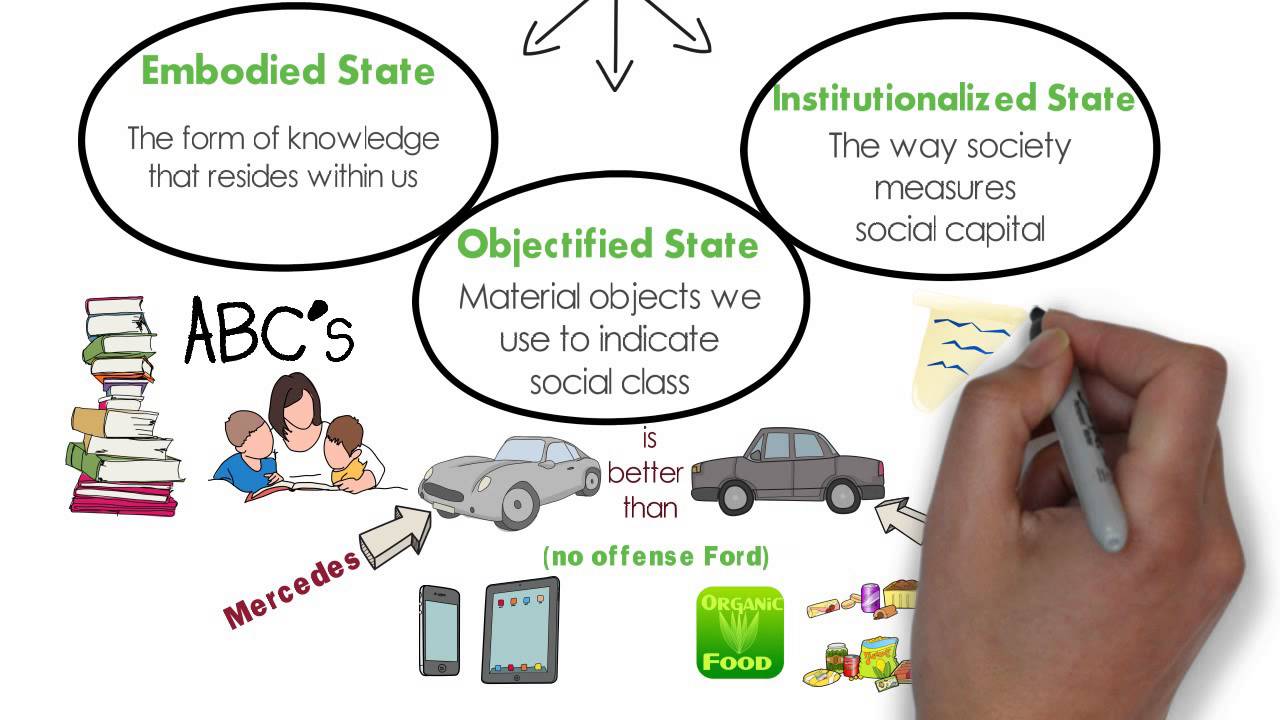
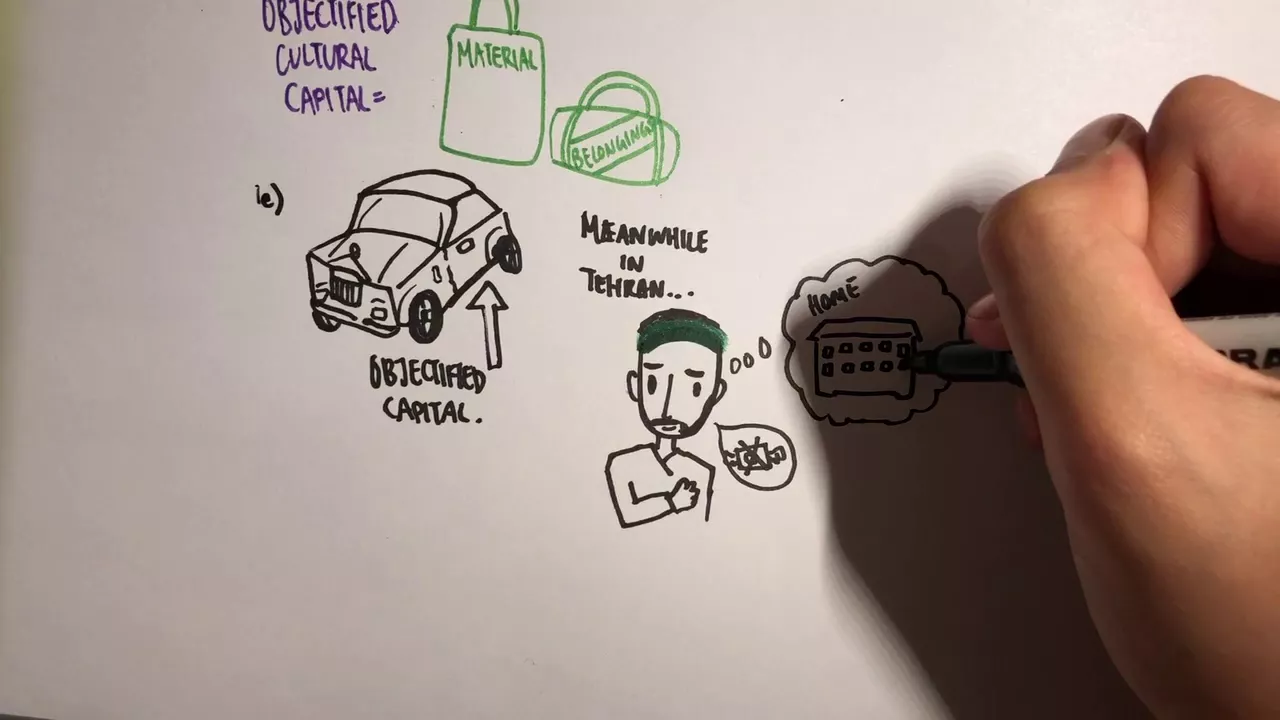
Next, let's look at cultural capital. Cultural capital is the work of this chap Pierre Bour, French sociologist. He argued that cultural and material factors contribute to educational achievement. So he's taken a bit of cultural deprivation theory, bit of material deprivation theory, mixing it up and looking at how it contributes to educational achievement or indeed underachievement. He used the concept of capital here and when we're talking about capital, we mean wealth. And he used it to help explain why the middle classes are more successful in education.
This is because the middle class and their culture is actually a form of capital or wealth as it gives an advantage to those who possess it. An understanding of what the education system requires for success is built into middleclass culture and it is gained through primary socialization. So middle class parents engage in primary socialization with their children. They teach them norms and values. But the norms and values they are giving them are middle-class norms and values. They also teach them about middleclass culture.
And this includes everything from art to music to architecture to history to literature, but also how to engage and work with the education system, how to engage and work with those who are in positions of authority or power. And as a result, middle-class children have an understanding by the time they even turn up to school for the first time of what to expect, how to engage with the teachers, how to engage with the process. But also, they've already begun to be subtly introduced to elements of middle-class culture which are deemed to be of worth, are deemed to be important.
And this means that they're going to be able to form a rapport or connection with their teachers. and they're going to be able to pull upon useful examples and ideas in their work which will mean that they will do better. Workingclass children, however, do not have this cultural capital. They haven't been provided it by their working-class parents. They haven't been socialized into middle-class culture and therefore this causes them problems. So in terms of what can make up cultural capital, just to reiterate, middle-class parents reading to their children, always buying them new books, stimulating books, harder books, teaching them about literature, giving them reference points for those elements of what are often referred to as high culture or very traditional classical uh novels, plays, poetry, and ideas.
Next, middleclass parents are more likely to take their children to museums to show them artifacts, show them uh interesting exhibits, teach them about the world around them, its history, different types of people, all of which are going to be useful in education. Furthermore, again, we have a little child there looking at a sarcophagus, and this is a very young child. So, the parents have clearly decided, right, we need to make sure you have an understanding of ancient history and we get you interested. And this child is already showing almost an inquisitive mind learning about history.
Wants to know more, wants to get some detail. Taking children on holiday. We often find that middle- class parents are more financially able to take their children on holiday. And when they do so, they take them places which are culturally rich and interesting perhaps with a lot of history. And so this mother has decided to take her child to Rome so she can learn a bit maybe about um ancient Rome. And so one of sort of the key areas for studying history for children in primary school is the Romans. And so perhaps that child would then be able to pull upon their experiences in their history lessons and say, "Oh, I know about the Romans because I have been there." Whereas perhaps a working-class child may not have those opportunities. There may not be the money available for those types of foreign excursions. Finally, also things like instruments and having hobbies and learning sports or skills.
Uh even doing ballet or dance and this sort of thing. These are all part of that high art, high culture that the middle classes promote. And so we often find the middle- class children from a young age have been encouraged to learn an instrument. And often an instrument as difficult or as complex as.
So with that in mind, middleclass parents use their economic capital, money, to help their children gain cultural capital, knowledge of middle-class culture and values, so that their children can then go on to acquire at school educational capital or qualifications. And if we were to carry the story on, ultimately once that child has their GCSEs and their A levels and their degree, they're going to be able to look for jobs and they will then earn money and they will gain economic capital themselves.
Whereas workingclass parents generally lack economic and cultural capital, placing their working-class children at a disadvantage in the middleclass education system, which values and rewards middlecl class culture. Finally, let's look at marketization and parental choice.
Sharon Gvertz or Gavitz examined the question of whether parental choice in school has benefited one class more than another. She also used Borg's ideas and found them useful and she discovered that there were three different types of parents who were making decisions with regards to where their children were going to go, where they were going to study. Firstly, we had the privileged skilled choosers. These are middle-class parents with cultural capital and economic capital who shop around to find the best school available for their children. So they will know how the education system works or they'll know who to talk to to learn about it. They will do their research. They will visit schools, talk to teachers, head teachers, read perspectuses and work out what's the best school for my child.
Next, disconnected local choosers. These are workingclass parents who lack cultural and economic capital. So they don't know how the system works and therefore are more likely to choose the closest school or the school which is going to be safest for their child to travel to when it comes to deciding which school they're going to send their children to. Finally, semi-skilled choosers. These are the ambitious workingclass parents who want the best for their children. They want their children to perhaps find a way up and out of the working class, perhaps to try and become middle class themselves, but they become frustrated. They don't entirely understand how the system works. They may find the system is almost hostile to them, finding out how it works. And so therefore, they tend to rely on other people's opinions. They think about who do they trust in their common circle of friends or people they work with. And if someone says, "Oh, that's a good school." That's where they're going to send their child.
Overall, therefore, Gavitz is finding that generally this system, this system of marketization, which has sought to empower parents to make decisions on behalf of their children, has benefited middle-class parents more than working-class parents and therefore by extension middle-class children rather than workingclass children. That's it. Thank you very much.
Up Next

16:28
Habitus and Field Theory Explained | Pierre Bourdieu Simplified
@christopherboan-lenzo8622
1K views•2021-03-18
54:57
Contemporary Sociological Theory: Micro, Macro, Integrative
@NaSESYNC
45.7K views•2016-02-17
19:23
How to Analyze Conversations Scientifically | Elizabeth Stokoe | TEDx
@TEDx
1M views•2014-12-04
9:41
What is Sociology? The Sociological Perspective Explained
@crashcourse
4.6M views•2017-03-13
Related Study Plans & Knowledge Roadmaps
Structured learning paths in Sociology
sociology
Celebrity Culture: From Hollywood to TikTok
01Foundations of Celebrity Sociology
02The Rise of Micro-Celebrity & Digital Platforms
03Parasocial Relationships & Algorithmic Intimacy
+ 2 more learning modules
12h5 modules
Explore Roadmap
sociology
Hostile Architecture: Space, Power & Control
01Introduction to the Sociology of Space
02Social Control and Surveillance in the City
03Hostile Architecture and Defensive Design
+ 2 more learning modules
12h5 modules
Explore Roadmap
sociology
Loneliness Epidemic: Third Places & Isolation
01Foundations of Social Capital and Community Cohesion
02The Death of Third Places and Urban Space Erosion
03The Privatization of Leisure and Atomization
+ 2 more learning modules
12h5 modules
Explore Roadmap
sociology
Sociology of Tourism: Gaze, Power & Heritage
01Foundations of the Sociology of Travel and Leisure
02John Urry and the 'Tourist Gaze'
03Staged Authenticity and Cultural Commodification
+ 2 more learning modules
14h5 modules
Explore Roadmap