













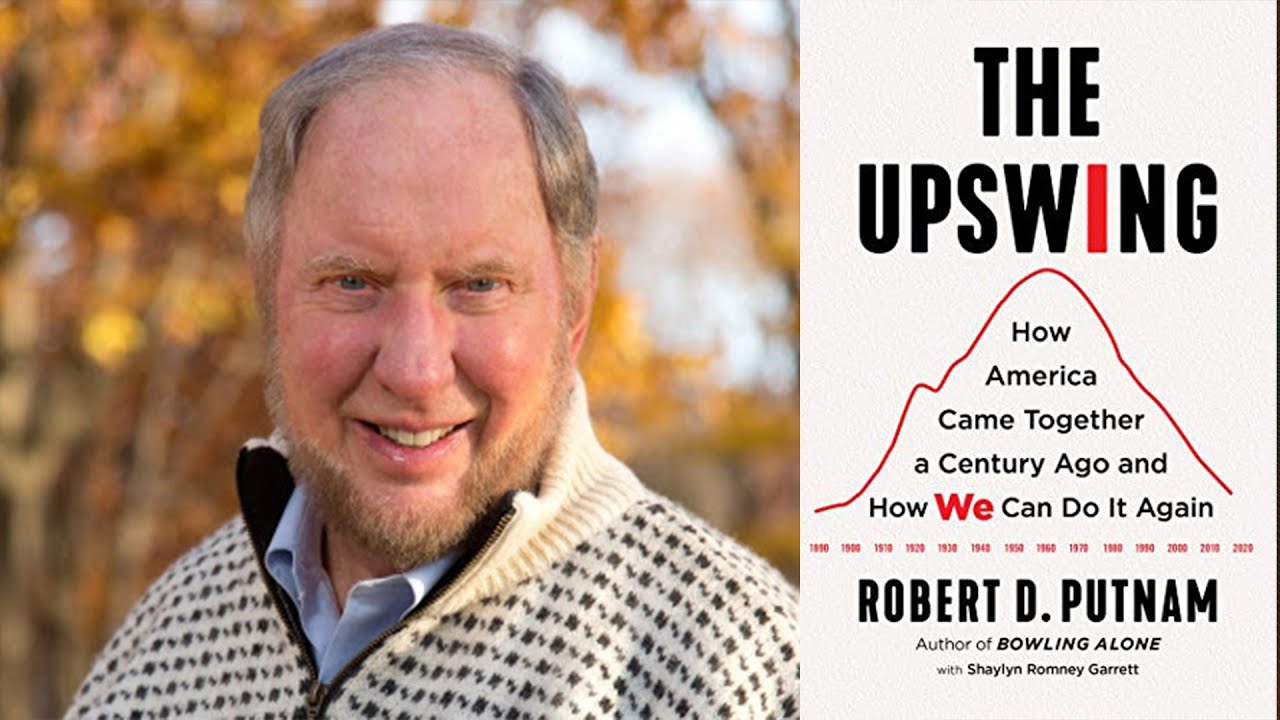






America has followed a recurring 'I-We-I' pattern over the past century, where society oscillates between individualistic ('I') and collectivist ('We') orientations. In the late 19th century, America was highly individualistic, unequal, and fragmented (the Gilded Age). Beginning in the early 20th century, America pivoted toward greater equality, cooperation, and community focus—the 'upswing'—reaching its peak in the 1950s-1960s. However, this trend reversed around the mid-1960s, returning America to levels of polarization, inequality, and fragmentation similar to the Gilded Age. The key lessons from this historical pattern are: (1) moral and cultural shifts drive social change more than economic factors; (2) youth-driven movements are essential for turning points; (3) grassroots innovation at local levels precedes national solutions; (4) charismatic leadership follows rather than leads social movements; and (5) any 'We' period must be fully inclusive to succeed. The current moment resembles the Gilded Age, suggesting another upswing is possible if citizens embrace civic engagement and moral language to address shared challenges.
The Upswing: Robert Putnam on Rebuilding Community | Harvard Scholar Talk
Added:[Music] good evening everyone i'm lani stonech the executive director of fan and i'm so excited to welcome you to tonight's conversation between robert putnam shaylyn romney garrett and spiro bolos thanks for attending we're a non-profit organization that presents a high quality speaker series offered free to the public on a wide variety of topics including human development mental health education and social justice among others we have over 100 videos of past events archived on our website and youtube channel so please be sure to explore and now for my formal introductions i will also offer an introduction of mr bolos that he will not appear until later on in the program robert putnam is the peter and isabel malkin professor of public policy at harvard university having retired from active teaching in may of 2018 he has written multiple books translated into 20 languages including the best-selling bowling alone the collapse and revival of american community and our kids the american dream and crisis a groundbreaking examination of the growing opportunity gap fan was honored to host professor putnam in 2018 for a talk on our kids at evanston township high school professor putnam recently completed a study of broad 20th century american economic social political and cultural trends entitled the upswing co-authored by shaylyn romney garrett miss romney garrett is a writer and social entrepreneur who has dedicated her life to the pursuit of connection community and healing in an increasingly fragmented world she's a founding contributor to the aspen institute's initiative weave the social fabric project and writes about her personal journey back to community on her blog project reconnect spiro bolos is a 26-year veteran of the classroom having taught a wide range of courses in the social studies department at nutra high school in winnetka and at various other institutions in the past mr bullock's instructional methods which include a strong emphasis on media literacy have been studied by researchers from northwestern kent state and the harvard school of education he is the president of the nutra high school education association serving a second term let's now welcome bob putnam shaylin romney garrett and later spirobolos thank you very much um it's good to be i should say back uh in uh on the north shore um lonnie i appreciate those though that that uh kind introduction and i'm looking forward to talking one thing you omitted is that um i have a lot of ties especially to eths uh my wife uh whom people will meet later on in in the um in the afterwar in the after hour after hours uh session uh is a graduate of eths um and uh her parents lived for many years in um on herzl street in um on the north side of um evanston so i'm very familiar and it's good to be back and i'm trying to deal with the fact that um spiro is from let's see what's the name of that other school out there new trier i think is his um in any event it's great to be it's great to be with you um shailene and i want to talk tonight i'll give you a sense of what this book is about and then we're looking forward to questions comments and questions from spirulina from and from others um is the is the chat is the powerpoint about to come up i'm hoping sort of it is super um so um we're this is a book we've just published um just a few months ago and we're gonna the the book has in a way two parts to it they're they're intermingled but there are two parts one is some hard data about change in america over the last 125 years and the second is a kind of a narrative intermingled with the data a narrative about how america has changed over these years and what lessons we can learn from the patterns of uh of this historical these 125 years i'm going to begin by by talking about if we can have the next slide i'm going to begin by talking about the um uh the data and then uh and i'm going to try to do it in a way that's it's reasonably consumer friendly um and then later shaylin will come in and go over much of the same material but talking about it from a more historical in terms of historical narrative um so we begin with the fact that and if america is today in a pickle and there's probably only one thing that all americans agree which is we're in a real pickle and in particular we're going to be showing in this um in this discussion that america has reached historically high levels of political polarization of economic inequality of social isolation and of cultural self-centeredness that's that's what we find that's the world the world which we find ourselves and you didn't have you don't have to do go more than just today's uh headlines to realize that's where we are and so we want to begin by asking how did we get here and then later it's going to turn out that finding out how we got here is relevant to how we might get out of here but we can have the next slide i'm going to show you a series of charts here in this case we're starting with polarization and the all the charts are going to have the same form so they're going to be kind of easy to follow the horizontal axis here is the time from basically from the late 19th century until the early 21st century um and the vertical axis is going to be measures of in this case polarization political comedy the opposite of polarization bipartisanship you can think of it um and so you can see in this graph that beginning in the late uh in the in the 1990s america was extremely polarized very low levels of bipartisanship and comedy um later on we're going to say probably that was the most polarized that american politics and american life had been in american history with the exception of the period from 1860 to 1865 the civil war so america was really polarized in 18 in the in the period in the late in the late 19th century but then you see that coming out of that period beginning in the early years of the 20th century we begin to become a little more a little more cooperative politically pause for just a second we in that period we didn't become overnight oh lovey-dovey but the trend changed we pivoted from a period of great polarization to a moving in a direction or at least looking in a direction that was going to take us over the next 60 years to a more a less polarized america a more cooperative politically cooperative america and you can see that trend is more or less steady through that whole period there was a little bit of dip there you can see in the in the 1920s but then steadily through the 30s and 40s and 50s and into the 60s let's pause up there at the 60s very very relatively low levels of political hostility political polarization high levels of bipartisanship that's sort of symbolized by the president right in the middle of that decade of the 50s dwight eisenhower who would historians all agree is the least was the least partisan president in american history with the exception of george washington now i'm not saying that that dwight eisenhower caused that i'm trying to say dwight eisenhower was a good symbol of the fact that in that period america was very we did a lot of a lot of business across party lines but then as you see beginning in the 60s that begins to dip a little bit and then especially as we get into the 70s we start becoming more polarized much more polarized and from then on it just keeps getting every year more polarized um keep going just every year the 80s and the 90s paused about in there someplace now remember donald trump doesn't come into this study until about there and that's way in other words one of the things we're going to say is donald trump didn't cause this problem his arrival in the white house came very late in the process really much further down keep going down maybe because the polarization continues it goes steadily more polarized then we get down to the middle the last data point we have here is from 20 2015 but actually we all know anybody in america knows that it's become even more polarized ever day by day in the ensuing period so now we're down below the level of of a political bipartisanship or above the level of political conflict if you want to say polarization america is now more polarized than it had been in in the 1890s and just about as polarized as we were in the civil war i'm trying to say historically we are currently in a very polarized politics let's go to the next slide which looks at another measure of how we're doing this is a measure of economic equality basically the gap between rich folks and poor folks in um in american life and again this the data here began in 1913 because that's when the irs was created and we start having good really quite reliable income data and you can see if we had data going back further we have a little less reliable data going back further and back further america was even more unequal that was called the gilded age in american politics the late 19th century and the and the early 20th century and just into the 20th century the gilded age was a period of great a great huge gap between the folks the the folks on the upper east side of new york uh in the mansions of the upper east side of new york and the folks in the lower east side of new york where we're living in tenement slums um but then you see beginning about 1910 we're beginning to make we start making slightly more progress toward a little more economic equality again you see that in the 1920s that that was that was a kind of pause a little bit of this progress that was sometimes called the roaring 20s when the stock market rose but then coming out of the uh the 20s even before the great depression uh a new deal takes over we begin having greater equality it's so it's not just the new deal you can see during the late 20s 30s into the 40s keep going into the 50s um there's a little dip after the war but then into the 50s and then the 60s and we're very now america in at that period we're at the kind of height of amer of economic equality in america and again at that point we were we were not equal of course we were rich people and poor people in america in the 1960s but relative to ourselves we were very much more equal and indeed relative to the rest of the world america at that point looked like sweden or something we were relative i mean by that we were the difference between rich and poor in america then wasn't any bigger than it is was or is now in in scandinavia where notor notoriously they have low levels of political inequality but then as you see beginning slowly in the 60s but then increasingly accelerating um in the late 70s and and especially in the 1880s and 1990s more and more economic inequality and you can see now we're down right now and then if we again if we continue that out after 2015 you and if any of you who've been following the news about the economy over the last four or five years know that rich folks have done very well in the last five years poor people have done not i've done actually quite poorly and therefore we're now down if we had the numbers all show can if we could show you exactly the numbers where we are now we're back at the levels we started with in the in the first age we're now in what we could call a second gilded age so let's look now at the next slide here the next slide is is what we call social cohesion this is a measure of the degree in which americans in their daily lives are connected with other people so it's a measure of things like to what extent do people uh work on in in community organizations to what extent do people know their neighbors to what extent do people you know how strong is the american family how much do americans trust each other that's what we're measuring here and you can get it looks pretty similar actually in the 1890s america was pretty uncohesive and in a minute shailene will give you a little bit more of what that felt like at the time but america was pretty unqueasy but then again look at this very similar beginning in the 19 in the first decade of the 20th century and then sort of accelerating um become more cohesive and what let me remind you what that means is families are becoming stronger people are trusting one another more people are joining organizations more uh people are are joining organizations of all sorts more again let's say you see the same pause in the 1920s but then coming out of the 20s and 30s you see in the 40s and 50s probably the greatest civic boom in american history every year in that period the pga and and community organizations of all sorts including bowling leagues which was a famous example i used every every year people those organizations had more members every year that was the baby boom so more people had more kids and that more people were marrying and they were marrying earlier and so on until again look at that sort of in the middle 1960s that suddenly reverses all of a sudden it begins to go the other direction and here it's a steady downward trend every year for the last 50 60 years really um every year we've seen fewer membership and organizations less trust in other people um more fragmented families um and and less involvement in community life people know their neighbors less well and so on down to the the the current period let's go to the next slide quickly and finally we're going to turn to measures of cultural solidarity this this is a measure i'm not going to be able to explain it in detail but it's based on par numbers here which show the degree to which americans think of themselves as one as a unit as a cult as a unit um a kind of a we and indeed this chart led us to begin talking about this whole curve as an i we i curve we start off in the 1890s very much focused on what's in it for me we're very much focused on um i on me me that's an i period but then as you see again very familiarly in the early years of the 20th century begin to become a little less focused on i and a little more focused on we and that rises steadily again there's a there's the little pause in the 20s but then we begin to be ever more year by year we're becoming more focused on what we have in common more altruistic more focused that more of a greater sense that we're all in this together until remarkably up there in 1964 it looks like suddenly that turns around and we begin to be we don't become instantly in high society of course not these things these social changes occur slowly but we pivoted and began to go down this long and as it turned out interminable trend toward greater narcissism toward less altruism towards more focus on what's in it for me and less focus on what we have in common let's see the next slide because here i'm uh i'm going to quickly end up here shailene um you here i put all four of those charts together and you can see they're not separate charts it's one this all quite remarkably it's astonishing that this is true especially particularly because these are all underneath all these curves there are scores and scores of individual data points and nevertheless it shows that in economics politics society and culture america went through one huge swing you might say a swing of the pendulum although for reasons that shailene will explain later we're a little uncomfortable with the metaphor of a pendulum but you can see began in the eye period move to the we period and then uh back down now to the to a extremely high period let's have the next slide the next slide just puts all these things together into a single curve it's easy to do that because they are all so similar and you can see it starts over there low you can and all these curves are basically quite astonishingly basically show the same story even that little pause during the 20s and so this in a way summarizes what happened to america or as we move from an emphasis on individualism to an emphasis on community from i to we and then back down back down to eye but shalin why don't you pick up this story here and you can be a little you know you can expand a little bit more on what's what's going on behind the scenes what what was happening historically that makes sense out of these curves sure so you know um i'd like to start off by pointing out that there's a lot of books that have actually been written about the down slope of this curve really what's happened over the last half century um in in one article that i read the the author referred to it as the how america got in this mess genre of books right and a lot of these books focus on maybe one or a couple of the different phenomena that that bob described um but their focus is really on this sort of fall from grace um the idea that america used to be great and and we've slid down and and the problem with some of these narratives as we see it is that um that wasn't necessarily a golden age in american history it had a lot of problems and we'll go back to some of that um in a minute for us therefore what's less interesting is the story of the downward slide and what's more interesting is the story of the upward swing hence the title of the book which is the upswing and the reason that that's particularly fascinating to us is because when you look at this both from the standpoint of the data which bob just outlined really hard measures and also from the standpoint of the historical record what what life looked and felt like america is in a remarkably similar place to where we were at the last gilded age i mean you can see that graphically here but also that was true just in sort of the lived experience of what americans were going through and so our feeling is if ever there were a moment in american history whose lessons we need to learn today it was the moment when americans in a very similar situation to the one we find ourselves in today turned things around righted the ship and got america back on a track toward greater and greater equality toward greater cohesion toward greater altruism really sort of reclaiming americans america's promise and so if we go to the next slide what we want to do here is just look at that period of the upswing what happened during that period that really set all of those upward trends in motion so when people look at this data at these graphs they often ask us you know what's the thing that turned first like you you're looking at economics politics society culture if you had to identify the one thing that started going upward first which is it because if we knew what that was well maybe then we would know what the silver bullet is what the thing is that we could focus on today that might turn everything around and a lot of times people assume that that thing is economics i think especially in the social sciences we tend to have this kind of marxist view of history which is that that economics drives everything and the rest is just details right um and that actually turns out not to be true one of the things that does seem clear from the data is that economics was what we might call a lagging indicator the economic equality came along after some of these other phenomena started to move in the right direction which is a really interesting finding so we know that economics is not the silver bullet at least it wasn't during this historical period so what was if we had to identify something that did turn first what might it have been fascinatingly when you sort of pair the data with the historical record and granted it is difficult looking back that far from a data perspective it's a little bit hard to find data sets that go back 125 years although this is what bob is famous for and as a statistician is finding these obscure longitudinal data sets and when we look at those data sets it looks as though the culture of america is what changed first that moved from narcissism toward altruism so so what we want to talk about first about this period was that it was marked by a real significant moral and cultural shift the gilded age was characterized by a culture called social darwinism which was the idea that you that that darwin's theory of survival of the fittest was not only something that was descriptive of the natural world but was something that was a good way to think about organizing society basically you know it's a giant competition um and whoever is strongest and fastest wins and the devil take the hindmost and that was really the reigning ethos of the gilded age and there were there was a group of reformers that came along and really said you know i don't i'm not comfortable with this as a value system that reflects what america is about and it on the in the heels sort of on the heels of that social darwinist idea came a movement called the social gospel it originated in evangelical protestantism but ultimately became sort of more of a broad cultural ethos that said you know society is not just about competition society is about what we owe to one another what we can do for the most vulnerable what we can provide to everyone what we ha the ways in which we are in this together and that moral and cultural shift really motivated a whole movement of people that we now look back and call the progressives with a capital p to to to start a movement to really get into the trenches and change america motivated by this moral and cultural shift so that was one really important facet one of the earliest facets of the upswing and that is an important lesson for today if we are going to look for a way to spark another upswing today we need to get comfortable with looking at and thinking about and talking about our problems through moral language through a moral lens another lesson from this upswing is that it was incredibly youth driven movement the progressive era the progressive movement was incredibly youth driven and i just want to pause here for a moment to say when we talk about the progressive era we're talking about the capital p progressive era and that term progressive is used differently today as it as it is to describe this historical moment today we'd talk about progressive as the sort of left-most side of the political spectrum but back then the progressive era was really a bipartisan movement almost so diverse as to be barely coherent that's how historians describe it there were people of all stripes who claimed the mantle of progressives in fact in the 1912 presidential election all three candidates were sort of jockeying for the title of most progressive candidate because it was such a popular movement and such a popular widespread ideal that had captured the american imagination but a lot of the people that were driving this movement were super young they were doing their work when they were in their 20s in their 30s changing america and so if we're going to look for an upswing today it needs to come we believe from this sort of post-baby boom generation those young americans who can really give us an innovative vision for for thinking outside the box about how to solve americans problems one of these things one of the things that these young people and these young reformers really focused on was association that's kind of an antiquated term um it's a term that comes out of that historical period that's how they would have described it today we might describe it as relationship building or to use a term that bob has popularized social capital they really focused on the power of people coming together and particularly people coming together across lines of difference people who didn't understand each other who wouldn't have an opportunity to meet in the public square these progressives invented a lot of initiatives to bring those people together but also they recognized as we showed in the data that this was a really lonely and dislocated period you had millions of americans that had moved out of small towns off of farms into cities that were busy and commerce driven and all of the ways that people had for connecting in those small town american experiences no longer replied once they were in chicago and new york and so you you saw as bob described at this civic boom the invention of new ways of bringing people together through clubs and civic associations and service societies religious organizations this there was a huge boom that really created a vast store of social capital that fueled this upswing for decades another thing that really characterized this progressive movement and characterized the upswing was grassroots innovation so a lot of times if if any of out there of you out there have studied the progressive era you might think of the things that sort of big national programs the federal programs that came to characterize the progressive era things like um uh the federal income tax child labor legislation trust busting um consumer protection agency all of these things even you know um constitutional amendments that the progressive era is famous for but the fact of the matter is those things came later and they were actually not the start they were sort of the caboose of this change this change process so many of the ideas even things like a federal income tax were tried and tested at the local level at the municipal level at the state level by local innovators who looked around and didn't look to washington to solve their problems they looked to their fellow citizens to solve their problems one of the the best examples of this that we love to tell is the story of the public high school in america public high school is now such an integral part of america that you it's hard to imagine a time when that wasn't part of the american experience a free public education for everyone up through secondary school but at the time of the gilded age secondary education was really only available to the wealthy it was something you had to pay for or you know if you couldn't pay for it you had to be super talented or super smart to get a scholarship that sort of a thing and because of the industrial revolution you had people in towns all across america looking around parents really saying if my child is going to succeed in this economy they really need a secondary education and so instead of saying oh you know the federal government really should start providing secondary education instead of doing that they actually looked to each other banded together passed you know local tax initiatives created public high schools that were then available to every kid in town simply by virtue of the fact that that you lived in town that was an entirely new idea that originated not from academia not from washington but from small towns in the american midwest and then that idea sort of went viral over the course of a decade or two and ultimately blossomed into the systems of education that we have in this country today um so that's an example of the way in which these progressives were really solving problems on their own doorstep and then that became the blueprint for changes that could be applied more nationally so if we are looking for solutions today we really believe that we need to get really local we need to start in our neighborhoods we need to start in our cities we need to start right where we are in what louis brandeis who's a famous progressive called the laboratories of democracy those small towns those localities where people can actually work across party lines a lot more effectively than they can in washington to get things done and then show what works and and have those solutions um bubble up to the to the national level another lesson from this period is actually that charismatic leadership came late in the story as well again when you think of the progressive area you think of people like teddy roosevelt right um but actually he came again quite late in the process there were a lot of charismatic political leaders in this story but they really sort of saw a parade that was already happening and got out in front of it it wasn't that that they were these leaders who had this big idea and everybody started to follow them the opposite was actually true and so again today um you know we've we've seen a charismatic leader come and go from the white house in the last four years and as bob has mentioned he didn't cause these downward trends they started long before he got into the white house but the same thing is going to be true of the solution it's not going to come from some charismatic leader that's suddenly going to solve all of our problems it certainly didn't happen that way before we don't believe that it's going to happen that way again we believe the solution is going to come from citizens and then hopefully we'll have some enterprising political leaders who will take those solutions and turn them into real bipartisan solutions so the last thing that we want to point out about this period we've said a lot of great things about what the progressives did and lauding them sort of as these people that righted the ship in a dark moment of american history right but they weren't perfect and there are not there are some lessons from this period that are what we might call negative lessons not positive lessons the biggest of which of course is that the we that these progressives were building toward was simply not inclusive enough um as we know this we period the we decades that we described this upswing coincided with jim crow uh furthermore many of the progressives who were leading change were themselves racist so a lot of the structural inequality of structural racism that's knit into some of our programs even some of our federal programs um some of that is certainly a legacy of the this period in which you had a lot of people do making a lot of progressive change in this country but not necessarily extending that fully to everyone especially to people of color and so any we that we would hope to build toward today any upswing that we would hope to see today has to be fully and completely inclusive um because there are some ways you know we don't have time to go into detail now but there are some important ways in which um the upswing sort of um created the seeds of its own demise by by not being fully inclusive and so that is a huge lesson from this period something that absolutely must be top on the priority today um as far as what what would need to be on our agenda if we are hoping to see another we in another upswing so if we could just go to the next slide this quote from teddy roosevelt is something that really summarizes what we feel like is the lesson of the i we i century this really breathtaking discovery that all of these phenomena turned together both going upward and going downward roosevelt said the fundamental rule of our national life the rule which underlies all others is that on the whole and in the long run we shall go up or down together good or bad whether we recognize it or not we are in this together as a mass multicultural democracy and we believe that there's real hope in the idea that we've been in a situation like this before we've turned it around we didn't push that we high enough we didn't reach the summit of what was possible but we think that there's a chance that we could do that again today um get the things right that we got wrong the last time and see another we a new we um that takes us to eva even closer to the ideals upon which this country was founded that's kind of an overview of of of the book and some of the ideas that are in the book and we're just super excited now to just be in conversation um about some of the other issues uh that might be on people's minds thank you so much um as a as a history teacher i have to say i very much appreciated your focus on the parallels you drew to the gilded age and to the progressive era because these are two underappreciated periods of history both by students and also by many of their teachers uh as you created these inverted u-shaped curves i was fascinated to sort of play along with the two of you in dividing the ultimate cause or purpose behind these extraordinary shifts from an individualistic i focused society to a more communitarian uh we focused america and then back again as i wrote my immediate reactions to every one of your arguments on a post-it note and you can see my book is almost warped from all of these um you did something in a subsequent paragraph that i always tell my students that they must attempt in their own writing that's addressing the other side of the argument or the reader's possible objection i still develop my own theories regarding causation and i quibbled over a little bit of the methodology but honestly i found your intellectual honesty um to be quite refreshing so uh for example besides the four areas of focus we saw in the curves um i wondered how inclusive those curves were of other factors and shaylin you were already hinting at this such as race yeah yeah um so i i might just take that question just because i happen to have done a lot of the writing around race for the book and um you know i think what's interesting is that we know that that we period in american history that first two thirds of the century was was extremely um exclusive and not inclusive right in in often really violent ways and so how does that story square the story of race in america in the 20th century how does that square with this i we i century and so when um when we were looking at this even even the story that we sort of brought to this was well you know that just must be like a completely glaring exception to this argument right and and that's often the view that we have when we think about um the the trends in racial equality over this period we often think that because the outlook for african americans was so bleak at the beginning of the century and jim crow was such a violent and real reality that the idea is sort of that nothing changed for those first six decades of the century and then suddenly everything changed during the civil rights revolution and that turns out to be true for a lot of things actually black political representation is one that didn't change markedly during that period the long-standing white supremacy in mainstream culture mainstream media access to professional schools and jobs residential segregation these are all examples that would look in in contrast to that inverted you which is like better and better and better it more like a hockey stick no change and then and then sudden positive change in the 1960s but interestingly when you look at different metrics specifically material equality the curve looks quite a bit different so when we talk about material equality we're talking about things like um income equality we're talking about home ownership we're talking about health measures like um infant mortality or um or let's see even things like voting voter participation voter registration we're talking about education um you know completing degrees completing high school when you look at those measures and you compare the progress toward parity or equality between blacks and whites what you actually see is that the bulk of the progress toward equality happened during that first two thirds of the 20th century which is actually a big surprise not a surprise to to black americans because they lived that story right but actually surprise i think to a lot of white americans to see that most of the progress on those metrics came before the civil rights movement and then when you look at those same metrics after the civil rights movement you would think okay we had this moment where finally we dismantled you know legal barriers to integration certainly those measures would have accelerated toward full equality when in fact the opposite is true we see stagnation on many of those measures we see reversal of progress such that black americans are doing worse today than they were in 1968 on things like homeownership on things like graduation from college right and those are really i want to say shocking but i can say that just because i'm a white person that is not shocking to black americans that is the underlying call to a clarity that the black lives matter movement is putting forward which is saying in the wake of the civil rights movement where white americans said oh finally you know we took care of this problem in fact we didn't take care of the problem and what's fascinating about this to us is that when you map that that data onto the iwei curve which is our bigger thesis right what does it mean well it looks you what you find is actually that the we decades were actually a bit more hospitable to progress toward equality between the races than worthy eye decades and so there's a lot of explanations for this i mean it begs a lot of questions first of all how did black americans make that that progress during a period characterized by segregation and jim crow the short answer to that and again we've written a whole chapter on this as well as a an op-ed in the new york times on this for people who want to get into it but the short answer is the great migration black americans essentially stood up and claimed their place within the american we they started building their own associations their own schools their own hospitals so it was a highly racialized we but it was nonetheless a we in which they were making progress toward the american dream and and and then the question of course is what caused the stagnation after the civil rights movement when we would have expected it to keep going a lot of that has to do frankly with white backlash during the peak of the we was that moment when we had this kind of fragile national consensus where we finally could pass the civil rights legislation and people when you look at the survey data we're very much in support of those things in principle but then when the johns administration tried to put them in practice they tried to do busing they tried to do integration the survey data really flips and americans white americans start to say not in my backyard and so it's hard to say whether that broader turn toward eye that happened at the same time drove the white backlash or whether the white backlash drove the broader turn toward eye that's something that we can't say but the two factors were definitely intertwined and i think it's a hard lesson for america to learn that a society that is incredibly focused on me on competition on what's in it for me on my rights not my responsibilities is not a society that's going to achieve racial equality and i actually think that interestingly that's a lot of what the black lives ladder movement is black lives matter movement is trying to call us to see well spiro can i just add because this is a chicago audience and what we what shayland has just described is actually consistent with if you know anything about chicago that is the the the great migration created the south side and and and it was by folks coming up from the mississippi delta and ending up on the south side of chicago brownsville it was sometimes called in those years and this is important blacks know very well what i'm about to say this the hospitals and the schools and so on in the south side were way inferior to the hospitals in the schools on the north side of of chicago and in in evanston for example but in terms of equality what was true was that the the schools and the hospitals that saw the south side of chicago were way better than the schools and hospitals available to blacks in mississippi the mississippi delta which is where the people were coming from and that's how it was possible for blacks by themselves by trekking up the mississippi river on the you know on these trains that all we have a whole bunch we have a whole music college music literature devoted to the this period of moving up the from the mississippi delta to the to the cities of the north and just one last sentence this is the story that that michelle obama tells in her biography it's exactly the story that she tells her grandparents moving up her parents doing reasonably well and and her making progress all the shoulders but then americans stopped after that being so uh sympathetic to to to the continuing the uh the still unmet needs of of the black folks i don't think you can emphasize enough the momentous nature of that great migration right there's been nothing like that in our history um and as you know blacks were segregated uh which is tragic but it also gave them a power base in terms of churches organizations um and then you know as people are making more money they can contribute to things like that we know the united negro college fund absolutely and those college students were the you know the foot soldiers of the civil rights movement so you know any student of history will tell you you know there's going to be long-term causes and short-term causes and it was kind of a revolution of rising expectations i think as people got economic power in society so great can i just recommend anybody who wants to dig into this further must read isabelle wilkerson's book the warmth of other suns um which is just a fantastic account of the incredible work that black americans were doing to build the wii in america absolutely yeah we've used uh expert excerpts of that in our american studies curriculum as well so it's great um i'm going to switch gears here a little bit then um because there's a question i think people people have in their minds now that the book is out there and now we've had certain recent events uh that have been uh quite upsetting so um according to a recent uh marist npr pbs newshour poll it said that about only 20 of americans currently believe the nation is on the right track big surprise and that number is at its lowest point in 20 years a year ago it was like double that and that may have everything to do with the coronavirus pandemic but i suspect we'd all disagree with that um however i'd be remiss if i didn't ask you about the attack on the capitol on january 6th sure what arguably could be called a protest clearly turned into into an act of domestic terrorism uh even though we still don't know all the details behind what happened and given the low point on the curve we currently occupy i still feel obligated to ask you how do you think we got here politically how do you interpret that event well shannon can i start and then you i know we both have thoughts about this the first thing that sparrow that you and and the other people in on this discussion need to know is our book was in the hands of the publishers in a year ago now in january of 2020 way before the pandemic the economic collapse the black lives matter movement the the what happened you know the the extreme polarization of the of the presidential election and the and the so our book was written knowing nothing about that and um and therefore i'm not gonna i'm not gonna duck the question but i'm just asking your readers to understand our book is is at the level of changes that are made over a century over decades and now we're dealing with changes that happen over a matter of hours and um historians may be useful in offering perspective we think we are but we're not good at predicting the next two hours it's just not the framework that we're thinking about um so i'm going to answer the question but i want to i'm going to answer the question it's going to require something that is a little bit for for a pair of historians like us a little bit of an unnatural act actually to try to try to interpret what's happened in the last week or two yeah um another thing to say as i said earlier is the bigger change the bigger shift to eye has been had been underway for decades before anybody even heard of trump and what follows from that is his leaving office or maybe leaving office or maybe not leaving office will not solve the bigger problem it's going to take us years maybe a decade or two to get to complete this pivot if we're in the middle of a pivot and we and we hope we are nevertheless it's true that the extreme polarization that we've that we saw on january 6th is clearly you can see the roots of that going back decades and you can see it now we're beginning to remember even even you know news commentators are remembering that we saw this in the tim mcveigh period that was another period of white nationalism white nationalism that led to violent actions and so this what i'm really trying to say is don't get too focused even if you're only interested in what's going to happen tomorrow don't get too focused right on this year or two it's these trends all have deep roots now if if historians are not so good about telling you how to interpret the last two days they may also be even worse we think we are even worse actually at particularly the future that's not what we're in yeah nevertheless um sheila and i are gonna say just a word about that because i know that that's on the mind of a lot of people here yeah sure and um [Music] shall i go first or you go first we have uh complimentary um she'll explain why we have complimentary but not identical views about what's what's happening right now and what will happen right i'm pretty optimistic actually that things that have been happening in this year after we wrote the book um are illustrations of that the pivot may be underway already take for example the fact that we said in the book written long before any of this last year we said it's going to take a generation of young people who are morally committed to themselves getting involved in civic life and leading the rest of us and that's the the you know the gratitude berg and the and the uh the people who are concerned about the environmental crisis or the kids from the high school in um in florida that you know are leading the parts for our lives that you mentioned that also right and and and um or for that matter the the black lives matter movement is also being led heavily by young people in the first instance by young black but actually also young white people all of that would would make you and i could go through the other lessons we learned from the the previous period and there are some seriously interesting parallels that would lead you to think well maybe we're all maybe you just are we're only you know you were about six months early in publishing this book that you the the the the pivot was already underway right on the other hand it's possible to be more pessimistic and to think it's going to be a long time before we get past the white nationalists especially the white nationalist terrorism i don't and shannon you and i have different slightly different views and you'll explain why we have slightly different views if you would yeah so so bob and i share the same political views however he happens to live in a zip code where 75 of his neighbors voted for biden and i happened to live in a zip code where 75 percent of my neighbors voted for trump um and you know i have friends of friends who went to the capitol on january 6th um which i struggled to make sense of deeply struggled and so so for me i'm a little bit more exposed to the reality of the thinking of people who still are pushing in this direction right and so one thing i just want to point out that the broad lesson here is of the story of the iyi curve is the story of pivot moments and when you think about the definition of a pivot um a pivot means that you're standing in one place and and before you are facing this direction and now suddenly you're facing a new direction meaning that all the energy you were putting in this direction now suddenly goes in a new direction right um but you're still standing in the same dark hole right you still gotta think your way out even if you've decided to stop digging your way deeper and so um my the hope is that january 6 was a moment where people sort of woke up to to how deep the hole is getting that are going to pivot and start putting their energy in a different direction you know i look around my neighborhood and i'm not sure i don't know what my neighbors are thinking i'm a little afraid to ask right um and so but i think that the other thing to know about these pivots is that people often ask us like you know when will we know that we're in the upswing you know and it's like well during the last upswing there were a lot of countervailing forces still pushing in that same dark direction even while the progressives were there in the trenches trying to move america forward and so we need to understand that i don't think that that the upswing is going to look like all of a sudden all of america changes its mind about where we're headed it has a moral reformation and we suddenly feel like we're all in this together it's not gonna feel like that for a long time um so we can be in the midst of a pivot and i actually do believe that we are pivoting but it's but in the end it's a matter of critical mass meaning that individuals have to exercise their agency to figure out which direction they're going to put their energy the more of us who sit on the fence the less likely it is that this is going to turn into an upswing what are the role of let's say social media that was one of the questions an audience a member was asking you know is it still possible you know to do the changes we need in order to bring about an upswing given the role of you know algorithms and how we've been cut kind of siloed in terms of our opinions i mean some of the things that you know the theories that have been espoused by certain people seem wild like they seem uh completely um you know out of control in terms of just uh the feasibility of something like we've always had conspiracy theories but you know that that that is for sure true um sorry uh shailene i didn't want to jump in front of you but i'll uh this is a tough question so i'll take the bullet for the team um um um no that's i'm sorry that's a terrible metaphor it's fine go back and reset movement bob keep moving so i don't know for sure um about what what difference that how much difference social media make um i'll say a couple of just a couple of things quickly about that but it's a very big complicated question i'm not just trying to talk it it's a really big complicated question one um for a long while people thought even after i wrote bowling alone that okay we may not have bowling leaves but at least we've got facebook that is that face-to-face connections could be easily replaced by by um virtual connections right one thing that the that the corona that the epidemic has taught us is that's just not true people are desperate to hug their grandmother or their grandchild and that's because and that's that's because face-to-face connections matter and social media though they are important of course they are important they're not actually as important as face-to-face ties that's the first point i'd make secondly the um it's true we're in the middle of a major communications revolution but so were they then it's really easy to miss that that america in 1900 was just living through immense technological changes that was changing in fundamental ways the people you connected with and i'm thinking of the telephone for goodness sakes the telephone was even more important than the internet for goodness sake because it meant for the first time in human history you could talk to someone without being in their physical presence so the telephone and the radio and the automobile all bent that you were you're you realistically were connected in you know a lot of different ways and nevertheless story that we tell is true of that period and and in fact it turns out that back then people dramatically overestimated what difference the telephone was going to make or their car was going to make in the end what the car or the telephone did was to enable us to do a little more efficiently what we've been doing before yeah and that's so i don't know i shouldn't i'll give you the last word on the on the well on the social media internet to the point though about misinformation disinformation people living in an alternate reality i mean a parallel that comes to my mind is think about this period in american history called the progressive era was characterized by eugenics people literally believed a completely false claim there were genetic differences that made white people superior to everyone else on earth it was believed so fully that it captivated most of academia during that time it wasn't until the holocaust that that really was fully rooted out of ours i mean so it's like there are parallels here where people believe stuff that was just wildly false right i mean this isn't the first time that that stuff like this has captivated americans and really honestly it's about it's about flooding the falsity with truth again it's about that idea of critical mass i think both in terms of what we're putting out onto social media and in terms of how we are using social media bob often likes to point out you know if we use social media as a place to fight with people then that's what the internet will be a place to fight with people but if more of us begin demanding that the internet be a place where we come together and doing that ourselves that's what it will become it's really in our hands and again another character i know we're almost out of time but another characteristic of that um progressive period was the the belief that there were just so many forces beyond our control that it was out of our hands that that the big forces had come to take democratic agency away but these progressives said that's not true and we're going to prove it to you and we need a generation of young people today who get on the exact same um belief and put it into action and say it doesn't matter how big these forces are how how ugly the falsehoods are we have the power to change this we're going to do it today if anybody could do it it's our students right like my students they are they've grown up on this so they know how to use it as a tool i mean the the ver you know the virality of it is is the part i think i always worry about how easily it spreads but you know it's important to say to keep in mind your students and even my students i've just stopped recently teaching but i you know i've got i had students who were the age of my grandchildren those kids have never lived in their lives lived in a society that was moving in the right direction i mean by that in a direction of more equality more cooperation more um you know less polarization and so on they don't know that it is possible to change and therefore they're very cynical and so the fundamental message we are trying to convey to especially the kids is look at this historical go beyond your own lived experience and if you do go beyond your living experience you can see you don't have to be cynical those people 150 years ago could have been cynical but they actually i don't mean they fixed forever the problem they moved the country for 70 years think big is what we want to say think about devoting your life to moving this country in the right direction and there's a good chance you could do it because people just like you have done it before i'm sorry i'm getting in my sermon mode here but i i really feel very strongly that's this book is meant not just to be a descriptive one it's meant to change america i think that's an argument i think this is where we could end as well but i think it's an argument for more history education right more progressive era and you know in in contrast to the gilded age wonderful thank you both so much for this uh opportunity to talk to you uh i see lonnie you want to uh maybe tell us where we're going next yeah yeah well i don't know i i'm not a historian so i guess i can make all kinds of predictions uh what i can predict is we're going to end in about 30 seconds so i want to just say that bob as always it was such a pleasure to host you again we had so much fun with you uh last time you were here in chicago in evanston um you and your lovely wife and shaelyn the pleasure to get to know you as well hope you both will come back and spiro thank you so much i love high school history teacher coming and just doing this conversation you are right in touch with the very generation that bob and shaylan are talking about so much so i love the energy here a reminder to anyone watching um if you want to ask some questions you want to join in the conversation we've been putting links in chat to buy a copy of the upswing buy a copy the book stall will be sending you a link to register for the little after hours that we're gonna be hosting it's a nice casual environment you'll be able cameras will be on you can ask questions so please join us so on behalf of everyone in fan land thank to all three of you for your service to our community we're very much appreciative you
Up Next

Any Given Sunday 25th Anniversary Sports History Discussion
@HATM_YT
124 views•2024-09-26

The Great Schism of 1054: Causes and Consequences
@SacredCathedrals
113.5K views•2026-02-19
The Geopolitics of the Ukraine War and the Rise of Global Autocracy
@JordanHarbingerShow
468K views•2025-04-19
Understanding the Cold War: Superpower Conflicts and the Road to Détente
@OverSimplified
46.1M views•2019-01-24
Related Study Plans & Knowledge Roadmaps
Structured learning paths in History