








![Introduction to Density Functional Theory [Part One] Background](https://i.ytimg.com/vi_webp/Ez_Fm4iTUeo/maxresdefault.webp)










A potential energy surface (PES) is a mathematical representation that maps molecular geometry (atom positions in space) to corresponding energy values, enabling chemists to analyze reactivity, equilibria, and molecular transformations; for a molecule with n atoms, the PES exists in 3n-6 dimensions after accounting for translational and rotational symmetries, and chemists typically examine one-dimensional slices called reaction coordinates to focus on specific processes like bond breaking or conformational changes.
Potential Energy Surfaces Explained | Computational Chemistry Lecture
Added:Fundamental concepts of molecular geometry, chemical bonding, and structural representations of molecules.
The concept of potential energy in physical chemistry, particularly how bond energy changes with interatomic distance (e.g., the Lennard-Jones or Morse potential).
Basic understanding of the Born-Oppenheimer approximation, which allows the separation of electronic and nuclear motion in quantum chemistry.
Multivariable calculus concepts, specifically coordinates in multi-dimensional space, partial derivatives, and identifying critical points like minima, maxima, and saddle points.
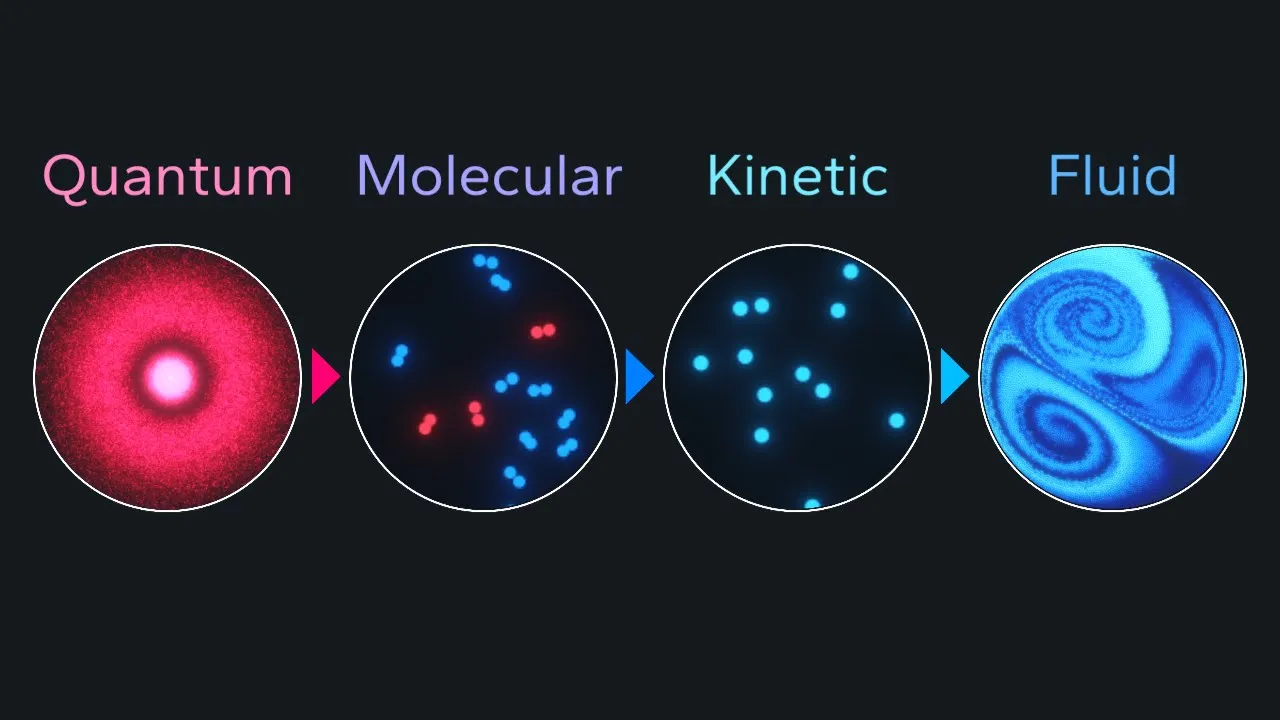
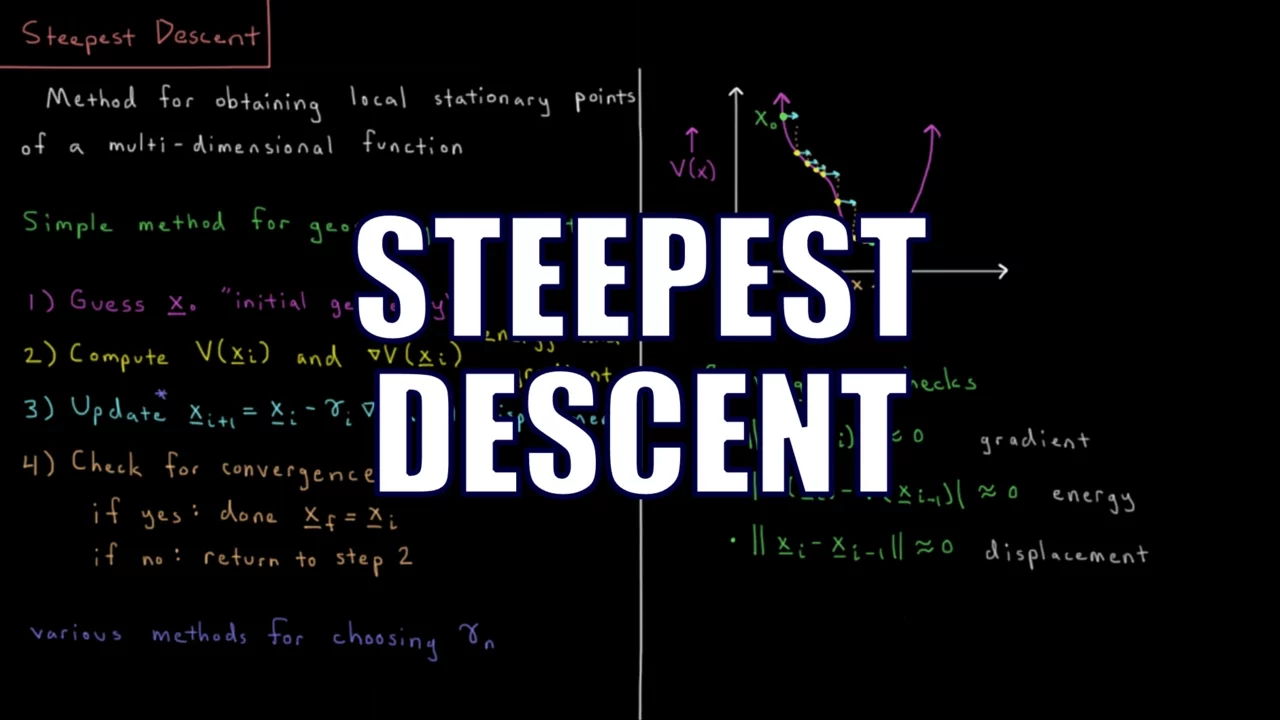
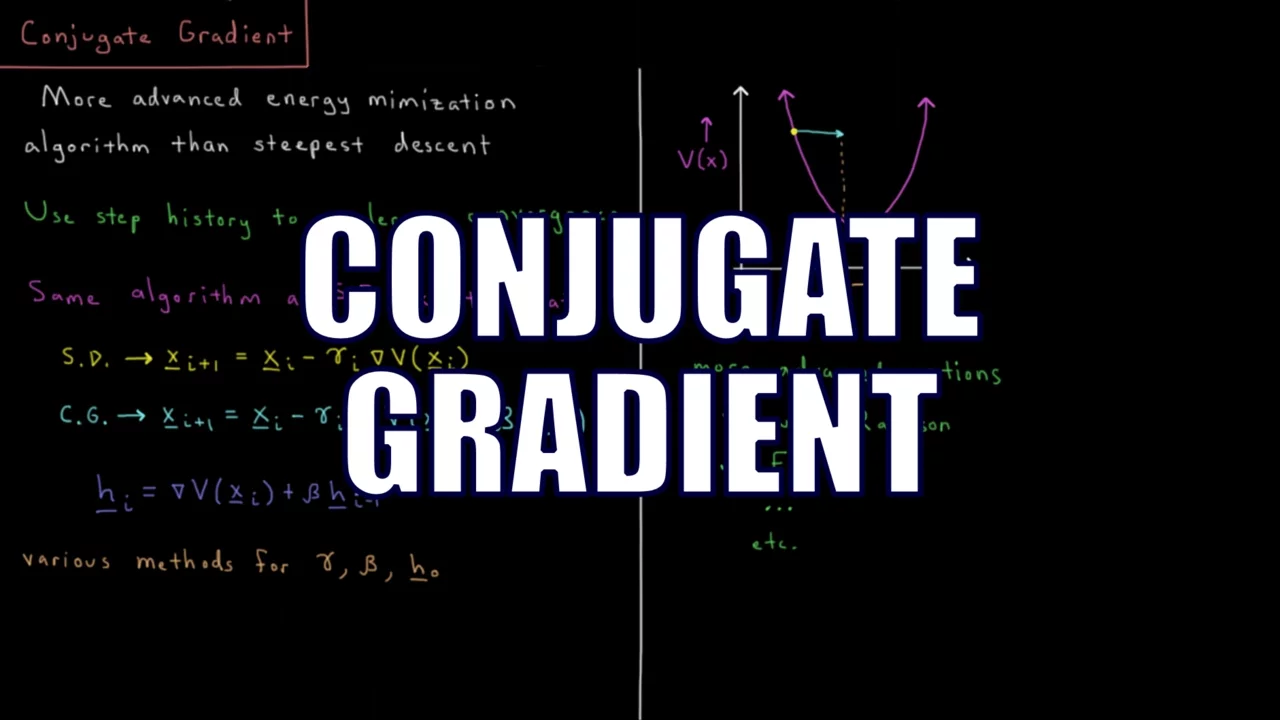
Geometry optimization algorithms (e.g., steepest descent and conjugate gradient methods) used to computationally locate stable molecular structures at minimum energy points on a PES.
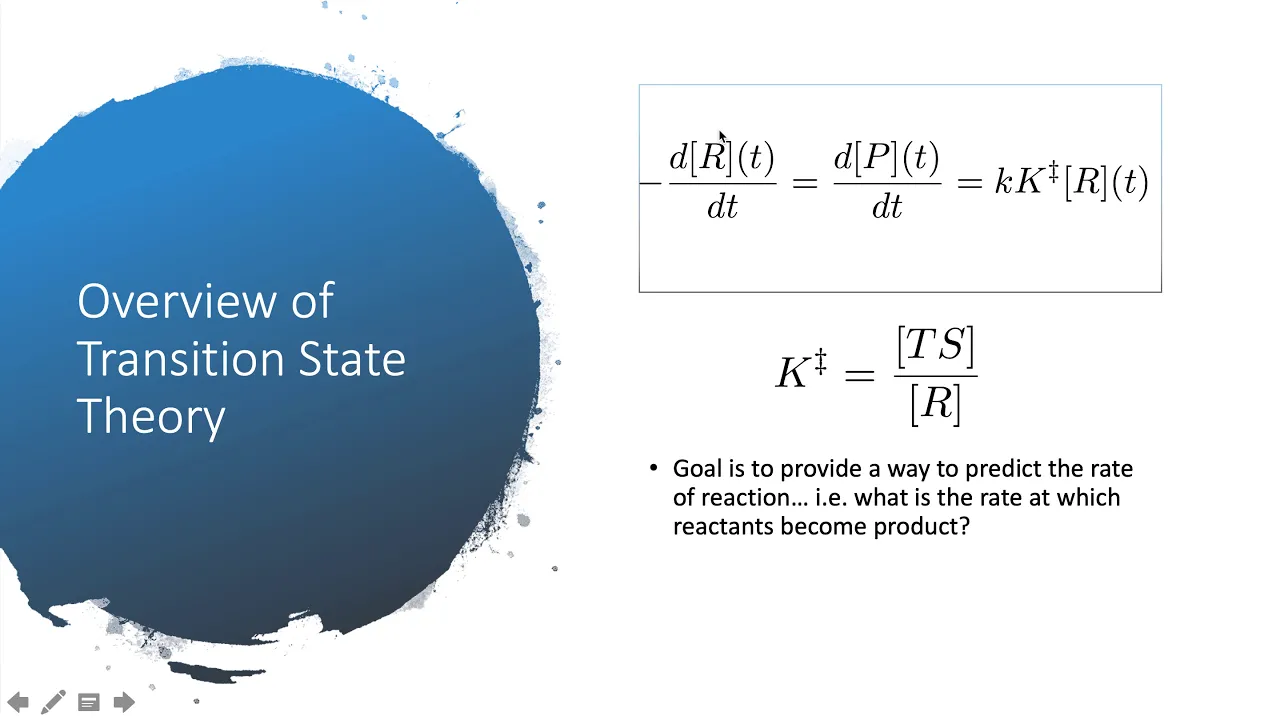
Transition State Theory (TST) and techniques for identifying transition states (first-order saddle points) to calculate reaction rates and activation energies.
Molecular Dynamics (MD) simulations, which utilize potential energy surfaces (or empirical force fields) to simulate the physical movements of atoms and molecules over time.
Advanced electronic structure methods, such as Density Functional Theory (DFT) and ab initio calculations, which are used to map out high-accuracy potential energy surfaces.
82.3K views933likes20:08Original Release: 2014-06-03
Welcome to the first video lecture for chemistry 4021 8021 computational chemistry. In this lecture I'm going to discuss the potential energy surface and this is a preamble to discussions we'll move into later having to do with the basic force field and molecular mechanics. So without further ado, let's uh let's discuss a concept that I think most people who've had chemistry at the undergraduate level are familiar with and that's the notion of a potential energy surface. So this is a a conceptual construct that we use to help us think about energetics, reactivity, equilibria. Many sort of macroscopic concepts in chemistry will be traced back to the notion of a potential energy surface. So what is a potential energy surface? Well, it captures the idea that every chemical structure and when we say structure certainly for small molecules we're thinking about a geometry. That is where are the atoms in space relative to one another. And the idea is that those structures have associated with them a unique energy. So once I know the positions I can uh determine in principle the energy it's it's a physical observable I might measure and moreover since changing from one geometry to another can in principle be done smoothly I would translate atoms from one position to another position in space given that you have that smooth change you'd also expect the energy to change in a smooth way as you move atoms around and if I were to graph that energy change as a function of the coordinates, whichever coordinates I choose, and we we'll get to that in a moment. That would end up creating a landscape, a a smooth energy landscape that I could plot, for example. And the virtue of that uh depending on how visually one thinks is that many notions of chemistry become associated with the topology of that surface. that is seeing how those energy changes take place as a function of structure may give one insights into uh important chemical concepts reactivity for example and so the the simplest example of a potential energy surface is an easy one to graph happily it's a one-dimensional surface and so here I have a uh a standard diatomic bond stretch and so typically when I'm uh going to create a potential energy surface I have as my yaxis. If I'm going to try to graph in two dimensions as I'm able to here, my y-axis is going to be the energy. It's a potential energy surface. That's really the quantity I'd like to read out based on structure. And then along the uh x-axis is going to be some sort of coordinate defining the geometry. Now, in the case of a diatomic, there's only a single degree of freedom. We'll say more about degrees of freedom here in a moment, but uh the trivial degree of freedom in this case is the separation between the atoms. So I've got some distance R and my atoms are the sort of generic physical chemistry atoms A and B. And then as an aside, it does turn out actually that once upon a time argon was abbreviated A. And so you can think of this as being the rather unusual argon bored molecule if you'd like to. But really it's just notional. I've got two atoms A and B.
And what this potential energy surface is telling me is that as I go to a very large distance, presumably these are large values of R, the interaction between these two atoms A and B becomes smaller and smaller and smaller and it approaches some asmtote where they just stop interacting at a certain point. So you have a flat energy at very large distances. Now if I imagine bringing them together from these very large distances, as they get closer and closer, they'll begin to interact. And we'll be saying a lot more about why atoms interact later on in the course.
But in any case, they have a favorable interaction and they go down down down down in energy. They hit some minimum after which point it's no longer favorable to keep pushing them closer together. So they begin to repel each other and we end up walking up this wall of energy and in the case of a simple diatomic that starts to rise very very steeply. In principle, you could get to ra equals zero. That is, you would actually uh merge the nuclei if you want to think about it that way. We're not going to really be dealing with that.
That's nuclear chemistry, not normal chemistry. But there would be a sudden change in the energy as you went from AB to whatever atomic number is associated with the sum of A and B. But okay, that's kind of a a weird little quirk about going to zero. But this is a standard looking diatomic potential energy associated with a we might call this a bond stretching coordinate.
Right? We're looking at the energy as a function of bond distance. And so an appropriate question to ask then is what's the dimensionality of the generic potential energy surface?
So I showed the very special case of two atoms in which case we've got a rather simple relationship between energy and a bond distance. But if we think about more atoms, how many dimensions would there be formally? Well, for the moment, let me not think about uh internal coordinates, that is relationships of atoms to one another. That's what a bond is after all. It's how how far apart are two atoms from one another. But if I wanted to approach this without having any sort of chemist intuition, I probably would take some sort of fixed spatial frame. That is I I could take cartisian coordinates for example and every single atom would have its own x y and z coordinates in some absolute spatial frame. And so to define where all the atoms are I would need 3 * n where n is the number of atoms coordinates right every single atom would have an x a y and a z. And if I want to define a molecular geometry, I would write down a little vector of uh x1 y1 z1 for the first atom, x2 y2 z2 for the second atom and so on. And that would be a a perfectly fine way from a mathematical standpoint to define a geometry. So that says that the potential energy surface would be 3 n dimensional where n is the number of atoms.
But as chemists one of the things that uh we typically expect is that in the absence of some sort of external influence right I don't have any electric fields I don't have any magnetic fields I don't have any gravitational fields uh in that case it shouldn't be the absolute locations of atoms that dictate the total energy really it should be their location relative to one another so if I think of my diatomic I just chatted about in the last slide and let's say I take a bond distance of 1.5 angstroms. Well, it doesn't matter where that molecule is in a space that has no external influence on it. If it's if it's always the case that the two atoms are 1.5 angstroms apart, they'll always have the same energy no matter where I move them to.
And so, it does seem that for chemical purposes, we ought to have an opportunity to reduce the dimensionality to really cover the critical interactions and critical changes in energy.
And so if if you think about that the the reduction that you can gain is once I've defined a molecular geometry I should be able to move it anywhere in space. That is I should be able to translate its center of mass is a way to think about it. Anywhere along the x direction anywhere along the y direction anywhere along the z direction and that's not going to change the energy.
So there are at least three redundant coordinates I'd be able to get rid of.
Moreover, not only can I translate that center of mass to any position in space, but I should as well be able to rotate about each of the absolute spatial axes x, y, and z, and still not have an effect on the energy. So, since I can twirl my molecule then about any of these axes, that's another three dimensions that I can remove from having an influence on the energy. And as a result for a molecule there's really 3 n minus 6 degrees of freedom.
Now many of you will have seen that in in other contexts and in particular when one discusses infrared spectroscopy for instance it turns out there are 3n - 6 degrees of freedom possibly and you may recall that in fact when there is a linear molecule it's not necessarily 3 n minus 6. you can have a a different number, but we're going to think about potential energy surfaces from the standpoint of considering all possible deformationations of a molecule. So even though a molecule may in fact have a linear equilibrium structure, nevertheless, we might be interested in cases where we are going to perturb the uh atomic position so that they're nonlinear. So normally we'll be thinking about potential energy surfaces having 3 nus 6 degrees of freedom. And just to be very careful of course we should specify n greater than two because there is no way to not be linear if you're a diatomic. But as soon as you have three atoms you can certainly be nonlinear. Now one of the great challenges in chemistry is that unfortunately once you get beyond that n equal 2 case so if I really do have 3 n minus 6 and I I just take n equal to 3.
So here's a nice triatomic molecule ABC.
So once again, if this were to in fact be the old way to write argon, we've got a very exotic molecule, argon, boron, carbon, but I'm really being a physical chemist again. I'm just taking arbitrary atomic labels. Well, here I'll have n equal to 3. So 3 n is 9 minus 3 uh there are sorry, excuse me, - 6. So 3 * 3 is 9 - 6. There are three spatial coordinates. And then there's the energy. So unfortunately, I would need in fact to be able to graph in four dimensions. one dimension will be energy and then I'll have three potential energy surface uh degrees of freedom.
And that's a tricky tricky graph to do.
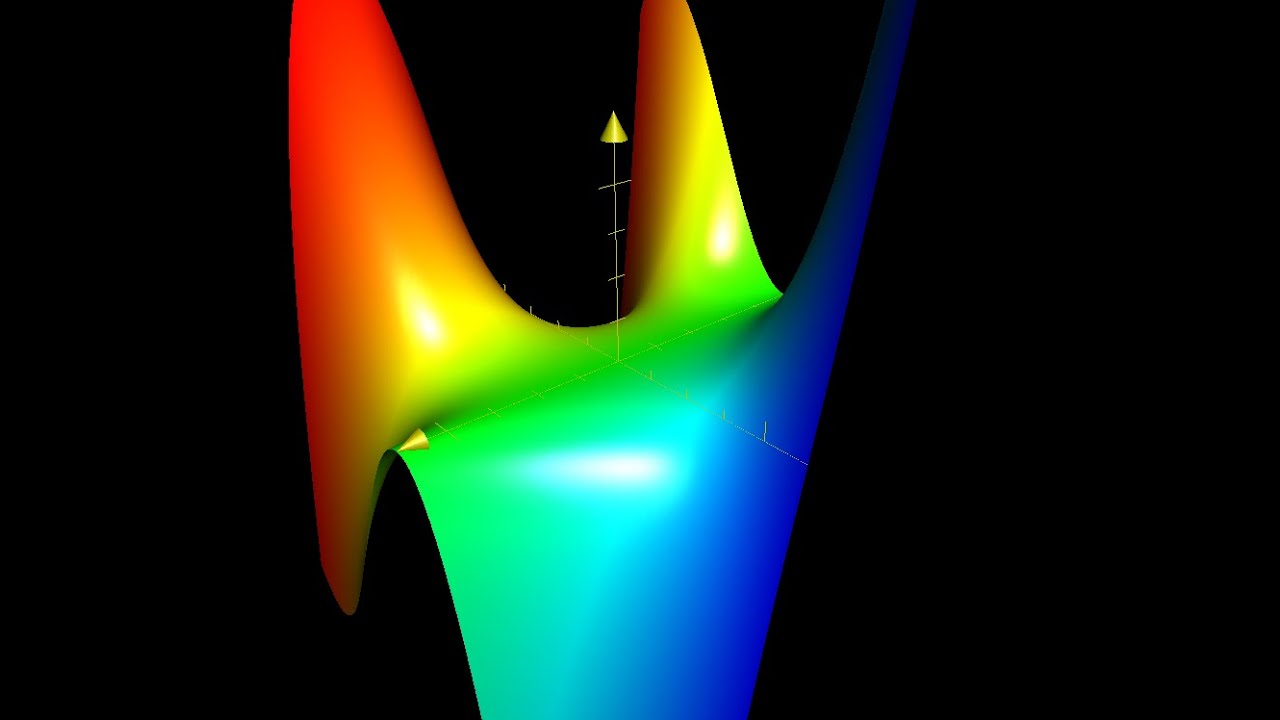
In fact, it's not impossible. The way you would do it is you would in fact plot in three dimensions and then you might color your three spatial dimensions uh in order to indicate energy. So your fourth dimension would be a color that the human eye would perceive. But I'm I'm challenged with creating such a plot. So in fact what I'm going to do here is I'm going to take a reduced dimensionality and when you reduce the dimensionality a way to think about that is that you are slicing through the potential energy surface right you are reducing arbitrarily the total number of degrees of freedom and so here I have that I've taken a two-dimensional slice as I've said here two-dimensional slice and the dimensions I'm going to keep track of are the bond distance between B and C and the bond distance between A and B and I sort of have to define once I do that what is the nature of my slice and so I'll say here for instance that I'm going to take this slice for a particular value of the bond angle so I might move in my multi-dimensional surface to a position where the bond angle is let's just pick a value 109.5° for example and I will now take all values of the AB distance and the BC distance where the angle is 109.5°. So that would be like passing a plane through the potential energy surface and keeping what's left at that stage and then graphing the energy associated with that. So that would define a slice and you do have to be careful. You have to tell people exactly what sort of a slice you're doing so that they understand the nature of these reduced uh dimensionality potential energy surfaces. And if we look at this one, let's just think about what it says. So if I look at this point over here somewhere on the surface here, what does it define? Well, I can just read it out on the axis. So I've got a about a 1.4 angstrom bond length to uh this position for AB. And if I track it over on this axis, it's also about a 1.4 angstrom bond length. And it looks like that's the minimum in energy that I'm showing here. It might actually be touching zero. Of course, I'd have to maybe have a way to rotate this graph to see that a little better, but that's the idea here.
And then what happens if, let's just say, I keep the BC bond length fixed at 1.4 and I start pulling the AB bond length. So, I'm going to translate along this axis in the direction that will keep this BC fixed at 1.4. So, that would be like moving on this surface up up up up up. And I'm still at short BC bond length, but now I'm at very long AB bond length. And you see it does sort of what you'd expect it to do. Just as in that one-dimensional surface, I'm going to increase the energy until A and B stop interacting so much, and it's going to become a constant at much larger values.
So indeed, that would correspond to taking another slice, right? It would be like I would pass a plane, and the plane would be defined by having BC be 1.4 4 angstros up and down through this potential energy curve and that would generate the one-dimensional curve we already saw earlier. And similarly, if instead I keep AB fixed at 1.4 and I lengthen BC, then I'll translate along this distance. Okay, I'll go up up up up and I see exactly the same thing, a different bond stretching coordinate.
This is another plane I could slice through as a second time and create another one-dimensional coordinate. Now, what's going on up here? Well, that corresponds, if I can get my cursor to move. There we go. What does that correspond to? That's really pulling on both bonds simultaneously. So, I'm starting at this 1.4 1.4 and I'm lengthening both. So, as I move the cursor along, say at this position, if I were to track this back, it looks like that corresponds to about 2.2 for the AB bond length and about oh, maybe 2.2 again, I suppose, for the BC bond length. I'm getting longer longer in both. I'm really breaking both bonds.
simultaneously. And of course, that gives rise to a much higher energy than if I only break one while allowing the other to remain at what what seems to be a near equilibrium value. Right? So this this sort of representation should make sense to you. It's got a sort of a rational look to it. The more bonds I'm breaking, the higher I'm going in energy because these atoms like to be bonded to one another.
So it is nearly always the case that chemists would like to simplify things as much as possible and really consider only a single dimension on a potential energy surface. And often they'll call that a reaction coordinate. So you're interested in some process, a chemical reaction, a confirmational change, which you could call a reaction if you want to. Uh that is dominated by changes in a single coordinate. And that coordinate now I want you to recognize that is a one-dimensional slice of a potential energy surface. So you are adopting some protocol for slicing what through what could be a massively highdimensional surface and really focusing on the energetic changes associated with a single dimension. Okay. So if I stick with my molecule ABC and I come back to this idea of AB. Now I got to specify what I'm doing. Maybe I hold the ABC angle still at 109.5 and I also hold BC at 1.4. I talked about that. And that would generate this curve. So I've got angle fixed and other bond length fixed. But what I want to emphasize uh from sort of a a careful speaking or presentation perspective is that usually a true reaction coordinate that is useful for conceptual purposes and what most people mean when they discuss it is not in fact slicing with I guess what I might call flat planes. You get a flat plane when your slice is holding other coordinates completely fixed.
However, in chemistry, if I really were to sort of infinite decimally slowly pull apart the AB bond, what I would find is that all the other degrees of freedom would begin to relax as I uh as I'm breaking basically the AB bond. So, for instance, I might find that B and C start bonding together more strongly because A and B are no longer sharing electrons that B can use to bond to C.
So, in fact, the BC bond would not want to stay fixed at say 1.4. it might be shortening and that would be energy lowering. It's stabilizing. Similarly, the angle might also change and so uh one should possibly allow these things to relax because that's really the low energy path and the rules of our universe are that's low energy things are preferred over high energy at least at reasonable temperatures where we all want to live. And so the real reaction coordinate I may want to consider is relaxing BC and perhaps relaxing the angle too. And what ought to happen here of course is if I'm starting from my minimum on the potential energy surface and that's why I picked a particular value of BC. That's still going to be correct. But there's going to be an opportunity to relax the energy at all the other positions that will be reflected then with an energy on the black curve. the relaxed curve that's lower than the energy on the red curve.
So that is the the additional energy that's gained by allowing BC to vary from this fixed value to whatever value it might take here. And without looking at it, we don't know what that value is.
But what I want you to think about is that uh in a way what you're doing is slicing with a very complex looking object. Now it's a very curvy wavy knife that is somehow passing through the highdimensionality potential energy surface and giving rise to this relaxed reaction coordinate. So that's all I want to talk about in this first video. But I also want to give you some things to think about and I recommend that now you you give some thought to these questions and it's something I hope we'll have a chance to discuss in class. And what I want you to think about is something almost everybody has seen in sophomore organic chemistry. It's one of the very first confirmational analysis problems that comes up and that is the rotation in N butane. And so what I'd like you to do is uh draw or look up in your organic textbook if you've actually forgotten this uh a relaxed butane rotational reaction coordinate. So draw the reaction coordinate carefully label all the structures uh have something that you know you might give you flashbacks but anyway that's what I want to discuss. And on that same drawing, I'd like you to overlay what would that curve look like if I I'll just tell you the organic chemists certainly were thinking about that conceptual coordinate as though everything is relaxed. But now I want to think about the ramifications of not having relaxation. And so if you were to start from the transbutane confirmer or the antiparplaner it's sometimes called too.
uh what would the curve look like if you held every degree of freedom fixed other than the reaction coordinate and I'd also like you to think about that and and plot that on the same plot and I'd also like you to do the same thing except now the fixed values would come from the go confirmer not from the antiparplaner confirmer and finally here's a a sort of a more general question I'd like you to think about how's the topology of a chemical potential energy surface that's defined by internal coordinates that's what we mostly been talking about here. How's that fundamentally different from the original thing we talked about which would be a sort of fixed framework uh xyz spatial coordinates which you were certainly all used to from grade school math. So with those questions in mind we're going to end this video and I will pick up from here when we uh begin the next video.
Up Next
8:45
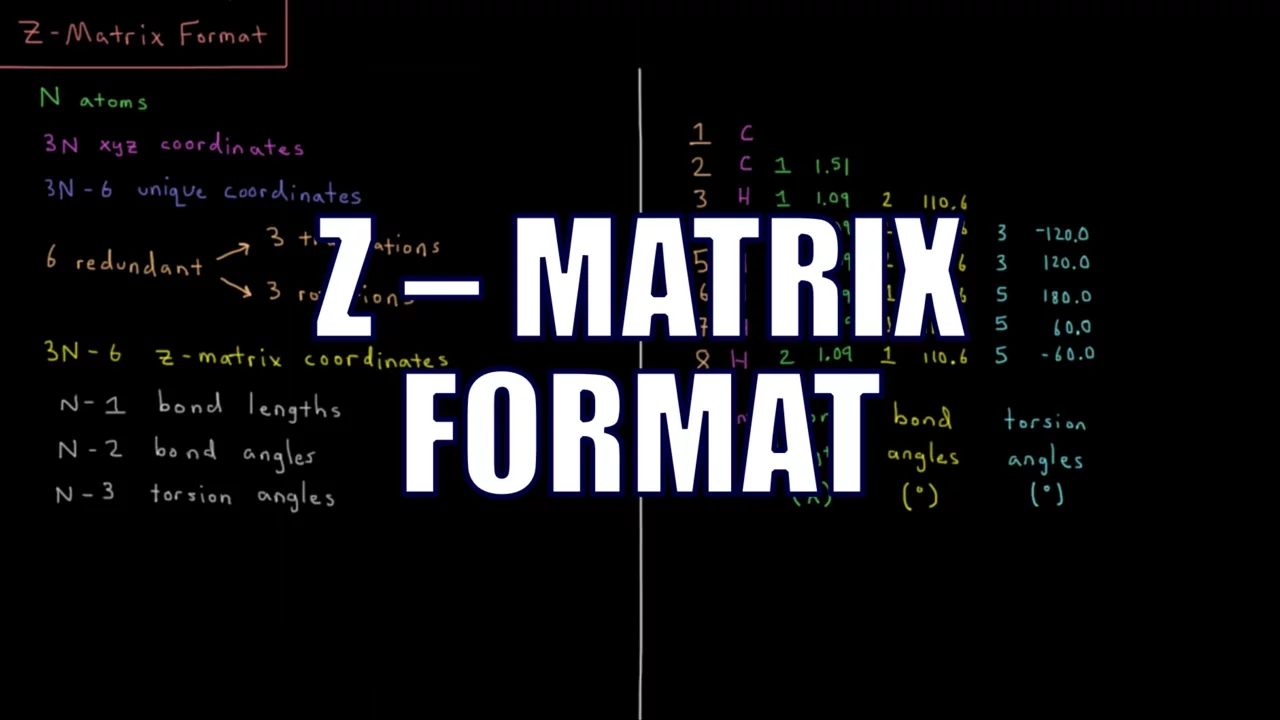
Z-Matrix Format | Computational Chemistry Explained
@TMPChem
30.4K views•2017-03-16

83:56
Biocatalysis and Catalysis in Islatravir Synthesis | Merck Webinar
@SCIwheresciencemeetsbusiness
675 views•2020-10-08

12:45
Density Functional Theory: Hohenberg-Kohn Theorems Explained
@ChemProfCramer
29.5K views•2014-06-03

17:31
Edible Water Bottles: A DIY Guide to Sodium Alginate Spherification
@ryan
10.5M views•2019-06-21
Related Study Plans & Knowledge Roadmaps
Structured learning paths in Chemistry
chemistry
Nuclear Chemistry: Decay, Meds & Fuel Cycle
01Introduction to Nuclear Structure and Radioactivity
02Decay Dynamics and Kinetics
03Radiation Interaction and Detection
+ 2 more learning modules
24h5 modules
Explore Roadmap
chemistry
Supramolecular Chemistry: Forces & Machines
01Foundations of Chemical Bonding and Intermolecular Forces
02Introduction to Host-Guest Chemistry
03Thermodynamics and Dynamics of Self-Assembly
+ 2 more learning modules
16h5 modules
Explore Roadmap
chemistry
Photochemistry: Excited States & Reactions
01Foundations of Light-Matter Interactions
02Molecular Orbitals and Electronic States
03Photophysical Processes and Jablonski Diagrams
+ 2 more learning modules
18h5 modules
Explore Roadmap
chemistry
Coordination Chemistry: Bonding & Properties
01Introduction to Transition Metals and Ligands
02Crystal Field Theory (CFT) and Geometry
03Magnetic Behavior and Spin States
+ 2 more learning modules
14h5 modules
Explore Roadmap