


















![Principles Of Chemical Engineering 1 lI Chapter 4 Part 7 [Arabic]](https://i.ytimg.com/vi_webp/nCzX7cLPKiA/sddefault.webp)




This video explains the fundamental design equations for three common chemical reactors: (1) Batch Reactor - uses differential/integral forms with well-mixed assumption, derived from material balance where accumulation equals generation/consumption; (2) CSTR (Continuous Stirred Tank Reactor) - uses algebraic equation with well-mixed and steady-state assumptions, where inlet equals outlet flow rates; (3) PFR (Plugflow Reactor) - uses differential/integral forms with steady-state and no axial dispersion assumptions, requiring differential element analysis. All design equations relate reactor volume to conversion and reaction rate, with the key distinction being whether the reactor is well-mixed (allowing rate to be pulled from integrals) or not (requiring differential analysis).
Reactor Design Equations: Batch, CSTR, and PFR Kinetics Overview
Added:So the focus of kinetics especially in regards to chemical engineering in particular is pretty much reactor design. So today's goal is going to be look at some basic reactors that we're going to see and figure out what the design equations for those reactors are going to be. The first reactor you probably heard of from some of your core engineering classes is the simple batch reactor where you have a bunch of materials already in the reactor. It spins around. it reacts at some later time. There's usually a spout on the bottom here and you take out whatever you had inside your reactor vessel.
Um, as we start looking at continuous processes and the advantages that come with those. Um, a lot of companies started using continuous stir tank reactors, which means you have an inlet stream constantly feeding in material to your reactor and an outlet stream constantly taking material out. And as with the batch reactor, you generally have some sort of heat source if you need that, as well as an impeller for mixing. The last type of reactor that we'll look at in this course is what's called a plugflow reactor. And that's probably a little stranger and probably haven't heard so much about that, but we'll take a closer look at it when we get to it. So let's talk about what a design equation is. So one of the more important parts about reactor design is you want to know for a given conversion and we'll talk about what conversion means exactly. Uh but if I guess in the basics you say okay will my reaction go all the way or will it not proceed at all? Generally, you want your reactions to go as far to completion as possible, and that's when you have a high conversion. But when you're designing a reactor, typically you want to figure out what kind of volume you need for your reactor. So, we want some sort of mathematical expression that relates the conversion to the volume. So, let's try figuring out how we would do that. Okay. Well, first of all, let's look at the batch reactor. And in every single one of these scenarios where we're looking for the design equation, we're going to start in the exact same way. We're going to do a material balance on the substances that are inside the batch reactor. So, let's take a small look at basically what the inside of a batch reactor looks like. So, you'll notice these over here. These are feed tubes.
So, they've fed the material into the reactor and down here, this is an outlet that will take away whatever's in the reactor at the end of the reaction. But during the actual reaction, which I'm going to pause it right at this point, when the impeller starts going, um, this is what we're looking at. We're not looking at the time where things are fed in or things are, I guess, taken out. We're looking at only the time where the reaction is running. And because of that, what we could say is that there's going to be no inlet or outlet that we need to consider in our batch reactor, right? Because when we're looking at what's actually happening, um nothing is being fed in and nothing's being taken out. So, we're only concerned with the generation, consumption, and accumulation terms, then our balance.
The other thing we want to assume is that our vessel is so-called well mixed.
So this impeller here is doing such a good job at mixing that um pretty much it's a homogeneous mixture all throughout. And what this allows us to do is it says the reaction rate R is not a function of the volume of the reactor.
What that really means is that if I choose any point within this reactor here, if it's over here or down here or down here or up here, the reaction rate is going to be the same regardless. So what that tells us is that the geometry doesn't matter.
Remember, it doesn't matter from here or here or here. And we don't need to use a differential an element in our analysis.
We'll talk a little bit more about what that means later, but basically it just means that our uh translation from words to I guess math here will look like this. Remember we don't have an inlet and we don't have an outlet. So we could ignore these terms here. I should introduce the variables actually first.
So F will be a flow. So F will have the units of moles per time.
R is the reaction rate. So R is the reaction rate. That's going to have units of moles per volume time or I guess you could say concentration per time. V will be volume. So V is volume.
And N. So A over here is what we've defined as just moles. So the change in moles per time will be equal to the inlet minus the outlet plus here we've lumped the generation and consumption terms together. We're going to call this a net rate. So if something is being consumed, it's generally a reactant.
Something's being produced, it's generally a product. You can have a reaction where something is both generated and consumed at the same time.
So we're going to include those those in this rate and say that this is a net rate of I guess either consumption if it's negative and generation if it's positive. So again we have no inlet we have no outlet both these terms will disappear. Now here we're saying the reaction rate is not a function of the geometry. So wherever we're on the reactor the rate is going to be the same which allows us to pull this r sub a out of the integral.
So now we're left with well okay first I got rid of the in minus out and then our assumption that it's a well mixed reactor says that we could pull this r sub a out of the integral and the integral of dv is simply going to be v. So our final design equation, remember we're looking for volume as a function of conversion.
So how many moles are left in the system or we'll again we'll look at conversion a little more closely later but basically we have a relationship between the volume of the reactor and I guess the moles that are remaining within the system.
Lastly, we know that the rate is a function of either the conversion or the moles in the system. We'll examine that a bit more closely later on. So, if we wanted to put this in the integral form, which means we isolate volume and we try to get in terms of everything else. We will have to do this integral and we can't pull R sub out of this integral because this integral is in terms of the moles and the reaction rate will be dependent upon the moles that are in the system. More on that later. Don't worry about that so much now.
Okay, that said, the next system we need to look at is the CSTR, the so-called continuous stir tank reactor. Let's try to get some intuition about what's going on here. So, CSTR will in general look like this. You'll have an inlet where material comes out.
You'll have again an impeller that's trying to do as as good as a job of mixing as possible. and you'll have an outlet over here where fluid that's within here will flow out. So you hope that your reaction pretty much proceeds uh to completion and the time it takes for this to come out and make its way into the outlet. That is called a resonance time. The amount of time it takes for a molecule here to make it through the continuous stir tank reactor and to this point at the outlet. Again, don't worry about that so much at this point. We'll go over that a bunch more later. So again, we're going to start with our general material balance. And this time, we're going to make two assumptions for our CSTR. The first that it's well mixed, that this impeller is doing such a good job that everything in here is going to have the same reaction rate throughout. The second is that it's steady state. So the flow coming in will be the same as the flow coming out.
So again, just like with the batch reactor, we're saying that the reaction rate is not a function of V. So wherever I am in the reactor, we are going to have the same reaction rate. This means is that we don't need to look at a differential element. And now we could say our generalized material balance is simply going to look like this. This time we can't cancel out the inlet term or the outlet term because we have an inlet and we have an outlet. Again we have this reaction right here being our generation and consumption over here is our accumulation.
Okay.
So first things first we had that assumption that it was steady state which means in general there is no accumulation within the system. So if there's no accumulation then this d NA dt is going to cancel out and we're just going to simply get zero. Second assumption that we made was again that the reactor is going to be well mixed. So the reaction rate is not a function of the geometry of the system.
We're able to pull that out and say it's simply equal to RV. Don't know why I had that twice.
See, no there's nothing important here. That means is that our generalized mass balance simplifies to this, right? Because this simply comes out. We integrate over TV and we get V. So we don't actually have any differentials or integrals in here, which means our design equation is going to be simple. We simply have the volume as a function of the moles within the system as well as the reaction rate.
And the interesting part about this rate law, sorry, not rate law, this design equation for the CSTR is that it's algebraic, right? So in the batch, we actually had um derivatives and integrals. But here with the CSCR, because those assumptions that we made, it's going to be algebraic. All right, before we get too carried away comparing these different reactors, let's take a look at the plugflow reactor. All right, so this one requires a little bit of an explanation. Let's take a look at this.
So, this is an example of a plug flow reactor again with this, I guess, blue dye that's going through it. You'll notice is that you don't have the same amount of blue all the way throughout.
So, you can't say that this reactor is well mixed, right? because this certainly looks like it's well mixed in the axial or along the axis as it's spinning. But as we look along the length of the PFR, we see that the concentration must be different. Likewise, if we take a look at this demo over here, um a lot of PFRs are I guess thin tubes.
So you'll see as this is the length of the reactor, uh the material would just simply flow through and react.
And a lot of these PFRs are pretty long as you'll also see in here. oftent times they have these coils here so that as you run your reactants through they'll simply go through the coils. Okay. So the takeaway is that this is not a well-mixed reactor. So again let's start with our generalized mass balance equation.
But this time we need to make the assertion that the reactor is not well mixed. That means is that we're going to need to look at a differential element. First of all, we can make some simplifications that do help. So if we assume it's steady state again, the inlet flow equals the outlet flow. we could get rid of this accumulation term.
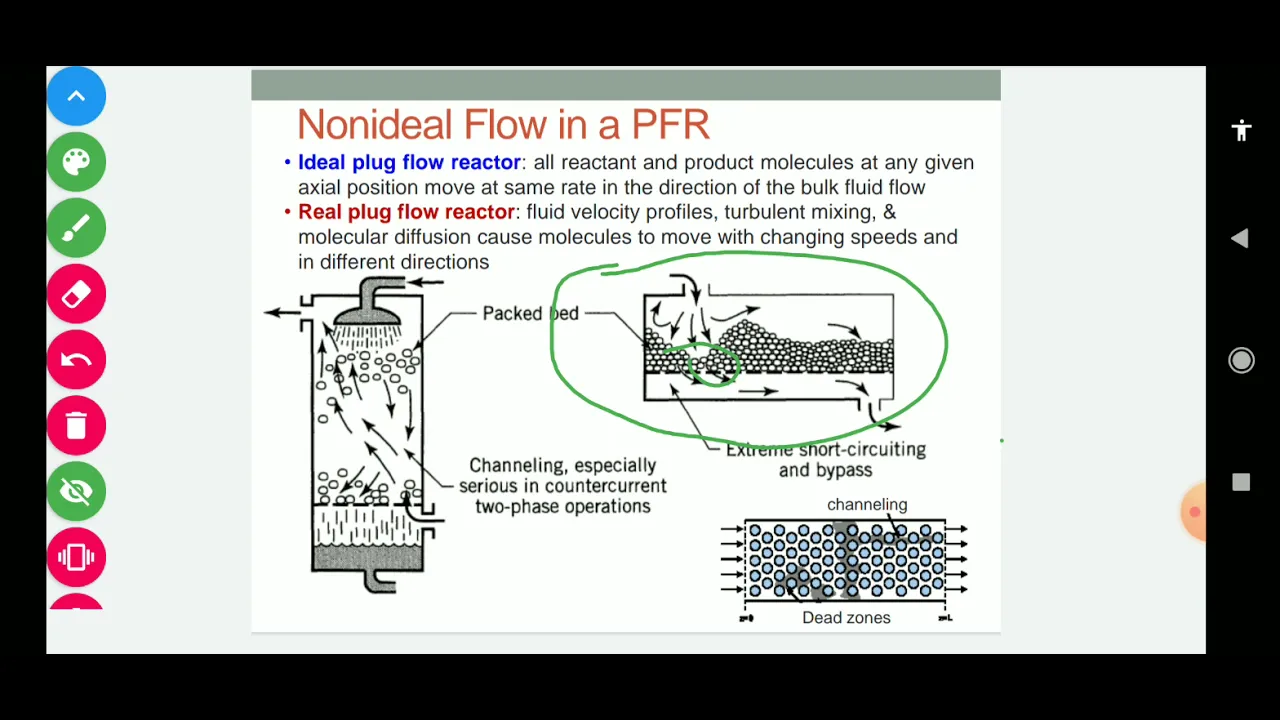
And another thing, we're going to assume that there is no axial dispersion. So this is the axis. We're going to assume that everything that is moving is going to simply be moving one-dimensionally upon this axis. So we could reduce this entire problem to a one-dimensional problem. You don't have particles flowing this way and this way. They're simply like rings that move along in the reactor. So those are our two major assumptions. One, it's steady state.
That gets rid of the accumulation term.
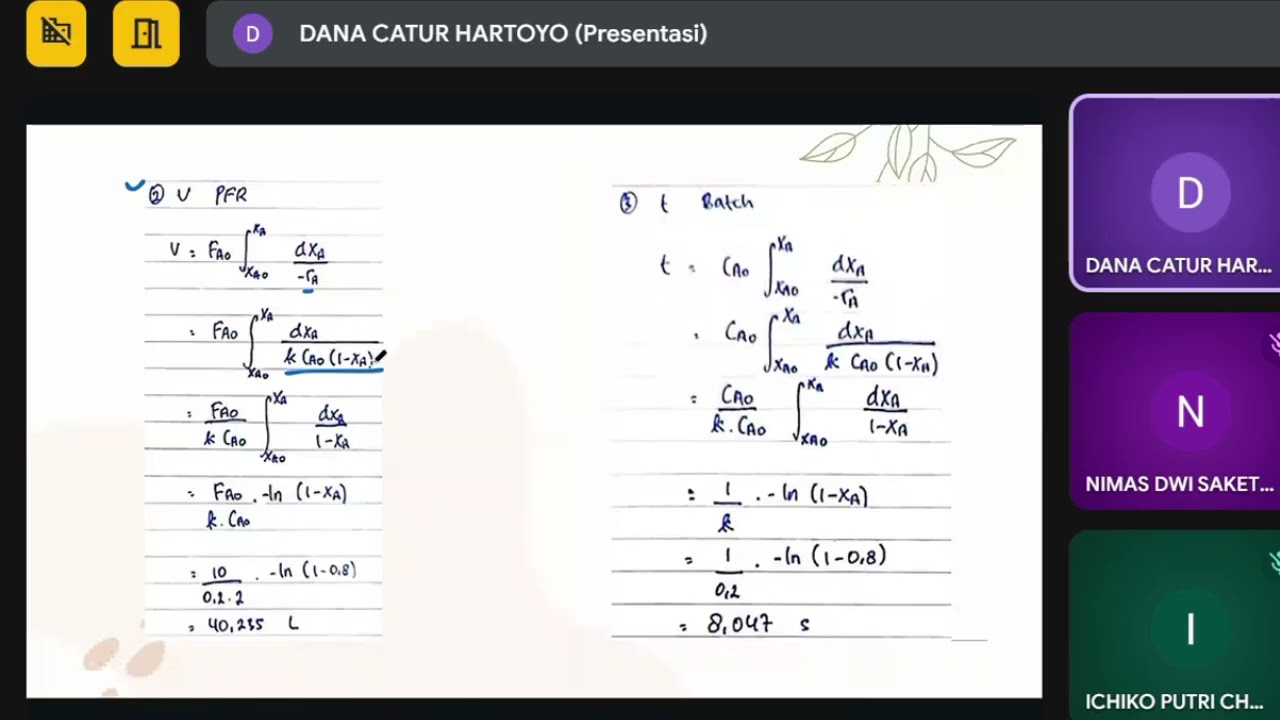
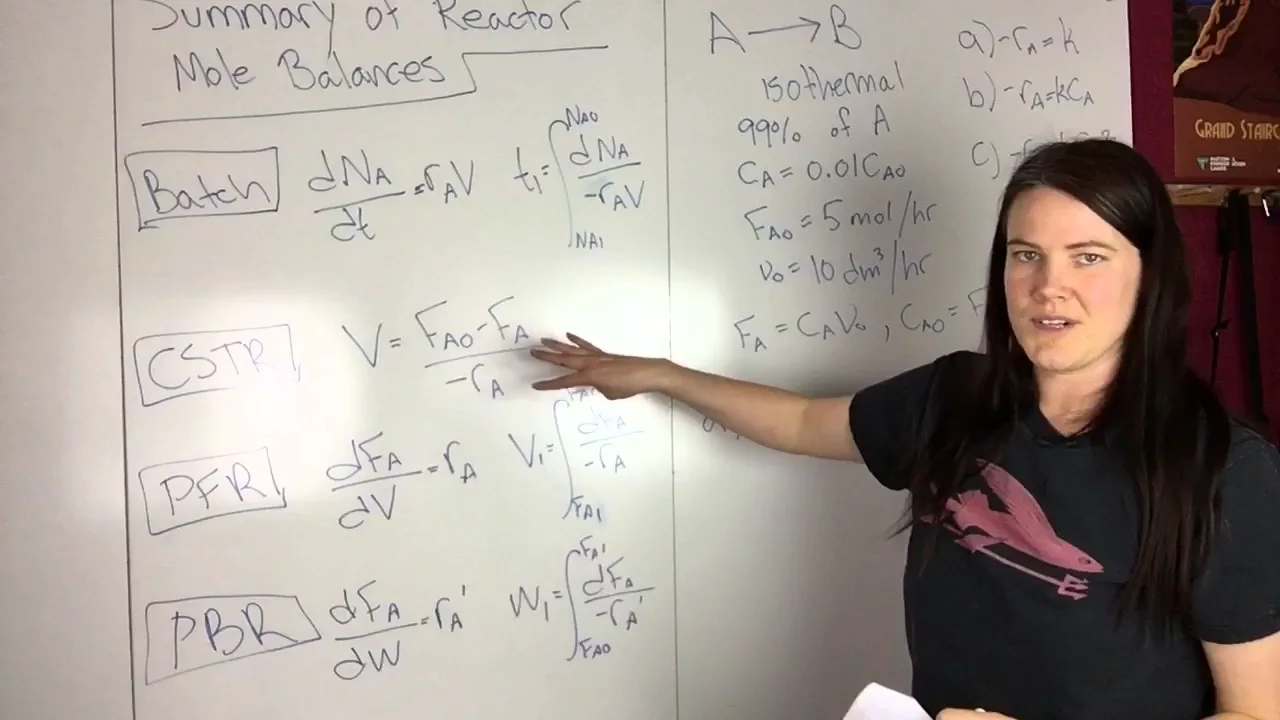
And two, no axial dispersion, which allows us to treat this problem as a one-dimensional problem. So here again, because it's not well mixed, we need to consider a differential element when doing our analysis. What that'll look like is something like pretty similar to a transport 2 or a mass transfer problem. So here we can't just translate our guess material balance to something like this. We need to look at a differential element. So that's a small volume from here to here. We're saying that at the inlet it's going to be f of v. the flow at V and at the outlet is going to be V plus delta V. We're gonna say those flows are not necessarily the same. And similarly, we have the instead of the integral of R sub A DV, we have the reaction rate within this volume here. And now because we have that zero on the other side, could simply divide by delta V. Well, first we're going to move this over here and we're going to divide by delta V. Now from calculus, this should look pretty similar to the derivative definition, right? So if we take the limit of delta v as it goes to zero, what we get is this. It's simply going to be the derivative with respect to v of f. And typically in the derivative definition, you'll see this minus this. So it's reversed. That's why we have an extra negative sign. And that's why we move that negative sign over here. And this becomes positive. So this is the differential form of the design equation for a plugflow reactor. Now if you want to put it in the integral form just integrate well you move the DV up you move the R sub A down you integrate both sides and remember we can't pull the R sub A out because it does depend on the number of moles that are in the system and we'll look at that more closely um we look at conversion in the next video. Okay, so now we have the design equations for everything. Let's take a look at that. This will be our summary right here. So for the batch reactor, it does have a differential form and integral form. The assumption that we used to arrive here was that it was well mixed and we have the design equation relating volume to the reaction rate and the moles that are in the system. For the CSTR, the assumptions that we made were that it was well mixed and steady state and we get an algebraic design equation that again relates volume, the number of moles in the system and the reaction rate. Lastly, we looked at the plugflow reactor. The assumptions we used were that it was steady state and it had no axial dispersion, but we couldn't say that it was well mixed because it was only well mixed um in I guess rings around the axis. So, we have a differential form and an integral form. And again, we're relating the volume to the moles within the system and the reaction rate. All right.
Up Next
Reactor Volume Calculations: CSTR, PFR & Batch Reactor Example
@railitaylor
46.4K views•2016-01-31
Biocatalysis and Catalysis in Islatravir Synthesis | Merck Webinar
@SCIwheresciencemeetsbusiness
675 views•2020-10-08
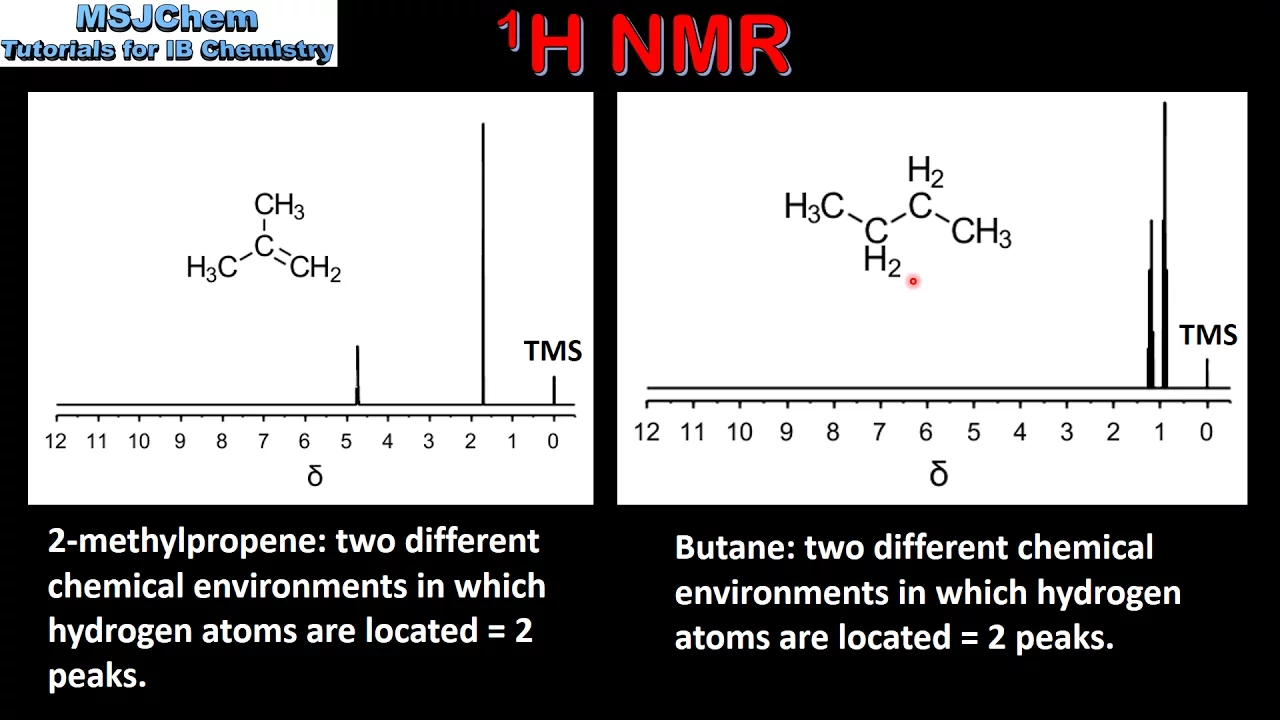
1H NMR: Determining Number of Peaks from Structure
@MSJChem
59.2K views•2017-04-06

Edible Water Bottles: A DIY Guide to Sodium Alginate Spherification
@ryan
10.5M views•2019-06-21
Related Study Plans & Knowledge Roadmaps
Structured learning paths in Chemistry