


















The Anthropocene represents a pivotal moment in Earth's 4.567 billion-year history, marking the first instance where a single species (humans) has become the dominant force shaping planetary systems. This epoch emerges from humanity's unique capacity for collective learning, which enabled two transformative energy bonanzas: agriculture (capturing recent photosynthetic energy) and fossil fuels (accessing energy accumulated over 300 million years). While this energy abundance has dramatically improved human living standards and doubled life expectancy, it simultaneously threatens the Goldilocks conditions necessary for sustaining complex life. The Anthropocene thus presents both unprecedented opportunity and existential risk, requiring humanity to transition from crude exploitation techniques toward delicate, sustainable management of Earth's systems.
Anthropocene in Context: Big History & David Christian
Added:PROFESSOR DAVID CHRISTIAN: First I want to welcome you all.
We're very excited about this conference.
Welcome to Macquarie particularly those of you who have come across many continents.
We're so pleased to see you here and we really do hope that this is fun, that this is enjoyable but also that you might come away with some interesting insights about this incredibly important moment in world history and Big History.
Secondly, this conference is part of what we hope will be a series of conferences run by the Big History Institute.
I believe very strongly that the Big History framework can support the institutional frameworks we need to encourage transdisciplinary research.
More and more big problems, important problems today lie between disciplines rather than within disciplines but the institutional structures really discourage interdisciplinary research.
One of the things we'd like to do to help with that is have this series of conferences that take big problems across many disciplines, and the Anthropocene is one, bring together scholars from many disciplines and see what comes out to encourage, provide frameworks for interdisciplinary work. Before I start my talk, one other thing.
I want to thank all of those who've worked on this conference.
I'm particularly aware of those in the Big History Institute.
Andrew, Tracy Sullivan, Elle Hrobat, David Baker and Kathy Ford.
I want to thank them very much for all the work they've put into this.
OK. I've taken as my title, The Anthropocene in Context.
What I'm going to try to do is put the Anthropocene in the context of Big History.
I hope I can persuade you that we don't just live in strange times.
We live in times that are so strange that their strangeness will show up on cosmological time scales, on the time scales of Big History.
What I want to do in this lecture is talk about the Anthropocene as part of the Big History story and I hope I can persuade you that there are insights into the Anthropocene to be seen at all the scales of Big History.
Big History of course goes for the biggest possible scales up to 13.8 billion years.
That's what I'm going to try to do.
Big History is a very new discipline.
I'm a sort of endless tweaker so I tweak lectures to the last minute, which means that some of the ideas in this lecture are still wriggling.
I haven't quite pinned them down yet so you may well see that some of them are wriggling out of shape but they're alive at least.
I think that's very much in the nature of Big History.
The first part of the lecture I'm going to do two things.
I want to talk about Big History briefly particularly for those of you less familiar with it and then I want to talk very briefly about the idea of the Anthropocene.
These are introductory sections.
A 10-minute course in Big History and then a brief discussion of the idea of the Anthropocene.
Introducing Big History.
Big History surveys the history of the entire universe since the Big Bang 13.8 billion years ago.
When we first began doing this, it seemed a completely outrageous, very foolish enterprise actually.
I thought it would be lots of fun but even I thought maybe this is very foolish indeed, but over the years what we discovered is that it's not foolish at all.
One of the reasons is that there is a coherent story to be told.
There may be several coherent stories, but the one that I find most powerful is a story of increasing complexity.
Let me try to introduce you to this idea.
The early universe was very simple.
It had very little structure.
You can think of a thin mist of hydrogen and helium atoms.
They're embedded in dark matter which we don't understand.
They are at a very, very uniform temperature.
This is very, very smooth indeed.
Charles Lineweaver from ANU, a cosmologist from ANU writes in a recent book on Complexity & the Arrow of Time, whatever measure of complexity we use, there was little of it in the first tens of millions of years after the Big Bang. How do we know?
We know because we can study the universe.
Within 380,000 years of the Big Bang, there are techniques for getting much closer to the Big Bang, but we can actually observe the cosmic background radiation.
Now, many of you will have seen these iconic images from the Planck satellite.
What you need to know is that these are really measuring temperature differences and they're effectively pressure differences as well.
Look, there's going to be a lot of change or science here so those of you who are serious scientists, forgive me if some of these generalisations make you flinch.
I hope not too many of them will. Anyway, here's the goal.
What you need to know is the difference between the blue areas and the red areas is about 100,000th of a degree.
That's what I mean by saying this is incredibly smooth homogenous early universe.
There are no galaxies and stars.
There are no heavier chemical elements.
Hydrogen and helium, that's it.
A tiny smattering of lithium and beryllium but not significant.
Without complex chemicals, you can't make planets.
You certainly can't make living organisms or humans.
Then over 13.8 billion years, what this story tracks is the slow appearance, step by step, of new things, of more complex things and when they appear... Most of the universe, let's be clear about this, remains very simple today.
If I could pick you up and hurl you randomly in the universe, the odds are overwhelming that you would end up in a not very nice place. It would be incredibly dark.
It would be incredibly empty and you wouldn't last long.
Most of the universe is vacuum. But there are special places with the right Goldilocks conditions and where there are gradients of energy and in such environments, it turns out that more complex things have emerged and we can track this story.
I use the word "emerge" quite precisely. They emerge with new emergent properties.
There was a time when there was no life in the universe then there was a time when there was life.
Life has new qualities that didn't exist before.
I think this is the magic of the story for me as a story is that utterly new things appear, and when they appear, it's always magical but we can have a shot at a decent scientific explanation of how and why they appeared.
Now, the extreme complexity of today's world, of the world we live in, of the Anthropocene, of this global planetary society is why this story is relevant because today's worlds, the world of the Anthropocene is perhaps the most complex thing that we're aware of.
This story of building complexities is very much a story about the Anthropocene and about us.
That's the first justification for putting the Anthropocene in the context of this large story, but there's a puzzle as in any good story.
There's an evil force that has to be overcome and that evil... Damn the laws of thermodynamics!
The first law is not evil.
It is that energy is conserved.
It's the second law that's evil.
What the second law says is that energy... Again, this is chainsaw science so forgive me scientists in the room.
Energy and matter both tend to exist in random forms unless there's something organising them and when energy exists in random, we often call it heat energy and it can't really do work precisely because it's pushing in all sorts of directions.
This is why physicists argue that entropy tends to increase.
Over time, the randomness of the distribution of energy and matter tends to increase and eventually, and I'm told by Charles Lineweaver that this may happen 10 to the 104 years in the future, we will meet the heat death of the universe. Everything will run down.
There just won't be enough free energy to create complex things.
The problem is this.
If the second law really exists, it plays the role of Darth Vader.
How could complexity increase?
How could more interesting things appear in the universe?
Now, again, more chainsaw science.
I'm going to attempt to a tentative solution to this.
I think many scientists could give us a much more sophisticated one but this is one that's really aimed at people like myself quite frankly.
Three possible explanations of how it was possible for complexity to increase and all of them have a bearing on understanding the Anthropocene. The first is this: The Big Bang itself generated a minimum of structure within the first second, different forms of energy and matter appeared.
Each of them had their own qualities.
Gravity pulled things together with a very definable strength, quarks of particular qualities, electrons of particular qualities.
This means that there was a minimum of structure in the universe from the first second.
That guaranteed that universe would never be pure mush and really that provides the foundation for building all later forms of complexity.
When I talk about complexity, I'm talking about things that are interesting for us humans.
That's the first thing. There's always a minimum of structure there, an operating system if you like.
Secondly, there were flows of free energy.
Again, our historians will probably never talk about the laws of thermodynamics but I'm going to have a go here.
I've defined heat energy as energy that's distributed randomly.
By the same token, I think you can describe free energy as energy that has some structure or organisation.
Heat energy is pushing randomly in many directions.
Free energy is distributed non-randomly.
Think of the flow of water over Niagara Falls.
Such energy can actually do work. It can in a sense push against entropy and it can create complex things.
Where we see free energy, flows of free energy, there it's possible to create more complex things.
As energy flows, it tends to get less structured and that's where the second law kicks in.
Because eventually, even these flows of free energy increase the entropy of the universe. That's the second thing.
Flows of free energy can construct complex things.
The third is again a very simple concept.
It's Goldilocks conditions.
As we watch this story, we find that environments appear in the universe and this is something we can just observe.
They're perfect for the creation of complexity.
Not too dense, not too empty, not too hot, not too cold.
In such environments such as the surface of a rocky planet like our earth, in such environments, we observe the appearance of more complex things. These three things may help us understand why it was possible for complexity to appear.
Now, Eric Chaisson is an astronomer who's been teaching courses in Big History in Boston for much longer than I've been teaching courses in Big History and he argues there's a rough correlation between levels of complexity and the density of flows of free energy.
I'd just like to plant this idea because it will turn out to be relevant for understanding the Anthropocene.
On the vertical axis, we have free energy rate densities.
That is to say the amount of energy flowing through a gram in a second.
He does calculations for a number of different densities.
For the sun, what's the density and then also for the Anthropocene.
What he finds is that the density of energy flows in the Anthropocene is about a million times that flowing through the sun.
This and a lot of other calculations provide the justification for the argument that more complex things may be characterised by denser flows of energy.
Now, there's a second thing hinted at in this graph.
The horizontal axis shows how long these different entities last.
You can see this line here.
What it's telling us is that more complex things by and large don't last as long as simpler things.
You and I will not live as long as our sun to put it simply.
I think that is telling us that managing dense flows of energy is a really difficult thing because those dense flows of energy are very powerful and they can be very destructive so they have to be managed delicately if you're going to have more complex things.
Here's an example. How stars form.
This is chainsaw sculpture.
These are computer simulations for the role of gravity.
Now, for gravity, gravity likes to pull things together so for gravity, that homogenous early universe actually represents a gradient.
We look at it and we see homogeneity.
For gravity, it represents a gradient so gravity is going to pull things together and it clumps these clouds of hydrogen and helium.
They get hotter and hotter and hotter as it clumps them until eventually, at the centre of these clouds, you get the Goldilocks conditions for fusion.
We get fusion and now there's a huge release of energy at the centre of the star and now you have stars, but this is a very wasteful process.
Lots of energy is wasted in it.
A universe with stars is already much more interesting than one without stars.
Stars themselves are complex.
They gather in galaxies which are very diverse, very complex.
They generate massive new gradients of heat, of density, of gravity.
These are the stellar equivalents of Niagara Falls but much of the energy that forms them is wasted.
It's dissipated as heat energy.
They're doing the work of the second law.
Now, here's another example.
As complexity increases, more delicate mechanisms for managing energy seem to appear.
This is inside a cell.
Again, the biologists, please forgive this very general account.
Management of energy inside cells is very delicate indeed.
Here's just one example.
Special protons known as proton pumps move protons across cell walls proton by proton.
That creates electrical gradients along which electrons can flow.
This is very delicate management of energy. You need delicate management inside a cell, otherwise you bust the cell apart.
Here's another way of managing energy and here's an illustration of this from photosynthesis.
In photosynthesis, energy from sunlight drives electrons in pigmented cells to higher energy levels.
Those higher energy levels drive complex chains of chemical reactions that create sugars that in effect store that energy.
Now, you can do two things with those sugars. You could just burn them, it's what happens in cr?me caramel, and so it's all released suddenly or you can do what happens in cellular respiration.
You can release that energy electron by electron down very delicate chemical change and this can do delicate work inside the cell.
Here is Escherichia coli, E. coli. In its cell wall, you have this fantastic flagella which drive it through its environment.
Each of them is a propeller. You can see this.
That's the propeller there. That's the flagella. It rotates 18,000 turns per second and each rotation is driven by the movement of a hundred protons.
This is what I mean by talking about delicate energy management.
Now, back to the Big History story.
We tell it as a story of eight major thresholds.
Now, that's simply a convenience.
It's a helpful way. It's a sort of scaffolding for the story.
We could argue maybe there are 10, maybe there are 20, but that's not the point.
We focused on eight thresholds of increasing complexity and delicacy.
Here they are: The Big Bang, the creation of stars, the creation inside dying stars of new chemical elements so the universe becomes chemically more complex.
Using more complex chemicals and greater diversity of materials, you can create planetary bodies such as our solar system.
Planets provide very chemically rich environments. On some of which... Well, let's be precise. On one of which, we know life appeared but I think the astrobiologists among us would say the odds are looking pretty good that life appeared elsewhere in the universe as well.
Now, humans, this is where we cross from the natural sciences to the humanities.
I'm going to argue that the appearance of humans counts as a threshold moment in the story not just because when I teach most of my students are humans and therefore I assume they're interested in humans.
I'm going to argue that objectively, this is the turning point of threshold in the history of the planet. I'm going to add two thresholds here which are really part of human history, but I'll come back to those later, the appearance of agriculture and the fossil fuels revolution and the Anthropocene.
What this is saying is if I have this right, the Anthropocene is significant on cosmological scales. That's the first very general justification for the general theme of this talk.
This is where the first stars appear about 500 million years after the Big Bang. This is where our Solar System appeared on the timeline of 13.8 billion years.
That's when life appeared quite rapidly which is one of the reasons why increasingly we tend to think that life maybe fairly common bacterial life and here's where humans appear right at the end of the story. Despite that, I'm going to argue that humans are very significant in the story.
Now, to see if anyone is still with me, can you place where the dinosaurs were wiped out on this line?
Just to see if you got a sense of the shape of this line.
See if you can mentally place when the dinosaurs were wiped out 65 million years ago.
OK.
There. Many students who are not used to these time scales are really shocked at how recent that was.
When I taught at the Ewha University in Seoul, I used to organise timelines with students.
One student would be the asteroid that wiped out the dinosaurs and the asteroid that wiped out the dinosaurs was always shocked to find that she was standing next to the student who represented the first humans on the timeline.
Now, just to finish this introduction to Big History, let me try and give a sense of chronology to those for whom this chronology is not familiar.
Natural selection did not give us brains that can cope with a million years or billion years. We don't need to.
I found that it helps to divide all the dates by a billion.
Let's imagine that the Big Bang happened not almost 14 billion years ago but 14 years ago.
Then it's easier to understand the timeline. Here's what would have happened: The earth would have existed for about five years.
Life would have existed for four years three months.
Large organisms with many cells, I'm talking the Cambrian revolution here, for about seven months.
It's worth getting a sense of the difference.
Life would have appeared in September 2011.
Large organisms, just seven months ago. That tells us that creating large organisms seems to be pretty difficult.
The asteroid that killed the dinosaurs would have landed three weeks ago on November the 19th if I got the sums right.
Our own species would have existed for 50 minutes, uh, and that can seriously shock history students.
Agricultural societies for five minutes. The entire recorded history of civilisation which is what my tribe, the historians, spend most of their time working with would have begun three minutes ago.
Modern industrial societies would have existed for six seconds and the great acceleration of the Anthropocene would have happened in the last second.
That I hope gives you some sense of the time scales we're dealing with in Big History.
OK. That's a sort of short course in Big History.
Now, I want to talk briefly about the idea of the Anthropocene.
Again, these introductory ideas you're going to learn a lot more in detail during the rest of this conference.
The idea is first proposed in its modern form by Paul Crutzen in 2000.
He proposed that we've entered a new epoch, a new geological epoch and it's being proposed as a new epoch to the International Commission for Stratigraphy.
Jan Zalasiewicz who's here I think has been very much involved in that process and I'm hoping we'll have a chance to talk about it later on.
Here's my definition.
The geological epoch in which one species, our own, has become the dominant force for change in the biosphere.
That definition, we could quibble about it. It will take us some.
The idea of the Anthropocene has a prehistory.
Something like it was floated already in the late 19th century.
The idea that we humans were beginning to transform the planet.
An Italian geologist, Stoppani talked about the Anthropozoic era late in the 19th century and George Perkins Marsh in his famous "The Earth as Modified by Human Action" cited Stoppani's ideas.
In 1896, Svante Arrhenius argued that human activity might be transforming the atmosphere.
He first talked about what we now call the Greenhouse Effect.
Henri Bergson in 1907 wrote: "A century has elapsed since the invention of the steam engine, and we are only just beginning to feel the depths of the shock lines of the present age.
Our wars and our revolutions will count for little, but the steam engine, and the procession of inventions of every kind that accompanied it, will serve to define and age."
In the early 20th century, the idea faded from academic attention and then was revived in the 1980s.
There are lots of reasons for this.
One of them may be simply the Apollo Earthrise photo that encouraged a lot of global thinking.
Eugene Stoermer used the term "anthropocene" in the 1980s.
In 1992, in a popular science book in 1992, Andrew Revkin suggested" We are entering an age that might someday be referred to as say, the anthropocene."
I think that was his word.
"After all, it's a geological age of our own making."
In its modern form, it was proposed by Paul Crutzen in 2000.
Paul Crutzen, you may know, was a Dutch climate scientist who did a lot of the work on CFCs and the hole in the ozone layer.
He was at the conference. This is how he tells it.
At a scientific conference, whose chair kept referring to living in the Holocene, and Crutzen recalls blurting out: "Let's stop it!
We're no longer in the Holocene.
We are in the Anthropocene."
Immediately, there was a buzz of excitement in the conference.
In fact, one of his colleagues went up to him after it and said, "Copyright the term. Copyright the term as soon as you can."
Crutzen's evidence for this?
Well, one crucial piece of evidence was rising CO2 levels in the atmosphere.
He argued this is the foundational piece of evidence that they've risen above normal levels for the past many millennia.
There were series of other markers he listed: Human populations had increased by 10 times in 300 years.
About 30 to 50% of the Earth's surface was being exploited by humans. I suspect we could bump that figure up nowadays since he wrote.
Tropical rainforests are disappearing rapidly.
Human energy use had increased by 16 times by some estimates in the 20th century, 16 times in one century.
Humans were using half of all accessible fresh water.
They were removing over 25% of production in fisheries and rates of extinction of other species were increasing rapidly.
Here's the International Stratigraphic Chart.
To give you a bearing, that's the origins of the Earth.
That part is compressed. This is the Cambrian so this is the Phanerozoic and here's where the Anthropocene would go.
In fact, it is such a short period it would probably fit into the baseline at the top of that chart.
Since he wrote, there's been increasing academic and journalistic interest and in the last 15 years, there's been a colossal amount of research. We now have a much better understanding of the Anthropocene and we can measure it.
There remains interesting discussion about when it began.
Here are four alternative periodisations.
Steve Foley who was at this university has argued that it's worth talking about the Paleoanthropocene that begins with the genus, Homo that first began to have a significant impact on the environment.
William Ruddiman has argued that there was a Neolithic Anthropocene, that Neolithic farmers through deforestation, through clearing the land, through wet rice farming, were already beginning to transform climate systems and that we would have entered an Ice Age if it had not been for the activity of farmers.
The third is the Industrial Anthropocene.
That's probably Crutzen's preferred date.
It correlates with the industrial revolution, with the beginnings of the use of fossil fuels in a large scale, but an increasing number of researchers I think would argue that the real tipping point is the middle of the 20th century.
I'm going to confess that yesterday was my 69th birthday so this happened during my lifetime.
Humans have been around for perhaps 200,000 years so that's a way of putting it in perspective.
OK. That's all introductory.
Now, I want to talk about the Anthropocene through different chronological lenses.
In Scale 1, the Anthropocene today.
Scale 2, the Anthropocene on the scale of human history.
Let's say 200,000 years.
Scale 3, the Anthropocene on planetary scales.
Our Solar System is created about 4.567 billion years ago and finally, the Anthropocene on cosmological scale.
The Anthropocene today, as you can see, I love this picture.
It for me just captures some of the sentiment that hangs around the word, Anthropocene.
I imagine this bear just saying, "What is happening right now?"
As all scientists in this room know, measurement is critical to understanding the Anthropocene because it's not just about change.
Humans have changed environments for many thousands of years.
It's about threshold changes, phase changes, fundamental changes and global impact so you have to measure to prove that the changes are this significant.
This is the original hockey stick.
Charles Keeling from the Scripps Institute in San Diego. These are measurements he began taking on Mauna Loa in Hawaii from 1958.
You can see the Keeling curve here and he first showed this increase, clear increase in atmospheric carbon dioxide.
His measurements begin as you can see here just above 300 parts per million, but by now, I believe they've crossed the 400 parts per million line. Now, why hockey stick?
If you extend this graph leftwards, a long, long way in your imagination for at least 800,000 years, we can do that using ice cores, what you find is that carbon dioxide levels have stayed within this range and that's what creates the hockey stick.
Hockey sticks are good for showing turning points.
If you read about the Anthropocene, you're going to see lots and lots of hockey sticks.
Here's just one collection of them.
Lots of interrelated processes.
Carbon dioxide change is just one of them.
I'm not going to talk you through them. Other speakers will be doing that, but just as an illustration, population growth.
You can see the uptake after 1950.
Fertiliser consumption, immensely important.
The Bosch-Haber process... Or is it Haber-Bosch process?
I can never remember... allowed us to capture nitrogen for the atmosphere, turned it into ammonia and produced artificial fertilisers and incidentally explosives.
Without those, we could not be feeding a population of 7 billion people today, but also the scale of production of artificial fertilisers means we now dominate the process of nitrogen fixation on Earth.
We dominate this fundamental planetary cycle of nitrogen.
Here's a second series.
These are earth system trends.
CO2 levels I've already talked about. Global biodiversity.
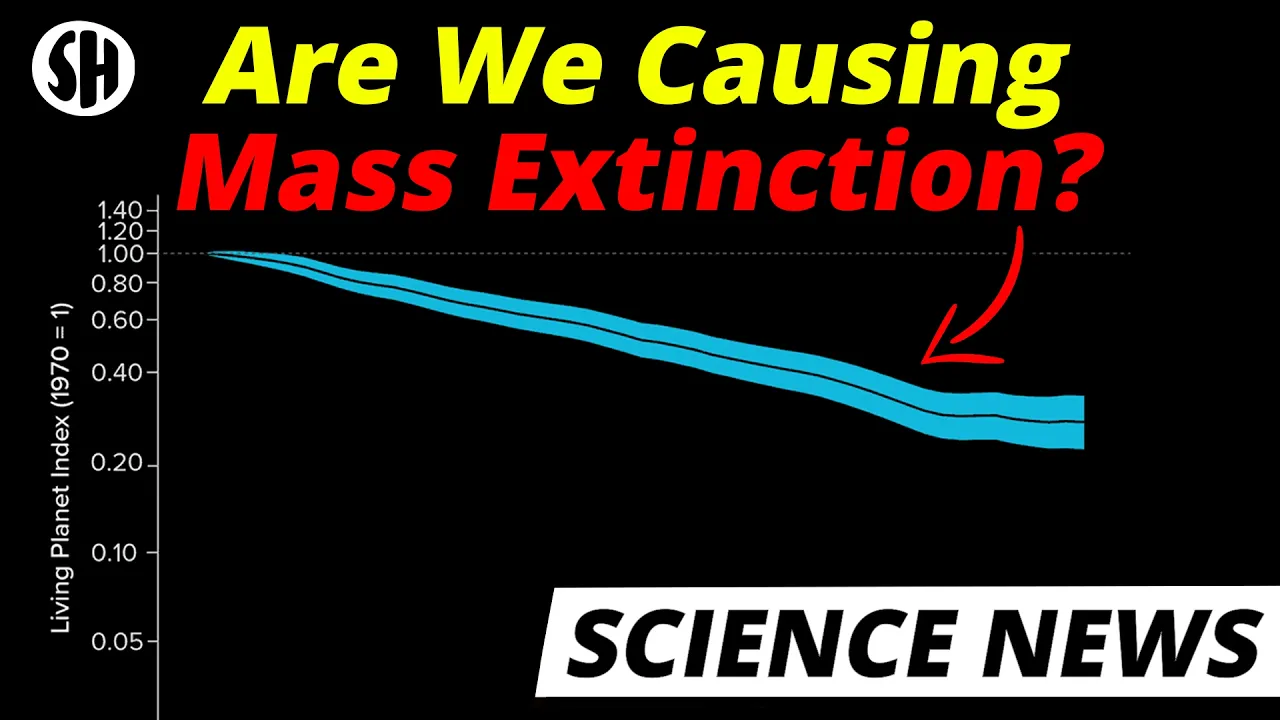
What this shows is increasing rates of extinction of other species.
I think many scholars would argue that this is one of the most important measures because biodiversity is a measure of resilience of the biosphere as a whole. Declining biodiversity is a dangerous sign for the workings of the biosphere.
This terrifies me. I have this nightmare sometimes that I'm waking up at the controls of an Airbus 380 and someone says, "Captain, are you ready to land at LAX?"
I go, "Aarrghh."
I don't know what these dials mean.
Am I supposed to press a button? Am I supposed to pull a lever?
I sometimes feel that we're in a position like that.
We collectively have created this colossal machine.
I'm not sure that we know how to land it.
This is the problem.
There are many warning signs and scholars looking at the Anthropocene are very much aware of them.
Here's one of the accounts of this that's much easier for someone like me to understand.
The Stockholm Resilience Centre has charted, has tried to document nine planetary boundaries that we must not cross or we cross with utter peril.
The terrifying thing is they argue that we've already crossed two.
This is declining biodiversity and this is biogeochemical flows including the nitrogen flow that I just talked about that has a lot to do with fertilisers.
We're in the danger zone, the yellow zone for two more here.
Land system change and climate change.
This is already looking a bit scary.
Let me just talk briefly about biodiversity.
I think as a non-scientist, it's actually very simple, if we gobble up more and more resources, there are less available for other species. If we take more land, more energy, more food, there's less available for other species.
Our close relatives, the chimps, are very close to extinction.
Here's a Larson cartoon which I love but it's very, very sad indeed.
I hope you can see what's going on here.
This is Noah in committee discussing the consequences of the death of the last unicorn and trying to take some decisions about what to do about that and his decision is to move the carnivores away from the herbivores.
Not really a realistic option.
This graph I couldn't resist putting up here because it scares the hell out of me. It really shocked me when I first saw it.
This is Vaclav Smil and his estimates of biomass of land mammals.
Over here we have wild land animals.
Here, we have domesticated land animals and here, we have humans.
The blue bar is 1900.
The red bar is 2000.
You can see most mammals consist of domesticated land animals.
I haven't figured out the ratio here but ratio of wild land animals to domesticated land animals is very significant indeed.
We humans a century ago had about the same biomass as wild land animals.
Now, probably four or five times as much, taking over the planet.
There are also tipping points here.
That's the other scary thing about this research.
Potentially dangerous positive feedback cycles.
For example, glaciers reflect heat.
If they vanish, the Earth's surface will darken.
The Earth will absorb more heat that will speed up the process of global warming, accelerate the rate of ice melting and raising sea levels.
There are many of these possible tipping points.
We don't really know how dangerous they are but it's not hard to see the possibility of these tipping points.
For me, this became personal when I went walking in the Mer De Glace in the Mont Blanc Massif in 2010 with a friend Craig Benjamin.
These are pictures that I took of the Mer De Glace.
Here's Craig showing a sign saying where the Mer De Glace was in 1990 and we need personal test of this.
This brought it home to me very vividly.
There's one more thing which we often lose sight of.
Nuclear weapons.
There are over a thousand nuclear weapons on hair-trigger alert still today.
We have the power to ruin the biosphere in just a few hours if we're foolish enough to use those weapons.
J. R. Oppenheimer when he watched the first test at the Trinity Test Site in July 1945 was reminded of the words of Vishnu from the Baghavad Gita.
"Now, I am become death, the destroyer of worlds."
This is the Anthropocene today.
You're going to hear a lot more in detail later on during this conference.
Now, let me pan back and look at all these changes in the context of human history.
One of the advantage of doing this is that we may come up with a sort of explanation for the phenomena associated with the Anthropocene.
What makes humans so astonishingly powerful?
There are many different answers to this deep question, what makes humans different but most of them, if you imagine a lot of Venn Diagrams, would overlap on the idea of accumulating information.
We're very good at accumulating information across generations.
Information is power.
Living organisms use information to control their environments, to control energy flows, the energy flows they need to maintain their structures.
Humans seem to have broken through information limits that have been in place for four billion years.
Let me explain what I mean.
I've been arguing for many years what makes us different is what I call collective learning. Many species learn.
We learn collectively and that makes all the difference.
Many animals communicate but they communicate inefficiently.
Think of chimps. The result of that is that information leaks away as far as it comes into a community.
There's no long-term accumulation.
Now, we can be pretty sure of this because if there was, if chimp technologies were getting more powerful generation by generation, we would see evidence of that and we don't.
Humans seem to have broken through a threshold in communicative efficiency. Our language has more bandwidth and more precision so we can exchange ideas more efficiently using human language.
The result is that the flow of ideas is now powerful enough that ideas begin to accumulate across generations and they accumulate faster and faster because some of the new ideas tell you how to accumulate more ideas.
I'm thinking of the internet or printing for example.
Crossing this linguistic threshold unleashed a new mechanism of change in the biosphere.
More information means more control over energy flows.
Let's track the energy flows in human history.
There was a Paleolithic energy regime.
Now, at first sight, you might think hunters and gatherers are doing what all other organisms do.
They gather stuff in the environment more or less as it is but there's a fundamental difference between human hunting and gathering and that of other species and that's that they do this with increasing precision and the increasing precision is because information about how to manage the environment is growing.
Communities learn how to control things at the edge of their range for example.
There are many ways of demonstrating this but here's one of the most powerful for me.
It's a map of human migrations during the Paleolithic era.
Here's the chimp range. Now, the significant thing here is we have no evidence that that's changed over several million years.
Not change significantly.
Here's where humans appear somewhere in East Africa.
We're not sure exactly where.
Then what happens during the last hundred years certainly in the lasts 60,000, but this may have started 120,000 years ago is they start spreading into new environments.
Coastal regions, desert regions, tropical regions.
Each of these environments requires new information, new technologies in order to survive.
Then from 60,000 maybe earlier, some of them begin to leave Africa.
Some of them enter Australia.
That requires navigational technologies to get across the water and you have to learn how to live with entirely new plants and animals.
Some live in Ice Age Siberia. Now, again, think of the technologies you need to survive in Ice Age Siberia.
What we're observing during the Paleolithic is a slow, collective accumulation of new information on the part of our species.
By the end of the Paleolithic, collectively humans control much more of the resources flowing through the biosphere.
Each community may still be living close to subsistence but as a species, we're controlling a lot more of the energy flowing through the biosphere. Then at the end of Ice Age, agriculture.
I've argued that this is a threshold in the Big History story.
A new energy regime.
How does agriculture work?
From the Big History perspective, agriculture looks not just like farming.
It looks like an energy grab by single species. Here's how it works.
Let's go back to the fusion in the sun, generates energy, pours into space, plants collect that energy by photosynthesis, and then what farmers do is they manipulate their environment so as to increase the production of those plants they can use such as rice or wheat or goats or sheep and reduce the production of those they can't use.
The end result of this is humans get more of the food energy flowing through the biosphere.
That's what I mean by saying this is energy grab by one species.
Humans have more energy. More energy means larger populations.
You get villages. You get towns. You get cities. You get civilisations.
You get states and empires.
You get more people.
That means more collective learning.
This process accelerates of learning how to control the environment.
All the things that historians get excited about seem to be driven, in my view, by this process of collective learning.
But there's a limit to these energy flows gathered by agriculture.
Agrarian societies managed recent photosynthesis.
Let's me explain what I mean by that.
Most energy in the agrarian regime came from human and animal labour.
In 1800, John McNeill argues, 70% came from human labour much of the rest from domesticated animals.
The remaining energy comes mostly from wind, water, wood.
Now this is recent photosynthetic energy.
If you burn a piece of wood, you're releasing energy that was captured sometime in the last 50, maybe a hundred years.
This is recent photosynthetic energy.
That sets limits.
Humans and animals need to be feed.
The limit there is probably the amount of arable land.
Wood, the limit is set by forestry.
By the late 18th century, there were growing signs that humans are beginning to push at these limits and the economists knew it.
Now, we often forget this about Adam Smith.
We think of him as the apostle of growth, but in fact, Adam Smith, Malthus, Ricardo, all expected growth to stall for this reason: that energy flows would cease.
This is what Adam Smith said: "In a country fully peopled, "the competition for employment would necessarily "be so great as to reduce the wages of "labour to what was barely sufficient "to keep up the number of labourers, and the country already being fully peopled, the number could never be augmented."
He expected growth to stall.
By Adam Smith's time, as Al Crosby writes, "Humanity had hit a ceiling in the utilisation of sun energy."
Population growth, growth in general ought to have stopped at this point.
Then fossil fuels kick in. This is a second energy bonanza.
If agriculture was one energy bonanza, this is a second one and it's what drives the Anthropocene.
Fossil fuels represent energy accumulated not over 50 years but over 300 million years.
This is a staggering store of energy that begins to be used by humans from the late 18th century.
E.A. Wrigley writes, "An industrial revolution is physically impossible "without access to energy on a scale which does not exist and cannot be secured in organic economies."
It makes sense to think of the Anthropocene as a sort of gold strike, the energetic equivalent of gold strike.
Think of today's world as a gold rush town. There's all the craziness that that implies, the sudden wealth, the sudden impoverishment, the chaos, the uncertainty about where things are going.
Here's a graph showing this increase in energy. The crucial thing here is this is energy under the agrarian energy regime.
Can you imagine the Anthropocene without all of that?
I don't think so. Fossil fuels in this sense are clearly the foundation of the Anthropocene.
Here, by the way is 1950. This is the Great Acceleration measured in terms of energy flows.
That's one way of thinking about what lies behind the Anthropocene this process of collective learning, a species that gets more and more powerful at controlling its environment.
Looking at this in the context of human history suggests one more idea.
It's a very naive and simple one but it's quite helpful for thinking about the politics of the Anthropocene. I believe it's helpful to think about a good and a bad Anthropocene. Let me explain what I mean.
The good Anthropocene simply tells us that this energy bonanza has improved billions of human lives in all sorts of ways.
That's the good Anthropocene.
We belong, all of us, everyone in this room to the sort of global middle class that's benefited from these energy flows.
The bad Anthropocene tells us that the scale of energy flows that support the good Anthropocene are undermining the Goldilocks conditions for the good Anthropocene.
I think it helps to think of these two Anthropocenes.
Let's go back in human history. In the Paleolithic era, how did we use this energy bonanza? What did we do with it? You can partition the energy bonanza and mainly it went into population growth.
There was clearly some investment in new technologies particularly in very difficult environments and we have evidence of some level of luxury goods but most of it went into growing populations.
Now, here's a table I put together from estimate by Vaclav Smil, who's a bit of an Anthropocene sceptic by the way, so these are less extreme than some figures you might see that capture the shape of all of this.
The good Anthropocene. How did humans use the two energy bonanzas?
Well, total and per capita energy both increased. There's the agrarian bonanza and there's per capita energy use in these two eras. Not just total energy use but per capita energy use increased with both these bonanzas. Now, how was that bonanza of energy, of wealth partitioned?
A lot of it went into population growth. You could actually do some sums to estimate the proportion that went into population growth almost certainly well over 50%. A lot of it, the second partition, is what I call the infrastructure of complex societies. Complex societies appear with agriculture.
They have cities. They have roads. They have palaces.
They have temples. They have bureaucracies.
They have armies. That all costs a lot of money.
A lot of that went to build the infrastructure of complex societies.
This is straight out of Eric Chaisson's playbook by the way.
Increase in complexity needs increase in flows of energy.
A third partition is elite wealth.
Very hard to measure that but we know it was there.
We'll soon know that the elites constituted perhaps something like 10% of populations on average. 5 to 15%.
Now, for an ecologist, I think that's a very interesting figure.
This represents a new trophic level.
Humans who extract energy from other humans who extract energy from the environment.
As any ecologist will tell you, the energy gets lost up the food chain.
Perhaps 90% of the energy gets lost at each step so that 10% should make up the elites.
Makes lots of sense on the scale.
The payoff? There seems to be none leftover to fund a general rise in living standards.
Now, that, if I've got it right, tells us something very profound about the agrarian era.
This means that despite our increase in control over energy, there's little evidence of significant increases in living standards or life expectancy for most people over the entire agrarian era.
Despite this energy bonanza, most people continued to live close to subsistence with a slight margin.
I'm sparing you a graph from my own early work where I studied the diets of Russian peasants to convey what living close to subsistence means.
It means 80% of your diet comes from rye and wheat.
It means every year, you suffer a period of semi-starvation.
It means that most of your calorie intake is close to subsistence.
Now, here's the Anthropocene energy bonanza.
What does that fund? It clearly funds population growth.
By the way, I'm taking the size of the largest city.
This is a surrogate for the complexity of civilisation.
It's a very general surrogate. A lot of it goes into the infrastructure of modern society, the roads, the cities, the planes. You name it.
A lot goes into elite wealth but the critical difference is there's enough left over to fund the general increase in per capita living standards and life expectancy.
Per capita energy use almost quadruples even on Vaclav Smil's figures. All these would make the increase look more significant.
One of the most significant things of all for me is life expectancy, how long we humans can live.
Average life expectancy doubled more or less in my lifetime.
That's the good Anthropocene. It's a measure of the good Anthropocene.
There was enough energy to raise general material living standards as a result of the energy boom of the Anthropocene and that generated many new possibilities.
There's a wonderful book, at least I'm a great fan of it, not everyone is, by Steven Pinker called The Better Angels of our Nature.
It's a very rich an quite complex book but the payoff to the book as I understand it is that this level of material abundance meant that we were no longer in a world with so many zero-sum games.
We were no longer in a world in which most people's wealth meant someone else's poverty or starvation.
We're in a world where it was possible for a lot of people to enjoy more abundant life phase and that meant less violence.
He argues that levels of interpersonal violence have declined.
Slightly counterintuitive argument but his argument is very persuasive.
There may even be a link between fossil fuels and the end of slavery.
For many thousands of years, slavery was regarded as a normal way of mobilising energy.
Animals and other humans were regarded as energy batteries or stores.
With fossil fuels, you have a more efficient way of mobilising energy; you don't need slavery.
Is it a coincidence that the Anthropocene coincides with the official end of slavery?
Now, I know that the actual number of slaves today is probably larger than it was 500 years ago, but relatively speaking, it's much smaller.
The crucial thing is that slavery ceased to be an acceptable way of mobilising energy.
That's the good Anthropocene. The bad Anthropocene, the same energy flows undermining the Goldilocks conditions for the good Anthropocene.
Here's the challenge.
Who said "We must have continued economic growth in order to generate the wealth required to pay for the protection of the environment but it must be growth which does not plunder the planet today and leave our children to deal with the consequences tomorrow"?
Does anyone know who said that?
I think you'll be surprised when I tell you who.
It was Maggie Thatcher.
Maggie Thatcher was after all a scientist.
She understood the science behind climate change.
OK. Scale 3. The Anthropocene on Planetary Scales. I'm nearly there.
If you look at the story on planetary scales, we're talking about 4.567 billion years, what stands out is how strange the story is.
Here are the normal biological rules: A species evolves with a particular way of controlling energy.
If populations expand and contract depending on the energy they can mobilise, then the species goes extinct or evolves into something else.
Generating this population graph, it appears its numbers rise, it fills its niche, its populations fluctuate then somewhere over there, it goes extinct.
Those were the normal rules for 4 billion years.
Now look at this graph. This is a human population graph.
I hope it's obvious that the rules look very different here. Here are the species that keeps crashing through these sort of barriers.
This is the first species in four billion years that accumulates information across generations so it learns to exploit more and more flows of energy and resources.
Now, if I've got that right, that means that's the justification for saying that the moment we live in now is significant on a scale of four billion years.
Something new is happening on the surface of this planet.
We're the first species to control significantly more energy than is needed for survival.
By some estimates, we control a hundred times what each of us needs for survival.
Buckminster Fuller preferred to use the metaphor of energy slaves.
Each of us has a hundred energy slaves.
That's utterly new in the history of the biosphere.
On Paleontological time scales, this is an explosive and sudden change like major extinction events.
On the 14-year time scale, the Anthropocene has been around for two seconds.
The energy that's driving the Anthropocene was accumulated over 3.5 months beginning with the carboniferous period and ending today.
We're expending that accumulation of energy in just a century or two.
That's what's going on now. An alien paleontologist studying this planet, imagine alien researchers are sending ships to study it, we'd see after 4 billion years, a planet lights up.
Something happens very suddenly.
The Anthropocene is strange on scales of four billion years.
Now, finally, on cosmological scales, is the Anthropocene significant on cosmological scales?
Well, at present, we know of nothing as complex as the Anthropocene except on planet Earth.
They may be more complex things. We don't know of them.
If more complex worlds exist, the question is why haven't we detected them?
That's Fermi's famous question.
Where are they?
Is the Anthropocene unique?
Is it an event that's happened only on one planet in the history of the universe or is it possible there have been other Anthropocenes?
Here's a sort of SETI perspective. This is just a thought experiment.
Does the universe contain other humanoids? Now I'm going to suggest that we define humanoid as species capable of collective learning.
I think that anchors the idea of humanoids quite precisely, and I've defined collective learning.
The odds that life is widespread are increasing.
We've detected so many new planetary systems, I've seen estimates that there may be 17 billion earth-like planets in our galaxy alone.
Some biologists such as Simon Conway-Morris have argued that evolutionary pathways are quite constrained.
In other words, not an infinite number of possibilities if you have a planet in which life evolves for several billion years.
It's not impossible that evolutionary pathways generates species that are not utterly dissimilar from each other.
They may for example have complex neurological systems to control information.
Have there been many Anthropocenes?
Once a species has crossed the threshold of collective learning, we can predict that they will be an Anthropocene barring strange accidents, asteroid impacts or something like that.
It will become a planet changing species.
That means its history will surely parallel ours.
This is an argument I think historians ought to really love.
When we're teaching history, we're not just teaching human history but teaching something that may have happened many times at a general scale.
In stage one, it will accumulate information and power over energy flows. In stage two, it will have an Anthropocene.
It will become a planet-changing species.
Now the question is: What happens next?
Is it possible that no humanoid species gets past this stage?
Do humanoid species flicker in and out of existence like Galactic fireflies? If so, is this the answer to Fermi's question?
There's a wonderful post World War II science fiction novel called A Canticle for Leibowitz.
I don't know if people know.
It begins in our post-nuclear war era after the Flame Deluge and it's a sort of Dark Age. During the novel, you track over several hundred years and slowly the science is recovered using past manuscripts but they go through a Renaissance, a scientific revolution.
Then they start building nuclear weapons again and they use them.
Here's the world according to that novel.
It's a terrifying vision of the future.
Or is there a stage three?
Could some humanoids have achieved a sustainable relationship with their home biosphere? Could we be among them?
I mean this is the game that is at stake right now.
The challenge is to create a safe operating space for human societies to develop and thrive based on our evolving understanding of the functioning resilience of the Earth system. Collective learning got us here.
Can collective learning get us through the challenge posed by the Anthropocene?
Now, if the story I've told is right, in a world of rapidly increasing complexity, sustainability will mean shifting from chainsaw techniques to the surgeon's scalpel, to much more delicate and subtle techniques for managing our relationship to the biosphere.
We'll need collective agreement on delicate technologies, delicate politics, delicate economics, delicate ethics.
That's what we're going to need if we're going to make this transition.
Why does it matter? This is my son Joshua. That's his son, Daniel.
This is my granddaughter Evie Rose who's nine months old.
If we get it right, they live well.
They benefit from the good Anthropocene.
If we get it wrong, we risk ruining their lives and the lives of their friends and their children.
That's why this colossal planetary gamble really matters.
I thank you for your attention. (APPLAUSE) You've been very patient. I've gone much longer than I intended. I think there's about five minutes so I could take one or two questions.
I think there is a roving mic if anyone does have a question.
There's a question over here.
I wish I thought I had some intelligent thoughts on that.
I've been reading Nick Bostrom's book "Superintelligence" which scared the hell out of me, I have to say.
Because his vision as I understand it is of the machines which at the moment are very docile, very polite, they do what we want.
Suddenly, just like that, taking over and turning us into cattle.
That's his vision as I understand it.
Nick Bostrom is clever enough and sophisticated enough to make that vision seem one that we need to take very seriously.
If it's true, and if I could momentarily put aside the fact that I'm a human being and I care about the fate of human beings, then I suppose I could say that this is in the logic of collective learning that this process of collective learning turns out to be gone with a squishy species like us, but eventually to have really taken off inside metals and silicon and things like that.
I wish I could say something more intelligent.
I don't know if that solves the problem of the Fermi paradox because I can see no reason why a machine civilisation shouldn't also be quite feasible.
I believe there are going to be one or two people later on talking about these issues more seriously than I can.
That is such a subtle question. I'm not sure I could... It's a chainsaw answer. It's important to distinguish when we talk about collective, it doesn't of course mean that every individual has agency here.
It means that something we as a species have created.
Now, individual members of our species will experience much of the products of that as coercives.
I talked about slavery. I've talked about this new trophic level.
Well, that new trophic level, some of the machinery of civilisation of course involve fiscal mechanisms and armies and police and tax collectors, all that so yes.
The word collective, I'm not implying a fuzzy generalised agreement to all of these processes at all.
That's probably the first thing.
Secondly, the reason for arguing this, this is a thought experiment I do with students.
If you doubt the collective nature of humanity, we're much more collective than chimps.
Chimps were individualists. You look inside your head.
You do a quick census of everything that's inside your head, then you ask yourself, if I'd never talked to another human my entire life, how much of that stuff would be there?
That's a reminder that we humans live in a collective sea of information.
Chimps do not live in that world.
Again, if you look at all of this, the results of this collective accumulation of information, if you look at the results of this on paleontological time scales over a hundred million years say.
Jan Zalasiewicz has written a wonderful book looking back on the Anthropocene from a hundred years in the future.
If you look at this on that time scale, it's an explosion.
As a historian, of course we see slow, subtle, complex processes.
It's an explosion. Something happened very, very suddenly indeed.
There has to be a new mechanism of some kind.
I think it's the shift from genetic learning which is what natural selection is all about to cultural learning because cultural learning is just orders of magnitude faster in its impact.
All of these mechanisms for deliberate manipulation by one group of humans of other humans are products of collective learning.
The advertisers are beneficiaries of collective learning.
Chimps don't do advertising. That's why I would say collective learning is a larger process within it. Yes.
Lots of coercive, exploitative things go on but nevertheless, all the technologies, the political technologies as well as the technological technologies as it were I think we can only explain as the product of the slow incremental process of accumulating information over thousands of years.
Look, I feel I've taken up far too much of your time already.
We have so many other speakers that we need to listen from so I'm going to stop there but I'll be here all three days of the conference.
Would love to pursue any of these conversations further.
Up Next

Family Myths and the History of Marriage: Stephanie Coontz
@uchannel4592
85.9K views•2010-09-29

The Great Schism of 1054: Causes and Consequences
@SacredCathedrals
113.5K views•2026-02-19
The Geopolitics of the Ukraine War and the Rise of Global Autocracy
@JordanHarbingerShow
468K views•2025-04-19
Understanding the Cold War: Superpower Conflicts and the Road to Détente
@OverSimplified
46.1M views•2019-01-24
Related Study Plans & Knowledge Roadmaps
Structured learning paths in History