





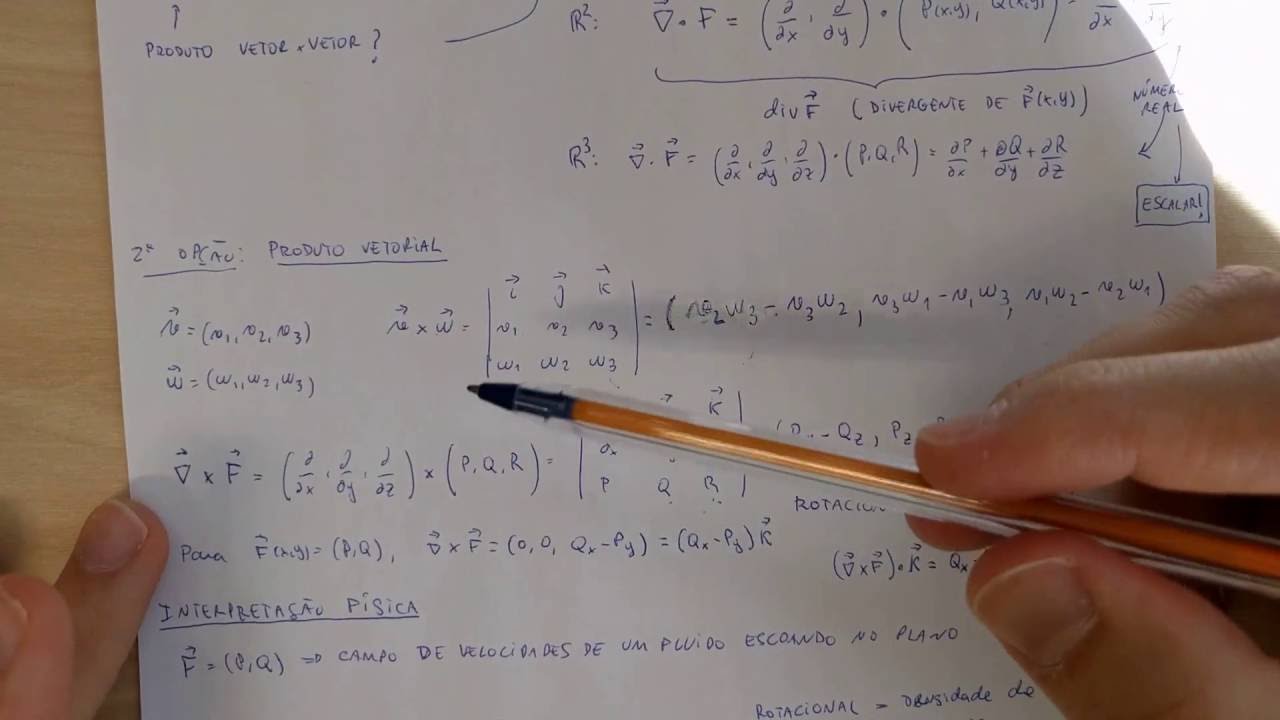


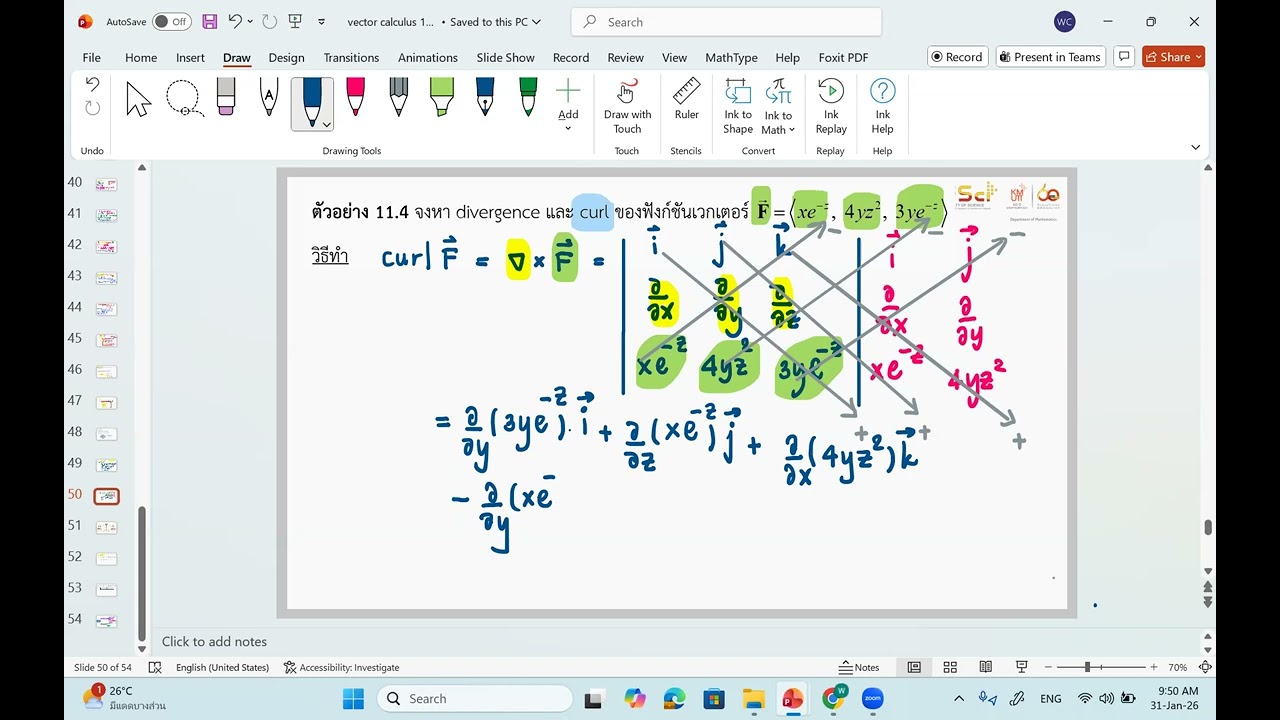


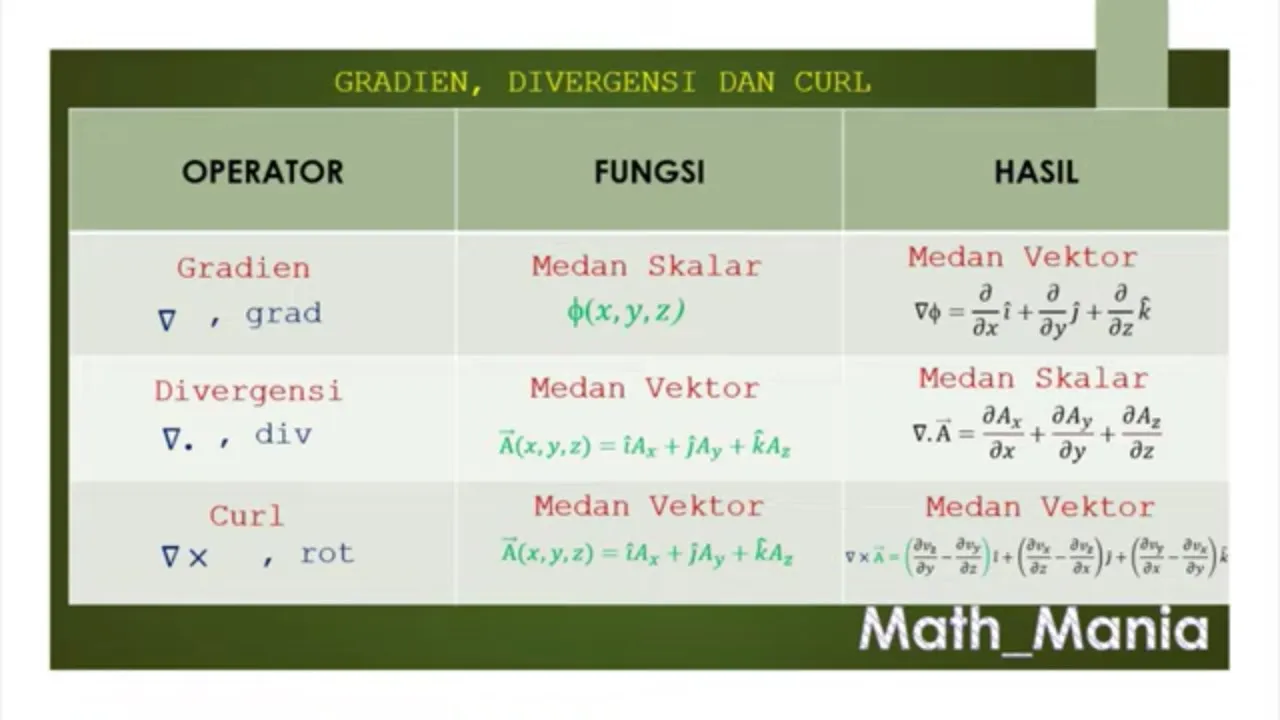








Divergence measures the net rate at which particles are generated or absorbed at a point in space, calculated by examining the net flow of arrows perpendicular to the surface surrounding a volume; Curl measures the rotational tendency or swirling of particles around a point, calculated by examining the tangential flow of arrows along loops surrounding a surface, with both concepts being fundamental operations in vector calculus used to describe how vector fields behave in space.
Divergence and Curl Explained: Visual Vector Field Guide
Added:Basic vector algebra, including vector addition, scalar multiplication, and the physical interpretation of vectors in 2D and 3D space.
The concept of multi-variable functions and partial derivatives, as divergence and curl are defined using spatial derivatives of vector components.
An introductory understanding of vector fields, specifically how a vector is assigned to every point in a given region of space.
The Del (nabla) operator and the mathematical definitions of the dot product and cross product, which form the algebraic basis for divergence and curl calculations.
The Divergence Theorem (Gauss's Theorem) and Stokes' Theorem, which relate volume and surface integrals to divergence and curl.
Maxwell's Equations in electromagnetism, which describe how electric and magnetic fields propagate and interact using divergence and curl.
Fluid dynamics applications, such as using divergence to model fluid compressibility (sources and sinks) and curl to analyze vorticity and turbulence.
The study of conservative vector fields, scalar potentials, and determining path independence in line integrals.
459.8K views10.2Klikes25:33Original Release: 2015-12-07
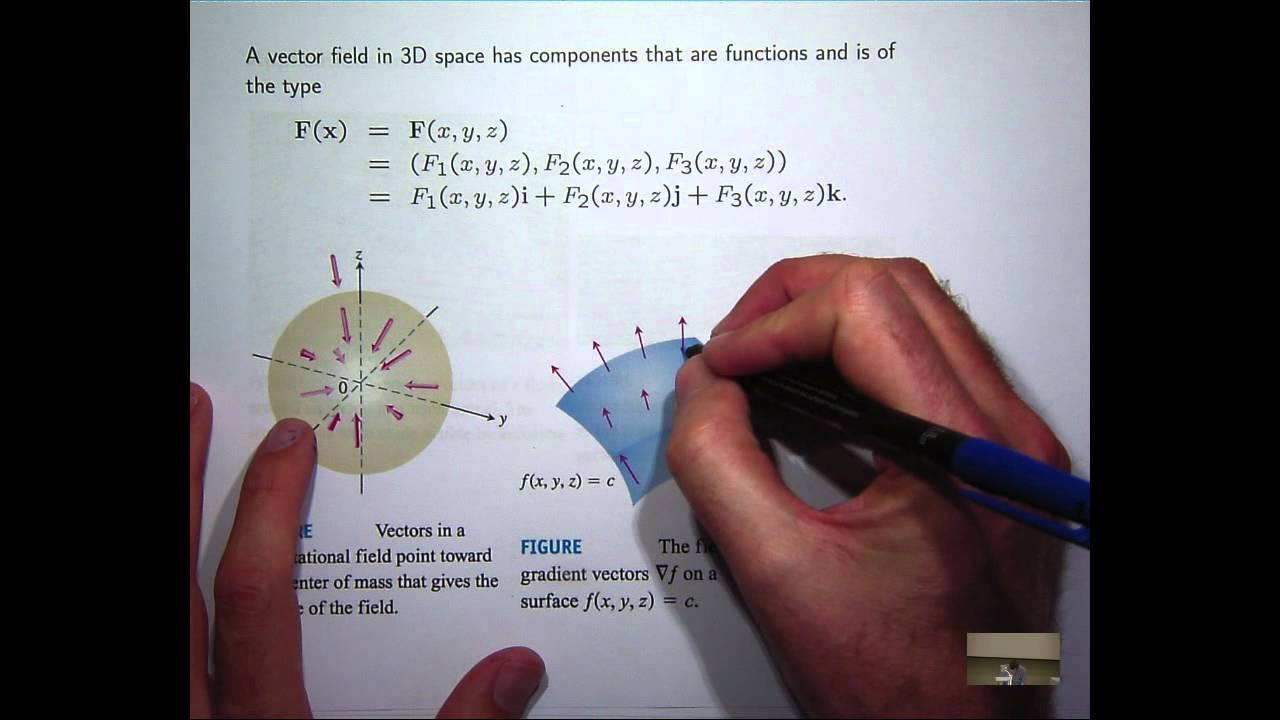
Imagine that we have particles moving throughout all of space.
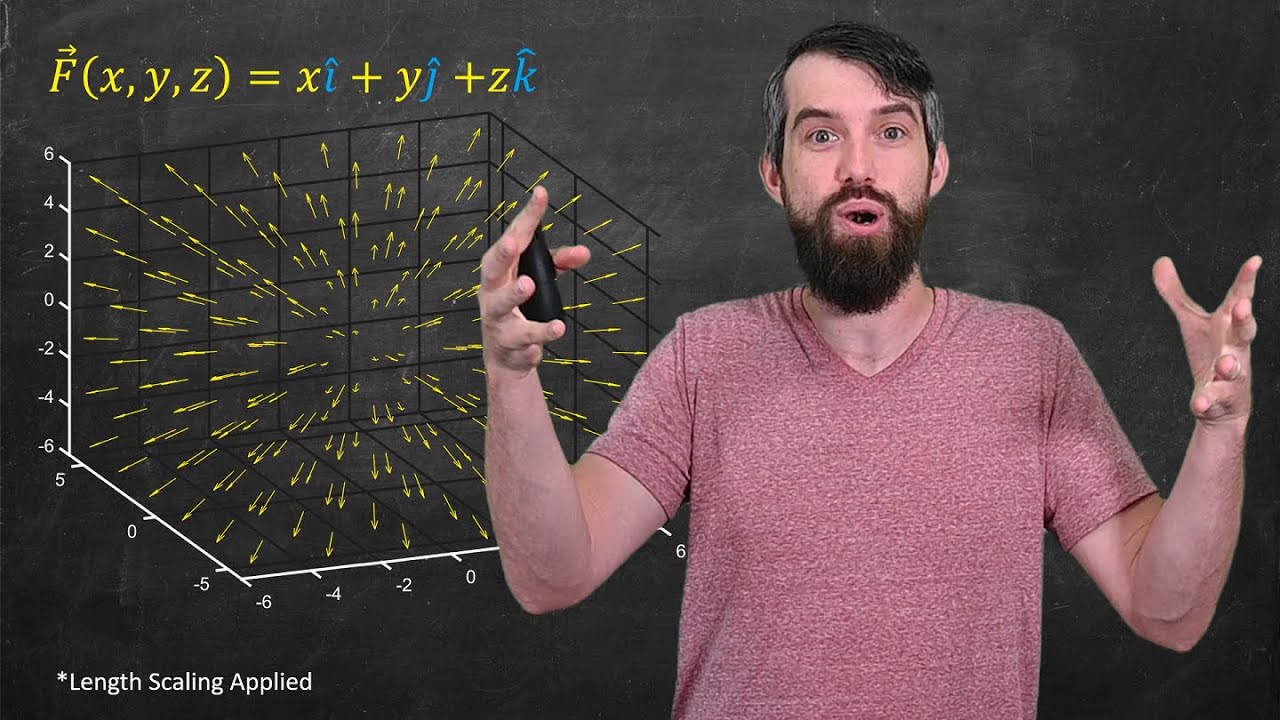
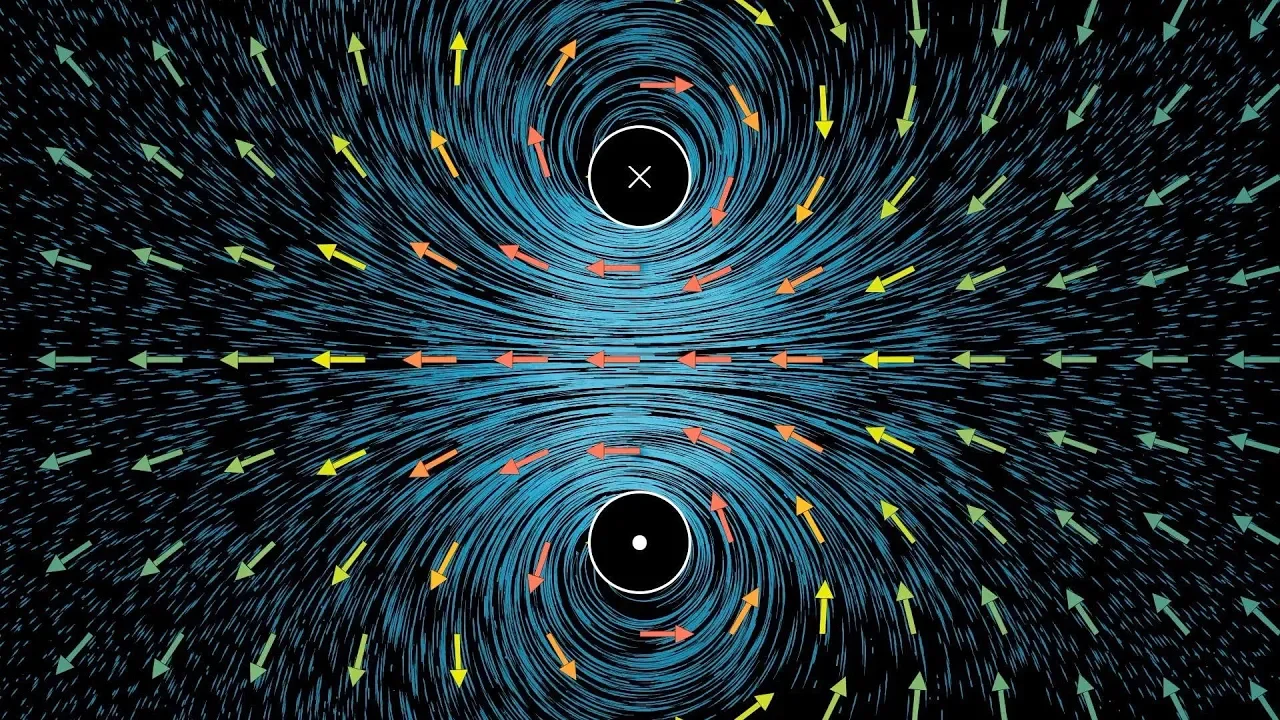
At each point in space, this can be represented by an arrow pointed in the direction of motion.
The length of the arrow represents the amount of motion.
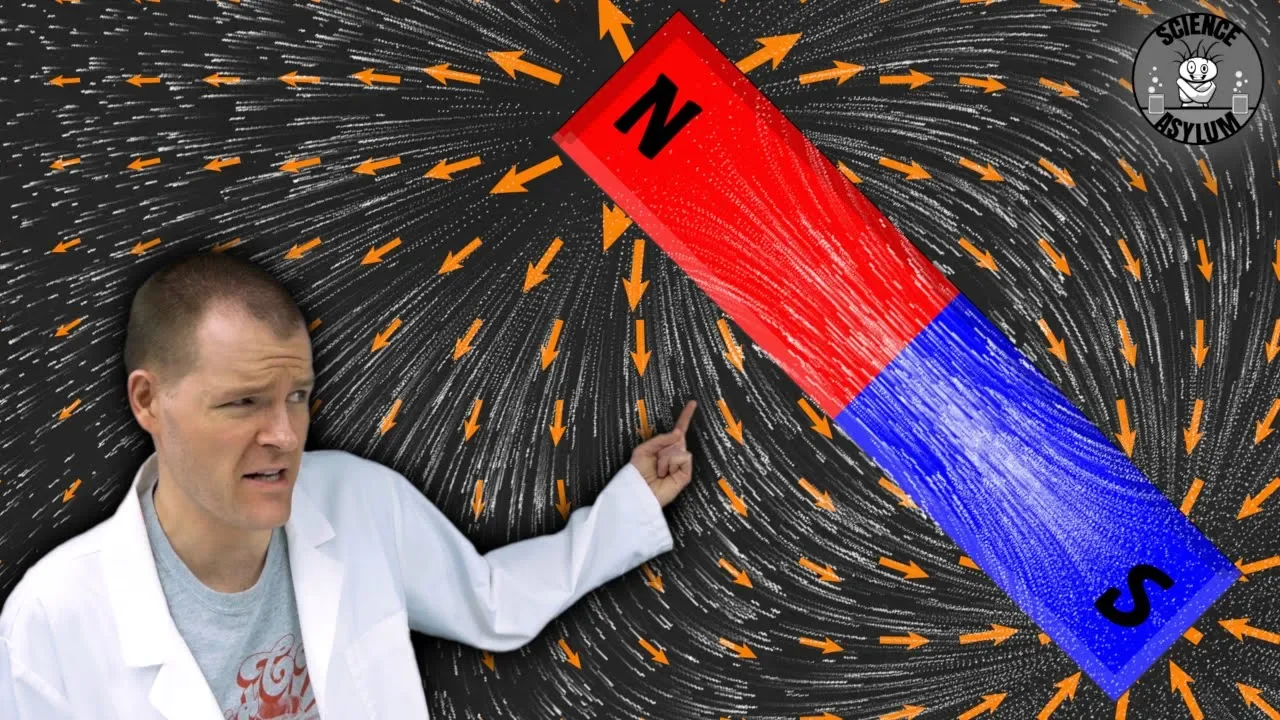
At any given moment in time, all the arrows that are located throughout all of space can be referred to as a “vector field.” A vector field does not necessarily have to represent the motion of particles.
The arrows could instead, for example, indicate the strength of a magnetic or electric field at every point in space.
But, for the purpose of visualizing the mathematics, let us think of all these arrows as representing the motion of imaginary particles.
These imaginary particles do not necessarily have to obey the laws of physics.
They can appear or disappear into thin air.
And they can suddenly change direction.
At every region of space, there are two very important questions we need to answer.
The first question is whether the particles are just passing through the region of space, Or if the region of space is generating particles, Or if the region of space is absorbing particles.
The second question we need to answer is whether the particles are swirling around this region of space, like in the case of a hurricane or a tornado.
Both of these questions can be answered by examining the arrows.
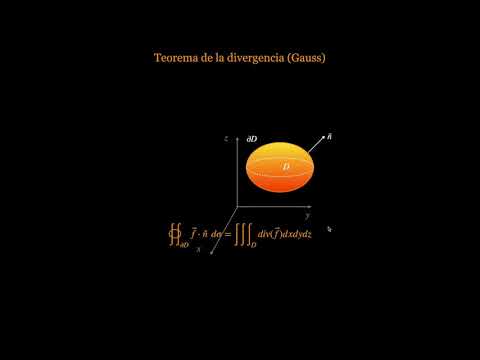
Suppose we have a volume of space.
This volume can be any shape or size.
This volume is surrounded by an imaginary surface.
Although the arrows exist throughout all of space, let’s just look at the arrows only on the surface surrounding the volume.
If all the arrows on the surface are pointing into the volume, then this means that from the perspective of the outside world, this region of space is absorbing particles.
If all of the arrows on the surface are pointing out of the volume, then this means that from the perspective of the outside world, this region of space is generating particles.
If the particles are just passing through this region of space, then some of the arrows will be pointing into the volume, and some of the arrows will be pointing out of the volume.
But, what is happening from the perspective of the outside world does not necessarily reflect what is happening inside the volume.
For example, there might be a region of space inside the volume that is generating particles… And another region of space inside this same volume that is absorbing particles.
In this case, the volume as a whole is neither generating nor absorbing particles, since the number of particles entering is still exactly equal to the number of particles that are exiting.
From the perspective of the outside world, particles are just passing through this volume.
In this other case, from the perspective of the outside world, the volume is absorbing particles.
And in this case, from the perspective of the outside world, the volume is generating particles.
We can determine which of these three cases we have by examining the arrows on the surface of the volume.
Suppose we take all the arrows on the surface, and we add the lengths of these arrows together.
If the sum of the lengths of all the arrows that are pointing into the volume is equal to the sum of the lengths of all the arrows that are pointing out of the volume, then from the perspective of the outside world, this region of space is neither generating nor absorbing particles.
If the sum of the lengths of all the arrows that are pointing into the volume is greater than the sum of the lengths of all the arrows that are pointing out of the volume, then from the perspective of the outside world, this region of space is absorbing particles.
If the sum of the lengths of all the arrows that are pointing out of the volume is greater than the sum of the lengths of all the arrows that are pointing into volume, then from the perspective of the outside world, this region of space is generating particles.
The amount by which the region of space is generating or absorbing particles depends on the difference between the sum of the arrows pointed into the volume, and the sum of the arrows pointed out of the volume.
Arrows that are parallel to the surface don’t count, as these arrows represent particles that are travelling parallel to the surface of the volume, without entering or exiting.
If an arrow is passing through the surface of the volume at an angle, then it can be thought of as the combination of an arrow that is perpendicular to the surface, and an arrow that is parallel to the surface.
It is only the portion of the arrow that is perpendicular to the surface that counts in the sum of arrow lengths.
Suppose we subdivide a volume into a set of smaller volumes.
From the perspective of the outside world, each of these smaller volumes is either generating particles, absorbing particles, or just allowing particles to pass through.
For each of the smaller volumes that are absorbing particles, we can refer to this by saying that it is generating a negative rate of particles.
If we add together the rate at which each of the smaller volumes is generating particles, then the sum will be exactly equal to the rate at which the large volume as a whole is generating particles.
For example, in this case, only one of the smaller volumes is generating particles, and all the other smaller volumes are just allowing the particles to pass through.
Therefore, the rate at which particles are generated by the large volume as a whole is exactly equal to the rate at which particles are being generating by this one smaller volume.
If two of the smaller volumes are generating particles, then the rate at which the larger volume as a whole is generating particles is equal to the sum of the rates of these two smaller volumes.
On the other hand, if one of the smaller volumes is absorbing particles, then we say that it is generating a negative rate of particles, and this therefore reduces the total rate of particles being generated by the large volume as a whole.
If there are more particles being absorbed than generated, then this means that the large volume as a whole is absorbing particles, and we can refer to this by saying that it is generating a negative rate of particles.
At each point in space, the rate at which particles are being generated per unit volume is what we refer to as the “divergence” of the vector field at this point in space.
If the vector field that describes the motion of the particles is symbolized by the letter “F”, then the divergence of this vector field at each point in space is signified by the following.
If we have a volume of any shape or size, then the divergence of all the points inside the volume is what determines the rate at which the volume as a whole is generating or absorbing particles.
Now let us focus on the other question.
Are the particles swirling around a region of space?
When we answered the previous question about particles being absorbed or generated, we had a three dimensional volume that could be any shape or size, and we cared only about the arrows on the surface surrounding the volume.
And we cared only about the portion of each arrow that was perpendicular to the surface of the volume.
When answering question about the particles swirling, instead of using a volume, we now use a two dimensional surface that can be any shape or size.
This surface is surrounded by a loop.
We care only about the arrows that are on the loop.
And we only care about the portion of each arrow that is parallel to the loops path.
This is because if a particle is moving perpendicular to the loops path, then this means that it is not swirling around the loop, and its arrow doesn’t count.
If we add the lengths of all the arrows around this loop together, their sum indicates how much the particles are swirling around the loop.
Now suppose we have this situation.
Here the particles are not swirling at all.
Suppose we have a point that travels around the loop.
Some of the arrows on the loop will be pointing in the same direction that the point is traveling, and some of the arrows will be pointing in the opposite direction that the point is travelling.
These two types of arrows cancel each other out when the sums of the arrow lengths are added together.
Therefore, in this case, the total sum of arrow lengths around the loop is zero.
In this other situation, the arrows do not cancel out, and we say that the particles are swirling around this loop.
In this other situation, we say that the particles are swirling in the other direction.
Suppose we take the surface inside the loop, and we subdivide it into smaller surfaces.
Each of these smaller surfaces also has a loop.
By adding together the lengths of the arrows around each of these new smaller loops, we can calculate the amount by which the particles are swirling around each of these smaller surfaces.
If we add together the amount by which the particles are swirling around each of these smaller surfaces, this will give us the amount by which particles are swirling around the larger surface.
This is true regardless of what the particles inside the loop are doing.
Arrows cancel each other out The total swirling of particles around the large loop is always equal to the sum of the swirls of each of the smaller loops.
This is similar to how when we added together the amount of particles generated by each of the smaller volumes, we determined the amount of particles that were generated by the entire larger volume.
Also, just as volumes which are absorbing particles cancel out volumes that are generating particles… Surfaces which have particles swirling around them in opposite directions cancel each other out with regards to calculating the swirl around the entire larger surface.
In this case, the total amount of swirling around the larger surface is zero.
In all cases, regardless of the surface’s shape or size, the rate at which the particles are swirling around it is exactly equal to the sum of the rates at which every region inside the surface has particles swirling around it.
At each point in space, the rate at which particles are swirling around it per unit area is what we refer to as the “curl” of the vector field at this point in space.
At each point in space, the amount of curl can be represented by the length of an arrow that is perpendicular to the surface.
The more the particles are swirling per unit area, the longer the arrow representing the curl.
If the particles are swirling in the other direction, then the arrow representing the curl will be pointed in the opposite direction.
If there is no net swirling around the point, then the arrow representing the curl has zero length.
The surface at this point in space can be oriented in all three dimensions.
Therefore, the curl of this vector field at each point in space can have components in all three dimensions.
Suppose we have three of these surfaces, located in the exact same point in space, all oriented 90 degrees to each other.
Each of these surfaces will have a curl arrow associated with it.
We therefore have a total of three curl arrows at the same point in space, all 90 degrees to one another.
If we add these three arrows together as vectors, then the result is the total curl of the vector field in this region of space.
If the vector field that describes the motion of the particles is symbolized by the letter “F”, then the total curl of this vector field at each point in space is signified by the following.
If we have a surface of any shape or size, then the curl of all the points inside the surface is what determines the rate at which the particles are swirling around the loop surrounding the surface, and in what direction.
This is similar to how the divergence of all the points inside the volume is what determines the rate at which the volume as a whole is generating or absorbing particles.
Here, the vector field “F” was defined by the motion of particles moving through space.
However, it is also possible to have a vector field which does not represent the motion of particles.
Instead, it could just be a bunch of arrows located throughout space, and the definitions given here for divergence and curl would still apply.
This is true, for example, in the case of Maxwell’s Laws of electromagnetism, where the strength and direction of the electric and magnetic field at each point in space are described by a vector field.
The divergence and curl of these two vector fields throughout all of space is what allows us to mathematically describe the way in which electric and magnetic fields relate to each other.
Up Next

15:36
Vector Fields, Divergence, and Curl | Calculus Tutorial
@ProfessorDaveExplains
288.7K views•2019-09-18

4:43
Elliptic Curve Cryptography Explained: ECC, ECDSA, ECDH
@PracticalNetworking
28.5K views•2024-10-21
10:44
Fourier Series Introduction: The Big Idea Explained
@DrTrefor
387K views•2021-05-03
6:00
The Mathematical Impossibility of Accurate World Maps
@Vox
23.3M views•2016-12-02
Related Study Plans & Knowledge Roadmaps
Structured learning paths in Mathematics
mathematics
Tensor Calculus: Vectors to Riemann Curvature
01Mathematical Foundations: Linear Algebra & Calculus
02Covectors, Dual Spaces, and Tensor Basics
03The Metric Tensor and Index Gymnastics
+ 2 more learning modules
40h5 modules
Explore Roadmap
mathematics
Gödel's Incompleteness: Logic, Proofs & Limits
01Introduction to Formal Systems & Hilbert's Dream
02Set Theory, Cardinality, and Cantor's Diagonal Argument
03Arithmetization and Gödel Numbering
+ 2 more learning modules
14h5 modules
Explore Roadmap
mathematics
Galois Theory: Fields, Groups & Solvability
01Foundations of Abstract Algebra: Groups & Fields
02Polynomials & Field Extensions
03Splitting Fields & Symmetries
+ 2 more learning modules
24h5 modules
Explore Roadmap
mathematics
Non-Euclidean Geometry: Models & Geodesics
01Euclid's Fifth Postulate and the Birth of New Geometries
02Hyperbolic Space and the Poincaré Disk Model
03Geodesics: Defining Straight Lines in Curved Spaces
+ 2 more learning modules
15h5 modules
Explore Roadmap