



















Nanomaterials exhibit unique properties distinct from bulk materials due to their nanoscale dimensions, which arise from the interplay of composition, phases, defect structures, and residual stresses across multiple length scales; understanding these factors is essential for designing nanomaterials with specific properties for technological applications.
Introduction to Nanomaterials: Characterization and Properties
Added:Basic concepts of materials science, including crystal structures, Bravais lattices, and unit cells.
Fundamentals of thermodynamics, specifically phases, phase diagrams, and Gibbs free energy.
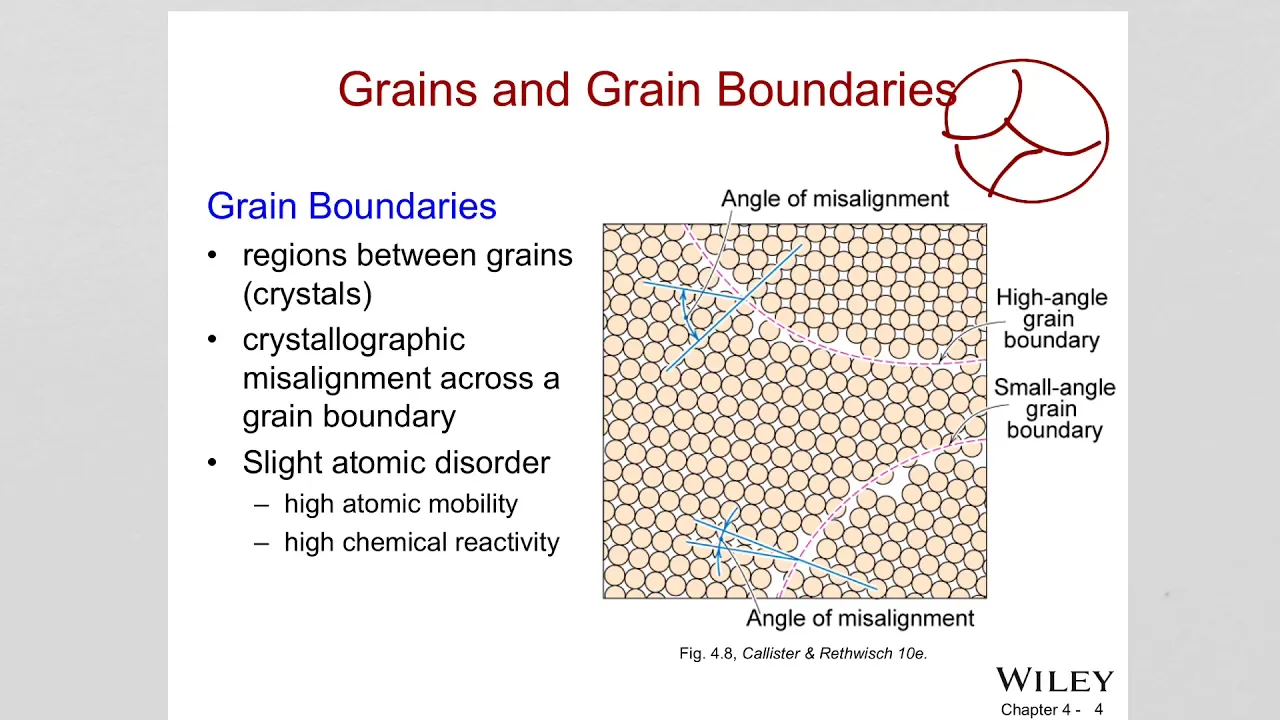
An understanding of microstructure, including grains, grain boundaries, and crystal defects (such as dislocations and vacancies).
The physical concept of surface area-to-volume ratio and how surface energy influences material behavior.
Advanced nanomaterial characterization techniques, such as Transmission Electron Microscopy (TEM), Scanning Electron Microscopy (SEM), and X-ray Diffraction (XRD).
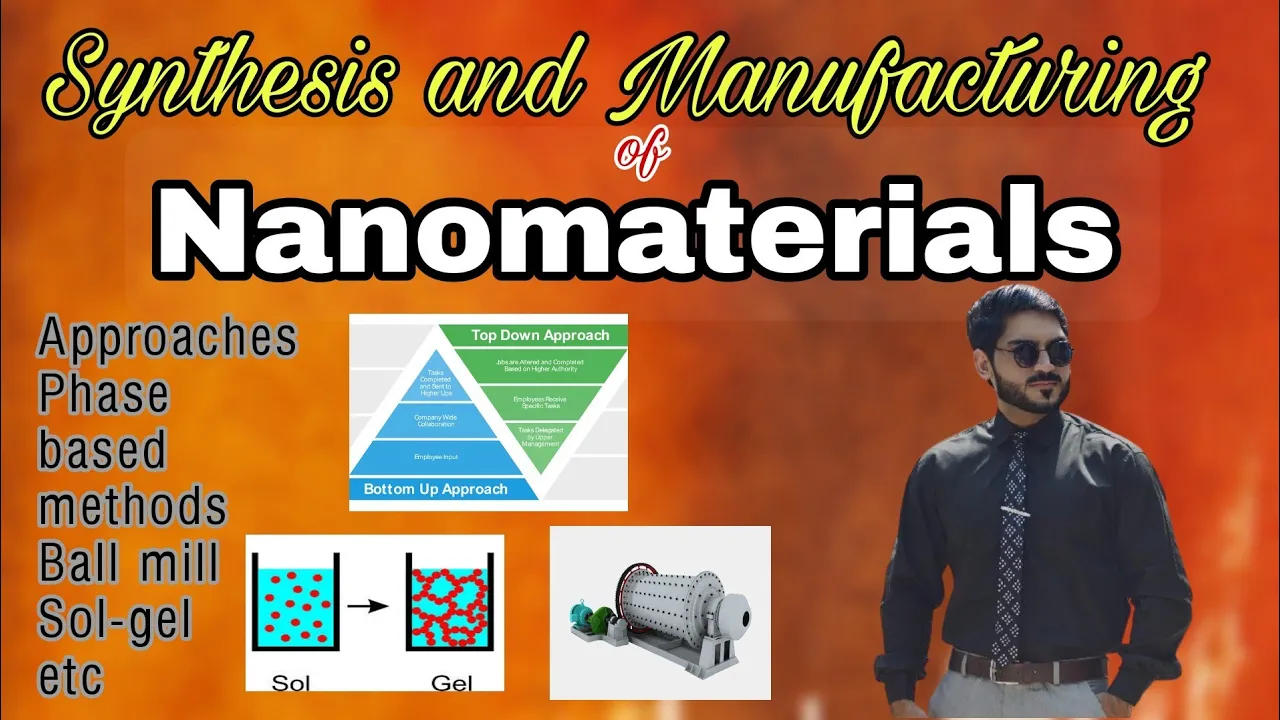
Synthesis methodologies for nanomaterials, detailing bottom-up (sol-gel, chemical vapor deposition) and top-down (ball milling, lithography) approaches.
The phenomenon of quantum confinement and its direct impact on the optical, electrical, and magnetic properties of quantum dots and thin films.
Real-world engineering applications of nanomaterials in fields such as nanoelectronics, targeted drug delivery, and high-strength nanocomposites.
121.7K views811likes57:17Original Release: 2014-09-18
[Music] [Music] Good morning. Welcome to the NPEL video lecture on nanoructures and nanomaterials in which we will consider characterization and properties of nanoructures and nanomaterials. My name is Anand Subramanyam and my co-instructor in the course is professor Kantesh Balani. Both of us belong to the department of material science and engineering at IIT Kpur. Our email addresses are Anand atk.ac.in in and k balani at iitatk.ac.in. You may kindly give your feedback on any aspects of the course including any possible improvement to the lectures at these email addresses.
This will help us plan better for the future and also improve upon the content which is currently being recorded.
As you are aware that nanoructures and nanomaterials are a age of the future. There are a lot of interesting research going on currently and therefore the literature has been growing very fast in these areas.
Certain beautiful references and texts are currently available. For example, the encyclopedia of nanoructure nanocience and nanotechnology which is edited by Dr. Haris Singh Nalva which runs into about 10 volumes. There is also the handbook of nanosphase and nanoructured materials which is edited by Wang Leu and Zan. There are other equally interesting and nice accessible texts like the nanomaterials nano technologies and design which is an introduction to engineers and architects the book by Ashb Ferrer and Shek. Some of these books um as you can see are handbooks and therefore they are better for consultation purposes while others are in the textbook format like the first one by professor Ashby. Nevertheless, the literature in the area of nanoructures, nanomaterials and nanotechnology has been growing so fast that often a textbook or a handbook written about 5 to 10 years back gets soon outdated and newer and newer concepts emerge. Therefore, it's very important that students also consult various journals and periodical publications in the area which include lot of new journals which have come up in the last 10 years. So, it's important from a student's perspective not only to consult textbooks and handbooks but also to consult journals because the area of nanoructures, nanomaterials, nanocience and nanotechnology is growing at a extremely tremendously fast rate.
So with and for a simple easy accessible point of view students may consult the first textbook. While in no sense this book can be considered a comprehensive text on all aspects of the subject. Let us first start with some basics. In other words, let us introduce ourselves to nanocience, nanomaterials and nanotechnology in the broadest possible way. And this will involve an understanding of the fundamental concepts. Right from the outset, it needs to be understood that nanomaterials or nanocience or nanotechnology is built on a foundation which is the usual science or the physics or the chemistry or the material science which we normally study. So it is a layer up and above that which we normally study and therefore the fundamentals in these areas need to be strong. Therefore, if I were to draw a sort of schematic, so this will be a foundation of basic science and this foundation would include physics, chemistry, material science, etc. And on this foundation resides the subject which we can call the nanocience or nanotechnology.
Therefore, a student should be aware that whatever the fundamental subject he's devoting his career towards, nanocience is built on that subject. For example, suppose somebody is interested in magnetism. He needs to have his fundamentals in magnetism strong then on that fundamentals he can build up nanomagnetism. Suppose a person is interested in plastic deformation then a student can learn severe plastic deformation techniques which can give rise to nanomaterials. Suppose a person is interested in chemistry then he can go ahead and devise those specific chemical synthesis techniques which can produce various kinds of nanomaterials and nanoructures. Therefore the fundamental subject is important like one might be interested in nanomechanics and then there a person may be interested in mechanics and once the fundamentals in mechanics are strong he can go ahead and learn the subject of nanomechanics. In other words the learning of nanomaterials is absolutely contingent upon learning the fundamentals of the various aspects of usual physics, chemistry, biology and other aspects.
One of the important reasons why we want to study nanocience and nanotechnologies is because it gives us a beautiful new array of properties which are typically not found in normal bulk materials. We will see some of these properties as we go along. But it should be remembered that the origin of these properties should be absolutely clear.
So that when we design our nanomaterial, we can take into account these factors and design a nanomaterial for a given set of properties which is going to be the cornerstone for the technological application of these materials. So let us ask ourselves this question. What determines the properties of materials? This is perhaps the broadest kind of question one can ask. And the properties one could be talking could be mechanical properties like hardness, eel strength, fracture toughness etc. He could also be talking about optical properties. Could be talking about magnetic properties, electrical properties and many other possible properties including biological properties like biocompatibility, toxicity etc. But we will start with a small set here and try to understand what are the factors which determine that what how these properties come about. Okay. The first thing we see that suppose I put in about a few t of ppm of oxygen in copper. This would degrade its conductivity drastically. Therefore, I need to go in for what is called oxygen-free high conductivity copper to make my copper wires which is used for electrical conduction. Therefore, just knowing the composition cannot give me my properties. I need to consider further factors. For instance, it is not enough. I know what are the phases that are present in the material. To give an example, there is a microraph on the right hand side in which there is this perlite which is the alternating lama and this is from a carbon steel and hyper utcttoid and you can see that along the grain boundary region there is a continuous network of a second phase.
This face happens to be cementite which is extremely brittle. But if you look at the overall micro structure as you might see or the microraph you'll see that the volume fraction of the second phase along the grain boundary is small. But nevertheless the presence of this second phase the cement tide face which is an hard but brittle face along the grain boundary severely deteriorates the impact properties of the material or what you might call the impact toughness of the material. Therefore, just knowing the phases present is not enough for me to know their properties. I need to know further information about the propert about the material which will tell me how the properties of the material is going to be. In other words, I need to worry about the composition number one. I need to worry about the phases present number two. But that's not enough. For example, if I have dislocations in a phase, this can weaken a crystal severely. Suppose I take a single crystal and try to absolutely pure defect-free single crystal and I try to measure its sheer strength, it will turn out to be of the order of gigap pascals. But in the presence of dislocations which are crystalraphic defects, the strength of the material can fall by a few orders of magnitude and can severely weaken the crystal. This implies that I need to know the defects in the material present apart from knowing the phases and their distribution. But should I stop here?
Definitely not. And the reason being that we know that normal glass is very brittle and it fractures very easily.
The window pane glass if any ball is thrown on a window pane glass it shatters so easily. But we have another example of a glass which is known as toughened glass. Toughened glass consists of normal glass but in which there is certain certain distribution of residual stresses which especially compressive residual stress on the surface of the glass. This helps to toughen the glass a lot. That means that if I want to understand the properties of a material, I need to know its composition. I needs to know the phases present and their distribution. It's very very important. Not only I know the phases present but also how these phases are distributed within the material. I need to know the defect structure in the material.
um many of these terms like defect structure and the face and distribution.
We will consider a little more detail as we go along. This is just an overview slide where we want to put in a broader picture of what are the factors one needs to worry about when I one one is interested in knowing the properties of a material. So and when you're talking about defect structures I am talking about defects present in the phases like dislocations in the phase and between the phases like for instance interfacial dislocations also apart from the bulk dislocations. Last but not the least, I need to know the residual stress. And as we shall see later that residual stress can have multiple origins. And to understand all these aspects, I not only need to know for instance the phases present in the distribution. I need to know the defect structure and the distribution. I also need to know my residual stress and its distribution.
And in doing so, I would realize that these factors are not independent of one another. They often talk to each other. They talk to each other ac across length scales. To give an example, for instance, suppose you had a coherent precipitate. A coherent precipitate is not only a defect in the perfect single crystal in some sense, but also is associated with residual stresses. Therefore, the precipitate and the residual stress are intricately intermixed in the case of a coherent precipitate. Therefore, there is a lot of interdependency among these factors. And this interdependency often gives rise to the properties which one observes in a material. So let us summarize this slide because this happens to be a important overview slide and this will tell us set the tone that when I have a bulk material visav a nanomaterial or a nanoructure how the properties are going to arise and how the bulk material is going to be different from the nanoructure or the nanomaterial and how I can use the very same concepts which are present in this slide to engineer the nanoructure or nanomaterial to obtain a specific set of properties which are often very unique and this is what is giving the beauty to nanom materials and nanoructures. So I need to understand the composition of the material and of course the composition could be specially varying in the material and therefore the property could be region specific given given the composition I need to understand the phases present in the material and their distribution. We will also ask a question very soon that what do we mean by these phases? what kind of faces exist and what kind of distributions can these faces be present and how this distribution of phases is going to determine the properties. One example of course we have already considered that if you have a second face along a grain boundary which happens to a brittle face then cracks under impact loading can propagate all along the grain boundary and therefore the overall fracture toughness of the material happens to be very low in spite of the fact that the second phase as in the example considered above was just um present in a very small volume fraction. It's a connectivity there along the grain boundary which gave it a poor impact toughness. Additionally, we also have to consider the defect structure of the material which includes defects within the faces, defects at the interfaces and of course the unavoidable defect of the free surface along with how the defects are distributed spatially in the material. And if you're talking about a processing technique or uh or a long hold at high temperatures, how this defect structure evolves in service.
That means you had initial defect structure in the material at the start of the components in service. But as the time progress, it could so happen that the defect structure could evolve with time. So could the phases and the distribution evolve with time. And therefore I need to also worry about the temporal evolution of these what you might call these specially distributed phases and defects. We said last but not least that residual stresses play a very important role in the properties of a material. This is often underestimated.
In fact, residual stresses can play a very positive role like we saw in the case of toughened glass wherein we introduced compressive residual stresses on the surface which give rise to quite a bit of toughening of the glass. But on the other hand, residual stresses can also lead to warpage of the component and therefore can be delirious and we may want to avoid residual stresses in many case. Nevertheless, the presence of this residual stresses which again has to be understood spatially and temporally that means how it is present, how the residual stress is distributed within the material and how it's evolving time is very very important for the properties of the material. Suppose we were talking about the glass and the compressive residual stress. Suppose we put tensile residual stress on the surface then the properties would in fact be worse than that in a material which had compressive residual stress on the surface.
But we will have some more look at these concepts as we go along. Therefore, if one wants to understand properties of a material, then he he or she needs to consider various factors, the composition, the faces and the distribution, the defect structure, the residual stress and in doing so has to traverse across lens scales. He needs to go from as we shall see soon from the atomic lens scale to the length scale of the entire component. And this journey across lens scales has to be integrated into a form which we normally in a more uh common usage called the property of the material which could as we considered could be the ductility. It could be the fracture toughness. It could be the optical transmittance. It could be the magnetic electric polarization. It could or polarizability or it could be the magnetic susceptibility. So there are many very many properties which come about and many of these can be understood by traveling across lens scale and considering these factors. In the previous slide when we talked about properties and especially properties which are dependent upon microructure we were making an implicit assumption regarding the type of properties. This will become clear when I classify the properties into structure sensitive properties and structure insensitive properties. We should note typically in the usual sense when we talk about structure sensitive properties it is usually meant that we are talking about microructure sensitive properties and we are not usually talking about crystal structure or any other kind of structure. Um and therefore we should keep this in mind that properties can be structure sensitive and examples of such properties are yield stress, fracture toughness etc. On the other hand there are properties which are structure insensitive like density, elastic modulus and other kind of properties.
The key word in this definition is the word sensitive. Here we are not using the word dependent but we are using the word sensitive. And that means that there are for instance the presence of point defects in a material would affect the density in a small way. Therefore the density would be dependent on the presence of vacancies in a crystal. But it is not going to be the density is not going to be a sensitive function of the presence of vacancies. On the other hand, the um yield stress of a material could be a sensitive function of the presence of vacancies and therefore we have to worry about properties from the viewpoint if they are structure sensitive or structure insensitive and to once again reiterate when we use the word structure sensitive it is usually meant that we are talking about microructure sensitive properties. Now this classification is very very important because in the previous slide we had seen that the impact toughness of a material having cementite along the grain boundaries is very poor. Now typically this is because impact toughness is a microructure sensitive property. Now suppose I was talking about density then if this face is present along the grain boundary or as globules within the material which I can draw schematically on the board.
Now so the case one is the presence of cementite as a continuous network along the grain boundaries. In the second case, I can think of the same cementite in the same volume fraction present as small globules in the material. So the figure on the left and there is a figure on the right. The volume fraction of cementite it's considered to be equal in both the cases. But suppose I'm talking about a structure insensitive property like density then I would notice that the density of these two phases would be equal. Suppose I'm talking about a structure sensitive property a microructure sensitive property like fracture toughness then they would be different for these two phases.
Therefore, I need to clearly understand that the distribution of phases is going to uh change my micro structure dependent properties but will not change a micro structure independent properties. And as we shall see there are quite a few properties which are micro structure dependent and therefore I need to worry about my faces in the distribution and also my defect structure and also about the residual stress. Again if the residual stress state is changed between two kinds of uh what we might call distributions the change in density would be negligible but the property like we saw impact toughness would change drastically.
Therefore, it is very very important that whenever I'm talking about a structure sensitive property, I worry about all the details which goes on to form what we may call a micro structure.
During the course of these lectures, we will also evolve a more functional definition of microructure which can be used to directly correlate the term with properties.
So let me summarize this slide by giving this example like suppose I'm talking about a microructure sensitive property like yield stress which in the absence of dislocations can take a very high value of the order of gigapascals but in the presence of dislocations the crystal is severely weakened and the eel stress typically turns out of the order of megapascals.
It could be of the hundreds of megapascals but definitely a few orders of magnitude lower than what if the crystal had no dislocations in it.
Therefore, properties have to be understood in the context of structure sensitive and structure insensitive properties. In the use when we were trying to understand the properties, one of the words we introduced was faces.
We need to understand what is meant by a phase and further of course what is meant by understand by what is meant by the distribution of phases. So to understand material behavior one must have a thorough understanding of the phases and their distribution. So we raise the question what kind of phases exist and how they can be classified for a easier understanding of the diverse kind of faces which present themselves.
A phase can be defined based on a geometrical entity or a physical property. And this is a very important classification because when I'm talking about a crystal made of atoms or cluster of atoms, ions etc. I'm typically considering the definition of a phase based on a geometrical entity like for instance a copper crystal which is a crystalline phase has copper ions sitting at the lattice point. Suppose I'm talking about a sodium chloride crystal. Then sodium and chlorine ions are sitting in one of them in the latice position, the other in a position neighboring to a latice point. But we may have a definition of a phase which is purely based on a physical property. For example, we could be talking about a electron spin or equivalently a magnetization vector. We could be talking about the conductivity of a material and many other properties which are conceivable. And therefore in this context often we can talk about a material being ferroelectric anti-eromagnetic. We can talk about a conducting material an insulating material an insulating face as you may want to call it. And therefore this perspective of a ferroelectric material or antiferomagnetic material or a conducting phase is from the point of view of a physical property and not from the point of view of a geometrical entity.
And often we may come across a situation where when I'm trying to generate a crystal and as we know a crystal can be defined as In other words, I suppose I'm trying to generate a crystalline phase in which I'm have a lac latice and I decorate this latice with a motive. This motive can be a geometrical entity like we considered atoms, cluster of atoms, ions etc. Or it can be a physical property. And in the case of a physical property like we saw, we could have a magnetization vector as a physical property. But there are cases wherein I need to consider both of them and the combined geometrical entity along with the physical property goes on to decorate a lattice point in a the formation of a crystal. So let's take an example of this. Suppose I'm talking about Let me consider BCC ion. That means the BCC latis has been decorated with an iron ion. And this structure I'm considering at room temperature. That means it is below the cury temperature. And this implies that iron would be feromagnetic at this temperature. That implies that at each lattice point not only I have an atom like this but I can associate each one of these atoms with a magnetization vector. And this magnetization is what makes ion ferroagnetic. That means I can consider all my atomic latice points being decorated by an ion ion in which also has a net magnetization arising from the electron spin and also from the orbital motion of the electron though the orbital motion is often quenched in the crystalline form of iron. Therefore, if I see, I have to now describe this crystal in terms of the geometrical entity which happens to be the ion ion. But also along with it, I have to describe it in terms of the physical property which is now my magnetization vector which is from the starting point wherein we have defined a phase based on a geometrical entity or a physical property. And a few of those methods of classifying phases is shown in the slide which is being presented to you. The important thing we note here is of course we are considering atomic form of matter in all this classification. Um matter can exist in non-atomic forms like plasmas and other free fundamental particles but we are ignoring those kind of states of matter and therefore we are simplifying our understanding here to atomic form of matter and from school days we know that atomic form of matter based on state or viscosity can be classified into the gaseous state the solid state and the liquid state and we from the our knowledge of phase temperature pressure temperature diagrams. We know that there are coexistence lines and coexistence points where a gas and a solid could coexist where a solid and liquid could coexist but all three of these states of matters could also coexist at certain triple points. But this is a simple and well understood concept that we can have based on state or viscosity three forms of matter which is gas, solid and liquid. But the more interesting way of looking at these states of matter is from an atomic structure perspective which is shown in the diagram on the right hand side that is we can have classification of atomic form of matter based on the atomic structure that means where are these atoms positioned in the material okay and as I pointed out that when I'm talking about atomic structure I could also include in this picture the structure based based on certain other physical properties like I could overlay as I told you magnetization associated with these atoms on top of this picture but to start with let us consider the atomic structure of matter and the most common atomic form of matter which we usually consider which we have defined in the previous slide is the crystalline form of matter. A crystal as we shall see soon in the coming slide is defined based on two important criteria that there is it is ordered and it is periodic. It is ordered not only positionally but it is also orientationally order whenever we are considering the motive to have certain orientation and it is periodic. In the case we consider here you can clearly see that the magnetization vectors are ordered orientationally. That means they are all pointing in the same direction.
In this case, of course, we can think of it as the 0001 direction in BCC. Therefore, the order we are talking about here can be orientational or positional. And the crystal being considered has in the strictest sense orientational order and positional order. Often in real crystals as we shall see lot of these criteria which are imposed on ideal mathematical crystals are relaxed and therefore we may have crystals of various degrees of relaxed definitions which we shall consider later. There are other forms of matter and the other extreme to crystals are what are called amorphos or glassy materials or glasses in which case there neither there is positional order nor there is orientational order. Therefore it can be thought of as a material at best having short range order but definitely not long range order. Of course, when I'm defining a crystal and I'm defining a crystal if based on a combination of both a geometrical entity and a physical property, it might so happen that one of the two is ordered and the other is disordered. For instance, suppose I take the same ion above the cury temperature.
So suppose I'm talking about iron crystal above the cury temperature. In spite of the atoms vibrating about their mean latis position, we consider them to be positionally ordered. But you can clearly see that the magnetization direction which was all along the same direction has will be lost. And this crystal will go from a ferroagnetic state to a paramagnetic state in which case we will find that with respect to the physical property now it has become disordered. Therefore when I'm defining a crystal I have to define it either based on the physical property or the geometrical entity or both. And when I'm talking about disordering or amorphousness it can come from either the physical property or the geometrical entity. And therefore we could have a material which is completely crystalline like the case of BC sand above cury temperature with respect to the atomic positions but it is definitely disordered with respect to the physical property and especially the spin orientation. Further to these important states of matter like crystalline and amorphous materials, there is a third class of um materials though not that well studied or that uh well applied in terms of its engineering applications.
They are the quasi crystals. They are in the international tables of crystalallography classified under higher dimensional crystals. In other words, they are sometime considered as part of crystals themselves. But here we have given them a separate position because they represent a definitely a third state of matter. And in some sense I have to understand this picture of atomic structure as consisting of crystalline, quasi crystalline and amorphous phases. Added to that there is another class of important class of materials which are between liquids and crystals which we have shown here which is liquid crystalline materials. And as all of you know that many of the displays and calculators etc are made from liquid crystals. They are the LCD displays or what is called the and as we can see later on during the course that any one of these entities we're talking about the crystallides or the amorphoser regions in a matrix etc could turn nano crystalline. That means that I need to know my basics regarding these atomic orderings of matter and then I go to the next level which is my understanding that some of these length scales in these could become nano. Another way of classifying atomic form of matter is using the concept of a band structure. Based on the band structure, a material can be a metal, it can be an insulator or it can exist in one of the intermediate states like what is known as a semimetal or a semiconductor. Now when we talking about the band structure, it should be clear that one way of classification should not clash with any other way of classification of matter. For instance, a material could be amorphous and still could be metallic.
In other words, that is what we call the metallic glasses. And now we have they have produced a materials which are bulk metallic glasses. In other words, which have a large cross-section of area or large volume of material which is fully amorphous but is metallic. A material could be an insulator but could be also be amorphous. For example, we know our silicate glass. It is typically a very good insulator but it is amorphous.
On the other hand, a material could be a crystal and could be a metal. For example, copper is crystalline and as we will see that it is actually not single crystalline but typically a copper conductor wire consists of many crystals in many orientations which we call a poly crystalline material and therefore copper wire is polyrystalline but it is metallic. We can also consider many ceramics like silicon nitride etc which are also polyrystalline but not good conductors. Therefore, one way of classific classification should not clash with another way of classification. Like for instance, mercury is liquid at room temperature.
But mercury is a metal. That means it's a good conductor of electricity. And essentially what we are talking about there from the band structure perspective, I'm classifying mercury to be a metal. But from a liquid from the flow properties or the viscosity properties I classify to be a a liquid.
Therefore when am I making a classification we should be clear that what is the basis of the classification and we should be able to assign materials into each one of these boxes based on the classification we are considering. Good examples of semiconductor would be silicon, germanmanium, solid solutions of silicon and germanmanium etc. Semi- metals are those in which there is a band gap but the band gap is across the K space. In other words, if you're considering an integration across K space, then you don't have a band gap but there is a band gap. Suppose you're considering a single K value. Another way of classification of matter which is very very important from this course perspective is what is we call the classification based on size.
Each one of these entities we have talked about could actually end up in the nano size for example and we will uh of course this set of lectures as you can see is a revision and sort of a consideration of the basics once again and some of these things would would be defined would have been defined in previous uh fundamental lectures before for you. Therefore based on size we can have nano crystals, we can have nanol liquid crystals if you want. We can have nanoquasi crystals. We can even have regions which are amorphous but have a very small spatial extent which we can call for instance nanomorphos if you like. We could have for instance an insulating matrix in which we could embed a metallic particle. In other words here based on size it's al it is nano. Additionally it is also nano from the perspective of being a metal which is or a conducting band structure that there are regions which are nano.
Therefore I can take each one of these entities in this diagram and make it nano. For instance I could have a nano droplet which is residing on a substrate in a gaseous environment. So let me draw a schematic of that.
So here I have considered a glass substrate on which nano droplets of water have condensed from the vapor phase and assuming that there is an equilibrium existing then I can visualize that there is water here and there is water as droplets and this size of the droplets is what is nano in this and when I'm saying nano typically it I'm using it in the more general sense of the definition which means that the size is of the order of nanometers therefore I can think of the of these droplets if you take an individual droplet think of this dimension to be in the nanometer regime maybe a few tens of nanometers or a few hundreds of nanometers therefore I can take each one of these entities in this picture and can visualize that they are in the nanocale.
I can in in fact invert this problem and I can a glass substrate in which there are the vapor faces in nanocale. I can put small bubbles of water vapor So I'm visualizing here certain gas bubbles or vapor bubbles which are entrapped in a glass matrix which are of the nanocale. Therefore let me summarize this slide for you. In the previous slide we saw that a face just here we're restricting ourselves to those faces which are made of atomic species and when I mean atomic species I'm talking about atoms ions molecules cluster of atoms etc. These atomic species can form based I can define a phase based on geometrical entity or a physical property.
Now atomic matter can be classified in various ways and all these classifications are important especially when we are talking about finally addressing the questions of important questions like what is nano in a nanoructure or what is nano in a nanomaterial or what is so important about nano. So based on state or viscosity we have the gas solid liquid picture. Based on atomic structure we can have amorphous crystalline or quasi crystalline states of matter and there are intermediate states between the important phases like the crystalline and the liquid states which can be thought of as liquid crystalline state.
We also seen that based on band structure we we can have metals, semimetals, semiconductors and insulators. And as we know that in case of metals the balance band overlaps with the conduction band that means an infinite decimal amount of energy which is supplied can or a small amount of energy which is supplied can actually take promote an electron to an higher energy level and because there is no band gap. In the case of insulator, there is actually a band gap between the balanced band and the conduction band.
And usually if the value of this band gap is small, then you call it a semiconductor. In other words, in a semiconductor, even at room temperature, you would find that many electrons have been promoted from the valance band to the conduction band. And therefore, a semiconductor at room temperature would show some conductivity. The important difference between a semiconductor and a metal being that a metal's conductivity degrades with temperature while a semiconductor's conductivity increases with temperature based on size which is very pertinent to this course. We can think of some of these we we're actually picking terms from the uh figures above.
We can have nano crystals, nanoquasi crystals, nano liquid crystals and as we have seen here we can have nano vapor phases etc. science size.
A very good question. Um Mr. Anil Kumar has a very important question. When you're talking about nano, is it purely a lens scale problem? Is it an issue related to properties? As we shall see very soon and we will specifically address this very question using a lot of slides that it is both. Often in a more loosest sense we would we would define something to be in a nanoructure or nanom material based on some length scale in the problem as we shall see it's often not everything which is in the material which is nano it is particularly well defined uh part of the system which is in the nanocale we call it a nanometer the typically you would talk it about tens or at best hundreds of nanometers but that does not make it interesting for us to study these materials. it is not going to give me benefit if going to this scale of say 100 nanometers would give me some special properties. Therefore, we will see that unless there is a benefit of properties, it is not worth taking trouble to go down to the nano dimensions because as we shall see towards end of this introductory chapter that there are a lot of disadvantages nanomaterials also. There are a lot of challenges still which are open to us and therefore we need to address the effort versus benefit issue before we go to nanoscale and therefore in the truest sense as you I think have implicitly pointed out it is the properties which is going to tell you that it is nano or not and we will also see cases examples wherein there is nothing in the material which is in the nanocale but the material's property behaves in a nano way and so we will take up those example examples also wherein this specific question which you have asked here would be clearly exemplified and that would be very very important for us because when there is a benefit in properties and as we shall see very soon that not only there are often benefits in properties but there are absolutely new properties arising when you go down to the nanocale which have no counterparts in the bulk. I can mention some names for you. For instance, we have the phenomena of super paramagnetism or we have the phenomena of giant magneto resistance. So these have no bulk analogs. That means I cannot typically realize super paramagnetism in an iron particle which is of the order of millimeter size. I need to get down to the nano dimension before I even see this phenomena known as super paramagnetism. or if I'm talking about giant magneto resistance the length scale in the problem has to be reduced before it becomes uh viable for me to or it becomes the phenomenon of superparamagum source therefore whenever I'm talking about nanomaterials or nanocience even though I'm talking about size in the what you may call in the usual usage sense I'm always keeping properties at the heart of it and typically I would keep one property in focus But sometimes you may have synergistic multiple properties improving when you go down to the nanocale. We had talked about three terms in the previous slide. Uh it is worthwhile to mention that what is the basis of definition of these three terms and we should not confuse uh one term with the other. The three terms we had considered based on atomic order was crystalline, quasi crystalline and amorphous. And in this context we had clearly said when when you're defining these terms we would worry about atomic entities what or what we call the geometrical entities and also the physical property or we could even be talking about both of them put together and crystals are based on a latis of course a more formal and rigorous definition of a crystal is is an asymmetric unit plus a space group and in conjunction with what is known as woff positions which assign these atomic entities these onto the uh space group positions. But we will use a simpler understanding here in this course, a simplified definition wherein we are talking about a crystal to be a latis plus a motive because it's usually more accessible to a general student.
A crystal is ordered and periodic and we had already mentioned that the order we are talking about is orientational and positional and but the heart of the definition of a crystal lies in its symmetry and the symmetry as I pointed out can be captured by the term which is known as the space group. But for now since we are sticking to the latis plus motive definition we have to note that a crystal is typically has rotational symmetry or inversion symmetry or mirror symmetry in addition to translation. If a crystal has only translational symmetry, it has no other kind of symmetry like no rotational symmetry, no um inversion symmetry or a mirror symmetry. Or you can even think of higher order operators like screw symmetry or glide reflection symmetries.
Then such a crystal having only translational symmetry is called a triclinic crystal. But typically crystals have higher symmetries than what a tric crystal would have. Like for instance a cubic crystal can be given a symmetry. Of course this is not the only symmetry a cubic crystal can have. This is the highest symmetry a cubic crystal can have. In other words, this is what is called the holohedral class of cubic.
And a cubic latis would have this kind of a symmetry. And whenever you see a three in the second place and this is what I'm writing as the Herman Mwan symbol Herman Mwan symbol for representation of point groups. Then I clearly see that it has got higher symmetry than just that of translation.
And whenever I consider a crystal, the kind of rotational symmetries which are allowed in a crystal are one obviously 2 3 and four and six and no other symmetry rotational symmetry is allowed in a crystal. Of course, these symmetries can be normal rotational symmetries or they can be what we may call a roto inversion symmetries which are given a bar symbol.
Like instead of having 1 2 3 4 and six, I could also have like an one bar, two bar, three bar, four bar or a six bar symmetry.
Nevertheless, the presence or absence of these symmetries is not going to destroy a crystal. But the absence of translational symmetry is definitely going to destroy a crystal. And this translational symmetry is otherwise has been called a periodicity of a crystal.
And typically crystals are periodic in three all the three dimensions. But we can also think of crystals which are crystals in lower dimensions like a graphine sheet can be thought of as a crystal in two dimensions.
Therefore, crystals are those which at least have translational symmetry but typically have higher symmetries which include rotational symmetries like the two-fold, the three-fold, the four-fold and the sixfold. On the other hand, there are other states of matter like we have the quasi crystalline state which are not periodic but which are ordered.
The kind of order which a quasi crystal displays would require a little more thought and a little more description and I'm leaving out for now for that kind of an order. But this kind of an order we are talking about is typically the kind of order you would see in a penro styling or what you might call a structural analog of a Fibonacci sequence. But the important point to note regarding quasi crystals is that quasi crystals can have those kind of symmetries which are allowed in crystals. Of course they may have c allowed crystalraphic symmetries like the four-fold or the six-fold but more but in addition to these kind of symmetries they may have symmetries which are disallowed in the crystalallographic world. For instance, a quasi crystal A quasi crystal may have other kind of symmetries which are disallowed in the crystalallographic world like a five-fold, a 8fold, a 10fold or a 12fold. But more importantly, a crystal has translational symmetry while a quasi crystal has something known as an inflationary symmetry. Though we are not considering this inflationary symmetry in detail, but it is just an important point to note and readers may want to look up some of the literature in the area of quasi crystals to understand that how a quasi crystal is different from a crystal. But from the perspective of the nano world, we need to note that we could have a material for instance a polymer matrix in which I could disperse nano quasi crystals and this would give me certain important benefits in terms of the properties. For example, this very experiment I'm talking about of dispersing quasi crystals and polymers not necessarily of always the nanoized but if you do this then such a material would have good the polymer would have good abrasion resistance and added to that instead of if you suppose you disc put a hard material like silicon carbide which is a crystal into a polymer matrix it will have also have good wear resistance but the counterface will be very high but suppose I put quasi crystals and the counterface would be small therefore there are areas in which quasi crystals can be applied.
Interestingly, the other end of the spectrum as we saw was the amorphous phases wherein there are no symmetries present. That means it is neither periodic nor is it ordered. That implies that on one end of the spectrum I have crystals which are ordered and periodic and the other end of the spectrum I have amorphous phases and often these amorphous structures are also called glasses. Though there is a subtle technical point which can be be used to actually differentiate an amorphous structure from a glassy structure but for now we will not consider it from an atomic structure perspective. We will treat them equivalently and therefore an amorphous structure or a glassy structure is neither ordered nor periodic. This atomic order automatically would translate into the kind of properties that each one of these faces would show up. For instance, we know that a crystal can have defects like dislocations and therefore they are plastically deformable. You can easily form them at room temperature into various shapes. An amorphous face on the other hand if it cannot be plastically deformed and would typically fracture.
We know that glass silicate glass at room temperature is very brittle. Of course, if you heat it up to high temperatures, it can flow like a fluid.
It'll have a low viscosity and then it can be blown into various shapes like including a glass bottle.
Therefore, this atom atomic structure automatically translates into the properties. And therefore, whenever I'm using any of these crystalline or quasi crystalline or amorphos phases, I would worry about their atomic structure. I would worry about their band structure and I would also worry about their size before I engineer a material which can then be put to good use in an engineering application.
[Music] Huh? Heat.
[Music] [Music]
Up Next

23:12
Atomic Force Microscopy (AFM) Basics Explained
@tonyacoffey5568
58.6K views•2017-06-16
30:32
Ultrasonic Transducers: Resonant Frequency Measurement and Horn Design
@imajeenyus42
229.9K views•2017-02-22

56:53
Microfluidics Introduction | Micro & Nanofluidic Devices
@iit
37.1K views•2015-06-22
33:39
How a Student's Question Saved a NYC Skyscraper from Collapse
@veritasium
22.8M views•2025-04-26
Related Study Plans & Knowledge Roadmaps
Structured learning paths in Engineering
engineering
Building Acoustic Levitators: Physics & Arduino
01The Physics of Sound and Standing Waves
02Piezoelectric Transducers and H-Bridge Drivers
03Arduino Programming: Generating 40 kHz Signals
+ 2 more learning modules
14h5 modules
Explore Roadmap
engineering
Building Peltier Cloud Chambers: Particle Tracks
01Cosmic Rays & Cloud Chamber Physics
02Thermoelectric Cooling (TEC) Fundamentals
03Custom Liquid-Cooling Loop Design
+ 2 more learning modules
18h5 modules
Explore Roadmap
engineering
Yagi-Uda Antennas: Modeling, Build & VNA Test
01Introduction to RF and Antenna Fundamentals
02Yagi-Uda Antenna Design Principles
03Antenna Modeling and Simulation in 4NEC2
+ 2 more learning modules
18h5 modules
Explore Roadmap
engineering
ECG Monitor Design: Op-Amps, Filters & Noise
01Electronics & Breadboard Basics
02Op-Amps and Instrumentation Amplifiers
03Bioelectricity and ECG Fundamentals
+ 2 more learning modules
18h5 modules
Explore Roadmap