

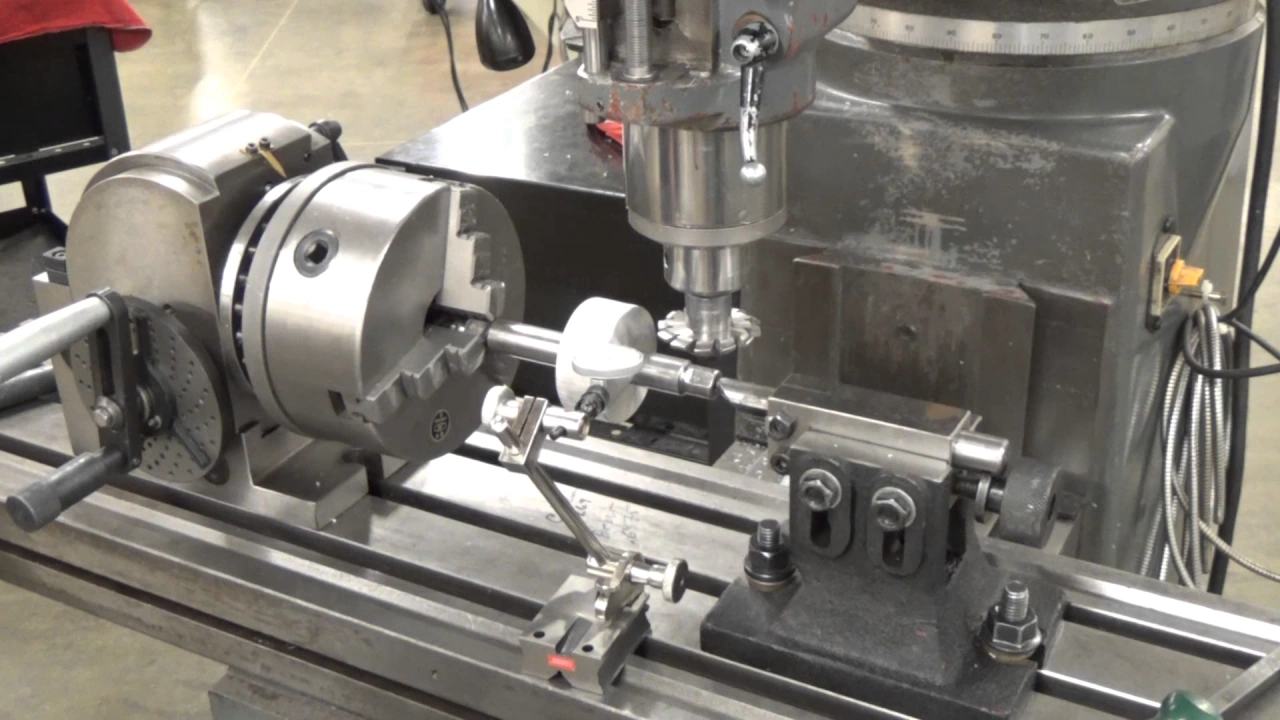


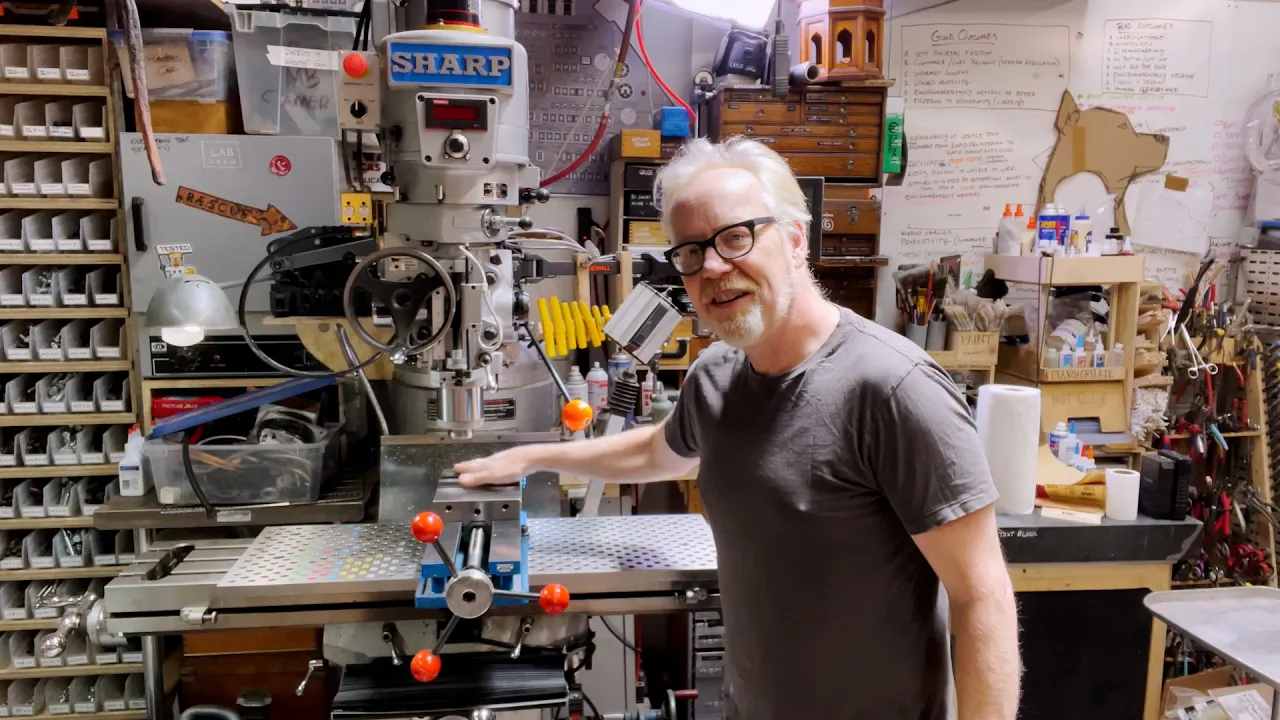


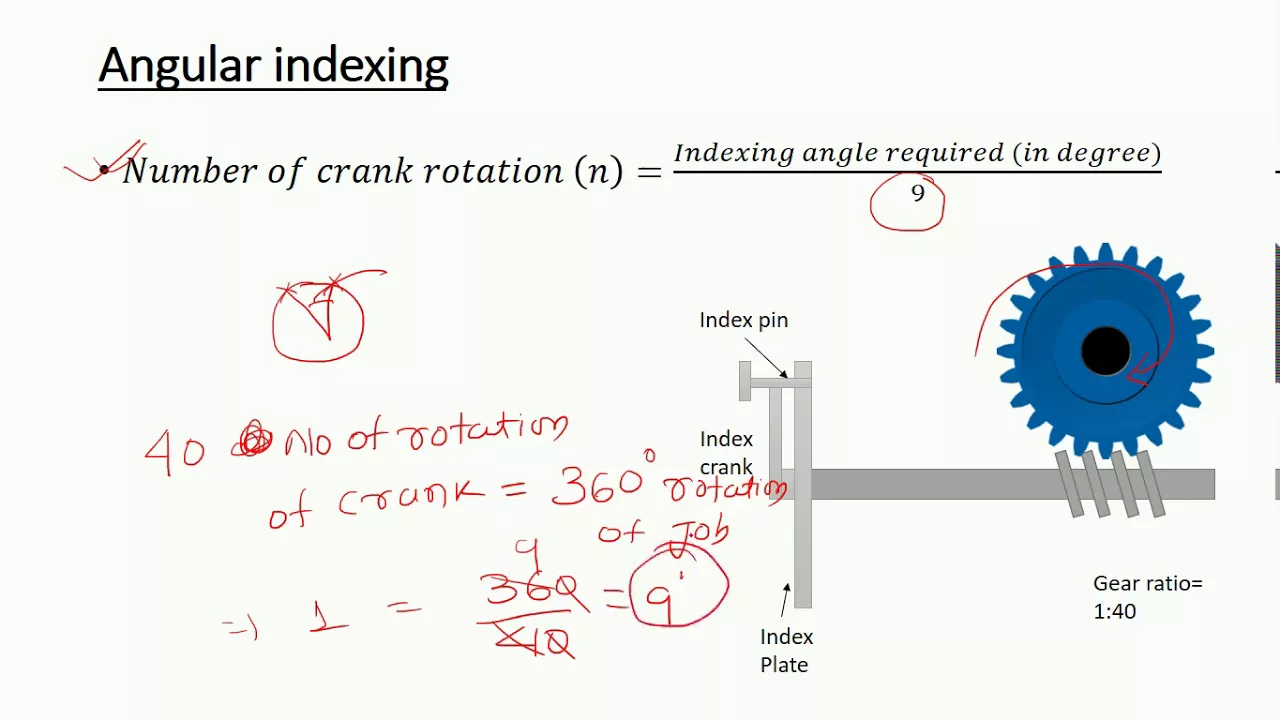










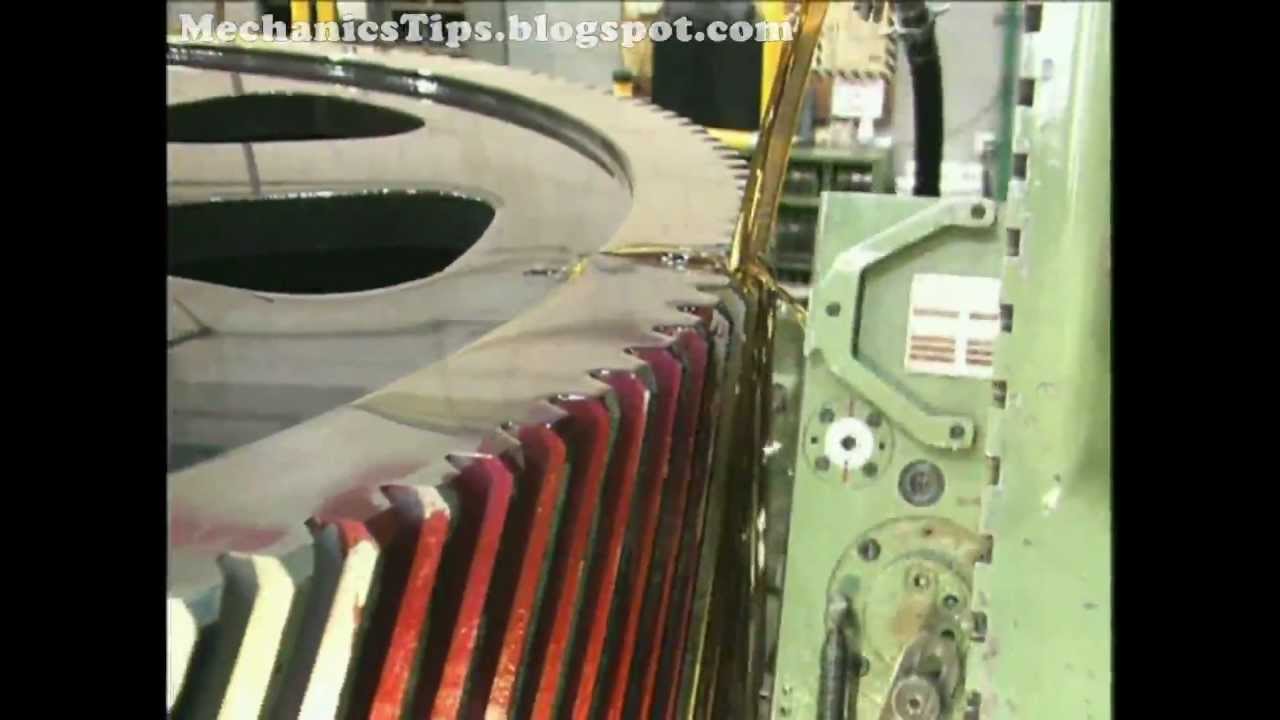

Gear tooth profiles, particularly involute gears, are designed to maintain constant speed and torque transmission as teeth engage and disengage, unlike square-toothed gears which cause speed fluctuations. Gear tooth form changes slightly based on the number of teeth, requiring appropriate cutters for different tooth counts. Precision gear cutting requires accurate indexing and dividing, typically achieved using a dividing head with a 40:1 reduction ratio and interchangeable dividing plates that allow division into any number of equal parts (e.g., 100 divisions for a 100-tooth gear).
Gear Manufacturing with a Dividing Head: A Machining Tutorial
Added:Basic lathe operation, setup, and safety principles, including adjusting spindle speeds and tool alignment.
Fundamentals of gear geometry, particularly concepts like diametral pitch, module, pressure angle, and the shape of an involute curve.
Basic workshop mathematics, specifically calculating fractional divisions of a circle and understanding gear ratios.
Understanding the mechanics of milling cutters, specifically how form cutters remove material and the importance of rigidity in a setup.
Advanced indexing methodologies, such as differential and compound indexing, to cut complex or prime-number tooth counts.
The principles of manufacturing other gear profiles, including helical, bevel, and worm gears, which require coordinated machine movements.
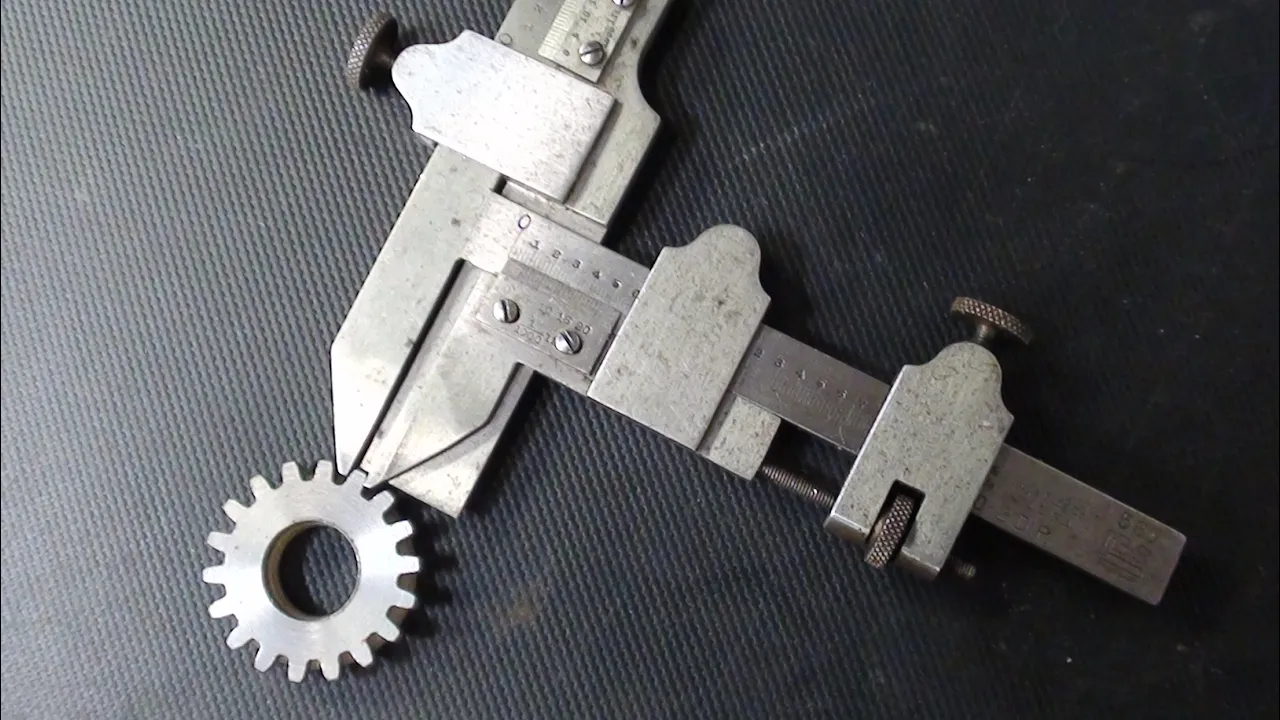
Gear inspection and metrology techniques, such as using gear tooth vernier calipers or optical comparators to verify profile accuracy.
Post-machining processes for gears, including heat treatment for hardening, tempering, and precision gear grinding for high-load applications.
479.8K views12Klikes29:02Original Release: 2019-02-03
you huh these gears actually work well I'll be de welcome back to the Greek one more stinkin thing on the channel today I thought we could talk about gears and more gears courtesy of the plastic gears that came with my recent mini lathe purchase this is a topic I get into with some trepidation for two reasons first there are a lot of way better videos on the subject already and second I'm not exactly Cosmo Spacely I don't do this everyday but if you could pay attention you'll find it's not that difficult now if you had the rewind to hear that last sentence again you should just stop this video right now specifically the two large Drive gears I'd like to make them out of not plastic by that I mean steel or aluminium or brass whatever I might have in my pile back there I haven't done any digging yet but I'd like to make them bigger as big as I can and still fit in the gear train of the mini leaves so as to slow down the feed rate of the machine you may or may not recall my complaint in the infamous mini lathe video that out of the box this gear train seems too fast for my liking and that slower might be better in order to bring all those pieces together for you though I have to run the risk of insulting your intelligence by starting from the beginning bear with me I'll try to make this as painless as possible for the both of us a gear is a simple machine I think weight a machine component perhaps no that's not right that definition seems oddly sir look we all know what gears are right these around bumpy knobby things and they're used in pairs to transmit torque and quite efficiently I might add spur gears like this are pretty darn close to 100 percent efficient ninety-eight percent maybe what that means is if I put 100 torques in this one say from a car engine the other one is going to output 98 torques again maybe two the tires only two of those torques are lost to friction or heat or cosmic rays or whatever let's say we boiled the gears down to just these two wheels to round things that don't slip where they touch and can thereby transmit torque from one to the other since we lost this smooth wield no slip technology back when the Aztecs chased the aliens away using the Egyptian pyramid lasers we've had to come up with another way to keep two wheels from slipping I've routed out some Flintstone style prehistoric gears you'll note the teeth are square and with any luck you'll have never seen a gear like this in real life outside of maybe some bad clipart also note that they're the same size so our gear ratio is one to one no torque or speed change just a direction change fun made-up fact this was likely our collective first attempt at getting two wheels to mesh without slipping I mean it might not have been square lugs at first maybe it was wooden pegs or like dinosaur short ribs but you get the idea we have some kind of tooth for lack of a better word on both that mesh into each other with teeth engaged between the two there's now a place where one wheel can push on the other one and transmit torque spec taxa set up like this probably worked great for a long time until our ancestors tried to build things like wristwatches and helicopters but those worked funny and eventually tore themselves apart rule of thumb if you build something that tears itself apart it's a good sign you're probably not there yet let's have a closer look at what our gear teeth are doing note where the contact point is between the teeth I'll slowly move one gear and you try to track that contact point you see it's sort of move its way up the flank of the tooth from the bottom of one tooth to the top and more importantly the direction of the contact force between teeth also changed what that means practically speaking is the speed of our output gear isn't constant if you drive the input gear at say a hundred rpm then this one will flutter around that 100 maybe going from 95 to 110 and back again as the teeth come in and out of mesh I'm just making those numbers up mind you but hopefully you see we don't have a constant speed here this has been what one might consider a gross oversimplification just to get the point across I asked you geologists out there to take a deep breath and unbunch your panties the tooth form is important and for a lot more reasons than just constant speed or torque I mean notice that these gears are exactly the same size unlike most other things on this channel that wasn't an accident in this case you can't make a different sized square tooth gear with the same profile and have the gear work they jam up binder probably not even mesh if you didn't catch on by my use of the words jam and bind well there's a problem and of course you wouldn't want to make each and every gear custom when you need a gear train alright let's cut to the chase mostly because I don't understand this subject myself but instead of admitting that let's just say that gear profile development is outside the scope of this video involute gears there you have it hopefully that tooth form looks familiar these are only three teeth per gear of course through these cut them out and plan to demonstrate what this tooth form does now that I'm sitting here holding these know the fact that they look like cow udders is freaking me out of it or that howie mandel glove thing not sure which one is worse instead I'll borrow this nice animated gift from the internet as of 2019 anyway the involute is the most popular year to throw fail in fact it's been trending in the top two going on probably a hundred years now it's not the only one that works but it's got a lot of things going for it that makes it real popular with the kids first the speed is constant as teeth roll into and out of mesh it doesn't fluctuate the way it did with the square peg gears in particular keep an eye on that blue arrow that shows the force direction notice how constant that direction is where it's pointing from the beginning of the mesh to the end of the mesh second this one is a biggie may be hard to get your head around but we'll get to in a second the tooth profile only changes based on the number of teeth the gear itself has not on the number of teeth the other gears it needs to mesh to has a small gear will mesh with a large gear just as well as it'll mesh with this medium gear it makes each gear independent in a way of the rest the stuff you're trying to design it for third involute gears have the added advantage that the center distance you mount them on isn't super sensitive you can install them closer together or further apart and the speed and torque they transmit will still be the same I mean if you pull them so far apart that they don't mesh that's a problem as is jamming them all up into each other's personal space but over some reasonable distance that tolerance isn't as tight as it might be with other tooth profiles in fact you remember back to Alex's pasta machine the fact that they used the gear mesh to accommodate the thickness of the noodles because of that involute gear profile it didn't really matter if the gears of the roller we're closer together or further apart they'd still run at the same speed well because the gears were the same size but same speed but opposite directions could you imagine what that possible would look like if one of those two rollers were moving at a different speed now this isn't really important but I thought I'd take the opportunity to demonstrate what an involute is that might sound like an intimidating mathematical term but there's not all that much to it and since this demo has always been a hit for me at parties I thought I'd do it for you too what we've got here is a square now if I take a string wrap it around this square keep it taut and sort of trace out the curve that that taut string generates those curves are the involute of a square it's the involute of this shape if you did this with say a mini lathe you'd end up with the involute of a mini lathe in the case of gears when they say involute they mean the involute of a circle so if your base shape is around and you trace the curve using a string like this this is the gear tooth shape we've been talking about or we'll be talking about a bigger base circle we'll give you a slightly different curvature to that on volute as might a smaller diameter that you start with but mathematically the shape that you get is the same where on earth do I even start ears are sized by their pitch and number of teeth not their diameter not directly anyway but of course those things are related you can't by say a one-inch gear or a 30 millimeter gear they're sized by how many teeth they have and how big those teeth are kind of like with sharks we have two popular systems one for a team imperial called diametral pitch and one for team metric called module and just like inch and metric screw threads diametral pitch in module are essentially the same thing except they don't work with each other for the sake of clarity we're going to stick with the module system in this video simply because the gears I want to make our metric my mini wave uses metric module 1 gears if you have Imperial tendencies just think diametral pitch every time I say module I know the mini leave uses module 1 metric gears because it's molded right into the gear M 180 teeth Z is the tooth count just like with threads skiers need to be all the same pitch if they're going to mesh you can't mesh a module 1 gear with a module 2 gear just like you can't measure 8 DP gear with a 6 DP gear no more than you can put a coarse thread nut on to a fine thread bolt I mean I'm sure there are some people out there with the determination to do it but it won't be pretty I mentioned the shape of the tooth changes based on the number of teeth a particular gear has it's still the involute form but it changes slightly the less teeth you put on a gear the more accentuated that tooth form is consider these two extremes this is a small module one wreck and this is a module one gear out of the mini leave this smallest one I could find in the mix it would have been nicer to show you this with a larger gear pitch but this is the only combination of stuff I have around again they're both the same pitch so they mesh up great and if we zoom in on the gear tooth hopefully we can see that involute profile we've been talking about but if you look closely on the tooth on the rack you'll notice the sides of the teeth are straight no involute there what gives think of this gear rack as a round gear with infinite diameter like this dirty rusty gear here is gigantic and from our puny human perspective this section here looks flat looks straight if you unwind a string from a circle of infinite diameter you'll get a straight line so for the rack the gears are straight the flanks of each tooth is still technically the involute of a circle it's just that circle is so big that the curve it traces out is effectively a straight line all right I think we're starting to get some we're looking at the extremes here more or less the smallest deer you can usually get is somewhere around I don't know 12 to 15 teeth and the biggest gear you can get is a wreck with theoretically an infinite number of teeth and since the tooth form changes slightly for every number of teeth between the minimum and infinity well theoretically each gear would need its own special cutter on paper 22 that a 21 2015 fiscal therapy to see that well that's a lot of cutters by a lot I mean infinite and infinite generally speaking tends to be impractical so here's the deal we divide infinity into eight parts this is a cutter set for module 1 gears and there are eight cutters eight cutters will do the whole range every gear pitch set Imperial or metric is a cutters each one accommodates a certain range of gear teeth now I just bought this set for this project I had a couple of m1 cutters but not the one that I needed I thought I'd go import the whole set was about 55 60 bucks ships I think and although I did get eight cutters for the m1 set I'll give them that much they didn't exactly get the order right I didn't get a number one cutter I got a number two number three no number four there were nice enough to give me two number Five's six seven and two number eights fortunately I got the number seven cutter I need for this project the change in the involute form in a certain range of number of gear teeth is Sol enough that it can be lumped into the same cutter reading from left to right it's for module one the pressure angle is 20 degrees that's something we're not going to get into it's the number two cutter and a note on that just in a minute but you can see it's 2/3 is from 14 to 16 now the numbering here is a little bit backwards from my point of view a 14 the 16 should be a number 7 these import cutters tend to invert the what I think is the standard number range if we go to the number 7 the range of teeth this does is 55 to 134 and since I'm cutting a hundred tooth gear this is the one I'll use so just be careful if you want to cut say a hundred tooth gear I think technically you want the number two and not the number seven but my suggestion is to ignore the cutter number and just go by the tooth range that's stamped on it because we're lumping a lot of involute shape changes into one cutter here each cutter is only technically correct for its first tooth count so this cutter would be the exact involute or a fifty-five tooth year and it works fine up to about a hundred and thirty-four once you get to 135 the error in that tooth form is large enough to warrant the next cutter this number eight which I think should have been a number one is good for anything from 135 teeth up to infinity meaning if you wanted to cut a straight gear wreck this is the cutter you'd use since we're all up close and personal let's compare the two extremes at least that I have here if you need high-precision gearing and each tooth form has to be perfect you can't do it with this system well unless you make a custom cutter just for that gear tooth count instead you'd turn to gear hobbing gear hobbing generates the involute curve naturally by the way the cuts are made like the cutters there are straight there's no involute form and the gear blank moves with respect to the cutter that results in the perfect omluke for any number of gear teeth but gear hobbing is outside the scope of this video that was quite long-winded my apologies all of this was to say we need the right cutter for the gear we'd like to make well shoot that I said that at the get-go I could have saved myself 10 minutes this is the cutter I need and this will be mounted on a milling Arbour that will fit my milling machine and allow me to drive the cutter through the work the next key to this puzzle is indexing and dividing what I thought this video is going to be mainly about before I got into the whole gear thing if this ends up getting the short end of the stick maybe I'll do a follow up video so I have my form cutter it'll make the correct shape and I have a gear blank maybe I'm gonna make it out of this I'm not sure yet but I think I can fit 100 tooth gear in this diameter my next problem is holding the blank and more importantly moving it so each cut lands in the right place to make a functioning gear my problem now is dividing there's no use in having the right cutter if I don't have a way to move my work exactly 100th of a division at a time and I do mean exactly ninety nine and a half gear teeth may sound close enough to 100 but it won't work trust me I've tried to restate the problem I'm starting off with a blank with no teeth on it if I had a hundred tooth blank I wouldn't be making this video in the first place making the first cut is easy I just come in on centerline and I end up with my first gear tooth but how do I reposition the work to get to my second gear tooth so it's in the place it's supposed to be so that when I'm finished rotating all of this work I end up exactly where I started and have a hundred teeth in my case a hundred teeth but you know you might want 99 or 101 or 52 would ask you the dividing head this is a bs0 size dividing head it's a semi universal head and I apologize for not cleaning it up for putting it out on camera here as its name implies it's really for splitting heads to give you a better sense of what this is for what this does let's back up and look at simpler dividing methods these are call it blocks they come in square and hex and they hold 5c kaulitz and the 5c kaulitz hold your work I also happen to have a 5c - er 30 to adapter this has a 5c tail that fits the block and an ER 30 to taper at the front for ER 30 to collets I have more ER 32 cops than I do 5 seat anyway you've probably seen this pop up a lot on this channel the square block can divide work into 2 or 4 parts 2 or 4 sections clamped in device I can cut the top of something and flip the whole block 180 degrees and cut the other side resulting in two divisions I can also move it or index it as we like saying the biz four times since this has four sides so it's clamped in the vise I take a cut flip at 90 degrees cut flip 90 cut flip and cut that would have turns say round stock into square stock the hex block does the same exact thing except it was born with six sides six is a bit more interesting than four this can also do two divisions as well as three divisions by turning it every other face I can do 120 degrees at a time and end up with something triangular and of course six divisions index to each face and the Vice and I can use this to put a hex on things next up is perhaps a tie between a rotary table and a spin deck sir though these are technically for two different things there is a little bit of overlap so far with a collet block we've been able to make two three four and six divisions but if you need five seven or a hundred they won't help you out much the rotary table well it rotates this one happens to have a forty to one gear reduction and graduated scales both on the handle and on the table itself if I wanted to make a hex with this I'd have to move it in increments of 60 degrees 60 then 120 then 180 and so forth if I wanted to make a hundred tooth gear I'd have to move it in increments of 3.6 degrees that's not easy to do nor is it very accurate or very pleasant for that matter these are mostly used for rotating work so you can cut round features or round slots for example you can of course do some non-critical dividing say you need a 10 hole bolt circle that's probably fine but any more precision dividing than that you'll have a hard time with one of these you can buy a dividing plate kit or most rotary tables so if you have one of these already you can convert it into a dividing head but we'll get back to that in a minute the spin deck sir or spin indexer like the collet blocks this takes 5 C collets or year 32 in my case and although you can use it to just spin stuff its main purpose in life is to provide easy fast indexing easy division it does that via a series of precisely spaced holes 36 holes in fact around this large diameter 360 divided by 36 is 10 degrees so if I line up that 0 put the pin in the zero mark I can do accurately 10 divisions at a time 10 20 30 etcetera so if I need to do a hex with this I start at 0 make a cut then go to 6 make a cut go to 12 make a cut go to 18 etc in addition this has another 9 holes let you split up those major 10 degree increments into single degrees it's a vernier scale so if I go to 0 drop the pin in the 0 mark that's locked then I could take a cut if I move the vernier pin to 1 let that drop in that's 1 degree 2 degrees 3 degrees etc until I get to 10 degrees I go all the way to that last pin it will coincide with the zero Degree hole on the 10 degree mark so this offers 360 degree division in 1 degree increments which means we can use this to divide a circle into hole number divisions of 360 again with the collet blocks we had 2 3 4 & 6 with the spin dec sir now we have 2 3 4 5 6 8 9 10 12 15 18 20 24 30 36 44 5 60 70 to 90 120 180 and we see that was totally off the cuff hope I didn't miss any but if you were paying attention I didn't say a hundred this can't make 100 equal divisions I still can't make the gear with this hence the dividing head dividing heads you can sort of think of as the lovechild between a rotary table and a spin dec sir even though technically it would be like its grandfather there are some sorted stuff going on with this just like the spin dec sir it does offer a fast dividing plate this one happens to have twenty-four holes instead of the 36 to spin Dexter head so if we ignore all this other junk for now with 24 holes it can do 2 3 4 6 8 12 and 24 divisions can't do 5 it can't do 7 it can't do a hundred which brings us to the dividing plates hold on let me go find the other ones that came and here they are you can remove the plate that's installed on the dividing head and put in one of these whichever one has the hole pattern you might need for the job at hand recall the spin indexer had 36 holes and this has 24 and 36 and 24 gave us some integer number of divisions we could do with both of those tools well think of these like adding to that expanding on those we can put in the plate that results in the integer division that we need though the dividing head has one more trick up its sleeve the connection between the dividing plate and the business-end runs through a 40 to 1 ratio in that reduction plus these whole plates allows a dividing head like this to do I'm not even sure really anywhere from 2 to some more than 360 it's probably almost 400 divisions moral of this story this will have absolutely no problem at all doing the hundred divisions we need to make the hundred tooth gear for the mini lady give me just a moment to prep the gear blanks get this installed on my mill and we'll talk about how these work or how you'd use one I won't go too deep into it but really it comes down to you being careful in patience it's easy to make mistakes with one of these remember that big aluminum round I showed you just a few moments ago took it down to the local deli and had them run off a couple of pieces on their slicer there's two blanks in there they're mounted on a bolt you can see the nut on that side there's a spacer so I get these clamps together that is probably borderline sacrilege probably want to do this on some kind of an arbor like a machined Arbor but for the mini lathe and demonstration purposes hopefully this is good enough because that support is so thin and I want to stay far enough away from the chuck that I clear it with the cutter I've brought in the tailstock the end support I drilled a small Center on the leave in that bolt and I think it's supported pretty well big picture of what's about to happen I'll take one cut move back out turn this whole assembly one hundredth of a turn take another cut do that a hundred times until I'm all the way around if first crash course in dividing with one of these again this isn't difficult it's just tedious I mean at least for the kind of dividing we're doing if you start doing helical tapered flutes or something like that it gets crazy I mentioned this head is a 40 to 1 ratio between the crank and the truck 40 turns of the handle makes one turn of the chuck see if you can keep up with what I'm about to lay down daddy we want to divide the Chuck end into 100 equal spaces to make a hundred tooth gear that means we need to divide the 40 turn hand crank by the same 100 that's it so how on earth do we do 41 hundredths of a turn on that hand crank well think of it this way if we had a plate with a hundred holes in it we could simply move 40 holes at a time after all that's what 41 hundredths means right already out of a hundred you could take a cut move 40 holes take another cut move another 40 holes and keep doing that till you're done with your dividing but I don't have a plate with a hundred holes in it so let's change that fraction up a bit 41 hundredths is the same as four tenths that's for over ten mind you not 0.4 do not convert to decimal you want to stay in fractions with these things they're like fourth graders they only understand fractions four tenths again means move four holes on a 10 hole plate unfortunately and you probably guessed it I don't have a 10th hole plate so here's what I did look through my plates and found this one that has a hole pattern that's a multiple of ten this plate has a 20 whole series on it so I installed it on the dividing head now that four tenths we were trying to do before in the context of this plate becomes eight twentieths eight over twenty still the same fraction still the same division let's say I start off in that hole where I make my first cut where the 20 is stamped the second cut I would move one two three or eight holes technically it's eight spaces but same thing to do that sort of mechanically the crank on these heads have a spring-loaded pin I've already set it for this 20 hole pattern and if I start in that hole I can take a cut retract the pin move eight holes and drop it in that last hole my camera lens keeps fogging up it's rain and today I apologize if this starts to get hazy I'm getting tired of taking it apart and wiping one last thing while we're here you see these two arms they're not just for keeping track of the time these are called sector arms spanning this sector of a circle they're there to help you avoid counting genius a long time ago realized that counting was for suckers so if we started up here in this hole we took a cut move it eight holes took a cut instead of counting another eight you could just shift the sector arms over having already set it to eight spaces or eight holes ahead of time take a cut move again advance the sector arms and just keep going till you're done with the project I haven't actually measured these but at the risk of speaking too soon I think they might have turned out all right I don't think there's anything more anxiety inducing than cutting gears you've prepped the blanks set up your machine done all the math but I tell you when you clicked into that last index mark for your final cut let's just say if you weren't a god-fearing person till then I chamfered them a bit and filed in a QA d bird and leaned them up a little as you can see I pushed in the smaller gear these mesh like this well let's mount them on the lathe and see how they do I got some good news and I got some bad news good news is the gears work great the reduction to the lead screw now seems a lot better before we had a 20 to 30 tooth 22-8 that's one to four and the same thing here one to four four times four is 16 we had a 16 to 1 gear reduction to the lead screw now we've got twenty to a hundred and twenty to a hundred that boils down to five times five is twenty five to one gear reduction they're also not as noisy as I was expecting I don't know the comment section from the mini lathe video got me thinking metal gears would be an absolute racket sounds about the same as with the plastic gears the bad news is 102 years don't actually fit this mini lathe I've had to remove the motor cover that would need some kind of a notch cut in it to clear this larger gear and the side cover is just a lost cause this thing would have to be an extra I don't know an inch wider probably 25 something millimeters and if that weren't bad enough I had to modify the banjo Hardware the banjo is that black metal plate that supports these two gears this stud used to clear the 80 tooth tier but now runs into the back of the hundred tooth gear so for now I kind of bodged it with an m8 screw with a reduced head in a washer stack although it's working well enough for a demonstration sake I would probably make a new banjo stud and not just so this is nice and solid but it's not really a big deal in my case I realized this might sound a little sour grapes but I don't plan to even have the gears in the back of the gearbox the intention is to go C and C with this thing and so all of this isn't even necessary that's why I made these out of aluminum and not steel well one of the reasons anyway I realize this videos already too long as is what I'd like to do if you're all still with me is do two more videos in no particular order I would have liked to get into making your own gear tooth cutters not like this of course but close enough to make functioning gears and after that armed with what we learned in this video how to make your own gears at home using only the mini lathe in granted there's one or two other accessories you need for the mini lathe but the mini lathe would be the primary machine no mill no dividing head that sort of thing as bare bones as I could boil it down to frankly all right I'm done tuckered out for now this is usually the point where I thank you for watching but unfortunately that's outside the scope of this video [Music]
Up Next

4:53
Measuring Gear Backlash and Center Distance: A Practical Guide
@EvolventDesign
55.3K views•2022-07-29

30:21
Damped Free Vibration of Structures: Viscous Damping Theory
@IITKanpurNPTEL
23.4K views•2019-08-26

54:16
Polymer Environmental Degradation: Mechanisms & Stabilization
@iit
1.8K views•2012-07-10

33:39
How a Student's Question Saved a NYC Skyscraper from Collapse
@veritasium
22.8M views•2025-04-26
Related Study Plans & Knowledge Roadmaps
Structured learning paths in Engineering
engineering
Structural Dynamics (DIY TMDs & Shake Tables)
01Foundations of Structural Dynamics & Resonance
02Designing and Building a Motorized Shake Table
03Constructing the Scale Building & Tuned Mass Damper
+ 2 more learning modules
35h5 modules
Explore Roadmap
engineering
Building Acoustic Levitators: Physics & Arduino
01The Physics of Sound and Standing Waves
02Piezoelectric Transducers and H-Bridge Drivers
03Arduino Programming: Generating 40 kHz Signals
+ 2 more learning modules
14h5 modules
Explore Roadmap
engineering
Building Peltier Cloud Chambers: Particle Tracks
01Cosmic Rays & Cloud Chamber Physics
02Thermoelectric Cooling (TEC) Fundamentals
03Custom Liquid-Cooling Loop Design
+ 2 more learning modules
18h5 modules
Explore Roadmap
engineering
Yagi-Uda Antennas: Modeling, Build & VNA Test
01Introduction to RF and Antenna Fundamentals
02Yagi-Uda Antenna Design Principles
03Antenna Modeling and Simulation in 4NEC2
+ 2 more learning modules
18h5 modules
Explore Roadmap