
















![[사마귀 수치해석 문제풀이] 6. 수치 적분법](https://i.ytimg.com/vi/TGzh_3K1ScE/maxresdefault.jpg)

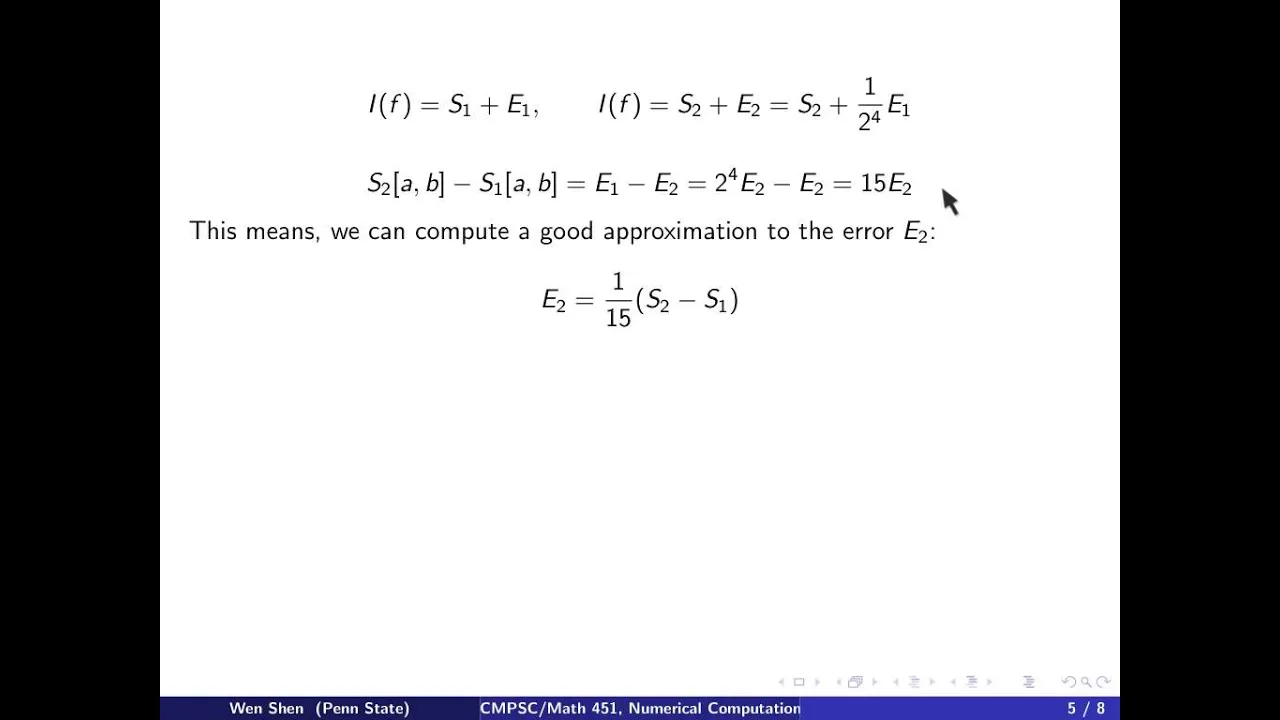


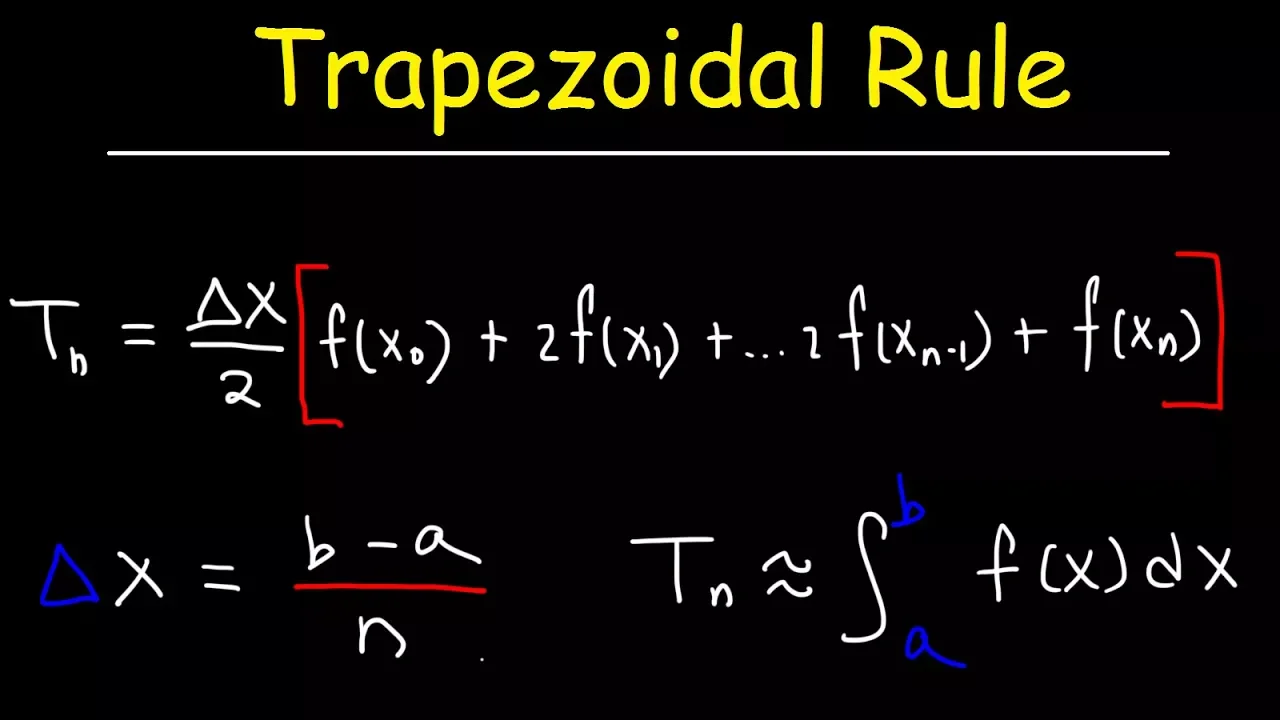
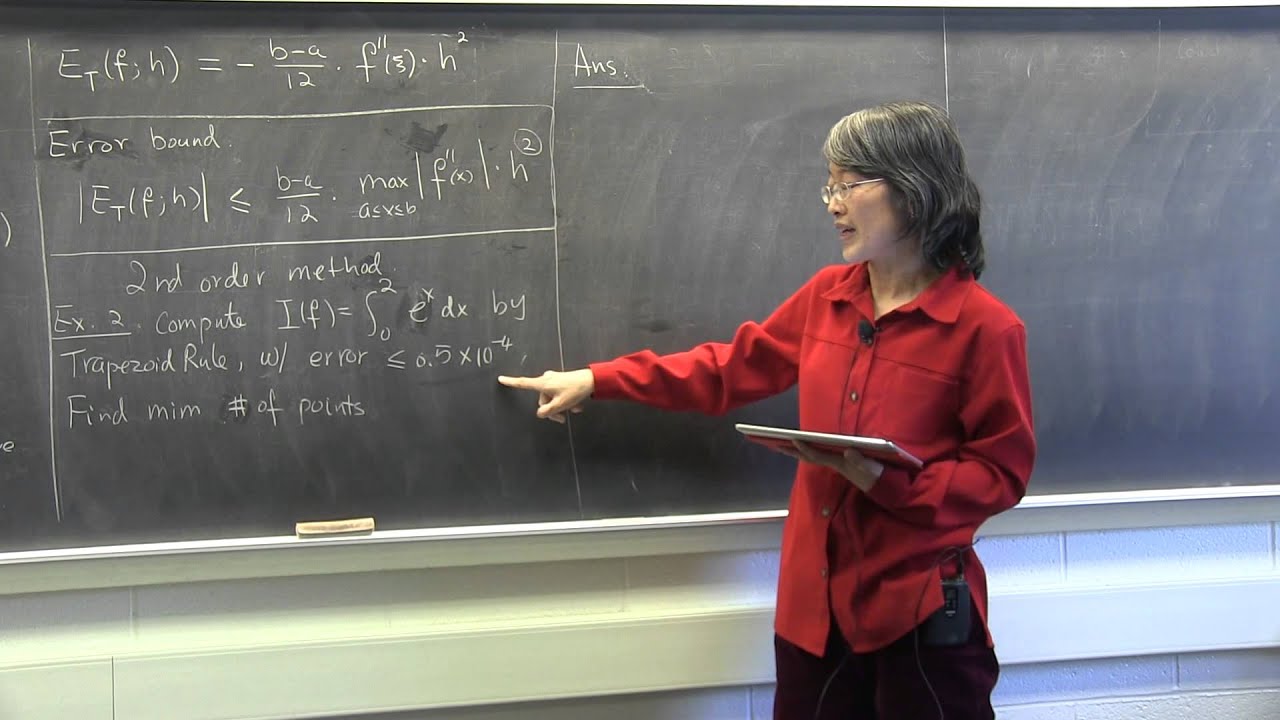
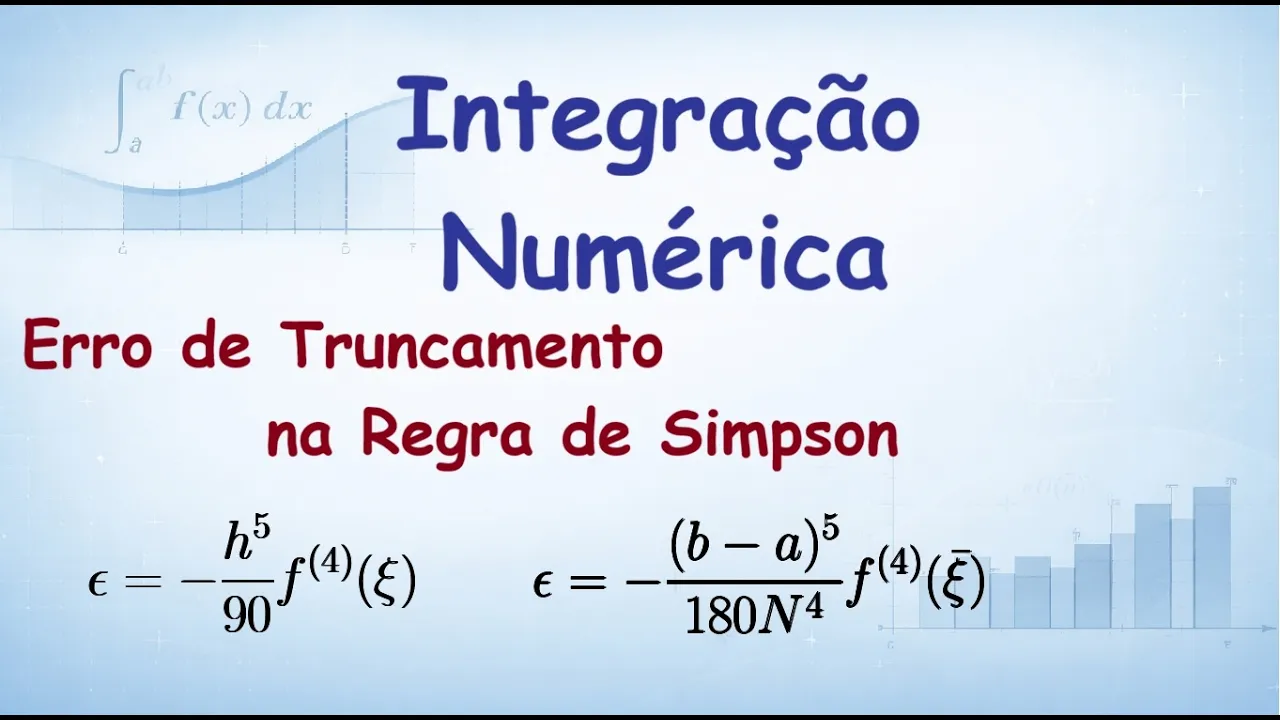
The error in quadrature formulae measures the difference between the exact integral and the approximate integral; for the trapezoidal rule, the error is of order h² (proportional to h³ per interval), while for Simpson's one-third rule, the error is of order h⁴ (proportional to h⁵ per interval), derived through Taylor series expansion of the function f(x) about the interval endpoints.
Error in Quadrature Formula | Trapezoidal & Simpson's Rule
Added:Fundamental concepts of single-variable calculus, including integration, differentiability, and the Mean Value Theorem for Integrals.
Taylor Series expansion and its remainder terms, which are foundational for deriving algebraic representations of approximation errors.
Basic formulas and geometric interpretations of the Trapezoidal Rule and Simpson's One-Third Rule for numerical integration.
Understanding of asymptotic notation (Big-O notation) to describe how error scales with step size (h).
Composite Trapezoidal and Simpson's Rules, including the derivation of their global error bounds over multiple subintervals.
Richardson Extrapolation and Romberg Integration, which leverage known error terms to systematically eliminate low-order errors.
Adaptive Quadrature algorithms that dynamically adjust interval widths based on local error estimation.
Gaussian Quadrature, which optimizes node selection to achieve higher algebraic precision than Newton-Cotes formulas.
4.2K views49likes14:24Original Release: 2020-10-06
so as friends i'll explain you the error in quadrature formula okay the error in quadrature formula is defined as if e is the symbol is e is equal to a to b by dx minus a to b cube dx yes this is the error for the quadrature formula now for the where q x is the polynomial of y is equal to f of x in the interval e b you see this is the general formula for the error okay now we have obtained the error for the quadrature and error for the trapezoid and quadrature formula and called in the trapezoidal rule and simpson's one third rule so on so the first one is error in trapezoidal rule yes yes by taylor series expanding y is equal to f of x about x is equal to x 0 yes now so y is equal to yes this one is equal to y0 plus x minus x0 y dash plus x minus x0 whole square by factorial 2 y double dash plus up to so on let us equation number one yes now now for using the same formula x 0 to x 0 plus h y d x is equal to x 0 to x 0 plus h here y substituting this one equation number 1 y 0 plus x minus x 0 y 0 dash plus x minus x 0 dash whole square x 0 whole squared y factorial 2 up to 1 ok substituting this here now also if you're integrating this one okay if you're integrating okay if you're integrating this then you get y 0 h y 0 d x yes and here is also and taking the limits from x 0 to x 0 plus s you get here is y 0 h plus h square by factorial 2 and y 0 times yes okay here is only integrating this x x square by 2 so you get this one okay this is the equation number two now we know that the area of the first trapeze represent in the x 0 and x 1 you know this one 1 by 2 h y 0 plus y 1 is equal to a yeah we have suppose the first one is in the first interval x 0 which is 1 now now putting this now putting x 3 x is equal to x 0 plus h and y is equal to y 1 in equation number 1 v that is equation number 1 here in this equation in this equation substituting y is equal to y 1 yes and x plus xt x is equal to x0 plus so you get this equation equation number four okay clear it now substituting y1 here in this equation yes from 4 substituting in this equation 3 then this a1 then this a1 become 1 by 2 h and y 0 is here and y 1 y 1 is y 0 plus h of this plus s also let's clear now after i'm solving this equation h y 0 is here y zero this is two times y zero so this is h of y zero here is h square of h square by two y zero times plus h cube by two here is factorial 2 is here ok you get the equation number 5 okay so it's clear now hence the error in the interval x0 x1 from equation two and five yes this is the equation number two use and this is the equation number five from which is equal to according to this according to the formula the error in this interval is e is equal to x 0 to x 1 y d x minus a and this one you calculated this is equal to x x 0 x 1 yes x1 is this one x0 to x1 this is this equation number two so substituting this so this minus this e is equal to x 0 minus x equal to 1 so substituting this value and also this value so these terms are cancel out the here you see this is the term minus of minus of a is this one these terms are cancelled out you became only this term okay i think you have clear it resistance now the principal part the principal part of the error in the interval x 0 x 1 is minus h cube by 12 y 0 double dash you see here yes minus s cube by 12 y 0 double dash now so one is so the principal parts of error in this interval is this one okay since now similarly the principal part of the error in the interval x 1 x 2 you get the same term yes clear now so on and hence the total error which is minus h cube by 12 y 0 double dash plus y 1 double dash plus y and minus 1 double time okay assuming y double dash is the largest of the n quantities y 0 double dash y 1 double dash plus y and y 0 double is this is greater than this is greater than this in this area so e this e is so this e can be written as e less than o n one this one x double dash double dash double a so this is n time so n h cubed by 12 yes so this can be written and h into h square y double dash x nh in place of nh you write it b minus a so b minus a by 12 h square y double dash x yes therefore the error in the trapezoidal rule is of order h square is clear this is the error for the parentheses yes similarly you can obtain the error in the simpsons one third row yes error in simpson's one-third rule okay by on the same way yes you can calculate by a taylor series yes expanding yes this one yes but energy is expanding y is equal to f of x about this one yes this is equal to y is equal to y 0 plus this one okay also here then for the simpsons one third rule n is 2 so x 0 to x 1 y d x which become x 0 to x 0 plus 2 h and here is y y is the same here is ok y 0 plus x minus x 0 y 0 double dash and so on clear now if you're indicating this this this equation then you get 2 times this here x 0 plus 2 s minus r this is that is 2h x h square by factorial 2 y 0 double dash y 0 dash and plus 8 by 3 h cube by factorial 3 now so 1 yes similarly you get the integration of this one yes clear now area from x 0 to x 0 plus 2 is by simpson's one third rule is this one you know a 1 is equal to yes h by 3 of this is 6 and therefore putting x per hour x0 plus h and y is equal to y1 in equation number 1 in this equation in this equation yes equation number one this one so you get this so you get this one y one y 0 plus x minus x 0 in place of x minus x 0 is h so y 0 plus h y 0 dash plus 1 this is equation number 4 yes clear okay okay next for this now we have obtained further further putting next x minus x 0 plus 2 h and and y is equal to y 2 in equation number 1 so this becomes y is equal to y 2 and this one though so become yes clear x0 plus 2h which is equal to x so x minus x0 is 2h yes clear now now putting y minus y1 and 2 from equation number 4 and 5 in equation number 3 yes that is a which is a a is h by 3 and a is equal to the equation which is equal to is this one yes y 0 plus 4 times y 1 plus y 2 so you substituting here from y 1 and also for the y substituting these values so a a 1 is equal to this of y 0 plus 4 times y 1 plus y 2 okay so now solving this equation you get equation number 6 that is solving this y 0 is here y 0 is here yes and 4 of y 0 plus 5 y 0 plus 6 of y 0 and divided by 3 so you get 2 times plus 1 0 similarly here here is h square by y 0 dash 4 by h square y 0 does n here is also 2 h yes so you get 2 h square y 0 yes equation number 6 is clear now hence the error in the interval this x 0 to x 2 y d x minus a so in this interval you're subtracting this one this equation so subtracting you get this one similarly on the same way as you have obtained a trapezoidal rule similarly you obtain this presence the principle for part of the error in this interval is solving this equation you get this one okay similarly the principle part of the error in the interval x 2 x 4 you get y 0 to 2 difference so here is 2 times up hence the total error flips similarly the total error minus h cube by 90 this one here so now similarly assuming this term is the largest of the this this this up to this so in all places we substituting this term so yes so this is equal to n of h cube divided by 90 in place of nh into h 4 in place of ns we write down b minus is equal to here is 2a yes the difference is so 2 energy so 2n is so this is become 2 divided by so 180 of hsq so this is the error yes this is the so this is the error in the simpsons one similarly we can obtain the error in three eight roll x zero three three and similarly for the one yes friends okay in next video i have explained you the codes method okay thank you
Up Next
7:22
Trapezoid Rule Explained: Approximating Definite Integrals
@patrickjmt
661.2K views•2009-02-23

4:43
Elliptic Curve Cryptography Explained: ECC, ECDSA, ECDH
@PracticalNetworking
28.5K views•2024-10-21
10:44
Fourier Series Introduction: The Big Idea Explained
@DrTrefor
387K views•2021-05-03

6:00
The Mathematical Impossibility of Accurate World Maps
@Vox
23.3M views•2016-12-02
Related Study Plans & Knowledge Roadmaps
Structured learning paths in Mathematics
mathematics
Tensor Calculus: Vectors to Riemann Curvature
01Mathematical Foundations: Linear Algebra & Calculus
02Covectors, Dual Spaces, and Tensor Basics
03The Metric Tensor and Index Gymnastics
+ 2 more learning modules
40h5 modules
Explore Roadmap
mathematics
Gödel's Incompleteness: Logic, Proofs & Limits
01Introduction to Formal Systems & Hilbert's Dream
02Set Theory, Cardinality, and Cantor's Diagonal Argument
03Arithmetization and Gödel Numbering
+ 2 more learning modules
14h5 modules
Explore Roadmap
mathematics
Galois Theory: Fields, Groups & Solvability
01Foundations of Abstract Algebra: Groups & Fields
02Polynomials & Field Extensions
03Splitting Fields & Symmetries
+ 2 more learning modules
24h5 modules
Explore Roadmap
mathematics
Non-Euclidean Geometry: Models & Geodesics
01Euclid's Fifth Postulate and the Birth of New Geometries
02Hyperbolic Space and the Poincaré Disk Model
03Geodesics: Defining Straight Lines in Curved Spaces
+ 2 more learning modules
15h5 modules
Explore Roadmap