













Game theory provides a systematic method for predicting and influencing outcomes in strategic negotiations by modeling rational self-interested actors who seek to maximize their own welfare; by identifying key influencers, their stated objectives, influence capacity, focus on the issue, and resolve, one can predict and engineer outcomes through incentives and disincentives, though this approach cannot substitute for wisdom or replace smart internal debate.
Predicting the Future with Game Theory | Bruce Bueno de Mesquita
Added:Fundamental concepts of Game Theory, including players, strategies, payoffs, and the concept of Nash Equilibrium.
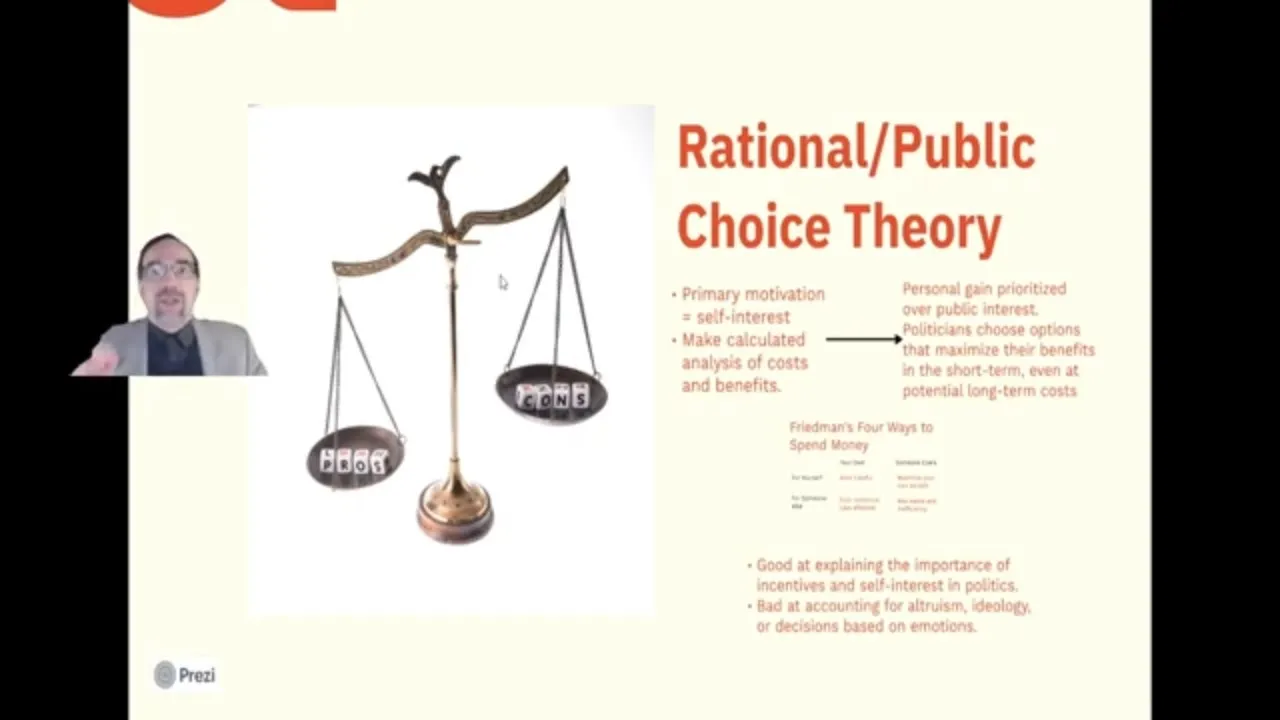
The Rational Choice Theory framework, which assumes individuals and political actors act self-interestedly to maximize their expected utility.
Basic principles of international relations, foreign policy, and how sovereign states and non-state actors interact.
The concept of mathematical and quantitative modeling in social sciences to simplify and analyze complex human scenarios.
Bruce Bueno de Mesquita's Expected Utility Model, exploring how computer-assisted political forecasting is mathematically constructed.
The Selectorate Theory, a political theory developed by the author explaining how leaders retain power based on the size of their coalition.
Strategic bargaining and mechanism design, studying how to structure rules and incentives to guide negotiators toward desired outcomes.
The application of agent-based modeling and computational simulations in predicting geopolitical conflict and market trends.
33.9K views331likes1:24:39Original Release: 2010-12-17
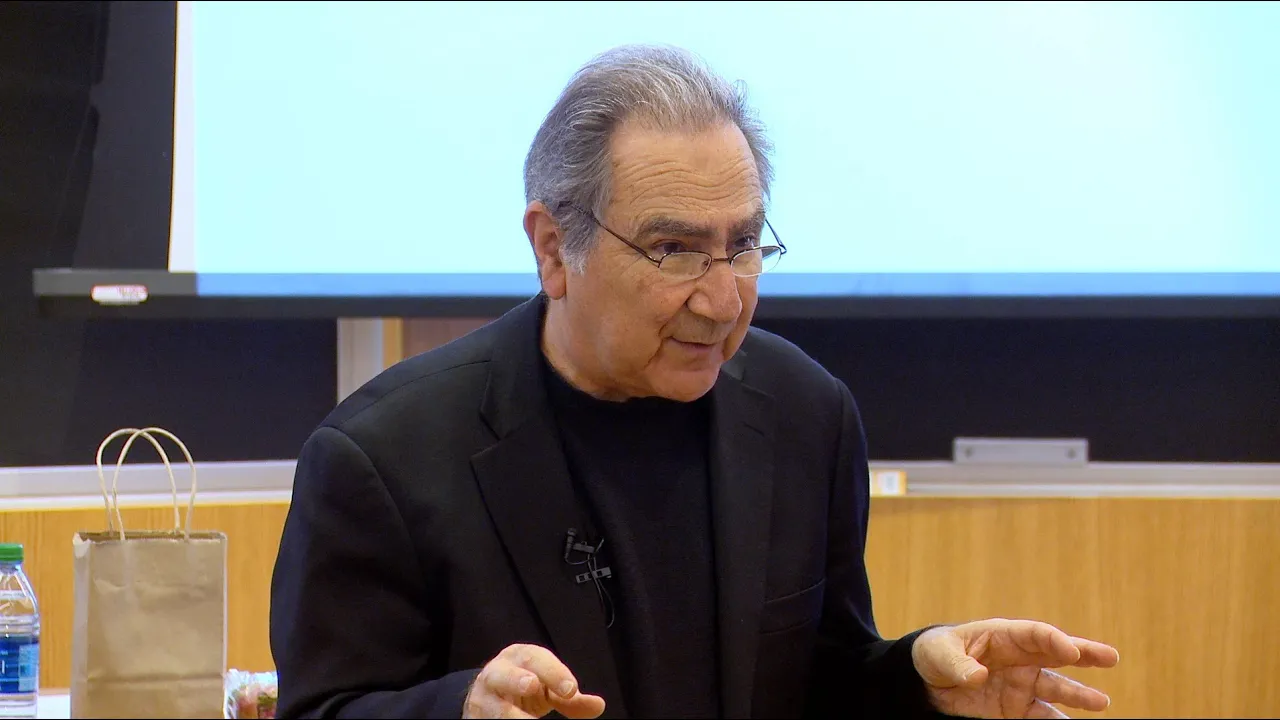
Good evening and welcome to the London School of Economics. My name is Richard Steinberg and I'm chair in operations research here at the LSSE. It is my distinct pleasure to chair this evening's speaker, Professor Bruce Bueno de Mosquito, whose talk is entitled Prediction: How to Predict the Future with Game Theory.
This event is sponsored by LSE's Department of Management. Let me briefly review the proceedings for this evening. Uh, Professor Bueno de Mosquito will speak till around 7:20 7:30 at which time he will take questions from the audience.
So, please hold your questions until then. Uh, I should also mention that is hope that a podcast of this event will be made available online. Following the Q&A session, Professor Bueno Dita has consented to hold a book signing outside the lecture theater here. Professor Bueno de Mosquita is the Julius Silver Professor of Politics at New York University and senior fellow at Stanford University's Hoover Institution. This evening's event celebrates the publication of Professor Bueno Disc's book Prediction, which is published by The Bodily Head.
For those of you who think that there's not much more to game theory than the prisoner's dilemma, I promise you that you are in for a captivating surprise.
And now, Professor Bueno de Mosquito on prediction. How to predict the future of game theory. Thank you. Well, with all the applause while I go on. So, I'm going to predict that you're going to be a good kind audience and I am that's going to turn out but we will see. So let me see if I can work out how to work things. I don't predict that well there.
Okay. So I got it. I'm slow but I catch up.
What I want to do tonight is sketch for you uh how to go about predicting things. And it will only be a sketch because I don't have that much time. And after I finish sketching things, I'm then going to go over some predictions. Uh some of which will probably make you happy and some of which will probably make you rather unhappy. Uh I'm just a guy who does logic and evidence. I I don't do opinion. So let me get started. How do you go about making a decision? What's the process for planning a decision?
Whether it's in business, it's in government, it's in personal life or what have you. Well, first of all, of course, you got to work out what is it you want to achieve? What are your objectives? And that is not my domain.
That's the domain of people who make decisions. So I work that out in my life, of course. But the kind of modeling I'm going to talk about is not about deciding what to want. It is about deciding what to do in order to get as close to what you want as possible. So analysts look for what are the the impediments. What are the things that get in the way of achieving what you want? And game theory is a method for assessing what gets in the way in the form of the interests of other people who don't want what you want, who would like to have something else happen in the world. And you can't wish them away.
You've got to figure out either how to incentivize them to go along with something close to what you want or how to make it costly for them to get in your way. Basically, the world reduces to those two simple choices. You give people rewards for doing what you would like or punishment for not. We try to work out a little bit more carefully what that looks like. Before I do that, I want to talk a little bit about what game theory can do and very importantly what it can't do and what it shouldn't do. It's not a panacea. It's not the solution to everything, but it is a solution to a lot of things.
One of the most important things that a game theoretic analysis can bring to the table is transparency. If you ask an expert on a problem what will happen, they will express their assessment. And if you ask another expert on a problem what will happen, they too will express an assessment and it may very well be a different assessment. And if you ask them, how did you arrive at that conclusion? They may or may not be able to tell you in a satisfactory way because they haven't written down the logic behind their reasoning process in an explicit way.
Well, you can't solve a game without writing it down. And so the the logic has to be transparent. That means that we can argue with the logic. We can question whether those are the right assumptions or we should be assuming something else.
And because game theory is about people trying to do what is what they believe is in their best interest, we can find optimal strategies for people. That's what we all try to do in our lives.
However much we may talk about being altruistic and being concerned about the welfare of others. I'm afraid I'm going to be very tough on that. I'm going to claim that we are all very narrowly self-interested. We are interested in the welfare of numero uno and uh everything else is gloss and I will elaborate on that later. Decision making is problematic because it is fraught with uncertainty and with risks. And games of course require you to model uncertainty and risk. And so they can help you to sort out what the uncertainties are, what the risks are, and they can help you sort out the possibility of exploiting uncertainty to your advantage.
No, we have a polite word for exploiting uncertainty. We call it bluffing, which means lying to people. And so in games, we can work out how often should you lie, how much should you lie, how should you lie, what's a good lie, what's not a good lie. Uh, one of the ways that we know whether a lie is good or not is, for example, to distinguish between cheap talk and credible commitments. So a a cheap talk signal when you disagree with somebody is a a claim that doesn't cost you anything to make and so shouldn't be taken seriously. It is what we call a babbling equilibrium. It's just as if the person was standing there saying blah blah blah blah blah. There's no meaning to what they're saying. For example, I teach an introductory under undergraduate course in international relations.
My students came to class several months ago very excited. After the North Koreans had uh engaged in some nasty behavior on the nuclear front, President Obama gave a speech announcing that there would be dire consequences for the actions that Kim Jong-il and his regime had taken in violating the agreement that they had signed just a couple of years before. And my students came to class very that was cheap talk, wasn't it?
What possible dire consequences could there be short of the United States invading North Korea, which wasn't about to happen? President Obama said, "We will impose economic sanctions on North Korea. The United States does not trade with North Korea." So what would these economic sanctions be? It was cheap talk. My students understood that. What we want to look for is credible signals, costly signals, things that people say that don't just cost you something, but cost them something to say. That's how we know that we can begin to take seriously what they are declaring. And that's one of the things that these sorts of models look for so that we can work out is the person just babbling or is the person likely to be telling the truth. How much can we raise those costs to find out where their breaking point is? and so forth. Okay, so those are things that game theory is very helpful for. It can help you to engineer outcomes.
But we shouldn't get confused. Just because you solve a game doesn't mean that you can get what you want. Other people have interests. They're also solving the game and they have clout and you you can't take that away from them.
You can't wish it away from them. If you are dealt lousy cards, you may be able to play those cards optimally, but they're still lousy cards. Kim Jong-il has been dealt lousy cards. He plays them very well. But still, there's just so much that he can do and there's just so much that anybody can do. Game theory can't make that go away. And there are things that game theory ignores. I say this with a parenthetical remark. Game theory ignores emotion.
Except when people use emotion strategically. Before the talk, we were talking about a colleague of mine at New York University, Steven Bramps, who has written on the strategic use of emotion.
But most of the time, when people think about emotion, they're thinking about raw emotion, reacting at the instant of anger or frustration or whatever. And I'm going to contend that while emotion is very important, it is much much much much less important than you think it is. And I'm going to offer evidence for that.
What shouldn't game theory do? It should not substitute for good judgment.
But let's be clear here. What we think of as good judgment is wise decision- making. We only know whether a person was wise in their decisions after the fact. That is, if things turned out well, they were wise.
But if things turned out badly, they weren't wise. It's hard to know before the fact who has wisdom. And even if we know who has wisdom, maybe because they have a track record of wisdom. There's a big problem with with wisdom that game theory doesn't have. The big problem with wisdom is you can't teach it to people. You can't make somebody else wise just because you are wise. But you can teach people to do rigorous transparent game theoretic or other forms of analysis. And that means that while you may not be able to substitute for the deep thoughts of a wise person, you don't need to have a wise person.
You can't count on having wise people.
You can have some good well-trained analysts who could do just as well, maybe in fact even do better. And finally, game theory should not be no model, no bundle of equation should ever substitute for smart internal debate about issues. But game theory should inform debate. When I talk about Iran, I will illustrate that with a very concrete example. But basically, because game theoretic reasoning is transparent, game theory, right, being just a way of thinking about how people interact strategically, because it's transparent, if you come to a conclusion and my model comes to a different conclusion and we're looking at the same data, we can have a sensible conversation because we can ask the question, how did you arrive at your decision different from my decision? The model I'm going to talk about, for example, regularly disagrees with my opinion about things. Even when I'm the expert who provides it with data, it disagrees with me. And I'm sad to say because I'm not very wise, it turns out to be right much more often than I do. Okay. So, game theory starts with a few very basic assumptions. Isn't it fortunate that the nose is large enough to accommodate the equations there? They planned ahead. So people are assumed to be rationally self-interested. What does that mean? It does not mean that they can foresee all developments. It does not mean that they look at every possible alternative that they could pursue in trying to solve a problem.
Indeed, people who would do that, if such people exist, would be irrational because clearly when the benefit is exceeded by the cost of continued search, it's no longer rational to keep searching. They are people who do what they think is in their own best interest. That's a very straightforward condition. How do they determine what's in their interest? They have values, things they want. Those are outside the realm of explanation in the sort of work that I do. I take those as given. There are things people want and they have beliefs. They have beliefs for example about how other people will react to what they want. How other people will compete with them or cooperate with them and they choose their actions taking those values and those beliefs into account. Now those beliefs force people to confront the strategic reality that they face impediments to what they want. It's clear that I know who among all the people in the world who meet the constitutional requirements to run for president of the United States who has the values that most match my own. But I don't vote for that person. It's me.
Nobody wants what I want more than I want what I want. But I know I have no chance of getting elected. So I have to think about well who might be next best or in my case I have to get pretty far down because I generally don't agree with any of the candidates uh and find somebody with whom I I feel closest affinity. These are constraints that we have to overcome. So, who's rational and who is Mother Teresa? Rational. And if you read Prediction, you can have the pleasure of seeing me slam Mother Teresa as a narrow, self-interested individual who, after all, did could have lived her life like most nuns do, doing good deeds anonymously. But no, she chose to have a branded sorry white blue trim so people would recognize her.
Leather sandals. She did a lot of things to draw attention to herself. Suicide bombers, terrorists, rational. They will get questions on that later. I also explained why they are rational and how they are incentive driven. Pretty much I think everybody in this room is likely to be rational. I only know of two types of people who I would say are not rational.
Two-year-olds because two-year-olds have not yet formed firm preferences. So one minute they want chocolate ice cream and as soon as you hand them chocolate ice cream they want strawberry. Okay, you switch to strawberry. No, no, no, I want chocolate. That's not rational because there are stable preferences and schizophrenics because schizophrenics seem wired to not be able to have stable preferences. I don't deny that two-year-olds exist and I don't deny that schizophrenics exist. But for the problems that I study, it's not likely that two-year-olds or schizophrenics get to make decisions. So pretty much everybody in the world that I study going to say is rational. Okay.
How do we go about modeling the problem?
So there are immediately problems that people have in thinking about issues. So we know that there are people who influence issues. For example, there is Gordon Brown or the CEO of a corporation. These are people with a lot of say. They have a lot of influence. Let's take Gordon Brown. Let's take President Obama.
Either one of them. They need to formulate policy towards Iran's nuclear program. Let's face it, I mean no offense, no disrespect to either my president or your prime minister. They don't know much about Iran. They probably can find it on a map, but maybe they know the difference between Shia and Sunni Islam, but these are not experts on Iran. So, they have advisors.
They have a foreign minister. They have various people who focus on national security issues. And most of the senior people who speak to the prime minister about Iran, let's be honest, they don't know a lot about Iran either. They have advisors. Those advisors probably know something about Iran. So when we think about who influences decisions, we need not to just focus on the key decision makers. Something that most people do for good reasons which I will come to. We need to focus on everybody who will try to shape the decision. The decision makers, their advisors, lobbyists, interest groups, people who will organize and demonstrate on the streets. Anybody who tries to shape decisions should be paid attention to. Now if we have a very simple problem with just five decision makers, Harry, Jane, Sally, George, and John there, Harry wants to think about how is the best way to interact with Sally and with George and with Jane and with John. What what are the what what should I do to try to persuade them? And each of them is thinking about that about the other four. And Harry probably also is thinking, I would like to know what Jane is saying to Sally, George, and John because it might be that Jane is forming a coalition with those people. That would be a problem for me. And Harry probably even thinks, I wouldn't mind knowing what Jane thinks Sally is saying to George and John and so forth. So pretty quickly, the problem gets to be pretty complicated. As a matter of fact, although I can't draw enough of them there, with just five decision makers, there are potentially as many as 120 interactions, five factorial, that are interesting to know about. Unfortunately, when I deal with big problems, my computer is too slow to deal with the factorial. So, in this particular case, I'd want to know about 60. Now, suppose we move from five decision makers to 10. So, I just doubled from the number of people who could interact. But the number of interactions has gone from 120 to 3.6 million. Here is where the comparative advantage of a computer model comes in. A smart person probably can keep track of 120 interactions in their head. Nobody can keep track of 3.6 million. Now, we don't really need to know the 3.6 million. fine print. I like to know about 5,760 of those. You can't keep track of that either, however. And most problems of important questions in the world are involve many many more influencers than just 10. So the number is exploding. So what do real decision makers do? They take intellectual shortcuts. They say, "Well, yeah, there are these 40 people who are trying to influence this decision, but it's these six who get to make it. We really should pay attention to them." That's where the influence lies. And much of the time, that'll be right. They do pretty well.
But a lot of the time it won't be right because those people are taking advice and being shaped by the views of other people who are being discounted, who are being overlooked. The computer doesn't have to overlook them. It's not as smart as we are, but it has close to perfect memory. It doesn't sleep. It has no union. It is It will work 24 hours a day if you ask it to. No coffee breaks, no lunch break. Just crunch the numbers. Crunch the numbers.
So, we can keep track of all of these interactions. And that means that we can look at a much more nuanced level of decision making than real decision makers often are able to do. Okay, we now get to a little bit of academic stuff. I apologize, but this is after all a university. So I thought I should at least very briefly show you that there is actual stuff behind this.
So that ugly picture is the extensive form of one little piece of the game for one stage. One of the big differences between modeling the world to predict the future and engineer it and sitting down and writing pure theory models is in a pure theory model. You start out and you assume either the game will be played once, it will be played twice so you can work backwards to what you should do now or it will be played an infinite number of times.
Infinity infinity is a wonderful thing because it allows you to take advantage of all sorts of theorems about convergent number series and so forth.
Great. But in the real world, when we play real games over real policy matters, whether in business or in government, we face the serious problem that we don't know how long the game will go on.
When we try to put together a merger or an acquisition, we know that there will be conversations between the two sides, but we don't know how many conversations. When we try to resolve nuclear issues with Iran or North Korea or what have you, we know that there will be many discussions, but we don't know how many. So, we need some way of modeling that. So, here I have a semiopic, semi-shortsed game where people can only look one move ahead.
This is one stage of the game. It will run for as many stages as the model concludes will be played. This is one stage of one game out of 16 times n^2 minus n. N being the number of players of games that I'm going to solve to analyze a problem. Why 16 times? Because there's uncertainty in this model. The uncertainty is on two dimensions for every player. I don't know when I start to interact with you whether you're the kind of person who would like to settle this dispute between us by negotiating or maybe you're the kind of person who thinks, you know, if I punch Bruce in the nose, he'll see the light and let me have what I want. So, I don't know if you're a hawk or a dove. You also don't know that about me. I also don't know if I punch you in the nose to try to get you to do what I want. Whether you're the kind of person who will throw up your arms and say, "Oh, you're serious about what you're demanding. I give in." Or you will punch me back. You'll retaliate. And I don't know that about you. So, we have four degrees of uncertainty. So, you take, you know, I'm uncertain about whether you are hawk or dove, retaliator or not. You work this out. I'm You don't know that about me.
That's 16 different combinations of types or beliefs that we can have that we have to solve. So it very quickly gets to be a complicated problem. So I solve a model that looks something like that. Why in the world should anybody believe any claim I make about the value of such a model? Well, there is a track record. How often is this model right? It is said to be right 90% of the time. Who makes this claim?
So I I offer three sources. The Central Intelligence Agency in the United States has a declassified evaluation of the accuracy of this model applied to several thousand cases. They've concluded it's right about 90% of the time. You may not like the CIA, the Culinary Institute of America. They're very nice and make Oh, they're CI. How about academics? There's an article in the British Journal of Political Science 1996 I think uh that puts the accuracy rate also at about 90%. There's an article by journalists who have evaluated prior predictions that I've made in print also put it at about 90%. And I've done something obnoxious to the naysayers out there who don't believe that game theory can help solve real world problems. The obnoxious thing I've done is over the last 30 years that I've been doing this, I have, it's not my main academic work, but from time to time, I publish peer-reviewed papers in journals making predictions about things that have not yet happened, but are big important things. So people can look at the record after the fact, that's what the academics have done, and see were the predictions right. There's a chapter in prediction year called dare to be embarrassed. And this is what I invite all the people who think that they have a better way of predicting to do. Dare to be embarrassed. It is incredibly easy to fit a bundle of facts to a known outcome. I can write down a statistical model to get really good fit. If I know the value of the dependent variable, I can write down a case study to give a wonderful explanation of any event. If I know how the event turned out, so what I invite people to do is do that when you don't know how it's turned out yet. That's a real test. That's hard. And so I obnoxiously am willing to do that. Okay. So, a little bit of embarrassment here, but what the heck, might as well brag a little bit. So former director of central intelligence James Wolsey says you shouldn't miss this if you care about understanding how decisions are made. Richard Lapthornne chairman over here of cable and wireless nothing shimmy shammy or flip-flop about it. It has intellectual rigor. No American would say that by the way.
That's a wonderful statement. Kenneth Arrow Roger Meerson both Nobel laureates in economics. So and and Roger a game theorist. They say very nice things. So, there's some reason to think if you don't like statistical evidence like 90%, okay, we go with testimonials. We got some pretty fancy people who say this works. All right, one last little bit of academia here. Boring but hard evidence. There's a table of some tests. You can see what the median error rate is with the game in prediction compared to uh some standard methods of predicting median voter mean voter theorems. the model greatly outperforms them. All right, I bored you enough with that. What do you need to know to make successful prediction and to engineer outcomes in the world? Turns out you don't need to know a whole lot. You only need to know a little bit. You need to know who has a stake in shaping the decision. That's the influencers, the lobbyists, the interest groups, the decision makers.
You need to know who they are. You need to make a list of them. And what do you need to know about them? You need to know four numbers. Only these four numbers. What do they say they want? Not what in their heart of hearts do they want. No way to know that. But what they say they want is a strategically chosen value. They made a calculation about how far out on the limb they should go, which is going to reflect a lot of things that we can work with about their about their characteristics. So what do they say they want? Which means we have to define an issue or set of issues. issues are things that require actual decisions. How much do they prioritize the issue you're looking at? How important is it to them? How willing are they to drop what they're doing when the issue comes up and attend to it rather than something else that's on their plate? How much clout could they exercise if they chose to? How good are the cards that they're holding? And how resolved are they? So I make a distinction between somebody who values reaching an agreement even if it's not the outcome they want and somebody who is resolute and sticking to their position even if it means not coming to an agreement and being defeated. Let me illustrate that with a very quick example. In my consulting life, I do a lot of work on litigation. Consider a mediator. A mediator doesn't care whether the plaintiffs or the defendants prevail.
A mediator, self-interested individual, cares to shape an agreement because the next job for the mediator depends on the mediator being able to establish, I am successful at resolving disputes.
They'll take any outcome. They don't care what the outcome is. They just want to figure out what can I get these other people to agree to. The plaintiff, the defendant, they typically are pretty resolved. Not completely because they want to settle the case, but they want to settle it on their terms if possible.
So the mediator, I'll go with anything that works. The other sides more resolved.
Okay. If we have those four variables, what do people say they want? How influential could they be? How focused are they? How resolved are they? And we have those numerically. Then we can calculate with game structure what their choices are, what their chances of succeeding or failing are in different actions, what their values are based on their choices of position, and what their beliefs are. And if we can work that out, then we can predict and engineer their behavior. Okay? So, let me be obnoxious again. Let's notice what I have not said you need to know because I'm claiming 90% accuracy by knowing these things and I'm reporting that other people attribute 90% accuracy. I have not mentioned culture. I have not mentioned history and emotion and so forth. All of that stuff is great. I love it. I'm trained as a South Asianist. I speak poorly, but I speak Udo. I read and write Udo a little bit. I mean, I've been an area specialist. I know what it's like. All that expertise is great at getting you to understand the information that a model like this needs, but 90% accuracy without knowing that stuff.
That stuff is fed into that shaping what the data look like. But however you got there, you got there. Think about playing chess. If you walk in on two people playing a game of chess and you look at the board, you can pretty quickly work out for whoever has the next move what's good move for that person to make. You don't know the history of the game. You don't know how the board got the way it is. You don't know their culture. You know they both want to win the game. and you're looking at the board and from this moment forward, what's the best move? That's the ball game. Okay. So, where can you get the kind of information that I'm talking about? You can get it basically from two sources. If you are an expert on a problem, you know this information.
Indeed, think about it. How could you be an expert and not know this? Notice I'm not going to ask an expert, what do you think is going to happen? This is not some deli method. I don't even ask myself, what do you think is going to happen? Just four numbers about each player. If you don't have access to experts, I teach an undergraduate course called solving foreign crises. My students troll the web. I don't have the skills they have on the web. They find the data. They find very high quality data. They've made very reliable predictions, some of which I'm going to be talking about. Okay. So, now let's talk prediction.
Copenhogen. What is the long-term commitment in the international community to reduce greenhouse gas greenhouse gas emissions? So, how do we go about studying this? Well, we could identify the trends in support of regulating such emissions and we could identify better approaches than the universal pact, the universal treaty that is being sought in Copenhagen.
I have nothing against universal treaties, but I'm going to contend and my model contends that there is almost no prospect of a universal treaty being beneficial. So if you really want to reduce greenhouse greenhouse gas emissions, you should be looking to your domestic politics and volunteering to make taxbased sacrifices to improve the environment.
As I will argue, universal treaties are cheap talk excuses for not taking action. Let me illustrate this with the 175 countries, not including the United States. 175 countries signed the Kyoto protocol. On average, there was a promise of a 5.2% reduction in greenhouse greenhouse gas emissions. And this led to elation. People were very excited by this. Ah, finally we're going to do something. So let's take a look at killer. So we can foresee Copenhogen. Of the 175 signitories, 137 were in complete compliance with what they signed by doing nothing. by just continuing to do whatever it was they were always doing.
All they were obliged to do was report and again this week we have done nothing about greenhouse greenhouse gas emissions and we are thrilled to report that we are now fully in compliance with the Kyoto protocol. 137 out of 175. So that at least 38. So 38 were asked to do something real. They had to produce this 5.2% 2% reduction the host country Japan shortly after Kyoto with deep regret we have to announce that we cannot meet the standard that we agreed to meet your own government within a short while after ter quite well intentioned you know but we just can't do it and indeed most of the 38 did nothing. Why is that? How could they do that? What is the nature of a universal treaty? A universal treaty asks people to do one of two things. Remember, you have to get just about everybody to sign. Otherwise, it's not a universal treaty. How do you get people to sign?
Ask them to do nothing. that is go to the lowest common denominator and it's very easy to get people to sign up because they don't have to change their behavior or ask them for serious changes in behavior and either introduce no consequential monitoring device to the treaty so that you have no way of knowing whether they're cheating. Check out OPEC. no mechanism for monitoring whether countries are exceeding their quota. Everybody knows Nigeria cheats, but there's no proof. Don't monitor or if you monitor so you can say not nice, you're cheating. Have no punishment strategy. Impose no cost for cheating.
That is the nature of universal treaties. The only exceptions to that universal treaties are pure coordination goods where everybody who signs it has an interest. Consider, for example, practically the entire world except for this country and Japan have worked out that driving on the right is a good thing. It avoids accidents. Okay, it works well here too. You're an island. If everybody drives on the left, it's left is just as good as driving on the right till you come visit us in the United States. We won't get to that. Uh or in the late 19th century universal agreement on what time it is in every part of the world. That was a useful thing. It benefited everybody. No downside. So you can get universal treaties that do something like that.
But when you ask people to undertake costly behavior as Copenhogen will, then you have to ensure either they don't actually have to do anything or there are no teeth to enforce it. Consider the alternative. if people are really serious. So what is the story for universal treaties which by the way your prime minister and my president argued vigorously for at the UN just a few weeks ago. Well if it's not universal then there will be others who will be cheating.
India, China, we know who they mean. And if they produce a lot of a lot of effluence and so forth, if we let them cheat, we will have to pick up the burden. And that's not fair to our people. Everybody has to pitch in. Oh, I forgot. We were polluting for 200 years before those guys got around to the opportunity to pollute. That's all right. Now, why why don't our leaders get up and say, "Well, here's what we're going to do. We're going to impose unilaterally high taxes on petrol consumption." You have those. And on the use of fertilizer because fertilizer is a bigger greenhouse gas emitter even than gasoline or petrol. So, we are going to impose high taxes on produce. You're going to have to pay more at the grocery store. And we're going to take some of that money that we collect in taxes that will encourage you to look for alternative energy sources.
And we're going to transfer that money to poor people in order to get them to adopt better energy sources that will be less polluting. Why don't our governments do that? It's very simple.
Political leaders like everybody's self-interested. Their self-interest is very easily described. They want to get reelected and they want to control the budget if they get reelected. How do you get reelected? You don't get reelected by asking people to reach in their pockets and give the money to people far away who don't get to vote. That's why foreign aid is such a teeny weeny itsybitsy amount of money. It's a longer story than that, but it's not politically popular. We're all concerned about the environment. We all recognize that in the long run there may be disaster. But very few people are willing to make short-term sacrifice. I don't want to dwell on this, but very quickly I ask my students a question. I won't ask for a show of hands, but I'll ask you to think about this. I will ask for a show of hands. How many of you have a mobile phone? Yes. Everybody. Okay.
How many of you would be willing to give up your mobile phone so that your government could put that money towards foreign aid such as money used to compensate people for using better energy sources? Oh my goodness, it's not very many hands, is it?
How about if I tell you that you could probably increase foreign aid 20 times by giving up your cell phones? But we don't like to make these sacrifices. We like other people to make the sacrifices. We are very good at suggesting how to spend other people's money and very reluctant actually to do it ourselves. Just to keep in mind, okay, this is a graph out of my game of results of what will come out of Kyoto out of Copenhagen. 50% is the Kyoto standard and you can see all the trends are down below 50%. There will be some improvement for a short while. What will actually solve the this is the big guys uh India, China, US, the European Union and you see they converge uh at 30 on the scale way below the Kyoto standard. And you might appreciate my daring here. I've shown you every 10 years.
This is alpha 2130. Write this down.
Leave a note for your great grandchildren to write to my great grandchildren. Let them know if I got it right. Sorry. Okay, skip that. The key here is unilateral action is a much better way to solve this problem than universal treaties.
Universal treaties are an excuse to push the responsibility off to other people so we don't have to do anything. And the model predicts that that's exactly how we will behave. All right, very quickly. I'm going longer than I wanted to talk about Iran. So, I'm going to make some predictions about Iran. I made these predictions at a conference, the TED conference in February. So, these were publicly made in February. They actually are based on analyses I did as early as August of 2007.
I'm going to predict whether Iran will build a nuclear bomb and what the future of Iran's theocratic regime is likely to be and how the student dissident will do relative to Ahmed Jad and also the kung clerics and others. All right, this is a little bit complicated. Let me take you through this. This is all done in August 2007. This is not updated. This is what I was predicting about the world back then. So the yellow bars is the world of January 2009. The gray bars are roughly the present, but they're not a representation of what we know today.
They are what my model was saying the world was going to look like in terms of the distribution of interest in Iran with regard to the nuclear question for now predicted several years ago. And the white bars are looking ahead to 2011, which gets a little bit worse than now.
So, we need to get things worked out.
What's important to see here, January 2009, the overwhelmingly dominant view in among Iran's leaders was that it's a good idea to build a bomb. And there was a significant component of people who also thought that even testing a bomb would be a good thing to do. And what is the dominant winning position today? The majority of clout falls here in these three categories. That's the winning position today. Develop enough weapons grade fuel to show that you know how to build a bomb, but not enough to actually make a bomb. And that remains true in a year. Although the incentive to build a bomb, you can see goes up if they don't get a useful deal. All right. At the time that I said that, I was rather severely criticized, chastised. Oh god, these the Israelis.
Oh, they were very upset. The Bush administration was exceedingly irritated. Okay. I also claimed the solid red line there, that is Ali Kamei's predicted power on the way down. Where does it turn down? It starts to turn down around June July of 2009. Model did not know about elections. Who's rising? Jafari. General Jafari. The head of the revolutionary guard shooting up in power. Who else is rising? The bunyards. The people who control the money. They've got a very good arrangement. And who's kind of down there? Not all that important. We pay much too much attention to him.
Mahmad. Kind of diddly squat. I mean him no offense. The students here they are compared to him through July weaker than he is rising shooting up now sinking a little bit but basically staying more influential the students of the disciplines more influential than Amad that will be shaping important changes for kum clerics also haven't shown you them here there were 80 some odd Iranian players in this game 87 kum clarics also rising in influence so how good were those predictions So let's start with a typo that should say October 14th, 2009, not September, sorry. New York Times, many analysts inside outside Iran who say that tan's objectives have been to master or at least appear to master the process of preparing nuclear fuel blah blah blah.
But International Atomic Energy Agency has found that Iran has acquired sufficient information to be able to design and produce a workable nuclear weapon, but did not present evidence that it was trying to produce one. The New York Times, September 9th, 2009.
That's the correct date there. American intelligence agencies have concluded that Iran deliberately stopped short of the critical last steps to make a bomb.
Okay. The rest is about how Jafari is rising in power, the Kung clerics are rising in power and the others are declining. Looks like pretty good predictions. That's dare to be embarrassed. That's what we have to do if we want people to start thinking about whether a given method works. I'm also happy to talk about the 10% of cases that don't work and why. So, let me conclude by saying, what do I want you to take away from this? I want you to take away two things. Everything is not predictable. I can't predict, at least not by me, I can't predict markets. But most complicated negotiations are as long as it's negotiation in the shadow of the threat of coercion. Why is it important to be able to predict Because if you can predict things, you can engineer them. You can work out how you could alter a player's behavior to change how other people perceive that person and thereby alter the path of the game and perhaps produce a better result. And with that, I will sit down. Thank you.
[Applause] [Music] [Applause] Well, now I'm sure um there'll be a number of questions. I should say that LSE has given me a list of fairly detailed list of instructions. One of them is very unbritish and is in bold type that says at the start of the Q&A session, it is recommended that the chair reminds those wishing to ask a question to ask a question rather than deliver their own lecture. So I'm sure you abide by that. Uh the way this works, the logistics of it is we have the stewards who have microphones. We'll try to arrange it so that they don't have to go from one end of the auditorium get there to the other auditorium over a period of minutes. So I'll try to group them. So, if you're interested, if you have a question, would you raise your hand and we'll we'll try to do some u Okay. So, how about over on on this side? Uh yes, the gentleman in the back to begin with and then we'll take it from there and I'll repeat the question afterwards. Hi, thank you very much.
Thank you very much for an interesting lecture. Um, I wonder between the combination of your uh predictions, which I'm going to take your word for the effectiveness of because uh partly for the sake of argument and partly because I don't have any other evidence.
Um, and I and the uh predictive success of people like Nate Silver with elections doing very detailed statistical analysis. I wonder if you think there's some danger of sort of complacency of thinking we have statistical models that predict with 90% accuracy the outcomes of negotiations or elections and whether that might endanger us to become sort of uh to think that we can actually predict the future with perfect accuracy. Thank you.
Okay, I'll just summarize that question.
Basically, is there a danger to believe that we have a method that can predict the future with 90% accuracy?
So of course this is not a statistical model. I do lots of statistics. So this is a purely mathematical model. This is it is just solving a set of equations.
The data are just informing the model of the value on variables. Um I think that there is first of all no danger of perfect prediction.
Uh the world is a noisy place with lots of random events. I do have mechanisms in my model for trying to address randomness and I don't think it leads to complacency. God, I wish people took it seriously enough that that were a real danger. Uh the the the real danger is that people don't pay attention to the warning signs that comes out of modeling uh and are complacent in thinking that they are wise when often they are not.
So this should just not this should not be replace a replacement for people. It should be a compliment that helps them to have something to argue with that is transparent and what and and analytically informed.
Okay. Thank you. Um sorry I'm going to try to group them up there and then we'll come down to you. Is that okay?
Were there some other questions? Yeah, there's gentlemen there.
Thank you for your lecture. Um I was wondering what goes into your model because you're talking about qualitative motivations and then they become quantitative in your kind of you know the graphs you were shown. So how do you make the translation?
Okay. So the question is actually what goes into the model to be able to make these predictions? Who are the players? What do they say they want? How influential could they be? How focused are they on the issue? And how resolved are they? uh it is either hard data where I can get it or expert judgment about that information. One of the things that's interesting about the expert uh assessments of these data is that uh there have been control experiments on this that experts who dramatically disagree on what they think will happen nevertheless construct data sets that produce very much the same results. Uh because this is very basic information about a problem and there's a very straightforward check on whether it's garbage in, garbage out. So the model is dynamic as you saw. It's predicting shifts in position and so forth through time. That first slice is simply echoing back what the data say going in before the logic of the model is taken over. If that first slice does not produce something that looks an awful lot the way we understand the world on the issue at the moment, then we can be confident that it's garbage, that the data are garbage. But if the first slice reproduces what we believe is the way the world looks at the moment then anything that happens after that is just a product of the logic of the model which is endogenously changing the values of the variables and so therefore we can then have arguments about the logic but the data are probably pretty reliable. Uh that's a very straightforward check which I use all the time when I collect expert data.
Okay, thank you. Next question. Do you have do we have any more up in that region? Uh how about uh yes yes please gentlemen there.
Um hi uh a little bit of a hot topic at the moment uh banking regulation around the world. It it seems to me that your model would uh work perfectly trying to work out how regulation is going to be divvied up between various countries etc. How they want to regulate their banking systems. Have you thought about this at all? I have. So the question was about how whether your model could be applied to banking regulation.
Uh so the answer is yes it can be. Um have I thought about it at all? I have thought about it somewhat actually. uh in the book in prediction there is a section on a particular aspect of uh regulatory policy and institutional structure that addresses uh from a game theory point of view the probability that a corporation will commit fraud securities fraud. uh and that particular section comes to some conclusions um radically different from the journalistic accounts of fraud for example in particular that fraud is almost not not never but almost never produced by greed. Uh fraud is produced by a desire by senior management to keep their jobs by protecting shareholder value while they attempt to fix the internal problems of the firm and fraud comes to light of course if they discover that they can't fix the problems and you know at that point they they cash out. That's exactly by the way what happened at Enron.
my fraud model predicted. I actually was consulting with Arthur Anderson advising them to stop auditing Enron.
Um they had, by the way, I I have to share this a wonderfully incredible response that only a lawyer could think of. I apologize to the lawyers in the room. So their lawyers looked at at this model whose outof sample uh results were that if you were in my highest risk category, you had an 85% chance of committing fraud two year within two years. If you were in my lowest risk category, you had about a 1% chance.
Lawyers looked at this and said, "Wow, this model really works well." Remember those were out of sample. We better not use it because if we use it and the firm commits fraud, we have no plausible deniability.
Heather is no longer an Arthur Anderson.
I was Anyway, uh you might be interested to know that one of the best early warning indicators of fraud is that relative to growth in market cap, compensation for senior management is under expectation for the size and organization of the firm. Not over, not over, but under expectation. They're husbanding whatever resources they can to try to save the company. And you have to ask yourself about Enron.
If they were in it just to to steal money, why? My model says the fraud began in 96. The Securities and Exchange Commission says it began in 97. What do they know? The the senior management of Enron didn't cash out until 2001. Why would you wait four or five years to make your money if you were in it for greed? They were trying to save the company. So regulatory policy can be analyzed and its impact on what firms do can be analyzed. I would love to be analyzing the current environment because we're going to see lots of change in regulatory policy and those changes are going to probably be made without a whole lot of insight into what they will actually do. They will they will be good at the moment and then maybe potentially problematic, but unfortunately nobody has so far asked me to do it.
Gentleman down here in the 1, two, three, six row. Yeah.
Uh thank you very much for your comments tonight. Uh I was wondering the work of uh Nasim Taleim and his black swan theory discusses the idea of how chance occurrences can drastically impact statistical models such as yours uh due to the nature of uh unique occurrences in human uh in human nature. How does your how does your model adjust for such chance occurrences? Uh or is that part of the 10% of your of your models that that are incorrect? A great question.
Let me just one minor correction. This is not a statistical model. I am not fitting past data to current or future patterns. I am fitting current data to project future patterns strictly out of those data and logic.
So, uh, Black Swan's wonderful book, almost as good as prediction.
Um, and indeed rare events happen rarely. Um, so how does my model deal with the the the rare or the random event? So, my software allows me to introduce randomly introduced shocks to all of the variables. So I can designate a 20% probability, a 30% probability, a 2% probability, a 50%, whatever I want to change the value of the variables within their admissible range. By repeating that many, many times, you can simulate how robust is the result against some sort of unanticipated earthquake. You can't know what the earthquake will be because it's unanticipated. But you can simulate how big does it have to be to fundamentally change the results. I am ever surprised at how robust results are. I showed you that graph which had a lot of simulations for example on Copenhogen. So a lot of lot of lines.
There was a 95% confidence interval plotted around the results. It was very narrow. So it was quite a robust result.
It would take an astronomical shock which indeed in the case of global warming may be the nature of the shock uh in order to disrupt things. Some of the 10% is surely unanticipated events that were sufficiently big to disrupt the the the expectation. That was more true many years ago than now. I introduced this random shock ability uh when in 1993 I analyzed the likelihood of the Clinton administration passing healthc care reform. I did an extremely detailed study. I got everything wrong. I think I have 27 issues. Everyone was wrong. It was wrong according to my analysis.
Other people disagree with this, but I know within my analysis that a particular member of Congress, the then chairman of the House Ways and Means Committee, Dan Rostinowski, in my model, was the person who would shepherd through the compromise that could pass the Congress. He was indicted on 17 felony council corruption. He actually went to prison. His interest, his focus, his salience for healthc care reform went, you know, straight down the tubes.
And I had not taken that into account.
Once I simulated that it it got things right that this wouldn't be agreement.
So I now am able to shock the data uh to check most of the error is either poor quality data or more likely there are problems where the model is not capturing the calculations that people are making. I I would hate to throw away the 90% right to get the 10 to get the 10% I'm missing right. So to the extent I have to trade one for the other, I much rather have the 90%. And so the back blacks want phenomenon is worthy of attention because rare events do happen.
But as I said, they happen rarely. We should not lose sight of the main trends in order to get the rare events right.
Any more? Um let's take one more from this side and then go over to another part of the room to your right. Uh yes.
Hey, how's it going? Uh thanks for the lecture. Uh I just wondering uh uh if every player in your prediction model uh use your model and uh they get a predictions and according to those prediction they change their strategy and you think what going to happen in that scenario.
So basically the question if I understand the question is what would happen if all the players involved in the model actually used your prediction method what would be the outcome? Yeah interesting question. It is an interesting question. I have attempted on many occasions in my consulting life to persuade people to let both sides to a dispute use the model.
So what happens if you do that? So if I'm in a consulting environment, my academic work, I make predictions. I don't engineer things. In my consulting life, I engineer. So if I'm working for a client only for the client, the client is likely to get a better solution to the problem than they otherwise would get. If both sides have the model, then there's going to be a high probability of a faster resolution, a more efficient resolution, and a resolution that is satisfactory to both sides. Um, and is not close necessarily to optimal for either side.
And unfortunately, because people are self-interested, they are I've never had somebody who's willing to do that because they are more interested in getting that little bit of advantage than they are in an efficient quick solution. But that I believe is what the consequence would be because then what the engineering part is is looking at the model and and testing what if you do things somewhat differently. For example, what if you take a more moderate position than people expect you to take or a more extreme position or know good cop bad cop versus a unified position or you pay less attention to the issue than people are expecting or so forth. These are the things you can manipulate uh and you can see what will translate into a better result. They much prefer that than to find because you would lose that. That's the other side would know you could do that and so they would know what the counter moves are. Uh and that would be lost uh to the benefit of collectively better decisions.
Okay. Thank you. Uh by the way, did you um how about uh one more qu question uh from the lady in the first row here and um Yeah.
Um, I'm curious about your statement about cheap talk and um, on the one hand, you kind of seem to to dismiss it in the case of Obama's threat of dire consequences for North Korea and clearly that didn't result in some sort of unilateral naval blockade. Uh, but on the other hand, you say that um that what people say is is strategically chosen and in fact has a has a place in your modeling. Um and so it kind of seems to me and you know some other scholars too who have you know published things that um whether or not somebody threatening sanctions results in sanctions or or whatever the threat actually is it matters that they say it in terms of u sort of framing the debate and and and shaping the the political relationship between actors. So, um, because I was wondering if you could speak to that and and whether or not maybe threats are worth taking seriously even if it's not the actual content of the threat that's carried out. Right.
Thank you. So, the question uh, as I understand it, is doesn't cheap talk still have an effect even if the verbal threat isn't really what goes into effect, it still can have an effect. And does your model take that into account? Super question.
So here's where it would be nice if I had a semester to cover this work instead of you know 45 minutes. So I've given a very stark view of cheap talk.
Um there there are multiple audiences for example for Obama's statement uh visav the North Koreans. It was a statement devoid of content visav the American electorate. It was not a statement devoid of content. there there's a pure coordination of interest they have same so far I don't want to get too technical here but um so from that perspective is a valuable statement there is a wonderful literature um on cheap talk signaling and costly signaling uh and within the political science the the good literature of course is in economics so but within political science there's uh a very nice book by an Sartorii on uh the use of cheap talk as a diplomatic tool and a nicer book uh by Barry O'Neal uh which looks at problems of face saving and so forth uh through cheap talk uh utilization. So I've given a very stark view there there there is a more nuanced view that more nuance view really needs more than this amount of time. Uh so yes I I absolutely accept the principle.
Okay, can we get some questions on this side? um gentleman on the end in the third row.
Thank you. Thank you.
Um on on on the issue of uh maybe I don't understand the model in terms of how static or dynamic it is particularly feedback between a current situation and the input to your model uh beliefs and values for example. Um could you discuss this a little? So the question is uh about dynamics of the model and feedback and does your model take that into account and if so how? So the model is uh solving a series of basian perfect equilibria if that's a meaningful statement. Um and if it's not don't worry about it. Uh so it is dynamic.
What it is doing is it is looking with some simplifications and some handwaving. It is looking at the playing out of the all the possible games as a set of pair-wise games taking all third parties into account. And it is uh people are are are making proposals that are uh internally indogenously optimal. the proposals that they choose. They're looking down that stage of the game and the next stage and they're working back and they're calculating how likely is it this is the sort of person who is going to try to coersse me, impose costs on me. What is the optimal proposal I could make that benefits me at the the most at the minimum cost by getting that person who may be a bully to negotiate with me rather than bully me. And if I don't think they're a bully, then might I make bigger demands and I may be wrong because I've got uncertainty. So the model is working out what is the internally optimal demand to put on the table. It is then looking at each player is looking at okay how did that game turn out? Did I did I get it wrong? Did I have a lot of costs imposed on me or not? I can use B theorem to update on my belief about each of these people based on that. and I can alter my salient. So, for example, if I'm winding up with a lot of status quo outcomes, nothing's happening. I really shouldn't be putting necessarily so many resources into this problem. I should I could I can afford to reduce my salience, pay attention to something else or I'm getting beaten up a lot by that guy. I better pay more attention. I better raise my salience, my focus on that person and so on. So the model is looking at what the equilibria are at each stage and solving for what is the optimal strategic response to that and what have I burned by way of resources because of the cost that these folks imposed on me that I didn't anticipate correctly and so forth doing that sequentially uh it decides that the problem has come to an end either solved or not solved when again a little bit of a handwave there two rules the average player's total utility for all of the games being played is higher in this period than that player anticipates will be in the next period. So for the average player there's an expectation that the payoffs are going to go that the utility will go down they stop playing. The other rule is not the utility across all the games but their payoffs on their specific the specific games that they're the uh proponents in if they expect that their welfare is going to diminish in the next round then they want to stop playing. That's basically how the dynamics work.
Yes. Um, how about this chap to your left and fourth row? Yes. Thank you very much. Uh, great great talk. Go all around. Are you familiar with Frederick Veester and the sensitivity model? So, Frederick Frederick Vester and the sensitivity model. So, the question is if you're familiar with Frederick Vester, just in case you couldn't, but he's you're you're describing a a very very similar model. Oh, is that right? Well, I'm not familiar with him. Frederick Bestester is a biologist. He's dead now, but No, sorry. You can you can get you can get his work on That's not funny. Uh I I'm not familiar with him.
Uh I certainly know some of the game theoretic work in uh in biology. Uh and I clearly should be reading it. You wrote a thing called eco which is anybody here to university and asked for a copy of but it achieved many of the same results that you're aiming to. Great. And apparently with uh equal success with me that is hardly anybody's paying attention.
I'll I'll have to read them. Thank you.
Yeah. Okay. There's a chap in the fourth row to your right. Yeah.
I was I was wondering if you know of any other models that have uh close to the predictive power that your model has. If so, are they statistically based or are they based on game theory? And if it is game theory, um is game theory the future then? And what relevance will statistics have? And one more thing, you are and you were on the history channel and this is a little interesting, but yeah, I'm going to bring it up. You were compared to Nostradamus, right? So, I just have to ask um have you read his works? Do you think he was right? And if he was right on anything, what do you attribute it to?
I don't think I need to repeat the question. Why don't you go ahead?
Let's deal with Nostradamus. I'm not that good at prediction. I was hoodwinkedked. I was told this was going to be a show where they'd start off well. Nostradamus predicted this guy predicts. We've done stuff on mysticism. Now we're going to do science done with Nostradamus. Didn't work out that way. I signed a release.
Very stupid. Anyway, uh so they're very big and important differences between what I do and what Nostradamus did. Uh let's give Nostradamus his due.
He was a professor of medicine, very successful. He treated the plague more effectively than almost any physician of his time. Although his family died of it, maybe he didn't like them. I don't know.
Um, how did Nostradamus make predictions? He went up to his to an upstairs room in his house where he had a bowl of water and he stared at the bowl of water and then he wrote quattrains. And I don't know if you've read any of these quattrains. I have had the misfortune of reading a lot of them because of this regrettable association. Utterly totally completely impenetrable. God knows what they mean.
So they have the beautiful virtue that when he wrote them, nobody had a clue what they meant. But after something happens, there's always somebody, oh look, Nostradamus said that. You know, the sky is blue, the sun is gray, the rain is coming down. Have a good day.
Aha, that's about Kim Jong-il.
I don't get it. Me, I'm doing something replicable. Other people have used my models. They have published predictions as well. I like to think it is science.
That is it is rep replicable. You can run experiment. You could do all the things that the scientific method requires. So in that way, I I have in common with him that we're both professors. Although he was a professor of a real subject when it wasn't a real subject. I'm a professor of not a real subject that will become a real subject someday, too. All right. Predicting power change. Yes.
So my academic work is on international conflict. I don't know of models that in this way predict changes in power by any means statistical or otherwise. I I know of lots of models that predict how countries will interact and statistical models of what leads to war and so forth. I don't know of many that have endogenously changing power. Uh they may exist. Um I'm a great fan of statistical analysis, but I make some very important distinctions. I do a lot of statistical analysis in my research. Statistics, if you're forwardlooking, I'm not talking about trying to explain the past. If you're trying to predict the future, statistics is a very powerful tool as long as there is a smooth function of some sort. Uh it doesn't have to be monotonic that doesn't have to be you know straight. Um it it can curve and so forth. Uh but you have to not have a sharp break from the past. One of the great virtues of game theory is of course it's an equilibrium based concept. So you can have a nice steady progression. You can also have very sharp breaks with the past. So for example, uh if you look at the end of the cold war, I'm being very simplistic again, better to have a semester, but uh so you look at the Soviet economy steadily getting worse. no change in their fundamental behavior, but they reach a cut point at which they can no longer sustain the behavior, the equilibrium that they're in. The economy has just gotten epsilon bad enough, they have to do something else. That's the nature game theory.
Nature game theory, if you have a multiple equilibrium game, is you see no change across lots of variation in the value of of key variables. You cross a threshold, a cut point, and you see a big change. Statistical models are not good at that. Most statistical models uh this is a great strength of game theory is it is a way to see how smooth change on an independent variable or set of independent variables can lead to discontinuous change and outcome.
Okay. Um I think we we're getting close to 8:00 and Professor Bueno de Mosquito would is going to conduct a book signing. So just that we have time enough I think we'll just take just a couple more questions. this lady in just to your right in that row. Thank you very much, professor. I thoroughly enjoyed your talk this evening. I think I'm going to put you on the spot a little and and you may very well be able to wrigle out of it a little bit. But uh there's been much written uh over the last two years, over the last five years actually, but certainly over the last two years that suggest there may be some important developments in uh Israel, Palestine. Is there a settlement for a two-state solution on the horizon?
Uh this was a question about what Israel and Palestine and the two-state solution. Can you talk to that? Yeah. Um there is a lengthy discussion of that issue uh two lengthy discussions of that issue in prediction year.
Um I am extremely optimistic that there will be a meaningful peace agreement sometime in the next three to four years.
Uh to my surprise, part of what makes me optimistic based on analyses that I and my students have done is that the decision a year and a half or so ago, two years ago, to marginalize Hamas has had very beneficial effects.
It has made the more moderate elements in Hamas u see that there is advantage to them in trying to exert greater control over the more hardline elements in Hamas. So for example the last several months Hamas has begun to switch to a strategy of public relations films and so forth as opposed to violence. the on the Israeli side the um election of the current government is problematic for peace but I don't think this government will last the three years um I believe that there are actions I talk about this extensively in the book that could be taken to greatly advance the prospects of peace without any trust between the two sides and I have I proposed this to Ahud Barak when he was prime minister he liked the idea and he lost his job two weeks later unrelated to the idea. I proposed this to Condisa Rice when she was Secretary of State. I can't say whether or not she liked the idea.
She didn't respond to it. Um I know her quite well. And the idea is very simple. Imagine that the Israelis and the Palestinians agreed to divide all the tax revenue from tourism just from tourism.
6040 percentage division of the population between Israelis and Palestinians. 60% of the Israelis, 40% of the Palestinians.
It turns out that tourism is anticipated to be the biggest industry for for Palestine and it's a consequential industry in Israel.
And it turns out that tourists are extremely responsive to violence. A single, this is a nice little statistical analysis of this by the way in the book. A single Palestinian or Israeli death from violence between the two sides translates, it's hard to get the Palestinian data. On the Israeli side, it translates into a decrease of,300 tourists, 2500 tourist hotel nights.
If this automatic division of tax revenue, which is not hard to monitor because foreigners use credit cards and so forth, of tax revenue from tourism were divided as I proposed for conservative assumptions about the diminution in violence. If both sides police themselves, the net cost to the Israelis is close to zero because the increase in tourism offsets they're the bulk of the revenue offsets their loss of revenue.
And for the Palestinians, so you understand the magnitude I'm talking about, it represents Palestine has a gross domestic product of approximately 5 billion dollars. That's about three and a half billion pounds. It represents a conservative estimates 20% increase in their gross domestic product. We're not talking about loose change. We're talking about dramatic shift in the economy in which neither side has to trust the other. The money is automatically distributed by an an international agency and each side has a strong incentive to police its own behavior.
And if they don't, there's no downside because then they're just back at the status quo where there's no not very much tourist money. So I I I keep trying to get somebody to say this is worth testing because it really is very little downside and there's a huge upside. But in any event, I believe I'm very optimistic about the prospects.
By the way, we really just have time for one more question. Does someone on that side have a short question? A lady at the end. Can we I'll try to have a short answer and she'll Yeah. and she'll be the last um question of the evening.
It's a different kind of question, but I wanted to know about who's listening.
So, is there partisan bias in who listens when you consult the government?
Are neocons less likely to listen? Are liberals less likely to listen and to act upon your recommendations? Whose ear do you have in the US government? Um, so the question is who listens to your advice on one side of the polit political spectrum or the other? Hardly anybody. Um, no. So I have advised my government since the Ronald Reagan era.
Uh the Reagan team for a variety of odd reasons listened a lot. One of them was I at the time was teaching at the University of Rochester and the former chancellor of the University of Rochester. Alan Wallace was under secretary of state for international affairs and he was a statistician. He he believed what I was doing. Um the George Herbert Walker Bush presidency listened a fair amount. the Clinton administration less uh but they did listen on some very important subjects um having uh to do with uh terrorism and with nuclear proliferation in some important settings. uh the Bush administration uh generally did not like what I had to say um and so didn't listen with one very important exception and that is uh I did a study I won't go into the details on Iran's nuclear program I will just say that my experience is that undergraduates trolling the web produce data that with an extremely high probability produces the same answers as having highly classified data produces.
Um I won't say more than that but uh I did a briefing on Iran uh to the intelligence community which uh led to extremely hostile response followed two days later by an email because I am not shy in retiring and I pointed out that they had poked no holes in my logic and it was their data and I had poked a lot of holes in their logic. Uh anyway, the person a key person who was responsible for nuclear policy sent me an email two days later saying that uh he could not dismiss what I had to say and he is the person who correlation is not causation who two months later wrote the new national intelligence estimate that said that Iran was not trying to build the bomb and may have prevented the Bush administration from using force in Iran. So they listened to that. I have so far had no contact with the Obama administration.
I'm willing but they haven't called.
Okay, I want to thank everyone for coming out to LSC and to thank the speaker for a really fascinating talk.
Up Next
20:31
UN Peacekeeping: Bangladesh, Sri Lanka Human Rights Violations Exposed
@DWDocumentary
734.1K views•2024-05-21

24:30
BRICS Pay and de-dollarization: A New Financial Order Emerges? | 55 chars
@DannyHaiphongYT
164.6K views•2024-10-22

88:33
Fragments of Home: Refugee Shelter, Design & Politics | LSE
@theLondonSchoolofEconomics
957 views•2024-11-20
10:19
Explaining the Saudi-Iranian Proxy Conflict in the Middle East
@Vox
18.2M views•2017-07-17
Related Study Plans & Knowledge Roadmaps
Structured learning paths in Political Science
political-science
Economic Statecraft: Sanctions & Chokepoints
01Foundations of Geoeconomics and Economic Statecraft
02The Mechanics of Weaponized Interdependence
03International Sanctions: Types, Implementation, and Efficacy
+ 2 more learning modules
12h5 modules
Explore Roadmap
political-science
Central Bank Independence: Politics & Policy
01Foundations of Central Banking and Monetary Policy
02The Time Inconsistency Problem & Inflation Bias
03The Delegation Model and Designing Independence
+ 2 more learning modules
12h5 modules
Explore Roadmap
political-science
Consociationalism: Power-Sharing & Stability
01Democratic Dilemmas in Divided Societies
02Introduction to Consociational Democracy
03The Four Pillars of Consociational Design
+ 2 more learning modules
12h5 modules
Explore Roadmap
political-science
Rebel Governance: Legitimacy, Economy & State
01Foundations of Rebel Governance and Statehood
02Establishing Political Legitimacy and the Rebel Social Contract
03Wartime Economies and Rebel Resource Management
+ 2 more learning modules
14h5 modules
Explore Roadmap