
![МАТЕМАТИКА МОЖЕ ВРЯТУВАТИ ВАМ ЖИТТЯ 🤯 [VERITASIUM]](https://i.ytimg.com/vi/c6zxT14L-G8/maxresdefault.jpg)










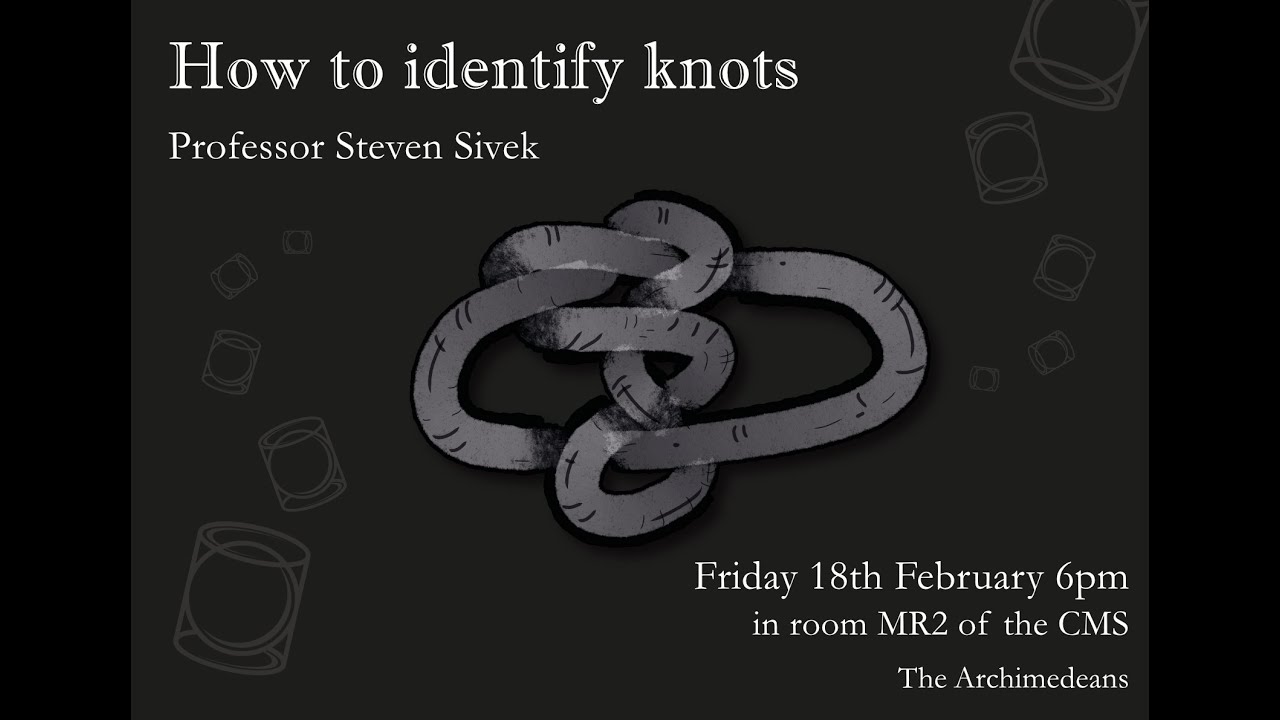




The fundamental group of the complement of a knot naturally carries a quandle structure defined by the conjugation relations at each crossing, where for each crossing with arcs a and b, the overcrossing arc c satisfies c = b⁻¹ab, establishing a deep connection between algebraic topology and combinatorial knot invariants.
Knot Theory Lecture 4: Quandle Coloring & Fundamental Groups
Added:Basic concepts of knot theory, including knot diagrams, Reidemeister moves, and elementary invariants like tricolorability.
Fundamentals of Group Theory, particularly group presentations, generators, relations, and homomorphisms.
Introduction to Algebraic Topology, specifically the definition and properties of the fundamental group of a topological space.
The concept of a knot complement, understanding the topological space obtained by removing a knot from the 3-sphere (S³).
The Wirtinger Presentation, which provides a systematic method for computing the fundamental group of a knot complement from a knot diagram.
Quandle Cohomology and its application in constructing more powerful state-sum invariants for knots and links.
Representations of knot groups into non-abelian groups (such as SL(2, C)), which connects knot theory to geometric topology and gauge theory.
Hyperbolic Knot Theory, exploring how the geometry of the knot complement (specifically hyperbolic structures) classifies knots.
299 views10likes1:44:54Original Release: 2020-10-10
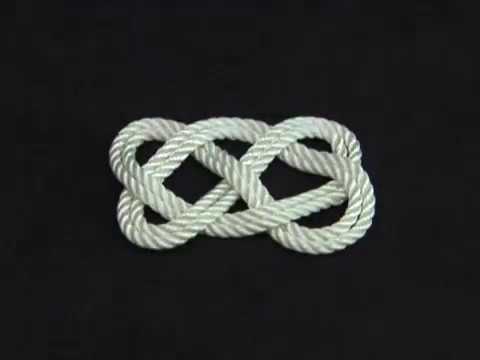
that's perfect right so here is a dna knot and here is the not tables up to a point and your task is to find out where this knot is on the not table i'm assuming we're not quite starting yet so you could look at this whoever is here and see if you can find out where this is on the not table i will give you a guide to just to discriminating over and under by walking along this knot this goes over and under then over then under then over then under then over then under over under alternating and a lot of the crossings are very clearly uh what they are and one or two of them require a little judgment it's a photo micrograph that was made in the 1980s electron micrograph of knotted dna first proof that everyone would accept that dna could be nodded by causality spangler and stasiak is rna or dna i'm sorry it is rna for dna it's it's dna um dna coded closed circular and it's been coded by a process with protein to make it thicker but it's uh it's got how many crossings one two three four five six so it must be a six crossing diagram here it's a six crossing diagram and there are three candidate six crossing diagrams in the table so it should be one of them is it says two yeah six two right it's still kind of it's kind of thrilling to actually you know realize you put your eye back and forth between these generalized oh yes this this artifact of very complex uh very complex equipment observation in a micro world comes out as one of the knots on the table well maybe i should consider this the beginning of the lecture um the table you will find this table um in the dropbox corresponding to the course so if you wanted to use an opt table you can use this one this table is uh descendant of the original map tables that were produced by tate and kirkman and little in the 19th century um they were commissioned by sir william thompson that's lord kelvin to make tables of knots um because kelvin thought that atoms were knotted vortices in the ether we'll talk about that some other time but the ether theory disappeared after a while and so the knotted vertices in the ether were not considered as models for atoms but not and very microscopic physics are still interrelated something to talk about later not tables are very useful for us as sources of exercises uh let me explain uh we have worked out the coloring structure for three one that's the knot and for four one a figure eight knot and we have some other continents we should make about that which i will you could if you take the knot tape grab another like maybe six one six two eight eight and uh or whatever and figure out the coloring structure for it and for the small ones you can do it by hand by just putting on a zero and a one and propagating colors until you find a modulus so well let's do an example or two of that so i'll leave this up i'll let go of the dna maybe i want to keep this file but let's get a drawing board and see what we can do okay so we made some multiplication tables um maybe i should recall sorry this will take me a moment because of the lookup i need to do uh yes oh so we got the 20 i want to go back to maybe 15.
uh yeah let's just review where we were last time by going through the last few slides um we were saying things like well um if we wanted to write down the quandl that would be associated to a given link like a hop link here then we write down one relation for each crossing in the halfling that's quite simple we have a bumping into b so a times b is a and b times a is b so the quantile is given by a and b such that a b equals a and b a equals b but what would happen if you were to decide oh i'll write it on my own slide what would happen if you were to decide to go through the coloring uh uh uh the fox coloring for this same link so then you might try a and b again i'll i'll use the same letters a and b but now you have that 2b minus a is equal to a and 2a minus b is equal to b right where what i'm using is uh the fox coloring method which we talked about before which does give us a quantum where a we have a b and c like this and c is going to be equal to twice b minus a and this could be over the integers or over uh the integers mod and for some n right this is fox coloring as we called it and it is a model in general the operation 2b minus a is a quantum operation so so over here we can and we have the equations and this says that 2 times b minus a is equal to zero right so this implies that we are looking at z mod two z right which i write as c two so our quantum is two element quantiles zero and one um and in fact if we were to do the coloring i'm going to run out of space here um i might call this one zero and this one one and then two times one minus zero is zero and two times zero minus one is minus one but minus one equals plus one and z two z so this is a non-trivial coloring of that link and the multiplication table for our quantum is zero one zero one two times zero minus zero is zero two times one minus zero is also zero two times zero minus one is one and two times one minus one is one and now you see something interesting in relation to a question that was raised in the last time uh the rows are not permutations of the elements of the quantum there's repetition in a row but the columns are uh are a lists of all the quantum elements so that in fact is what what will happen in general but let's find out what does happen in the case of the modular arithmetic fox type quantum so this is a nice little example of somebody where the sudoku method wouldn't work if you were trying to get roseanne columns all right now let's see what i'll i'll come back to this but let's see what else we have in a review from last week so let's open another one this was whoops i forgot which one it was [Music] sorry uh oh i pushed the button that i didn't want i'm sorry i'm gonna have to stop sharing and and fix this so let me just do that i don't want the chat and then i will go back to share screen yeah all right okay 15. yeah and then we talked about how to make that linear quantum and we pointed out that uh yeah it could be derived all right that was that slide then sorry then i told you about fox coloring and then i told you about the men coloring questions and we thought we actually talked about that all right okay and we talked about this about let's let's look at it again from here so um we understand this and then i gave you an exercise and um it's interesting to do this exercise um i think you find it quite easy so i won't bother you with it but maybe in the margin maybe it's a good idea to look at it in margin um so we're defining an operation um it's motivated by algebra uh strictly for us at this point but i want you to know and you can check a times a is a a inverse a because this is a group multiplication and here we're defining the quantile operation so a times the inverse is the identity and you get b so um i mean i'm sorry you get um if you take a times a then you get a right a times a is equal to a inverse a which is equal to a works fine and what about a times b and then times b leave the last one for you but let's do this one so this is b times the inverse of a times b which is b a inverse b and then you take the inverse of that and you multiply by b but the inverse of the product of group elements is the same product in the reverse order with inverses so we get b inverse a b inverse and b and this is a group so everything is associative so this is the same as a itself and that's what we wanted to check and then the last thing that you want to check is that a times b times c is equal to a times c times b times c now there actually is a geometric interpretation of this quantum in relation to not links but i'm not going to talk about it now later i hope we come back to it at some point you can notice the following and this is interesting and it does constitute a motivation for this rule let me just review a command here my command is abelianized okay so if you follow my command a billion abelianize this turn the group into an abelian group write it with a plus so it's easy to see that means this becomes minus a and you would have b [Music] minus a plus b right and that's equal to twice b [Music] minus a so so you see that this rule this quantum rule is a generalization of the two b minus a rule okay um the the item that i actually want it must be earlier in our slide let me see if i can find it i should have checked where it was before um maybe oh at 14.
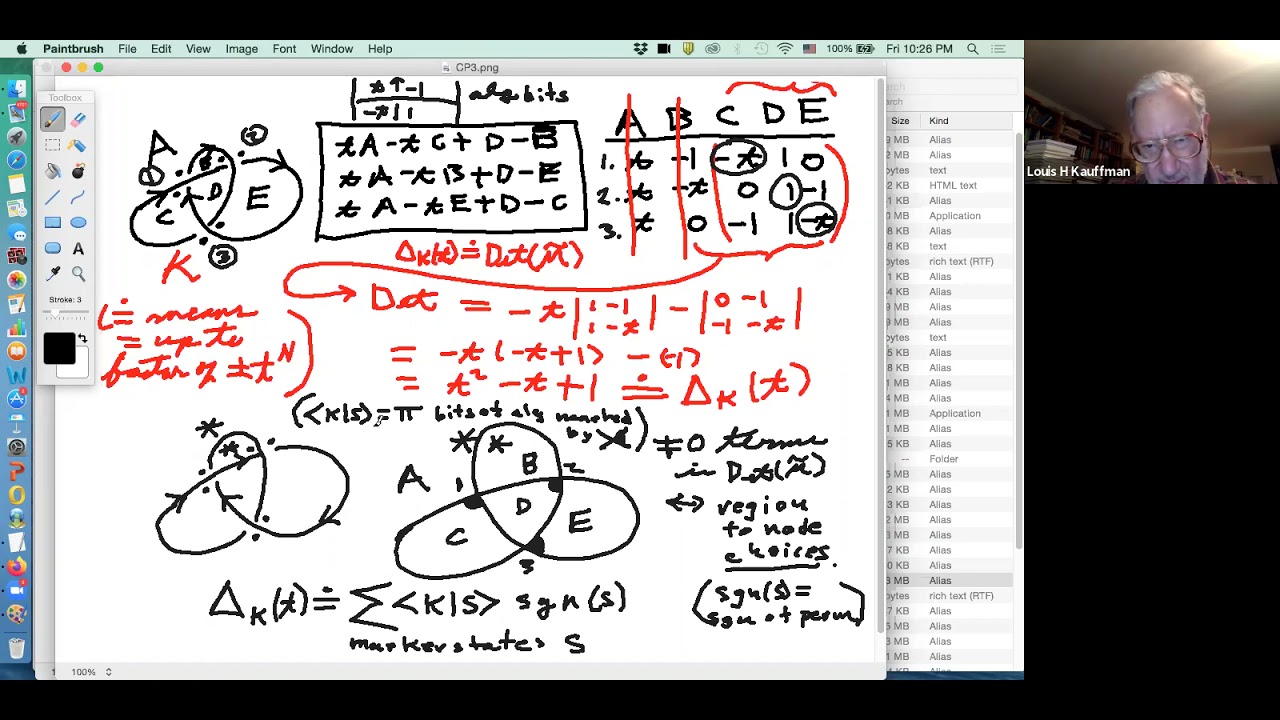
uh earlier than that there we go okay so by sudoku we worked out the whole multiplication table five element bundle associated with the figure eight knot remember how we did it we said ah let's see um we said um we have these relations a times c is equal to b i'll circle them and we have b times c is equal to a these are coming from the diagram d times a is equal to c d times a is equal to c c times a is equal to d d times b is equal to a a times b is equal to d b d equals c and c d equals b that's not everything but we also have a times a is equal to a b c d e because of the axis for the chronicle and then we said uh let's um let's assume that that the um that the rows and columns are all permutations of the quantum elements let's assume it and then we could say well we used up a b c and d and what would what would a times d be um um it must be some new element because we've already used up too many things and then we figured out that we'd better add an element e and then we figured out that that should be c and we went through and filled in the blanks and got the multiplication table and we found out that it worked and not only does it work but um it is isomorphic to the fox z 5 quandl for the figure eight knot which you can easily check if it wasn't in the notes and i don't remember whether it's in the notes or not but if you work out the z5 bundle and compare uh the multiplication tables you see that they're the same quite interesting but now we have the question that came up and let me try working that question in this same set um no i think i'll start a new set okay so okay so that'll be lecture four and we'll put well we can keep it going in there all right so we have the following question when are the rows permutations right so we're thinking a multiplication table and we have the quantum elements a1 a2 a3 and so on and we have some element b and here you have b times a1 and then you have b times a2 and so on uh and we want to know when is this a permanent mutation so that means we want to know what happens if b times a is equal to b times a prime what does that imply so case one for us we can test on something simple let's suppose it's a fox quantum box color chronicle the 2b minus a right so then we have 2a minus b equals 2a prime minus b and that implies the 2a equals 2a prime so it implies that 2 times a minus a prime is equal to zero if these are equal then two times the difference between them will be equal to zero so moral if two does not divide n [Music] we're using z on m for the for the [Music] um then a equals a prime and b times a equals b times a prime and that and so therefore when two does not divide in then the rows are permutations so that's a partial answer to the question right um that tells us that if we're if we're trying to figure out the multiplication table in the mod then you can do it by sudoku well what about the columns uh let's just put the remark in a small box here the columns are always permutations because what's the column question the column question is uh b times a equals b prime times a right that would be two elements in the same column but that is true if and only if b times a times a equals b prime times a times a and that's true if and only if b is equal to b prime so you see that that's just true in any quantity in any quantile when you make the multiplication table the columns will be permutations that says that the quantity is acting by permutations on the columns and it's worth looking a little more closely at that fashion that's going to be related to a group in general like that but we all we know the columns are always permutations but the rows are not but if two doesn't divide the modulus and we're in the box colored bundle then it will work so that was and that explains why it did work in the case of the mod five situation that was still happening with the figure eight but in general you you you don't know unless you know some extra information whether or not there will be permutations in the roles now what if we took another example of a quantum type that we could work with what if we took a times b is equal to b a inverse b and then we ask about the row problem so the row problem becomes we're going to look at a times b equals a times b prime and compare them so that means b a inverse b is equal to b prime a inverse b prime and now we can't solve something like we did when it was two b minus a equals two prime minus a and get rid of the a the a is stuck in the middle um and so um so you can think about what groups so if if in your group something was happening that was very nice then uh you could see that this would be true so we could play around with this suppose i multiply by b prime inverse b inverse so i would have a inverse is equal to b inverse b prime a inverse b prime b inverse right so i have a inverse is equal to beta some element of the group a inverse uh beta inverse now not beta inverse beta what shall i say it's just the inner reverse order product sorry let's think i'll erase you think so what do we have here this is this is what our equation is and i multiply by b inverse on both sides and then i have i have b inverse b prime here and i have b prime b inverse here not the inverse of that but just a special group element i guess i want to try another i'm looking for a way to express this so let's try a different way let's write it as a inverse times b times b prime inverse is equal to b inverse b prime a inverse that's okay right i just hold pi on here b and then b prime inverse now um still not the inverse so needs thought it would work we could analyze it as a group of zebelian but maybe we can think about groups that are not quite a billion but have some interesting property that would allow you to conclude that b was equal to b prime under these circumstances i leave it to you to think about that okay so the next item is this uh is this exercise that i suggest to you of taking somebody from the table and um trying out the coloring on it so for example i could take 5 2 from the table where's our table we can find it again well you don't need it i'm just going to draw it but if you look at the table this is 5 2.
all right that's fine too um and i'm interested in finding out about chlorine 5 2 so as i say one way to investigate this and it's quite interesting you just choose not from the table and give it a try is to just start with a zero and a one of course that's not the most general case you really should start with an x and a y and propagate around a system of equations but you can stop at zero and one and then two times one minus zero is two two times two is four minus one is three two times three is six minus two is four two times four is eight minus one seven seven and zero are communicating so we must be in z mod seven and then you could take a look at what you've colored you've used you're in you're going to be in the modulus 0 1 2 3 4 5 and 6.
um and what have you actually used here you used zero you used one you used two you used three and you used four but you didn't in this case use five or six so um so that means that if you wanted to investigate the whole quantum table you've got a good chance of perhaps getting closer if you added two more elements and then you could go ahead and try that so you can also write down the entire system of equations here and work out the uh the whole story about this um i'll come back to the matter of the whole system of equations in a moment but let me show you one more example um let's look at six two which was the dna so six two has this diagram and again i'll try this out you're on one and that's gonna be two two times two is four minus one is three ah let's see two times zero minus one is minus one i work over the integers until i have to go somewhere else two times three is six minus minus one is seven two times seven is fourteen minus three is eleven there we are so now we have z not eleven and with c mod eleven you'll see that we have left out one two three four five five new elements what you see when you start looking at particularly alternating knots you will find out that the modulus that you get grows rapidly and um a relatively small alternating eye has an enormous modulus much bigger than the number of colors that you can you can use to color the knot in its minimal diagram form so that question that i mentioned before of least number of colors raises its head and wants to be answered um there is another property that you see here which is that it was a conjecture it was a conjecture of myself and um our conjecture was that if you have k alternating and the modulus n a equals p a prime number then all the colors on a minimal alternating diagram of k are distinct i think we surprised ourselves with that guess it turned out that it was true um i proved it for alternate for rational not the class that i'll tell you about but it was eventually proved proof in general by matman and solas um as you see in these examples that's what's happening you're seeing different you're not seeing the same coloring of color appearing twice anywhere all the colors are different in this mod seven uh mod 11 or mod seven um and you could look up the mothman source paper or you could try proving this for yourself it's um it's a curious combinatorial facts so not obvious what it means topologically but it means something um let's talk now about getting our coloring uh in shape in the sense that uh what is the method of finding out what the modulus is for any diagram not just by experimenting with numbers on the diagram so let's go back to the truffle knot to illustrate so i use truffle because profile doesn't give me too large a system of equations for what we what i'm doing for truffle you could do for any any knot diagram whatsoever you label every arc and then write down an equation from each crossing so the equation from crosstalk number one is two a minus b equals c the equation from crosstalk number two is 2c minus 2 c minus a equals b and the equation from crossing number 3 is 2 b minus a equals c um of course another way to write this which might be better for these purposes would be if you have x and you have y and you have a z you could write x plus y minus 2 z equals zero right and that would all be on one side of the equation so in this case this is b plus c is 2a a plus b is to c a plus c is to b put it on that side of the equation so we have a system of equations and we're trying to solve it over the integers or over a modulus so let's look at what the system of equations looks like i have the equations for a b and c for crossing number one crossing number two and crossing number three so for crosstalk number one i have two a minus b minus c equals zero crossing number two i have two c minus a oh excuse me we're running the matrix form of a system of equations so i have 2 a minus b minus c i have 2c [Music] minus a minus b and i have 2b minus a minus c so this is our system of equations and then as i have remarked to you um it's a redundant system of equations one of the any one of these is the consequence of the other two as you can do exercise to check and so if we are i want to put it in another way as well let me make it as a statement we can choose one edge and call it's color zero the reason is as follows if i have a coloring x y and 2y minus x i think we said this before but it's worth saying again i could look at what happens when i multiply by a constant all the colors or if i add something to all the colors let's look at each in turn multiply k by a constant and you have kx ky and then you have two times k y minus k x and everybody has been multiplied including the third color by k so this is still a coloring if this is a coloring that's a color on the other hand what if i changed x by x plus n for some n and i change y by y plus n for some n then 2 y plus n minus two x plus m is two y minus two x i'm sorry plus ten i mean i get two times let's look at it two times y plus n minus x plus n and what do you get when you write that out you get two y minus x okay two n minus n is n so that's cool right that says that if it's colored x y and 2 my one two y minus x then it is also color x plus n y plus n and that color plus n so if you have a coloring of a knot and you can shift it to another coloring by adding a constant color to any colors that are there let's that's such a nice property that it's worth seeing an example take the truffle knot mod 3 0 1 2 mod 3 i believe you'll see that that's a coloring right 2 times 1 minus 0 is 2. 2 times 2 is 4 minus 1 is three which is zero now add one to all the colors that's because one and this becomes two and that becomes three which is equal to zero and it's still coloring you see that's what i'm saying that so that means that i could if i want to just choose one edge like a and decide that it's zero and then i don't have to have any equations for a and i only need the other equations and a 0 i am reduced to this little matrix here for the colors assuming that the color a is 0 i'm reduced to this sub matrix which i would call m and now i i need to figure out what i'm going to do so let's consider that and go to the next slide want to say them there's our m so i'm just using that to remind me what m was m is equal to the matrix minus one two two minus one okay and what we are concerned with is because we're assuming that a is equal to zero by assumption so our system is m times a b should be equal to 0 0 mod n for some n right but we don't know what them right we want to find our what is the appropriate answer and now comes a little bit of matrix algebra given a matrix m there exists m tilde equals the add joint of m such that m tilde times m is equal to the determinant of m multiplied by the identity you may remember this from linear algebra for example uh if m is equal to a b c d then m tilde is equal to d a minus b minus c check it a d minus b that's the determinant a minus a b plus a b zero c d minus c d and a d minus b c um so this tells us that m tilde times m is congruent to zero what we want when we work over z n where n is equal to the determinant of the matrix what's the determinant here by the way the determinant here is uh one minus two which is minus three so that's perhaps not surprising because we knew that we should be working in mod three for the trial not but what does this say this says the m tilde multiplied by any column [Music] of m it's converted to zero mod n so a column of m uh still i wanted it the other way any column of m tilde is a coloring solution i misspoke myself let me fix the slide and and we'll say what we need right because it doesn't matter it does matter uh i want m times any column of m tilde and the best way for you to think about that is if i wrote this which works in both orders but i should write it this way okay there we go so m times the joint is the determinant of m tonsil identity we're looking for solutions to m times somebody is congruent to zero so m times any column of the adjoint matrix is going to be zero m and that gives me a collection of color solutions for my knot very easy in the case of the truffle no problem but if you have a large knot you see that this is a simple linear algebra problem to do you um you need on your computer to set up the matrix m um to find its determinant and find its adjoint and of course on a computer m tilde is equal to the determinant of m multiplied by the inverse frame um that that will get you the adjoint immediately on your computer which calculates inverses and calculates the determinants and this will be integral again after all that um and um and so you can look at the columns of this so the columns of this matrix use the computer to compute m inverse multiply by the determinant make sure you've got integers when you're back here and those are the colors um i'll leave it to you to try this algorithm out on something larger for next week just try it on something larger go to the table and take a nine or ten crossing knot and um and write down the matrix and hand it to your nearest computer and see what you get and i'll do the same with some example and show it to you next time okay um but i hope this is clear uh let's um let's just do part of it on the truffle matrix here's our m right um [Music] and uh we we want the adjoint and remember that if m is equal to abcd then the adjoint has the formula d a minus b minus c so for two by two that's easy m is minus one minus one and minus two and minus two so so that's telling us that it should be the case that for the truffle mod if you use zero uh then you could use -1 that was b and minus 2 or you could use 0 and uh minus two and minus one and of course that's correct mod three not not so interesting much more interesting if you did a larger example so i'm suggesting you try it out on a larger example and i will and you can um compare notes on what it's like to calculate these things um it is fact that the absolute value of the determinant of m is an invariant of not for that you have to um you have to settle down and look at something a little more careful you have to for example you could do it by examining how the determinant of them would behave under right meister moves i won't try to do that here but um i've given you quite a bit of work to play with with this kind of an example so let's leave it at that and go on to talk about oriented products so i'm going to talk about oriented crundles in a procuratorial way and then we'll talk about the fundamental group today and see how these are related in an oriented crundle i'm looking at an oriented knot so instead of or link so instead of just having an unoriented species i have somebody like this or maybe more interesting when you just even go up to the next knot with the figure eight knot you see that the signs of the crossing are not all one type here where we're we're talking about having crossings with uh with orientations when we do then you see that we're going to use the convention that this is the positive crosses and that's a negative crossing so the in the truffle knob that i'm on here these are all positive but in the uh but in this figure what do we have this is positive by that convention and this is positive by the convention but this is negative and this is negative so the total uh the total uh uh here is 2 minus and two plus the total here is plus so in an oriented situation i'm going to define a quantum with two operations i'm going to add a and b b going to the right and here i'm going to add 8 times b i'll write it the same way but if it goes the other way then i'm going to have an opposite or in opposite operation a sar bar b okay and then we can figure out if we if we're keeping track of orientation this way what the rules should be for such things uh after all if you have something like this then you would have an a coming into an a and growing it should grow out of an a and this would mean a star a equals a and if you have the opposite kind of crossing like this um then this would be a mystery a um uh i really wanted this to stay with my convention similar to the other cases but you see if i had a crossing like this this is coming up and meeting it going to the left uh and it's a and it's a and this would be a star a so i want this and then but this is a star bar a is equal to a so i need these two facts that i certainly need and what what about the writer monster 2 situation hey b he reversed a star b but then i get a star beast or barbie so i need that this should be equal to a and of course i need a star bar b star b will be equal to a so that's one and two and then from the third red master move you're going to find the same story but you needed for each of the operations you're going to need a star b style c a star c for b star c and a star barbie for bar c should be equal to a slab rc [Music] bubba [Music] so this is an oriented quantum algebraic another big structure that satisfies these rules and if we go to this we actually get stronger in variance of knots and links and we come closer to having topological interpretations of these that are direct so let's continue now any question about these rules we'll see them actually happening in in some examples a moment so here's an algebraic example g is a group and we define a star b to be equal to b inverse a b conjugation it looks like the previous one but this is um actually a more more uh frequent sort of operation in groups conjugation by an element and if i use the star bar it's going to be conjugation by the inverse all right and i claim that's uh an oriented chronicle structure and let's just do the exercise quickly at least up to the point so a star a that's fine a inverse a a is equal to a and a star a bar a is a a a inverse and that's also fine um what about the second one um i'll just write it out uh a star b star bar b let's do that one so that's equal to b inverse b a b inverse b right conjugate in the reversed way the conjugate but of course the group is associative and so this goes away and becomes a and um just for fun let's do the other one so we have a star b star c so we get c inverse times b inverse times a times b times c all right and the other way a times c [Music] times b times c is going to be equal to b times c inverse a times c to c uh c inverse a c right let's say c times b times c and then i have to write that out and i get c inverse b c inverse times c inverse ac times t inverse b c and working out that inverse i got c inverse b c right all right in the opposite order with the inverses c inverse b inverse c d inverse a c c inverse b c and now these inverses will kill each other often these inverses will kill each other off so this will be c inverse d inverse a [Music] b c and that's equal to uh uh that's equal to this so we're done right conjugation self distributes and reverse constitution both self-distribute remarkable and important fact so there's a quantum for you now now i want to talk about the fundamental group now i don't know whether you're used to the formalism of the fundamental group of a topological space so let me review it quickly we can speak of the fundamental group of a topological space x um i need a chosen point b and x called the base point and i will assume that x is path connected for simplicity and then the ideas as follows [Music] i have a point p and i consider a loop which is path which pulls out and comes back to p like that a loop alpha at p meaning it starts at p and it ends at p and it's a continuous mapping loop alpha is a mapping of the integral 0 1 into x continuous and alpha 0 is equal alpha 1 is equal to p so now what i'm going to do is i'm going to multiply loops or if i have a loop face to p and i have another loop face to t then i obtain a new loop alpha beta which means run along alpha and then run along bay all right and then i'm going to tell you that two loops are equivalent if you can deform one into another but i have to say this on my slide don't never going to make a group out of it by having it happen that the relationship that i define makes these invertibles so i say that two loops at p are homotopic if there exists half taking a square into s such that f of zero t is equal to alpha t loops out from beta and f of one t is i i would like to do the second coordinate i'm sorry is basically t and f of t s is a loop at p for all f belonging to the interval zero one so what that means is the following that we have the following picture we're mapping this square in and along the bottom we have alpha and along the top we have beta and this entire edge goes to p and this entire edge goes to p so that if you were to take any intermediate line this would be f of something s where s is this distance here that would also be a loop so this means do you have a continuous family this is continuous it means you have a continuous family of loots that starts in alpha and goes to bed so for example suppose that your space was an annulus a circle across the unit interval an annulus and suppose suppose that this is your base point here right and let's suppose that you not this curve it goes around for a while and then it comes back it doesn't go all the way around the hole and comes back to the origin right well then you can see that you can put this loop alpha into a family of loops by contracting it each one is continuously varying from the preceding one until finally you get down to one loop which is just theta here i can have alpha looking like that and i have i have beta of t is equal to p for all t in the interval zero one and here alpha is homotopic to beta i write twittle for homotopic so um that's the equivalence relation i'm going to put on loops i'm going to let myself deform them but of course you see you see that um it's quite possible to have another situation like the same annulus and another loop which is not likely to contract at all um we could start at the same base point and go all the way around and come back and if you try to if you try to contract this loop you run into the fact that the missing region here doesn't let you continuously deform the loop over that region and in fact you won't be able to um it's not homo topic to the uh trivial loop this is the trivial now i may be for some people re repeating things you know very well let's let's just spend a few minutes and say these things out loud so that we have them um and um and now um we need to say a bit more in order to get the fundamental group of course let's see so so i start with l of x at p which is equal to all loops at p on x which is equal to the set of all alpha taking the unit interval um in x such that alpha zero is equal to alpha one and then i define pi 1 of x p to be equal to l of x v mod acquittal where twiddle is equal to the equivalence relation on the topic of loops and then our claim is that y1 at xb is a group and that it is an invariant of x and in fact more to the point if you have h taking x to y continuous then there exists a natural extension h star taking the fundamental group of exit p to the fundamental group of y at a to t [Music] and and x star will be an isomorphism [Music] when h is a homeomorphism these are naturality properties of of our definition of the fundamental group now i wanted to discuss why it's a group um i'll leave the natural properties out we could talk about them a little bit more next time they're the easy part but seeing that a group is worth understanding and then i want to show you what the fundamentals of the complement of knot looks like so um if i have a loop half of t t belonging 0 1 then i'm going to find what will turn out to be its inverse alpha bar of t and that's defined to be alpha y minus t right and that's still defined on the interval 0 1 it just starts in the other direction and goes backward so um if we wanted to understand alpha bar um then we just start here and go that way right and go all the way back to the beginning now the claim is that if you do alpha and then you do alpha bar it's the same as if you did nothing after homotopic and the reason is the following i have to tell you about what it's like to multiply two loops first of the geometry of that so here is alpha times beta i do see when i look at all the times beta i can deform it a little bit if i want to so i can deform it right in there it comes in towards the baseball and comes back out and i can make it look like this instead of going all the way to the base point let's go part way and then i come right back along beta and continue on like that so this is gamma and alpha times beta is homotopic to gamma where it didn't have to go all the way back to the base point it can just come back nearby and then come right back over and you can see how to manufacture that i'll say this more but the point is that if you multiply curve by its reverse i can draw that reverse by just drawing it in parallel to its all and coming back to base point so this is equivalent to alpha alpha bar where i deformed it a little bit now i deform it a little bit more i go all the way out but i don't go all the way to basement i just go part way in on parallel and come back over here like that you see and then i'm going to do this even a little nearby right just keep contracting that right until finally i have this and then i have this and then i have this finally i have the identity so what i get is that alpha star alpha bar is equivalent to what i'll call e and e of t is equal to the base point for all t okay so that's going to be my identity you'll see that it is an identity times alpha bar is equivalent to the identity element and that's going to turn into its inverse that's the inverse now how do we say this in terms of homotopies while you watch here's my square and i'm trying to fill it in to create a homotopy and right here i'm doing alpha and then i'm doing alpha bar so i'm going to write that by putting the arrow in the other direction so this just means that i run alpha backwards along this part and now i'm going to make a draw and i'm going to tell you what i'm going to do at a given level in this run let's go up to s then i'm going to run alpha up to this point and this is the same point right so this is this is some place t in fact uh well i know i'm not going to do the analytic geometry because of the difference on the two sides but this is also someplace t it corresponds to t because of the way i'm parameterizing from zero to one from zero to one half from zero to one half i'm re-parameterizing but this will be basically the same evaluation point so the value of alpha bar here the valley is about but it but of course it isn't t it's really t prime and we're going to have alpha of t that's equal to alpha of t prime so this is running how this is the same as running alpha to a point and then running it back okay and then what how will i map this this interval here is going to go the whole interval is going to get mapped over to alpha t which is equal to alpha of t prime so this is a new path which runs which is parameterized on the entire interval and what it is is the following up we go then for a certain period of time just sit there ah that's this period of time and then we could walk backward uh and come back to face point now as you see as i go up higher i'm using less and less of the curve up here i'm using a little bit of the curve a lot of constant time and by the time i'm all the way up to the top i'm only mapping to [Music] p so this is the construct of the homotopy of alpha star alpha bar to e now i forgot to mention reparameterizations so we'll keep to that and go back to something more fundamental in a moment multiplying paths what does multiplying paths look like well first of all i have to tell you how to multiply paths i i told you in geometrically how to multiply paths so what am i going to do i want to define alpha star beta taking the interval from 0 to 1 into x and i know how to define alpha on the interval 0 1 and so on so it's quite clear what i want to do i want on the first half of the interval to do alpha so that's going to be alpha of 2t for zero less than or equal to t less than or equal to one half right and that will do that will run alpha i'll run all of alpha from zero to one but it will compress it into the first half of the interval and then i need to do beta and i need to start it at one half and so i i want to start at in half at um i want to start at and that will correspond to zero for the parameter for beta and i'm going to go uh um i'm going to go to one which will correspond to the one for betas i didn't think this through beforehand so what do i do um i have to take um i need that a t plus b should be equal to one half when t is equal to zero and it should be equal to one when t is equal and should be equal to one when t is equal to one so when t is equal to zero we get b is equal to one half and then um when uh when t is equal to one we get a plus b and that should be equal to one so a should be enhanced so this should be equal to beta of t plus one over two for zero less than or equal to one half for one i'm sorry four for one half less than or equal to t less than or equal to one check it if t is equal to one half uh then you get oops or i did the inverse very sorry we want a t plus b so that uh when t is equal to one half it should give us zero now when t is equal to one it should give us one so a over two plus b is going to be equal to zero and a plus b is going to be equal to one which says that a over 2 is equal to 1 which says that a is equal to 2 and then b is equal to 1.
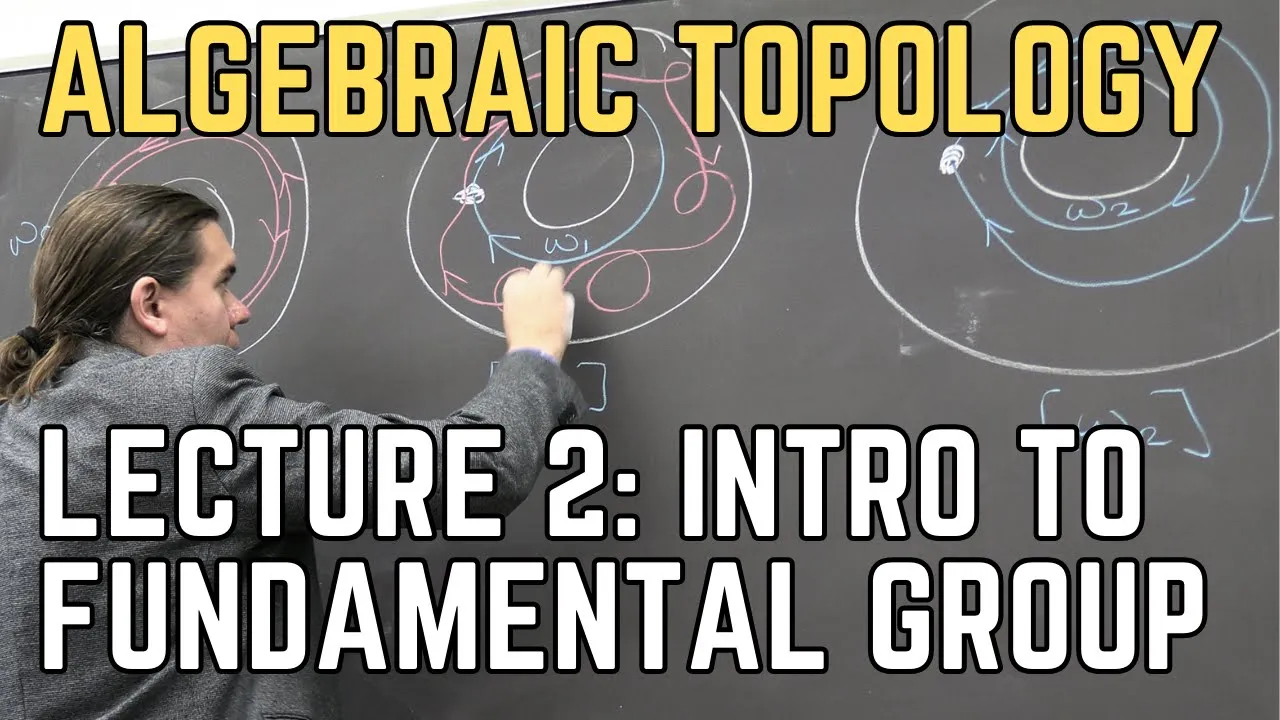
so so that says that but this should be equal to [Music] 2t minus one all right let's see when t is equal to a half i get zero and one t equals one i get one there we go okay right um i may have written something a little long but we got that corrected okay so just look at it now the point is you do need to do if you want to actually get used to doing these things you could should do a little bit of the analytic geometry to make sure that everything works right and then after a while you're going to stop doing all of it but um this this this tells you how to multiple two paths right and did we get it right when t is equal to one half we get beta of zero and when t is equal to one we get beta one so this is running beta now i wanna claim alpha star beta for gamma is homotopic to alpha star beta star gamma and then we're in a ballpark of having a group so this is what the parameterization would look like if you did alpha star beta and then gamma and this is what the parametrization would look like if you did alpha star beta star gamma right so we want to find a homotopy that starts here and ends here and you see what you do you start shifting the parameterization so the parameterization is the one that you would get by iterating this and you would start here or here but in the middle you're shifting the endpoints of the parameterization in the middle until as they move along so you do alpha a little longer you do better or shift it a little bit and you do gamma and so on and you get homotopy quite clearly that goes for me from one association to the other and so we have association associativity and now or one last thing multiplication by e here is e which is always constantly at the base point and here is alpha i'm multiplying on the left on the right and you want to see that it's homotopic to alpha and so you just do that changing your parameterization and staying at the base point for shorter and shorter periods and as you do here you're parameterizing alpha for longer and longer periods but you're doing all of alpha just running it over a longer parameterization until it's always just alpha and this is the homotopy of alpha times e equal to alpha and also e times alpha is homotopic to alpha on the other side so so you see that once you get used to how to make these homotopies you can see very clearly what the fundamental group is this is a general a general construction which works for any topological space but we're interested and we want to get to this point before we today we're interested in seeing what it looks like if we are dealing with the fundamental group of the complement of the knot and so if you're dealing with the complement of a knot then you see your space consists of all of three-dimensional space except for the knot and you could choose the base point out here and you can have curves which wander around the knot now i'm going to have to do a little eraser to make this a convincing picture okay so so here's an alpha um which is running around not and and um and it's telling us something in the group in the fundamental group of the complement of the knot it's telling us something about the way the nod is uh by the fact that it apparently isn't going to be homotoped off the line but what kind of relationships among the elements of the fundamental bar there and what will generate it well the answer to generation is the following for every arc in the knot we'll orient it because we'd like to have a direction on the loops as well and then for every for every arc in the diagram we're going to run a loop which comes around the arc in the diagram and runs back to base point so it just you can think of the base points high above the plane and you come down to the arc and then you go around the arc and come back all right and i'm going to use the right hand rule so that this is the orientation if this arc is a then i will call the element in the fundamental group that corresponds to an a as well and so the arc uses the right hand rule the right hand rule is this that if you have a loop that goes around an arc like this and this is five right orientation by right hand rule now i come to the fundamental thing that we can do in a minute or two and then we'll quit i know we're a little over time suppose you're two arcs of the knot running parallel to one another like this and suppose they add an element in the fundamental group which encircles both of them all right i guess i will obliterate that orientation rule maybe there's no need to but we'll we need a little extra room here okay now i want to homotop this loop and i'm going to homotopic in the following way you'll see hmm sorry so i hope my picture convinces you that c the loop that encircles both of them is homotopic to the product of the loop around b by the right hand rule times the loop around a by the right hand rule remember the base point is up above the border and i just pulled in here and pulled back until i got near the base point so that first i go around b and then i go around a and i'm following my rules that's the key to seeing something marvelous that's going to be on our next slide and we'll stop with that uh oop okay here's a crossing here's um somebody let's call him b and there's somebody else oh i like to call him a it doesn't matter but i do like kong a and i'll call this one b and this one's e and now we have we can apply the ideas that we just worked out so that means that if i encircle both of these like that if i insert both of these like that then this this loop here is the product a times b remember it was the right loop times the left but this loop here can be deformed certainly until it goes all the way around the top part that's not a problem but what's this this is bc so that implies that a b equals b c in the fundamental group of the three dimensional space minus the not or in other words c is equal to b inverse a b remember that that's our quantum operation so what we're finding out is that the fundamental group has one relation forever crossing and it is exactly this conjugation relation that we saw was a quantum structure so that the fundamental group of the complement of the knot naturally has and naturally is related to the quantum structure that we understood would be invariant and if you stay at the level of the topology uh then it turns out that it is a fact or a theorem it is the fact that the fundamental group of the complement of a narrow link in three-dimensional space is generated by the loops corresponding to the arcs in a diagram and one relation relation per diagram per crossing one relation for crossing and that's the relation so so with this we've come full circle from thinking purely algebraically and combinatorially about invariants of mounts and rings and the bundles over to the fundamental group which is part of a general scheme for getting invariants of topological spaces and this general scheme uh gives us a condle structure on the not group on the fundamental group of the complement of the knot so uh if you want to think about uh something for next time you can think about the way the structure of fundamental groups looks uh starting with the profile let's just very quickly show that and then we'll stop so if we wanted to understand the fundamental group of the truffle or not then we can say generated by a and b and c and and the relations are that c is equal to b inverse a b that um b is equal to c inverse ac and that a is a is equal to b inverse c d so that the fundamental group of the complement of the trifold is given by generators a b and c and relations above and then here's an exercise show show that g is isomorphic to the group generated by just a and b such that a b a equals b a b that's an amusing exercise easily done by putting in c into the formulas and eliminating it and get just getting the relations for a and b we'll say more about that next time and and we will also go on to alexander polynomial and jones polynomial next time so thank you for bearing with and i'll stop there
Up Next
9:58
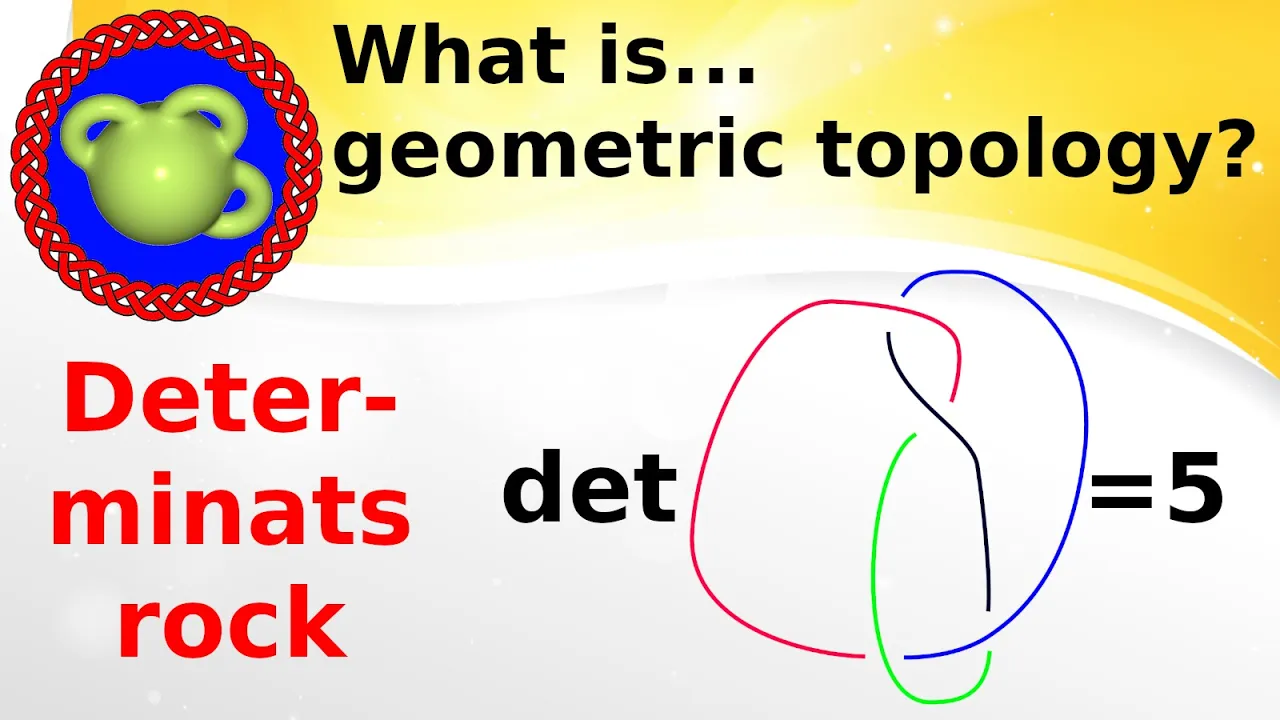
Knot Determinant: Understanding Colorings via Linear Algebra
@VisualMath
1K views•2022-08-16
4:43
Elliptic Curve Cryptography Explained: ECC, ECDSA, ECDH
@PracticalNetworking
28.5K views•2024-10-21
10:44
Fourier Series Introduction: The Big Idea Explained
@DrTrefor
387K views•2021-05-03

6:00
The Mathematical Impossibility of Accurate World Maps
@Vox
23.3M views•2016-12-02
Related Study Plans & Knowledge Roadmaps
Structured learning paths in Mathematics
mathematics
Tensor Calculus: Vectors to Riemann Curvature
01Mathematical Foundations: Linear Algebra & Calculus
02Covectors, Dual Spaces, and Tensor Basics
03The Metric Tensor and Index Gymnastics
+ 2 more learning modules
40h5 modules
Explore Roadmap
mathematics
Gödel's Incompleteness: Logic, Proofs & Limits
01Introduction to Formal Systems & Hilbert's Dream
02Set Theory, Cardinality, and Cantor's Diagonal Argument
03Arithmetization and Gödel Numbering
+ 2 more learning modules
14h5 modules
Explore Roadmap
mathematics
Galois Theory: Fields, Groups & Solvability
01Foundations of Abstract Algebra: Groups & Fields
02Polynomials & Field Extensions
03Splitting Fields & Symmetries
+ 2 more learning modules
24h5 modules
Explore Roadmap
mathematics
Non-Euclidean Geometry: Models & Geodesics
01Euclid's Fifth Postulate and the Birth of New Geometries
02Hyperbolic Space and the Poincaré Disk Model
03Geodesics: Defining Straight Lines in Curved Spaces
+ 2 more learning modules
15h5 modules
Explore Roadmap