










![[Discrete Mathematics] Modular Arithmetic](https://i.ytimg.com/vi_webp/d-n92Ml1iu0/maxresdefault.webp)

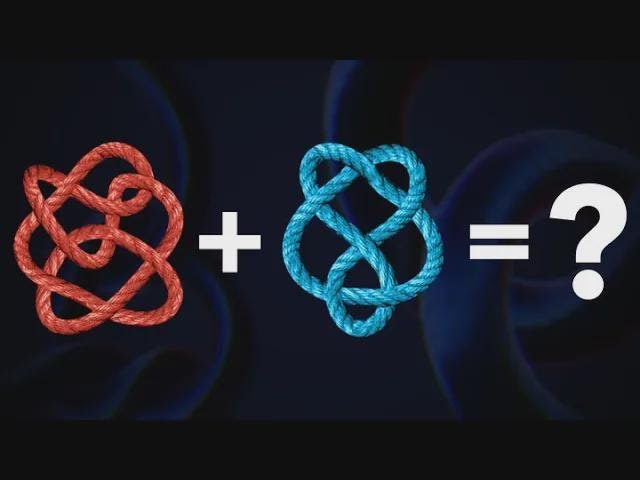









The knot determinant is a linear algebra invariant computed from a knot's matrix representation, where each crossing contributes +2 for over-strands, -1 for under-strands, and 0 for non-involved strands; a knot has an n-coloring if and only if its knot determinant is divisible by n, providing an algorithmic method to determine colorability without exhaustive case-by-case checking.
Knot Determinant: Understanding Colorings via Linear Algebra
Added:Basic Knot Theory: Understanding knot diagrams, crossings, Reidemeister moves, and the concept of topological invariants.
Knot Colorability: Familiarity with Fox n-colorability (specifically tricolorability) and how crossing rules dictate coloring constraints.
Linear Algebra Fundamentals: Mastery of matrix representations, solving systems of linear equations, and calculating the determinant of a matrix.
Modular Arithmetic: Comfort with performing algebraic operations modulo a prime number p, which is essential for analyzing p-colorability.
The Alexander Polynomial: Exploring how the knot determinant is a specific evaluation (at t = -1) of this fundamental polynomial invariant.
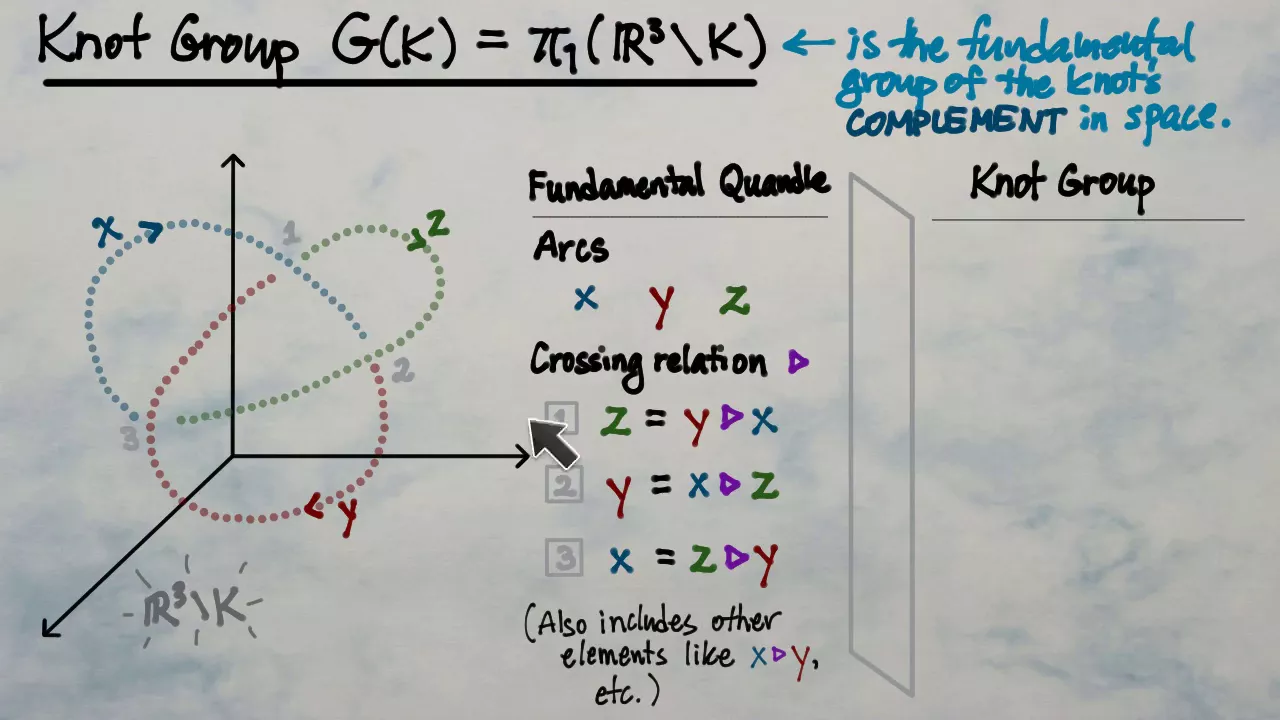
Knot Group and Fundamental Groups: Investigating the algebraic topology of knot complements using the Wirtinger presentation.
Jones Polynomial and Quantum Invariants: Transitioning to modern, more powerful polynomial invariants that offer deeper topological insights.
Khovanov Homology: Studying the categorification of knot invariants, which replaces polynomial invariants with chain complexes and homology groups.
1K views40likes9:58Original Release: 2022-08-16
Okay, welcome everyone to my continuation of what is geometric topology. Today I would like to tell you a little bit more about colorings um a linear algebra way to attack the coloring problem because a coloring problem as we will see well or as I will sketch is not completely trivial. Um and the kind of the solution if you want will be given by a determinant and not well it's just the determinant that gives the solution is called the not determinant whatever. So let's have a look and it's actually pretty cool. So linear algebra plus not theory which is always a good connection. It's always just a really good linear algebra is great and not theory is also kind of fun both together and it will be a lot of fun. So that's what we will do. So uh remember from last time the coloring rules. So um for the three color ability for example um you either every crossing had a monochromatic coloring or you had one of these uh where every color appears and such something like this is bad and then there was an example of the trifle that's a very nice trifold of the figure eight knot and well it's not you can't color it with three colors but it's not quite obvious to see so you kind of need to play around a little bit. um just try all possibilities and trying all possibilities is usually not the best way of doing something right try all possibilities and brute force approach I'm always using the brute force approach but it might not be the best one um and the idea is now to kind of still try everything but in a linear algebra fashion so you try everything in a smart way and well up it's just not easy to decide whether you have this end coloring because it will be for a huge knot again it will be kind of brute force you need to test everything. Not a good idea. Um it would be much better to have some algorithm to decides very easily whether something is colorable or not. And turns out that you can and basically you turn as I said the I need to do all possibilities into a linear algebra problem where you solve a certain type of equation and you solve those equations using a determinant.
That's but what a determinant is for the determinant tells you whether a certain system has a unique solution. Basically, that's what's going on. Okay, let's have a look. It's actually pretty easy. It's pretty nice. So, here's now it's really the trifle. By the way, here's my example. Um, the trifle knot. And what you do is you color all arcs or all segments of the knot. Um, you give it a number. So, uh, so here I have my segment C1, segment C2, the blue one, segment C3, the green one. And you also give the crossing some numbers. Um, so here's crossing one, here's crossing two, the blue one, the green one, and the orange type crossing is crossing three. And you put everything in the matrix in the following way. So matrix associated to a knot. Um, so crossing one, crossing blue, so crossing green, crossing blue, crossing whatever orange, whatever it is, uh, segment one, segment two, segment three. And in general you get this huge square matrix a number of crossings number of segments. Um and you just read off a local contribution and sum over all of them. So whenever we will do this in example life. So whenever something goes over your arc goes over it contributes two to the crossing. Whenever it goes under it contributes minus one. And whenever it's not appearing at all it just contributes zero. So let's have a look at an example here for example. So this one is the green crossing. And I look at the strand that goes over. That gives me a plus two. And that's clearly well it is just the C1 strand. So I put a plus two here.
Um but the C1 strand also goes under. It gives me a minus one. I put a minus one here. And the remaining strand is the blue strand C2. So I put a minus2 in the blue column. And this one is boring. It doesn't appear. Okay. Let's do another one. The last one maybe. So we look at the red crossing again blue very nice blue red goes over red goes under so 2 minus one blue is not involved at all green is the remaining color you write this down very simple you write this down you get a matrix and matrices well it's a matrix right so now we have linear algebra so you can associate this matrix MK to every knot in a very very straightforward fashion just so what you very often do in this setup is just you you color segments into color crossings and put everything together in some kind of matrix type fashion and that's exactly what's happening here. Um, okay.
And then so here's another example. So let's try to do this as well. So this is a Tfoil and a Tfoil is very symmetric.
So the matrix you get is also very symmetric. So let's just do one of them.
So I did what I did here. I just numbered or colored whatever you want to call it the segments again. I have segment number three. This is three. I have segment number one. I have segment number two and I also numbered the crossings. So here's two, here's one, here's three, you get a 3x3 matrix and for example for crossing one, blue goes over so you put a two, the other two go under so you put two minus ones and so on. Um, turns out that not because everything is kind of closed will force the matrix to be degenerate. So there will be a linear relation among the columns and rows and you can get rid of that by just getting rid of one relation. It's a little bit like cutting the knot open if you want but simply algebraically speaking you just get rid of one column and you just get rid of one row. You have a remaining matrix and you take its determinant and haven't miscalculated here the determinant of this 2x2 matrix is three and that's what you call the not determinant right so the not determinant compute the not matrix get rid of one column and run row because the not forces um the matrix to be degenerate anyway so the determinant will be zero. If you do that, the determinant could still be zero, but it might not be zero like in this example.
In this example is three. So you get a number associated to every knot. And then the statement is actually pretty cool statement is the following. So a not determined by some projection is divisible by n. So the not determinant if and only if it's divisible by n for any projection. So the this definition our priority depends on the it depends on the projection. But still you get this result that it's divisible if and only as for any projection and it's if and only if the not has a coloring. So you can now check algorithmically whether a not has a coloring and that's pretty pretty cool. So for this guy for example you would write down the matrix you check that the determinant is five, right? Three doesn't divide five. So it's doesn't allow a three coloring. It doesn't allow a seven coloring either or an 11 coloring or whatever. But it does allow a five coloring because well determinant is five. That's clearly divisible by five. And actually the example I had all the time is a five coloring. It just uses four colors namely in this case black as a uh the first color. So red, green, blue and black. And you can identify them as numbers s if you want to do the calculation and they will satisfy the condition on being a coloring. I mean that's pretty cool right? So you just associate a object of linear algebra and in linear algebra you compute determinance. So that's kind of simple and just the divisibility of the determinant tells you uh how it's colorable. So if it would have something like 3 * 5 then it would be colorable by a three five and 15 um and and so on. So here five just tells you it has a five coloring. It has a five coloring. So that's a new result. It's not quite trivial. Well, of course, if I just write down the coloring, it's not too hard to check, but to check it by hand is much much harder. Um, and even worse, if you would need to check whether it has a 21 coloring, quite a lot of cases to check by just computing the the matrix. Well, that's much easier and check what the determinant is and check whether it's divisible by whatever kind of number uh you're looking for. Okay, but there's still a catch. Obviously, there's still a catch. Here's my running gek. So um that the determinant the not determinant and not matrix actually doesn't see the difference between mirror images. So those are the two mirror images the left-handed and the right-handed trifold. So they both have determinant three which means the trifold is three colorable but not five whatever blah blah blah. Um so we get this sequence associated to it. So it's three colorable it's not five colorable it's not not whatever blah blah blah blah but this gets exactly the same sequence. So we still can't say anything about the left and the right-handed trifoil. So it's still not good enough. Although we take now all possible colorings into account and it's still not good enough to detect uh the left or the right-handed trifoil. So strictly speaking, we still don't know whether they are the same or not. Anyway, so the coloring is kind of cool, right? It's a cool idea. It's pretty simple. And here's an was an algorithmic way to actually compute whether something is colorable, which is pretty cool. So you really just need to write down a matrix and compute its determinant and check what the devices on the determinant are which is pretty straightforward. Um and the computer can do it very easily but it's not a perfect invariant. Why should it be? So for example we can't distinguish the left and the right-handed um Tfoil. We can distinguish the Tfoil from the figure eight node and we can distinguish the figure eight knot from the unnot because the unnoting and the figure eight figure eight we found five coloring. So it's not the unmot again if you build those alo rope it's it's pretty simple to see but that's not the point here right uh but it's not perfect so we need to look for more environments in particular I'm a little get a little bit pissed here that we can't distinguish the left and the right-handed trifold we should really be able to do that anyway I hope you enjoyed the video and I also to see you next
Up Next

9:57
Introduction to the Kauffman Bracket (Definition and Axioms)
@richardhepworth1441
5.8K views•2015-03-11

4:43
Elliptic Curve Cryptography Explained: ECC, ECDSA, ECDH
@PracticalNetworking
28.5K views•2024-10-21
20:20
Normal and Separable Field Extensions Explained | Abstract Algebra
@VisualMath
957 views•2021-07-13

6:00
The Mathematical Impossibility of Accurate World Maps
@Vox
23.3M views•2016-12-02
Related Study Plans & Knowledge Roadmaps
Structured learning paths in Mathematics
mathematics
Tensor Calculus: Vectors to Riemann Curvature
01Mathematical Foundations: Linear Algebra & Calculus
02Covectors, Dual Spaces, and Tensor Basics
03The Metric Tensor and Index Gymnastics
+ 2 more learning modules
40h5 modules
Explore Roadmap
mathematics
Gödel's Incompleteness: Logic, Proofs & Limits
01Introduction to Formal Systems & Hilbert's Dream
02Set Theory, Cardinality, and Cantor's Diagonal Argument
03Arithmetization and Gödel Numbering
+ 2 more learning modules
14h5 modules
Explore Roadmap
mathematics
Galois Theory: Fields, Groups & Solvability
01Foundations of Abstract Algebra: Groups & Fields
02Polynomials & Field Extensions
03Splitting Fields & Symmetries
+ 2 more learning modules
24h5 modules
Explore Roadmap
mathematics
Non-Euclidean Geometry: Models & Geodesics
01Euclid's Fifth Postulate and the Birth of New Geometries
02Hyperbolic Space and the Poincaré Disk Model
03Geodesics: Defining Straight Lines in Curved Spaces
+ 2 more learning modules
15h5 modules
Explore Roadmap