
















In direct drive wheelbases, encoder resolution (measured in bits) determines the precision of force feedback by calculating position pulses per revolution; a 15-bit encoder provides 32,768 pulses per revolution, meaning higher resolution results in smoother force feedback and more detailed road feel, though actual user experience also depends on motor type, build quality, and software implementation.
Moza R5 Bundle Review: Entry-Level Direct Drive Wheelbase Analysis
Added:Understanding the differences between gear-driven, belt-driven, and direct-drive force feedback mechanisms in sim racing.
The physics of Force Feedback (FFB), including the concept of torque (measured in Newton-meters, Nm) and signal clipping.
Basic components of a sim racing setup, specifically how wheelbases, steering wheels, and pedals interface with a PC or console.
Fundamental knowledge of control software and driver suites used to calibrate gaming peripherals.
Advanced Force Feedback tuning, including damping, friction, and inertia settings to match specific car physics in simulator software.
The role of load-cell technology in pedal sets and how it compares to standard potentiometer-based pedals for braking consistency.
Comparative analysis of mid-range and high-end Direct Drive systems (9Nm to 20Nm+) to evaluate the law of diminishing returns in haptic fidelity.
Mechanical engineering principles of cockpit rigidity, specifically managing the flex and structural demands of direct-drive forces on aluminum profile rigs.
5.8K views91likes11:38Original Release: 2023-07-17
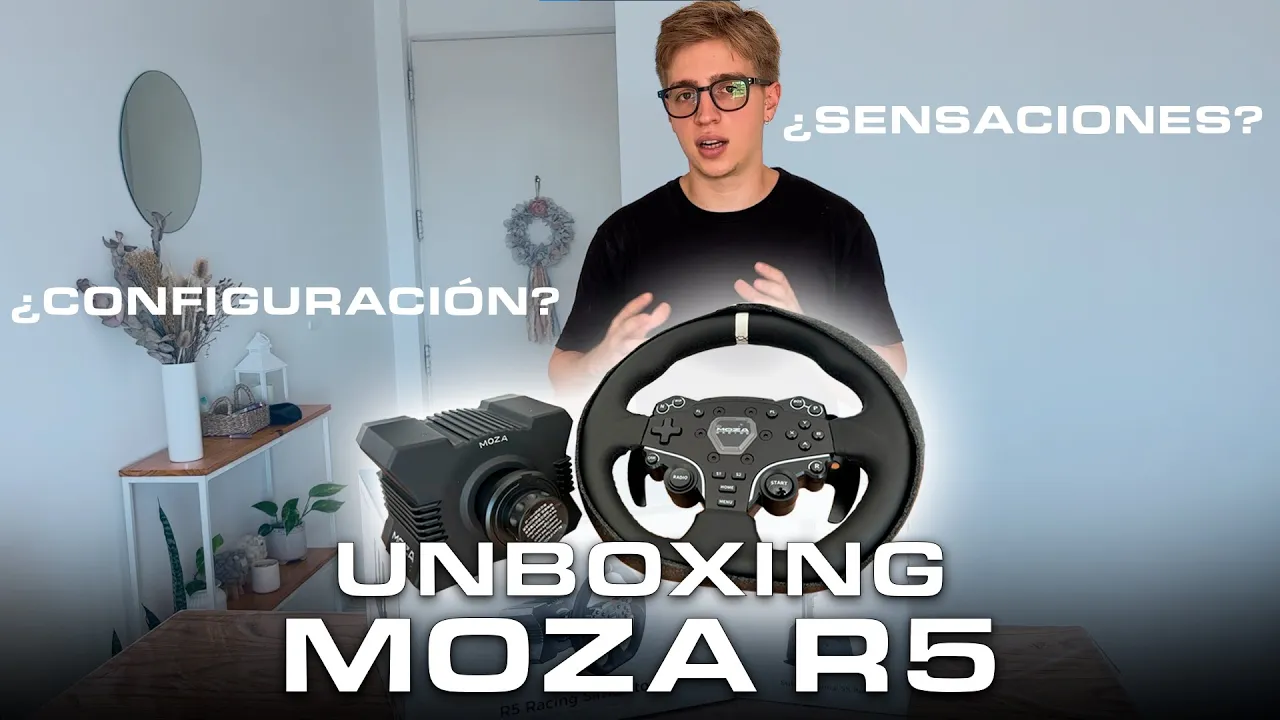
so you love driving but the fuel expenses are off the charts maybe you want to drift a lot but the tire and tuning expenses are worrisome maybe you want to drive around in your favorite race track but you live too far away or maybe maybe you want to drive your car up that beautiful mountain in your backyard but you don't have a rock crawler because your wife doesn't does not the list goes on and on and this is exactly where Sim racing Bridges the Gap welcome ladies and gentlemen to this five and a half Newton meter power pack review of moza R5 this video has been made possible by virtual racing hub the One-Stop shop for all your sim racing needs in India whether you are in need of a sturdy rig or a certain Sim racing product they have got you covered and if you are planning on purchasing from them use my code dartsnape to get 10 off on most products all the links are in the description box down below they say happiness comes in small packages but in the world of sim racing this hasn't necessarily been the case because you see sometimes the boxes are really big and heavy while other times they are small and well still sort of heavy such is the case with the Moses R5 bundle this little offering from moza includes the five and a half Newton meter wheelbase the es wheel which features the energy style quick release and the SRP light pedals which do not come with a clutch because that is sold separately also a side note these are Hall sensor pedals not load cells this bundle comes at a sweet sweet price of 500 US dollars if you are looking to upgrade from your existing non-dd setup or if this is your first ever wheelbase you are in for a treat moza brought some heat with the introduction of R5 it was introduced after R9 and is considered an entry level DD but what if you're thinking about R9 well to that I would say why not R5 as much as I want to I would rather not talk about how it feels amazing or how smooth it is when I turn the steering or anything like that because what I am feeling is not going to help you right and let's be honest there's no fun in that because in the end you will still have questions such as which one to pick between R5 and R9 is that enough or should you even go for R5 considering it only has a peak torque of five and a half newton meters so instead of talking about obvious stuff let's talk about why R5 is an amazing base and how moza was able to achieve the same things on R5 in contrast to the R9 okay good so if you are unfamiliar with the price of this bundle it sells at about 500 US Dollars which is a great deal but should you buy it just because it is priced appropriately hmm let's find out so the thing which makes R5 stand out and quite simply the best thing about it is its encoder resolution which is 15 bit if you don't know what an encoder is it is a sensor which is responsible for determining the position of the motor and oftentimes you might have come across this term while talking about certain bases from manufacturers such as fanatec or simicube or moza itself but what exactly is this 15 bit of resolution in moza R5 and why should you care let me explain a bit is a binary unit which means 15 bit is equal to 2 to the power 15 which is 32 768 tpr or pulses per Revolution now this is the exact same resolution that you will get on a mosar 9. meaning whatever you would feel in an R9 it can be felt on an R5 too minus the higher talk obviously so if you are still confused don't worry let me put it this way the higher the resolution the better the details will be on the force feedback obviously this isn't the only Factor on which the details depend upon of course the type of motor matters as well but generally speaking the better the resolution is the smoother the bass feels and the more details you encounter while the R5 and R9 are stated as having 15 bit of encoder resolution the R16 and r21 have 18 bit what does that mean it means that each time you have to calculate the resolution you just have to do simple math on exponents or ask Google as to what is 2 to the power 18. and the answer is 262 144 PPR pretty simple right so now when you know what a resolution is does that mean you should simply assume that higher resolution means a better feeling DD well to some degree yes the higher you go up in terms of resolution the minimal the difference becomes such as an 18-bit symmetric Alpha U would be very close to say a 22-bit vrs direct Force Pro or semi-cube2 Pro but now we are approaching the territory of subjectivity again because force feedback still has a big role to play and some people might not even feel the difference when dialing an 18-bit base and a 22-bit base to their liking sure they might be able to Spot the Difference jumping back and forth because while the difference will be there it just won't be that significant with that said I hope you have a better understanding of why the R5 is a great entry level base and why it feels very close to an R9 now you may be wondering that while R5 checks all the boxes for an entry level DD what is the catch here well moza knows what a customer wants they know their market and they are very well aware of the thing that force feedback is the only factor which makes or breaks the experience and that's exactly what they did they did an outstanding job on making the wheelbase and software experience a delight but they paid a little bit less attention to the esfm and my opinion it is the only thing which holds the R5 back upon unboxing I found the leather to be comforting the buttons to be clicky and the build quality to be slightly average you see while the R5 is a fantastic base it loses some points on the rims build quality they did a fantastic job with their wheelbase and I understand that for a delightful experience the force feedback has to deliver which it does but I don't know I was a little bit unimpressed with the overall build of the rim considering how well built and premium they are Cs and GS rims are I remember when I held my CS for the first time I was pretty much Blown Away by the quality and once you have experience that solid construction you're bound to expect something like that but on a lower price range without a whole lot of compromises the wheels structural Integrity did not feel like other rims that moza offers I understand that es is priced significantly lower than their CS but the cost cutting affected my experience a little bit now the easy solution would be to use a different Rim such as CS right maybe let me explain because the es weighs around one kilograms the base has little to no problem on rotating it whereas the Cs weighs around two and a half kilograms which means if you use a heavier Rim the motor has to work harder to rotate the wheel because of the added weight and diameter and since the overall output of the base is limited to 5 newton meters the R5 will have a hard time don't get me wrong it will still be usable but you might lose some details also I found the oscillation to be outright evident I'm not sure what causes it but fiddling with damping and inertia quickly solve it but if we keep the force feedback matter aside which obviously is highly subjective my only issue with R5 bundle Remains the average build quality of ES if moza could improve upon this this bundle would be a solid starter pack watched my video of the switch from moza R9 to Alpha U you might remember that I said that it's not simply about the torque output it is about how it is being delivered and that is where the software support comes in for example you can have the best track racing car but if you are planning on using off-road tires on a sunny day on tarmac chances are you might finish first but from the bottom of the leaderboard in order for you to have a better chance of winning you need proper tires similarly you can have a 30 Newton meter wheelbase but if the software is lackluster the base won't be able to put all of that power to use but luckily that is not the case with moza pet house the UI is very clean and beginner friendly a bunch of pre-loaded profiles are present with which you can play around just in case you are struggling to set up your own first feedback settings you also get this frequency slider with which you can increase certain frequencies for instance if I want a bit more feel in the sand I can simply increase this and voila more feedback on this ad I tried to make this segment a bit longer but because the software is so well done I don't have a lot of words to say about it except job well done when it comes to buying a wheelbase console compatibility Remains the primary deciding factor although the R5 bundle is a really great starter pack for anyone looking for a step up in their Sim racing Journey it lacks console compatibility which a lot of people including myself was really looking forward to it while some users have been able to make it work on PlayStation 5 using a converter such as this one does not work flawlessly so for now moza's DDS are PC only so if you play on Xbox or Playstation you might want to consider something else from fanatic or Logitech now that you're here I'm going to assume that you have watched the whole video if you plan on buying this I recommend that you go back and watch it completely so that you can have a clear understanding of what is being brought to the table and what moza brought to the table is something which has heated the competition quite a bit the R5 base holds itself amongst their 9 Newton meter wheelbase while being priced considerably low even if you do manage to get an R5 instead of an R9 you won't be disappointed because Frankly Speaking this does not feel like a 5 Newton meter base at all the details are as good as it can get I haven't noticed any notchiness at all and the best of all this bundle is for people who are looking for an upgrade from their existing setups I'm sure the pedals would be the first thing you would want to upgrade as they are not load cells but when you look at the pricing of this thing you won't be able to nitpick let me know what you think of this video or if you have any questions let me know in the comment section down below I have been dark Snape and may the downforce be with you
Up Next

8:10
SimpleFOC Lesson 2: Basic Testing of Makerbase Motor Driver
@makerbaseteam4217
3.7K views•2021-04-07

26:22
Walking in the City: Urban Rituals and the Flâneur in Contemporary India
@PSBTIndia
1.9K views•2016-08-02

9:49
FastAPI vs Flask vs Django: Choosing the Right Python Web Framework
@TechWithTim
302.5K views•2024-05-26

1:42
Game of Thrones Opening Credits: A Cinematic Analysis
@gameofthrones
46.3M views•2011-04-18
Related Study Plans & Knowledge Roadmaps
Structured learning paths in General & Interdisciplinary Studies
general-studies
Artificial Light: History, Tech & Human Impact
01The Pre-Electric Era: Fire, Oil, and Gas Lighting
02The Incandescent Revolution and Grid Electrification
03Gas Discharge and Fluorescent Illumination
+ 3 more learning modules
14h6 modules
Explore Roadmap
general-studies
Elevator Engineering: History, Physics & Cities
01From Hoists to Safety Brakes: The Dawn of Vertical Lift
02Hydraulic vs. Traction: The Engineering Physics of Elevators
03Modern Speed, Safety, and Algorithms
+ 2 more learning modules
12h5 modules
Explore Roadmap
general-studies
Rubber: Material Science, History & Geopolitics
01Origins of Natural Rubber & Mesoamerican History
02The Chemistry of Natural Rubber & Vulcanization
03The Geopolitics of the Rubber Boom & Colonization
+ 2 more learning modules
12h5 modules
Explore Roadmap
general-studies
Containerization: Evolution, Logistics & Trade
01Ancient Trade & Bulk Cargo: Amphorae to Barrels
02The Industrial Revolution & Cardboard Packaging
03The Containerization Revolution: Malcom McLean
+ 2 more learning modules
12h5 modules
Explore Roadmap