






![[Vật lí 11] Chương 1- Bài 1- Điện tích Định luật Culong- Lý thuyết](https://i.ytimg.com/vi/gA9AtKXvusg/maxresdefault.jpg)






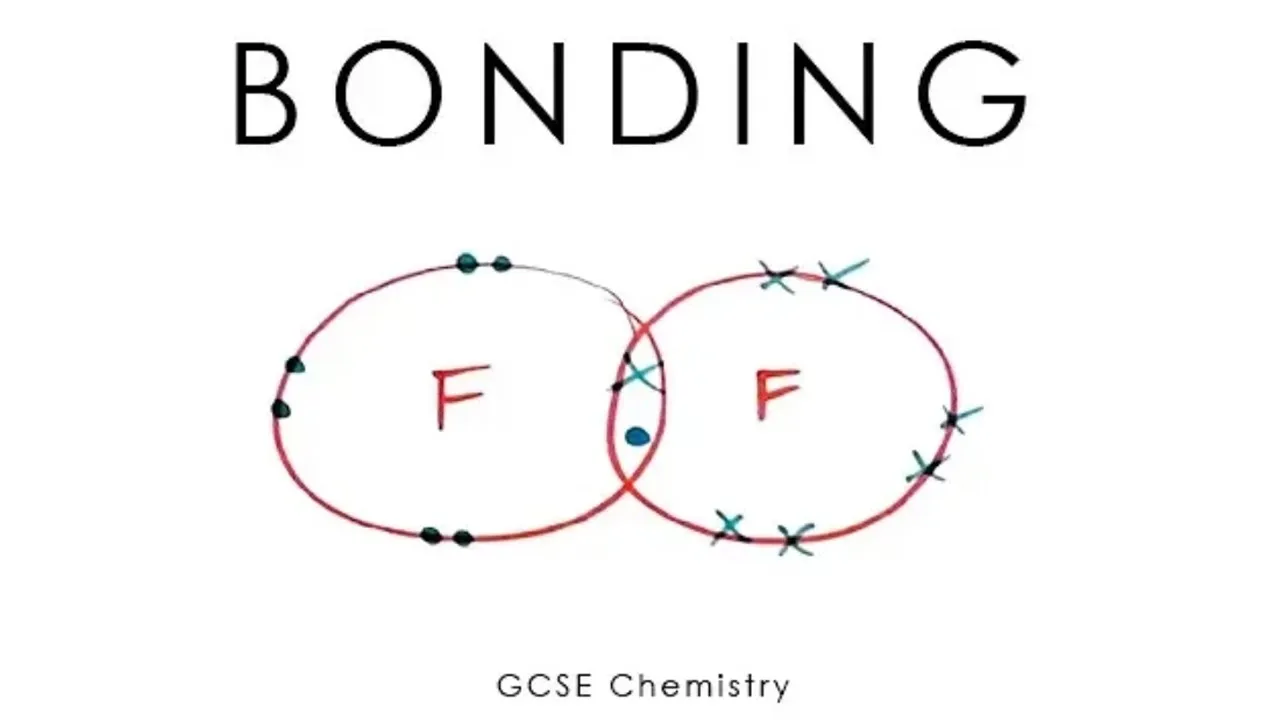








Electrons are best understood as wave-particle dualities that exist as standing waves in orbitals around atomic nuclei, with their behavior governed by quantum mechanics; electrons fill orbitals according to specific rules (s-orbitals hold 2 electrons, p-orbitals hold 6, d-orbitals hold 10), following a diagonal filling order (1s, 2s, 2p, 3s, 3p, 4s, 3d, 4p, 5s, 4d, 5p, 6s...), which explains periodic trends like ionization energy and electron affinity, ultimately revealing how the periodic table encodes the fundamental reality of atomic structure.
The Electron Configuration and Electron Shells in Chemistry
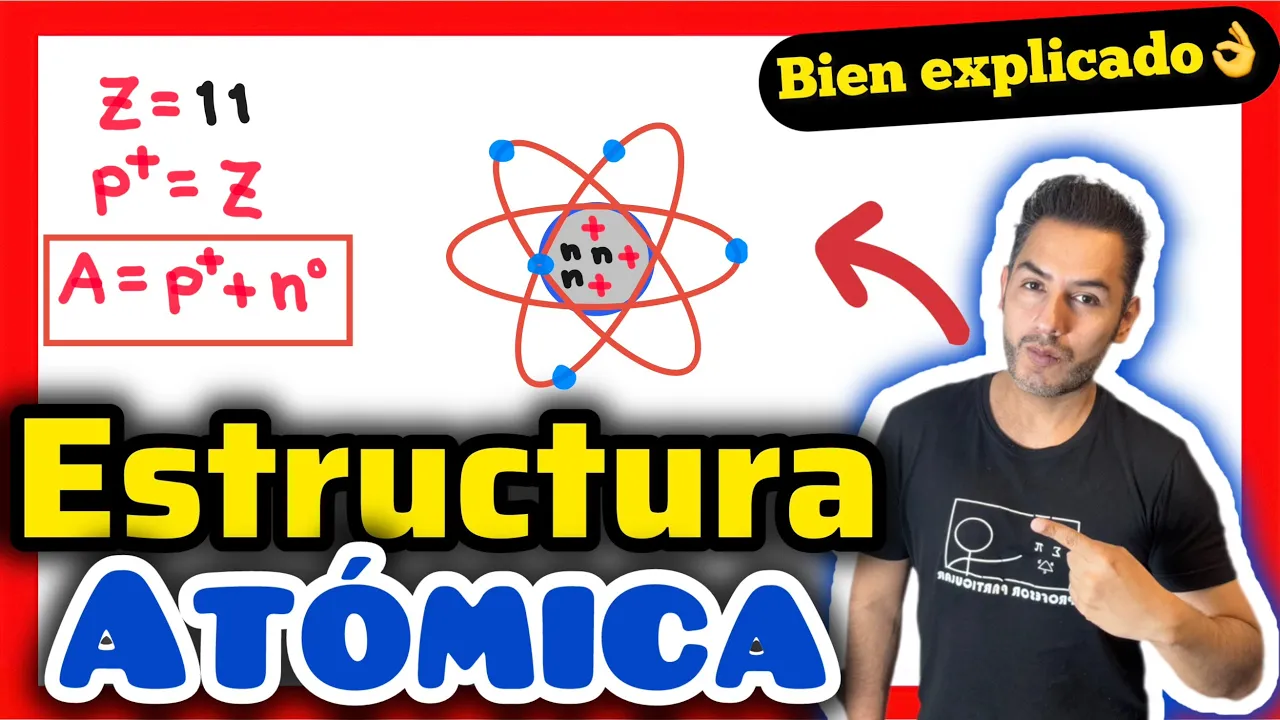
Added:Fundamental atomic structure, including the properties and locations of protons, neutrons, and electrons.
Basic organization of the periodic table, specifically understanding atomic numbers, periods, groups, and chemical symbols.
The concept of electrostatic attraction (Coulomb's Law) between the positively charged nucleus and negatively charged electrons.
The Bohr model of the atom and the foundational concept of quantized energy levels.
Chemical bonding theories, including ionic, covalent, and metallic bonding, which are driven by valence electron configurations.
Molecular geometry, Valence Shell Electron Pair Repulsion (VSEPR) theory, and orbital hybridization (such as sp, sp2, and sp3).
Advanced periodic trends, such as electronegativity and atomic/ionic radii, analyzed through the concept of shielding and effective nuclear charge (Zeff).
Transition metal chemistry, including d-orbital splitting, coordination complexes, and magnetic properties like paramagnetism and diamagnetism.
3.9M views46.9Klikes12:48Original Release: 2013-03-12
Hello, I'm Hank Green! Welcome to Crash Course Chemistry.
Last time we left off with Mendeleev believing he had discovered a cosmic, mystic reality about the world, but in fact he had discovered the effects of his worst enemy: tiny invisible particles.
Electrons, which are so marvelous and peculiar that it wasn't until 80 years after Mendeleev's 1st periodic table that they were really understood by anyone and to this day still very, very few people understand them.
But in like 10 minutes from now, if all goes according to plan, you will be one of those people. So let's do this.
[Theme Music] In 1865, before Mendeleev published his first periodic table, a young chemist, and activist, John Newlands published a paper on the periodicity of elements, comparing their repetition, at least the first two rows of it, to a musical scale.
All do re me fa so la ti do and stuff.
Maybe, he theorized, lithium was just sodium but an octave higher.
Maybe they were, in a sense, the same note.
He delivered this idea to the Royal Academy, the most prestigious group of scientists in the world, and they basically laughed him off the stage.
"Music is art and chemistry is science.
Now describing science in an artistic way might be a fine parlor trick for helping little babies or women understand the work you do but they have no place in the Royal Academy."
That's my impression.
But there was no way of course of knowing that it turns out John Newlands, when it came to the actual, functional, physical reality behind the periodicity of elements, was more right than any of the scientists who laughed him off the stage that day.
And he never got to find out how right he was.
We didn't discover that his analogies were barely analogies until long after his death, but it turns out that reality is like a kind of music.
And maybe you want to laugh me off the stage right now but bear with me.
Before quantum mechanics, scientists envisioned the atomic world as just a miniature macroscopic world.
Electrons seemed to just be particles orbiting around a nucleus.
In fact, there was a great Dane...no Nick...other kind of Dane... Niels Bohr, yes.
Like certain other people I might name, he sometimes felt like he was in the shadow of his older, more successful brother, an Olympic soccer player, while Niels' handwriting was so poor that he had to dictate his PhD thesis to his mom Nevertheless, he was an ingenious physicist.
Now, you might remember a couple of episodes back, when John Dalton determined that elements only exist in discrete packets of matter.
Well, by Bohr's time the same thing was known for the energy given off by electrons.
That energy only came off in what ended up being called "quanta" which is the root of the term "quantum mechanics."
In 1913, Niels Bohr came up with a simple model for describing these energy levels for a single electron in hydrogen merely assuming circular orbits.
So there is some truth to the framework of thinking of electrons as particles.
However, when he or anyone else tried to apply this to more complicated atoms, they failed miserably.
Long story short, electrons don't really behave like particles; they're better described as waves.
So we've known for, like, fifty years that this is a an entirely inaccurate way of visualizing an atom.
Nuclei, yeah, you can think of them as solid particles but not electrons. Electrons are wave-particle dualities.
I think of them like resonance in the universe.
And just like a single string producing multiple notes on a guitar, an electron can exist in a number of different harmonics.
This isn't an analogy either, quantum physicists actually talk about the harmonics of electrons.
After a few years of trying to figure this stuff out, a couple of very smart physicists started to look at electrons as waves, standing waves.
This makes a lot of sense, even to us lay guys.
When you swing a telephone chord in a straight line there are a discrete numbers of nodes, depending on the tension and the frequency, or in better physics terms, "energy", you put into the system.
The same thing happens to an electron around a nucleus; a standing wave is produced only at certain energy levels.
Anything in between is not allowed.
An Austrian physicist, Erwin Schrodinger, who you may have heard of because of his cat, is the first guy who developed a mathematical model where the electron was assumed to be a standing wave.
Now, it is time to move a little bit into the realm of metaphor here because I'm gonna tell you how I think, how I think of electron shells and orbitals, not really how they are.
The music of electrons is not simple music. It's no three chord song; it's like Beethoven but with more rules, hard fast rules that can't be broken.
In that way, at least, it's more science than art.
Electrons exist in orbitals a bit like the individual notes on a keyboard.
But the orbital's tone isn't complete until it has two electrons in it, and orbitals exist in shells.
The first shell just has a single orbital, an s-orbital, which can only fit two electrons.
That's why the row of our periodic table only has two elements.
They play simple song those two and a song that every other element will build upon.
The second electron shell is physically larger and thus can include more than just the s-orbital.
A second sort of orbital with three different configurations is added, the p-orbital.
Instead of just being a single tone, the p-orbital is more like a 3 part harmony with 2 electrons in each part for a total of 6.
Those 6 electrons of the p-orbital plus the 2 s-electrons are the eight electrons referred to in the octet rule: the desire for most of the lighter elements to have 8 electrons in their outer shell, just like a musical scale.
This is often described in terms of fullness or satiation, as if the atoms are devouring electrons.
But I prefer to think of an incomplete electron configuration as a cacophonous symphony playing in different keys and at different tempos.
And the closer you are to harmony the worse it is, until one final note chimes in, that eighth note and everything crisps into full resolution a deep, complex tone emerges, and the atom settles into complete harmony, the harmony of the noble gases.
That's just how I think of it.
And just like with music, there's a bit of notation to learn as well.
It's important to know how to write out what we call "electron configurations," a condensed way of showing exactly where all of an atoms electrons are.
First, we write the number of the shell, then the letter of the orbital, then the number of electrons in that orbital, and repeat until we run out of electrons.
So for hydrogen, with just one electron it's 1s1. For fluorine it's 1s2 2s2 2p5.
Now as we move to the third row, an interesting thing happens; the third shell adds a third kind of orbital: the five part harmony, with ten electrons, of the d-orbital.
But you might be saying, "There's still only eight elements in the third row.
What's up with that, Hank? It's all lies, I'm leaving!"
OK calm down, the atomic symphony composes itself in peculiar ways.
Because building the 3d orbital requires a lot of energy, electrons actually go into the s-orbital of the fourth shell, 4s, before going into the third shell's d-orbital.
This is actually a trend that continues, and to remember it just write out the following on a piece of paper -- these are the orbitals we know and all the shells that we've seen exist.
To figure out what order to fill them in, you just draw a diagonal line from the top right to the bottom left as you go.
So 1s first, then 2s, then 2p 3s, then 3p 4s, 3d 4p 5s, 4d 5p 6s, and so on.
Armed with this knowledge you could write out the electron configuration for pretty much any element on the table.
Iron, number twenty-six, would be 1s2 2s2 2p6 3s2 3p6 4s2 3d6.
Now there are a couple of elements that have weird electron shells, but you can just look it up on Google.
An interesting thing about d-orbitals, and the even bigger, more electron rich f-orbitals, is they don't really need to be filled quite as much as the s and p's, because they're literally shielded beneath the s-orbitals of the next shell.
The s and p-orbitals I think of kinda like the trumpets and violins: it's really terrible when they sound bad, but the base notes, deep and rich, hide a bit underneath the rest of the orchestra, just like the d-orbitals literally hide underneath the s-orbitals that have already filled above them.
Yes these incomplete orbitals affect them, but because their shielded, these middle of the chart elements are generally less reactive and happier to bump electrons along from atom to atom making them conductive, or just hanging out together in big masses of electron-sharing lumps of metal.
So why are orbitals useful when it comes to understanding how an atom is likely to react?
Well first, it really matters how much energy is required to remove an electron from an atom to form a positively charged ion.
This energy is called "ionization energy."
If there are several electrons being removed this is a step-wise process, starting with the electron at the highest energy level, or the outermost one.
Since the outermost electron has the highest energy, there's the least energy necessary to remove it.
More energy is needed to remove the second furthest one out and so on.
And of course when all the electrons in the outermost shell are removed there is a really large energy jump necessary to remove an electron from the next shell down because that shell will be isoelectrically analogous to a noble gas.
Just like how atoms are isotopically the same when they have the same number of protons and neutrons, atoms are isoelectrically the same when they have the same number of electrons.
And just like there's energy associated with removing an electron to form cations, or positively charged ions, there's energy associated with adding electrons, usually to fill an orbital to achieve a stable two or eight electron shell configuration.
Just like with the ionization energy there's a discrete energy jump involved with the adding of an electron.
That energy is called "electron affinity."
Now, you ready for the real mind melter? If you're following along in your periodic table, which of course you aren't, you may have noticed a little something interesting.
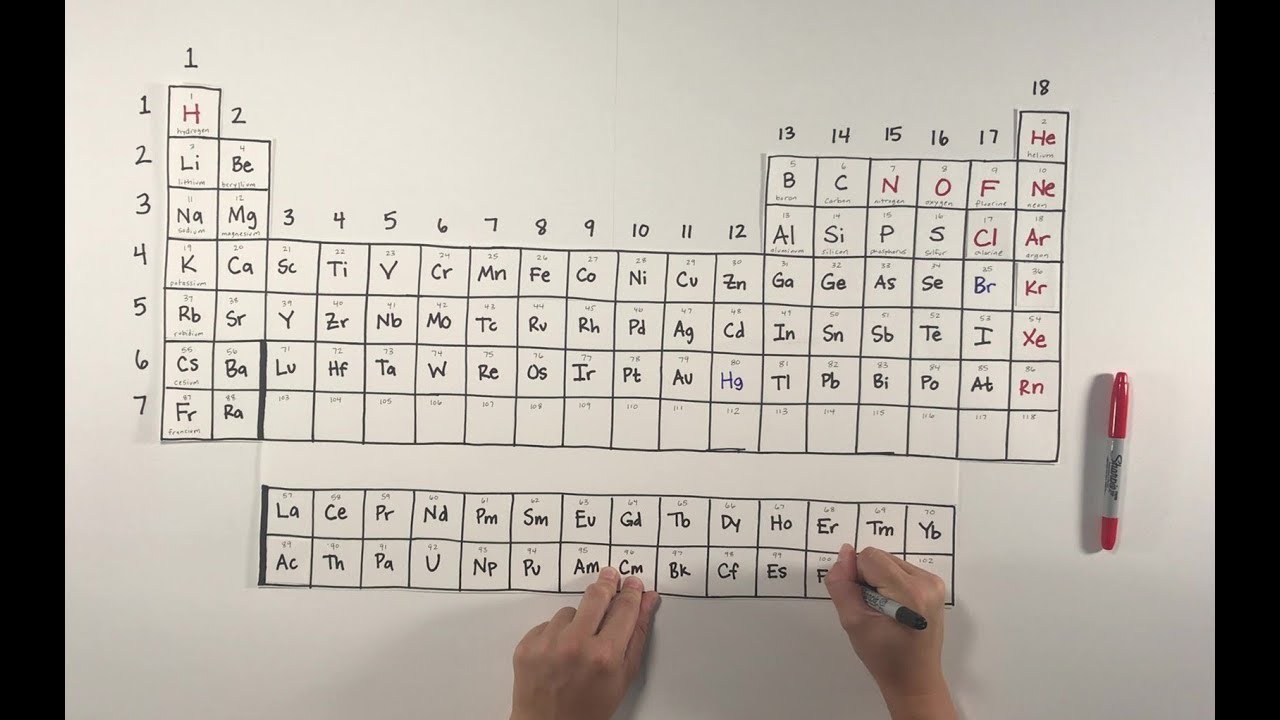
On the left-hand side you have your s-orbitals -- one, two, three, four, five, six, seven s.
In the middle, you got your d's: 3d, 4d, 5d, 6d.
And on the top right, 2p, 3p, 4p, 5p, 6p.
And below of course, in the little island of the lanthanides and actinides, your f-orbitals: 4f and 5f.
And so, with just a glance at your periodic table you can work out electron configurations and elemental stability and the fundamental, physical reality of the elements.
That's why this thing is so beautiful to me, because when you get to know it, you see all those flawed, competing harmonies, and the actions and reactions that occur because of them, changing their song into something more stable and powerful and eternal together, making everything.
Now as I've gone through today's episode I've described electrons mostly in musical terms as vibrating waves, harmonies in the fabric of the universe and that's, indeed, how I like to think about them, but of course, that isn't a complete story.
And I have gotten sick of people telling me that the human brain is incapable of imagining the reality of the subatomic.
So I'm actually just going to serve a big heaping pile of reality on you right now no matter how odd it turns out to be.
There are, a number of everywhere-permeating fields in our universe.
One of those, is the electron field.
In order for an electron to exist, there has to be an excitation of the electron field and we can describe those excitations as waves, just as a wave in the ocean is an excitation of the water.
At any given moment, the electron can be anywhere within the function of the wave.
But waves are defined not by harsh boundaries, instead they're strong in some areas and weak in others.
The strength of the wave at one certain point in space determines how likely it is that you will find an electron there at any given time if you measure.
And so if we're trying to understand reality, we should not think of electrons as circling around the nucleus of an atom, like planets around a star, but instead as an excitation around the nucleus, and the shape of that excitation is the orbital.
Orbitals are precisely the reason that everything exists.
They are the root, and the key, and the nexus, and the crux, and the keystone, and every other metaphor of not just chemistry but existence.
Thank you for watching this episode of Crash Course Chemistry. I hope it blew your mind.
If you were paying attention you now know about a poor young man who was laughed out of a meeting of snotty scientists because of being far more correct then anyone could ever have imagined.
About a great Dane whose incorrect model of the atom was pretty amazing anyway.
About electrons as music, and electron shells and the orbitals they contain.
How to write out electron configurations, what ionization energies and electron affinities are, and how the periodic table ties all of these realities together.
And with all that knowledge now in your head, you know more then 99.9% of the world about electrons.
This episode of Crash Course Chemistry was written by myself, filmed and directed by Michael Aranda, who is also our sound designer, and edited by Nick Jenkins.
The script was edited by Blake de Pastino an Dr. Heiko Langner.
Katherine Green was our script supervisor and our graphics team is Thought Cafe.
Up Next
11:02
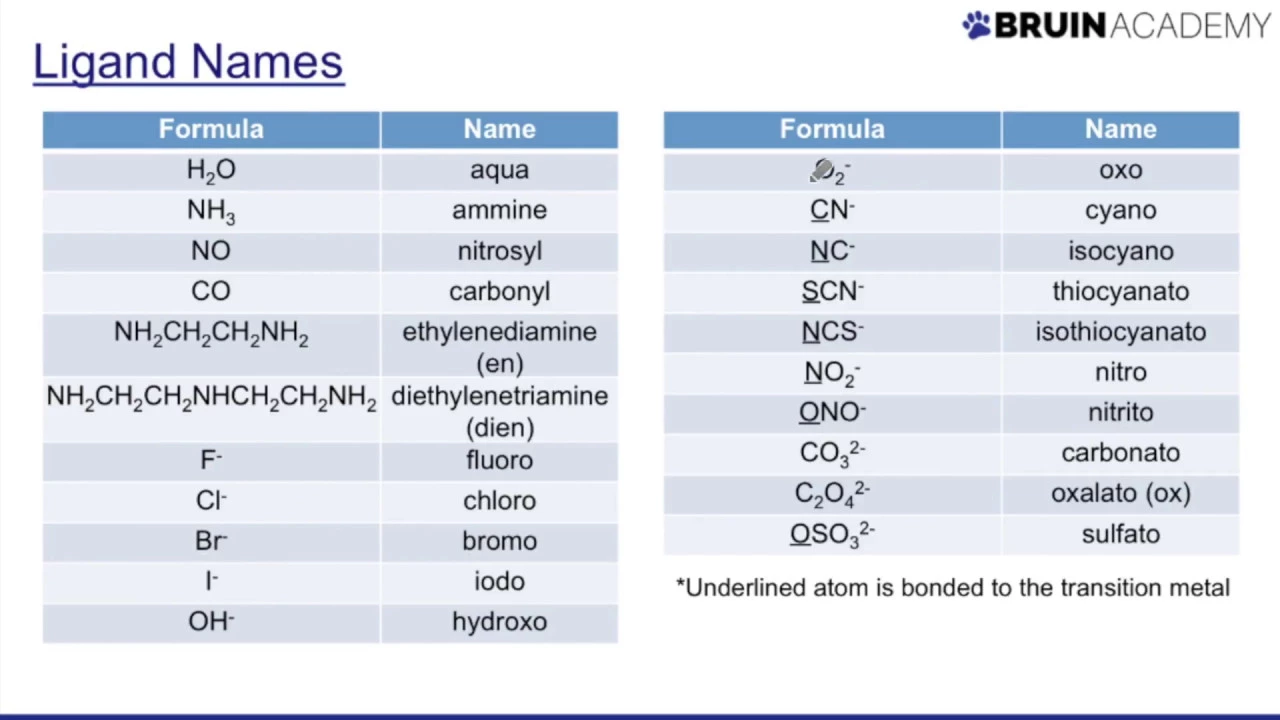
How to Name Coordination Compounds | Chemistry Nomenclature Guide
@bruinacademy
108.9K views•2017-08-16
83:56
Biocatalysis and Catalysis in Islatravir Synthesis | Merck Webinar
@SCIwheresciencemeetsbusiness
675 views•2020-10-08
9:57
Nuclear Chemistry: Radioactive Decay & Half-Life Explained
@crashcourse
2.1M views•2013-11-11

17:31
Edible Water Bottles: A DIY Guide to Sodium Alginate Spherification
@ryan
10.5M views•2019-06-21
Related Study Plans & Knowledge Roadmaps
Structured learning paths in Chemistry
chemistry
Nuclear Chemistry: Decay, Meds & Fuel Cycle
01Introduction to Nuclear Structure and Radioactivity
02Decay Dynamics and Kinetics
03Radiation Interaction and Detection
+ 2 more learning modules
24h5 modules
Explore Roadmap
chemistry
Supramolecular Chemistry: Forces & Machines
01Foundations of Chemical Bonding and Intermolecular Forces
02Introduction to Host-Guest Chemistry
03Thermodynamics and Dynamics of Self-Assembly
+ 2 more learning modules
16h5 modules
Explore Roadmap
chemistry
Photochemistry: Excited States & Reactions
01Foundations of Light-Matter Interactions
02Molecular Orbitals and Electronic States
03Photophysical Processes and Jablonski Diagrams
+ 2 more learning modules
18h5 modules
Explore Roadmap
chemistry
Coordination Chemistry: Bonding & Properties
01Introduction to Transition Metals and Ligands
02Crystal Field Theory (CFT) and Geometry
03Magnetic Behavior and Spin States
+ 2 more learning modules
14h5 modules
Explore Roadmap