


























![Conscious Caracal Interview [on the South African Solidarity Movement]](https://i.ytimg.com/vi/weJCsfcbJIU/maxresdefault.jpg)


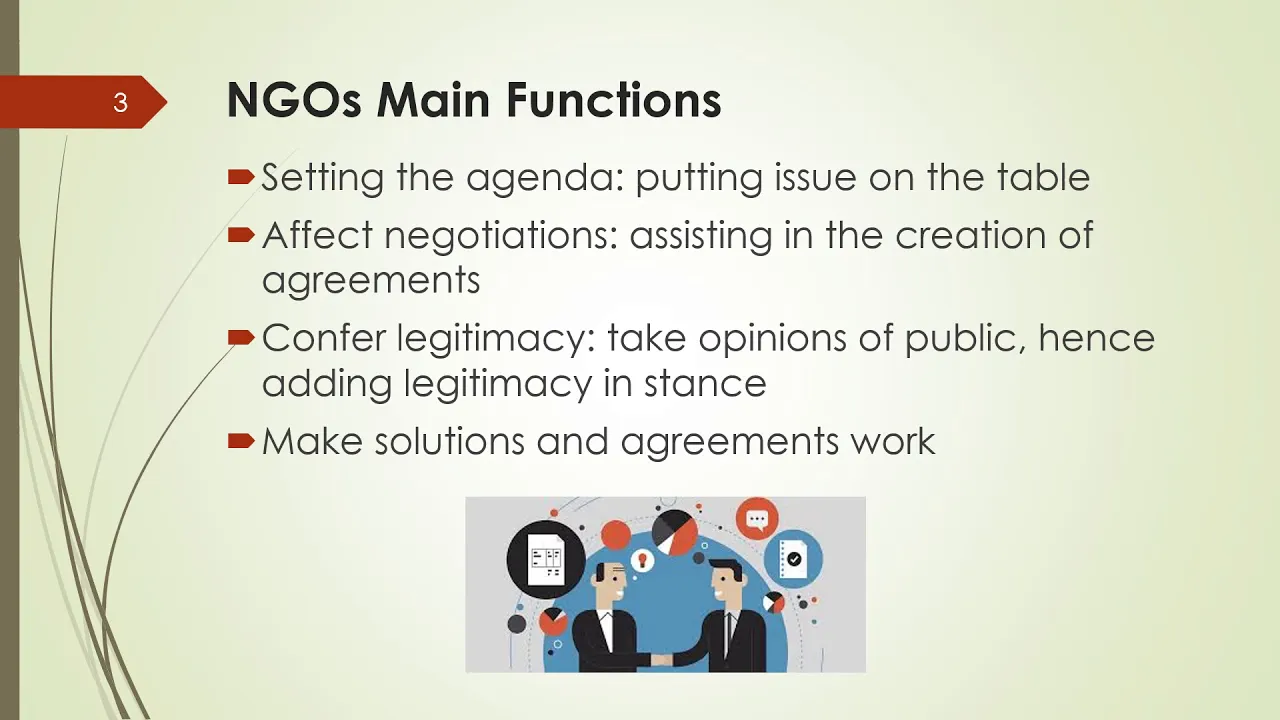
NGOs can inadvertently undermine genuine political resistance by diffusing political anger, creating dependency, and providing salaried alternatives to grassroots activism, thereby transforming radical movements into manageable, professionalized activities that serve the interests of their funders rather than the communities they claim to help.
The NGO-ization of Resistance: Arundhati Roy's Critical Analysis
Added:The core tenets of Neoliberalism, particularly privatization, deregulation, and the reduction of state-provided social safety nets.
The basic structure and funding mechanisms of Non-Governmental Organizations (NGOs) and their role in global civil society.
Fundamental concepts of grassroots political organizing, social movements, and collective resistance.
The concept of the state-citizen social contract and how the outsourcing of state services impacts democratic accountability.
Critical study of the 'Non-Profit Industrial Complex' (NPIC) and how funding structures can co-opt radical political agendas.
Exploration of 'Philanthrocapitalism' and the influence of multi-billion-dollar private foundations on global development policies.
Analysis of alternative, non-institutionalized models of resistance, such as mutual aid networks and horizontalist social movements.
Case studies of NGO-ization in specific regional contexts, such as post-apartheid South Africa, post-conflict zones, or structural adjustment eras in the Global South.
12.8K views252likes5:52Original Release: 2014-09-19
A second hazard facing mass movements is the NGOization of resistance. It'll be easy to twist what I'm about to say into an indictment of all NOS's, but that would be a falsehood. In the murky waters of fake NOS's set up to siphon off grant money or as tax dodges in states like Bihar, they're given as dowry. Of course, there are no NOS's doing valuable work, but it's important to consider the NGO phenomenon in a broader context. In India, for instance, the funded NGO boom began in the late 1980s and early 1990s. It coincided with the opening of the of India's markets to neoliberalism.
At the time the Indian state in keeping with the requirements of structural adjustment was withdrawing funding from rural development, agriculture, energy, transport and public health. As the state abdicated its traditional role, NOS's moved in to work in these very areas. The difference of course is that the funds available to them are a minuscule fraction of the actual cut in public spending. Most large funded NOS's are financed and patronized by aid and development agencies which are in turn funded by Western governments, the World Bank, the UN, and some multinational corporations. Though they may not be the very same agencies, they are certainly part of the same loose political formation that oversees the neoliberal project and demands the slash in government spending in the first place.
Why should these agencies fund NOS's? Could it just be old-fashioned missionary zeal, guilt? It's a little more than that. NOS's give the impression that they're filling the vacuum created by a retreating state.
And they are, but in a materially inconsequential way. Their real contribution is that they diffuse political anger and dole out as aid or benevolence what people ought to have by right nos alter the public psyche. They turn people into dependent victims and blunt the edge of political resistance.
They form a sort of buffer between the circar and the public, between empire and its subjects. They have become the arbitrators, the interpretators, sorry, the interpreters, I'm sorry, the facilitators. In the long run, NOS's are accountable to their funders, not to the people they're working amongst. They're what botonists would call an indicator species. It's almost as though the greater the devastation caused by neoliberalism, the greater the outbreak of NOS's. Nothing illustrates this more poignantly than the phenomenon of the US preparing to invade a country and simultaneously readying NOS's to go in and clean up the devastation.
In order to make sure their funding isn't jeopardized and that the governments of the countries they work in will allow them to continue to function, NOS's have to present their work in a shallow framework more or less shorn of a political or historical context at any rate an inconvenient political or historical context.
apolitical and therefore extremely political distress reports from poor countries and war zones eventually make the dark people of these dark countries seem like pathological victims. Another malnutritioned Indian, another starving Ethiopian, another Afghan refugee camp, another maimed Sudanese in need of the white man's help.
They they unwittingly reinforce racist stereotypes and reaffirm the achievements, the comforts and the compassion, the tough love of Western civilization. They are the secular missionaries of the modern world.
But eventually on a smaller scale but more insidiously the capital available to NOS plays the same role in alternative politics as the speculative capital that flows in and out of the economies of poor countries. It begins to dictate the agenda. It turns confrontation into negotiation. It depoliticizes resistance. It interferes with local people's movements that have traditionally been self-reliant.
NOS's have funds that can employ local people who might otherwise be activists in resistance movements, but now can feel they're doing some immediate creative good and earning a living while they're at it. Real political resistance offers no such shortcuts. The NGOization of politics threatens to turn resistance into a well-mannered, reasonable, salaried 9-to-five job with a few perks thrown in.
But real resistance has real consequences and no salary.
Up Next

88:33
Fragments of Home: Refugee Shelter, Design & Politics | LSE
@theLondonSchoolofEconomics
957 views•2024-11-20

24:30
BRICS Pay and de-dollarization: A New Financial Order Emerges? | 55 chars
@DannyHaiphongYT
164.6K views•2024-10-22

7:33
Government Surveillance Methods: 10 Ways You May Be Watched
@BeAmazed
1.6M views•2017-04-09
10:19
Explaining the Saudi-Iranian Proxy Conflict in the Middle East
@Vox
18.2M views•2017-07-17
Related Study Plans & Knowledge Roadmaps
Structured learning paths in Political Science
political-science
Economic Statecraft: Sanctions & Chokepoints
01Foundations of Geoeconomics and Economic Statecraft
02The Mechanics of Weaponized Interdependence
03International Sanctions: Types, Implementation, and Efficacy
+ 2 more learning modules
12h5 modules
Explore Roadmap
political-science
Central Bank Independence: Politics & Policy
01Foundations of Central Banking and Monetary Policy
02The Time Inconsistency Problem & Inflation Bias
03The Delegation Model and Designing Independence
+ 2 more learning modules
12h5 modules
Explore Roadmap
political-science
Consociationalism: Power-Sharing & Stability
01Democratic Dilemmas in Divided Societies
02Introduction to Consociational Democracy
03The Four Pillars of Consociational Design
+ 2 more learning modules
12h5 modules
Explore Roadmap
political-science
Rebel Governance: Legitimacy, Economy & State
01Foundations of Rebel Governance and Statehood
02Establishing Political Legitimacy and the Rebel Social Contract
03Wartime Economies and Rebel Resource Management
+ 2 more learning modules
14h5 modules
Explore Roadmap