![Semiconductor Class 12🔥 [JEE Crash Course👻] | JEE Main 2022 (JEE Physics) | Vinay Sir | Vedantu JEE✌](https://i.ytimg.com/vi/QwLQM4Qktw4/maxresdefault.jpg)













![5.1. Introduction to Mosfet and its I-V Characteristics | CSE251 Fall 2024- [PDS]](https://i.ytimg.com/vi/CYzz05G1UPo/maxresdefault.jpg)
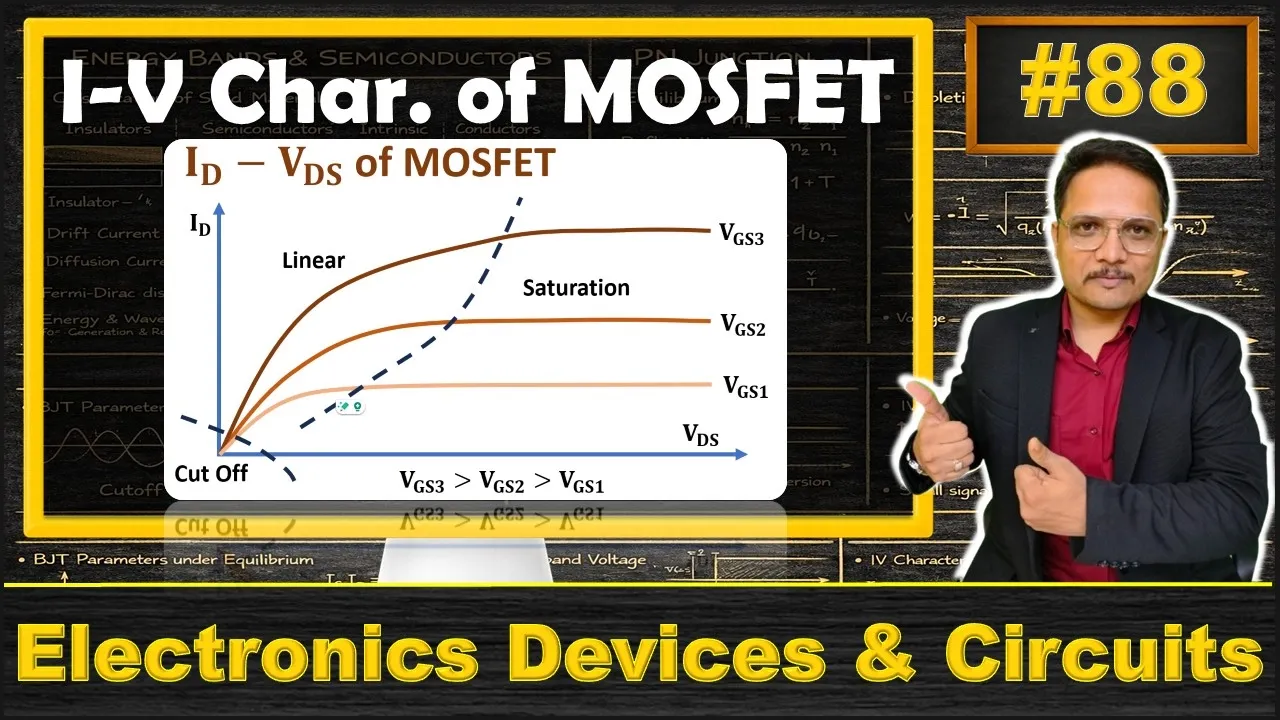
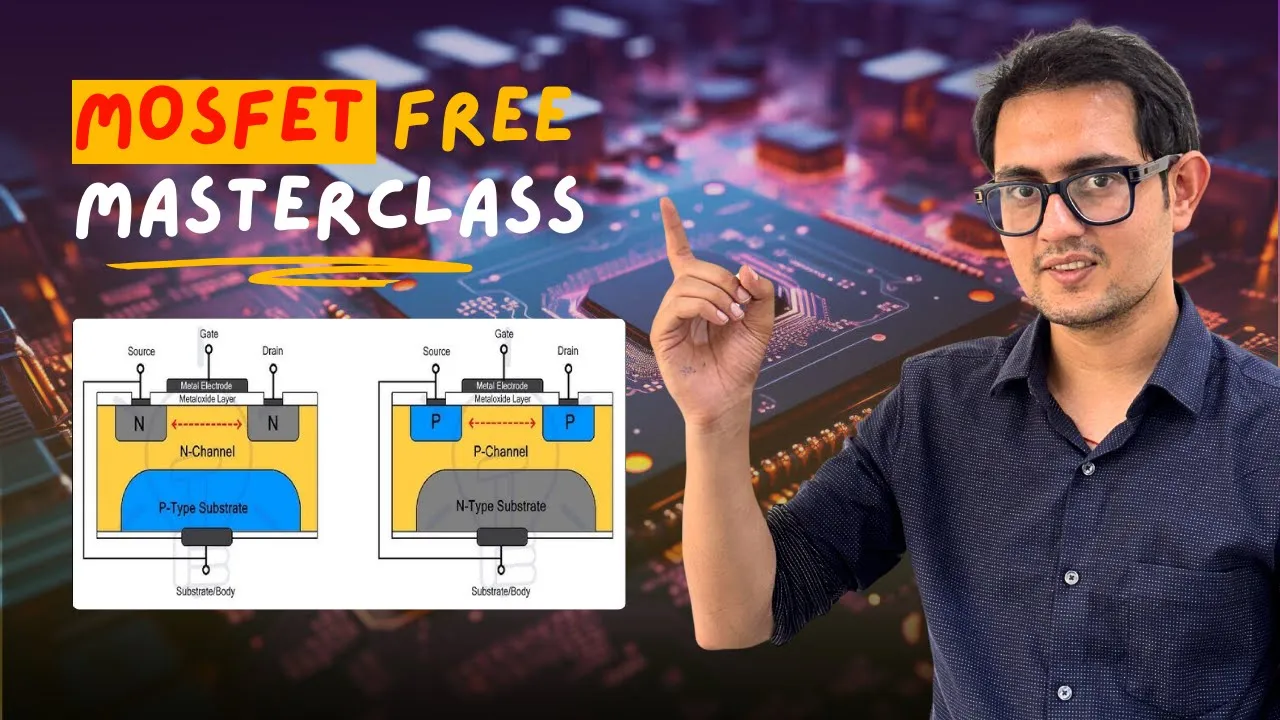


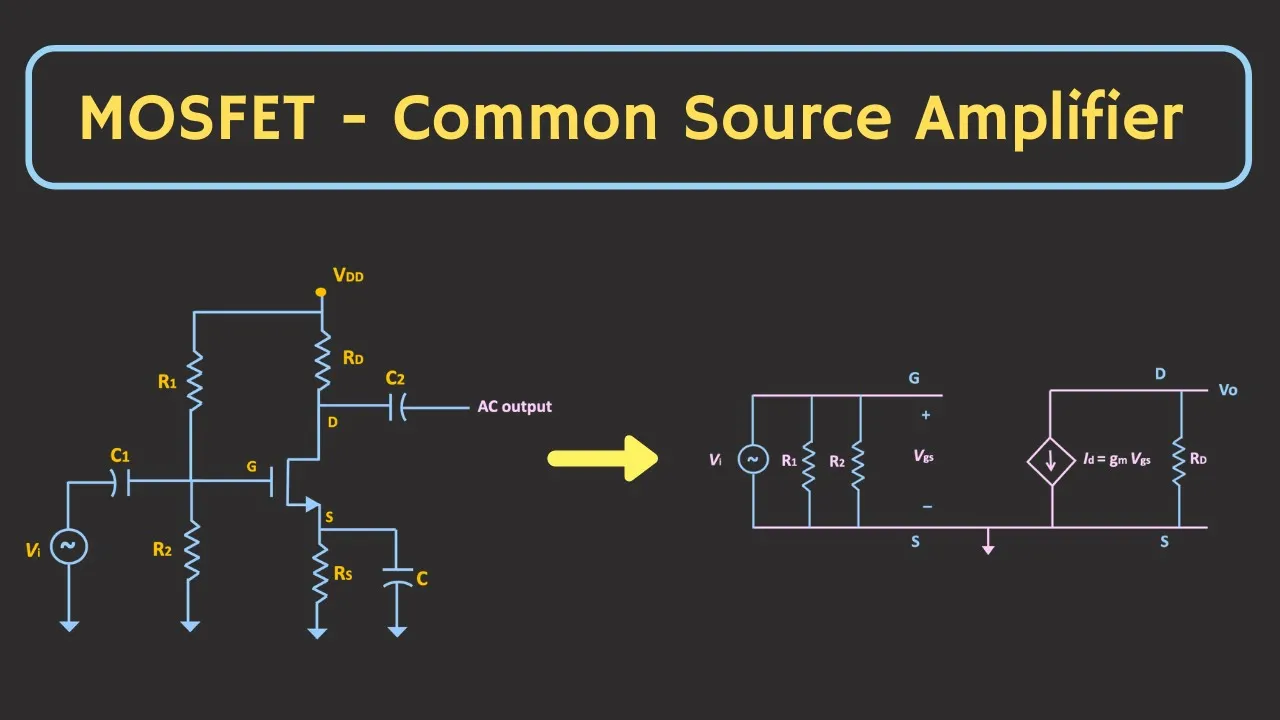








A Metal Oxide Semiconductor Field Effect Transistor (MOSFET) is a voltage-controlled device where the gate voltage controls the flow of current between the source and drain terminals. In an N-channel enhancement-type MOSFET, applying a positive voltage to the gate relative to the p-type substrate attracts electrons to form an n-type channel near the gate, enabling current flow from drain to source. As the drain-source voltage increases, the channel width decreases due to the expanding depletion region at the drain end, eventually reaching pinch-off where the channel is completely constricted. Beyond this point, the MOSFET enters the saturation region where the current becomes constant regardless of further increases in drain-source voltage. The MOSFET operates in four distinct regions: cutoff (no channel, no current), ohmic/linear region (channel conducts freely, current increases with voltage), pinch-off (channel begins to constrict), and saturation region (constant current flow).
MOSFET Working Principle: Semiconductor Physics Explained
Added:Transistors are the basic building blocks of modern day electronics.
There are billions of transistors in the device which you are using to watch this video, mostly of which comprises field effect transistors.
In today's video we will be exploring one of the field effect transistor which is metal oxide semiconductor field effect transistor or MOSFET in short.
From the basics of current and semiconductors to the regions and structure of MOSFET and then it's complete working at last we will also look at its circuit symbols.
Before everything let us understand the flow of current and electrons with this basic circuit.
In this circuit, the current flows from the positive terminal to the negative terminal of the battery.
Also, the electric field flows from the positive terminal to the negative terminal outside the battery.
The flow of electrons is opposite to the flow of the electric field or current, that is, electrons flow from the negative terminal to the positive terminal.
A MOSFET is made from a semiconductor material such as silicon.
Semiconductors have conductivity between conductors and insulator.
Hence, to make a semiconductor a good conductor we introduce impurities in the pure crystal.
There are two types of impurities that are added.
If the impurities are pentavalent, then the resulting semiconductor is n-type.
In n-type electrons are the majority of charge carriers.
And, If the impurities are trivalent then the resulting semiconductor is p-type.
In p-type holes are the majority of charge carriers.
Now if we join them then at the junction the electrons from n-type will fill the holes in p-type depleting the charges near the junction.
This region is known as the depletion region.
If we connect p-type to the positive terminal and n-type to the negative terminal of the battery, then the depletion layer reduces and this is called forward bias.
If the polarity of the battery is reversed the depletion layer increases, and this is called reverse bias.
MOSFETs are of two types, enhancement type and depletion type.
Both of the types are further divided into two types, N - channel and P - channel.
In this video, we will look at N - channel MOSFET only.
First, let's see the N-channel enhancement type MOSFET.
This is the structure of MOSFET.
The yellow regions are n-type semiconductors and blue are p-type semiconductors.
This terminal is connected to the substrate or body hence it's called the substrate or body terminal.
These two terminals are called source and drain terminals.
Between these terminals we have a thin layer of insulator or dielectric.
Above this insulator another terminal is attached, It is called the gate terminal.
These are all four terminals of MOSFET.
As the MOSFET is symmetrical, that is, the source or the drain can be interchanged.
Hence, the source terminal and substrate terminal are connected internally, and the MOSFET we see has three terminals.
Also, this stops any current flow from the substrate to the source as they are at the same potential.
Now, in the MOSFET we want to flow conventional current from drain to source.
So let's connect a battery between drain and source.
This voltage is called Vds, as it's between the drain and the source.
Also, we can see the graph of drain current versus Vds.
The positive end of the battery increases the potential at the drain terminal, thus increasing the depletion region between the drain and substrate.
Due to this there will be no current flow from the drain to the source and the MOSFET is off.
This is also called the cutoff region.
Now, to flow current from drain to source we have to create a channel between them.
To create the channel we connect a small voltage source between the gate and substrate with the positive terminal to the gate.
This voltage is called Vgs, as it's between the gate and the source.
The substrate is a p-type semiconductor. Hence, the charge carriers are holes.
But, there exists some free electrons as minority charge carriers.
The battery creates an electric field inside the substrate.
Due to this field the electrons in the substrate flow opposite to the electric field, that is, towards the gate.
Due to the presence of an insulator these electrons cannot flow from the substrate to the gate.
And thus they accumulate near the gate in the substrate.
We know that a capacitor is used to store charge on two metal plates.
Also, we can increase the capacitance by placing an insulator or dielectric between the plates.
Similarly, the insulator or dielectric in MOSFET, not only blocks the electrons but also increases the charge on them, thus attracting more electrons.
Now, If we increase Vgs more electrons get attracted towards the gate and these electrons start filling some of the holes.
Also, due to the stronger positive charge of gate holes start moving away from the gate.
Now, in this region we can see there are no holes but we have free electrons.
Due to these electrons, the region near the gate becomes negative or an n-type semiconductor.
This creates a channel that connects the source and the drain with each other internally.
In effect we have created a pipe between the source and drain so that electrons can move from the source to the drain.
The thickness of the channel can be controlled by changing the gate voltage.
As the voltage increases or decreases the width of the channel also increases or decreases respectively, And the voltage at which the channel is formed is called the threshold voltage.
As this channel is created now we can flow current from the drain to the source by the channel.
The flow of conventional current is from drain to source, but the flow of electrons is opposite to it, that is, from source to drain.
This is also the reason why they are called the source and the drain, because the source supplies electrons to the channel and the drain collects the electrons from the channel.
As the conventional current flows from drain to source it is called drain current.
Now the MOSFET is in the ohmic or linear region. In this region, it follows ohm's law, that is, as the voltage increases the current increases linearly.
But, as the voltage increases the depletion region between the drain and substrate will increase as they are reverse biased.
Also, the channel begins to deplete towards the drain end.
This is because, the drain is at a positive potential and negative charges from the channel closest to the drain are being pulled into the drain.
This reduces the width of the channel restricting the flow of charges and reducing the flow of current.
As we increase the voltage, a point will be reached when the channel is completely pinched off. This is called the pinch-off effect.
In real cases the channel is not completely pinched off.
Due to the large flow of electrons in the channel, a number of electrons will keep the channel.
Hence, instead of stopping the current there is a constant saturated current.
This current is called saturation current and the voltage at which it occurs is called saturation voltage.
Now, if you increase the voltage the reverse biasing will increase and the channel will further decrease but the current will not increase because it's saturated. This is known as the saturation region.
But if you still want to increase the current in the MOSFET, how will you do it?
(THINKING) Now that you thought about it let us see it in animation.
As you may have remembered, the width of the channel is controlled by the gate.
Hence, by increasing the gate voltage we can increase the width of the channel.
Now, if we increase the voltage the current will also increase.
Again at a certain voltage pinch off will occur and saturation will occur.
Then again increase the gate voltage.
MOSFETs are also called voltage control devices, because the amount of voltage at the gate controls the flow of current from drain to source.
Also, there is no current flow from the gate.
If you have noticed the two graphs that we created are the characteristics of the MOSFETs.
This is the drain characteristics and this is the transfer characteristics(constant Vds).
There is another type of MOSFET called the depletion type.
This is similar to the enhancement type except the channel is also formed while doping.
That is, the channel that was formed by the gate voltage in enhancement type is present by default in depletion type.
All other working principles are the same except that, the depletion type requires a negative gate voltage to turn off it is normally on (Normally closed) while the enhancement type is normally off (Normally open).
Now we know how a MOSFET works let us look at its circuit symbols.
There are four terminals, source, gate, drain, and substrate.
The gate is not directly connected to the substrate an insulator is present.
Hence, the gate terminal is floating in the symbol.
Source and substrate are connected internally, hence, we connect the source and substrate in the symbol also.
If the lines are broken then its enhancement type as the channel needs to be formed, else if it's one solid line then the channel is present and its depletion type.
If the arrow is pointing towards the substrate then its N channel or the electrons flow towards the gate to form an N channel.
Otherwise its P channel or the electrons flow away from the gate to form a P channel.
These MOSFETs are present in almost all electronic devices and they need electricity to work.
Watch this video on how the mobile charger works or continue by watching this video on how mobile knows about its orientation.
Thank you for watching.
Up Next

Intro to MOSFETs: Structure, Operation, and Amplifier Applications
@b_razavi
335.2K views•2014-11-11

Ultrasonic Transducers: Resonant Frequency Measurement and Horn Design
@imajeenyus42
229.9K views•2017-02-22
Polymer Environmental Degradation: Mechanisms & Stabilization
@iit
1.8K views•2012-07-10
How a Student's Question Saved a NYC Skyscraper from Collapse
@veritasium
22.8M views•2025-04-26
Related Study Plans & Knowledge Roadmaps
Structured learning paths in Engineering