
















![How load balancers work - System Design Interview knowledge [Beyond the interview]](https://i.ytimg.com/vi_webp/escR-07yVAs/maxresdefault.webp)










A load balancer is a hardware or software device that sits between internet traffic and application servers, distributing incoming requests across multiple servers to prevent any single server from becoming overwhelmed; it operates using different traffic distribution algorithms including round-robin (sequentially cycling through servers), smart load balancing (dynamically routing traffic based on real-time server utilization reported by application servers), and random selection (using probabilistic methods to distribute traffic), with each method offering different trade-offs between complexity, cost, and efficiency in handling varying workloads.
Load Balancing Explained: Algorithms & Architecture
Added:Basic Client-Server Architecture: Understanding how clients make requests to web servers and receive responses over a network.
Concept of Scalability: Knowing the difference between vertical scaling (adding resources to a single node) and horizontal scaling (adding more nodes).
IP Routing and DNS: Familiarity with how domain names resolve to IP addresses and how network packets are routed.
Basic Network Protocols: Understanding the fundamental roles of HTTP, HTTPS, and TCP/IP in web communication.
Layer 4 vs. Layer 7 Load Balancing: Exploring the operational differences between routing at the transport layer (TCP/UDP) versus the application layer (HTTP/HTTPS).
Session Persistence and SSL Termination: Learning how load balancers manage stateful sessions (sticky sessions) and decrypt SSL/TLS traffic to relieve backend servers.
High Availability and Failover Configurations: Designing redundant load balancer setups (such as active-passive or active-active) to avoid a single point of failure.
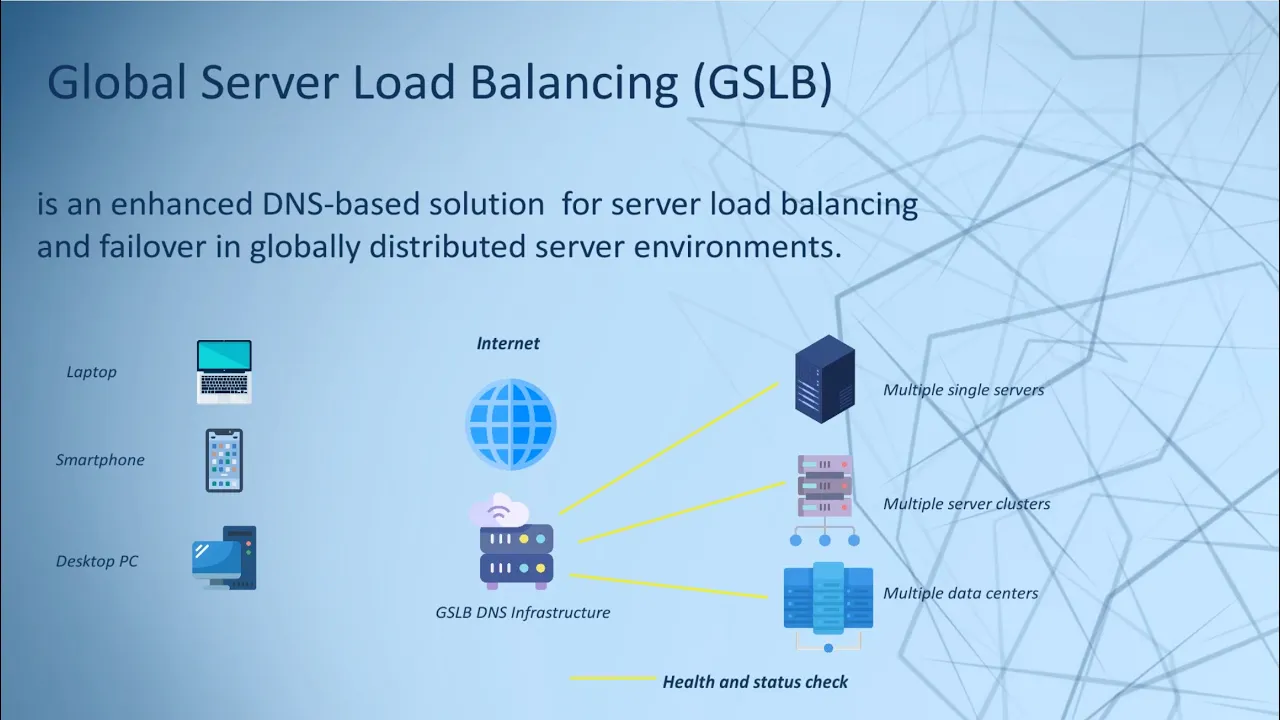
Global Server Load Balancing (GSLB): Understanding how traffic is routed across geographically distributed data centers using DNS-based load balancing.
309.8K views7.7Klikes8:22Original Release: 2021-10-04
Hi there and thanks so much for stopping by today. My name is Bradley Nap with IBM cloud and the question that I wanted to go over with you guys today is what is a network load balancer. And so I want you to imagine a scenario, right?
You have decided that you are going to run a website and this website is going to be immensely popular. You need to build it to scale to serve millions of users all of whom are accessing it at the same time. So imagine that single user and what is his experience going to be? Right? So you've got your guy, he's out here and he's got a laptop, right?
And so on his laptop, he wants to open your awesome new website. So he's going to send that traffic out into the internet, which we're going to put a little cloud in there for the internet.
And then as it transmits through the internet to the actual servers where the data is hosted, it's going to get down here and it's going to get to an application server. And that application server is going to be what actually serves all of the data back via the internet to his laptop so that he can view what's going on on your on your website. Now, that's fine if you've just got one person who accesses your website at a time. What if you have 10 people at once? Well, that app server is probably going to be fine to do that. What if you have 10,000 people who are accessing it at once? And so that's when you get into this interesting scenario where you can saturate out this application server.
And so if you think about an infrastructure level definition of an app server, you can scale them up to a certain size, but you've got limits in how big these application servers can be. So what do you do? All right. Well, you need to scale them out, right?
Instead of having one app server, you might have three or you might have four or you might have five or you might have 10 or you might have 10,000. You are going to horizontally scale those application servers so that you have enough to satisfy your customer load.
But how do you know how much scaling you need? And more importantly, how does this guy with his laptop get to the application server that he needs in order to be successful? And the answer to that is in between your customer and all of your app servers, you are going to put a load balancer. What is a load balancer? It's a hardware device or it could be a softwaredefined device. And that load balancer is going to intercept all of the traffic that's coming in from the internet. And it's going to decide what goes to this server, what goes to this server, what goes to this server, and so on and so forth. It's also going to provide and collect information. So your application servers down here, they can be talking to this load balancer. They can be saying, "Hey, I'm only being used 20% of the time. Maybe you don't need me right now." And that load balancer can then dynamically scale or autoscale and turn that application server off if you don't need it. Helps drive down costs.
Likewise, if all of your app servers are checking in and they're saying, "Hey, I'm super busy. I'm running at 85 90% utilization. It's time to bring in help." Then that load balancer can hit that autoscale service again and it can say, "Hey, look, I need another one. I need another app server to try and decrease my load." And so when folks talk about cloudnative architectures, this is a key component. The load balancer is a key component because that load balancer is going to assign out that traffic to all of the different application servers. And then the app servers, they're all going to go down here, right? They're going to talk to a common database tier because you don't want to get into a goofy split brain scenario with your database.
but they're going to get the data that they need and they're going to serve that back up to the end customer directly. So that's how you split up the data. That's how you serve it up. But so now that we're in load balancers, we said it's going to decide which application server gets the traffic, right? How does it decide what to do?
And so let's get our three most common scenarios, right? So, we're going to go over here and we're going to have scenario one, scenario two, and then scenario three.
So, scenario one, our load balancer right here, right? It's got all its app servers.
And we're going to call this one a relatively dumb load balancer, right? We don't need a lot of complexity in it.
It's serving a fairly basic purpose. And so it's going to use an algorithm called roundroin in order to sign assign the traffic. And so what does roundroin means? It means that for the first user that connects, it's going to send that person to app server one. For the second person who connects, it's going to send them to app server two. The third person who connects is going to go to app server 3. And then when a fourth one comes in, it's just going to start back over again. Roundrobin literally means just going sequentially through it. Now, round robin is not a perfect scenario.
If you have user sessions that last a long time, some people log in and run for 5 minutes, some people log in and run for 2 hours, your app servers can get out of balance with one another when you're using that roundroin scenario.
And so then you need to think about things like smart load balancing. Smart load balancing is going to be our second piece here, right? And this is an application server load load balancer.
So again, just like before, we've got our load balancer here and we've got our app servers.
But this scenario, this smart load balancing scenario rather than the load balancer just acting as king and directing what all happens, the load balancer works in cooperation with the application server. So the app servers are constantly transmitting data back and forth to that load balancer, letting them know how busy it is. And that load balancer is then going to make the decisions to send the incoming connection. So your guy over here, if he comes in and he starts a user session, that load balancer is going to say, "Look, server 3 has the least load on it right now. I'm going to assign him over here." And it's constantly monitoring that. Now, obviously, you're going to look at that and you're going to say, "Well, why wouldn't you always use this kind of setup?" Well, it is more complex to get set up initially, right? It takes more configuration. Also, the load balancer software or the hardware device that you use to set this kind of a scenario up, it is more expensive. And so, while technologically it's probably always the best choice, for your specific scenario, it might not be. And then the third the third scenario that we've got down here, right? So, we've got our load balancer and all of our app servers.
This is a scenario where you want a little bit more control than you do in just a straight round robin, but you don't want to go all the way through the setup and config and everything like that that you need with a with a smart load balancing scenario. And so there are actually like nine different algorithms that you can pick from that split the difference between these two.
Uh the one that I'm going to use right now as an example is a a random select, right? So the load balancer rather than sequentially working through application server 1 2 3 1 2 3 1 2 3 over and over again, it's just going to run a randomizing function and it's going to decide that maybe the first two go to one and the third connection goes to two and connections four through six are going to go to three and so on and so forth. Again, it's just it's different kinds of algorithms to decide where you need to go, where you need to send that traffic. And if you want to get into specifics, there's tons of information out there. Be happy to to share that with you. Let us know in the comments.
If you want to know specific advice, uh please feel free to reach out to to anybody in the channel or anybody at IBM. We'll be glad to help you design and architect a load balancing solution that is going to work to help you solve the needs of your customers. Thank you so much for stopping by the channel today. If you have any questions or comments, please feel free to share them with us below. If you enjoyed this video and you would like to see more like it in the future, please do like the video and subscribe to us so that we'll know to keep creating for
Up Next
76:04
Networking Fundamentals: From MAC Addresses to TCP/IP Explained
@TomNomNomDotCom
62.8K views•2021-03-22

87:26
Introduction to Secure Multiparty Computation with Yehuda Lindell
@fhe_org
7.7K views•2021-02-04
9:37
NLP Explained: Natural Language Processing Basics for Beginners
@IBMTechnology
464.6K views•2021-08-11

19:25
Enigma Machine Mechanics: WWII Encryption Explained
@JaredOwen
13.2M views•2021-12-11
Related Study Plans & Knowledge Roadmaps
Structured learning paths in Computer Science
computer-science
Container Runtimes: Namespaces, Cgroups & Go
01Linux Systems & Go Programming Foundations
02The Core of Isolation: Chroot and Filesystems
03Linux Namespaces: Process Isolation
+ 3 more learning modules
32h6 modules
Explore Roadmap
computer-science
Building a CHIP-8 Emulator: Rust & CPU Basics
01Computer Architecture Foundations (Bits & Bytes)
02Rust Programming for Systems Development
03CHIP-8 Virtual Hardware Specifications
+ 2 more learning modules
32h5 modules
Explore Roadmap
computer-science
Building BitTorrent: Go, P2P & Concurrency
01Go Fundamentals & Concurrency
02Networking Foundations & P2P Architecture
03Bencode Parsing & Torrent Metadata
+ 3 more learning modules
26h6 modules
Explore Roadmap
computer-science
Actor Models (C++ Concurrency & Lock-Free)
01C++ Multi-Threading Foundations
02Thread Pools and Task Scheduling
03Atomics and Lock-Free Queue Design
+ 3 more learning modules
45h6 modules
Explore Roadmap