



![19 - Curso TEORÍA CUÁNTICA de CAMPOS [Funcionales]](https://i.ytimg.com/vi_webp/64jolFAwx4o/maxresdefault.webp)




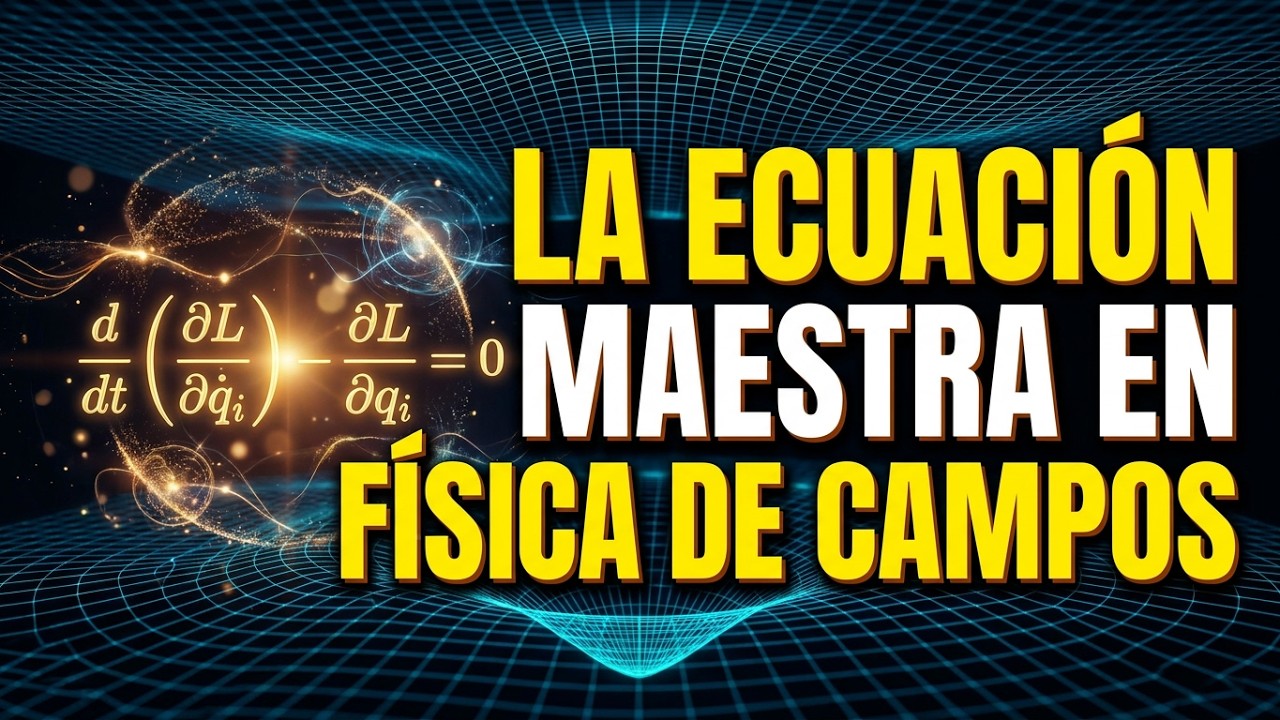














The Euler-Lagrange equation is derived by introducing a variation η(x) that equals zero at the boundaries, defining a family of curves ȳ(x) = y(x) + εη(x), then setting the derivative of the functional with respect to ε to zero and applying integration by parts to obtain the differential equation ∂F/∂y - d/dx(∂F/∂y') = 0, which provides a necessary condition for a function to make a functional stationary.
Deriving the Euler-Lagrange Equation | Variational Calculus
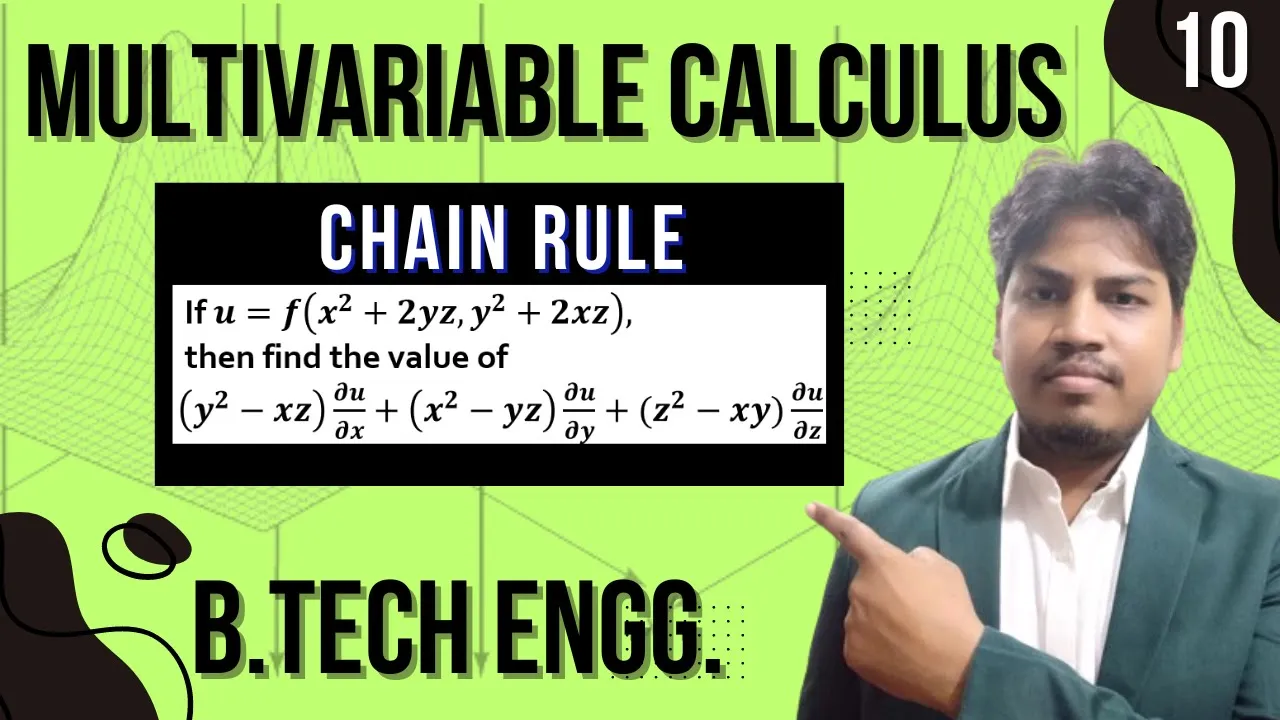
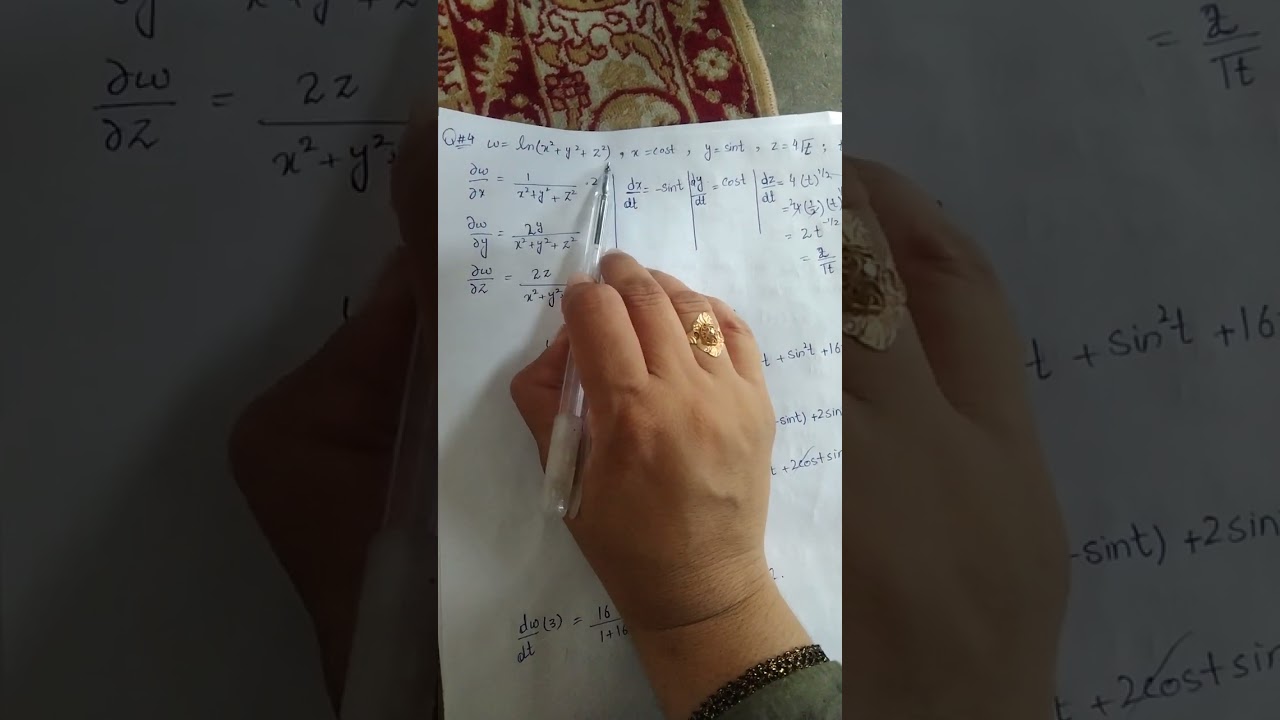
Added:Multivariable calculus, including partial derivatives and the multi-variable chain rule.
Integration by parts, which is a critical mathematical technique used to handle boundary terms during the derivation.
The fundamental concept of a 'functional' (a function that takes another function as an input and returns a scalar value).
Basic optimization theory, specifically how derivatives are used to find stationary points (extrema) in standard calculus.
Lagrangian Mechanics, utilizing the Euler-Lagrange equation to derive equations of motion for complex physical systems.
Solving classic optimization problems such as the Brachistochrone problem and finding geodesics (shortest paths) on curved surfaces.
Hamilton's Principle of Least Action, which generalizes the formulation to wider areas of physics, including electromagnetism and quantum mechanics.
Variational calculus with constraints, including the use of Lagrange multipliers to solve constrained optimization problems like the Isoperimetric problem.
Higher-order variational problems and multidimensional functionals (such as those found in classical field theory).
289.9K views5.6Klikes7:50Original Release: 2017-07-17
greeting students and welcome back to my second lesson on variational calculus in this video I'm going to derive the Euler Lagrange equation which allows you to find the stationary functions of a functional so let's begin by supposing that we have two points a and B given by x1 y1 and x2 y2 respectively what we want to do is find some function of X that makes the following functional or function of functions stationary now in addition to making this functional stationary there's another condition that we have to take into account when determining y can you see what that is it's the boundary conditions at X 1 our function of X has to equal y 1 and at X 2 our function of X has to equal Y 2 so now that we've set up the situation let's go ahead and begin our derivation slash proof of the Euler Lagrange equations we will suppose that our desired function that makes I stationary and which satisfies the relevant boundary conditions is given by what another name for Y is the extremal because it's the particular function that makes our functional stationary or extreme now what we're going to do here is introduce a function EDA of X the only condition on EDA is that it has to be 0 at the boundaries X 1 and X 2 otherwise EDA is just a completely random function by the way in this entire discussion it's implied that these functions ye done basically all the functions were concerned with all have continuous second derivatives so just keep that in mind anyway what we're going to do is define a new function y bar given by our extremal y plus some parameter epsilon times the arbitrary function EDA essentially y bar represents a variation in the extremal Y and because EDA is an arbitrary function you can conclude that by extension Y bar can also represent any arbitrary function the only restriction on Y bar arises from the restrictions we put on Y and EDA earlier on and you can easily verify that Y bar satisfies the exact same boundary conditions as what now because of the parameter epsilon and the arbitrary function EDA this y bar can be interpreted as a mathematical entity representing a whole family of curves now what I want to do is find the particular curve in this family that makes our functional eye stationary now one thing I want you to notice before I continue it's that this quantity I depends only on the parameter Epsilon why is that well because the X gets integrated out from this definite integral which means that once you integrate and apply your limits to end up with your I the only parameter or variable remaining in the final expression is epsilon because everything else depends on X now my primary objective here is to make eyes stationary but since I only depends on epsilon making eye stationary is equivalent to setting D ID epsilon equal to zero it's like single variable calculus if you want to function to be stationary just that it's derivative to zero but we already know what value of epsilon corresponds to a stationary eye and that's epsilon equals zero because remember the function y if X was already assumed to be stationary beforehand and so it's easy to see that when epsilon equals zero the particular curve that we end up for y bar is our desired extremal y all right so what we're going to do is use the fact that D ID epsilon equals zero at epsilon equals zero we're going to use the stock to differentiate the integral expression for I do some algebra and eventually arrive at the Euler Lagrange equation hopefully everything should be clear so far now when the derivative of i with respect to epsilon is zero then the derivative of this whole integral with respect to epsilon is zero obviously because i equals this integral by definition now let's move this derivative inside in which case we end up with a partial derivative with respect to epsilon now y bar and y bar prime are the only variables or functions inside capital S which depend on epsilon X is just an independent variable by itself so what we can do is apply the chain rule of partial differentiation to end up with the integral from x1 to x2 of partial F partial y bar times partial Y bar partial epsilon plus partial F partial Y bar prime times partial Y bar prime partial Epsilon and this integral at epsilon equals zero has to be equal to zero let's copy-paste the expression for y bar that we defined above which is just y bar equals y plus epsilon times eita now we also need to find the derivative of Y bar Y bar Prime and the derivative of Y bar is then just given by Y prime X plus epsilon times eda prime X if I take the partial derivatives of these expressions with respect to epsilon now then I'll end up with EDA and EDA prime respectively and let's plug them back into our expression for di D Epsilon this is what we'll end up with alright so now we need to simplify further we'll take the second term in this integral and integrate it by parts separately we'll have the first function which is the partial of capital F with respect to Y bar prime times the integral of e de Prime with respect to X minus the integral of the integral of e dot prime times the derivative with respect to X of partial F partial Y bar prime and of course our limits of x1 and x2 would still be there the integral of Fida prime is just e de so let's just plug that in now we know from the boundary conditions on EDA that at both x1 and x2 EDA is just zero so we can cancel out this first term and the integration by parts expression and let's plug this remaining term back into the equation for di D Epsilon and here is what we'll end up with we can take the EDA common and end up with a factored expression for the integral now when epsilon is zero y bar is just equal to Y by the definition of Y bar and we'll end up with this simplified expression for D I D Epsilon and because EDA is an arbitrary function the only way this integral is guaranteed to be 0 is if partial F partial y minus the derivative with respect to X of partial F partial y prime is 0 and this equation is called the Euler Lagrange equation what it means is that if Y if X is an extremal of the functional given by I up here then Y of X must satisfy this differential equation this Euler Lagrange equation just a couple of things to note the Euler Lagrangian is a necessary condition for the function yfx to give a stationary functional it is not a sufficient condition also Euler Lagrangian which make a functional stationary it doesn't tell you about whether the functional becomes a maximum or a minimum it doesn't tell you about the nature of the functions and determine by solving the Euler Lagrange equation the nature is something you'll have to infer or find out on your own using some other method anyway that's it we've successfully derived the Euler Lagrange equation if you have any questions or requests please let me know in the comments below and if you enjoyed the video feel free to like and subscribe this is the Faculty of Kahn signing out
Up Next
6:13
Legendre Transformation Explained with Geometric Animation
@MathAndPhysics
85.7K views•2018-04-16

4:43
Elliptic Curve Cryptography Explained: ECC, ECDSA, ECDH
@PracticalNetworking
28.5K views•2024-10-21
9:00
Einstein Summation Convention: Introduction to Tensor Notation
@FacultyofKhan
227.8K views•2018-07-02
6:00
The Mathematical Impossibility of Accurate World Maps
@Vox
23.3M views•2016-12-02
Related Study Plans & Knowledge Roadmaps
Structured learning paths in Mathematics
mathematics
Tensor Calculus: Vectors to Riemann Curvature
01Mathematical Foundations: Linear Algebra & Calculus
02Covectors, Dual Spaces, and Tensor Basics
03The Metric Tensor and Index Gymnastics
+ 2 more learning modules
40h5 modules
Explore Roadmap
mathematics
Gödel's Incompleteness: Logic, Proofs & Limits
01Introduction to Formal Systems & Hilbert's Dream
02Set Theory, Cardinality, and Cantor's Diagonal Argument
03Arithmetization and Gödel Numbering
+ 2 more learning modules
14h5 modules
Explore Roadmap
mathematics
Galois Theory: Fields, Groups & Solvability
01Foundations of Abstract Algebra: Groups & Fields
02Polynomials & Field Extensions
03Splitting Fields & Symmetries
+ 2 more learning modules
24h5 modules
Explore Roadmap
mathematics
Non-Euclidean Geometry: Models & Geodesics
01Euclid's Fifth Postulate and the Birth of New Geometries
02Hyperbolic Space and the Poincaré Disk Model
03Geodesics: Defining Straight Lines in Curved Spaces
+ 2 more learning modules
15h5 modules
Explore Roadmap