


![개념을 말하다 - 수학1 19강 (쎈 8/20~9/2) [EBS,메가스터디,대성마이맥 송진규T]](https://i.ytimg.com/vi/9hnalp8atN4/maxresdefault.jpg)



![[4강] Cheng 전자기학 강의 챕터2 (3) 직교 좌표계, 데카르트 좌표계](https://i.ytimg.com/vi/eH0575OjeMQ/maxresdefault.jpg)

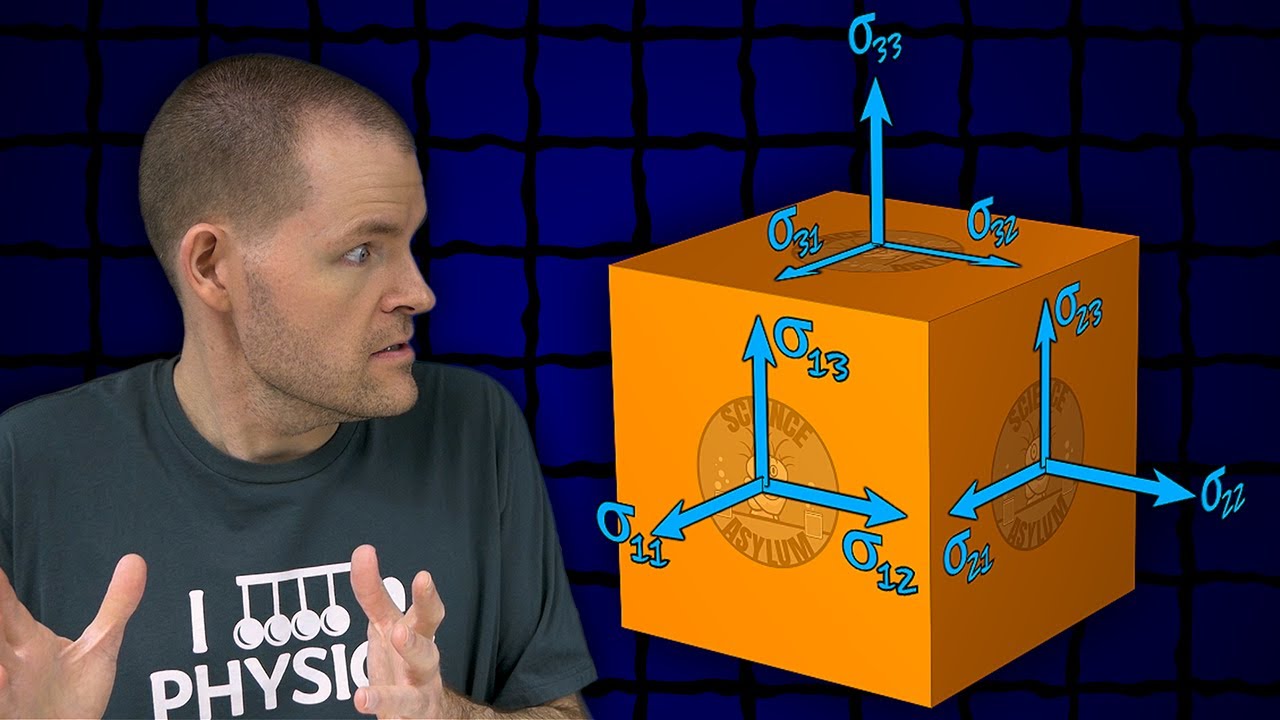






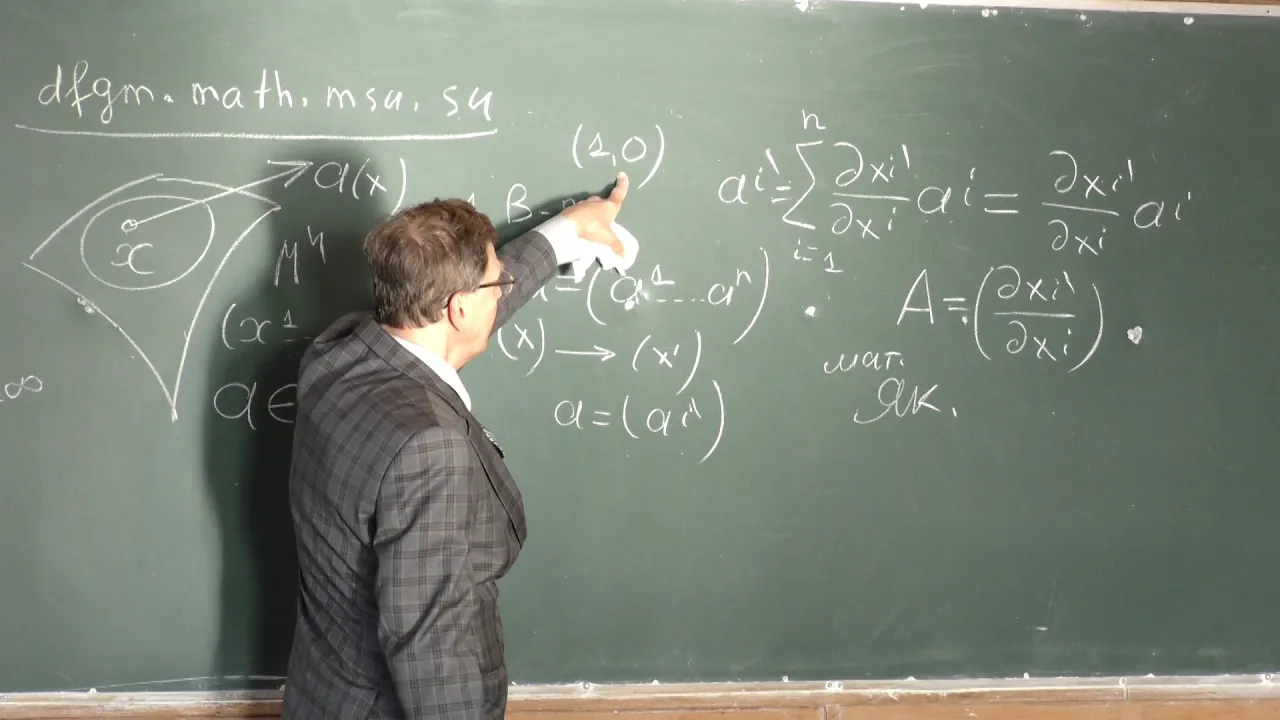
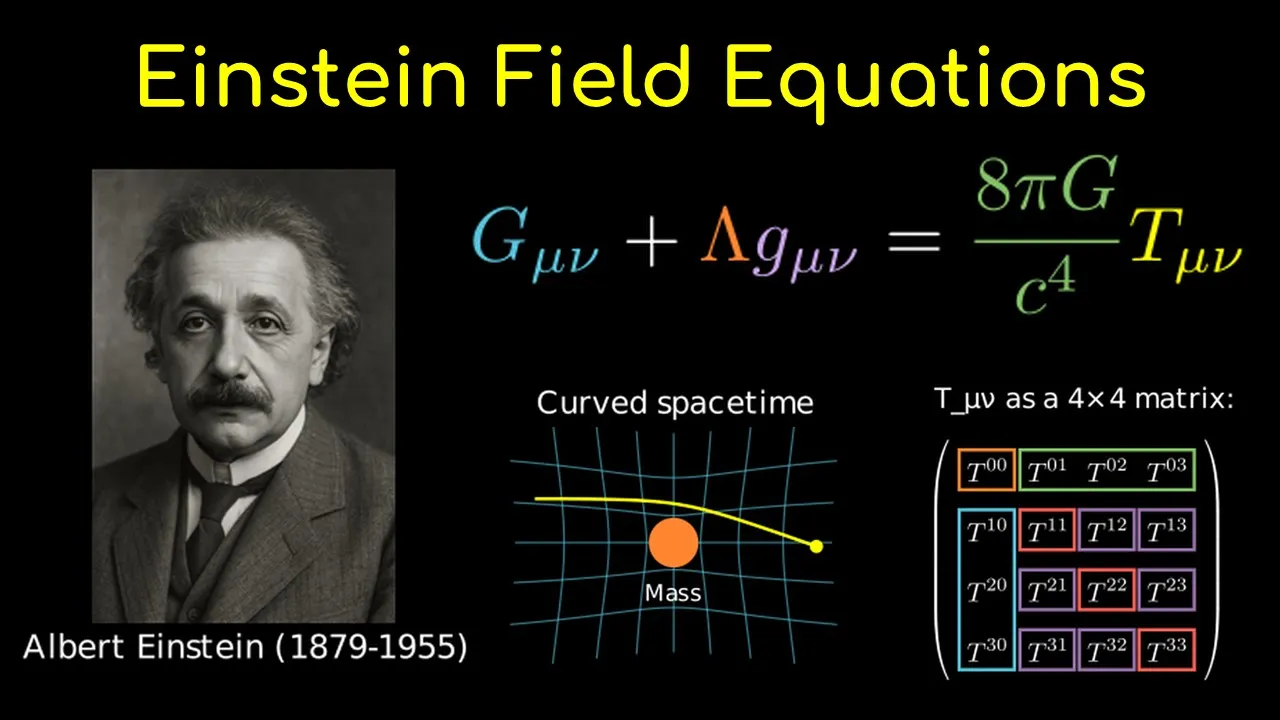


Einstein summation convention is a shorthand notation in tensor calculus where repeated indices (appearing twice in a single term) are automatically summed over, with indices counted together regardless of position (superscript or subscript); this system relies on two fundamental index types: dummy indices (repeated twice and summed over, which can be renamed freely as long as they don't conflict with existing indices) and free indices (appearing only once and not summed over, which must match identically on both sides of an equation); importantly, no index may appear three or more times in a single term, though this restriction applies per-term rather than across the entire expression.
Einstein Summation Convention: Introduction to Tensor Notation
Added:Fundamental concepts of linear algebra, including vectors, matrices, and matrix multiplication.
Familiarity with standard summation notation using the Sigma (Σ) symbol.
Basic understanding of Cartesian coordinate systems and vector calculus operations, such as the dot product and cross product.
An introductory concept of what a tensor is (e.g., scalars as rank-0, vectors as rank-1, matrices as rank-2).
Using the Kronecker delta and Levi-Civita permutation symbols to simplify complex vector identity proofs.
Distinguishing between covariant and contravariant components, and learning how to raise and lower indices using a metric tensor.
Applying tensor notation to formulate equations in Continuum Mechanics and Fluid Dynamics, such as stress and strain tensors.
Exploring advanced applications in modern physics, specifically General Relativity and the Einstein Field Equations.
227.8K views6.2Klikes9:00Original Release: 2018-07-02
let's talk about Einstein notation because this is one of the most crucial things you need to know if you're going to get anywhere in tensor calculus I'm going to describe Einstein notation using or simple rules that should allow you to tackle most problems in this area so let's begin when you're starting off Einstein notation can be pretty annoying I would use a stronger word but this is a family show and I'd much rather have four-year-olds watch this video than those spider-man Elsa videos anyway one of the reasons I'm Stein notation is annoying is that in addition to using indices as subscript so like a sub I for example which you might have already done quite frequently you're also using indices as superscript and this can be really confusing because when you're new to tensors you tend to confuse the superscripts for powers but they're not powers they're super scripts in fact for the rest of the series if I ever want to raise something to a power I'm going to be using parentheses so a super I to the power to or a super I squared would be written like this but a with a simple I will be written like this a super I now to be quite honest I'm not really aware of a short way of saying superscript indices I could just say a superscript I but that takes more time and I'm too lazy to say the extra syllables so I'm just gonna call it a super I let's move on from basic indexing to more involved topics in tensor calculus a lot of expressions will involve summation over particular indices this means you'll see lots of expressions like this where I have the sum from I equals 1 to I equals 3 of a sub I times X sub I this is of course just a 1 X 1 plus a 2 X 2 plus a 3 X 3 in Einstein notation when we write summations like these we don't use the Sigma symbol we just write a sub I times X sub I and this brings me to the foundational rule of Einstein notation which is that if you have a single term then any index that is repeated twice is summed over the positive integers usually from 1 to 3 it's 1 2 3 mainly because there are three dimensions and we tend not to go higher than that for the most part for example if we have a IJ times V J then according to one of Einstein notation this term would be equivalent to AI 1 B 1 plus AI 2 B 2 plus AI 3 B 3 now just a couple of things to go over here the first is that the index that is summed over in this case the index J is called a dummy index a dummy index is an index that is repeated twice in a term and I can replace a dummy index like J with any letter or index that I want as long as that letter or index satisfies two conditions the first is that the letter or index cannot already be in the term I have so I can't replace my dummy index J by I the second condition is that the replacement index is also defined over the same range that the original dummy index is defined over so in this case from 1 2 3 so for example another way I could write a IJ times B sub J would be to replace J by something like R so I get a sub i r times B sub R where R varies from 1 to 3 this replacement because it satisfies both of these conditions is valid so I've talked about dummy indices like J but what about indices like I well I is something we call the free index like the dummy index the free index can take on any value that the dummy index can take on so 1 2 3 for example the difference is that the free index is not summed over which means that it can only take on one of these values in a given term in other words I can be either 1 2 3 etc but it can only be one of these numbers and not multiple now unlike the dummy index the free index occurs only once in a given term and we cannot always replace the free index by and other free index for example I can't just replace the free index I in a sub IJ times V sub J by another free index K and necessarily get the same result K could be 2 for instance and I could be 1 with a dummy index though you can perform a replacement without too much trouble so just to summarize a dummy index is summed over it occurs twice and it can be replaced by another dummy index a free index is not summed over it only occurs once and it cannot be replaced by another free index these definitions of dummy and free indices I'm gonna call them rule 2 now the third rule of Einstein notation is pretty simple I just said that a free index occurs once in a term and a dummy index occurs twice the third rule says that we cannot have three or more of the same index in a single term so for example we're allowed to write a sub IJ times V sub IJ but we can't write a sub I I times B sub IJ or a sub IJ times B sub J J in Einstein notation you can only have free indices that occur once where dummy indices that occur twice in a single term there's no such thing as an index that occurs three or more times in the same term if you do see an index that occurs three or more times in the same term then either you can simplify things and prevent that same index from being seen so many times or you made a mistake somewhere just a quick note that when we count indices in a single term we're counting superscripts and subscripts together we're not separating the counts what I mean by that is if I have something like a sub J Super J then J is not a free index J is a dummy index because it occurs twice once in the subscript plus once in the superscript so we actually have to sum over J in this term and if I have something like a super JJ sub I then I is the free index and J is the dummy index again we're counting superscripts and subscripts together another thing to note is that when you see two terms like this combined together then you might be immediately inclined to say hey that's not right the index J has occurred four times in this expression which goes against rule number three and you would be partially correct the index J has occurred four times in this expression but that's not actually in violation of rule three the reason is that this whole expression consists of two terms being added together rule three says that no index may occur three or more times in a single term but if multiple terms are added together the index counter basically resets after each term that means the number of times J occurs is actually - in the first term and - in the second term which makes it a dummy variable in both terms this is fully within the legal limits allowed by rule 3 which only limit the index appearances to single terms terms that are added together aren't actually counted in the situation they're counted separately the fourth rule of Einstein notation is that when you have an equation involving terms in Einstein notation the free indices on the left must match the free indices on the right again just to remind you free indices are indices that only occur once in a given term so according to this rule an equation like X sub I equals a sub IJ times B sub J is fine because on the right hand side you're only free indexes I and on the Left you're only free index is also I remember a free index only occurs once in addition if we had something like the second equation then again the only free index on the right hand side is I because if you look at the terms J appears twice in this first term and K appears twice in both the first and second terms this means that J and K are dummy indices but I only appears once in the first term and once in the second term so therefore it's a free index and on the left hand side I is also the only free index which means that both sides are consistent however if we had these equations than in both cases there's an inconsistency between the free indices on either side of the equality the first equation I is the only free index on the left but I and J are free indices on the right so this first equation is written incorrectly it's meaningless in Einstein notation in the second equation J is the only free index on the left but AI is the only free index on the right again there's a mismatch and this equation is wrong finally in this third equation I is the only free index on the left but I and J are free indices on the right which again makes this equation wrong anyway that should do it for this video in the next lesson I'm gonna continue with Einstein notation with a few more examples and identities I'd like to thank the following patrons for supporting me at the five-dollar level or higher and I've put a link to my patreon in the diss scription and if you enjoyed the video feel free to like and subscribe this is the Faculty of Hon signing out
Up Next
24:38
Raising & Lowering Indexes in Tensor Calculus: Metric Tensor Operations
@tensorcalculus822
1.7K views•2022-06-04

4:43
Elliptic Curve Cryptography Explained: ECC, ECDSA, ECDH
@PracticalNetworking
28.5K views•2024-10-21
11:36
Contravariant vs Covariant Vectors: Transformation Laws & Examples
@FacultyofKhan
68.3K views•2019-03-24

6:00
The Mathematical Impossibility of Accurate World Maps
@Vox
23.3M views•2016-12-02
Related Study Plans & Knowledge Roadmaps
Structured learning paths in Mathematics
mathematics
Tensor Calculus: Vectors to Riemann Curvature
01Mathematical Foundations: Linear Algebra & Calculus
02Covectors, Dual Spaces, and Tensor Basics
03The Metric Tensor and Index Gymnastics
+ 2 more learning modules
40h5 modules
Explore Roadmap
mathematics
Gödel's Incompleteness: Logic, Proofs & Limits
01Introduction to Formal Systems & Hilbert's Dream
02Set Theory, Cardinality, and Cantor's Diagonal Argument
03Arithmetization and Gödel Numbering
+ 2 more learning modules
14h5 modules
Explore Roadmap
mathematics
Galois Theory: Fields, Groups & Solvability
01Foundations of Abstract Algebra: Groups & Fields
02Polynomials & Field Extensions
03Splitting Fields & Symmetries
+ 2 more learning modules
24h5 modules
Explore Roadmap
mathematics
Non-Euclidean Geometry: Models & Geodesics
01Euclid's Fifth Postulate and the Birth of New Geometries
02Hyperbolic Space and the Poincaré Disk Model
03Geodesics: Defining Straight Lines in Curved Spaces
+ 2 more learning modules
15h5 modules
Explore Roadmap