

















A tensor is a mathematical object that generalizes vectors and scalars, characterized by its rank (number of indices), where vectors are rank-1 tensors (one index per component), scalars are rank-0 tensors (no indices), and higher-rank tensors like rank-2 tensors have multiple indices representing combinations of basis vectors; the defining property of tensors is that all observers in different reference frames agree on the combination of components and basis vectors, making them fundamental descriptors of physical reality.
Understanding Tensors: A Visual Guide to Vectors and Their Higher-Rank Extensions
Added:Fundamental understanding of vector algebra, including magnitude, direction, and vector addition.
Familiarity with coordinate systems and the concept of basis vectors (e.g., unit vectors in 2D and 3D space).
Basic matrix operations, such as matrix-vector multiplication and representing linear transformations.
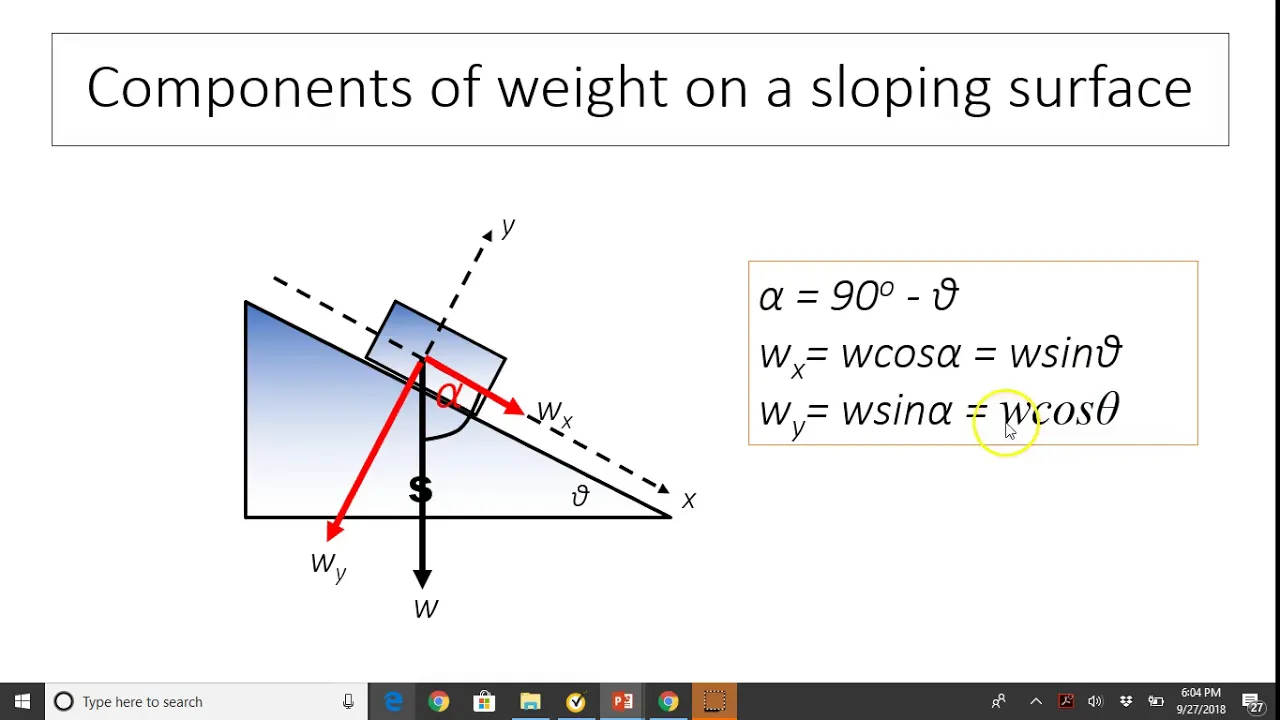
Introductory physics concepts, specifically the definition of force and how it is resolved into components.
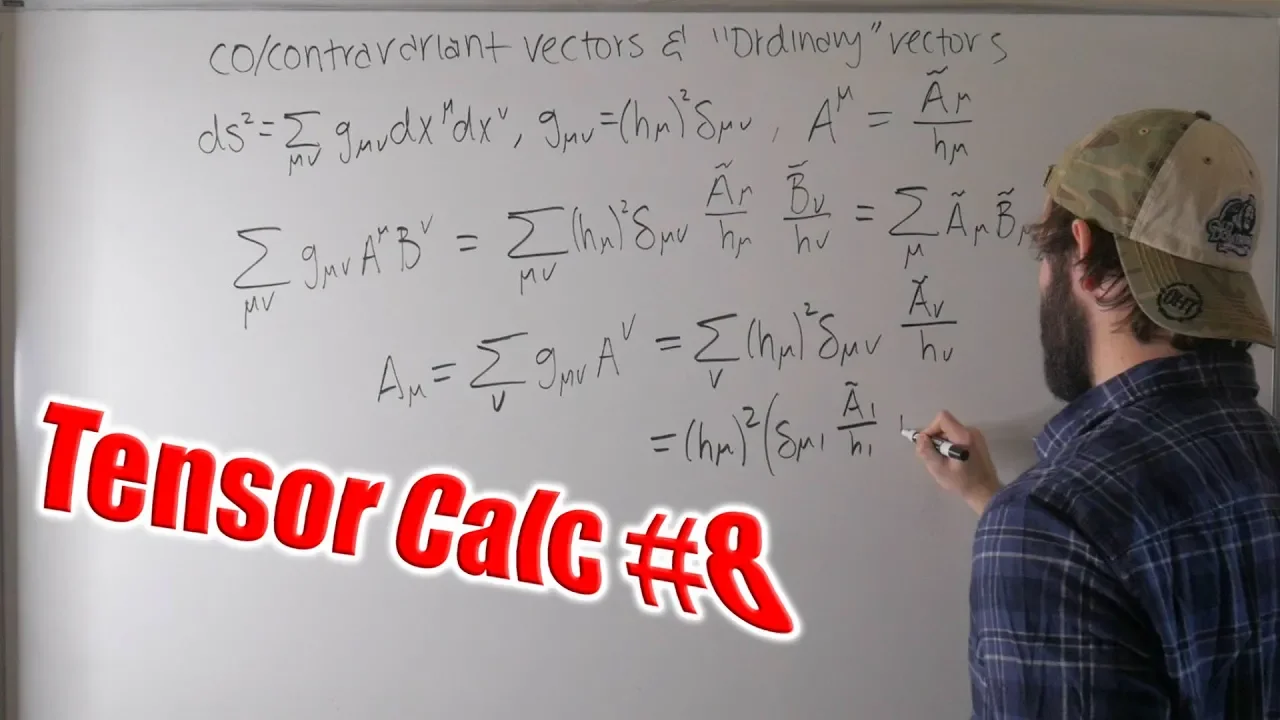
Formal tensor calculus, including covariant and contravariant components, coordinate transformations, and the Einstein summation convention.
The Stress-Strain Tensor in continuum mechanics, exploring how materials deform under multi-directional forces.
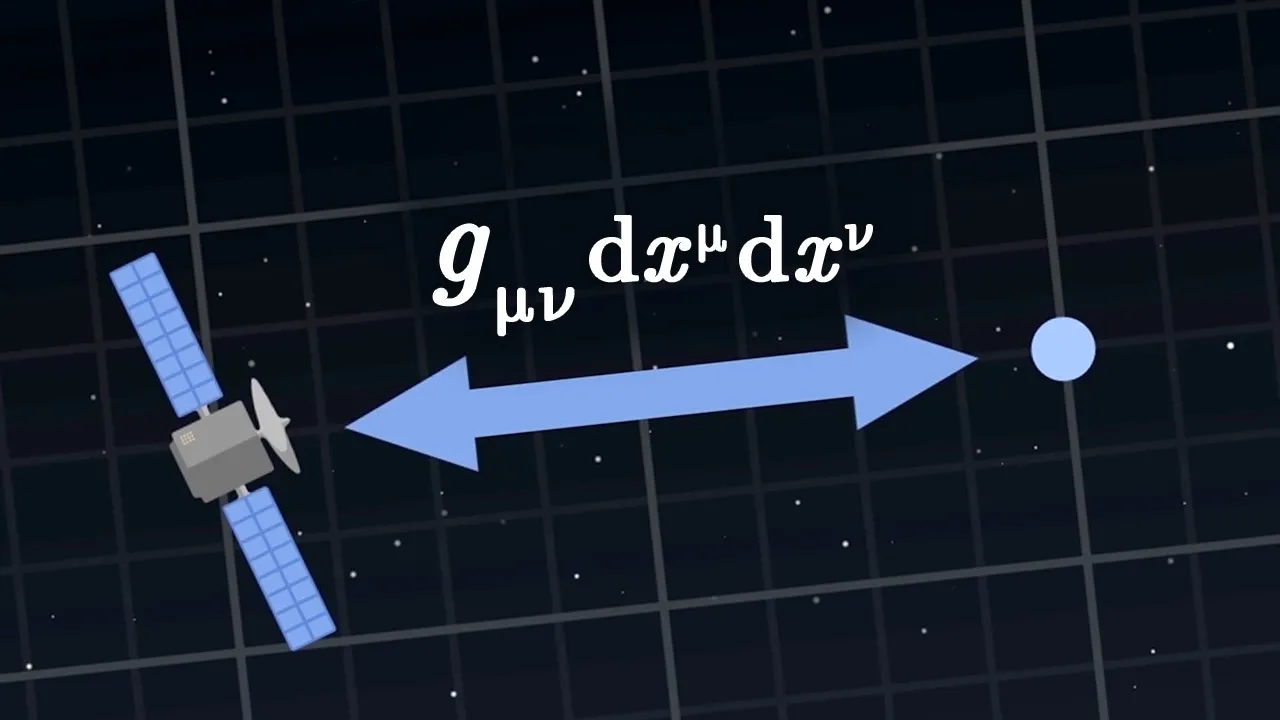
The Metric Tensor and its application in General Relativity to describe the curvature of spacetime.
Tensor representations in computer science and machine learning, specifically multi-dimensional arrays utilized in deep learning frameworks like TensorFlow and PyTorch.
4.2M views142.3Klikes12:21Original Release: 2011-11-21
Hi. I'm Dan Fleisch. When people hear that the subject of my new students guide is vectors and tensors, a reasonably high percentage of them have the same question: What's a tensor? My goal for this video is to take about 12 minutes to answer that question, not using a bunch of mathematical equations, but instead some simple household objects including children's blocks, small arrows, a couple of pieces of cardboard, and a pointed stick.
I think the very best route to understanding tensors is to begin by making sure that you're solid on your understanding of vectors.
If you've taken any college-level physics or engineering, you probably think of a vector is something like this: an arrow representing a quantity that has both magnitude and direction, where the length of the arrow is proportional to the magnitude of the quantity and the orientation of the arrow tells you the direction of the quantity.
This could represent the force of gravity on an object, or the strength and direction of the Earth's magnetic field, or the velocity of a particle in a flowing fluid. But vectors can represent other things as well, such as an area.
How does a vector represent area? It's pretty straightforward: you simply make the length of the vector proportional to the amount of the area (the number of square meters in the area) and then you make the direction of the arrow perpendicular to the surface.
So in that way this can represent an area as well. So vectors can represent lots of things. But if you want to take the step beyond thinking of vectors representing quantities with magnitude and direction, to understanding that vectors are members of a wider class of object called tensors, then you have to make sure you understand vector components and basis vectors.
If you're even going to think about the components of a vector, you better get yourself one of these.
This represents a coordinate system - in this case I picked the simplest one with the x-axis the y-axis and z-axis all meeting at right angles.
This represents the Cartesian coordinate system, and the thing to remember about coordinate systems is they come along with coordinate basis vectors.
You probably ran into these as "unit vectors" and the thing to remember about these little guys is they have a length of one. One what? One of whatever the units are that you're going to express the length of your vector in. The direction of the basis vectors or unit vectors is in the direction of the coordinate axes, so this might represent the unit vector in the x direction that's often called "x" with a little hat over it or sometimes "i-hat".
That's the x-hat unit vector - it points in the direction of increasing x coordinate.
Likewise the y-hat (sometimes called the "j-hat") unit vector points in the direction of increasing y, and the z-hat or "k-hat" unit vector points in the direction of increasing z.
Once you have the coordinate system and the unit vectors in place, now you're in a position to find the components of your vector.
How exactly do you do that? I think it's easiest to understand how to find vector components if you begin with a vector in the (x,y) plane, so i'm going to lay this vector in the (x,y) plane at some angle to the x-axis. In order to find the x- component, I'm going to project this vector onto the x-axis. In order to find the y- component, I'm going to project this vector onto the y-axis. And how am I going to do those projections?
Here's one way: I've darkened the room because I want to use this lamp to project the vector onto the x- and y- axes.
First I'm gonna shine the light perpendicular to the x-axis (that is parallel to the y-axis) and look for the shadow of the vector on the x- axis. That will be the x-component of this vector. As you can see the shadow of the vector on the x-axis ends right here. This is the x-component of this vector.
If I make the vector have a greater angle to the x-axis, notice the shadow moves this way - the x-component is getting smaller. And if I make the vector lie entirely along the x-axis, then the shadow and the vector are the same length - the x-component is the length of the vector in that case.
Now I've got my lights shining perpendicular to the y-axis (that is parallel to the x-axis) and the shadow cast by the vector onto the y-axis gives me the y-component of the vector. Notice that as I increase the angle to the x-axis and decrease the angle to the y- axis, the y-component is getting bigger.
Another way of visualizing vector components is to ask yourself: "To get from the base of the vector to the tip of the vector, how far do I have to go in the x- direction and how far do I have to go in the y-direction?"
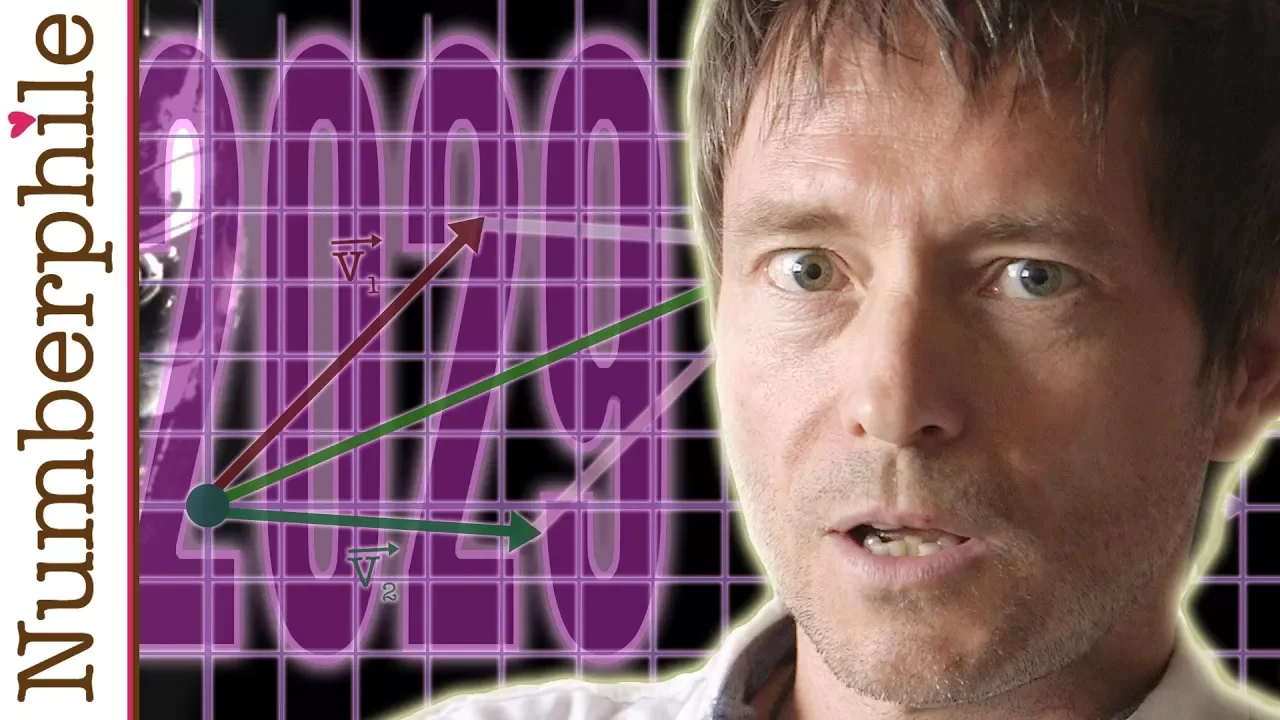
In other words how many x-hat (or i-hat) unit vectors and how many y-hat (or j-hat) unit vectors would it take to get from the base to the tip of this vector?
I can show you this if I get rid of these axes and just line up some x-hat basis vectors (these are going to go in the x-direction obviously), and some y-hat basis vectors.
So in other words this vector is made up of about four x-hat plus three y-hat.
That means that instead of drawing an arrow for this vector you could simply say four of these, plus three of these. And if you want to be complete (since there's no z-component of this vector), zero of these. That is the same as this.
In other words, this is a perfectly valid representation of that vector, and of course if you know the basis vectors, you wouldn't even have to put these on, would you? You could simply use these components as your vector. You could write him in a little array.
You could even stack them up, and put a nice set of parentheses around them.
This looks just like the way you see column vectors written.
Of course these three components pertain only to the vector we had lying on the table a minute ago. To generalize this to vector capital A, for example, we can replace these components with A sub x, and A sub y, and A sub z. Of course, A sub x is the component that pertains to the x-hat basis vector, A sub y pertains to the y- hat basis vector, and A sub z pertains to the z-hat basis vector.
Notice that we need one index for each of these, because there's only one directional indicator (that is one basis vector) per component.
This is what makes vectors "tensors of rank one" - one index, or one basis vector per component.
By the same token, scalars can be considered to be tensors of rank zero, because scalars have no directional indicators, therefore need no indices. Those are tensors of rank zero.
I'll see in a minute why it's so powerful to represent tensors as this combination of components and basis vectors, but first I want to show you some examples of higher-rank tensors. This is a representation of a rank-two tensor in three-dimensional space.
Notice that instead of having three components and three basis vectors, we now have nine components and nine sets of two basis vectors.
Notice also that the components no longer have a single index, they have two indices. Why might you need such a representation?
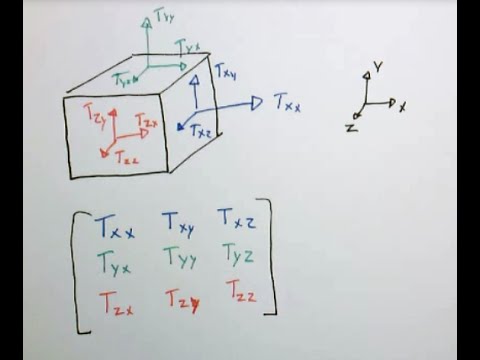
Consider for example the forces inside a solid object. Inside that object you can imagine surfaces whose area vectors point in the x- or in the y- or in the z-direction.
And on each of those types of surface, there might be a force that has a component in the x- or in the y- or in the z-direction. So to fully characterize all the possible forces on all the possible surfaces, you need nine components, each with two indices referring to basis vectors.
So for example A sub xx might refer to the x-directed force on a surface whose area vector is in the x-direction, A sub yx might refer to the x-directed force on a surface whose area vector is in the y- direction, and so forth.
This combination of nine components and nine sets of two basis vectors makes this a rank-two tensor. This is a representation of a rank-three tensor in three-dimensional space: 27 components each pertaining to one of 27 sets of three basis vectors. I'll zoom in a little bit here so you can see the components better.
Notice that now each component has three indices: A sub xxx pertains to three x basis vectors, A sub xyx pertains to two x and one y basis vector, and so forth.
This entire front slab has x as the third index and pertains to these nine sets the basis vectors. The middle slab all has y as the third index and pertains to these nine, and the back slab all has z as the third index and pertains to those nine.
So in three-dimensional space 27 components, 27 sets of three basis vectors, and three indices on each component.
You may be wondering what is it about the combination of components and basis vectors that makes tensors so powerful.
The answer is this all observers, in all reference frames, agree. Not on the basis vectors, not on the compliments, but on the combination of components and basis vectors.
The reason for that is that the basis vectors transform one way between reference frames, and the components transform in just such a way so as to keep the combination of components and basis vectors the same for all observers.
It was this characteristic of tensors that caused Lillian Lieber to call tensors "the facts of the universe".
Thanks very much for your time.
(Subtitles bei Majestik Moose)
Up Next
14:07
Understanding Covectors in Tensor Algebra: Linear Functions Explained
@eigenchris
308.8K views•2017-12-15
4:43
Elliptic Curve Cryptography Explained: ECC, ECDSA, ECDH
@PracticalNetworking
28.5K views•2024-10-21
10:44
Fourier Series Introduction: The Big Idea Explained
@DrTrefor
387K views•2021-05-03

6:00
The Mathematical Impossibility of Accurate World Maps
@Vox
23.3M views•2016-12-02
Related Study Plans & Knowledge Roadmaps
Structured learning paths in Mathematics
mathematics
Tensor Calculus: Vectors to Riemann Curvature
01Mathematical Foundations: Linear Algebra & Calculus
02Covectors, Dual Spaces, and Tensor Basics
03The Metric Tensor and Index Gymnastics
+ 2 more learning modules
40h5 modules
Explore Roadmap
mathematics
Gödel's Incompleteness: Logic, Proofs & Limits
01Introduction to Formal Systems & Hilbert's Dream
02Set Theory, Cardinality, and Cantor's Diagonal Argument
03Arithmetization and Gödel Numbering
+ 2 more learning modules
14h5 modules
Explore Roadmap
mathematics
Galois Theory: Fields, Groups & Solvability
01Foundations of Abstract Algebra: Groups & Fields
02Polynomials & Field Extensions
03Splitting Fields & Symmetries
+ 2 more learning modules
24h5 modules
Explore Roadmap
mathematics
Non-Euclidean Geometry: Models & Geodesics
01Euclid's Fifth Postulate and the Birth of New Geometries
02Hyperbolic Space and the Poincaré Disk Model
03Geodesics: Defining Straight Lines in Curved Spaces
+ 2 more learning modules
15h5 modules
Explore Roadmap