


![Tensor Analysis Chapter- 02 [Riemannian Metric And Metric Tensor ] Tutorial- 09](https://i.ytimg.com/vi/yrWg_0eT2gM/maxresdefault.jpg)












![[Metodos I] Ejercicios Propiedades y Derivadas de Tensores](https://i.ytimg.com/vi/Z3bbhdvWg8g/maxresdefault.jpg)


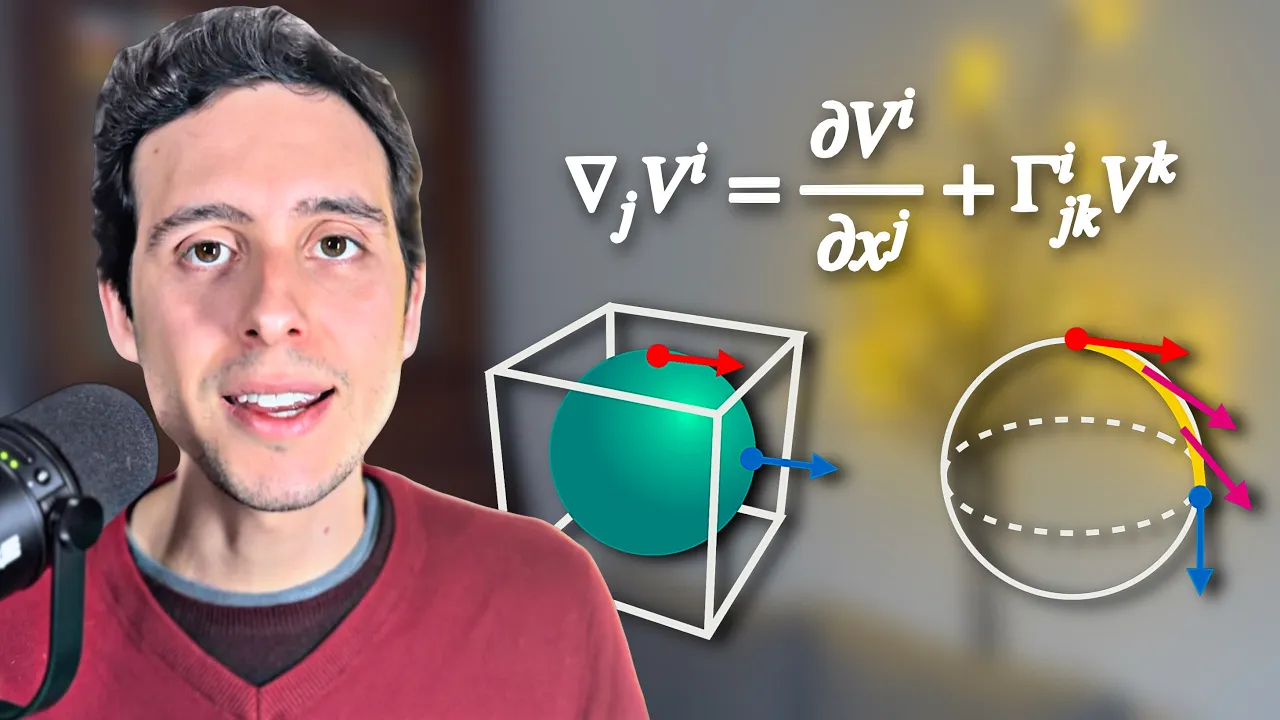
![평행이동, 공변미분, 크리스토펠기호의 이해(일반상대론의 이해3)Understanding of covariant derivative and Christoffel symbol ]](https://i.ytimg.com/vi/aXULmeyGAMo/maxresdefault.jpg)

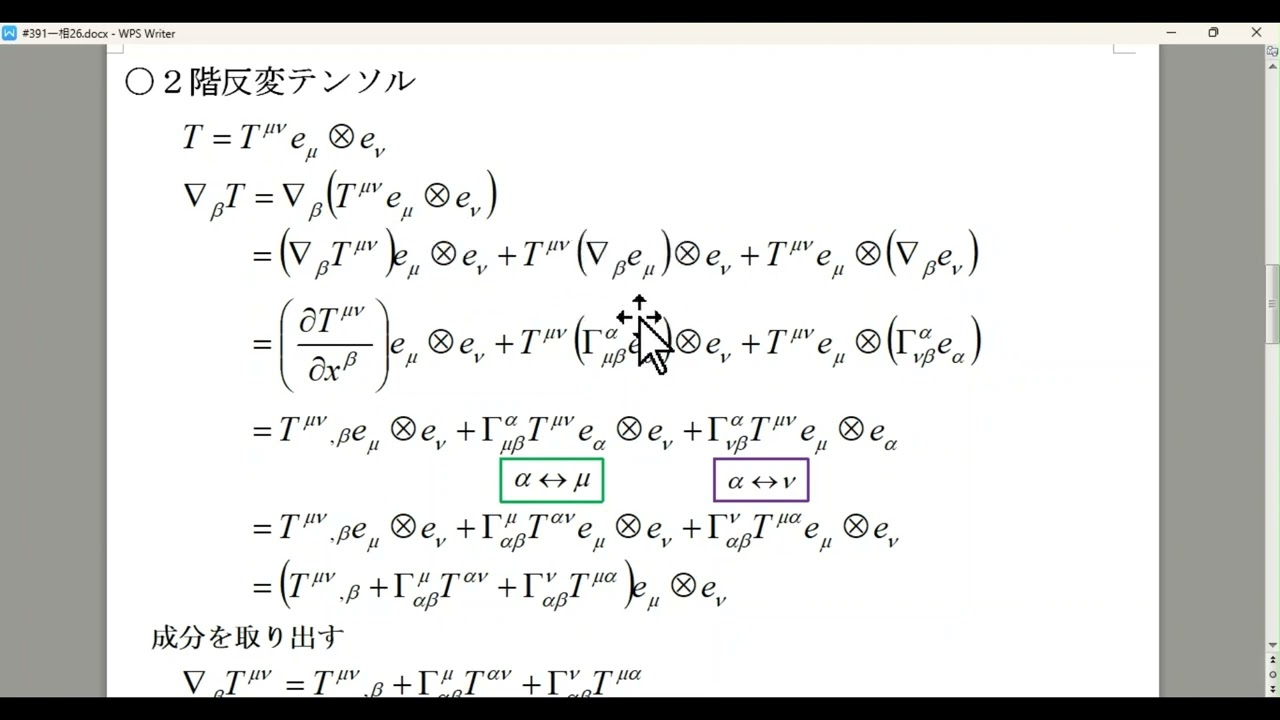











In tensor calculus, the metric tensor serves as a fundamental tool for converting between covariant and contravariant representations of vectors and tensors through index raising and lowering operations; specifically, multiplying a covariant basis vector by the contravariant metric tensor yields the corresponding contravariant basis vector (raising the index), while multiplying a contravariant basis vector by the covariant metric tensor yields the corresponding covariant basis vector (lowering the index); similarly, vector components can be raised or lowered using the metric tensor, and this technique extends to higher-rank tensors by forming contractions with the metric tensor to move indices between upper and lower positions, with the important exception that symmetric tensors allow interchangeable notation for mixed-index forms.
Raising & Lowering Indexes in Tensor Calculus: Metric Tensor Operations
Added:this is video 22 in our series on tensor calculus in this video we're going to build on what we've learned about contraction and develop a technique known as raising and lowering indexes back in video 17 we used this expression to define our contravariant metric tensor as the matrix inverse of the covariant metric tensor the matrix product of these two will yield the chronic or delta or the identity matrix we then went on to use this expression to define the contravariant basis vector and by looking back at the last video you'll recognize this now as an inner product or a contraction between the covariant basis vector and the contravariant metric tensor okay i want to continue along with some analysis here i want to form a contraction or an inner product with the covariant metric tensor so i'll do it this way and i need a new letter m and z m i times z i like this i've simply multiplied this factor times the left side of course i have to do the same on the right z m i times z i j c j like this so i have altered the meaning of the i index from a free index to a dummy index and introduced a new free index of m on the right hand side we have a double contraction all right now you'll recognize i hope that this expression is the same form as this and that means that our product of terms there really will result in a chronic or delta j m that times zj like this and now the chronic delta absorbs the j index leaving us with just cm okay and finally i want to swap sides of the equation i want this on the left and this on the right and i want to rename some indexes i'd prefer this to be i so i'll rename it here and here and to do that i have to rename i to something else like j that's what i'll do so the final expression i'm looking for would be z i that's this guy over here equals z i j times z j just like this now if you look you can see that we have an expression here that is like the mirror image of what we started with it's the same form it's just that the indexes are in the opposite position here we started with the covariant basis vector times the contravariate metric tensor and we got the contravariant basis vector here it's just the opposite we start with the contravariant basis vector times the covariant metric tensor and we get the covariant basis vector so these two are actually inverse operations of each other we start with the the basis vector that has the lower index here go through the operation and we wind up with the basis vector that has the upper index here we start with an upper index and it yields a lower index there so we call this kind of operation we refer to it as raising the index we raise the j index here up to i and here this is the operation of lowering the index we started with an upper index and we're able to determine the lower index as a result okay let's keep going we know that a vector any vector can be represented as a linear combination and we can do it in two ways we can use the contravariant component times the covariant basis vector or the covariant component times the contravariant basis vector either one works well now that i have this kind of relationship or i can go back and forth i can now replace the contravariant basis vector here with the equivalent expression which we just derived which was well actually it's part of the definition up here so i'm going to replace it this way so i hope you see what i've done i have taken this expression and replaced it with this expression over here like so okay and when i do that i'm now going to do some index renaming i'm going to rename i to j and j to i so we'd have v j z j i z i like this and i'm going to reorder some terms we'll put the metric tensor in front but i can also switch the index order because this is a symmetric matrix symmetric tensor so that zji is the same as zij i'll put our scalar component next and the basis vector at the end now at first it looks like i'm just doing operations at random but not really here because i've now manipulated it so this factor is the same as this one which means that this scalar component out front must be exactly equal to this expression right here so i now can say that vi our scalar component is equal to this expression which is z i j v j like so and if you look closely you can see that the form of this expression is exactly the same as the form of this expression right up here so again we have a situation where we start with a lower index here use the contravariant metric tensor as a factor to form a contraction or inner product and it yields the counterpart of the component that has the upper index we have raised this index all right now it shouldn't be much of a stretch of the imagination to see that if you start with this guy and go through this set of operations it yields this well it's not a stretch of the imagination to realize that if we start with this one do the same kind of operation then you're going to come out with v i lower index equals z i j times v j like this and so we find that not only do we have a correspondence of of expressions between this guy and this one but we have a correspondence of this to this so the same process of raising the index for our basis vector and lowering the index for the basis vector also works for the covariant and contravariant components the scalar components of our vector so we have an operation that lets us raise the index or lower the index and so this is an extremely useful technique and you're going to see it happen over and over again and things as we move forward it gives us the ability to switch from covariant to contravariant factors anytime we want to or vice versa if you're working with covariant components you don't like it you want to work with contravariant components this simple little expression will convert them so you can use the ones you want now the vector can be expressed either this way or this way so the covariant and contravariant components are equivalent they're not the same but they're equivalent that means that they carry the same information about the vector and each one is as useful as the other so we can trade one for the other any time we want it using this expressions these two formulas for raising and lowering indexes maybe you can appreciate now why we refer to the metric tensor as the fundamental tensor because it is something of a conversion factor that connects the covariant and contravariant components of vectors and the basis vectors okay well what we see working here for components and basis vectors also works for tensors of higher rank so let's take a look at that let me move up here a little bit suppose i have a second rank tensor t i j that looks like this and i form a contraction now with our contravariant metric tensor and i'll use the letter r this time and contract with the i index so what was originally a second ranked tensor twice covariant now when i form this contraction i is now a dummy index so it's no longer a free index but i've introduced the r index well that converts the rank of the expression to a tensor that looks like this it has r in the upper position and it has j remaining in the lower position now here i've put a dot in this position to show that we have raised the first of these two indexes into the r position well now if i take this tensor which is t r dot j and i form another contraction this time with s and j as the the dummy index i'm forming another contraction or an inner product and this time what was a second ranked tensor once at once covariant now it's going to become a tensor that is twice contravariant like this so i use the same idea of forming these contractions to raise the indexes only had to do it twice this time in order to get both indexes raised where they belong okay now i could have done this in a single operation i could have taken t i j i've formed a contraction with r i here and another factor of r s j here so i have a double contraction i've formed a dummy index with i and with j and the s and r components will take the place as it moves up into the position of t r s so the operation of raising the index works the same way and you could see that in reverse it would work by lowering the indexes now let's be clear that i could have started with tij and formed a contraction first of all with the s first i could have done sj and that would have formed a tensor that looks like this this time the dot is here with the s and the i because i'm raising the j index into this second position then i could have taken t dot s i and form the contraction of r i and we get the same result as before the order doesn't matter i can do one first and the the other second now let's say a word about these placeholders these dots i've put in place and we said a moment ago that covariant vector components and contravariant vector components are equivalent they carry the same information so we can represent the vector in one of two ways with these sets of components well vector components are really first rank tensors well if we look at a second rank tensor we know that we can represent that with lower indexes as a a covariant tensor or upper indexes like this or as a mixed tensor where we have i and j but the point i'm trying to make here is there's a difference between i dot j and dot i j just because we have an index on top and bottom doesn't mean that these are the same thing in fact in general these two will not be equal to each other so the order in which you raise these if we raise them both in the end we'll get the correct result but if you raise only one of them and you raise the other one in a different order the matrix that you produce here is not necessarily going to be the same so we use these dots as placeholders to distinguish between the two forms now to understand this better let's um do a more complex example suppose we have a sixth ranked enter that looks like this i j k on top r s t on the bottom now for whatever reason we decide we want to lower the j index well we need a factor first of all it's a covariant metric tensor term because we're lowering the index and so we need a new letter and then we'll contract on the j index like this so we're going to drop the j index using this particular technique well where does it go and what does it look like well here's a convention that i use and i think it's used by most authors but not everyone and it's this we consider the upper indexes to lie to the left of the lower indexes so the meaning of this expression really is this mj t i j k with three dots as placeholders and on the bottom we start with three placeholders and have r s and t now if we arrange it this way we have no trouble in seeing that lowering the j index would result in a tensor that looks like this i dot k with three dots and then dot m dot r s t you can see how nicely everything winds up in its own slot or its own position and then because of the convention because we understand that the lower indexes trail the upper indexes we don't need any trailing dots on the top or any leading dots on the bottom so the end result here is i dot k and on the bottom it's just m dot r s t okay now i mentioned this convention is very popular widely used but not by everyone so be careful when you read other literature that you understand what the author uses sometimes they do it just the reverse so make sure you understand the convention the author's using all right there's one very important exception here we said earlier that t i dot j is in general not equal to t dot i j in this form and in general that's true but if our tensor tij is a symmetric tensor then these two forms will be equal so if and only if the tensor is symmetric we'll find that this statement is true and because it's true we are okay just representing either form as t i j without any dots and i say all of this because most of the second ranked tensors we encounter will be symmetric tensors so you'll see this form quite often and just realize that there's no ambiguity here because raising the right index of the left index first will result in exactly the same matrix all right i've got one more topic to cover now suppose i have this expression r i and t i combined as an inner product like this well i'm going to replace the first factor with this z i m r m with an upper index i hope you see that this expression is the same as r with a lower index of i i'm going to do the same thing with t i'm going to replace it with this expression and i hope you see that this factor is the same as t with an upper index of i okay collect the terms a little bit we have z i m z i k and we have r m and t k like this well the combination of these two factors a contraction of one of the indexes of the covariant and contravariant metric tensors will result in a chronic or delta km like this rm and tk the chronic delta will absorb let's say the m index leaving us with rk tk and we can always rename the indexes of any dummy index leaves us with this result r i t is equal to r i t now i call this the flip flop because anytime we have a contraction like this a dummy index we can flip the positions of the dummy indices if we do both at the same time so i can raise the index of r while i also lower the index of of t and this operation is always permissible i don't need to go through this whole exercise anytime i see a dummy index i can flip the two indices one going up and the other going down and the results will be exactly the same okay i think that's quite a bit for one video so let's go review what we've done we first discovered that forming an inner product between the contravariant metric tensor and the covariant basis vector had the effect of raising the index and giving us the contravariant basis vector and we see that the same thing happens when we use the the contravariant metric tensor with a covariant vector component it also has the effect of raising the lower index here to give us the contravariant vector components we then discovered that the converse works as well if we form an inner product using the covariant metric tensor with the contravariant basis vector the effect will be to lower this index and give us the covariant basis vector and the same thing happens with vector components we can lower the index from a contravariant component to a covariant component like this so with these tools we can raise and lower the indexes anytime we need to then went on to look at the operation as it applies to higher ranked tensors we started by looking at a second rank tensor we raise the i index first by forming this contraction so the r index appears on the right hand side now i have set these two forms equal to each other because of the convention we talked about we said that the upper index is understood to be to the left of the lower index so we don't need the leading dot here to understand that that's the meaning of this expression on the other hand if we started by raising the s index first such as down here we do need to retain the dot because if we didn't have the dot there we would understand the s to be to the left of i and it's not true i is to the left of s in this relationship now i'll remind you here of our important exception if t is in fact a symmetric tensor then it would be okay to represent this result as t s i and the reason is because this expression would result in exactly the same matrix as this expression but that's only true if we have a symmetric second rank tensor okay in either case if we start by raising i first we can raise j next to get this if we start with j first and then raise i we get the same result or we can do both operations as one expression by creating a double contraction like this we raise both i and j at the same time then we went through a more complicated example in which we illustrated the fact that due to our convention this form of the tensor actually means this and because of it it's very clear where the j index drops down into the second position on the bottom and ultimately because of the convention we can drop the trailing dots on this side and the leading dot on the bottom giving us the final result that's here now in the recap i've given you the inverse operation where we start with this tensor right here and show you an operation for raising the m index back into the second position and we would do just the opposite we would insert the trailing dots and the leading dot here and that makes it easy to see that the m index goes up into this second slot giving us this form we can drop now the trailing dots and the leading dots and go back to the original form of the tensor back here that also shows you that these operations are reciprocals of each other they're inverses they're they're one produces this form and doing this takes us back to the original form that we had all right the last thing we did was to show that we can do a flip-flop on dummy indexes and this is the example we used in doing the derivation but it works anytime you have dummy indexes for example in this illustration i flip both i and j so that the i and j appear on top here instead of bottom and these two drop to the bottom like this i don't need to do any calculation or derivation i can just flip flop these dummy indexes anytime i feel like it all right with that i think you have a pretty clear understanding of what it means to raise and lower indexes
Up Next

Conceptualizing Christoffel Symbols in Curvilinear Coordinates
@dialectphilosophy
201.4K views•2023-10-07

Elliptic Curve Cryptography Explained: ECC, ECDSA, ECDH
@PracticalNetworking
28.5K views•2024-10-21
Fourier Series Introduction: The Big Idea Explained
@DrTrefor
387K views•2021-05-03

The Mathematical Impossibility of Accurate World Maps
@Vox
23.3M views•2016-12-02
Related Study Plans & Knowledge Roadmaps
Structured learning paths in Mathematics