







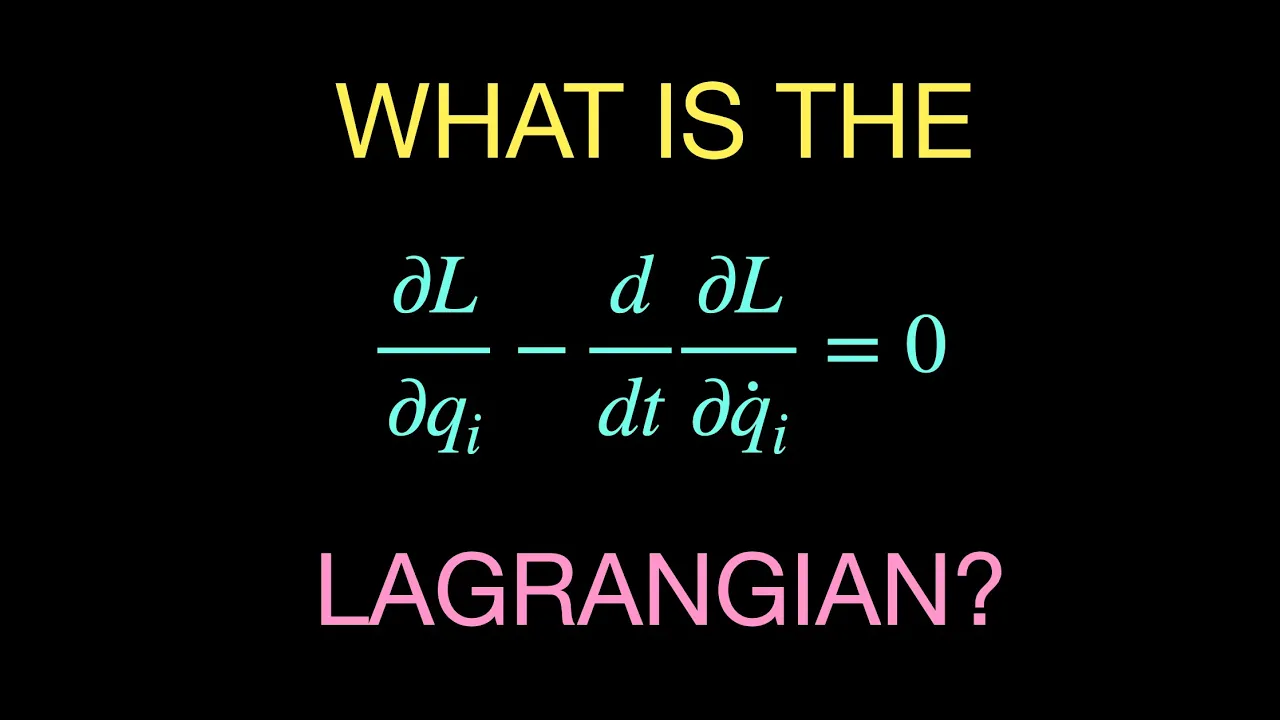












The Legendre transformation is a mathematical technique that transforms a function f(x) into a new function G(p) by using the derivative p = f'(x) as the new variable, where G(p) = f(x) - x·p with x expressed as a function of p; this transformation preserves all information from the original function and is fundamental in thermodynamics for deriving potentials like enthalpy and in theoretical mechanics for transitioning from Lagrangian to Hamiltonian formulations.
Legendre Transformation Explained with Geometric Animation
Added:Basic Calculus and Tangent Lines: A solid understanding of derivatives, slopes, and representing a curve by its tangent lines.
Convex and Concave Functions: Familiarity with the mathematical definition of convexity, as the Legendre transformation typically requires strictly convex (or concave) functions to be uniquely defined.
Lagrangian Mechanics: Fundamental concepts of classical mechanics, specifically the Lagrangian function L(q, q-dot, t) and generalized coordinates.
Basic Thermodynamics: An understanding of state variables, heat, work, and the first law of thermodynamics.
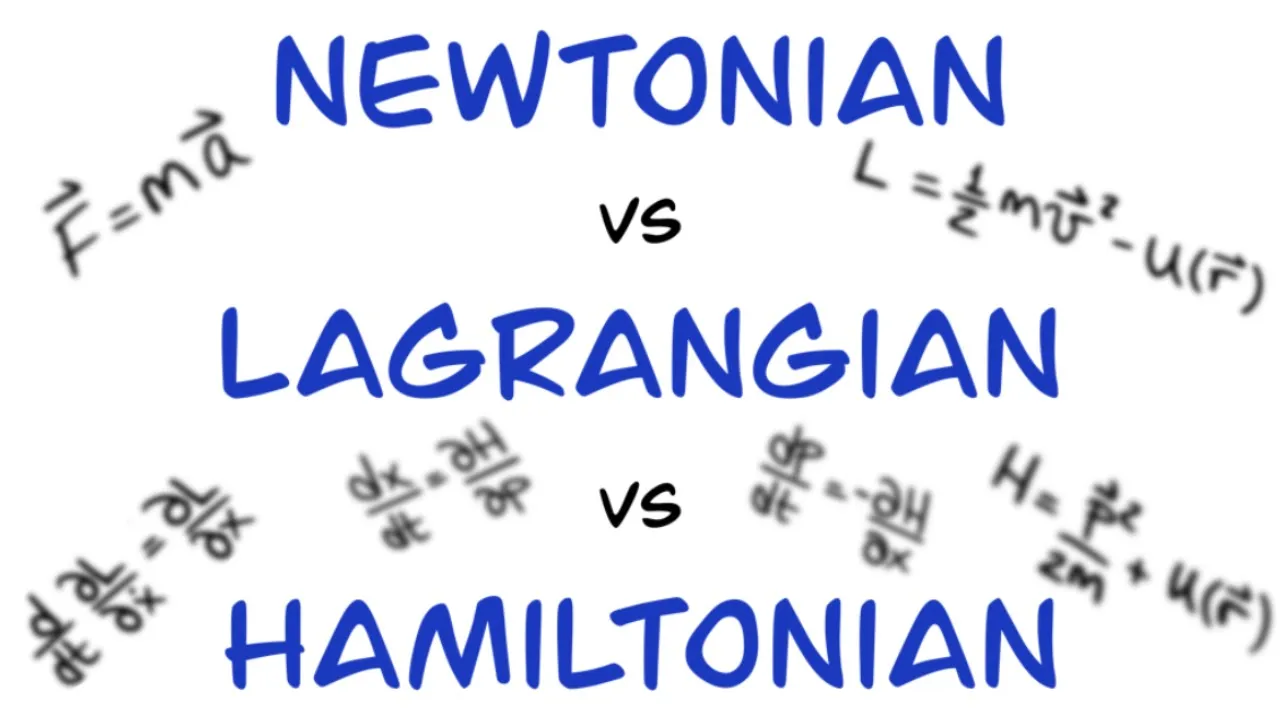
Hamiltonian Mechanics: Deriving Hamilton's equations of motion by performing a Legendre transformation on the Lagrangian with respect to generalized velocities.
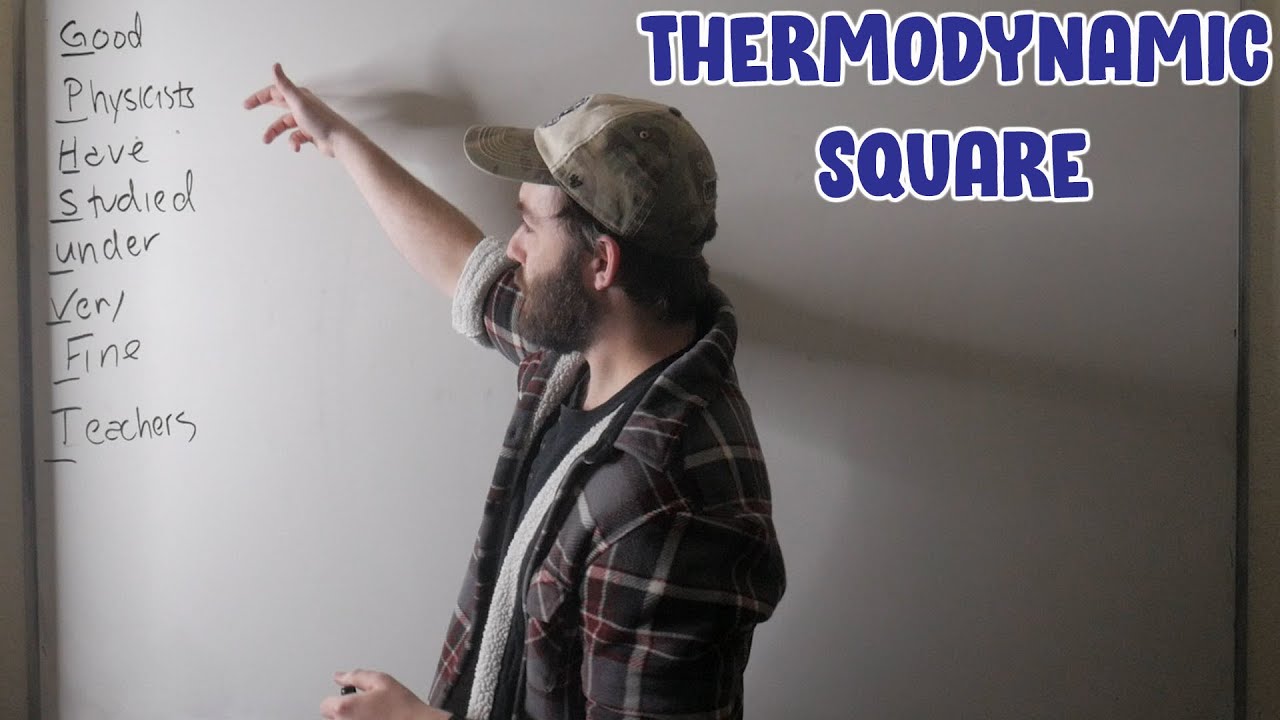
Thermodynamic Potentials: Applying the transformation to transition between Internal Energy, Helmholtz Free Energy, Enthalpy, and Gibbs Free Energy.
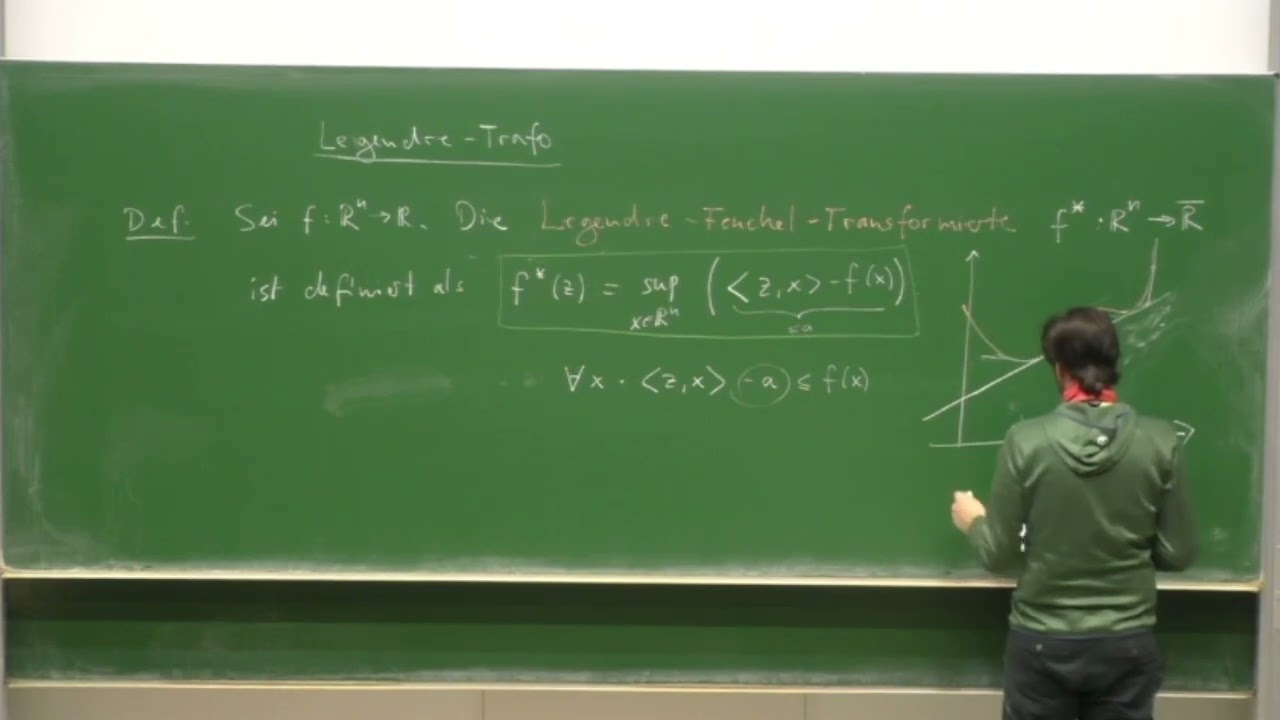
Legendre-Fenchel Transform: Exploring the mathematical generalization to non-differentiable or non-convex functions, which is highly relevant in machine learning and optimization theory.
Canonical Transformations: Studying coordinate transformations in phase space that preserve the mathematical structure of Hamilton's equations.
85.7K views1.4Klikes6:13Original Release: 2018-04-16
a LaShondra transformation is a way of transforming certain functions into new functions while retaining all of the information contained as a physicist your first encounter of little genre transformations is probably either in thermodynamics or in theoretical mechanics but let's first look at the purely mathematical aspects I'm going to restrict this to differentiable functions and although the concept is more general in physics were usually dealing with differentiable functions so we start with a function f of X we know that derivative of F with respect to X and we call it P we would like to find a new function G of P that contains all the information contained in f of X in other words it has to be possible to recover f of X from G of P so let's take a look at the function f of X equals x squared the first derivative of this function is 2x we can use that to draw a tangent at each point of the function f as depicted by the red line the equation for that function is pretty straight forward is of course a straight line and the slope is given by the derivative of f you may think of this as the linear Taylor expansion of the function at x0 now take a look at this little animation that I made it shows the tangent at all points of the curve f and I put a red dot where the tangent touches the function now focus on the intersection of the tangent and the y-axis let's highlight this intersection with a black dot we can now compose a function by taking the x-coordinate of the red dot and a y-coordinate of the black dot which is now showing green in the animation the resulting function is G of X and is the LaShondra transform of F so let's write this down as a function of X we are interested in an expression for the green curve we set for each x coordinate the corresponding y coordinate is equal to the y coordinate of the intersection of the tangent of original function f and the y axis and of course from all tangents available we use the one that touches f at the exact x-coordinate that we're currently looking at so G of X equals T of 0 and X since we evaluate on the y-axis and X 0 which I used to denote the point at which a tangent is constructed is now our variable X this equals to f of X minus x times P in our example this gives minus x squared we're not completely there yet because the leshawna transform is always a function of a different variable than the original function and it is in fact a function of the derivative of the original function which we called P so we have to express X as a function of P and put that into our expression for G which in our example yields minus P squared over 4 note that to get to this ax of P we had to compute the inverse of F prime of X now we computed the Legendre transform of our function and simultaneously derived the general expression which is G of P equals f of X of P minus X of P times P if you look into a textbook you might find a different expression where signs are switched and actually both of these transformations do appear in physics the one I derived is even a little less natural from a mathematical point of view but the difference is just a minus sign now I didn't choose the function x squared by accident and as you might have noticed there are functions for which this formalism fails a geometric construction is possible for any function but it doesn't actually yield the final a genre transform as that is a function G of P and not of X to replace the argument X with P we have to find the inverse of P of X which is f prime of X if the first derivative of F is not invertible then f has no Legendre transform thus F prime of X has to be a monotonic function I wanted to start with the geometric construction because I think it's actually insightful but it's of course not the mathematical definition of the leshawna transformation and will now attempt to construct the transformation from the exact definition so consider a differentiable function f of X and its first derivative that we call P the Legendre transform G of P is the function whose first derivative is up to assign the inverse of the first derivative of the original function we start by taking the total differential of G which happens to be plus minus XD P and the total differential of F which happens to be P DX now we take the term P times X and compute its total differential and note that I put a plus minus sign in front just so that we'll get both variants of the transformation with a single calculation evaluating these partial derivatives gives plus minus P DX plus X DP which when compared to the top right equations gives plus minus DF plus DG we can draw that D to the front since the total differential is linear and by comparison or integration if you will we obtain that px equals F plus minus G and that means that G equals plus minus px minus F so you see that what I derived geometrically was the transformation where the first derivatives are not inverse but actually minus inverse to each other but if you study thermodynamics for instance you'll usually encounter the transformation with a minus sign it really depends on the application which one is used
Up Next

7:59
Coxeter on Hyperbolic Geometry & Escher's Circle Limit
@twistedlot
42K views•2010-12-27

4:43
Elliptic Curve Cryptography Explained: ECC, ECDSA, ECDH
@PracticalNetworking
28.5K views•2024-10-21
10:44
Fourier Series Introduction: The Big Idea Explained
@DrTrefor
387K views•2021-05-03

6:00
The Mathematical Impossibility of Accurate World Maps
@Vox
23.3M views•2016-12-02
Related Study Plans & Knowledge Roadmaps
Structured learning paths in Mathematics
mathematics
Tensor Calculus: Vectors to Riemann Curvature
01Mathematical Foundations: Linear Algebra & Calculus
02Covectors, Dual Spaces, and Tensor Basics
03The Metric Tensor and Index Gymnastics
+ 2 more learning modules
40h5 modules
Explore Roadmap
mathematics
Gödel's Incompleteness: Logic, Proofs & Limits
01Introduction to Formal Systems & Hilbert's Dream
02Set Theory, Cardinality, and Cantor's Diagonal Argument
03Arithmetization and Gödel Numbering
+ 2 more learning modules
14h5 modules
Explore Roadmap
mathematics
Galois Theory: Fields, Groups & Solvability
01Foundations of Abstract Algebra: Groups & Fields
02Polynomials & Field Extensions
03Splitting Fields & Symmetries
+ 2 more learning modules
24h5 modules
Explore Roadmap
mathematics
Non-Euclidean Geometry: Models & Geodesics
01Euclid's Fifth Postulate and the Birth of New Geometries
02Hyperbolic Space and the Poincaré Disk Model
03Geodesics: Defining Straight Lines in Curved Spaces
+ 2 more learning modules
15h5 modules
Explore Roadmap