


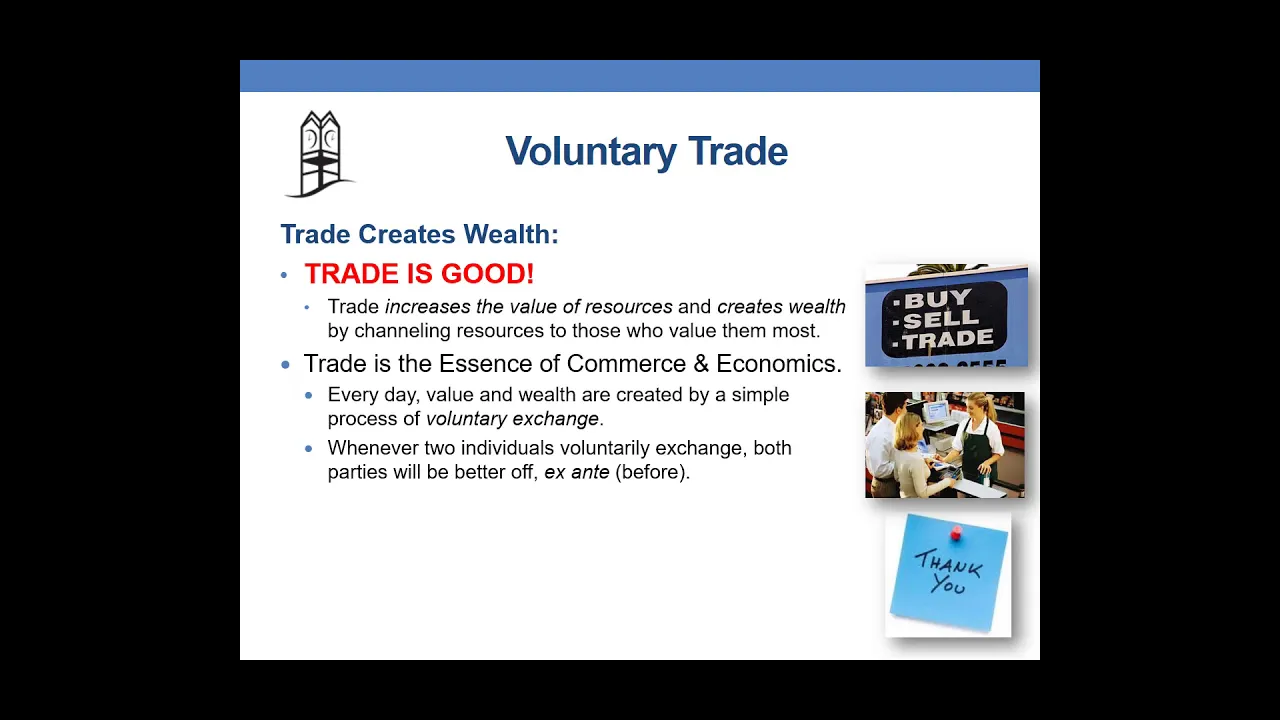










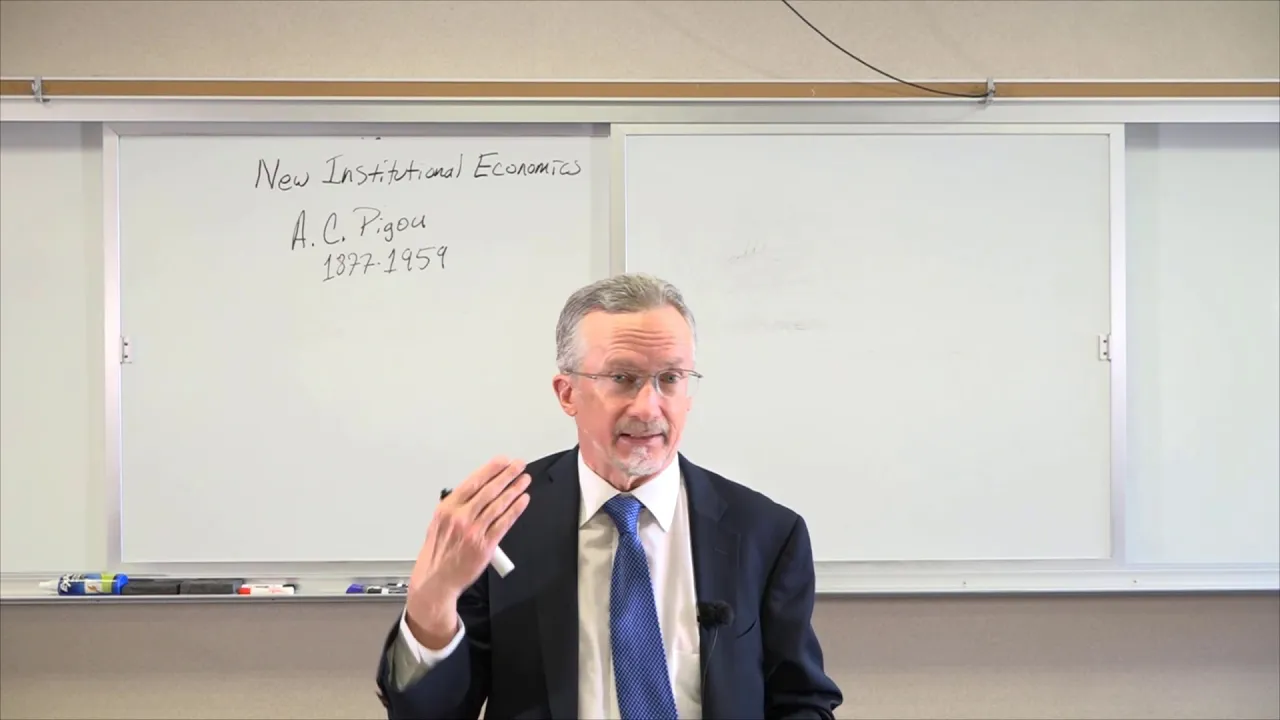



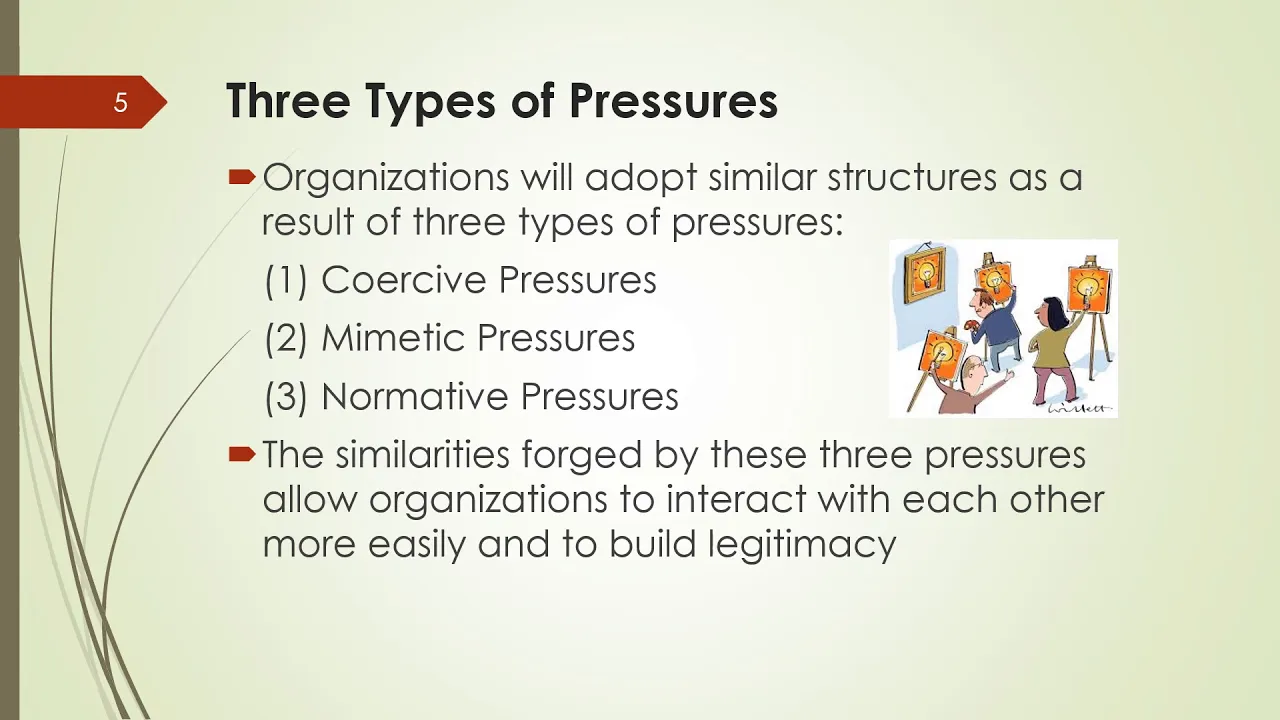
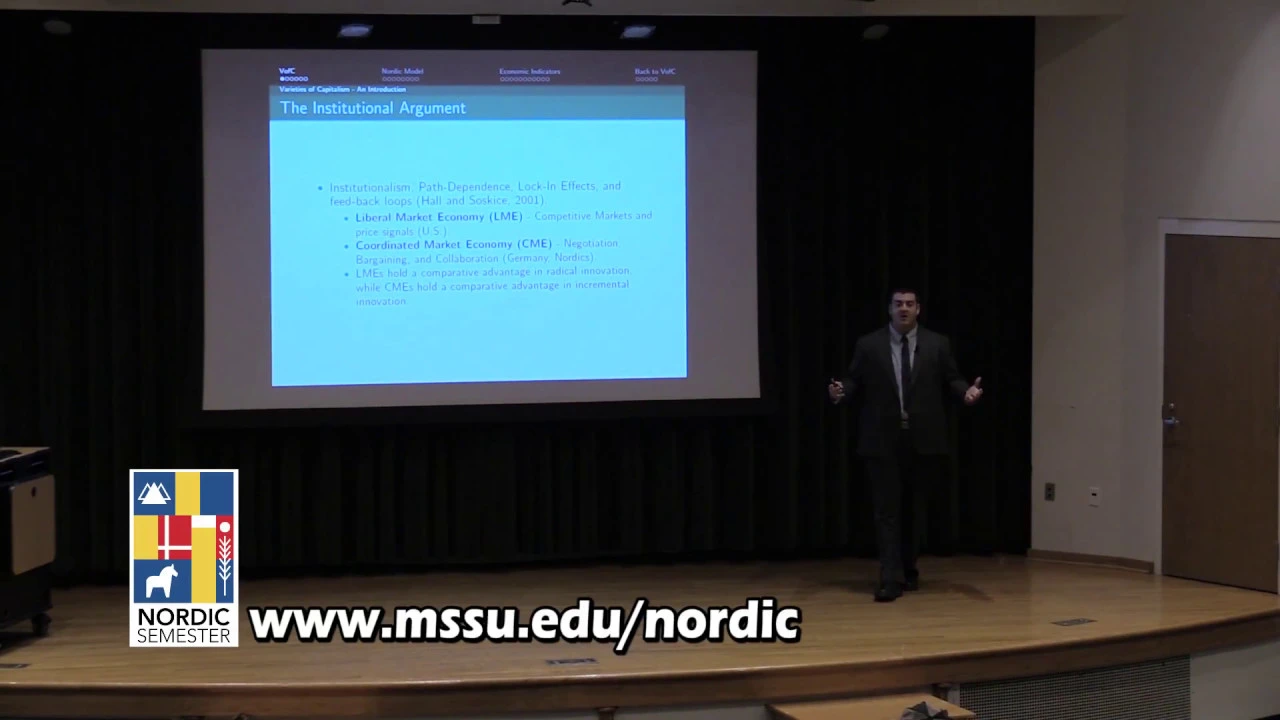








Institutions—the formal rules, informal norms, and enforcement mechanisms that structure human interaction—are the key determinants of economic performance and growth, as they create the incentive systems that either promote or hinder voluntary transactions, competition, and productivity; effective institutions must be neutral and fair to encourage production and reduce transaction costs, rather than relying on idealistic virtuous leaders or simplistic spending solutions.
Why Institutions Matter in Economic Growth | Nobel Lecture Insights
Added:Understanding of classical and neoclassical economic growth models, specifically the Solow-Swan model and its focus on capital, labor, and technology.
The basic concept of transaction costs and how they affect market efficiency and exchange.
The definition and role of property rights in securing economic incentives for investment and trade.
Distinction between formal rules (laws, constitutions) and informal constraints (customs, traditions) in a societal framework.
In-depth study of New Institutional Economics (NIE), focusing on the works of Ronald Coase, Oliver Williamson, and Elinor Ostrom.
The concept of 'Path Dependency' and how historical decisions permanently shape a nation's institutional and economic trajectory.
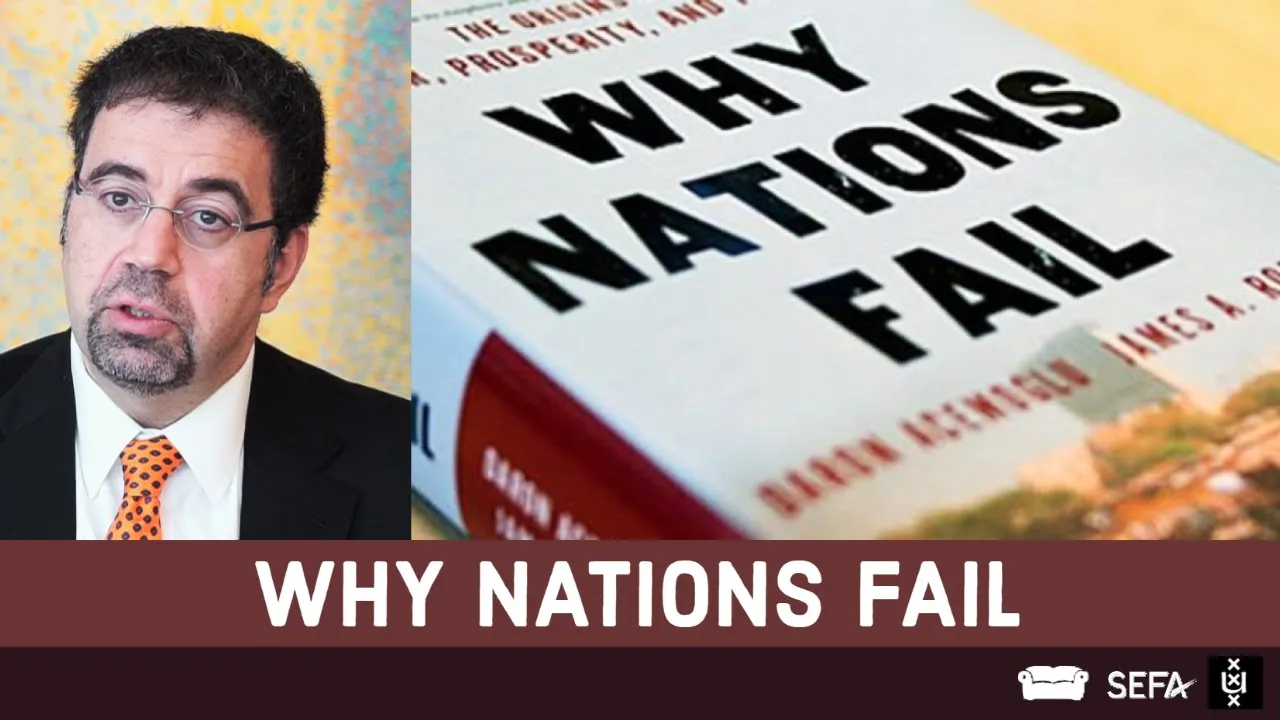
Comparative analysis of 'inclusive' versus 'extractive' institutions, as popularized by Daron Acemoglu and James A. Robinson in 'Why Nations Fail'.
Analysis of institutional reform strategies in developing countries and the challenges of importing Western-style institutions into different cultural contexts.
23.7K views130likes14:01Original Release: 2010-12-31
things that destroy voluntary transactions. In most of human history, leaders and kings have been faced by the problem that we can say for short is the problem of make or take. For most of the world's leaders, for most of the world's nations, it is easier for the state or for the elites to encourage redistribution, whether for the sake of special interests, cronies, or for raw populism, then promote competition and production. As North will tell you, no one, least of all academics, likes competition. Hence, the great successes have been the nations that generally promoted order while mostly allowing economic competition to flourish. Even the great welfare states are mostly free economies and modern bureaucracies have mostly arisen after substantial development occurred. In contrast, many of the poor nations often saw the opposite, bureaucratic growth and transfers without the preconditions of initial economic growth. But what are we to do then? Nort's work encourages to focus on the structure of incentives.
Neither idealism nor cynicism will serve us. Most discussions of the economy in the popular press veer between a search for virtue or a crude descent into spending more money. But the search for the virtuous politician is a misguided one. What we want are not angels but constrained rulers. The tendency of a frustrated people to hope for the election of saints on high will always mean more failure or frustration. We need to remember that some of the most well-intentioned rules have often led to the worst corruption. The point is to push the rules so they are as neutral and fair as possible and cause people to focus more on better production and making money, not just lobbying for it. Nort's latest work is a sobering examination of how difficult it is for nations to emerge out of what he calls the natural state. However, by causing us to focus on strategies that may be more limited and realistic, we might enjoy more success and less disappointment in the future. Ladies and gentlemen, I present my colleague and friend Douglas North.
[Applause] [Applause] [Music] President Roman, ladies and gentlemen, it's a great pleasure to be here in the Philippines. John has been trying to get me to get here forever and I kept saying I'm going to come and now I'm very glad I have come. It's a wonderful place and I'm delighted to be with [Applause] you. Uh John gave such a good introduction. I'm not sure I couldn't just sit down, but I think I better do more than that.
But he does pose a problem that is what I want to focus on and that is why do we have a problem?
Why aren't all world countries rich? Uh as economists we know a great deal about the sources of what makes countries rich. It's productivity increase. And productivity increase means you get more output per unit of input. You'll pardon the jargon of an economist for a minute. Uh and we know a lot about the sources of productivity increase. We also know the kind of institutions when put in place that tend to produce that result. Secure property rights, a judicial system that works, lowcost transacting which John mentioned, all those are straightforward. If we know all that, what's the problem? How come countries that want to be rich are poor? And that's the subject of my talk really. Now, it is about institutions.
So, I have I'm not deviating from what the title of my program says. It's just going to I'm going to focus it particularly on a specific aspect of institutions and the most important one which is how they affect the performance of an economy over time. Now if we know all that what is missing? What's missing is how to get there. It's one thing to know about uh what makes for economic growth. It's another thing how do you create the conditions that will produce that result? And that's turned out to be very complicated for reasons I hope to elucidate in the next half an hour or so.
Now to give you an idea of how difficult it is, the World Bank, which I've been an adviser to for the last 10 or 12 years, has spent more than a hundred billion dollars on economic development.
And as my friend Mary Shirley over there will testify who has been a participant in World Bank for many many years. Uh it's done a lot of good things. But when it tried to evaluate and ask itself how much have we contributed to improving economic growth they had to shake their head and say we can't seem to see much evidence that we've done much. And that's peculiar. It seems obvious that it should be very simple and straightforward.
Well, there's a number of things missing.
Beliefs, time, culture, institutions. I'm going to talk about each one because you got to sneak up on this in order to get there. Why beliefs? Because the way we understand the world around us turns out to be terribly complicated.
And in fact, our mind and brains are perhaps the most complex things that exist anywhere, any place, any time.
The brain may weigh only 3 and a2 pounds but operating it produces takes the senses what we get from our eyes ears knows and feelings and in our brain constructs an explanation of what we're seeing hearing and and so forth. Now that construction obviously is going to change with different environments with different experiences and those will produce different belief systems.
So the first thing therefore is to recognize that the beliefs people have are a function of the experiences that they've had and those experiences will vary with different different environments, different cultures, different civilizations. Why is time important? Well, time's important because the way in which we understand the world is evolving through time. John and I are economic historians and one of the things that we have long since recognized is a dynamic process of change that's going on through time means what happens in time one and what happens in time two you've got to explain how you got from one to the other and that's not simple and indeed economics tend to ignore it. Now, the reason why it's important was, and I'll say this very carefully, you don't know where you are until you know where you've been. And the reason why that's so is because the cumulative beliefs and institutions that that are product of of the past constrain the choice set in the present. Now, I've used a technical economic jargon. You want to ignore economic jargon but in this case it's useful because what you want to know is how how do you see the world? You don't see you don't learn everything. You've accumulated from the past set of institutions and beliefs that shape the way you understand the present. And that indeed is what culture is. Culture is the set of beliefs and institutions that you've inherited from the past that shape the way you see the present and way you shape the future.
And therefore it's very important to understand where you've been to know where you are.
Institutions institutions as John said are the way we structure human interaction.
that is they define how we interact with each other and they define the way the game is played. They made up of formal rules, laws, things like that done usually by governments, informal norms of behavior, codes of conduct, uh things that shape informally how we deal with each other which in many respects are much more important than the formal rules. how I deal with all of you here or individuals in classes or whatever are all a a structure that has evolved so that we know how to deal with each other effectively. And so informal norms of behavior not only uh shape the way we do things but build into it a lot of the things that make for reducing the cost of transacting to use the point term that John used.
Because to the degree that we have developed norms to trust each other, to rely on each other, to be in to be interdependent, we lower the costs of human interaction in ways that turns out to be terribly important to uh economic activity. Institution of formal rules, informal norms, and enforcement.
Now without enforcement institutions don't make any difference because if in fact there was no enforcement people can ignore what the rules of the game are and act accordingly and obviously that makes it so that you would have the institution not make a difference. So enforcement is always there. It's either by uh laws that stipulate punishments for people who don't obey the laws or by norms of behavior such as the fact that if we violate agreed upon codes of conduct uh other people will not deal with us whatever. But let me illustrate with my standard story uh professional sports. I'm going to talk about American football, but that's not that's a little different than your football here, but this it'll apply the same way. Football is determined and is shaped by the rules of how you're supposed to play the game, by informal norms, such as you're not supposed to try to injure the players on the opposing team, and by referees and umpires who see that you don't.
Now, I know that this doesn't happen in the Philippines where you're much nicer than we are in the United States, but in thei United States in professional football, the Oakland Raiders used to always get to the Super Bowl, or not always, but often enough by breaking the quarterback's leg on the opposing team. That's not cricket, another game.
Uh and indeed the result is that uh all games are played by a degree to which the rules and norms and enforcement define the way the game is played. And if you have for example uh strict enforcement, you have clear clear observation by umpires of of violations and punishments that are deterrence, then you'll come closer to obeying to to rules that apply. Where you don't have such things and in fact uh anything goes. Now the reason why this is important is because that's the way societies work. They don't work the way they were intended. No society works exactly like it was intended. The further degree that they are from the intentions is a reflection of the degree to which informal norms and rules are not obeyed or have characteristics that don't encourage people to be creative, productive and so on.
So institutions are the keys to our understanding the performance of an society. They are the incentive system of a society. They are the that is they provide the framework that determines how people will and should behave and therefore the incentive system guides and really the
Up Next
56:14
Hernando de Soto: The Power of the Poor and Economic Reform
@freetochoosenetwork
89.3K views•2015-12-30
5:07
Impact of Yuan in Indo-Russian Trade Amid Sanctions
@WION
261.9K views•2022-07-01
10:33
Behavioral Economics Explained: Rationality, Nudges, and Risk
@crashcourse
1.1M views•2016-03-12

113:18
The Age of Easy Money: Fed & Inflation | Full Documentary
@frontline
21.2M views•2023-03-15
Related Study Plans & Knowledge Roadmaps
Structured learning paths in Economics
economics
Sovereign Debt: Defaults, IMF & Restructuring
01Introduction to Sovereign Debt & Government Bonds
02Debt Sustainability & Credit Ratings
03Anatomy and History of Debt Crises
+ 2 more learning modules
12h5 modules
Explore Roadmap
economics
Market Design: Matching Theory & Gale-Shapley
01Introduction to Market Design and Price-Free Markets
02Two-Sided Matching & The Gale-Shapley Algorithm
03School Choice Systems and Mechanism Design
+ 2 more learning modules
10h5 modules
Explore Roadmap
economics
Impossible Trinity: Forex, Capital & Policy
01Introduction to Monetary Policy and Central Banking
02Exchange Rates and International Capital Flows
03The Mundell-Fleming Model
+ 2 more learning modules
8h5 modules
Explore Roadmap
economics
Healthcare Economics: Market Failures & Systems
01Introduction to Healthcare Markets and Market Failure
02Asymmetric Information and Adverse Selection
03Moral Hazard and Insurance Design
+ 2 more learning modules
12h5 modules
Explore Roadmap