













![🎓 باك 2025 🚀 | علوم الطبيعة من A إلى Z في أقل من ساعة ⏱️💪 [ الفرزة الواعرة 🎯 ] !!](https://i.ytimg.com/vi_webp/Lye5cEn0K-Y/maxresdefault.webp)
The Calvin Cycle (light-independent reactions) takes place in the chloroplast stroma and uses ATP and NADPH produced by the light reactions to fix carbon dioxide into organic molecules; specifically, six CO2 molecules combine with six molecules of ribulose-1,5-bisphosphate (RuBP) to produce twelve molecules of glyceraldehyde 3-phosphate (PGAL), with ten of these molecules recycled to regenerate RuBP while two are used to synthesize glucose and other carbohydrates.
Calvin Cycle Explained: Photosynthesis Light-Independent Reactions
Added:Understanding of the light-dependent reactions of photosynthesis, specifically how ATP and NADPH are generated.
Basic knowledge of chloroplast anatomy, particularly the distinction between the thylakoid membrane and the stroma.
Familiarity with the overall chemical equation of photosynthesis and how carbon dioxide and water serve as raw materials.
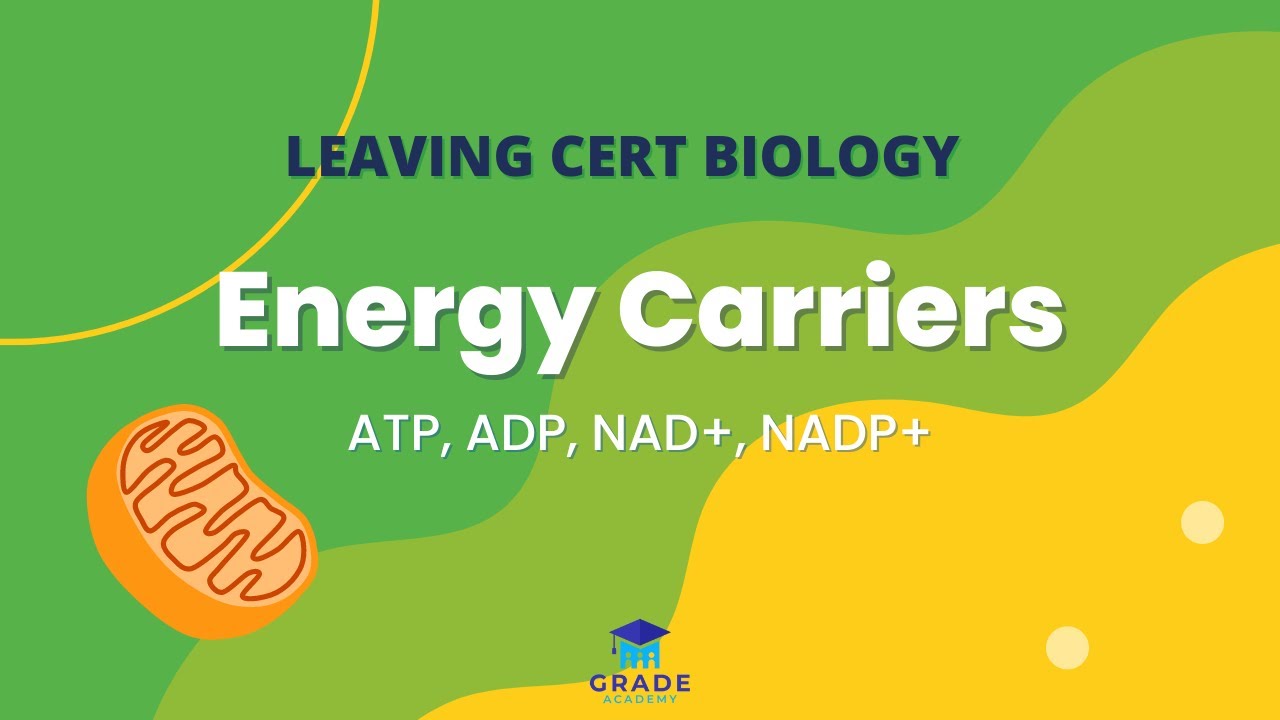
An understanding of energy carrier molecules (ATP/ADP and NADPH/NADP+) and how they store and transfer chemical energy.
The phenomenon of photorespiration and how the limitations of the enzyme RuBisCO affect plant efficiency in high-oxygen environments.
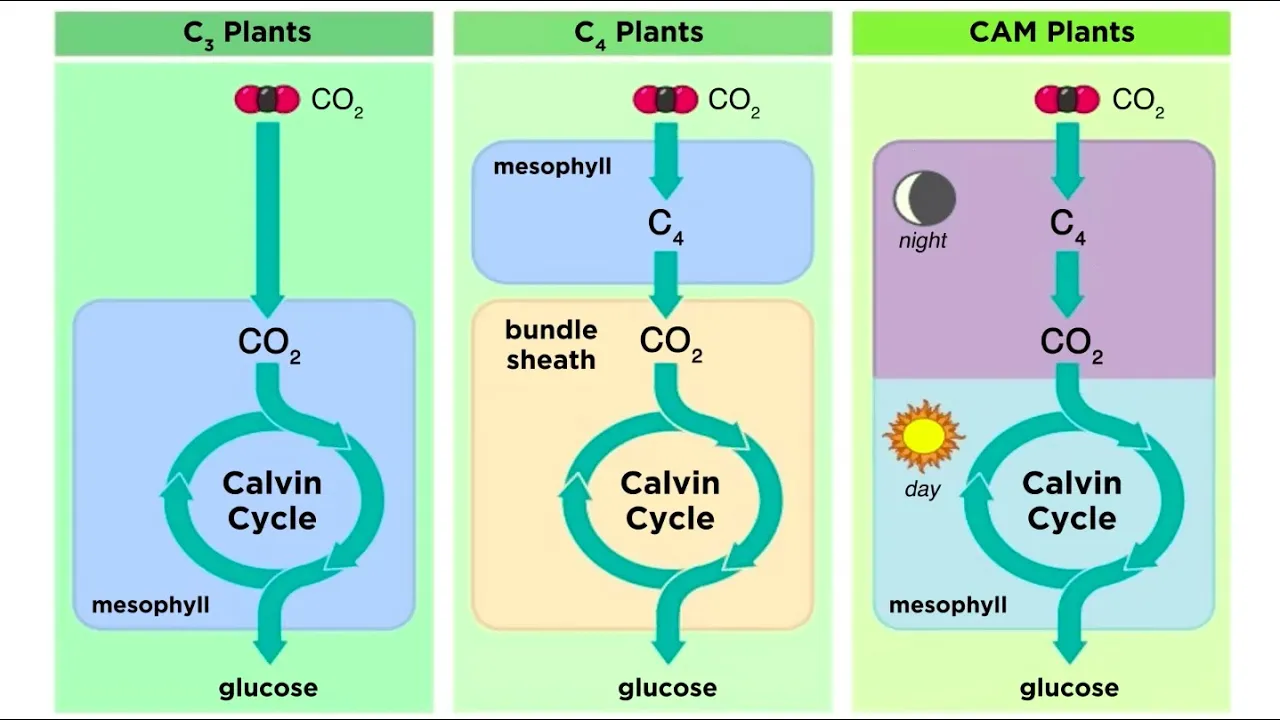
Alternative carbon fixation pathways, specifically C4 and CAM plants, and their evolutionary adaptations to hot, dry climates.
The connection between photosynthesis and cellular respiration, illustrating how synthesized glucose is utilized by mitochondria to produce ATP.
The regulatory mechanisms of the Calvin Cycle, including how light reactions and pH changes in the stroma activate key enzymes.
1.4M views6.3Klikes13:28Original Release: 2010-02-02
I think we're now ready to learn a little bit about the dark reactions.
But just to remember where we are in this whole scheme of photosynthesis, photons came in and excited electrons in chlorophyll in the light reactions.
and as those photons went to lower and lower energy states-- we saw it over here in the last video-- as they went to lower and lower energy states, and all of this was going on in the thylakoid membrane right over here.
You can imagine-- Let me do it in a different color.
You can imagine it occurring right here.
As they went into lower and lower energy states, two things happened.
One, the release of energy was able to pump the hydrogens across this membrane.
And then when you had a high concentration of hydrogens here, those went back through the ATP synthase and drove that motor to produce ATP.
And then the final electron acceptor, or hydrogen acceptor, depending on how you want to view it.
The whole hydrogen atom was NAD plus.
So the two byproducts, or the two byproducts that we're going to continue using in photosynthesis from our light cycle, from our light reactions I guess.
I shouldn't call it the light cycle-- were-- I wrote it up here-- ATP and NADPH.
And then the byproduct was that we needed the electron to replace that first excited electron.
So we take it away from water.
And so we also produce oxygen, which is a very valuable byproduct of this reaction.
But now that we have this ATP and this NADPH, we're ready to proceed into the dark reactions.
And I want to highlight again, even though it's called the dark reactions it doesn't mean that it happens at night.
It actually happens at the same time as light reactions.
It occurs while the sun is out.
The reason why they call it the dark reactions is that they're light independent.
They don't require photons.
They only require ATP, NADPH, and carbon dioxide.
So let's understand what's going on here a little bit better.
So let me go down to where I have some clean space down here.
So we had our light reactions.
And they produced-- I just reviewed this-- produced some ATP and produced some and NADPH.
And now we're going to take some carbon dioxide from the atmosphere.
And all of this will go into the-- I'll call it the light independent reactions.
Because dark reactions is misleading.
So the light independent reactions, the actual mechanism is called the Calvin Cycle.
And that's what this video is really about.
It goes into the Calvin Cycle and out pops-- whether you want to call it PGAL-- we talked about it in the first video-- or G3P.
This is glyceraldehyde 3-phosphate.
This is phosphoglyceraldehyde They are the exact same molecule, just different names.
And you can imagine it as a 3-carbon chain with a phosphate group.
And then this can then be used to build other carbohydrates.
You put two of these together you can get a glucose.
You might remember in the first stage of glycolysis, or the first time we cut a glucose molecule we ended up with two phosphoglyceraldehyde molecules.
Glucose has six carbons.
This has three.
Let's study the Calvin Cycle in just a little bit more detail.
So let's say exiting the light reactions, let's say we have-- well let's start off with six carbon dioxides.
So this is independent of the light reactions.
And I'll show you why I'm using these numbers.
I don't have to use these exact numbers.
So let's say I start off with six CO2s.
And I could write a CO2 because we really care about what's happening to the carbon.
We can just write it as a single carbon that has two oxygens on it, which I could draw.
But I'm not going to draw them right now.
Because I want to really show you what happens to the carbons.
Maybe I should draw this in this yellow.
Just to show you only the carbons.
I'm not showing you the oxygens on here.
And what happens is the CO2, the six CO2s, essentially react with-- and I'll talk a little bit about this reaction in a second-- they react with six molecules-- and this is going to look a little bit strange to you-- of this molecule, you could call it RuBP.
That's short for ribulose biphosphate.
Sometimes called ribulose-1 5-bisphosphate.
And the reason why it's called that is because it's a 5-carbon molecule.
So, three, four five.
And it has a phosphate on the 1 and 5 carbon.
So it's ribulose bisphosphate.
Or sometimes, ribulosee-1-- let me write this-- that's the first carbon.
5-bisphosphate.
We have two phosphates.
So that's ribulose-1 5-bisphosphate.
Fancy name, but it's just a 5-carbon chain with 2 phosphates on it.
These two react together.
And this is a simplification.
These two react together.
There's a lot more going on here, but I want you to get the big picture.
to form, 12 molecules of PGAL, of phosphoglyceraldehyde or glyceraldihyde 3-phosphate of PGAL, which you can view as a-- it has three carbons and then it has a phosphate group.
And just to make sure we're accounting for our carbons properly, let's think about what happens.
We have 12 of these guys.
You can think of it that we have-- 12 times 3-- we have 36 carbons.
Now did we start with 36 carbons?
Well we have 6 times 5 carbons.
That's 30.
Plus another 6 here.
So, yes.
We have 36 carbons.
They react with each other to form this PGAL.
The bonds or the electrons in this molecule are in a higher energy state than the electrons in this molecule.
So we have to add energy in order for this reaction to happen.
This won't happen spontaneously.
And the energy for this reaction, if we use the numbers 6 and 6 here, the energy from this reaction is going to come from 12 ATPs-- you could imagine 2 ATPs for every carbon and every ribulose bisphosphate; and 12 NADPHs.
I don't want to get you confused with-- it's very similar to NADH, but I don't want to get you confused with what goes on in respiration.
And then these leave as 12 ADPs plus 12 phosphate groups.
And then you're going to have plus 12 NADP pluses.
And the reason why this is a source of energy is because the electrons in NADPH, or you could say the hydrogen with the electron in NADPH, is at a higher energy state.
So as it goes to lower energy state, it helps drive a reaction.
And of course ATPs, when they lose their phosphate groups, those electrons are in a very high energy state, they enter a lower energy state, help drive a reaction, help put energy into a reaction.
So then we have these 12 PGALs.
Now the reason why it's called a Calvin Cycle-- as you can imagine-- we studied the Kreb Cycle.
Cycles start reusing things.
The reason why it's called the Calvin Cycle is because we do reuse, actually, most of these PGALs.
So of the 12 PGALs, we're going to use 10 of them to-- let me actually do it this way.
So we're going to have 10 PGALs.
10 phosphoglyceraldehydes 10 PGALs we're going to use to recreate the ribulose bisphosphate.
And the counting works.
Because we have ten 3-carbon molecules.
That's 30 carbons.
Then we have six 5-carbon molecules.
30 carbons.
But this, once again, is going to take energy.
This is going to take the energy from six ATPs.
So you're going to have six ATPs essentially losing their phosphate group.
The electrons enter lower energy states, drive reactions.
And you're going to have six ADPs plus six phosphate groups that get released.
And so you see it as a cycle.
But the question is, well gee I used all of these.
What do I get out of it?
Well I only used 10 out of the 12.
So I have 2 PGALs left.
And these can then be used-- and the reason why I used 6 and 6 is so that I get 12 here.
And I get 2 here.
And the reason why I have 2 here is because 2 PGALs can be used to make a glucose.
Which is a 6-carbon molecule.
It's formula, we've seen it before, is C6H12O6.
But it's important to remember that it doesn't have to just be glucose.
It can then go off and generate longer chained carbohydrates and starches, anything that has a carbon backbone.
So this is it.
This is the dark reaction.
We were able to take the byproducts of the light reactions, the ATP and the NADHs-- there's some more ATP there-- and use it to fix carbon.
This is called carbon fixation.
When you take carbon in a gaseous form and you put it into a solid structure, that is called carbon fixation.
So through this Calvin Cycle we were able to fix carbon and the energy comes from these molecules generated from the light reaction.
And of course, it's called a cycle because we generate these PGALs, some of them can be used to actually produce glucose or other carbohydrates while most of them continue on to be recycled into ribulose bisphosphate, which once again reacts with carbon dioxide.
And then you get this cycle happening over and over again.
Now we said it doesn't happen in a vacuum.
Actually if you want to know the actual location where this is occurring, this is all occurring in the stroma.
And the fluid inside the chloroplast but outside of your thylakoid.
So in your stroma, this is where your light independent reactions are actually occurring.
And it's not just happening with the ADP and the NADPH.
There's actually a fairly decent sized enzyme or protein that's facilitating it.
That's allowing the carbon dioxide to bond at certain points and the ribulose bisphosphate and the ATP to react at certain points, to essentially drive these two guys to react together.
And that enzyme, sometimes it's called RuBisCo, I'll tell you why it's called RuBisCo.
So this is RuBisCo.
So rub-- let me get the capitalization right-- ribulose bisphosphate rub-- bis-- co-- carboxylase.
And this is what it looks like.
So it's a pretty big protein enzyme molecule.
You can imagine that you have your ribulose bisphosphate bonding at one point.
You have your carbon dioxide bonding at another point.
I don't know what points they are.
ATP bonds at another point.
It reacts.
That makes this thing twist and turn in certain ways to make the ribulose bisphosphate react with the carbon dioxide.
NADPH might be reacting at other parts.
And that's what facilitates this entire Calvin Cycle.
And you might-- I told you over here-- that this R U B P, this is ribulose-1 5-bisphophate.
This RuBisCo, this is short for ribulose-1 5-bisphophate carboxylase.
I won't write it all out; you could look it up.
But it's just telling you, it's an enzyme that's used to react carbon and ribulose-1 5-bisphophate.
But now we're done.
We're done with photosynthesis.
We were able to start off with photons and water to produce ATP and NADPH because we had those excited electrons, we had the whole chemiosmosis to drive the-- that allowed the ATP synthase to produce ATP.
NADPH was the final electron acceptor.
These are then used as the fuel in the Calvin Cycle, in the dark reaction.
Which is badly named, it should be called the light independent reaction.
Because it actually does happen in the light.
You take your fuel from the light reactions with some carbon dioxide and you can fix it using your-- I like to call it-- the RuBisCo enzyme in the Calvin Cycle.
And you end up with your phosphoglyceraldehyde which could also be called your glyceraldehyde 3-phosphate, which can then be used to generate glucose, which we all use to eat and fuel our bodies.
Or we learn in cellular respiration, that can then be converted into ATP when we need it.
Up Next
29:49
Photorespiration: Rubisco's Dual Role & Glycolate Pathway
@AMUMOOCs
132 views•2025-03-19
50:12
Bacterial Communication: Quorum Sensing and Biofilm Formation Explained
@JHUAAP
12.6K views•2011-06-28
5:10
Mendelian Genetics: Alleles, Genotypes & Punnett Squares
@khanacademymedicine
648.4K views•2014-06-16
7:08
Bacteriophages: Earth's Deadliest Killers and Future Antibiotics
@kurzgesagt
34.6M views•2018-05-13
Related Study Plans & Knowledge Roadmaps
Structured learning paths in Biology
biology
RNAi: Biogenesis, RISC & Gene Silencing
01Molecular Biology Foundations: DNA to Protein
02Introduction to RNA Interference (RNAi)
03Molecular Biogenesis of miRNA and siRNA
+ 2 more learning modules
10h5 modules
Explore Roadmap
biology
Mycorrhizae: Signaling, Biophysics & Ecology
01Foundations of Mycorrhizal Symbiosis
02Molecular Signaling and Root Colonization
03Biophysics and Bioenergetics of Nutrient Exchange
+ 1 more learning modules
11h4 modules
Explore Roadmap
biology
Circadian Clocks: TTFL, SCN & Periphery
01Foundations of Molecular Biology & Gene Expression
02Introduction to Chronobiology and Actograms
03The Core TTFL: Molecular Architecture of the Clock
+ 3 more learning modules
14h6 modules
Explore Roadmap
biology
Population Genetics: Math, Drift & Selection
01Genetic & Probability Foundations
02The Hardy-Weinberg Principle and Baseline Models
03Mathematical Modeling of Natural Selection
+ 3 more learning modules
18h6 modules
Explore Roadmap