











![S2E3 Prof. Stefano Romagnoli - EEG for beginners [ITA]](https://i.ytimg.com/vi/z1rSC6u3RGI/maxresdefault.jpg)



Frequency filters are essential tools in biomedical engineering that separate desired signals from noise by allowing specific frequency ranges to pass while blocking others; they operate by transforming signals from the time domain to the frequency domain, applying a transfer function to modify frequency components, and then converting back to the time domain, with applications in EEG (where 50 Hz power line noise is removed using notch filters) and EMG (where muscle action potentials are isolated from noise), and can be implemented as either analog circuits (offering low latency and simplicity but with component aging issues) or digital processors (offering flexibility and precision but introducing latency and requiring conversion).
Frequency Filters Explained: EEG & EMG Applications
Added:Basic understanding of signal concepts, including amplitude, frequency, phase, and time-domain vs. frequency-domain representations.
An introduction to electrophysiology, specifically what EEG (brain activity) and EMG (muscle activity) signals represent biologically.
The concept of Signal-to-Noise Ratio (SNR) and awareness of common experimental noise sources, such as powerline interference (50/60 Hz) and motion artifacts.
Fundamental circuit theory, particularly how passive components like resistors and capacitors (RC circuits) act as basic analog frequency barriers.
Advanced digital filter design and implementation, including Finite Impulse Response (FIR) vs. Infinite Impulse Response (IIR) filters and filter order selection.
Spectral analysis methods such as Fast Fourier Transform (FFT) and Wavelet Transform to extract specific frequency bands (e.g., alpha, beta waves in EEG).
Real-world system design for Brain-Computer Interfaces (BCIs) and myoelectric prosthetic control, where filtering latency and phase shift are critical.
Applying machine learning and pattern recognition algorithms on filtered biomedical signals for diagnostic classification (e.g., epilepsy detection or sleep staging).
11.9K views92likes10:28Original Release: 2012-05-01
The following presentation will help you to understand the fundamental principles of frequency filters within 10 minutes.
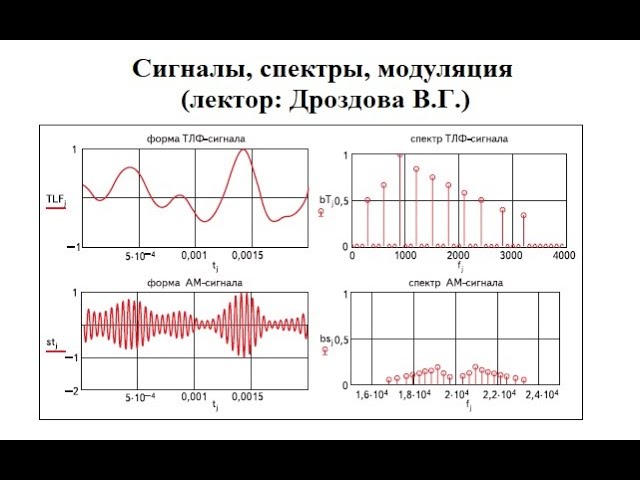
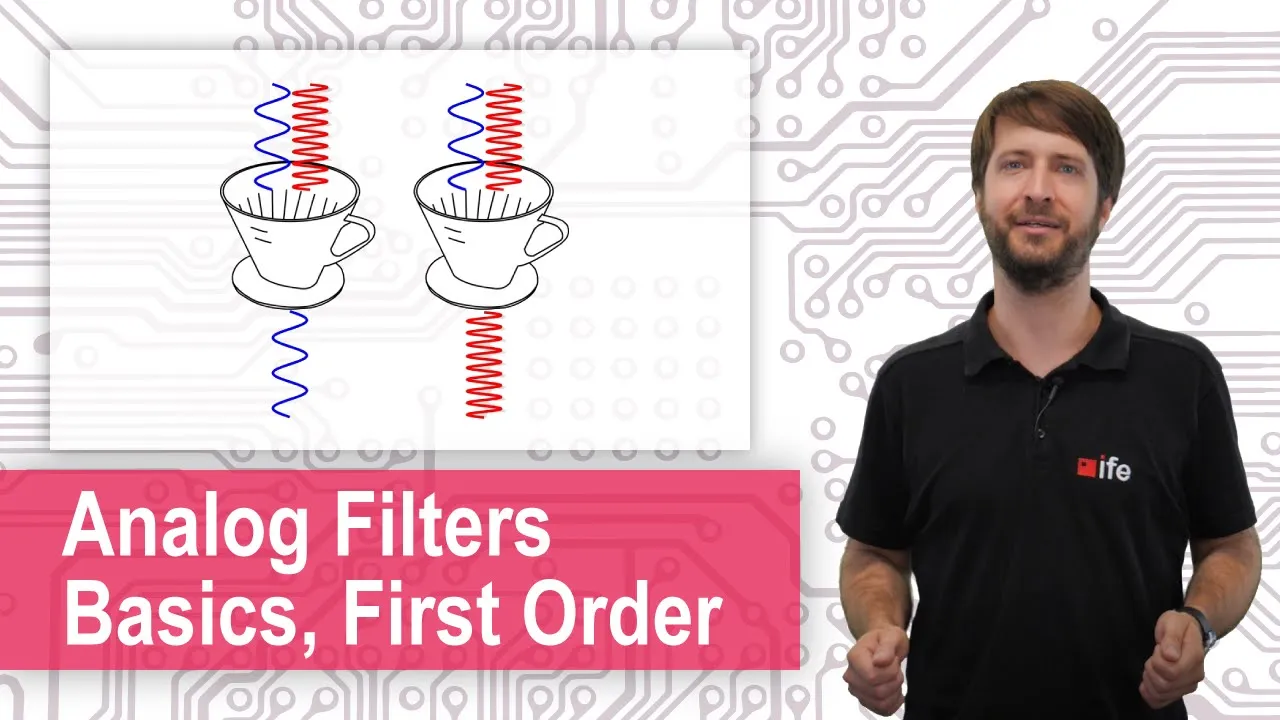
Why don't you just relax, grab a coffee, and sit back while watching it? First of all, we have to understand what a frequency filter is. Let's talk about the purpose of filters. Consider this video. There are three curves that represent three different signals, all of which are cenosidal, but with different frequencies.
Suppose we want to obtain the red signal only. How do we accomplish that? Well, we can use filters to do the job. We can filter out the blue signal first. Then we can filter out the black signal. Now we get our desired result, the red signal only. So the purpose of filtering is to get rid of noise and sometimes to amplify the desired signal as well. Now let's have a look at the different categories of frequency filters. We can categorize filters by linearity or frequency range. But let's consider also some important terminologies. The cut off frequency is the frequency at which the filter will begin to act. Pass filter allows the specified frequencies to pass while a stop filter does exactly the opposite.
Now let's go back and look again at the different filters. If we set the cut off frequency of a low pass filter to 5 Hz for example, then it means that any frequency which is lower than 5 Hz is allowed to pass while any frequency which is higher than 5 Hz cannot do so.
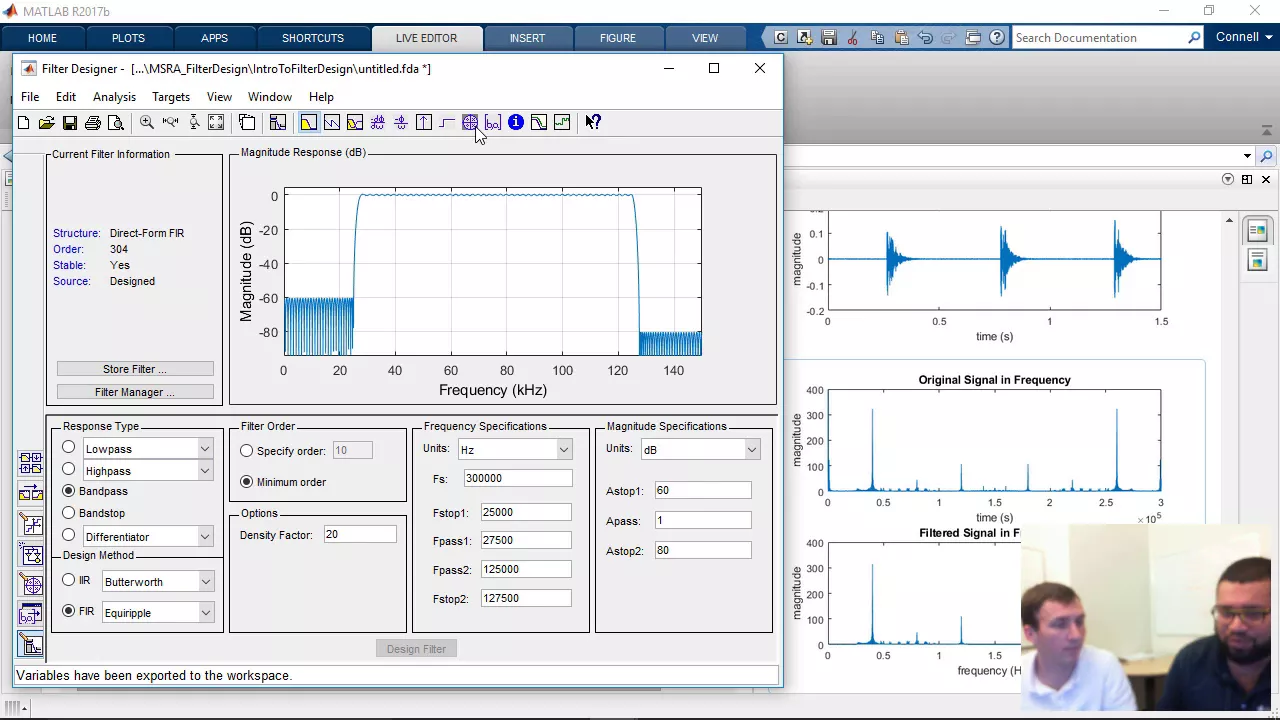
The same principle applies to highp pass filters. A band pass filter will allow a certain range of frequency to pass while a band stop filter does exactly the opposite.
We can also categorize filters by type of the approximation of transfer functions. Most of the different categories of filters can be either analog or digital in modality. We will consider those two modalities in more detail later as well. Now we are going to be able to look at the underlying mechanism of filtering. First recall the video I just showed to you at the beginning. Let's suppose that the signal is called X.
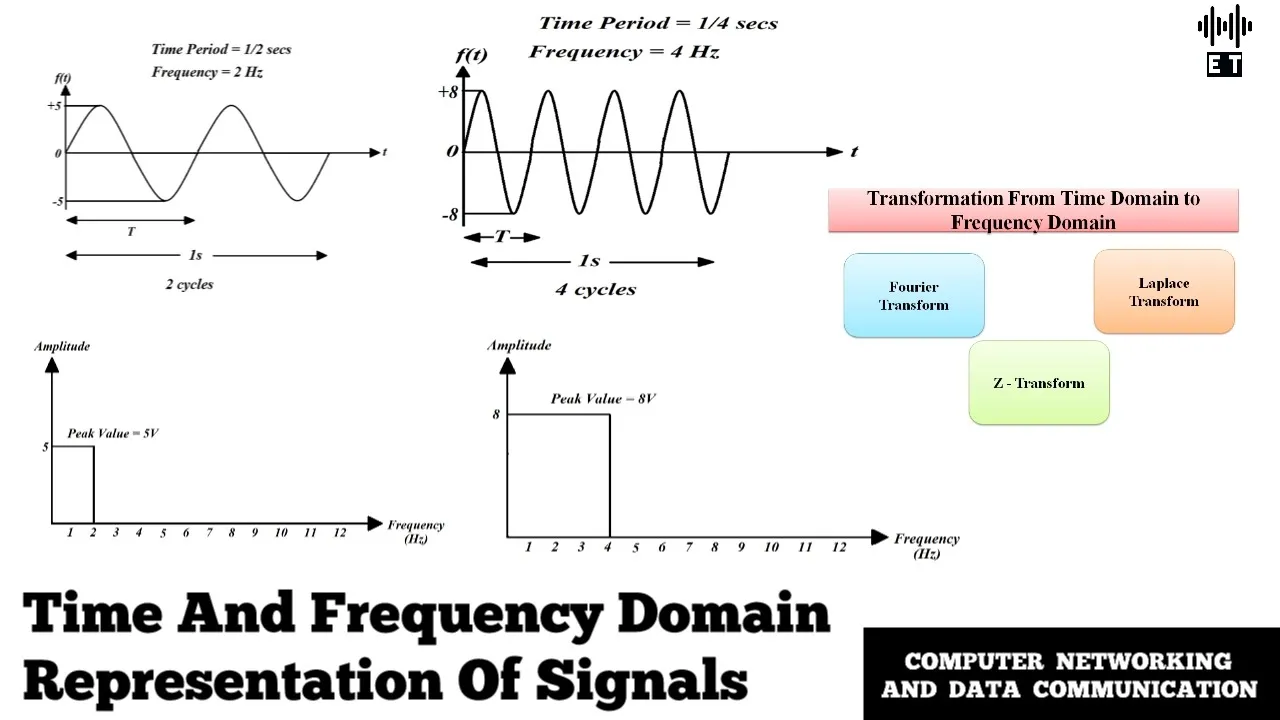
This function depends on time and it is in this case a superposition of three different cenosidal waves. Engineers often call X to be in the time domain which just means that it depends on time. Now we detected with a sensor and transform it with various methods to the frequency domain. That is we make the input signal dependent on frequency rather than time. This is because we can apply different sometimes very complicated transfer functions on a transformed signal. So the transfer function is the essence of any frequency filter. It takes out unwanted signals and sometimes even amplifies desired ones. Now as a result of the operation of the transfer function on the input, we get big Y depending on frequency. But we really want to have it in the time domain. So we just simply transform back the output to small Y dependent on time.
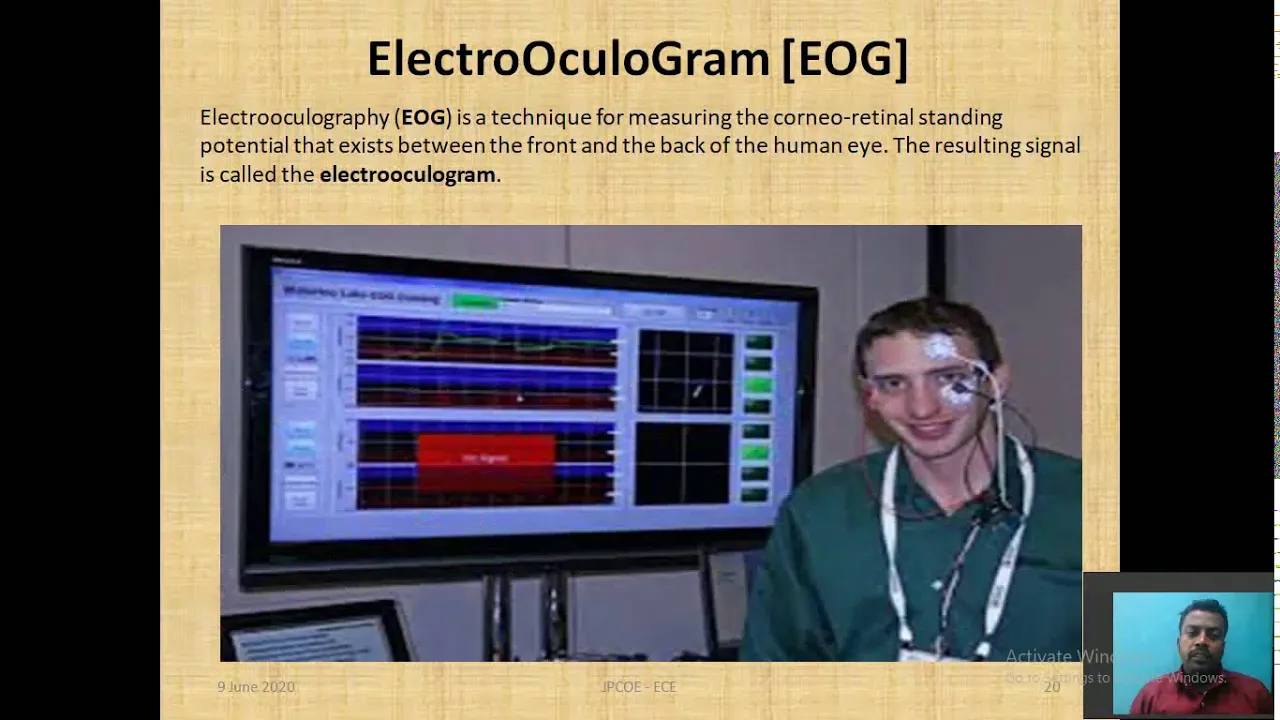
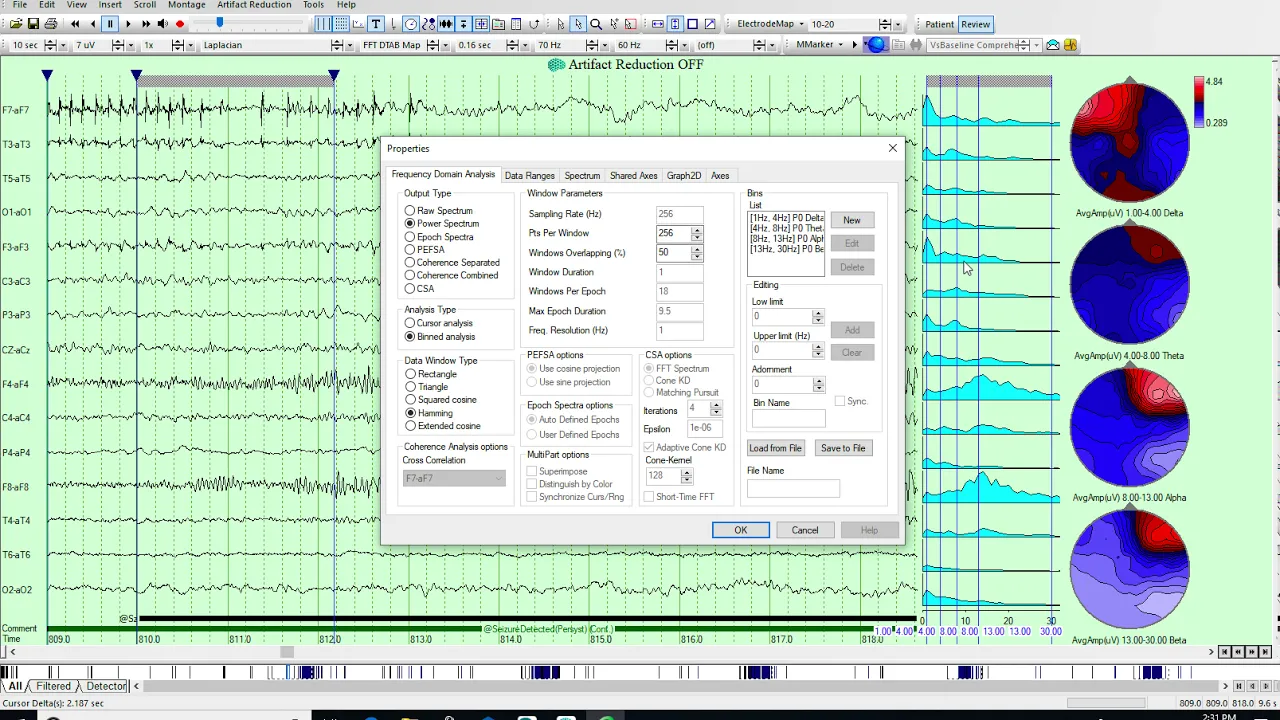
And that's it. We arrived at our solution. We got rid of both the blue and black component of the signal and we have now the pure red signal. The filter did its job. That is the underlying principle of filtering for any kind of filter independent of its category. Okay. Knowing the theory is good. But we also want to apply our theory in the real world. Let's consider some applications of filtering in different physiological measurements. First, the application of filters in EEG or electrophilography. Let's consider the most common signals of EEG. Note that the frequency range of the EEG is from about 2 to about 120 hertz. But we have noise all the time. It is important to state them clearly in advance. These are the most common noise types in an EEG recording. The power line noise refers to the frequency that results from the generators that supply our electricity in London. It is about 50 Hz. Also, eye movements will distort signals especially in the anterior region of the EG electrodes. Then there is the noise from the patient's heart and any muscle movement particularly on the face will distort the EEG signals.
significantly. Now, how to get rid of them? Well, we use filters, of course.
To get rid of the power line noise, we simply use a very narrow band stop filter or sometimes called notch filter.
Also, we can set the frequency range of the filter in specifying the appropriate cutff frequencies. The principle of this setup was already mentioned before.
However, there is a slight problem.
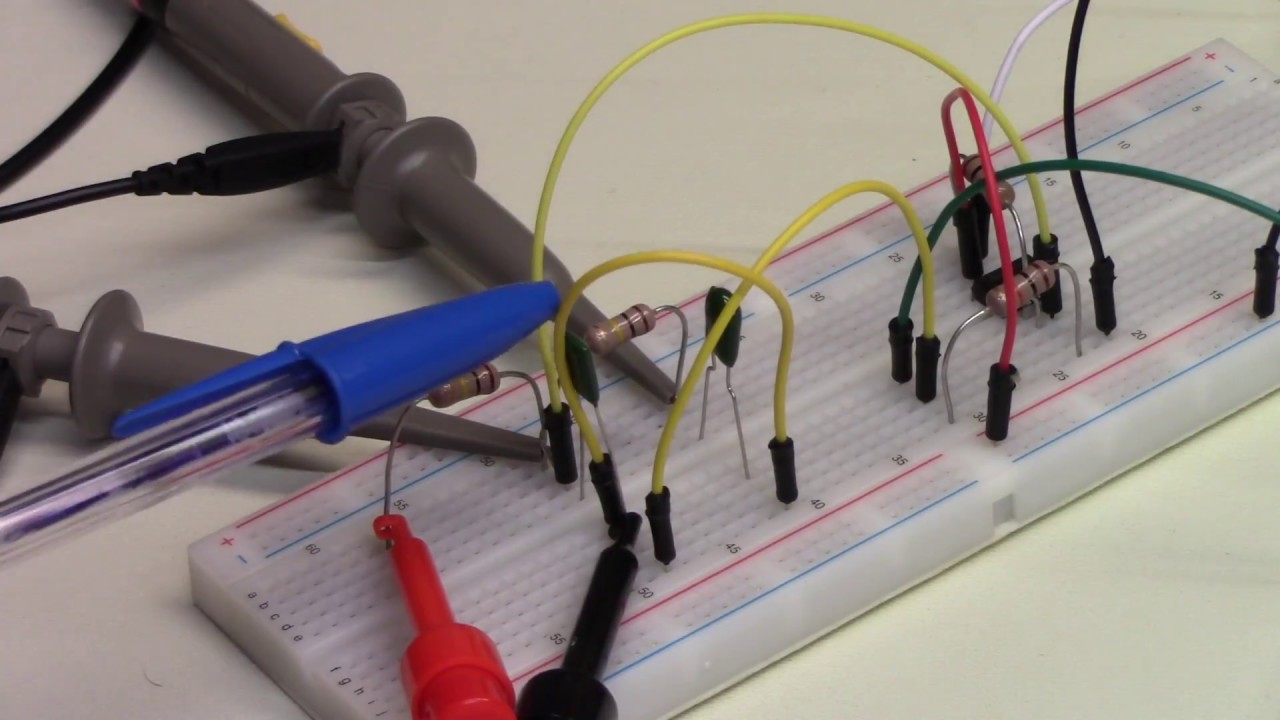
Remember the different waveforms of the EG signal? While the gamma rhythm is sometimes higher than 100 htz and can go up to more than 120 htz. That means that our filter which did a really good job in the first place now will filter out very interesting signals from our recordings. To avoid this sort of blind selection of frequencies, we can use for analysis to decompose the set of signals and filter out the uninteresting components bit by bit. This can be accomplished by digital filters. But before we go into more detail, let's first look at another common application of filtering filters for EMG or electromyiography. Again, let's consider the different signals we are going to measure with EMG. Essentially, we are measuring the muscle unit action potential. But often the nerve action potentials are so strong that they recruit a lot of muscle units. We are very often measuring the compound action potential. That is the frequency of our signal input is not only 15 htz but ranges from about 70 to 150 htz. The most common noise are moving artifacts of the patient and again power line noise. So we can apply the same methods as for EEG namely using filters to get rid of the noise. This is accomplished by setting the appropriate cutff frequencies. Okay, that was EMG. Now we move on to the comparison of analog and digital filters. This is the basic layout of an analog filter. Imagine the input signal to be a set of superposed cenosidal waves. This is relay to the circuitry of the filter with capacitors and inductors sometimes also resistors. By the way, this particular filter was invented by compel. Basically what happens to the signal is that the signal gets transformed by the filter with the same underlying mechanisms that I described before and at the end the output will become the desired signal with only a certain range of frequency. In contrast let's have a close look at digital filters. We consider again an arbitrary cenosidal compound signal. This is measured by detector and amplified. Then it goes to an analog to digital converter which does nothing else but assigning the analog signal packages with digital values. These digitized values are then fed into the microprocessor which has softwares running on it that does all the operations for filtering. After that the output goes through a digital to analog converter to make it time dependent. The effect is similar to using an analog filter, but the major difference lies in the presence of a digital processor. Okay, let's compare the advantages and disadvantages of the two modalities. The advantages of analog filters are as follows. They sample the signal in continuous time. They have negligible latency effects. They are generally cheaper than digital filters. But most importantly, analog filters manipulate the input directly without premodification, such as using the analog to digital converter. But let's also consider some disadvantages of the analog filters. They become old over time. They are inflexible in that they can hardly be programmed after implementation. Analog filters take a lot of space. This effect is also associated with the phenomenon that the error of filtering increases as the number of components in the analog filter increases. And last but not least, analog filters produce a lot of heat which is inefficient. Okay, let's take a look at digital filters. Their advantages are the following. They do not occupy much space as analog filters do. Complex analysis of signal can be accomplished.
High speed and accuracy is of paramount importance in our century. Both are realizable by digital filters. Also, they have stable components which means that they do not get old since they are essentially software which can be stored on a computer. However, there are some disadvantages in using digital filters. They sample in a discrete time mode and loss of information is apparent. Extra noise is induced while converting the signal back and forth and digital filters manipulate the input signals indirectly. They induce the so-called latency effect which means unwanted phase shift of the signal.
Also, they are generally considered to be much more expensive than analog filters. Okay, that was the comparison between analog and digital filters. The choice between them depends on what kind of signal you really want to filter out.
So, that was 10 minutes. Times up. I hope that you have a good understanding of frequency filters by now. Here's a summary of what I just presented to you.
I hope that you enjoyed your coffee too while watching my presentation. Please put some comments on this video. Thank you very much.
[Laughter] [Music]
Up Next
20:29
Off-Grid Gravity-Fed Water System: Design and Installation
@purelivingforlife
330.2K views•2017-06-06
30:32
Ultrasonic Transducers: Resonant Frequency Measurement and Horn Design
@imajeenyus42
229.9K views•2017-02-22
54:16
Polymer Environmental Degradation: Mechanisms & Stabilization
@iit
1.8K views•2012-07-10
33:39
How a Student's Question Saved a NYC Skyscraper from Collapse
@veritasium
22.8M views•2025-04-26
Related Study Plans & Knowledge Roadmaps
Structured learning paths in Engineering
engineering
Building Acoustic Levitators: Physics & Arduino
01The Physics of Sound and Standing Waves
02Piezoelectric Transducers and H-Bridge Drivers
03Arduino Programming: Generating 40 kHz Signals
+ 2 more learning modules
14h5 modules
Explore Roadmap
engineering
Building Peltier Cloud Chambers: Particle Tracks
01Cosmic Rays & Cloud Chamber Physics
02Thermoelectric Cooling (TEC) Fundamentals
03Custom Liquid-Cooling Loop Design
+ 2 more learning modules
18h5 modules
Explore Roadmap
engineering
Yagi-Uda Antennas: Modeling, Build & VNA Test
01Introduction to RF and Antenna Fundamentals
02Yagi-Uda Antenna Design Principles
03Antenna Modeling and Simulation in 4NEC2
+ 2 more learning modules
18h5 modules
Explore Roadmap
engineering
ECG Monitor Design: Op-Amps, Filters & Noise
01Electronics & Breadboard Basics
02Op-Amps and Instrumentation Amplifiers
03Bioelectricity and ECG Fundamentals
+ 2 more learning modules
18h5 modules
Explore Roadmap