








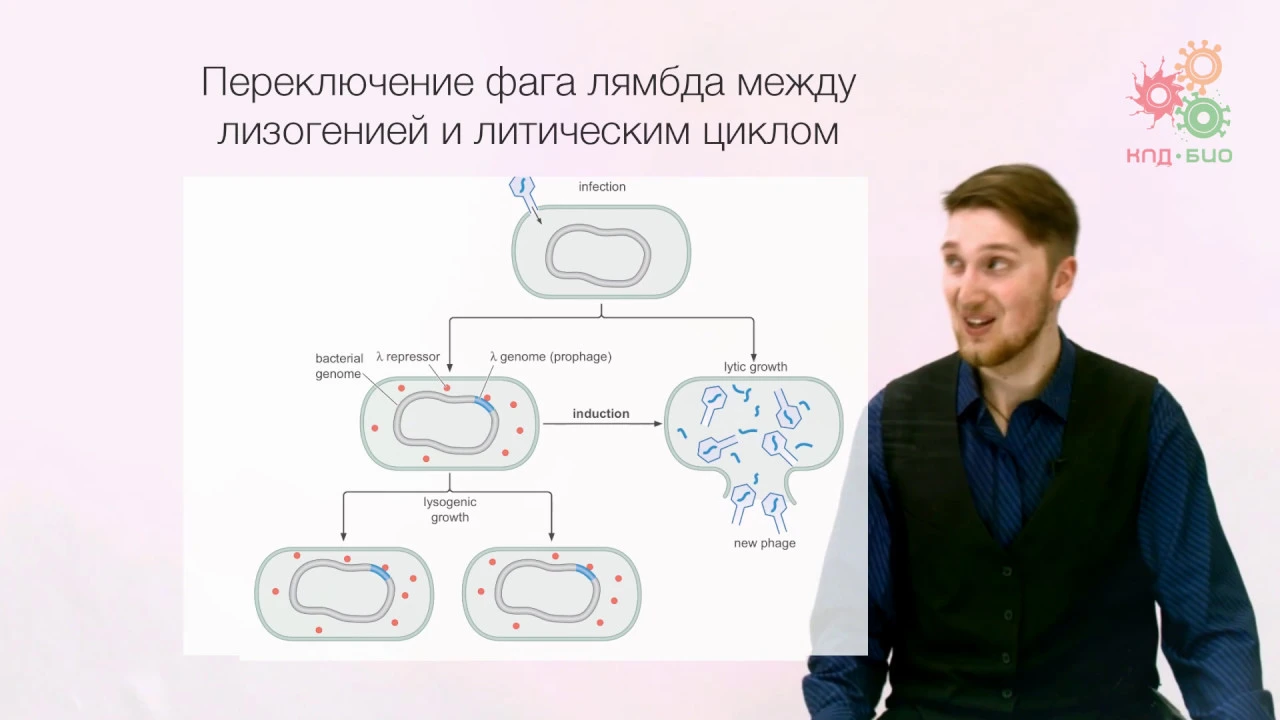






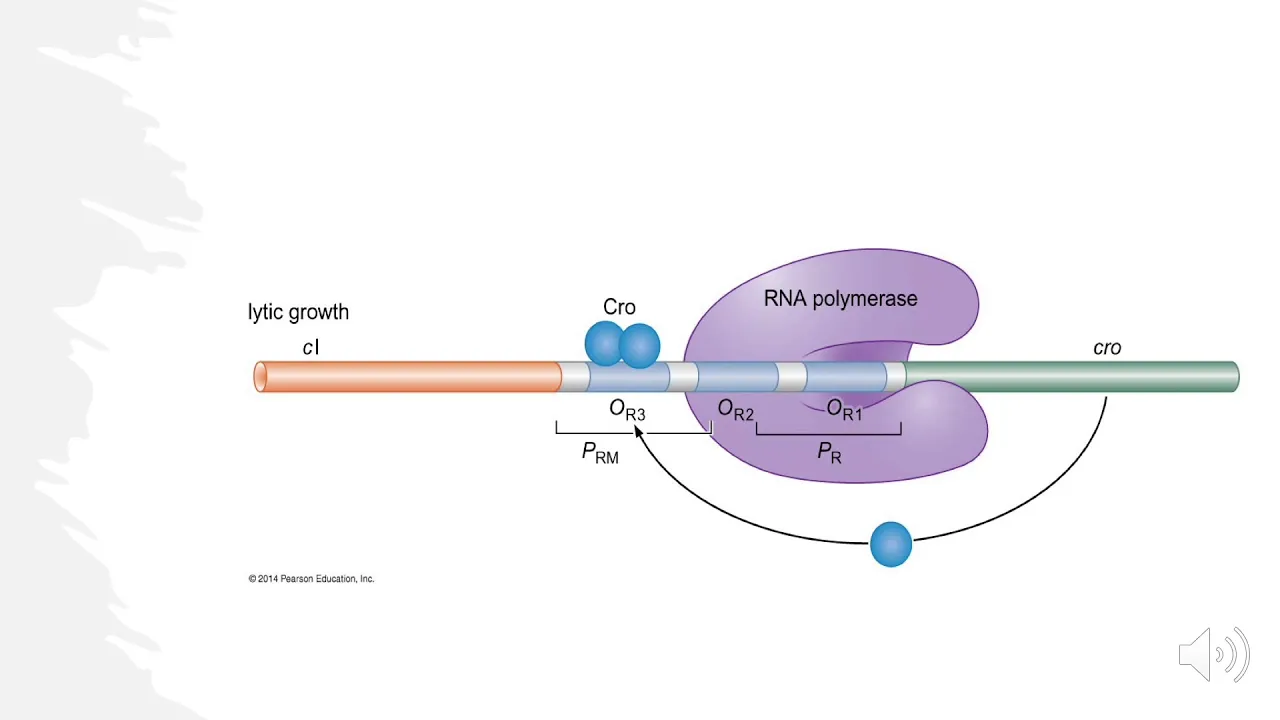


Bacteriophage lambda uses a sophisticated genetic regulatory system where the cI repressor (lysogenic pathway) and Cro protein (lytic pathway) compete for control of gene expression; the immediate early genes n (anti-terminator) and cro are transcribed first, followed by delayed early genes c2 (activator) and c3 (stabilizer), which enable cI repressor synthesis through the PRE promoter, while the cI repressor itself auto-regulates its own levels by binding to operator regions and blocking transcription from PL and PR promoters, thereby determining whether the phage enters the lysogenic (integrated, dormant) or lytic (replicative, productive) cycle.
Lambda Phage Genetic Regulation: Lytic vs Lysogenic Switch
Added:Basic understanding of prokaryotic gene expression, including the roles of promoters, operators, RNA polymerase, and transcription factors.
Fundamental concepts of bacteriophage life cycles, specifically the general distinction between the lytic (virulent) and lysogenic (temperate) pathways.
The molecular biology of DNA-protein interactions, including how repressor and activator proteins bind to specific regulatory DNA sequences.
The concept of genomic integration, where viral DNA inserts into a host bacterial chromosome to become a prophage.
The detailed molecular mechanism of CI repressor cooperativity and Cro protein antagonism at the OR1, OR2, and OR3 operator sites.
The role of host-cell physiology, specifically the bacterial SOS response and RecA-mediated cleavage of the CI repressor during induction.
Applications of lambda phage genetics in biotechnology, such as lambda red recombineering and the use of lambda vectors in genomic libraries.
Design principles of synthetic genetic switches, such as the bistable toggle switch, inspired by the lambda phage regulatory network.
6.2K views136likes26:32Original Release: 2020-05-27
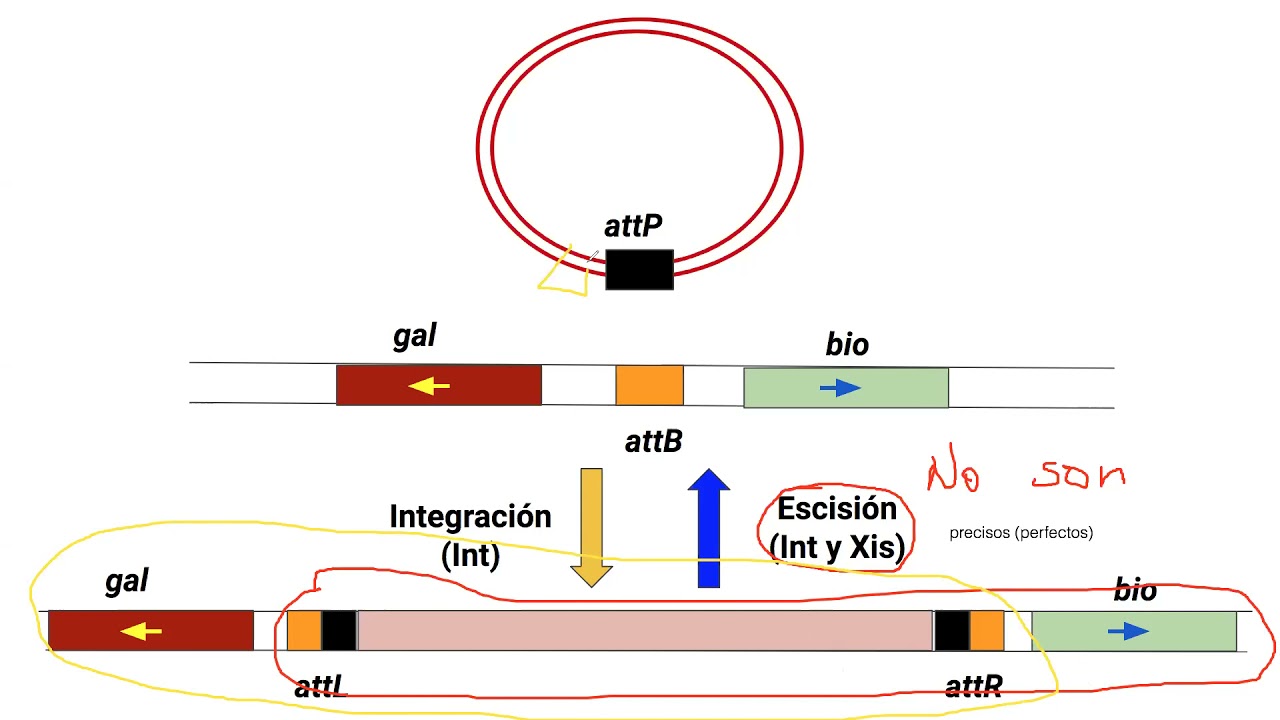
hello learners welcome to my youtube channel learn life science so this is going to be the third lecture on amrap bacteriophage that i am going to discuss and the topic is genomic map hand lytic as well as the lysogenic version lambda bacteriophage lifecycle okay in the last two lectures I have already given you a general introduction regarding lambda bacteria patch lytic analyzed with an X which as well as the major infraction that appears between the host cell as well as the lambda bacteria Hodge Tail proteins so genomic map gives you a proper outline or proper localization of various genes that are involved in a defined genetic region okay so the switch between the two states that is lactic and lysogenic cycle is mediated by proteins that are encoded by bacteriophage genome the two regulatory proteins are synthesized by the virus that is Sieben that is acting as a repressor also called as lambda repressor as well as the crew which is having a regulatory role which controls the repressor synthesis that is this even synthesis so these two are the major proteins that are involved in the switch and the thing you have to remember here is that Seawind repressor is involved in lysogenic pathway as well as the CRO repressor is involved in lytic pathway okay so these are some of the genes that are present on lambda bacteriophage genome and it is going to be very easy for you to remember as we will move further okay so the genes are divided according to their time of expression for example there is immediate early genes that is going to be firstly expressed then delayed early genes which is going to be expressed in the presence of immediate early genes and lastly there will be expression of late genes which is going to be expressed in the presence of delay early genes so let's look at one by one the first immediate early genes involved is n gene okay and gene encodes for a ante termination protein by the word it defines that it is anti termination means it will allow transcription to go on okay then the second one that is crew that I have already told you it encodes a crew protein which is inhibitor of our repressor that is c1 synthesis okay it will be going to inhibit the synthesis of c1 okay then there will be expression of delayed early genes which involved c2 that is also having an important role which codes for a activator of transcription of c1 and end okay now here c2 is encoding a protein which is which is going to act as a activator okay activator of what activator of c1 that is our repressor as well as and gene okay second is c3 c3 is going to encode for a protein that is involved in stabilization of c2 gene okay that is it is going to stabilize c2 c2 is going to act as a activator for c1 okay and crew is going to inhibit synthesis of c1 that I discussed till now the third one is the ain't Gina okay into gene codes for integrase we all know that integration is involved in recombination process of different genes then there will be cases gene which is involved in encoding our excises enzyme which is also having a role in excision and integration then there is o and P genes which are involved in DNA replication q genes which also acts as anti termination protein along with and okay and lastly there will be later gene expression that is a 2j which involved in head-to-tail synthesis then s and our genes that is lysis gene in this one chart you can clearly see the genes and classify them according to their pathway that is light again lysogenic pathway for example n gene is involved in lytic pathway CRO gene is also involved in lytic pathway delayed early genes that is c2 is involved in lysogenic c3 is involved in lysogenic and O P and A to G s and are involved in lytic cycle okay so it is going to be really simple for you now this is a diagrammatic representation of the general genetic map of lambda bacteriophage okay so what we have discussed about the early genes it involves n gene and CRO gene okay I have told you Gro encodes a protein that inhibits c1 and then I have discussed about the delayed genes which involved c2 genes which acts as an activator for c1 as well as the antigen then c3 gene is also a delayed gene that is involved in stabilization of c2 okay so these are the other genes that is localized apart the main function or the main regulation is going to appear here okay in the P letter designated here are the promoters okay so before beginning you should know about the operon system an operon system consists of a repressor gene that encodes for a repressor protein operator region as well as the promoter region and there are further your structural genes okay so let's discuss it one by one so promoter is the we're RNA polymerase binds and initiates your transcription okay sorry promoter is present right here and the operator is present right here let me draw it once again so promoter is present beyond the operator with close affinity to the structural genes okay and here is the repressor so promoter is the region where RNA polymerase binds and initiates your transcription and the structural proteins are synthesized and you might be also knowing that repressor protein is having the ability to bind to operator region and block it in such a way that RNA polymerase cannot move further and there will be no further transcription of structural genes so here you can see designated p letters are representing these promoter regions for various structural genes okay so here I have mentioned the genes and their roles for you so that you can easily memorize at one look okay in one law so here lambda repressor is encoded by a c1 n is encoding anti terminator CRO is the inhibitor of c1 synthesis c3 is going to stabilize c2 now I am going to make it more zoomed in to get you understand with the promoters so as I have already told you promoters the region at which RNA polymerase will bind and the transcription will begin okay and the structural genes are going to express their specific proteins so let's start and focus on these main genes okay now you can see here are the genes that is engine here is CRO gene c1 repressor c2 activator as well as the c3 stabilizer now here is the presence of PL promoter a promoter that will initiate transcription in left hand side here you can see by arrow I have given here it will start transcription in left hand side the PR promoter is going to transcribed in right hand side PR e promoter is present between crew and c2 that is going to transcribed in left hand style for the transcription of c1 okay so the thing you have to remember here is that force even expression PR e is going to transcribe okay and then there is also a promoter present PR m that is repressor maintenance occurred and as you know with the name repressive maintenance means what it is going to maintain the level of the repressor that is our C 1 so two promoters are involved in synthesis of the repressor c1 the first one is the PR e promoter and the second one is the PR M promoter okay these two promoter you will have to memorize and the other one are simple that is PL promoter that is going to transcribe the first early genes n PR promoter that is also going to transfer cried the early gene that is cru okay now here I have given the full forms as well as the function of various promoters from which the PL promoter is left work promoter for early gene n and other left word early genes as I have told you n is going to encode for auntie termination protein which will allow the transcription of further early genes the second one is PR promoter that is a rightward promoter for CRO and other right world early genes third one is PR e promoter that is repressor establishment repressor in establishment by the name indicates that it is involved in the establishment it means the first synthesis of c1 repressor is going to initiate from ER e promoter and the important thing that underlines here is the PR e promoter is recognized by RNA polymerase only when there is presence of activator c2 okay I have told you that c2 is going to act as an activator for c1 but how it is going to act for c1 it is going to act for c1 by giving PR a promoter its ability to get recognized by RNA polymerase okay means it is an indirect activation of c1 repressor by c2 and also it is going to activate int which I am going to tell you in further okay the second one is PR promoter that is a repressor maintenance it is a promoter that will activate lately and is going to maintain the level of the depressor and the last one is the p i-- promoter which is involved in transcription of integrase okay so these are the various promoters that you will have to remember PL promoter means leftward promoter PR promoter means rightward promoter p r e means repressor establishment which is going to be recognized only when there is presence of situ activator then there is PRM promoter that is repressor maintenance promoter and p i-- promoter for integrates now as i have told you that the immediate early genes are the one that are going to transcribe first means what if you if I ask you a question that which are the genes or which are the promoters that will be going to firstly recognized by RNA polymerase then your answer should be PL promoter as well as P R promoter okay because these are the promoters that are going to transcribe the first early genes and and go okay so let's get started with the lytic as well as lysogenic switch till now we have discussed about the genomic map as well as the various promoters now the first step that is going to happen is the infection infection of host E coli cell with lambda bacteriophage then the DNA of faj enters the host cell as i have told you that the lambda bacteriophage consists of various proteins and i've also mentioned about the protein that is GP j protein at the tail fiber which interacts with lambie receptor on the host cell then the third step that starts that the main stuff that start is that the RNA polymerase is going to bind firstly at T L as well as PR promoter okay and if you remember PL promoter is responsible for transcription of n as well as PR promoter is responsible for transcription from crow genes now gene encodes for anti termination factor whose action will allow transcription to proceed in delayed early genes okay then it will cause c3 to be transcribed and as I have told you c3 is going to encode for a protein that is going to stabilize c2 or protect c2 from action of F T SH and in the side by pathway you can see scroll gene causes for the transcription of c2 and now C 2 will act as an activator for c1 c1 repressor by giving pyaari promoter its ability to get recognized by RNA polymerase as well as the activation of transcription for from P i okay so let's understand this pathway diagrammatically so the first thing that will happen is the binding of RNA polymerase 2 PL promoter and p our promoter okay PL promoter of PL promoter will initiate transcription of engine on transcription of engine there will be further transcription of c3 gene ok then PR promoter will initiate transcription of corrosion and then of C to G okay and if you remember their function n is an anti terminator c3 is going to stabilize c2 and now c2 is going to act as an activator for c1 promoter by giving PR e its ability to get recognized by RNA polymerase means what this is so this is our four step from PL promoter this is our second step from PR promoter the third step will be the activation of PR e promoter and the synthesis or c1 okay now now when c1 is synthesized it is involved in lysogenic pathway then it will have to inhibit the other genes now how it is going to inhibit let's discuss about it now as I have told you see to act as an activator which is involved in recognition of PRI by RNA polymerase as well as it is going to activate transcription for P I now the recognition of PR e by RNA RNA polymerase will lead to expression of C 1 and C 1 is the lambda repressor the repressor of the genetic regulation system C 1 is responsible for classes anak cycle okay now C 1 is a repressor means what it is going to bind to the operator regions and it is going to shut off the transcription of the genes okay so C 1 is going to bind to Oh L the operator for left hand side genes and whoa are the operator for right hand side genes and shut off transcription from PL and PR as I have told you if the operator region will be blocked then the RNA polymerase cannot move further okay so this is what here mentioned here is now if there there is a off transcription at PL and PR region then there will be no end and no C 3 no crew then no C 2 and if there is absence of C 2 there will be no PR e recognition by RNA polymerase as well as there will be no repressor synthesis you can see here how C 1 repressor is maintaining it own level okay see one activate the promoter PRM and sivan synthesis continues so let's understand it dammit diagrammatically again here you are going to understand it easily okay so we have discussed until the repressor protein synthesis which is synthesized by PR e promoter okay when the c1 repressor protein is synthesized it is going to bind to operator regions okay now the promoter PL is having three operator regions means you can see here there is a l1 o l 2o l3 here there is o r100 r2 or r3 the first operator will always be at highest conflict or affinity to the structural gene okay always remember the first operator region that is o l1 and o R 1 will be at the highest affinity to the structural gene it transcribes okay then there will be 2 & 3 with low affinity here also 2 & 3 with low affinity now in this section you can see that over o r1 and r2 imparts the region of PR poon promoter as well as the PRM promoter imparts the or3 operator okay so this was about the diagram now the pathway follows that c1 the repressor binds with higher Pro affinity to the first operators okay for example c1 is synthesized initially in the cell means what it is now present in low concentration in the cell then it is going to bind with high affinity to the first operators such that there will be no crew as well as no n synthesis and then if there is a higher concentration of Sivan repressor then it is going to bind to other operator regions that is o R 2 R 3 o l1 as well as o R 3 now remember that the concentration of say c1 is increasing in this direction means what along with the increase in c1 repressor concentration their binding with operator region also increases this will be at low temperature this will be at higher temperature okay now if the or3 region is blocked what will happen if the or3 region is blocked then PRM promoter which is also involved in repressor protein synthesis is also going to get blocked okay so what I am going to tell you here is first we have discussed that pra is the promoter which is involved in c and c 1 synthesis and when the early genes are switched off the repressor maintenance promoter is involved in its synthesis but when the concentration is higher and lower 3 promoter operator is also blocked then the function of PRM will also get stopped and there will be inhibition of C 1 repressor synthesis ok so this is an important point where C 1 it is regulating its own level okay so let's get memorize it once again that the first genes that were transcribed were N and crew then other genes involved C 3 and C 2 in the presence of C - there was transcription of C 1 due to PR e okay there was transcription of C went wrong pyaari now C 1 is going to act as a repressor and Delta is going to block the transcription from or the early genes okay then it is going to bind to first operator regions and along with the increase in its concentration it is going to block Oh r3 operator as well as its own synthesis from PR M okay so there was also question in December 2019 about c1 repressor that which of the following acts as a positive as well as negative regulator and the options were about c1 repressor tryptophan operon and then Lac repressor and these were some of the other options and the correct answer about that was c1 the repressor so this is an important cycle that one should always remember when learning about the lytic as well as the lysogenic switch okay so I've mentioned in a introductory from that c1 repressor block synthesis of CRO and also maintained its own concentration at a particular level the stabilisation makes officiants even repressor to block not only prophase lytic cycle but also imparting immunity to life Susan against super infection what mentioned here is that I have told you Sivan repressor is involved in lysogenic pathway means what it is going to keep the lambda phage DNA in integrated form with the genomic DNA of the host cell okay and it is also going to impart immunity against super infection means it is also going to prevent infection of the lysogenic with another lambda bacteriophage when a Farge infects Ally Susan X's represent molecule already present in the cytoplasm of the cell will bind rapidly to the operator side of infecting molecule before polymerase bind to the promoter PL and we are now and I hope you understood this sentence that now when the concentration of repressor is maximum in the host cell whenever the foreign viral DNA will inject the RNA polymerase will be incapable of binding to the promoter region as there will be already bound repressor to the foreign gene region and in this way it will it is going to prevent the super infection so this was all about the lytic as well as lysogenic switch that is important point with respect to radius competitive exams and I hope you understand understood the pathway in a simpler way if you still have any kind of questions arising in your mind then you can comment and if you understood it well then please like subscribe and share with your friends in the next video I'm going to tell you about the retro regulation of antigen that I have told you that into gene is activated by c2 and that is why I'm going to discuss the pathway that how c2 is a responsible for expression of antigen okay so thank you so much and please stay
Up Next

4:06
Antibiotic Resistance Mechanisms Explained | Bacterial Defenses
@osmosis
141.6K views•2023-11-30
50:12
Bacterial Communication: Quorum Sensing and Biofilm Formation Explained
@JHUAAP
12.6K views•2011-06-28

5:35
Enteric Nervous System Explained: The Gut's Brain | Neurobiology Lecture
@alumniu6029
438 views•2018-09-12
7:08
Bacteriophages: Earth's Deadliest Killers and Future Antibiotics
@kurzgesagt
34.6M views•2018-05-13
Related Study Plans & Knowledge Roadmaps
Structured learning paths in Biology
biology
RNAi: Biogenesis, RISC & Gene Silencing
01Molecular Biology Foundations: DNA to Protein
02Introduction to RNA Interference (RNAi)
03Molecular Biogenesis of miRNA and siRNA
+ 2 more learning modules
10h5 modules
Explore Roadmap
biology
Mycorrhizae: Signaling, Biophysics & Ecology
01Foundations of Mycorrhizal Symbiosis
02Molecular Signaling and Root Colonization
03Biophysics and Bioenergetics of Nutrient Exchange
+ 1 more learning modules
11h4 modules
Explore Roadmap
biology
Circadian Clocks: TTFL, SCN & Periphery
01Foundations of Molecular Biology & Gene Expression
02Introduction to Chronobiology and Actograms
03The Core TTFL: Molecular Architecture of the Clock
+ 3 more learning modules
14h6 modules
Explore Roadmap
biology
Population Genetics: Math, Drift & Selection
01Genetic & Probability Foundations
02The Hardy-Weinberg Principle and Baseline Models
03Mathematical Modeling of Natural Selection
+ 3 more learning modules
18h6 modules
Explore Roadmap