














![[2026 EBS 수능특강] 인문 10 심리 철학의 물리주의적 이론들, 인문 11 인격 동일성에 관한 논의](https://i.ytimg.com/vi/BN8Nkyq66Vw/maxresdefault.jpg)


![Carl Jung, The Hard Problem, Non-Dualism, Buddhism | Consciousness Iceberg [Layer 2]](https://i.ytimg.com/vi_webp/TR4cpn8m9i0/maxresdefault.webp)


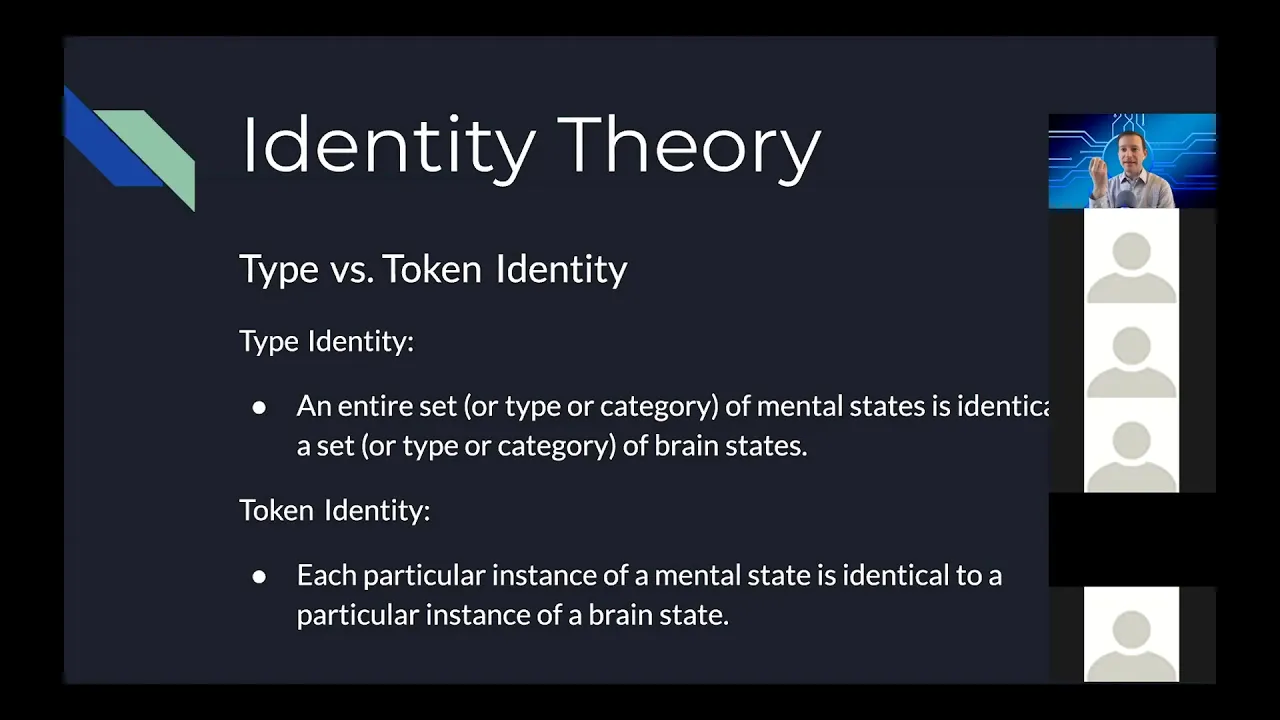
The mind-brain identity theory proposes that every mental state is identical to some brain state, meaning consciousness and neural processes are one and the same. This theory emerged from historical developments in neuroscience, including Galvani's discovery that nerve signals are electrical, the identification of neurons by Golgi and Cajal, and Kandel's work on long-term potentiation showing how memories form through strengthened neural connections. Identity theorists respond to Descartes' conceivability arguments by arguing that scientific identities (like water being H2O) are established through empirical investigation rather than a priori reasoning, and that mind-brain identity should be treated similarly—identifying phenomenal consciousness with specific brain states provides explanatory coherence that dualism cannot achieve.
Mind-Brain Identity Theory: Philosophy of Mind Explained
Added:hello and welcome to the week eight lectures for my online philosophy of mind course which I'm running at LaGuardia Community College if you've been joining and following along you might know I haven't been feeling very well for the last few days although I am feeling better today so hopefully that recording this lecture will be a little bit more fun for me I've been looking forward to getting to this lecture because the mind brain identity theory I think is a very important theory and very interesting so let's go ahead and jump right in because there's a lot of stuff to cover right here so we've been looking at the mind body problem and so far what we've seen is that if you want to have some kind of substance dualism it looks like epiphenomenalism is looming and epiphenomenalism is the view that the mind doesn't have any kind of causal interaction with the physical world whatsoever so it's kind of just floating there and of course it becomes very mysterious then like how we know about it and why it seems the case that's consciousness does play a role on the mind does have some causal influence in the world so we that seems to be a big problem and one way that people deal with this problem is to argue that the mind just is something physical and we've seen people going all the way back to Democritus and Democritus lives roughly around the same time as Socrates does and he argued that the mind really was just a special kind of atom as distinguished from the other atoms by its by its shape so people have been materialists but we haven't really been looking at the role that the brain in particular plays in people's thinking about the mind and so this week's discussion is about the idea that the simplest physicalist idea being just that the mind is the brain that whatever they are the same thing now of course one question you might have is why we pick the brain and it's part of a long long history of this stuff and part of what I want to do is look a little bit back at the history of this and we'll go kind of quickly to the history I know I have a tendency to get sidetracked by talking about all the minutiae of the history and somewhat sometimes that's not the most important thing but I think it is important for us to have some grasp of the history of this stuff because it puts the stuff that we're interested in in perspective and so you may wonder why we do things the way that we do and it's because we're coming out of this long history so now I'm not going to turn this into a philosophy of biology class or a history of philosophy of policy class but we're gonna start back in the same error that we did before with and we'll start with Hippocrates who of course is really well known and we still have the Hippocratic oath he gets credited with sort of being the first Western doctor and roughly what he does is to take this idea that I call the philosophical method the philosophical approach and to apply it to medicine so I'm not going to dwell on this but basically the idea is that the world is a natural orderly place that doesn't have any kind of supernatural stuff going on and it's explainable completely in terms of the stuff that we find around here that was what I what I call the the difference between the pre philosophical way of thinking and the philosophical way of thinking and so you know if you're interested you can go and watch my video what is philosophy alright talk about this but for now we'll just point out that Hippocrates was interested in explaining diseases naturalistically and he's credited with talking about the brain and in in particular he's credited with speculating that that the the epilepsy is caused by some kind of brain disorder and you know it's not really a hundred percent clear why he thought that to be honest but they didn't really know much about the brain in ancient Greece because there was a taboo on human autopsy there there's a certain view about the body which led people to do dissections on animals but not really human dissections and so in this period of time people weren't really talking about the brain even though you have some people speculating about it and there are also these rumors that Plato seem to have thought that somehow the brain was important or though what they call the seat of the soul and of course by the seat of the soul that's a weird way of putting it but we talked a little bit about the idea that Plato had this mind-body relationship in in in his thinking and so he often saw Socrates often says things that the soul uses the body as a means of perception and so that's interesting and so I don't know exactly where he says this I've looked through the dialogues and I can't find it if anyone out there knows where Plato talks about the brain in particular I would like to know now on the other hand Aristotle it's a little bit more clear because you can find where he talks about this stuff and with Aristotle it's pretty clear that the brain is not where the action is excuse me so I am feeling better of no no advil sign sinuses today but still not a hundred percent so sorry for any coughing him any coughing but yet my lungs still haven't cleared up at any rate though Aristotle really thought that the heart was where the mind in the body must somehow coalesce or interact and he he seems to have thought of four kind of largely aa priori reasons you know roughly speaking that the heart was in the center and the center was the best place to be that you can get around from the center you can you know communicate with everything and so he seemed to think that was important and of course that's why the title of this slide we still say things like I know it by heart because for a long time after this there's kind of a battle two camps form if you will one camp who says that you know the brain is what's doing something involves with thinking and you don't have to think it's identical you just have to think that that's sort of where this non-physical thing would have to interact so remember part of the the problem here is if you think there are two things you have to say where they they connect and so some people would say well they connect in the heart and other people say oh they connected in the brain so you don't have to buy into an identity or some kind of claim that they're the same thing in order to be worried about this question the general issue is one that everyone who's talking about the mind-body problem should care about so so these two camps form roughly the heart or the brain and what we see is oh here's the star of the show and that's the human brain so I should have warned you that this was coming on this slide but I figured we may as well throw it out there and they may have had a taboo on human dissection in in Athens but we don't have that taboo and some people donate their bodies to science and this is the brain of one of those people and so you can see the structure of the brain which is which was starting to be known like after the Greek period of time yeah in the in antiquity in the like first hundred or so years after year one you see people doing this dissections and noting the two sides so you see the left hemisphere the right hemisphere you see the cerebellum down there at the bottom and we'll talk a lot about that but I thought it was important to see that because according to the view under consideration that is the mind that's what it is when that thing is working I'm doing what it's doing it's doing mind stuff okay so now that the next kind of milestone here starts with Galen and Galen is very famous and so you can see this is sort of 200 years or so after year one and he gives a lecture on the brain and he's really getting into the anatomy of it here and develops what the very popular theory of the animal spirits which lasts for a long time and so I'm not going to dwell on this I always say that and well on it anyway but I promise not to dwell on this but the basic idea is that it's a spirit not in in the sense of a non-physical spirit but more in the sense of an alcoholic spirit so if you think about whisky something that I enjoy very much and I wish I was having some right now instead of coffee but at any point if you think of whisk what you do to make it is you take some liquid and you cook it slowly and it sort of evaporates and forms this mist this vapor and you collect that vapor and drop it down condense it into a liquid form and collect that liquid and that's the that's the product the whiskey so in the vapor stage that's the spirit it's this kind of vaporous thing it's just kind of mist so Galen thought that the way that the brain communicated with the rest of the body and he did advocate this and people also thought the heart might be involved with this because they thought well the ventricles of the heart which are these nice open spaces might be taking or distilling out some kind of vapor from the blood as it is in the heart they didn't they didn't really they weren't clear on what was going on there but that's what Galen thought and so he thought that the the the ventricles which are in the brain that which are these little areas of filled with liquid cerebral spinal fluid as it turns out well he thought well in there you would have these spirits and it could be distilled out and the brain would distill the mountains distribute them through the body and you would use them and other people I know the heart was doing in so people argued about where this was going on but there was a general theory that the way that the body operated was according to these animal spirits and roughly speaking the the going metaphor is one of hydraulics and it's no it's no mystery that this is kind of a metaphor that they're using because hydraulics are a big part of the day-to-day life and by the time we get to the time of Descartes hydraulics are very much developed and in play okay so let's go ahead and move on so that's interesting these ideas of these vesicles and here's a drawing from I think it's from Rufus of a thesis so that's what you get if you look his work up and this is again sort of a medieval anatomist of the brain and you see them sort of focusing by the way this is from a book of his called on the names of the parts of the human body and you see that this is a dead person the tongue is kind of sticking out but you can see up in the head there these three ventricles and those are the three kind of open spaces what you find if you were if you were to dissect a brain you'd find these three open spaces and so they identified those as each one of them being important and so here's a close-up of that picture so often it was said that imagination was in the first one reason in the second one memory and the third one and sort of imagination here means the sort of taking of images like the you know the thing that generates that experience and stuff like that so that was the idea and you see this popping up all over the place so here's another drawing of some other people corpses from that same period of time and you see the three ventricles and this is a common theme from this period that the way the body works is in this hydraulic manner that it's roughly just fluids some fluids can have things distilled out of them little vapors those vapors can be moved around and collected and you know distilled back into liquids so maybe that's what the heart is doing it's you know collecting liquids and so they had this whole Theory worked out now I'll just mention one person here in passing because I think it's interesting but so here's by in the West who's known as of vasana and I never can say a bit of ikana or whatever his Western name is but this is a urban center here and very influential philosopher of the medieval period so you see him living here 980 to 1037 and writes very very very influential book to canons of medicine and he's a very interesting philosopher and if this were a different kind of class we could spend like the whole whole period excuse me the whole semester just discussing this stuff but well I'll just point that out he's interested in vision he talks about vision also lots of others but but for our purposes one of the things that he points out is that the people of his time seem to really think Galen is interesting and special and he did want he likes Aristotle so he and this is sort of typical of this time period that you see the influence of Aristotle in the East not in the West and so he recommends that people should they worry about this thing called the census communis or the common sense which is somehow supposed to be the place where all these various things come together and form one unified conscious experience that's the common sense the thing which all these little parts somehow produce and so he wondered about that and we are not gonna again we're not gonna turn this into a history of this stuff but I just think it's important to mention this and of course when you're student through history in the way that we are how could you not mention Leonardo da Vinci who we haven't brought up yeah it's a bytes of course he's one of the great geniuses of history and so here's some sketches that he was also an anatomist and he was a close a careful student of the human body and Anatomy and he did it because he was interested in art he wanted to really be able to draw lifelike figures and you know what to be honest I don't know if he did it because he was interested in art I'm not sure if that's true but he was he seems to be generally interested in all sorts of stuff I mean the more you learn about this guy the more you're amazed by him but here are some pictures of the ventricles so you see still this idea that the ventricles are important this is in the 1400s the 1500s and so if you think back to our other discussions you know Descartes hasn't even come on to the scene yet Galileo hasn't showed up yet this is all sort of just before that and this is the culmination of this kind of previous way of talking about things the hydraulic ventricle animal spirits kind of view is really being developed and the drawings on the left there are kind of cool because what da Vinci would do is like take brains and fill them with wax and then make a cast of them and then draw it and so he gets these really nice pick over here you can see here's a picture from a modern textbook of the ventricles and you can see that you know he had it right his drawings really do capture the shape of these things now of course they always saw them empty so they assumed that there could be gases and liquids and stuff in there and you know there's some liquids and the brain ones and some emptiness here and they thought they were be filling up and in lowering down and there would be this kind of hydraulic system set up there now all of that is like a super quick history of everything that happens before the people that were interested show up like Descartes and Newton and all of these guys and so I'll mention a couple of them here one of the important ones is Thomas Willis and you can see his dates they're 1621 to 1675 and I like Thomas Willis I remember as a student learning about the Circle of Willis and I always really wondered why do they call it the Circle of Willis being a child of the 80s I wonder did it have anything to do with different strokes of course it doesn't have anything to do with different strokes it had to do with Thomas Willis who discovered it so but what's interesting for our purpose is is not that he's involved with the Circle of Willis named after him but that in 1664 he has a book on neural Anatomy where he really is critical of the ventricle hydraulic Aristotelian kind of idea he thinks it just read the animal spirits thing just doesn't doesn't work so just as in the other areas of physics also in biology people are starting to rebel against Aristotle's ideas so here's a picture of his actual book which some of the drawings that he's doing you're seeing he's actually pretty good artist thing these drawings are pretty cool so one other person from this time that we'll mention here is ostendo Nicholas steno also from the same period right this is 1638 1686 and the reason why I want to mention him is because he sort of is credited with definitively establishing that the heart is just a muscle what by just a muscle I mean a muscle like the ones you find other places in the body like in the leg and he does it by boiling cow hearts and in comparing the boiled tissue to two other muscle tissues it's pretty disgusting but that's the way that he does it and he's really interested in the in the cortex of the brain and he thinks that that's something that people should pay attention to and it turns out that he's right so he's he's he's really trying to push against the idea that the heart is what's the biological organ of the mind whatever you think that is so we're focusing away from the heart at this point and of course by this time Descartes would be on on the scene and if you look back at history you see Descartes is for the idea of animal spirits he's very much into the idea that what the heart does is distill the spirits out so he's he's maybe I'm bored with the claim that the brain is where these things connect and so he would think the brain is where the mind connects to the physical world and the pineal gland is important with that but he was very much involved with the idea that animal spirits and the hydraulic model of human action was something they took seriously and that's because by this time they had really good anatomically interestingly functionable hydraulic figures of the kind if you think about going to Disneyland and seeing the little animatronic figures there those ones are electronical electronical or electrical if you will whereas these ones are hydraulic but you get the idea you can see these sort of human esque figures doing human Eska movements and it was all done with hydraulics and fluids and so people thought this was very fancy now of course all of this is wrong that's what's so fascinating about this is you see this 2,000 year debate about what where is it the heart of the brain and even in the of this debate there both parties are assuming the incorrect view about how these things are working so even if the even the people who like the brain still think that it's this animal spirit hydraulic stuff but now we're starting to see something else well what else would you put instead of hydraulics well there was something that had been recently discovered and here's a picture of a guy I really like William Gilbert now there's a gentleman from history if there ever was one and this is rewinding a little bit we skipped over him so we were already up to the 1680s or so but now we're back in the 1540 forest for this guy to be born and he's the one who gives us the term electricity which I always thought was pretty cool and this maybe this was something that surprised me when I was a young person and found this out but the word electricity comes from the word electric us which he coins and it literally just means like amber and yes amber like the tree sap that you find and of course that's because if you rub it you can generate static electricity and the Greek word for amber by the way is electron and that's of course where we get electron and all the other stuff that we that we say about it and Gilbert's the first person to use the word electric electric us to indicate the kind of attractive force that you get so if you rub something and then a it'll take a little feather and suck it up close to it that's the static electricity or I'm sure you've all done this before with your hairs flyaway and it sticks to your hand and that's static electricity so he called it at the electric as' and it stuck so what's what's surprising is that they have not even discovered that electricity is important for brain function yet at this point they're most people are thinking in terms of excuse me I apologize um most people are thinking in terms of this hydraulic model and of course if you want to know when is it that we discover that the electrical and the sure of biological communication it's not until the 1790s and here's the guy who does it Luigi Galvani and he's the person who first recognizes that it's electricity which is being sent back and forth between the brain and the muscles and he's not working inside the brain easily he's trying to figure out how does the brain communicate to the leg muscle in order to contract it for instance and you know electricity is one of these interesting things we could do a whole section of a class just on that but it had been a static electricity had been known about for quite some time Bailey's talks about it and if Ailey's was interested in magnets and he says some weird things about them but it wasn't until this period in time that anyone had any clue that there were electrical inflows of impulses in the human body so now instead of the old idea of animal spirits we get the modern idea that there are nerve impulses that there are electrical signals that being generated by the brain being sent in various ways and so here's an illustration from gala Bonnie's actual paper that he presented and I really such a great drawing I mean all these old scientists were such a good artists and or some of them were anyway and it's really cool so here's an actual depiction of his experimental setup you see the little electrical generating device there and what he's doing he's got his frogs he's cut them in half and sort of I exposed the nervous system so you you thought Huxley was weird last week when we was talking about the frogs and this was what they did this is of that period so and he's taking these little current generators and he's actually stimulating the nerve and getting a response in the frog's leg showing that it's electrical signal he's measuring the electrical output on the other side with a thing that comes to be called the galvanometer so this is a huge step forward 1791 is when this is done and you might say that this is really the first time when we that we make a significant leap forward in our theorizing about the brain 1791 even though the very first recorded mention of the brain I think goes back to ancient Egypt when there's some scroll someone who got brain injury so a long time big discovery right here and of course gal bonnie is important he still hangs around and the words we used we talked about being galvanized group of people was galvanized into action we might say of course that word comes from him it means to be charged up we talked about galvanic skin response we have galvanometers so he gets his just recognition because this is one of the monumental major discoveries of the universe that this electricity the stuff that's out there somehow being generated inside and you know you might find that surprising that electricity which was only recently really sort of known about in the saint's period and Maxwell's equations are coming that deals with electricity and so people are really shocked by this how'd that get in there and it shouldn't be too much of a mystery that one of the fundamental features of the world is also involved in the way that we work I mean people were already thinking hydraulics thermodynamics and he had important things to do with life so why not electricity and of course there's idea that of energy and electricity that really in the popular culture this catches fire and I think the best example of this is you know Mary Shelley's Frankenstein or how do they get the thing to come to life they lightning bolt it laughs so this this idea that electricity like lightning and then also Oh electricity in here like brain so maybe they're importantly related to each other this generated some puzzles by the way when they started for instance I could tell you I mean again we don't want to do too many details but there's a whole story about von Helmholtz and calculating the speed of the action potential and it's not the same as electrons moving in a wire and so people have to do that there's a whole you know working out of this stuff and its really if you think about it 1791 1891 1991 has only been just over 200 years that we've discovered this about the brain then okay so some other landmarks just for reference single-cell recordings they take out these neurons they learn how to voltage clamp them keep the membrane voltage at a certain potential and then they can record from it and they can do things to it and see how it responds and that's these are single-cell recordings outside of living you know I in a dish or whatever so that's very interesting and then of course 1875 the first recording from an exposed brain you cut open the brain the head and you put an electrode in there of course they did that to an animal then of course there is the first EEG you put a sensor on the scalp so you don't have to cut them open and you record the electric and electric signal from from there and of course this is 1912 and it's done on a dog and it's not done on a human until sometime later so this is the beginning of our really beginning to be serious about the brain all right so we're almost done with this but we we can't leave this section with talking about two of the giants of this area and that's Golgi and qahal and so on the left over here is Golgi on the right as Ramona qahal you can see their dates there and these guys won the Nobel Prize they shared the Nobel Prize so Golgi developed a method for staining neurons and I'm getting some kind of stain inside of him so you could see them really clearly in a microscope and Ramona qahal be a great artist a brilliant anatomist in the long tradition of people drawing this stuff he actually went then and stained these things perfect the technique of it and then drew what he saw and he drew tons of these so here's one of his very cool drawings just of this is a slice of brain where some of the neurons have been stained and this is only some of them and you can see the dark blobs are the kind of cell bodies they I mean they can see that there are these cells in there so what we saw that bloody mass at the beginning if you cut that into really thin slices and look inside you find this and of course that's amazing people had not realized that there were these tiny little cells in there and of course just so we can see a couple more here's another drawing this is from the 1890s and this is supposed to be like a 3d you you can't really see it in this but every little dot there is like it's supposed to be an axon projecting out you see all the varieties of different cell shapes and though they're connections and then just because you know they're so cool I'll just show you one two more so here on the Left that's a pyramidal cell looks really cool simple elegant cell body in the middle axons extend it out but then look at the one on the right this is a different kind of cell I'm guessing it's a basket cell although I don't really know to be honest but you see there the axon extending down the bottom and then this large dendritic field so this is an amazing thing they find all these cells in there and so what are you gonna call those things well here's a guy who knows something about names Heinrich Wilhelm Gottfried von walder hearts that's a name if ever there was one to me he looks a little bit like Dan Dennett but he's the one who comes up with the term neurons and he's probably you know inspired by the people calling things electrons and I think the electron was recently discovered protons coming later so you know they like the word on it makes it sound fancy so now we have the neuron a neuron is a special kind of cell which somehow generates electrical impulses which then are transmitted to other cells in the brain but also down to the muscles so now we're starting to get some handle on what's going on here and things kind of tool along in this way until all of a sudden I owe this guy shows up Auto and what he discovers changes everything because he discovers neurotransmitters and specifically he discovers what turns out to be acetylcholine in case anyone cares but but what's interesting about this is so everyone knew that you know these electrical signals went down the axon and then there was this gap and then the next neuron was there but in between the gap they weren't sure like what happened did the electricity jumped like you know like a fire jumps offense or was it a kind of chemical thing going on so what exactly somehow they were communicating sending a signal because if you make one fire and it's somehow connected that one that other one over there will fire so he discovers that it's a chemical reaction acetylcholine does it and then turns out there's a whole suite of these neurotransmitters and this really complicates the entire game because now not only do we find out that the brain is an electrical organ that's generating electricity and doing something with it but also it's a chemical organ and that means that chemistry is relevant and of course chemistry is just being developed right now as well and before you go oh no and groan I will spare you the history of the transition from alchemy to what's called chemistry to what we now know as chemistry which really is a sub branch of the standard model of particle physics if if you get down to it so that's a whole different story and I'm not going to go through that history because we haven't even got to the point where we're talking about the identity theory yet we're trying to figure out like what would the identity Theory even be saying so if you want to say the mind this is the brain that's great but let's know a little bit about the brain first so we have our neurons now this is what they look like in the artist rendition in the year 2013 so we've come a long way from those little black blobs with their long stretching arms and so here what you see is a cutaway of the nucleus of a sort of typical neuron the axon extends out there's a synapse there you see the dendrites here and there's all kinds of stuff going on in side there and I won't really go into a lot of detail about the way that this works but roughly speaking what we can say is that these neurons are sitting in a kind of chemical bath full of ions which are chemic chemicals nutrients which carry a charge and it uses those to generate an action potential which then can travel down the axon there and I'll tell you just a tiny bit more about that in a second but for right now we can see once the action potential comes you can see that red arrow coming from the top there that's the electrical impulse that was generated in the cell body of the neuron once it gets there it can release some chemicals these neurotransmitters there's a gap there that's called the synaptic cleft these things are called vesicles I mean we're not gonna have an Anatomy test but it's important to understand some of the basics here now on the other side over there are the ion channels and those are the things in blue right there and so when these molecules are released neurotransmitters they float around in the liquid and some of them bind to the ion channels and then those open and other things flow in and flow out and so forth and so on and if enough of that happens in the right way then that neuron will send an action potential down and if it doesn't it well and so that's kind of what we've discovered about the way that these things work now how does it generate these electrical impulses well here if you take a if you take a neuron and you blow it up and you look at just the cell lining and on the top is the outside of the cell and on the bottom is the inside of the cell so that's called extracellular fluid on the inside it's called cytoplasm look none of these details ultimately really matter in between them is a layer it's actually a bilayer made of lipid approach so all of these things again not exactly that exciting but you see these little things right here in the orange brackets those are the ion channels and they can be closed or they can be open and you see these little sodium that's na and you see calcium that's CA and you see potassium that's K and those things are floating around out there and if the neurotransmitters that these gates like bind to them they'll open and let some of these things in now some of the calcium can go through because you know something might be blocking like a magnesium ion or something like that or it's not big enough it won't fit so there are various things that go on but what happens is if you take a lot of positively charged ions and they go rushing into the cell interior then suddenly start to generate a positive charge like the different there's a there's a change you get more of these positively charged things in there and if this happens in the right way you'll send an action potential so why are we talking about this because we're trying to give a theory about how the brain works and this is what we've discovered about it that these neurons really are these kind of little described in these kinds of terms right here there's ion channels they open the shut there are neurotransmitters they control the opening and shutting there's a bunch of other stuff that happens inside these ions are important for transmitting the pulse now we have a fairly serious understanding of what's going on and I just want to wave my hands in one general area which is kind of a crown jewel in early neuroscience and that's the hodgkin-huxley model of the way that this happens because as you've seen what people like to do is try to give a mathematical description of what's going on and these guys won the Nobel Prize for this basically for showing that you could model a neuron just like you model an electric circuit so here is supposed to be an actual circuit diagram of some neuron so the C over there is the capacitance and then there's the resistance they're located by G and the I's current and if you you know know about Ohm's law in a little bit Olympic electronics that's great and if you don't and then that's fine but roughly you can see that you have power sources in here those are the neurons they those that they generate power by sending a action potential and the little lines there with the ease that represents a power source and then there's a resistor something which sort of resist it that's the the axon which by the way has a myelin sheath around it which somehow you know slows and dissipate some of it and then so you get some current that flows around and then you have a capacitor and you can just give equations which describe this stuff and so you can start to understand what the what the brain is doing in mathematical terms and this culminates in a set of equations which describe the behavior and very limited cases granted this isn't like you know a generalized thing yet but this is supposed to be the beginning of something that's that's that's interesting and we're not going to go through these equations at all I mean they look like gobbledygook they're not elegant to learn like the ultimate equations that you get from physics but a couple of things that you should notice about them is that first of all they're differential equations so you got the DV over DT right there and what that tells you is that they're talking about things changing in time and in particular they're talking about the way that the cells voltage changes in relation to resistance and capacitance and so you can see that this takes into account the the G there which is the same from that diagram that we just saw or for calcium for potassium and you can just Ben calculate what would you see if there the sodium levels are this high and this happens what will be the voltage does it I will the neuron fire thought about it you can do a lot of stuff with these equations and so that's the goal of the mind brain identity theorist is ultimately to give some kind of account of how the brain does what it does and then to postulate that they are the same thing so that ultimately the identity theory is simply the that every occurring mental state is identical to some occurring brain state and we've just seen the kind of things that counts as brain states there are electrical states their chemical states they say really how could is that even plausible that all the states of the mind are like that well how many neurons are in the brain we don't know but people estimate that there are like a hundred billion some people say more some people say less one hundred billion different neurons now of course those things have both electrical and chemical aspects to them and you've seen how much detail there is and even tryna wave your hands in the direction of saying something informative about what's going on there trillions of possible connections so is it really that outlandish that you know after 200 years I've sort of pokin at the brain and this unsophisticated way is it really that outlandish that's we will ultimately just find out that's all there is to the mind to intentionality to consciousness how do you get intention ality well you know maybe neurons represent things in the world by being caused to fire by them being present may be causal relations are important now some people have tried to give concrete examples of this and I want to just briefly look at one kind of triumphant moment in science and this comes from the work of Eric Kandel he's also a Nobel Prize winner he's currently still alive possibly one of the few people we talked about who still hanging about um and he's at Columbia and he's on the radio and TV all the time talking about the brain they've done a lot of work on this stuff and what he's really known for is working on how memories get formed and stored and in particular in a giant sea slug and there are these giant disgusting sea slugs but they're really good for neuro scientists to work with cuz they're big neurons giant neurons and so what he is credited with and what he likes to argue in if you go and look in a introductory cognitive science book are you going to watch a PBS special on this stuff what they'll tell you is that memories really just are formed by electrical activations in the brain changing the chemical structure molecular structure of synapses this is something called long-term potentiation and so again I'm not going to dwell on this because we're not doing a philosophy of neuroscience class here but just to give you the flavor because this is supposed to be the idea behind the identity theory so you take an animal it learns something and like for instance the slug you shock it and it has a certain response and if you do it enough it learns to associate some other novel stimuli with the shock so there's all this conditioning stuff that's learning so okay there's a kind of memory there because if you do it again it will remember so how do you explain that well here's our neuron so somehow it's sending a signal there's chemicals being released there so what does this have to do with learning well it here's the simplest way to put it if you send one signal down and you drop out six little transmitters that's nice but if you send 15 signals in rapid succession bbbbbb beep and you end up dropping 400 little neural transmitters well then you're gonna get a much bigger effect now it turns out that if you do this enough you can get a big enough effect where some secondary things happen and this is where the interesting and exciting stuff really kicks in so the secondary things include other kinds of you know like the calcium's come in and so forth that secondary processes but the net result of that is that these little blue things that you see the ion channels well first of all more of them get made more of them get made so there's more there than was there before and then not only that but this is just one sort of connection between the dendrite and the axon they get more dendera tend rights so not only that not only do you get more connections but in the connections you get more channels and of course the more signals that are sent the more of this happens and so they're demonstrating this in this a slug but the idea is supposed to be look maybe that's the same thing as what happens when you learn how to play an instrument you move your fingers enough over and over again so what does it mean to say that you remember how to play the guitar or to ride a bicycle well they would say what means this that there's a certain pattern in the brain the result of long term potentiation and physiologically what that means is if you send the same signal like four bolts or whatever and if you do it the first time and you get like a weak signal one ball on the other side but if you do four fold over like over and over done it at it a little eventually just doing it once you get a huge signal from the other side so it becomes much more sensitive and this is a way of the brain sort of adjusting it's constantly doing this it's not a static thing it's constantly forming new channels new connections spreading out and so that then is the identity thesis science has shown us that water is h2o we start with some common-sense thing we identify by pointing out water we say a bunch of weird stuff about it it's a simple substance it's a basic element of reality we chop it up we we burn it we evaporate it we discover it's h2o people will point to genes and DNA and I won't get bogged down on that cuz I want to get to the other stuff here but one thing that people talk about a lot is lightning an electrical discharge and electricity's been a theme here so I want to focus on that and we'll see it some other people will talk about briefly focus on this as well so lightning being electrical discharge we have two different things here one is lightning they knew about it since the old days the ancient Greeks talked about lightning it's not a new discovery but the whole concept of electrical discharge is a new discovery we've just sort of seen how it doesn't even come around to the 1500s the very idea of electrical discharge being something that could be what that is over there i meanthe leas knew about static electricity and if you said hey they at least that's the same as lightning you might have thought hmm yeah if you mean its water because I think everything is water that's a little fait Lee's joke but of course the mind brain identity theorist then again to sort of bring this home makes the following kinds of claim look just like these other things so - now we know long-term memory ultimately could turn out to be something like just long-term potentiation in the brain seeing an object in front of you may simply be having the neurons which represent are activated in response to that thing all sort of firing around in the same pattern at the same time that's the claim the identity theorist makes those things really just our brain States and we want to give some meat to that we don't want to just say oh they're brain states what does that mean Oh some state of the brain so now that's why we went through this what we mean is some electrical or chemical state of the brain now of course just as the history lesson should have taught us if we could find out next week that this whole theory of electrical chemical stuff is wrong I mean the hydraulic analyst pair stuff lasted for a long time when Galen says it in 177 AD or I'm excuse me see II and then it gets you know sort of refuted in 1791 well gee that see huh seventeen hundred years plus that's a long time a thousand years so you know this electrical stuff has only been around for a couple hundred years and you know maybe five hundred years from now we'll find out that oh we were so misguided electricity in the brain who would have thunk it now of course we don't really believe that we think you know maybe we'll learn more about what it does but certainly is possible that we're wrong and we should bear that in mind now that brings us to the next point which is what do we say about Descartes and so these early identity theorists who are really getting excited about this and the 50s and you can see why because the hodgkin-huxley equations are being generated in the 50s and people are saying oh it's only a matter of time before brain science gets sort of shown to be like chemistry and then shown to be like physics something that we could like fully understand in physical terms so there's all this enthusiasm oh the brain the brain is fantastic lo the brain and then you get the naysayers oh well what about you know I can imagine myself without my body like you know de cartes arguments for dualism and the identity theorist of this time responded that these identity claims the ones that scientists make are importantly contingent excuse me sorry I'm feeling the Snead's coming on that these identity claims are importantly contingent and contingent is just a fancy way of saying that these identity relations are not necessary that they could they could be different that could have been different and that's an interesting idea one that work is going to come back to later but for right now we can just common sensical II point out that you know many people find the idea that you can answer a question like is the mind the brain simply by thinking about can you imagine something many people will find that to be just kind of ludicrous how could you answer a question that is that important is the mind the brain how could you answer that question without doing any science and so many people who are responding at this time are saying to Descartes and his sort of a priori istic approach to doing these things well look you can imagine anything that you like for instance we could imagine that water is a simple substance that isn't made of any part that's what Aristotle thought we can imagine that we could imagine that lightning is not electricity we could imagine that as something else that it's heat that's good for us in our imagination but the question is what is that stuff that over there that's flashing in the sky and if that stuff that's flashing in the sky actually turns out to be electricity then oh well for your imagination imagination doesn't really help us here science is what tells us which things are in the world science is what tells us whether water is h2o whether electricity is lightning and all of that stuff now that's a very interesting kind of claim that's being made here that you can't answer these kinds of questions on an 'a priori basis but that they should be treated like ordinary scientific claims and that they should be answered in the ways that ordinary scientific claims get answered but is that right so I want to finish up this discussion by looking at some quotes and so we'll start by looking at a quote from UT Place who's one of the sort of originators of the contemporary version of the mind brain identity theory and he writes a seminal paper in the 50s it's called is consciousness a brain process and we're reading in class but there's one passage I want to focus on because he sort of gets to the heart of what troubles a lot of people so he says sort of picking up here in the middle of this discussion he says quote lightning is a motion of electrons that's something that we think science has shown us to be true as to the case of consciousness however closely we scrutinized the lightning excuse me i messing this up it's hard to read the computer screen because uh anyway I need Visine ok so he says as in the case of consciousness however closely we scrutinize the lightning we shall never be able to observe the electrical charge what is it therefore that leads us to say that we have two sets of observations are really observations of the same thing so this is the important question because a lot of people will respond gee well water h2o you know we have two things we can we can sort of we can identify them because there's a scientific way of showing it but how do you do it when you can't see consciousness like how do you know you can't look in the brain and find it can't point at it and I think places insight here is is an interesting insight and we might wonder about it and I might want to ask you what do you think about it his insight is look you know the same thing is true with electricity you can't see the electron the electron is a theoretical in the philosophy of business class to actually show the video of the cloud chamber and if you haven't seen that you should go look at it but you can google it so there's tons of this kind of stuff on YouTube but basically the idea is that you ionize are you ionize some gas vapor some water vapor and then you shoot some electricity through it and you see this little poof and then people say aha see that that was an electron moving through that vapor it's a negatively charged that's positively charged so what you saw was it zooming through moving the other stuff out of the way now that's as close as we've ever got to seeing an electron you can't see it but yet we feel comfortable saying it exists and that it's identical with that thing over there which we can see so places point as well consciousness seems sort of to be on a par with that you can't look in the brain and find it but you also can't look in the lightning and finding the electron so then maybe we should think about what generally leads us to identify two sets of differing things it's a general philosophy of science question and places idea is we should apply the same strategy there now this model is one that is being currently defended by Ned block who we've talked about in previous week's of this class and he's currently still alive and teaching at NYU yeah now block is an identity theorist at least when it comes to things like consciousness especially phenomenal consciousness subjective character and phenomenal character so here's what he says here's the way scientific identities in general proceed by the way this quote here is from a paper that's that's so new it hasn't been published yet but it's coming out in a book which will come out some here but you can get on his website and I would tell you the name of the paper but since it's been on his website has changed names several times but the view that he's defending has not changed so here's what he says okay quote if want to know why water equals h2o why freezing equals molecular lattice formation why he equals molecular kinetic energy temperature equals mean molecular kinetic energy etc we have to start with the fact that water temperature heat freezing and other magnitudes form a family of causally interrelated macroscopic properties properties of the big world this macro family is mirrored by a family of micro properties h2o mean molecular kinetic energy molecular kinetic energy and formula form a formulation of a lattice of h2o molecules those are the micro properties which are mirrored by those properties and of course he wants to be sure we're aware of that what's micro and macro sort of a flexible kind of scale well we start off saying just like place was saying a second ago we have these two sets of properties properties from our ordinary experience and then properties from the scientific discovery of what's out there and we want to know in general when do we say that there is that these are really observations of the same thing so here's what he says and I think that this is the best kind of account that you can give from this perspective so he says the key fact is that the causal and explanatory relations among the macro properties can be explained if we suppose that the following relations hold between the families here are the relations that water equals h2o that is the same thing that temperature equals mean molecular kinetic energy that those are the same thing that heat equals molecular kinetic energy and freezing equals the lattice formation so you you can explain this stuff if you identify the properties for example what kind of explanations well these kind why does decreasing the temperature of water cause it to freeze and then also one of the other mysteries why does ice float on water when most other things went frozen become more dense and then they're liquid form and therefore don't float the water behaves differently well Locke says look we can give an explanation of that here's the gist of the explanation the oxygen atom in the h2o molecules has two pairs of unmated electrons which attract the hydrogen atoms on other h2o molecules when the kinetic energy of those molecules decreases and basically that means the temperature is decreasing each oxygen atom tends to attract two hydrogen atoms on those ends normally they're moving by too fast to do anything like that and Frankie doesn't like it when things move fast and do you Frankie no she says slow down you things so now when this process is slowing down and as they're losing this energy the result is a lattice which is some kind of a ladder like structure in which each oxygen atom is attached to four hydrogen atoms ice just is that lattice and freezing is the formation of such a lattice mmm which is why decreasing temperature causes water to freeze now see we just given the explanation because of the geometry of the bonds the lattice has an open less dense structure so basically if you think about a cube where the edges form the lattice and so it's sort of hollowed out in the middle it has an open less dense structure than other kinds of h2o structures like liquid water which is why it floats because it gets less dense as these things sort of form this this lattice structure so the idea then is look why do we say there aren't two things here and this is what he says suppose that someone were to deny this explanation suppose you say no no no water is not identical with h2o suppose you reject that freezing is identical to that lattice formation right there and suppose you say no no you just have these two things that are correlated with each other one the formation of the lattice and the other the ice but they're not the same thing well then he says we would have an explanation for something and that's an explanation of how these two weird correlated things are related to each other right an explanation for how something that is correlated with decreasing temperature causes something that's correlated with frozen water to float on something correlated with liquid water but that's not at all what we want therefore the reason to think that the identities are true is that assuming them gives us explanations that we would not otherwise have and does not deprive us of explanations that we already do have or raise explanatory puzzles that would not otherwise arise so roughly speaking then you have all these properties you identify and the ones that allow you to explain the most stuff without causing them the most problems the best fits explanatorily wise that's the strategy the claim that block is making is if you want to take a scientific approach to the mind bite excuse me to the mind-body problem well then what you do is you try to figure out the way identities work in science and that's sort of the idea that place and those guys had and it turns out that identities are just sort of postulated according to block in order to make this stuff work so therefore he says we should identify mind and brain because just like in those other cases we have two sets of properties one of the properties are the phenomenal properties associated with the subjective character of experience so those include the the phenomenal property of the redness of red the painfulness of pain and also the subjective character that it's for me not just for anyone so those are properties and on the other hand we have properties in the brain all of these neurobiological properties and it seems like they correlate fairly well for instance one kind of nice correlation here is you know if you have a certain area of the brain that seems to be involved with pain stuff and it's firing a lot you have a lot of pain if it's not firing very much at all you don't feel very much pain in normal cases that's a correlation between the activity you see in the brain and the conscious experience so you could reject the identity and become a duelist and then say well you know those are just two separate things with a correlated with each other but then you don't get an explanation by identifying them we get an explanation that we didn't have before what is that explanation well it's the one that we wanted to begin with the conscious experiences of pain play some kind of causal role in producing my behavior we get to say why epiphenomenalism is wrong we don't have two properties correlated with each other and then we're stuck with the mystery how does the painfulness of pain do anything block blocks strategy which is the traditional identity theory strategy coming out of the work of people like Jax mark and UT plays whoo you know we'll talk about in class more as we read the smart article for some classic objections excuse me but this is the classic strategy scientific identities worked like this therefore the mind brain identity should work like that you get an explanation you wouldn't have got otherwise epiphenomenalism should be rejected consciousness is a brain state we don't know which ones yet we're working on that whichever ones they seem to be ideally correlated with we'll identify them at a later stage kind of like the way we did with memory and long-term potentiation maybe like we're doing with synchrony and intentionality so these are prospects for future work but I think that's the best case for the identity theory that we have that this is just the way science works we postulate these kinds of identities now of course next week we're gonna look at the reaction to this view which comes from thinking about functions and in particular computer science and the way that artificial intelligence tries to build what we've got already so there's a whole story about functionalism coming up next week and then of course we'll be talking about a lot about compute computation and computer science and then after that we'll talk about the people who think that this whole project of trying to fit the mind into the to the physical world as we understand it now is misguided so still lots of interesting stuff coming up
Up Next
Dopamine Regulation: Science of Motivation, Focus, and Satisfaction
@hubermanlab
362.8K views•2025-08-14
Deciphering Neural Circuits Controlling Anorexia in Mice | Richard Palmiter
@AllenInstitute
2.3K views•2011-10-10

Vagus Nerve (CN X): Anatomy, Nuclei & Functions Explained
@Alilamedicalmedia
305.2K views•2022-10-31
How Exercise Benefits Your Brain: Science Explained
@TED
11.4M views•2018-03-21
Related Study Plans & Knowledge Roadmaps
Structured learning paths in Neuroscience