


















![Étienne Klein : la structure fondamentale de la matière : le boson de higgs [EN DIRECT]](https://i.ytimg.com/vi_webp/KJQl--wHQSM/maxresdefault.webp)






A topological manifold is a paracompact Hausdorff topological space that locally resembles Euclidean space ℝ^D around each point, meaning for every point P, there exists an open neighborhood U containing P and a homeomorphism from U to a subset of ℝ^D. Fiber bundles generalize product manifolds by introducing a projection map π: E → M from a total space E to a base space M, where each fiber π⁻¹(p) is a topological space; a section of a bundle is a continuous map σ: M → E such that π∘σ = id_M. In quantum mechanics, wave functions are actually sections of complex line bundles over physical space, not ordinary functions, because the bundle structure encodes non-trivial topological information that cannot be captured by simple coordinate functions.
Topological Manifolds & Fiber Bundles | Geometric Anatomy of Theoretical Physics
Added:[Music] So good morning and welcome back. Um today we'll uh start a new chapter namely topological manifolds and bundles. And very likely this will be at least in parts new territory for you because what we did so far was uh to revisit um material that you very likely saw already in one form or the other. But I assume uh the latest starting with bundles. Um there will be some new results and some new type of thinking uh associated with this. Um topological manifolds are still topological spaces, but they're very special topological spaces. And in fact, they're so special um that nobody would use simply the same term topological space for them, but they get deser they deserve an extra term and that's topological manifolds.
And all the later manifolds we're going to construct, differentiable manifolds and so on, they will all still be topological manifolds. And bundles will be a way to think about topological manifolds that have a certain structure and that underlies much of modern physics. For instance, the standard model of particle physics, in particular, nonabelian gauge theories and so on. Um in principle you understand or well really you understand their structure only if you understand the structure of bundles and introducing the language of bundles is very useful for that. But uh we first start with topological manifolds and very roughly speaking a topological manifold is a um is a topological space that locally looks like some RD. So roughly topological manifold is topological space is a topological space that locally and that's the key word here that locally looks like some R to the D for a fixed number D.
And uh so it's easy to draw some. So the surface of this Taurus, yeah, the surface of it, uh that's a topological manifold T2.
And we had the sphere.
So again, the surface of the sphere S2 that's a topological manifold looks locally like R2. both of them.
Um, this guy is a topological manifold again for D equals 2. So obviously it's particularly easy to draw examples for D equals 2. So T2S2.
So this is the brezil and so on. And of course also for higher D but uh so what precisely is a topological manifold? So precisely we have the following definition.
A parac compact house of topological space m o. So you see we uh raise paracmpact and housed off to conditions here uh is called a ddimensional topological manifold.
And usually we do not say topological manifold. We just say manifold. But it's used here as a qualifier to distinguish it from manifolds that have even more structure which we're going to look at later. It's called the D-dimensional topological manifold.
If uh for every point P in the set M there exists a neighborhood.
There exists an open neighborhood. That means there exists a U that contains the point and the U is an open set of the topological space. For every point or around every point there exists an open neighborhood and a homeo with its full name a homeomorphism um let's call it x that takes you from this open neighborhood u into some subset of RD. So into the image I'm sorry uh into the image X of U which is a subset of some RD. And that must be you see for every point x for every point p this must be the same d must be a subset of the same r to the d and a homeomorphism x for new into x u rd where if we talk about a homeomorphism we need to know um the topology on this space and topology on that space in particular. Well, RD we equip with the standard topology and X of U with the induced topology. That's fine. And the U is already an open set in M O. So the induced topology will uh yield what you need here. So that's the definition and that's this locality. So intuitively speaking, if you look at these pictures I drew, then in there you got to ask yourself is for every point of this space, is it true that around every P there exists an open set U that contains P? Well, without the boundary if you think in uh standard topology terms such that this set U and uh is mapped by some homeorphism into some uh subset of RD into some subset of RD. Okay. And obviously so you look at this space and you say sure locally if you just look very closely this looks like a piece of RD from the topological point of view it can be deformed such that it looks like a piece of RD okay so that's the definition um well examples uh I already drew gruesome. Uh maybe it's worth mentioning or worth emphasizing that looking at the whole thing through logic uh topological glasses. So looking through topological glasses if you wish.
What does that mean? Well, it means to identify all the homeomorphic uh manifolds that is identify all home morphic um manifolds.
We see that for instance S2 which is homeomorphic to the set if I think that this is embedded in R2 and it inherits the topology from R2 the standard topology uh but that's topologically the same um as if you drew a square so it doesn't know shape right because the square can be continuously deformed formed into the circle uh uh and so on. So you could even if you embed in R3, you don't need to embed, but you could embed. And you look at this guy here where this doesn't mean that the curve ends, but it's supposed to um to have some 3D thing that this line runs behind this line from the point uh from where you look and so on. Uh so all these guys here are actually this top as a topological manifold are this uh s2 and the real line if you wish is topologically equivalent. So that's the whole line but that's the same topologically as this guy and that's the same as and so on. So topological manifolds you see it's very easy to draw examples for topological spaces it was very difficult to get an intuition about uh their weirdness because that's a very very general notion.
So topological manifolds are very special topological spaces but still um they they cover a wide range of of um cases that we want to look at in physics. I also draw attention again to this word lo look locally like RD which uh formally is encoded here and only um having to have an an open neighborhood around each point that maps into some region of RD. You see uh this S2 is very different for instance from this real line. Locally it looks like a part of the real line. This locally looks like a part of the real line but globally as we say in uh in contrast to locally globally this is a different manifold.
For instance this one S2 is compact.
Well, I should always say S2 as this set with the induced topology from R2 and so on understood as this this is compact while the real line is non-compact.
Okay, because compactness is a topological property. You see two topological spaces they differ on one of the topological properties that are known to you or that you construct maybe in certain cases and you know they can't be homeomorphic. So there is no doubt that the homeo sign here isn't there. Okay. So those were examples. Now as always we want to construct new manifolds from old ones.
Construction or construct new from old.
And um well a very simple way to do that is to take a topological manifold. So M o top manifold if you wish you can provide the dimension it should have because that's part of what a manifold is. There's a notion of dimension for generic topological spaces. There is no notion of dimension but for topological manifolds there is. So if you have a topological manifold and you have n uh a subset of m then the question arises question oh we call n with the induced topology on it a submanifold submanifold of om m if it is a manifold in its own right.
So you just have a new topological space by looking at the induced topology on the subset and you check is it still true that this is um a topological manifold. So example be very simple. Uh you have R2. So M is R2 with the standard topology. Always the standard topology. Uh look at n being all pairs xy with x² + y 2 = 1.
So we also use uh some addition on uh on R2.
Uh look at this set. We all know that's the circle and you can check well n equipped with the induced topology on n.
This again is a topological manifold. It has a lower dimension than the bigger one but it's again a topological manifold. Um you could also look at examples where you take the half space uh that would also again give you a topological manifold. A counter example a counter example would be take again R2 with the standard topology and now take this subset um circle and another circle and they touch in one point. That's not a submanifold of R2.
It looks like a one-dimensional manifold. And in in fact, around every point, it locally looks like R1, a piece of R1.
But at this point here where they touch, uh, it looks like two R1s with one common point. So what's the dimension at this point? We don't know. It doesn't locally look like that. So this is not a submanifold.
Uh neither is the light cone in physics in relativistic physics. The surface here uh is not a sub manifold of R3 in this case because at this point here it fails to be a manifold.
And as you saw in the last problem sheet there's a notion of variety from algebraic geometry. Um and uh for instance this light cone is an algebraic variety but it's not a submanifold of R3 in this case. Of course that also works in higher dimensions. So that's that's a very uh simple case. A slightly more interesting case is that of a product manifold.
definition. Let M O M O M and N O N be manifolds topological manifolds. Then m cross n equipped with the product topology m cross n is a topological manifold of dimension dim m plus dim n. You just take the product of the manifolds and you get a new topological manifold and this is called the product manifold.
Okay. And by dim M dim N I obviously mean the respective D from the definition the product manifold for instance example S no T2 is the product of two circles. We saw this before but we only looked at it as the product of two topological spaces.
Now these two topological spaces well S1 happens to be a topological manifold of dimension one. So you take the product you get a new topological space which you're guaranteed if equipped with the product topology is then a topological manifold of dimension two. So you don't need to check every time that something even if it's pretty obvious. I mean you look at T2 and you say yeah it is a topological manifold. But if I had asked you to look at TN the N Taurus uh it's not so easy to imagine but you just need to know the definition. The N Taurus is just n copies of the circle put together in a cartisian product. And so that immediately gives you an nd dimensional topological manifold. Um you have other examples like a cylinder. A cylinder is s1 cross r. Now taken as manifolds. You see you always have to think at what level you are. Taken as manifolds gives you the cylinder. The cylinder is two-dimensional. But you could go to higher cylinders if you wish. Well, you you you get the message. So that's product manifolds. And obviously by product taking you can build interesting manifolds out of old ones you already have.
Now products are a nice thing and very often in physics we really think of one manifold as say the base space and we think that at every point and that's one way to think about the cartisian product you have one base space and at every point you attach the same copy of another given space.
Now it turns out that taking the product is a good thing but it's somewhat too restrictive. It's a little too special.
And for instance we have a counter example and that would be the um the Mibbus strip.
The Mibbous strip. So now that's that's tricky to draw. Uh let me do something that's fail safe here. Um take a rectangle.
That's the space. And take this side and glue it to that side with this orientation. So it's like a sheet of paper. You turn it around and then you identify this line with this line. What you get is a cylinder. Right?
Well, if this is infinitely long, but now let's not have this infinitely long and let's take this this side identified with this side in this direction. What do you get? You get the Taurus, right?
You get the two Taurus. You identify like this and then you bend this around and youident you get the Taurus. That's the Taurus. Well, that's not the counter example. That's obviously an example.
Uh but the counter example is produced counter example to a product manifold is produced by um identifying these two sides. So you can make the cylinder and now you glue it together in this fashion. I am sorry I'm that's already the Klein bottle. um we don't identify these sets. We just identify these two sides and what you get is something like the cylinder.
Okay.
But so we we do not and I'm sorry I I was already that's that's also an example I wrote. It's the climb bottle, but I want to do the Mio strip. So you go around, you don't get the cylinder, but you twist one end before you glue it together. And uh Oh dear. Um okay. How do you draw this? uh intuitively I don't know okay I'm I'm illprepared to draw this but you you've certainly seen this now you take a strip you twist this side and then you turn around and you glue it together it's the MU strip and that thing intuitively has only one side because you can from every point on there you can go to the other side of the piece of paper you have there um but that's not a product manifold that cannot be written as a product manufacture fold but this is not a product manifold although locally everywhere it looks like a product manifold. Okay. So and in order to get this idea formally uh clarified we introduce a new concept as a kind of a generalization of the idea of a product and that's a bundle.
So I guess uh up there I should have written 3.1 3.1 Definition and construction of topological manifolds.
And now we come to 3.2 bundles.
Again and again in these lectures we will have opportunity to speak of bundles and every time we add new structure to the manifold we have to revisit the bundles and see what happens uh to the structure from the point of view of bundles. But the basic ideas or the basic structure the whole idea actually is already uh clear at the topological level. So definition a bundle a bundle and let's be specific here of topological manifolds um is a triple. You have three data and the triple is e pi m where e is a topological manifold called the base space uh no sorry the total space I'm sorry it's the total space now the m is also a topological manifold called the base space and the pi is an onto map. It's a subjective map.
Subjective map from the total space into the base space.
And because we're in topological manifolds, we want it to be a continuous map.
And it's meaningful to talk about continuity because I have a top topology here. We have a topology there. And that is a bundle. Nothing more and nothing less. All right. Now, uh we further call uh let P be an a point in the base space then pi. Well, I almost wrote pi inverse, but that's just a not so good notation for the pre-image. The pre-image of the set with the element p that contains only this point under the map pi. Ah, and this uh subjective map is called the projection also names the projection.
So the pre-image of a point P in the base space under the projection uh we could call this F subp is the fiber fiber at the point P. This is the fiber.
Okay. Um well example uh a trivial example is a product manifold. So let uh E so let M comma F be topological manifolds uh and then define the total space to be the product of the base space and every time you attach the same fiber. So obviously we know if these are topological manifolds this is a topological manifold. Fine is a topological manifold. I also have to define the datim pi. Pi is a map from E.
That means from M cross F down into M.
That's what it's supposed to be. And uh I need to define it. Well, it's P comma let's call this F element of the fiber.
And you map this down just to P. It's a a real projection. Now you have a cartisian product has two factors. This P comes from M. The F comes from F and it maps down like this. And um if you equip M crossF with a product topology which is the understanding because nothing else was said um then this map is continuous. So pi continuous in the product topology uh on M cross F.
Well, in MSM, so we have everything together. So this way we constructed a uh a bundle as the product of two manifolds. So certainly the notion of bundle contains the idea to look at the product. It contains that idea. Okay. Um but the MBUS strip we talked about previously. If E is the Mibio strip and um and I have a base M um that be the uh circle and then I can construct a pi. So let me let me try to draw this is more quickly drawn than than written down in formula.
Um so what was the MU strip? You identify this side with that side. But before you do that, you twist before you glue it together.
But you can think of this intuition you can think of having in the middle for instance in the middle anywhere you have a um um you have a circle because if you now you twist and you identify but if you were here in the middle roughly speaking then this point will despite the reflection around that point will get identified with this point and then you can agree in this picture say that a point lying here will be projected to this point on S1. So if once you identify these two points, this dotted line becomes the circle.
And you can agree to always map this point to that one, that point also to that one. So that defines your projection map pi.
Everything is fine and that's continuous and and all all that. And you find that the Murbus strip um is not the product of S1 with the interval but nevertheless the pre-image of any point P on S1. So that's a point P on the S1 under pi will always be the interval minus1 to one say because that's at every point you attach that same interval. Okay. But it's not a product manifold because you don't identify like this. It would be a product manifold. You start twisting it and at some point the fibers meet like that. Okay. So strip therefore is a bundle but not a product not a product manifold.
Okay. And there you see our notion of bundle.
I point this out again. So it's very intuitive to think of the total space as some base space such that to every point there is a fiber attached. But that's the special example. If you carefully look at the definition, you see there is no mention of the total space somehow being built from the base space with something attached to it. It's weaker.
It says there's a total space and you have a projection map to the base space but there is no previous assumption on this total space being built in some particular manner of the base space and that is the generalization. Whereas in the product case you have this preconceived notion that you have a base and a fiber that's being attached. Hence the bundles are a generalization of the idea of taking a product in this subtle form and um and this is wildly important.
Now um sometimes if we have a bundle uh we use the notation well maybe I should use I first erase the blackboard. So yet another example would be afforded for instance by taking the real line as the base space and then attaching at every point a circle to it that looks like a cylinder.
But uh because topologically it doesn't matter how big that circle is, you could shrink down to a point and uh then afterwards start attaching uh small intervals or something like this. um and so on. Okay, so that would be the total space and then you have a projection map pi down to the real line that's continuous and this would also not be a product.
Why is this not a product? Um if you look at this point Q and this point P and this point R in the base space then you find that the pre-image uh of the point P with respect to pi is a circle. So that's the fiber at P by definition. um you find that the same at the point Q is just the point. Um what space is this? Um well, it's just a point. Okay, that's the fiber at Q. And if you go to R, uh then the fiber is just an interval.
Okay, that's the fiber at R. And these are all not homeomorphic.
That means in general you can have a bundle but the fiber space needn't be the same everywhere. It simply needn't be. If it is that's a special case definition.
Uh let e m and sometimes we write it this way. Pi be a bundle.
It's the same data and it emphasizes that pi goes to m uh let this be a bundle uh for which such that for all p and m of the base space uh the pre-image uh of the set p with respect to pi is the same if you and homorphic to the same f for sum f for some manifold f.
Uh then e pm is called a fiber bundle.
fiber bundle with typical fiber with typical fiber F.
So it's a little less general than a bundle, but it's still much more general than a product. It's a fiber bundle.
Examples.
Well, I think the examples we gave before are examples. Another example is the C line bundle over some manifold M. That's just a name. Why do we call C line? What's a line bundle? Well, line just refers to the fact that this is C to the one. C line bundle is a fiber bundle.
uh e pi m with typical fiber fiber c okay um if we have a fiber bundle we also often write okay and I'll write it here notation e m so we put this down. It's more like projection. And then we we very often draw a diagram like this that we say the fiber goes in there. But it's really understanding uh that this is the um the fiber of this bundle. This is just we say this is a fiber bundle.
And that's usually quicker than saying let this be the total space, this the base space, this the fiber with respect to this. We just draw this picture. It's just notation. Now the C line bundle over M uh will play a very important role in quantum mechanics and um by way of the following construction definition.
Um let E pi M be a bundle.
uh then a map sigma that starts in the base manifold and maps into the total space. So it's not in the projective direction, it's the other direction. Such a map is called a cross-section or a section is called a section of the bundle.
If now this is part of the bundle structure the base space to total space we haven't used the projection map yet it's a section of the bundle if you can um first apply the map sigma to go from m up to the total space but then you apply the projection afterwards and if this leads you back to the identity on the base space then you have a section well as a picture to this.
We have the base space M and let's look this is for a general bundle but let's consider the case of a fiber bundle to draw a picture. So at every point you attach the same topological manifold F and then it's clear the whole picture is the total space and if you have this point in the total space then the projection map will take you down to this base point. Okay. Uh if you have this point in the total bundle you got to see okay there's a fiber coming with it. The pi takes you down to this base point and any other point on that fiber is taken down to the same base point.
Now this is the projection map. Now what is a section? A section as it says is a map that takes a base point let's say this one and point in the base manifold m and it maps it to some point in the total bundle. So I could take this one and map it to this point in the bundle right in the total in the total space. I can do that. But if I do this, so this would be where the map sigma could take me. But then you apply the projection afterwards and you do not end up at the same point in the manifold m. That means pi after sigma is not the identity on m.
Hence this is not a section.
That's right. Clear.
It's only a section intuitively speaking if you always map by sigma into the fiber over that point because then pi takes you back to the base point and the map sigma does this for every point in the manifold.
Okay.
Now special case let's assume uh it's a the the bundle is in fact a fiber bundle but even more it's a product bundle. Um so let's assume that the total space is the product of m and some f and that pi is the projection to the first factor like we had it before. you go down to to M. So that's the a bundle that's constructed like this is a um product bundle and it's nothing but the cartesium product of manifolds right and you see a every product bundle is in particular a fiber bundle because if you take the product then every fiber is the same mean the second factor you chose okay you have this and in that case only in this case can you understand the sigma the cross-section so let's take a section only in that case a section sigma that takes you from the base manifold to the total space which is now this product can be understood as taking a point P in the base space and sending it to the pair P and let's call this S of P where S is a map from the base space into the typical fiber.
This is just a map without further conditions. And that's our intuition.
Well, if you tell me for every point of the base space the element of the fiber then and that telling the element of a fiber is just a certain function that you need to give me. Then what's the difference between a section and a function? Because from the function I can construct a section. Yes, but you only can if the total space is a product.
But bundles are more general than products. Okay. So in general for a bundle this is a different notion. Okay.
So in particular physics example um we could look at a C line bundle over M over M in quantum mechanics and the C line bundle need not be the product of M with C. Okay, it's just a fiber bundle.
And in fact, um a wave function, what usually is called a wave function in quantum mechanics is not a function at all. A wave function is actually a section of the C line bundle over uh physical space for instance R3.
And one always pretends the wave function is a function. It's a function that goes from the physical space into the complex numbers. That's the wave function. Now, if it always were the case that the C line bundle over M is a product M cross C, then indeed wave function would be the appropriate term and making this into a section would be just cumbersome, would just be unneeded formalism.
But it's just not the case. It's just not the case that you can always do this and you can get away with not doing this as long as you stay in cartesian coordinates on the physical space. You don't know yet what coordinates are. I'm going to introduce this later. But in fact, the C line bundle is something more special than attaching a complex line over every point.
Okay, so you need to think about this carefully. uh maybe I should just uh write down this uh kind of sequence. So you have a product product manifolds uh you have fiber bundles and you got bundles.
So uh fiber bun uh product manifolds are contained in all the fiber bundles and fiber bundles are contained in all the bundles. So this is the degree of specialization.
So if you have had a product manifold you could talk about a wave function if that was the structure in quantum mechanics but in fact you have only a fiber bundle. Okay but a product manifold. So fiber bundles are between product manifolds and bundles, but they're still much more general than product manifolds. So you should look at this at home, compare the definitions and see that it's all very simple. It's just a lot of terminology at once, right? And I'll come back. I mean, it's not like the physics example is not to be understood at the moment. It's just a hint to what is to come and that these constructions are not uh mathematical extravagance but that they are rather uh intimately connected uh with questions and structures uh we look at in physics.
Now once we have a structure like bundles, we uh need to understand and classify these structures.
For instance, we have the definition if e pi m is a bundle.
Um then E prime pi prime M prime is a subbundle subbundle of the previous bundle. If E prime lies in E, M prime li uh M prime lies in M.
And if you look at the map pi which goes from E to M and you restrict it only to the subset E prime then that coincides with the pi prime map. It's a restriction. So it's the B sub bundle. Okay. And that's one definition. And the other definition is the restriction of a bundle. So again let e pi m be a bundle.
And now consider a sub manifold n of m. So you see bundles use manifolds. And now if I say n and m I mean submanifold.
And in fact up here I should have said the same. So these two are meant these symbols these subset symbols are actually supposed to mean submanifolds.
Okay, because obviously um if this E prime and M prime were not sub manifolds, you couldn't speak of a bundle here. Okay, so consider N and M a sub manifold. Then the bundle Okay, what is it? um consisting of you want to go down to n and you need to take the pre-image of the entire set n under the projection map pi on the original bundle and uh define this projection pi here as the restriction of the original projection pi here to the pre-image of n under um pi.
Okay. Then this these data total space base space projection map is called the restricted bundle.
Namely, you start with a bundle and then you only look at it over a subset of the original base and that's restriction to this subset in a base space and only looking at the bundle over it. This bundle over it is this restricted bundle. Again, it's a very simple definition and very useful.
Now it's also very important to see in which cases two bundles are to be considered the same. So consider two bundles.
One is called E pi M and another bundle that's called E prime pi M prime. But there's no prior relation between this E and E prime and M and M prime. Oh, and this is the pi prime just two bundles.
Uh then uh the two bundles are called okay two bundles and uh consider maps two maps. One is a map uh U that takes you from one total space to the other total space and you have a map F that takes you from the base space of one to the base space of the other.
Then these two maps then the pair UF is called a bundle morphism.
a bundle morphism if now let's draw this diagrammatically.
It's really very simple. So you go from E to E prime by the map U and you go from M to M prime by the map F. Assume you're given these two maps.
If they're such that you look at the projection pi here and you look at the projection pi prime there.
If this diagram commutes then this pair UF that maps the total space to the total space and the base space to the base space then this pair is called a bundle morphism. Well, maybe we should spell out once again what it means for this diagram to commute. It means you can either go this way from this e to m prime or you can go that way and it should give you the same result.
So that is um pi prime after u pi prime after u is the same as f after pi.
And you see you need to use this uh projection map here and then this is called a bundle morphism.
Now is this already structure preserving? Well, what's the structure of a bundle? Well, the structure of a bundle, you have the base space and um and you have this projection map and if you preserve the fibers, if you have two bundles whose fiber structure is the same, then these bundles are isomorphic.
But formally we say definition two bundles um the same as before e pime e prime pi prime m prime are called isomorphic isomorphic as bundles.
Uh if uh they um there exists a bundle there exist if there exist bundle morphisms UF and How do we call this? Uh well, probably it's U inverse F inverse.
If there exists bundle morphisms UF and U inverse F inverse, what does that mean? Well, it means that actually this map that takes you from here to there, you can go back by U inverse and in both directions, it's a bundle morphism.
Okay. Uh then you have the pi map here, the pi prime map here, m prime, you go by f here, but there exists the inverse of f. So u and f are both bjective. But also in both directions, these are morphisms. If you have that, then the fiber structure of this bundle is the same as the fiber structure of that bundle. That's easy to see. So um such UF obviously we have a UF whose inverse is also a morphism such UF uh are called bundle isomorphisms.
bundle isomorphisms and they clearly are the relevant structure preserving maps for bundles.
Remember the recurrent theme is that you study a structure by studying its um structure preserving maps.
Okay.
So you could have two total spaces E and E prime that are uh homeomorphic isomorphic as topological manifolds and they have respective base spaces M and M prime that are homeomorphic as manifolds but they're just not isomorphic as bundles because in one the projection is defined differently from the other.
If that is the case, everything can be at lower structural level be isomorphic, have the same structure, but as soon as you take the projection map into the play, for instance, if you have the um the cylinder or in comparison to the MBUS strip, the projection map will be different because the cylinder has typical fiber interval minus one to one say, right?
uh and the Murio strip has they're even both fiber bundles. They have the same base space namely S1 but this twisting is encoded of course into how the projection map looks like.
Okay, because the projection map needs to be continuous. You cannot say oh I just take the projection map of the cylinder and then I twist it and I I join it because then the projection map would have to take at the point where you join a point up here down there but the next point it takes there would be this one from down here and that is not continuous. Think about this. Okay. So the cylinder and the mio strip if you look at them as if you look at the total spaces uh they are homeomorphic. Yeah, they must be uh but as bundles they're simply not. Okay, that's important. And hence we need a notion of isomorphism of bundles.
Aha.
Now think about this. A topological manifold was a topological space that was locally homeomorphic to some part of RD.
Now not homeomorphic that would be too strong. I mean all topological space that are homeomorphic to RD are seen through topological classes RD.
Now you look at two bundles. We now have a notion of isomorphism of bundles.
Okay. But that's again very strong. We could weaken this as well to local isomorphism of bundles. And that's the next definition.
You see these are a lot of definitions and that is because we're developing the language but once you need to trust me that you need to know all these definitions and you should think about them and you should memorize them. Um okay. So definition uh a bundle um m no e pi m is called locally um isomorphic as a bundle. I I read out locally isomeorphic as a bundle.
Sometimes we suppress this.
If for every point P in M of the base space, for every P of the base space, there exists a an open set U that contains the point P.
Ah so it's called locally isomorphic to another bundle I'm sorry to another bundle uh E prime pi prime M prime if for every P and M there exists a P in U and O such that the restricted bundle So we take the original bundle and we restrict it. So how did we construct this? This was the pre-image of U with respect to pi mapped to U. And here the projection map was defined as the restriction to pre-image of pi of u. If the restricted bundle meaning to this ne open neighborhood of the point p is isomorphic to the second bundle e prime pi prime m prime.
So these notions I'm developing here, they developed in order to further elucidate the connection between bundles, product bundles, fiber bundles and so on.
And to some extent to quantify this relation and uh there is some terminology that's heavily used um which we don't need because we already have all the definitions on the blackboard.
um but because it's so heavily used I name it. So we have the case that um a bundle e pi m is called trivial if it is isomorphic to a product bundle which then necessarily is of this form.
some pi that projects to the first factor m and we said this before I think it's still up there yeah I said that's the product bundle uh that's a particular product bundle but any bundle is trivial if it's at least isomorphic as a bundle to the product bundle so we're back to base one where we said well products of manifolds we understand and if we wish we can look at a product because if as a bundle because every time we take a product we can of course project back to the first part. So a product of manifolds immediately introduces a bundle. That's a very trivial case we started from and which needed generalization as we said.
Okay. So that's this uh but then there's the notion of a bundle being locally trivial. So a bundle e pim is locally trivial and that's a different beast. is locally trivial. Uh if it is locally isomorphic to um some product bundle, okay, that's locally isomorphic to some product bundle. So example and and obviously um trivial implies locally trivial but not the other way around. So example the cylinder is trivial as a bundle and hence also locally trivial.
Now the Mibio strip is not trivial as a bundle in this sense but at least it is locally trivial.
Okay.
Now a locally trivial bundle is not yet a fiber bundle because it could change the fiber along right but it just locally it everywhere needs to be um locally trivial. Yes. Could you give an example?
Um yes um they're hard to come by. In fact what we will do we will that's was the next sentence we will always restrict to to local triviality. Um yeah it should be possible to construct something that's not not locally trivial. Um well yeah I mean a bundle that very quickly I think what I drew down before um I have a base and here I attach a um here I attach at every point a complex line and now from a certain point onwards I decide to attach a real line. So here over the base I attach a complex line up to here. And this line is now a real line. And from now on I only attach real lines. Now that means locally this looks like a um so you go to an arbitrary point. You look in its and you find an open neighborhood U and you look whether restricted to this neighborhood U.
You look at the restricted bundle which is very easily thought of as not looking at the rest and you ask is this isomorphic to a product bundle? Yes, it is. It's locally isomorphic to M cross C. The same you can do here. You take an arbitrary point. You look at sum. You need to find one open set around every point. Search it locally. It looks like a probunnal. Yes. M cross R. But what about taking this point? Any open neighborhood you take in the base manifold doesn't look like a product because in one half it's cross C in the other half it's cross R or the other part. So this construction is clearly a bundle because I can always say well I project this down here and maybe I get this can do this in a cont continuous manner. I think one can and um and so this is not locally trivial.
Okay.
Okay fine. So that's a heavily used uh terminology and from now on uh only consider locally trivial bundles and that has an immediate implication and the implication is locally.
So if you restrict to some part of it locally every section any section of a bundle can be represented as a function or as a map from the base space to the fiber. from base space to fiber.
Okay. But again only locally because globally it's not a product.
Okay.
So there will be various problems on the problem sheet to uh get this clear.
So if in quantum mechanics we have to see line bundle over some physical space and it's still locally trivial then on some patches of the physical space it's perfectly fine to talk about the wave function. It just could happen that on other parts of the physical space you go to some other patch you need to choose another function representing the whole global section. Well, if the global section exists at all, we we'll we'll come to that. Okay. So, that's the um triviality and local triviality of bundles. And before the break, let me make one more definition, the very important definition. It's the so-called pullback of a bundle.
definition.
Let e projection pi m be a bundle.
And let there be a map f given that starts in some space m prime and embeds it into the space or sends it to the space m to the space space here.
Then we can construct the so-called pullback bundle.
Pullback bundle from these data namely from the data. Yeah. From these data as they're written there. The pullback bundle. Um as Well, what do you need to do? I need to give you the total space. So, I already have the base space of this pullback bundle that I want to use as the base space. But now I need to construct over it the total space.
I construct over it the total space and this total space is constructed as M prime cross. Now maybe you get suspicious because you say, "Oh, this so the pullback bundle is going to be a product bundle because I write cross." Well, but I cross it not with some fiber from here, but I cross it with the entire total space. Sorry, this is E prime, the yellow E prime. I cross it with the entire total space of the original bundle huge.
But then I impose a restriction and the restriction is that if I use here the projection map pi prime which is defined as pi prime taking an element m prime in m prime and an e that lies in this e I mean it's this product that it maps it back to m prime Okay.
The restriction is that if I um use the projection map and then f hang on a second. How is that?
is f.
Hang on, I need to go up here. Aha. So I take so I should get f of m prime is m is the same as pi of e.
Aha. Yeah. Now I I I know why uh I had to hesitate so long. So I don't take I only I'm sorry I only take those m prime e m prime e out of this m prime cross e that satisfy this condition that satisfy that I project the e down by the pi and I obtain the same as if I had taken the m prime and mapped it by f over here. So I'm sorry it's of course not the entire space. That's what I wanted to construct. It's a huge space but I only take those elements that satisfy this condition.
Okay. I'm sorry. So that took a second.
So that's the pullback bundle here.
Okay. It's a pullback bundle.
And um once you have that you can of course also construct immediately a morphism over here from the original data.
You can construct this morphism u here that takes you from the m prime e that qualify under this condition and map it over to e. So from the white data you can construct the yellow data and then this left column here E prime pi prime M prime is called the pullback bundle. E prime, PI prime, M prime. That's the pullback bundle, right?
uh remark sections on a bundle pull back to the pullback bundle.
What does that mean? It's very simple.
You take a bundle e pi m. But you don't only have that bundle.
You also have a section sigma which you know has this condition that pi after sigma gives you the identity on m.
That's the uh construction you start from. And then you got some additional data f that takes a base m prime into m. Now from these data we already know that we can construct the pullback bundle here.
E prime pi prime m prime. This is what we just did including the U such that U and F together are a bundle constitute a bundle morphism not isomorphism that could be but it doesn't need to be. Now the question is once you pull back the bundle can you also pull back the section? That means can you construct from the section on this bundle can you construct a section on that bundle? And the answer is yes you can.
You can construct the green section sigma prime on this pullback bundle.
And it's your homework to consider how to construct sigma prime. But if you look at this diagram and you look at the data you have obviously what you need to do sorry there's a prime missing here you need to construct from the f and the sigma and this pi you need to construct a map sigma prime from m prime to e prime such that pi prime takes you back to the identity pi prime after sigma prime takes you back there. It's not difficult. There's actually only one possibility out how you can construct from the given data this sigma prime and that is what one means. You see you you have a map from one base space from one space into the base space of a bundle and on that bundle you have a section you can pull the section back to the pull back bundle. Okay. So the only data in addition to a bundle with a section you had was this M prime goes to M and from that you can construct the whole picture and that is used very heavily. So let's have a five minute break.
Next we consider 3.4 I believe and it's in an entirely different spirit from the bundles. the bundle uh are covered now. Um and we'll revisit bundles only later when we have more structure. Uh now we'll look at something that's actually fully redundant. We don't need this for topological manifolds but pedagogically it will be invaluable later on. And so that's the topic of viewing manifolds from atlases.
So definition let M O be a topological manifold of dimension D.
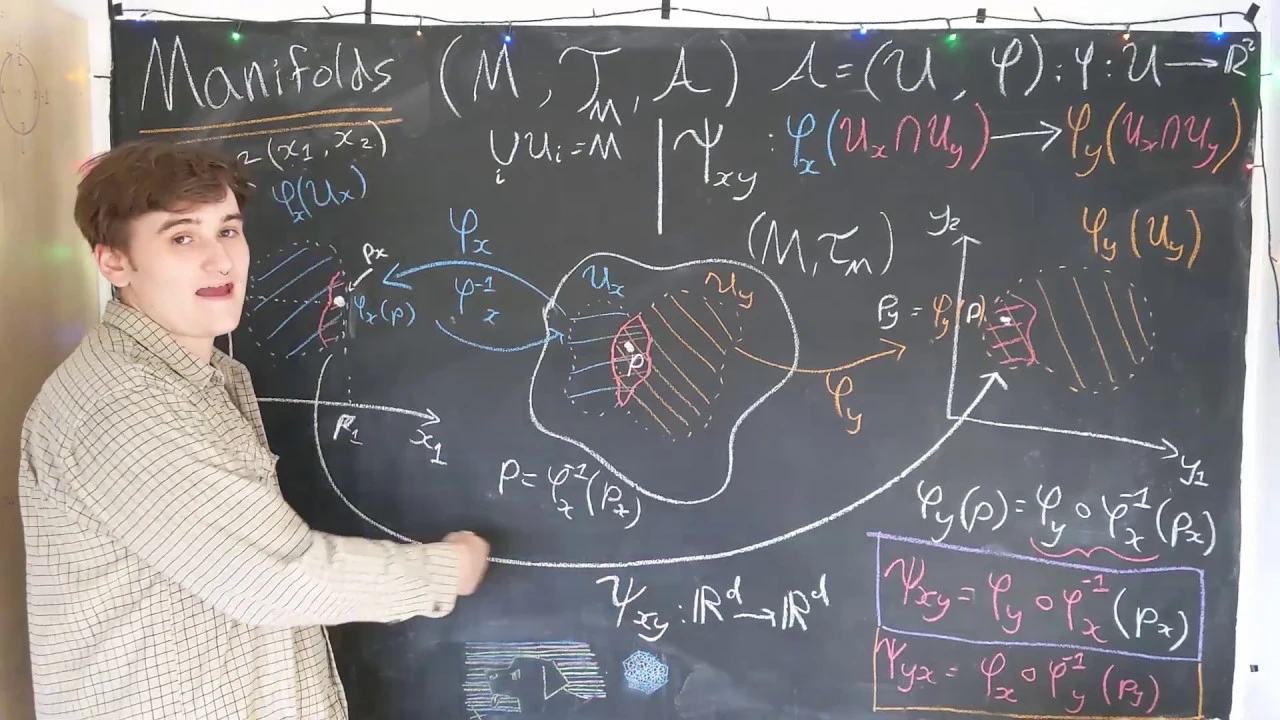
Then a pair U which must be an element of the open sets of the manifold. a pair ux where yeah u is in O and X from U to X in U which is a subset of RD is called a chart of the manifold.
What is new in this definition? Well, absolutely nothing. It's only that these maps I defined before which we know in a topological manifold which is a paracmpact housed of space that around every point of the manifold there is an open neighborhood U such that there exists such an X that this pair of the open neighborhood in the manifold together with the map that maps it into a part of RD that this pair be called a chart. Well, so it's not a definition.
It's it's almost only terminology.
Okay, but it's extremely useful terminology and we'll come to that. It's a chart of the manifold. The component functions, the component functions of X. Well, what's that? Well, X lands in RD. But what is RD? RD is a cartisian product of lots of Rs.
Now if I have such a map X I can ask what is the result of mapping a point P in U into RD what's the result in the first entry what's the result in the second entry and so on so the component functions of X these are the maps let's call them X up I of uh that go from U now only to the real numbers and is defined as taking a point P and mapping it to the i comp to the i component here. So if you want to be very formal you can say it's the projection to the i component of the result of the application of x. So you only look at the i component of this.
The component functions of xx i u2 r are then called the coordinates of the point p which must lie in with respect to and this is very important with respect to the chart.
ux.
So we cannot speak of the coordinates of a point. We can only speak of the coordinates of a point with respect to a certain chart.
Now all your life in physics so far your education in physics has taken place in charts. In classical mechanics, you said let's have a particle in R3 move like this and then you were told the coordinates of that particle at various points or even in lrangeian mechanics you wrote down the x1 to xd in a d-dimensional configuration space and so on your life took place in charts and that's fine but well the question is what happens if you look at the same point with respect to different charts.
You could certainly have that because if around every point of the manifold such a pair exists like the definition of a topological manifold uh guarantees it does then you certainly have overlapping charts.
So let's first have a a remark.
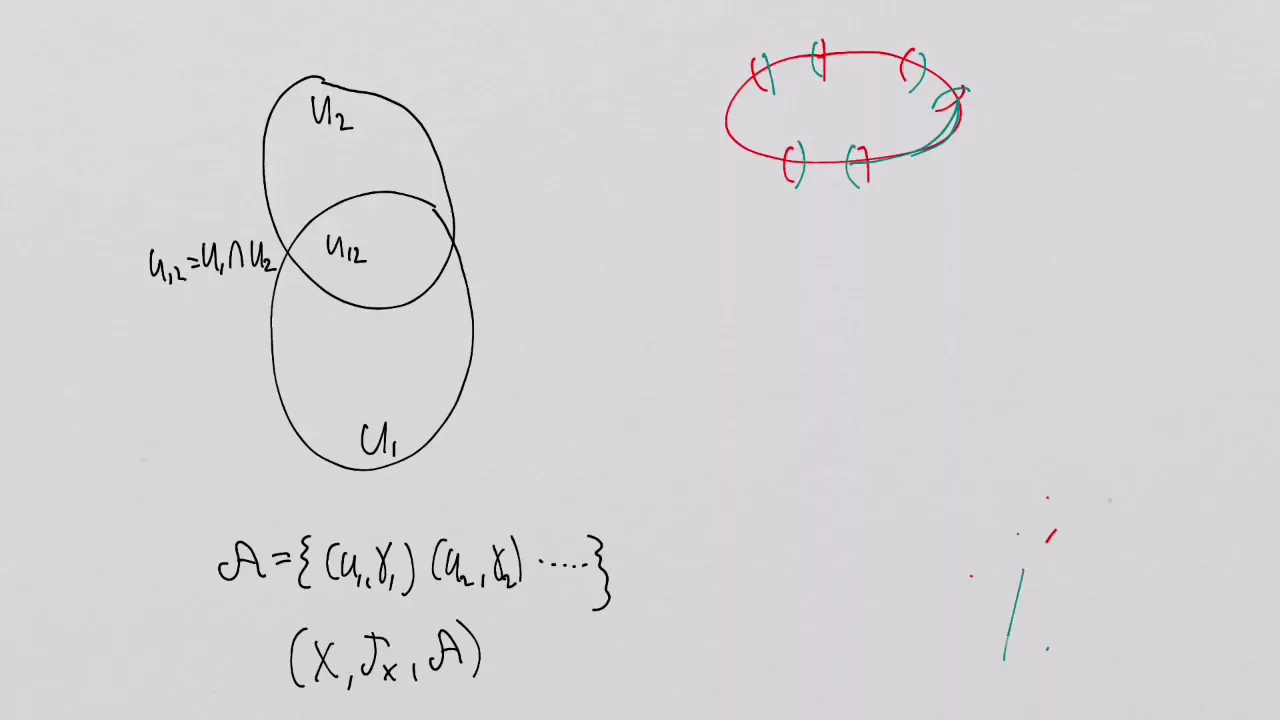
Obviously there exists a set of charts set curly A of charts such that if you take um the union of all the U's in there so the U if ux is an element of this collection then you do the union over all the u's uh and then you recover the manifold because every point is covered by some chart and there will be many charts that overlap that have non empty empty overlap.
Okay.
Then we immediately have another fully redundant definition which in later chapters will be changed slightly. Okay.
Definition two charts ah and such a collection of charts is called an atlas.
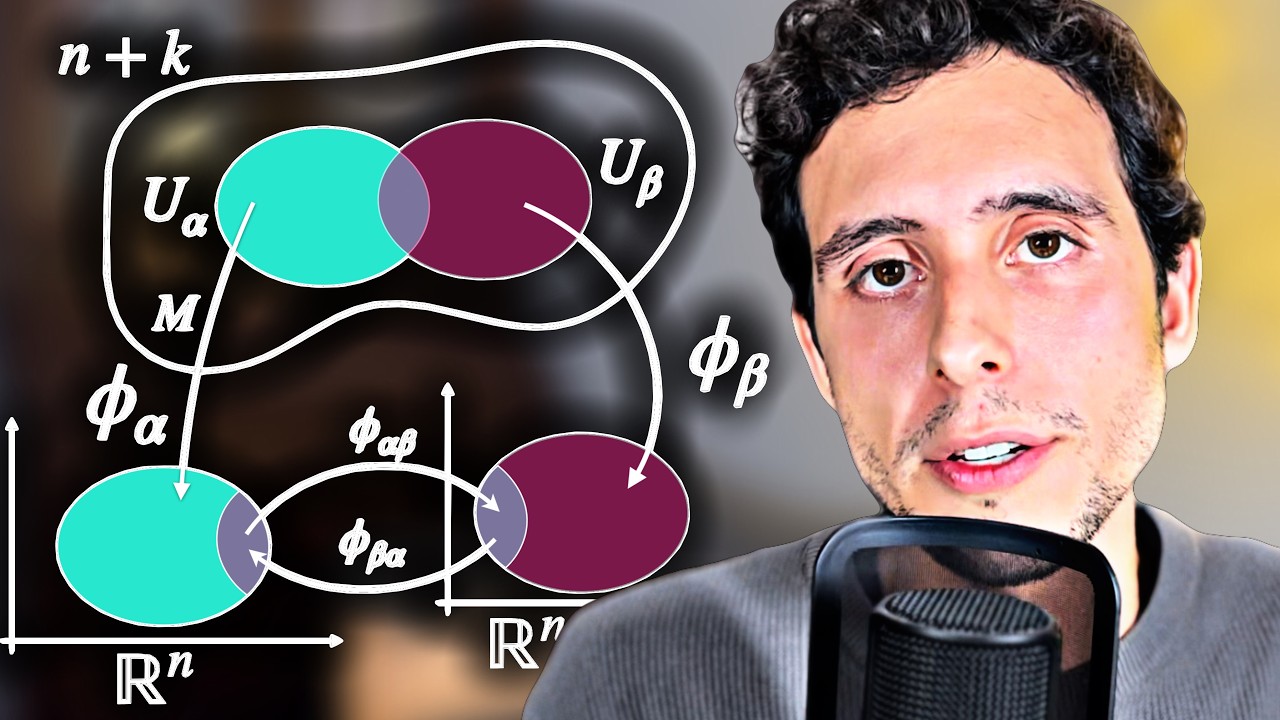
A is called an atlas and and the idea is clear. If you have the whole world and the whole world is covered with charts, you can print the charts and stack them together into an atlas. Then you can turn the pages of the atlas and you can look at on page 300 there's Paris and on that page it has the coordinates 2 cm to the right from the lower left corner of the of the chart. 2 cm up that's Paris. Now you turn the pages and you come to a later chart and again Paris appears there because now the charts are all overlapping Paris appears but now it has different coordinates. So the coordinates of Paris well with respect to a certain chart that makes sense to write down the coordinates. Um but the coordinates depend on the chart. Paris doesn't have the property to I mean Paris as such doesn't have the property to in this and that type of publishers atlas to be at these and those coordinates. Paris is Paris. It's it's the coordinates depend on the chart. Now you have two charts ux and v y let's call them like this um are are called c 0 compatible um and this C 0 later on will be changed in C1, C2, CK, C infinity, C omega all possible kinds of other C's but here it's just a name is called C0 compatible if either A well you're certainly compatible with someone if you never meet that person uh so if u intersected v is the empty set so if they the charts do not overlap or b if u intersected v is non- empty if the charts overlap Then we have the following situation. We have the chart U and we have the chart V. And if we start from U, we can actually look at the coordinate map X. So the components are the coordinates goes into RD. Well, it actually only goes in X of U that lies in RD.
and you have the chart V, you go down with Y, you go to Y of V lying in RD.
That's the situation. But now if the charts overlap then in the overlap you can apply either the coordinate uh map x and you land in x of u intersected v which is a part of rd or to every point in the intersection.
You could also apply the chart the the map y which yields y of u intersected v.
And of course you could also look at this path here which is y after x inverse.
Okay.
And so y after x inverse goes from x u intersected v to y u intersected v which is a part of rd. And that's the key observation here.
All of a sudden should put this in yellow. All of a sudden you have constructed a map from RD into RD from two chart maps.
And two charts are called compatible if this map y after x inverse which strictly speaking goes from this subset of RD to this subset of RD. If this map is continuous as a map from RD to RD. Well, it is a map from RD to RD. What I want to emphasize here is that um you can now decide on continuity without knowing anything about the topology of your original manifold in which these intersections are taken. It suffices to know the topology of the charts in order to decide whether this is continuous.
Now I think we showed that the composition. So these are homeomorphisms. So x inverse existence also continuous. The continu um the uh the I'm sorry the composition of two continuous maps is again continuous because this is continuous path back also continuous. This is always the case. This is always the case on a topological manifold. So hence any two charts in a topological manifold are C0 compatible. Okay. So it's at first sight fully redundant to have this definition because it applies to any two charts. However, later on we want to establish a notion of differentiability as well. Now this the manifold still staying a topological space. We have no way of saying that these maps into the coordinates should be differentiable because for that we need would have to have a differentiable structure on the manifold. What we will do instead we will later on require that two charts be C1 compatible C2 compatible. So once that there shall be uh continuously differentiable once or twice or K times or infinitely often as maps from RD to RD. because we understand differentiation on RD. We can do this later on. It's only for topological manifolds we introduce the notion and this idea and later on we refine it. So as I said fully redundant but it's a useful notion and again all your life in physics took place in charts and whenever you talked about changing coordinates you talked about this map because you lived in one chart you looked at the problem in one chart say cartisian coordinates and then you went to other coordinates.
So the coordinate changes in physics in the standard physics courses or introductory physics courses is between charts but you never consider the real world that lies over it. Well the real world in that sense is the manifold and what kind of chart you choose is largely arbitrary.
But whether you express some particle path, some curve in one coordinate system or the other coordinate system, that doesn't change the particle path.
All right, that's just up here. That's one curve in the manifold and this is coordinate changes. remark uh the map y after x inverse and of course you can also invert this then you get um x after y inverse. The map y after x inverse is also called the coordinate change map.
So in a sense you only perceive physics down here on the chart level so far unless you saw this in say general relativity but actually the abstract notions coordinate free notions lie above that.
So that makes this connection definition.
A C 0 atlas curly A is an atlas that is a collection of charts is an atlas um whose charts whose elements whose charts are pairwise compatible C0 compatible So again remark I said it before obviously any atlas is C a C0 atlas that will change later if we impose stronger conditions on the compatibility of chart maps of coordinate maps. Uh not every atlas will satisfy these conditions and that is one way to give extra structure to manifolds in particular differentiable structure.
And there's one more definition.
An atlas is called maximal If uh any chart ux that is C 0 compatible, so I should say a C0 atlas is called maximal. If any chart ux that is zero compatible with any vy that lies already in the atlas is already contained is also is already contained in the atlas.
So now here it is not the case that any atlas is maximal. Remark consider um the following consider the manifold M O being the real line equipped with the standard topology. It's a topological space, but it's clearly locally homeomorphic to R1. So, it's a one-dimensional manifold. And so for this one-dimensional manifold I claim that taking the entire line together with the identity on R is an atlas of this manifold M O is an atlas. Well, that's what you usually do. You say, well, if all of physical space is r, then I can obviously use 1 2 3 4 5 pi 7 half and so on as coordinates on there in this fashion. So you have an atlas.
You need only one chart to cover all of R.
But a prime that consists of well, let's be generous. Let's keep this chart. But now we publish a two-page atlas. And there is another chart. And the other chart could be um could be uh the interval from minus infinity to 0 again with the identity map uh going to the real numbers. Um yeah, that's fine. again with the identity map.
This is a different chart. This one only covers half of this. These two charts are compatible because any two charts are compatible. And this is a different atlas also atlas.
Now you say, well, hang on, but you can now of course construct an atlas a 10,000 prime where you take more and more charts into it. For instance, you could take uh another chart where you take r without the no that's not polar coordinates are not very meaningful here. Well, anyway, you you come up with with various charts and you can add more and more charts and any new chart will be compatible with the old. Well, the maximal atlas will be maximal atlas once you added all the charts that are compatible. Then it's a maximal atlas. Okay?
because then any one that's compatible with all that's in there is already in there. Again, this notion of a maximal atlas will become more interesting later on when we lift this restriction or when we intensify this restriction of the atlas being C0.
Okay, now we have all this terminology.
The big question is what is this all about?
Well, the answer is we can look at topological manifolds from two points of view um can look at topological manifolds um from two points of view.
In particular, we can look at objects on these manifolds from two points of view. In particular, with respect to objects on the topological manifold for instance or example, consider a curve. Consider a curve gamma. What's a curve? Well, let's say a curve is a map from all of R into the topological manifold. Now, you could have the question is the curve continuous uh as it should be if it is the trajectory of a classical particle.
So if we identify M with the physical space, we want to do classical mechanics, the particle trajectory shouldn't jump all of a sudden. It should be continuous.
You can ask this question on two levels.
So answer level one.
Answer level one is the following. You say it's a nobrainer.
It's a no-brainer because you have R equipped with the standard topology. You have M equipped with the topology you gave it. So it's a uh topological manifold. And it's full well clear what a continuous curve is. Then you say well the curve is continuous if for every open set in the target the pre-image of that open set under the map gamma is open in the domain.
Why? Well because that is the definition of a continuous map and the curve is just a particular instance of a map.
So you can decide this fully on the topological level. So there is nothing more that needs to be said. Well, however, that is not how so far you looked at it in your physics courses. In the physics courses, you looked at it at level two or at least at another level, you said, "Aha, I have R.
I map it into the physical space." All right, that's the curve gamma in the real world if you wish. But now you use you only look at one part of the real world namely the image of gamma only into a subset u. So that uh the domain is the pre-image of u under the map gamma. So that parameter range where the curve lies within this restricted set u. And if u together with x is a chart then you land in x of u in rd. Let's say m is a d-dimensional manifold dim m= d.
Okay. And then you actually were instructed in your physics courses to not look at the curve gamma but to look at this curve at the curve x after gamma.
And probably you were even instructed to look not at X after gamma which is a curve from some part of R into RD. You were instructed to look at the E component of this curve because these are for a given parameter the coordinates where your curve is.
Okay. And then you were instructed to check whether the definition of the curve is continuous in each slot. Right?
The curve is continuous into RD if each component function is continuous.
Well, this of course you can now check and you check it here. The question is if you check that this is continuous do you already as a map from R to RD can you already conclude that the gamma up here is continuous well in topological manifolds is very simple because you know this is the composition of two continuous maps so this is this is always this is continuous if and only if this is continuous okay so it's correct you can conclude that if the the curve is continuous in its components than the real curve in the real world not its coordinate representation not its chart representation that the curve in the real world is continuous. So if you want a picture for that you could say the gamma is so imagine a bird is flying through this room. Okay.
And then m is is this real space the physical space if you wish. our model of it. But nevertheless, the real physical space and the bird does what the bird does. Now I can decide to look at to put coordinates into this room like this. XY Z something like this. Okay? And then I can look at the path of the bird in these arbitrarily chosen coordinates.
That's what you're instructed to do in elementary physics classes. You could choose also a different coordinate system then. So that would be uh another map up here. So you choose a different coordinate system Y that goes into some part of RD and you consider the bird flight as Y after gamma. So that would be again the same bird is flying. It's the same trajectory but you choose to have different coordinate representation.
Okay. So this is more like our representation how we put numbers to the bird's paths. You need to choose coordinate frames. But the real birdly is encoded in the curve gamma. This is just how we attach numbers to it. And that's why we so often choose coordinate systems.
And now it's again a triviality. This is continuous if and only this is continuous. But now how do we have access to the real bird's curve? Well, we only have access to the descriptions in different charts. And you may wish to consider this map which is y after x inverse. Ah, it's the chart transition map. But the chart transition map ought to be continuous. If the charts are C 0 compatible that means if you know that in one chart your description is continuous you compose it with the chart change and then of course you could have equally well written looked at the bird's path in the other chart and you know that's continuous as well. So by having by looking at chart transition maps you can almost entirely well you can entirely forget about these inner workings which in some sense is the real world. You can fully forget about what is in the blue part of this and you can work in some chart. You can change coordinates to another chart and you describe the situation in full.
But it would be a shame because what you want to describe is here the real world and you you now see how why choosing different coordinate systems describe still the same world.
Okay, so that's the philosophy behind all of this. And here everything is trivial. You could go either path and you know everything about all the maps.
But as soon as we would like to speak about not the continuity of a curve but say about the differentiability, there is no way we do this via the topological manifold that would maybe present our model our real world. We then have to impose that these transition functions preserve any of the properties we want to impose on this. So if you impose here that this be differentiable, well, it better be differentiable in another coordinate frame. Okay, but then the transition function needs to be differentiable as a map from RD to RD and then we need to restrict our atlases on so and so on. So again in the topological manifold context this is all redundant but it will become important later on and equally well and that will be on the problem sheet you can ask when is a map from some topological space m to another another topological space n or from manifold to manifold when is it from manifold to manifold sorry when is it continuous you can then choose coordinates for both the domain and the target and you can extend this picture and that will be on the problem sheet sheet. So that's the contact of all we did so far to how you describe physics so far and it's very valuable to understand these relations.
See you next time.
Up Next

Differentiable Structures: Definition & Classification | Geometric Anatomy of Theoretical Physics, Lec 07
@FredericSchuller
63.2K views•2016-03-12

Elliptic Curve Cryptography Explained: ECC, ECDSA, ECDH
@PracticalNetworking
28.5K views•2024-10-21

Logic: Propositions & Predicates | Geometry of Physics 01
@FredericSchuller
455.1K views•2015-09-21
The Mathematical Impossibility of Accurate World Maps
@Vox
23.3M views•2016-12-02
Related Study Plans & Knowledge Roadmaps
Structured learning paths in Mathematics