















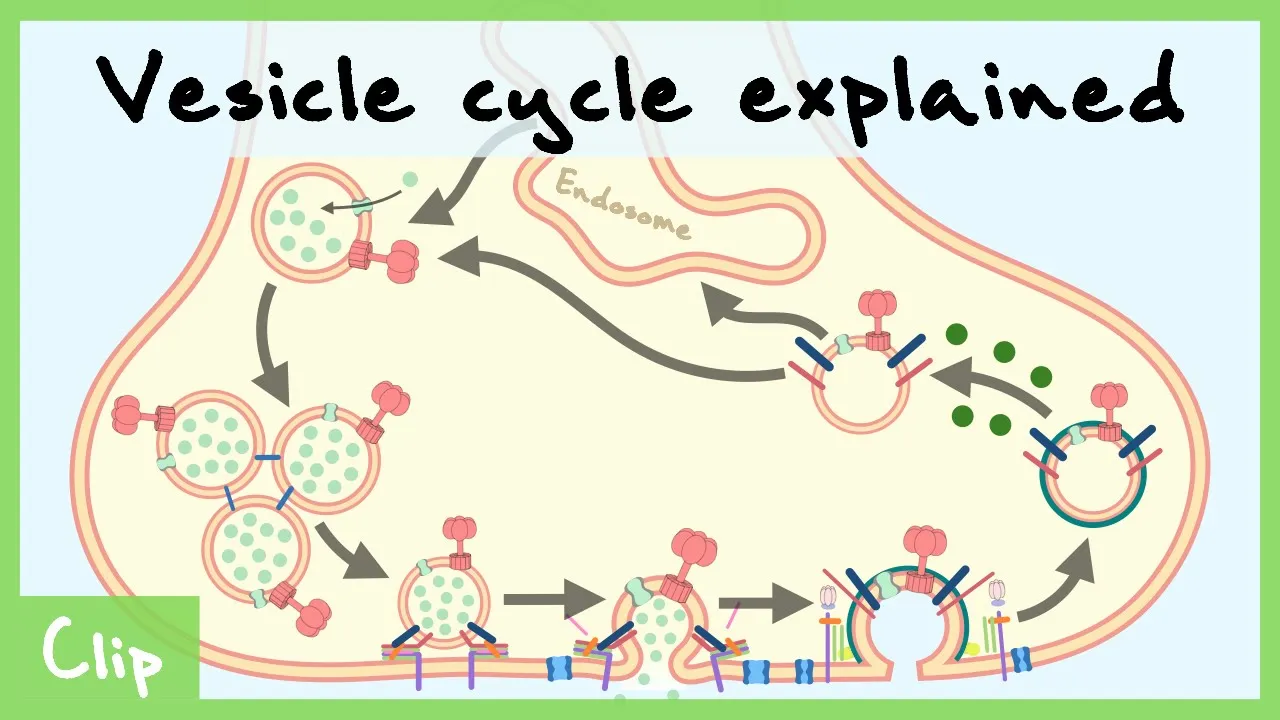





Neurotransmitter release occurs when an action potential triggers voltage-gated calcium channels to open, allowing calcium influx that binds to synaptotagmin; this binding induces a conformational change enabling synaptotagmin to interact with SNARE proteins (vesicular SNAREs on vesicles and target membrane SNAREs on plasma membrane), facilitating vesicle fusion with the plasma membrane and exocytosis of neurotransmitters; the presynaptic cell then recycles the vesicle machinery through endocytosis to prepare for subsequent releases.
Synaptic Vesicle Release: Mechanism of Neurotransmitter Exocytosis
Added:Basic anatomy of a neuron and a chemical synapse, including the presynaptic terminal, synaptic cleft, and postsynaptic membrane.
The generation and propagation of an action potential, specifically the role of voltage-gated sodium and potassium channels.
The concept of electrochemical gradients and how calcium ions act as intracellular signaling molecules.
Fundamentals of cell membrane structure and the general process of active transport and exocytosis.
Postsynaptic events, including neurotransmitter binding to ionotropic and metabotropic receptors to generate EPSPs or IPSPs.
Mechanisms of neurotransmitter clearance and vesicle recycling, such as reuptake transporters, enzymatic degradation, and clathrin-mediated endocytosis.
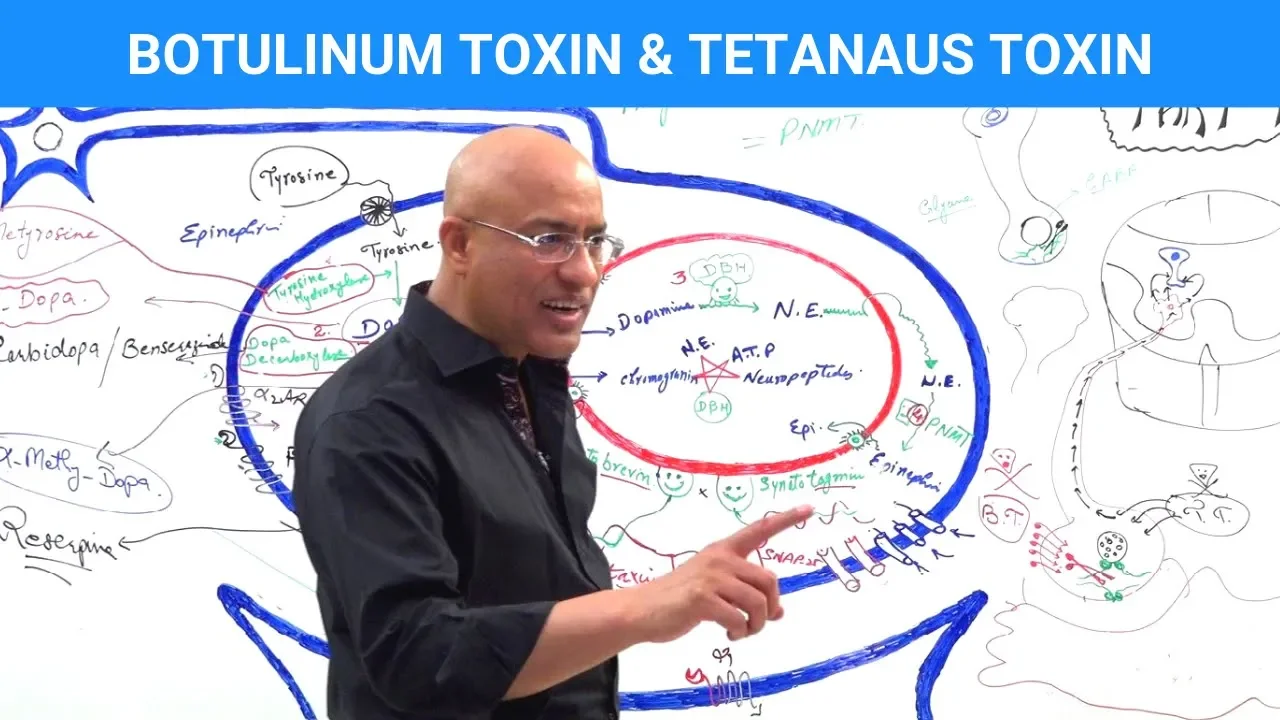
Clinical pharmacology and toxicology, particularly how Botulinum and Tetanus toxins target and cleave SNARE proteins to inhibit neurotransmission.
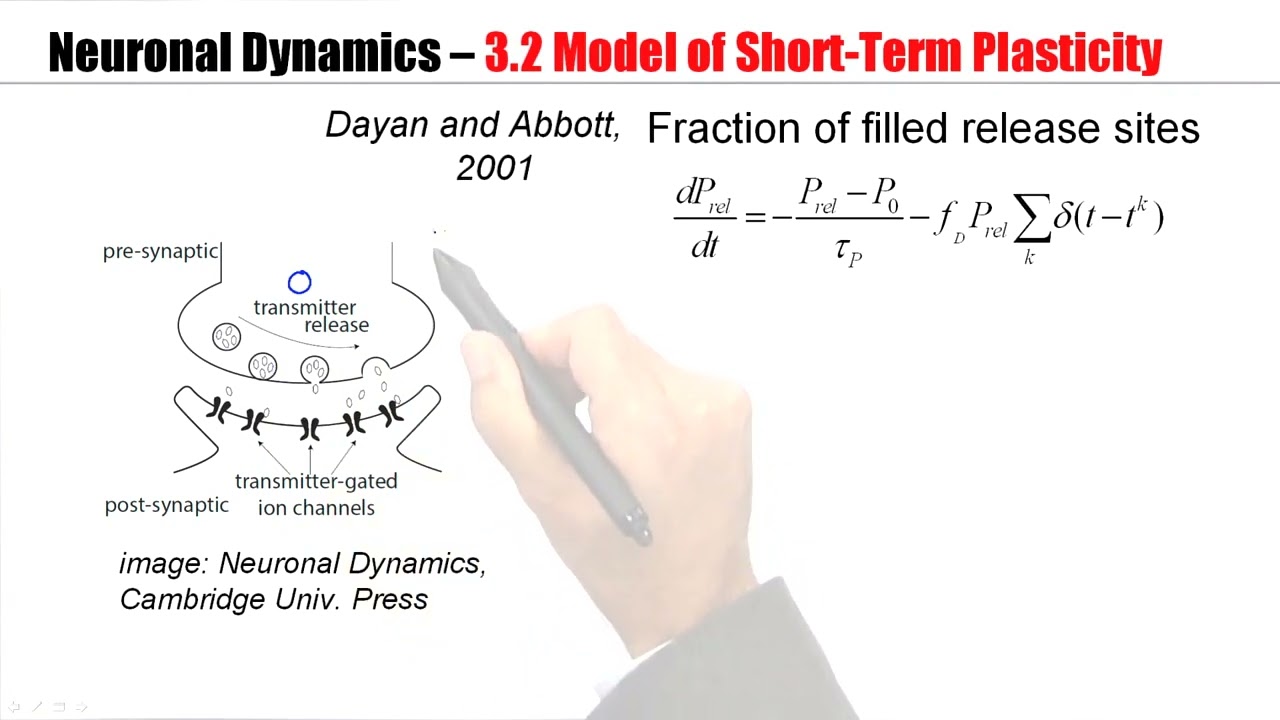
Synaptic plasticity mechanisms, such as how changes in vesicle release probability and pool sizes contribute to Long-Term Potentiation (LTP) and depression (LTD).
30.5K views682likes4:17Original Release: 2022-03-15
in this video I'm going to provide a mini tutorial on how neurotransmitter is released from vesicles at chemical synapses well let's begin by looking at a cartoon here's my cartoon of a chemical synapse we have the pr synaptic cell shown on the Left Post synaptic cell on the right and if an action potential arrives at the nerve terminal then we'll get those vesicles to fuse and transmitter will be released this process is going to be initiated when the action potential arrives at the nerve terminal their voltage gated channels in the axon those will be opening up sodium will come in and then a wave of positivity can spread into the axon terminal itself where there are voltage gated calcium channels these will open up in response to the increased voltage calcium will enter the cell and then calcium leads to a fusion of the vesicles so that we get release of the neurotransmitter those can then go bind to The receptors on the postoptic cell and we'll get signaling now this process sounds simple but it actually requires a fair amount of specialized Machinery so let's look at a blow up of the terminal so I can show you that well here's my cartoon showing a single synaptic vesicle at the terminal and I'll just Orient You by showing this is a cytoplasm that's the synaptic bhuton out here's the synaptic CL here would be the plasma membrane and then we've got our vesicle that's full of neurotransmitter for these two membranes to fuse the vesicular membrane and the plasma membrane to fuse we need to have a whole bunch of specialized machinery and collectively these are called snares there are vesicular snares those will be found in the vesical membrane and Target membrane snares or te snares which in this case will be found in the plasma membrane and I'll just draw some of them so here are some of the vesicular snares there's one called snapto brevan here are examples of some Target membrane snares this is syntaxin and snap 25 and then we're going to need another player here snapto tagman that's going to be important for binding the calcium all right well how are these going to act well even before the action potential arrives at the terminal there's a possibility to have these vesicles basically held ready to be released in What's called the docked and primed condition for example there's a protein called monk which can come and associate with one of the te- snares leading to a confirmational change and that then allows the te- snares to associate forming what's called a complex here the vesicle is docked at the membrane because of the association between the V snares and the t- snares but you can see that the two membranes haven't fused yet this protein is docked but it's not ready to be released that process will require an influx of calcium to do that we need to have voltage gated calcium channels now when an action potential arrives what's going to happen is calcium will enter through the voltage gate of calcium channel calcium can associate with number of different proteins including these calcium binding domains on the synaptotagmin and when the synaptotagmin binds the calcium it undergos a confirmational change and that allows that protein then to become associated with the other v& snares and this allows Fusion of the vesical membrane with the plasma membrane and release of the contents get exocytosis now the transmitter will diffuse across and it can interact with the post synaptic cell but in the meantime the presynaptic cell has to recycle this Machinery so that it will be able to reload it it does this with the help of even more proteins so the proteins will come in they'll associate with the bit of the membrane that was a vesicle and then take that membrane and endocytosis to bring it back into the cell and as this bit of membrane is taken away to be recycled and refilled with neurotransmitter another synaptic vesicle can come to the active Zone where it will be able to then fuse and release its contents what happens next will depend on the particular receptors that are present in the postoptic cell we'll leave that for a different video
Up Next
79:39
Neural Computation: RC Circuit Models & The Nernst Potential
@mitocw
28.8K views•2020-06-29
21:55
Deciphering Neural Circuits Controlling Anorexia in Mice | Richard Palmiter
@AllenInstitute
2.3K views•2011-10-10

4:10
Vagus Nerve (CN X): Anatomy, Nuclei & Functions Explained
@Alilamedicalmedia
305.2K views•2022-10-31
13:03
How Exercise Benefits Your Brain: Science Explained
@TED
11.4M views•2018-03-21
Related Study Plans & Knowledge Roadmaps
Structured learning paths in Neuroscience
neuroscience
Appetite Regulation: Brain Circuits & Hormones
01Foundations of Endocrinology and Brain Anatomy
02Introduction to Energy Homeostasis
03Peripheral Signals: Leptin, Ghrelin, and Insulin
+ 2 more learning modules
14h5 modules
Explore Roadmap
neuroscience
Neuroeconomics: Value, Risk & Brain Mechanisms
01Foundations of Neuroscience and Brain Anatomy
02Introduction to Neuroeconomics and Subjective Value
03Dopaminergic Prediction Errors & Reinforcement Learning
+ 3 more learning modules
18h6 modules
Explore Roadmap
neuroscience
Spatial Navigation: Cells, Grids & Brain Maps
01Foundations of Brain Anatomy and Memory
02Place Cells and Head-Direction Cells
03Grid Cells: The Brain's Coordinate System
+ 2 more learning modules
12h5 modules
Explore Roadmap
neuroscience
BCIs: Neural Decoding & Prosthetic Control
01Neuroscience Foundations: How the Brain Signals Intent
02Signal Acquisition: Recording the Brain's Activity
03Neural Decoding: Translating Brain Waves into Data
+ 2 more learning modules
25h5 modules
Explore Roadmap