














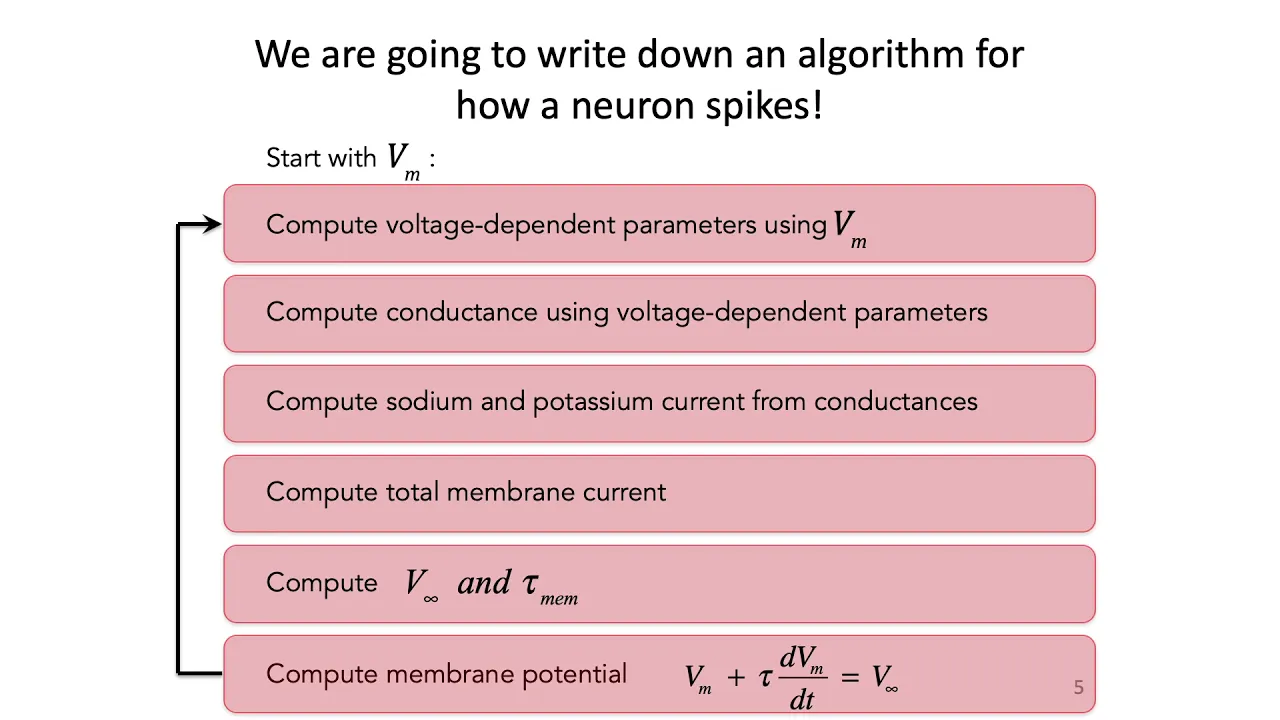







Neurons can be modeled as RC circuits where membrane capacitance integrates injected current over time (voltage = integral of current/C), while membrane resistance causes exponential relaxation toward steady-state voltage; the Nernst potential arises from concentration gradients across selectively permeable membranes, calculated as ΔV = (kT/q) × ln([outside]/[inside]), enabling neurons to generate their own voltage batteries through ion concentration differences.
Neural Computation: RC Circuit Models & The Nernst Potential
Added:Basic electrical circuit theory, including Ohm's law, the definition of capacitance, and how resistors and capacitors function in series and parallel.
Fundamental cell biology, specifically the structure of the lipid bilayer and the existence of selective ion channels.
Physical chemistry concepts of diffusion, concentration gradients, and electrochemical equilibrium across semi-permeable membranes.
Introductory calculus, specifically first-order ordinary differential equations used to describe rate of change over time.
The Goldman-Hodgkin-Katz (GHK) equation, which calculates membrane potential when multiple different ions are permeable simultaneously.
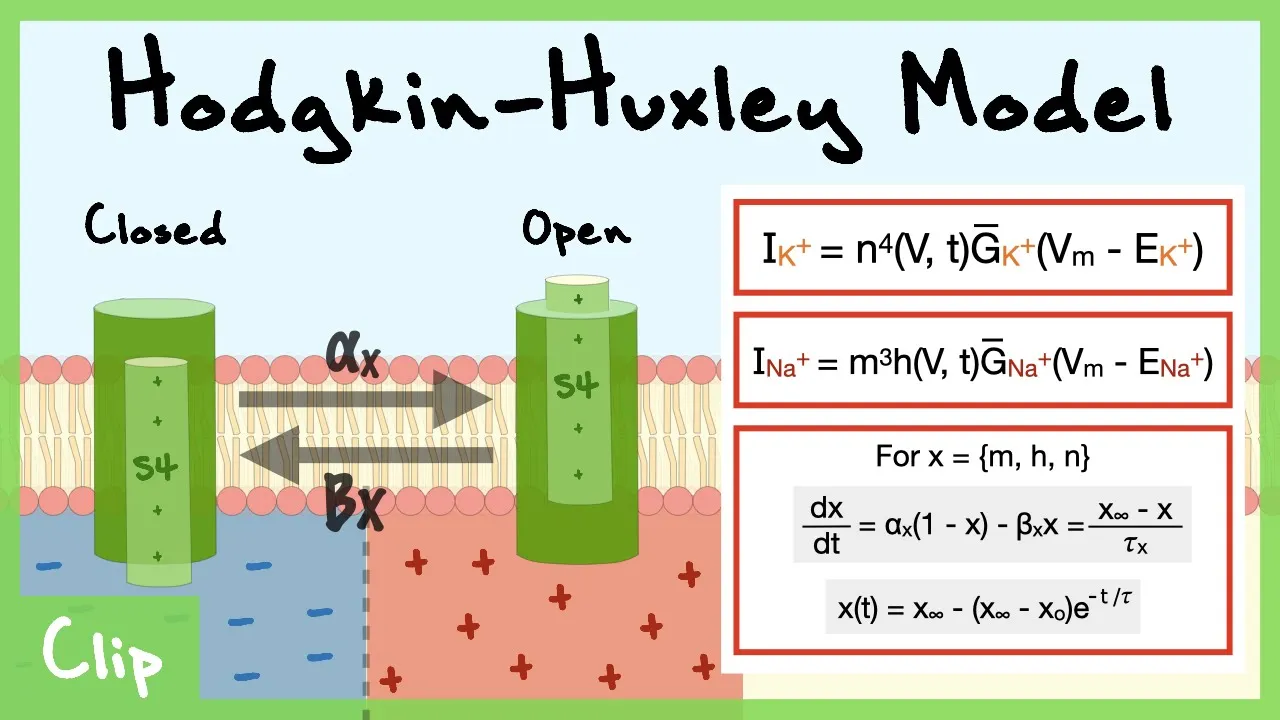
The Hodgkin-Huxley model, which introduces voltage-gated ion channels to explain how action potentials are dynamically generated.
Cable Theory, to understand how electrical signals decay and propagate over spatial distances along dendrites and axons.
Simplified computational neuron models, such as the Leaky Integrate-and-Fire (LIF) model, used in large-scale neural network simulations.
28.8K views419likes1:19:39Original Release: 2020-06-29
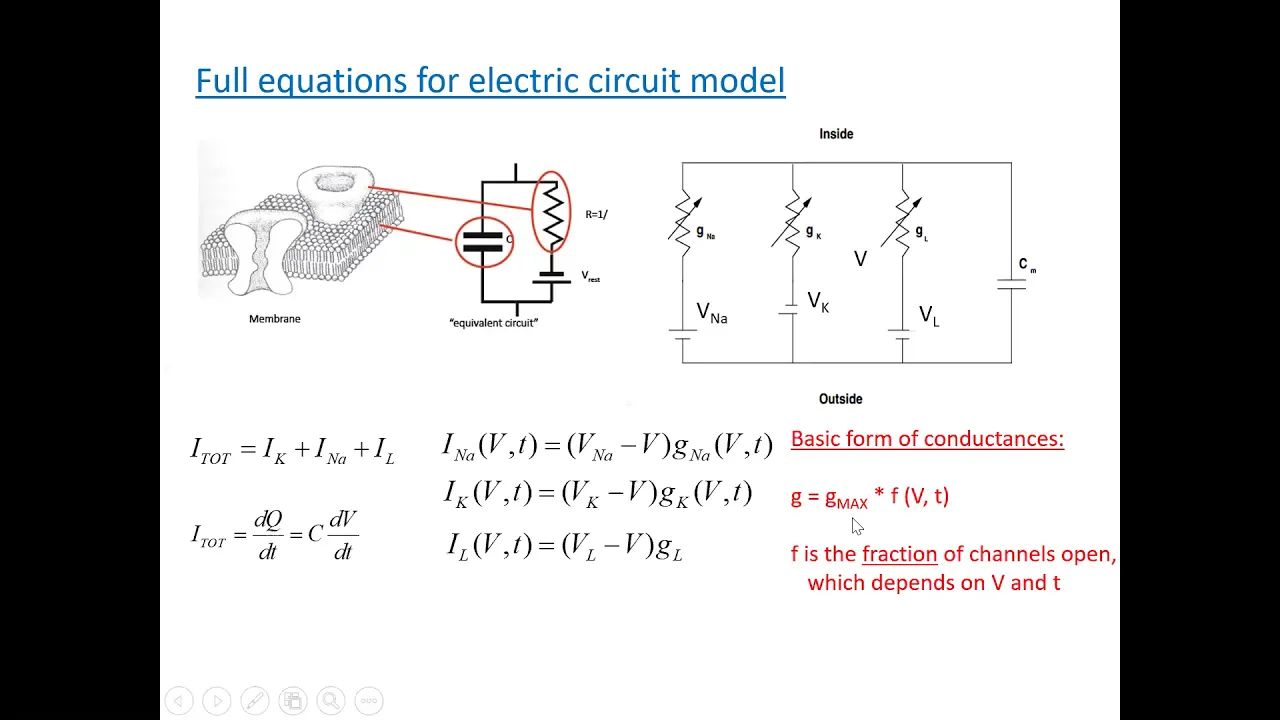
okay good morning okay so today we are going to continue the process of building our equivalent circuit model of a neuron this this model was was actually developed in the late 40s and early 50s by Alan Hodgkin and Andrew Huxley who who started working on the problem of understanding how neurons make action potentials and so they studied the squid giant axon which is actually a very cool preparation because the axon is actually about a millimeter across and so you can stick wires inside of it and they did a bunch of very cool experiments to figure out how these different ionic conductances and how these different components of the circuit work together to to make to make an action potential so that's that's what we're going to continue doing we're going to essentially continue describing and and motivating the different components of this circuit so today we are going to get through the process of introducing a voltage measuring device a current source a capacitor conductance and we're gonna start introducing a battery okay okay so here's what we what we want to accomplish today so we want to understand how kind of at the simplest level how neurons respond to injected currents we want to understand how membrane capacitance and membrane resistance allows neurons to integrate their inputs over time and to filter their inputs or smooth their inputs over time and that particular model is called a resistor capacitor model or an RC model of a neuron we're gonna go through how to derive the differential equations that describe that model it's actually quite simple but some of you may not have been through that before so I want to go through it step by step so we can really understand where that comes from and we're going to learn to basically look at a current a pattern of current injection and we should be able to intuitively see how how the voltage of that neuron responds and we're going to start working on where the batteries of a neuron actually come from okay okay so all right so all right so we're going to basically talk about the following sort of thought experiment okay the following conceptual idea we're gonna take a neuron and we're gonna put it in a in a bath of saline okay a salt water solution that represents the extracellular solution that neurons you know extracellular solution in the brain and we're going to put an electrode into that neuron so that we can inject current and we're going to put another electrode into the neuron so that we can measure the voltage and we're going to study how this neuron responds how the voltage of the neuron responds to current injections okay now why is it that we want to actually do that why is that an interesting or important experiment to do anybody have any idea why we would want to actually measure voltage and current for a neuron in the brain yes okay but it's it's it's more than just so that we can describe it mathematically right it's because these things something about voltage and current are actually relevant to how a neuron functions yes yeah so that's an important quantity but we're looking for something more fundamental like why is it actually important that we understand how voltage changes when a neuron has current injected into it habiba exactly so ion channels are sensitive to voltage and the way they function depends very critically on voltage so many if not most ion channels are voltage sensitive and are controlled by voltage okay and that's exactly why so nearly every aspect of what neurons do in the brain as you're walking around looking at things in doing things is controlled by voltage and that goes through the voltage sensitivity of ion channels okay but what is it that changes the voltage in a neuron yes that's on the output side yes good that's that's correct I'm looking for something a little bit different yeah those are all good answers not quite what I'm looking for yes so the answer is that the voltage of a neuron changes because the the reason current is important is because the reason voltage changes in a neuron is because other cells are injecting current into our neuron sensory inputs are injecting current into our neuron okay everything that a neuron receives all the information that a neuron receives from other neurons in the network and from the outside world comes from currents being injected into that neuron okay and so it's really important that we understand how the neuron transforms that current input from other cells and from the sensory periphery into voltage changes that then change the behavior of ion channels is that clear that link of current inputs to voltage output is really crucial and that's why we're doing this okay okay and that's this point right here okay so one of the first things we're gonna see when we go through this analysis is that neurons can perform analog integration they can perform numerical integration over time okay that's pretty cool voltage is integral over time of the injected current to first order the simplest behavior of a nerve so if you measure the voltage of a neuron and you turn on current and you turn the current on the voltage of a neuron will ramp up integrating that input over time okay pretty cool so we're gonna see how that happens why that happens biophysically okay so let's come back to our neuron in the dish let me just explain a little bit how you would actually do this experiment so these electrodes are little pieces of glass tubing so you take a fine glass tube about a millimeter across you heat it up in the middle over a flame and you pull it apart when it melts in the middle that makes a very sharp point you break off the fine little thread of glass that's left and you have a tube that narrows down to a very sharp point but it's still a tube and you can literally just there are some cells like in the old days people studied large neurons in in snails where the cells are a millimeter across you can take an electrode and literally just by hand poke it into the cell and then you fill that you fill that electrode with a salt solution and then you put a wire in the back of that electrode and you hook it up to an amplifier now we want to measure the voltage in the cell remember voltage is always voltage difference we're always measuring the difference between the voltage in one place and the voltage somewhere else so this amplifier has two inputs it's called a differential amplifier and we're going to hook the electrode that's in the cell to the plus terminal we're going to put a wire in the bath hook it to the minus terminal and this amplifier is measuring the difference between the voltage inside the cell and the voltage outside the cell okay any questions about that so we're gonna take the other other half of that piece of glass that we pulled fill it with salt solution stick it in the cell and we're going to hook it up to a current source now a current source is basically just a battery okay but it's got some fancy electronics such that the current that flows is equal to whatever value you set okay and of course remember that voltage is in units of volts and current is charged per second charge is coulombs so coulombs per second and that's equal to the unit of current which is amperes all right now let's take a closer look at our little spherical neuron our little neuron we've chopped all the dendrites and axons off so it's just a little sphere and you can basically model a neuron just like any other cell as a spherical shell of insulating material okay in this case a lipid bilayer this is a phospholipid bilayer phospholipids are just little fat molecules that have a polar head on one side that means they're soluble and water on this side and they have a non-polar tail so they don't like to be in contact with water and the two polar tails go end-to-end sorry the nonpolar tails go end-to-end the polar heads face out into the water that makes sense and they are very closely packed together so that ions can't pass through that membrane so it's insulating it's very thin it's only about 23 angstroms across okay an angstrom is about the size of a hydrogen atom they're very thin okay okay we have saline inside what is saline what is what is it in our model remember on Tuesday what good it's a wire and we have saline outside which is also a wire so we have two wires separated by an insulator what is that good that's a capacitor because it's two conductors separated by an insulator okay so in an electrical component that behaves like a capacitor like if you were to build one of those you would take like a piece of aluminum foil put a piece of paper on it put another piece of aluminum foil next to it and attach wires to that and you would kind of squeeze the stack of aluminum foil paper and aluminum foil together and that becomes a capacitor okay and it has a symbol that looks like this electrically so this is now our equivalent circuit of this model neuron okay it's very simple it's a capacitor with one wire here that represents the inside of the cell another wire that represents the outside of the cell we have a current source that connects the outside of the cell to the inside of the cell when we turn on the current source it takes charges from inside of here and sticks them through the electrode and pumps them into the cell does that make sense this is our this is sort of a simplified symbol for a voltage measuring device the voltage difference between the inside of the cell and the outside of the cell is what we're measuring here and that difference is called the membrane potential it's the voltage difference between the inside and the outside of the membrane all right any questions about that yes what's that yes but we're gonna do it one piece at a time so we're going to start with a capacitor the resistor will come in a few slides yes exactly so we've simplified our neurons so that it's just an insulating shell okay no ion channels no currents anywhere else if we want to inject current into this simple model neuron we have to inject it through this electrode here okay so we're we're just going down to the very simplest case because this is already kind of interesting enough to understand just by itself yes the energy is stored in the electric field that crosses the bilayer and I'll get to that in a second any other questions okay great questions all right so what happens when we inject current into our neuron as I said that current source is pulling charges as charges from the outside and pumping them into the inside all right so what what happens when when what happens when that goes on so what we're doing is we are injecting current let's say this is our capacitor there are charges there are ions on the inside that are just up against the inside of the cell membrane there are charges on the outside okay and when we inject a charge from the outside to the inside let's put one of those charges right here and we're going to push it into the cell when you inject a charge you get an excess of charge on the inside of the cell membrane okay and what does that do you now have more positive charges inside than outside like charges repel so it pushes one of those charges away from the outside of the membrane does that make sense okay that's kind of interesting we took a charge we pushed it in and a charge comes out right we have a current flowing we have charges coming in and charges leaving we have a current flowing through an insulator how is that possible it's a capacitive current okay no charges are actually passing through the insulator but it looks like you have a current flowing that's called a capacitive current and we represent that in our diagram by a current I sub C capacitive current that flows through the capacitor pretty cool right you have a current flowing through an insulator that's what a capacitor is okay now notice that you have a charge imbalance you have three positive charges here and only one positive charge here so there's an excess of two positive charges on the inside that's because we added a positive charge to the inside and took away a positive charge from the outside so that leaves a charge imbalance of two okay what what do you get between positive charge and a negative charge if you hold them next to each other what what is there in between good its attraction but what is it that causes that attraction remember yesterday we talked about something on a charge produces a force what is it good so there's an electric field between the positive the excess positive charges here and the excess negative charges here okay that's an electric field alright and that electric field stores energy how do you know there's energy in this system now what could you do to demonstrate that there's energy stored in that system the idea is you have two plates two metal plates let's say in the metal version of this separated by an insulator what would happen if you pulled away the insulator those two things would do that again by ladder boom what does that take to make that sound energy okay so there's energy stored in that electric field so there's a charge imbalance there's an electric field what does an electric field over some distance correspond to a voltage difference okay now there's a charge imbalance and a voltage difference and they're proportional to each other so there's a proportionality constant that's called the capacitance all right if you can put a lot of charge and have a small voltage difference that's a big capacitor you can get a big capacitor just by having a big area you can see you can have a lot of charges with a small voltage difference if you have big plates on your capacitor okay so that capacitance is actually proportional to the area of the plates and it's inversely proportional to the distance between them it's a very thin membrane which means you can get a lot of capacitance in a tiny area okay that's pretty cool all right any questions so charge is coulombs and there are six times 10 to the 18 charges in a Coulomb the elemental charges electron or mono valent ion charges voltages in units of volts and the capacitance is in units of farad's any questions all right so we have our relation between voltage difference and charge difference and what we're going to do is we're going to calculate this capacitive current how do you think we would calculate the capacitive current well the capacitive current is just the rate at which the charge imbalance is changing right current is just charge per unit time okay so we're gonna calculate the capacitive current as the time rate of change of the charge and I've dropped the deltas here so capacity current is dq/dt and remember that Q is just C V so the capacitive current is just C DV DT and the VM here represents the membrane potential okay so the capacitive current through a membrane is just the capacitance times the time rate of change of the membrane potential any questions okay pretty straightforward now what we're going to do now is we're going to relate the injected charge to the sorry the injected current to the capacitor and what does Kirchhoff's current law tell us it tells us that the amount of current going into this wire has to be equal to the amount of current leaving that wire okay so we can write that down as follows the difference in sign here is because the electrode current is defined as positive in word the capacitive current is defined as positive outward okay so you can see that we just calculated the capacitive current it's c dv/dt so we can just plug that in here and now we see this very simple relation between the injected current and the voltage and again the current has unit of amperes which is coulombs per second okay so have that now we have a differential equation that describes the relation between current and voltage we can just integrate it to get the solution so that membrane potential will just be some initial membrane potential at time 0 plus 1 over C integral over time of the injected current just integrate both sides you get B here you get integral of I there and divide both sides by C any questions it's either really confusing or really obvious yeah everybody okay all right good now what is this what is the integral of current over time good it's the amount of charge you injected between time 0 and time T right and what is the what is the amount of charge you inject if I tell you that I injected an amount of charge Delta Q how much did I change the voltage Delta V is Delta Q over C and that's exactly so so the voltage is just the starting voltage plus Delta voltage that makes sense this integral here is just that part is just the amount of charge you injected divided by C gives you the change in the voltage so the voltage is just the starting voltage plus Delta V okay yes what's that oh because this equation here just came from here that was our charge are related between charge and balance and voltage difference yeah if it's not cleared just please ask thank you okay there we go so what is the inter constant it's just some constant times time right so our voltage is just some initial voltage plus the injected current over C times time and so you can see where this comes from right when you turn the card on the voltage just increases linearly over time with a slope that's given by the current divided by the capacitance okay all right any questions you guys are being very quiet this is the point where I start feeling nervous I went too fast yes yes it does and it breaks at about a volt or so because the electric field gets so strong it literally just rips the atoms apart in the molecules of the lipid bilayer yes sorry I shouldn't say it doesn't rip the atoms apart at rips the molecules apart you need much higher electric fields to do that yes oh because we're integrating from time 0 to time T we're measuring we want to know the voltage at time T okay we're starting at zero we're integrating the current from time 0 to time T which is where we're wanting to know the voltage right so you have to integrate the current from zero to T so you can't use T in here T is T is the end point yeah that makes sense good question thank you okay everybody all right I'm gonna stand here until I hear one more question yes oh here because its current of value I not great question yes yes that's right this okay I should have maybe been more clear this current source has a knob on it but I get to set I get to I get to like that you guys see there would be an app now and I pull out my my current source app and I type in ten milliamps boom and this thing's there's a Bluetooth connection to this thing and it like sets this thing to ten milliamps and it just keeps pumping ten milliamps until you tell it to do something else okay yes okay sure yeah what would that be actually if you put in a linear ramp and current would be a parabolic voltage profile very good it's exactly it this current profile that you this voltage profile is literally just the numerical integral of this function so all you have to do is look at this and integrate it in your head and you can see what the voltage does okay great that's exactly right so let's do another example let's put it in a vault current pulse so we start at zero current we step it up to I naught we hold it there for tau and then we turn the current off so let's start our neuron right here what's gonna happen what's what's your name I'm gonna ask you to do this problem but yeah Sammy what's this voltage going to do good cuz it's zero current then what's going to happen good good awesome that's it it's that simple okay good all right now somebody brought up resistors who brought up ion conductances somebody somebody mentioned that so that's the next thing we're going to add this is sort of the zero order model of a neuron okay that's the simplest view and it's often not so bad okay for short periods of time but Norlin to actually have ion channels all right that allow current to flow through the membrane so we're gonna start today by analyzing the case of the simplest kind of ion channel which is the kind of ion channel when you take a needle and you poke a hole in the membrane okay it's called the leak or a hole alright and and we're gonna analyze what our neuron does when you do that so what we're gonna find is that the ion channel the leak conductance it can be represented in our model simply by a resistor okay and we're going to have our capacitive current membrane capacitive current and a membrane ionic current that's due to ions flowing through ion channels in the membrane okay and that current will be we're going to call that our leak resistance and that current will be our leak current okay so now kirchoff's current law tells us what that the leak current plus the capacitive current has to call the injected current right we know the capacitive current is just c dv/dt so we just plug that in now we have I leek plus C DV DT equals the injected electrode current that is called membrane ionic current that is called membrane capacitive current and that is our electric current there's a sign convention in neuroscience which is that membrane ionic currents that are outward from the inside of the cell to the outside of the cell membrane are positive inside positive charges leaving the cell have a positive sign it's just convention could have been the other way but you have to choose something so that's what I think it was hodgkin and huxley actually who determined decided that inward currents positive charges entering the cell through the membrane going this way from extracellular to intracellular are defined as negative electrode currents the other way electric current inward current is pop into the cell is positive okay so we're gonna poke off our membrane and we're going to model that ion channel using Ohm's law so the leak current is just membrane potential divided by resistance leak resistance so what do we get if we plug this into our I leak plus I capacitance capacitive equals injected current we get the membrane potential VM over RL plus C DV DT equals injected current okay we've multiplied both sides by resistance we get V plus RC that's why it's called an RC model DV DT equals leak resistance times the injected current all right now that's looking a little complicated but we're gonna simplify things now Tao I'm sorry RC is resistance times capacitance and it turns out that has units of time and so we're going to call that towel got a little ahead of myself that's called tau we're gonna make that substitution in a minute but first we're gonna calculate the steady-state solution to that equation okay so bear with me hang on it's all gonna make sense in a minute does anyone know how to calculate the steady-state solution of a differential equation yes good what's your name Rebecca so you set the derivative well so let's do that set dv/dt equal to zero and what do you find sorry we flash the answer up there what do you get if you said DV DT equals zero good so you inject some current we're gonna hold the current constant let's say hey we've put some current in and we hold it constant the voltage will change and eventually things will settle down and the DV DT will go to zero at that point we know the voltage it's just our L times ie what is the voltage equals resistance times current what is that Ohm's law it's just when we inject current bunch of stuff happens and when the dust settles the voltage difference is just the injected current divided resistance that makes sense yes well right now we just took a needle and poked a hole in our cell so yeah exactly it's how big the hole is now cells real cells do have leak channels they're actually ion channels that leak kind of any ion that's in there it's it's not very common and you'll see why in a minute actually it's not quite true there are ion channels that that look essentially like leaks and it turns out that the ion channels that many neurotransmitter receptors like glutamate and acetylcholine the ion channels actually look like little leaks they pass multiple ions that makes them look like leaks okay so in steady state the membrane potential goes to RL times ie and we call that voltage something special V infinity because it's the voltage that the system reaches at time equals infinity okay any questions about that okay so we're gonna just rewrite this equation as VM plus tau DV DT equals V infinity and that equation we are gonna see over and over and over again in this class in many different contexts all right it's a first-order linear differential equation and it's very powerful okay so I want you to get used to it so what what does this mean so let's rewrite this equation a little bit let's move this term to the other side and divide both sides by tau and here's what you get DV DT equals minus 1 over tau V minus V in times V minus V infinity okay now let's take a look at what the derivative DV DT looks like as a function of voltage yes V infinity is defined RL times ie it's a definition sorry I should have put like three three lines there to indicate that it's the definition yeah sorry that that's a very important question what's your name Rishi okay I'm going to make an attempt to remember names so is everyone clear about that the Infinity is defined as the resistance times this injected current so the injected current when we inject current into our neuron you're changing the Infinity okay you're controlling it that makes sense okay so let's look at how the derivative changes as a function of voltage it's very sympathy all of this is going to crystallize in your mind in one beautiful construct very shortly yes yep resistance times capacitance has units time okay and so we call it tau tau is just a constant okay so hang on bear with me the derivative is a function of ol tidge and at V equals V infinity the derivative is zero right that's the definition of the Infinity it's the voltage at which the derivative is zero the voltage is less than V infinity the derivative is is positive right when the voltage is below V infinity the derivative of voltage is positive so what is what what is the voltage doing it's approaching V infinity if the voltage is above the Infinity voltage greater than V infinity the derivative is negative so voltage does what yes but it's it approaches the Infinity so no matter where voltage is it's always approaching V infinity if it's below V and the slope is positive and it approaches the Infinity if it's above the Infinity the slope is negative and it approaches the Infinity from above pretty cool right so V is always just relaxing toward V infinity and how does it get there does it go linearly well you can see that the slope the rate at which it approaches V infinity is proportional to how far away it is from the Infinity and so it doesn't just go boom boom crash into the Infinity it kind of slowly approaches the Infinity okay and they know what that function is called it's an exponential good and it has a it it approaches with a time scale of tau so if tau is small it approaches quickly if tau is long it approaches slow and see that if tau is big the derivatives are small if tau is small the derivatives are bigger right any questions about that yes sorry say it again yes at time tau that at time tau at time zero the difference between the Infinity SR V and V infinity is V naught minus V infinity at time tau that initial difference drops by about a third about 1 over e which i think is 2.7 something okay so in 1 tau this voltage difference Falls by about it drops by about a third and in another towel it drops by another keeps going okay all right so let's let's just write down the general solution the general solution for the case where you have constant current that voltage difference from the voltage at time T to be infinity is just equal to the initial voltage difference times e to the minus T over tau okay so if taht if T is equal to tau then this is e to the minus 1 so the voltage difference will be one third of the original voltage difference that clear ok so now let's see what this looks like in our neuron we have our we have our neuron we have a current pulse we we have zero current we turn the current on to I naught at this time we hold the current constant and we turn the tert current off at this time right here okay so what what does the voltage do let's go step by step the first thing is that voltage sorry the current controls what in that equation current controls V V infinity so we can plot the infinity immediately because the infinity is just the resistance times the injected current so what does the infinity look like it's constant here and then what happens to be infinity it increases that's correct but good it will just be the resistance times the current resistance is a constant so V infinity will just go up here right good go up and then it stays constant at R times I and then at this point the current goes back to zero so V infinity is resistance times 0 so V infinity drops back to 0 that makes sense that's the infinity that's not the voltage of the cell that's the steady state voltage of the cell so now what does voltage of the cell actually do so let's start our voltage here at zero what happens good what is it doing good it approaches so V at every point is relaxing toward the Infinity exponentially right and that looks like that with some time constant and that looks like this all right now what happens here good because the Infinity suddenly changed to 0 and so V relaxes toward rien finiti exponentially with some time constant any questions okay now this that is our RC model neuron okay resistance times capacitor got a resistor and a capacitor it is the solutions are just exponential decays toward some steady state solution now it turns out that an RC system a first-order linear system acts like a filter okay so remember our neuron that just has a capacitor is an integrator integrates over time when you add a resistor this thing is it's kind of integrating here but then it gets tired and stops integrating it relaxes to some steady state so this actually looks like a filter it takes time to respond to something so that system responds well to things that are changing slowly in time and it responds very weakly to things that are changing rapidly in time so here's an example put together this this demonstration there in red is the injected current so if you have long pulses of injected current the time constant of this neuron is about 10 milliseconds I think this is probably a what is that of 50 or 100 millisecond pulse 80 yeah you can see that in blue is the voltage it relaxes toward V infinity and then the current goes off it relaxes back and you can see that the voltage is responding very well to the current injection but now let's make really short pulses that are much shorter than tau you can see that the that the voltage starts relaxing toward V infinity but it doesn't get very far and all of a sudden the currents turned off and it relaxes back and so you can plot the peak voltage response as a function of the width of these pulses and you can see that for long pulses it responds very well but for short pulses they response at all and that's called a low-pass filter okay it responds well to slowly changing things but barely responds to rapidly changing things so it's passing low frequencies low-pass filter okay alright any questions that was a lot of stuff all at once yes okay it's 10 nano farad's per 1 micro farad per square centimeter 10 nano fares per cube per square bill okay we're gonna get to that in a second that's a great question we're gonna get to what the actual numbers look like for real neurons okay I think you had a question sorry I say it again what happens is it reacts to it but because it's changing kind of linearly at these short times it doesn't get very far if the current stays on for a long time you can see it has exactly the same profile here but it just has time to reach the infinity here it doesn't have time to reach the infinity it just gets a little bit away from zero and then it decays back yes you can build different kinds of filters from circuits of neurons but neurons themselves tend to be high pass you can sorry low pass filters you can make so you can put in different kinds of ion channels that that change the properties of neurons but sort of to first order you should think of neurons as low-pass filters I wrote it like this you can write as V equals V infinity plus this other stuff but I wrote it like this because what you should really be seeing here is that the voltage difference from time between the voltage and and V infinity decays exponentially so the distance you are from V infinity decays exponentially okay it's it's makes it more obvious that you're decaying toward V infinity yes not not really not simply you can you can put in certain ion channels that that could make a neuron less responsive at low frequencies okay so you can make them kind of responsive to some middle range of frequencies there won't respond to very high frequencies and they won't respond much too low very low frequencies but but for the most part again just you should at this point let's just think of them as as low-pass filters we're gonna start adding fancy stuff to our neuron it's going to make it more complicated so don't get too hung up on this alright let me just make this point this right here V equals tau V Plus tau DV DT equals B infinity is appears everywhere its ubiquitous in physics chemistry biology will be using it in multiple different contexts in different parts of the class and in all computation okay and even slightly more complicated versions of this like the Michaelis Menten equations in in chemistry you know you can kind of understand them in simple terms if you like have a handle on this other slightly more complicated things become much more intuitive okay all right so try to try to really make sure that you understand this this equation and how we derived it okay okay let's talk about the origin of this the time scale of a neuron so that tau of a neuron of most neurons is about a hundred milliseconds to sorry ten milliseconds to a hundred milliseconds kind of in that range and it comes from the values of resistance and capacitance of a neuron so a resistor the resistance of a neuron range of a hundred million ohms okay and the capacitance is about ten to the minus ten ohms or about a hundred Pico farad's you multiply those two things together and you get a time constant of about about ten milliseconds okay so what that means is if you inject current into a neuron it takes about 10 to 100 milliseconds for it to fully respond to that step of current the voltage will jump up and relax to the new V infinity in about 10 to 100 milliseconds okay so let's take a little bit closer look at the resistance what this resistance and capacitance looks like in a neuron so we've described the relation between leak current and voltage as a current equals voltage over resistance but rather than using resistance to think about currents flowing through a membrane it's much more useful usually to think about something called conductance and conductance is just one over resistance okay so conductance G we use the simple G for conductance it's equal to one over resistance so now we can write Ohm's law as I equals G times B resistance has units of ohms G kin conductance has units of inverse ohms or Siemens is the SI unit for conductance so if we have two kinases if we have two let's say two ion channels in the membrane they they operate in parallel current flows through them separately right they're not in series like it flows through one and then flows through the other right they they are in parallel if current can flow through both like this up in parallel and we can write down the current using kirchoff's law the total current is just the sum of the current through those two separate conductances right now the total current is we can just expand this in terms of the conductance of each one of those so the total current is g1 times the voltage times the voltage difference plus g2 times the voltage difference for this conductance so the total current is just we factor out the V the total current is just g1 plus g2 so we can write down the total conductance is just g1 plus g2 does that make sense so conductances in parallel add together so if we have a piece of membrane that's got some ion channels in it or holes and we add another piece of membrane that kind of has the same density of ion channels you have twice the holes twice the current and twice the conductance so we can write the current as conductance times membrane potential but we can rewrite that conductance as the area times the conductance per unit area and that's called specific membrane conductance in this case it's a leak so we call it specifically conductance and it has units of conductance per area we multiply that by the area and we get that total conductance any questions about this No so you can see that we can now plot the current through the membrane as a function of voltage this is called that IV current plotted as a function of voltage you can see that the current is linear as a function of voltage right that's just Ohm's law and you can see that for a low conductance G is small so the slope is small for high conductance you get a lot of current for a little bit of voltage and so the deeper okay so if you plot current versus voltage you get a curve and the slope of that curve is just equal to the conductance all right okay now let's locate capacitance the total current through these two capacitors in parallel is just the current through one capacitor plus the current through the other we can write the current through each capacitor separately I total equals c1 DV DT plus c2 DV DT factor out the DV DT and you get that the total current is just C 1 plus C 2 DV DT so the total capacitance the sum of the capacitances so if you have a patch of membrane you measure the capacitance if you put another one next to it you'll get the sum of those two capacitance so as the capacitance also scales with area so we can write down the total membrane capacitance as capacitance per unit area times the area of the cell right in the area of a cell is you know like the if it's a sphere is 4 PI R squared where R is the radius okay all right and here's that this C sub M is called this specific membrane capacitance and 10 nano farad's per square millimeter alright ok now I want to show you something really cool we have a cell it has a membrane with some that has this cell has some time constant remember 10 milliseconds now you might think Oh the that capacitance of the cell depends on how big it is right and so the time constant will change depending on how big the cell is you might think but let's actually calculate the time constant from this capacitance and this conductance okay so here we go time constant C R is just 1 over the conductance right so the time constant is capacitance divided by conductance total capacitance divided by total conductance but you can rewrite this capacitance as capacitance per unit area times area you can rewrite that conductances as conductance per unit area times the area of the cell and the area's cancel and so that remember the time constant is just that capacitance per unit area of the membrane divided by the conductance per unit area of the membrane and what that means is that the time constant of a cell nothing to do with the cell the time constant is the membrane time constant and it's a property only of the membrane that's pretty cool right any questions about that now in a more complicated neuron where you have a soma and dendrites and axons different parts of the cell can have different conductance per unit area like more ion channels out here on the dendrite and maybe fewer on the soma and so one part of a cell can have a different membrane time constant than some other part of the cell okay but again it's a property of the membrane any questions about that yes you sure do absolutely that's one of the interesting things about you know when cells have multiple difference they have different properties you have current flowing between them but you have to understand this kind of basic stuff before you even get anywhere close to understanding a more complicated neuron right okay so we're gonna add a new component to our model it's a battery and it's gonna solve one really fatal problem with this model what what's the problem with this model can anyone see I'm kind of showing it right here what happens to this neuron if I turn the current off it goes back to zero and in order to get the voltage to go different from zero I have to inject current through my current source without me the experimenter with an electrode in it injecting current this Norlin literally just sits at zero and stays there right it's actually a good model of a dead neuron okay so in order to change that we need to add a battery okay and that battery is going to power this thing up so now it can change its own voltage and then things start getting really interesting so how can these batteries allow an Iran to change its own voltage well the way in Iran controls its own voltage is it has ion channels conductances that have little knobs on them that the cell can control called voltage so these conductances are voltage dependent and now the cell connect these batteries - it's inside wire at different times in different ways so let's say we want to make an action potential so we have a battery that's got a positive voltage we have a battery that's got a negative voltage and we make an action potential by connecting the bat to the inside of the cell by turning on this conductance and then we're going to connect the battery with a negative voltage to our cell and we're gonna do that one after the other so watch this we're gonna connect the positive battery and the voltage is going to go up we're going to turn off the positive battery connect the negative battery the voltage goes down and then we're gonna turn off both batteries and the voltage just relaxes okay cool right so now the neuron can control it can control its own voltage but before we do that we need to put batteries in our neuron okay all right so anybody know what the best good we're gonna get to that that was back next question what what what is it that makes a battery in a neuron good good you give the rest of the lecture that's exactly right okay well concentration gradients there's one more thing we need concentration gradients by themselves don't do it we need iron channels that are permeable only to certain ions okay and that's what we're gonna do now so you need concentration gradients and selective permeability okay so we're gonna go through that so let's take a beaker fill it with water have a membrane dividing it into two we're gonna have an electrode on one side we measure the voltage difference sorry we have an electron on both sides we hook it up to our differential amplifier and measure the bowl prints on the two sides okay then we're going to put we're gonna take up we're gonna buy some potassium chloride from Sigma we're gonna take a spoonful of it and dump it into this side of the beaker stir it up and now you're going to have lots of potassium ions and chloride ions on this side of the beaker right now we're going to take a needle and poke a hole in that membrane that becomes a leak a leak channel a knot it's a nonspecific a non-selective pore that passes any ion okay so what's going to happen good the ions are gonna diffuse from where to where somebody else to the lower concentration good so some of those ions are gonna diffuse from here to here and we can plot the the potassium let's focus on potassium now we're gonna plot we can plot the potassium concentration on this side over time and on this side over time by the way this side of the beaker is going to represent the intron which has lots of potassium and this is going to represent the outside of our neuron which has very little potassium okay so if we plot that the potassium concentration on this side it's going to increase over time it's going to take a long end and the concentration here will decrease and eventually they'll meet in the middle somewhere so they'll become equal and that's going to take a really long time right because it takes a long time for this you know half of this spoonful of potassium chloride to diffuse to the other side yeah okay now let's get a different kind of needle a very special needle that's really small and poke a hole in the membrane that is only big enough to pass potassium ions but not chloride ions so what's going to happen now you know somebody yes good good so potassium some potassium ions are going to diffuse through this pore and go to the other side and what's going to happen is if we plot the potassium concentration here it will decrease sorry over here it will increase a little bit and the potassium concentration on this side will decrease a little bit but then it will stop changing and it will never come to equilibrium it will also take a very short time for that equilibrium to happen because just a few potassium ions need to go to the other side before it stops so why does the concentration stop changing here well it's because the potassium current from this side to this side goes to zero and it goes to zero very quickly so why is that well one hint to the answer to that question comes if we look at the voltage difference between the two sides what you see is that the voltage difference started at zero and when we poked that hole all of a sudden there was a rapidly developing voltage difference across the two sides okay why why does that voltage go negative anybody what happened when these positive charges started diffusing from this side to this side basically this is like a capacitor right and we some charges diffused from here to here some positive charges diffused from here to here that charges up this side and so the voltage is positive we put positive chart more positive charges here the voltage here goes up okay so if the voltage here is higher than voltage here we're plotting v1 minus v2 the voltage here is lower than the voltage here and so this is going negative okay and that voltage difference that negative voltage here positive voltage here what does that do it repels it makes the positive side starts repelling which ions pelling positive ions so it keeps more potassium ions from diffusing through the hole does that make sense see like blank stares are we okay okay good and it continues to drop until it equal reaches a constant voltage and that's called the equilibrium potential okay the voltage changes until it comes to equilibrium and that voltage difference is called the equilibrium potential and that voltage difference is a battery okay and I'm gonna we're gonna explain a little bit I think it's in the next lecture the the one that's on tape that explains how you actually can justify representing that as a battery but right oh I'm going to show you how to calculate what that voltage difference actually is what's the size of the battery how big is the battery okay so you can see that when ions positive ions diffused to this side this voltage goes up you have a voltage gradient that corresponds to a field 20 in this direction and that electric field pushes against the ions remember we talked about drift in an electric field so when those ions are trying to diffuse across that electric field is literally dragging them back to this side right so we have a we have a current flowing this way from diffusion and we have a current flowing that way from being dragged in the electric field and so we can calculate the voltage difference because at equilibrium the current flowing this way from diffusion has to equal the current flowing that way from drift in an electric field okay so one way to calculate this is we're going to calculate the current due to drift current due to diffusion add those up and that's equal to the total and at equilibrium that has to equal to zero right so you could so I'm what I'm showing you now is just sort of the framework for how you would calculate this using this drift and diffusion equation so we have Ohm's law that tells us how the voltage difference produces a current due to drift and we have ficks law that tells us how to how much current is due to diffusion and you can set the sum of those two things to equal zero all right and so this is the way it would look I don't expect you to follow anything on this slide just except to see that it can be done this way okay so you don't even have to write this down okay so the drift current is proportionate some constant times voltage ficks law is some constant times that concentration gradient remember that we just set those two things equal and solve for Delta V and that's what you find what you find is that Delta V is just some constant times the log of the difference in concentrations on the inside and outside okay it turns out there's a way of calculating this that's much simpler and more elegant and I'm going to show you that calculation okay yes yes at the beginning and the answer is that the concentrations don't change very much through this process so you can even ignore that change okay all right everybody got this alright so here's how we're gonna calculate an alternative way of calculating this voltage difference just really beautiful we're gonna use the Boltzmann equation the Boltzmann equation tells us the probability of a particle being in two states as a function of the energy difference between those two states and one of those states is going to correspond to a particle being on the left side of the beaker or inside of our cell and that particle being outside of our cell or on the other side of the beaker and those two left side and right side have different energies so our system has two states a high energy state and a low energy State Boltzmann equation just says the probability of being in state one divided by the probability of being in state two is just e to the minus energy difference divided by Katie K is the Boltzmann constant T is temperature the same KT that we talked about in the last lecture now you can see if the temperature is very low all those particles are if the temperature is zero they're not being jostled they're just sitting there quietly they can't move it can't get into state one they just sit in state two okay so the probability of being in state one divided by the probability of being in state two is zero okay if KT is zero this is a very big number e to the minus big number is zero now let's say that we heat things up a bit so that now Katie gets big so that Katie actually gets approximately the same size as the energy difference between our two states so now some of those particles can get jostled over into state one and we can write down we could just calculate you can see now that the probability of being in state one is divided by the probability of being in state two is bigger than zero now you can actually just calculate it if the energy difference is just twice KT then energy difference do KT divided by Katie the problem that racial probabilities is just e to the minus two okay if the energy difference is bigger then you can see the probability ratio is smaller the probability of being in state one goes to zero if you increase that energy if you make that energy difference very small at temperature KT you see that if the energy difference is about the same as KT then the probability of being in state one is equal to the probability and state to those those particles just jostle back and forth between the two states okay so we're ready to do this ratio probabilities is e to the minus energy difference over KT what's the energy of a particle here versus here well that's a charged particle the energy difference is just given by the voltage difference so energy is charge times voltage where Q is the charge of an ion ratio of probabilities is e to the Q times voltage difference over KT take the log of both sides solve for the voltage difference VN minus V out equals minus KT over Q times the log of the probability ratio but the probability is just this concentration and so we can write this as Delta V the voltage difference is equal to KT over Q which is 25 millivolts times the log of the ratio of potassium concentration outside to potassium concentration inside and that's exactly the same equation that we get if you do that much more complicated derivation based on ficks law and Ohm's law balancing ficks law in Ohm's law okay and this is equilibrium potential here not electric field okay so let's take a look at potassium concentrations in a real cell this is actually from squid giant axon 400 millimolar inside sol 20 millimolar outside so there's a lot of potassium inside of a cell not very much outside plug those into our equation KT over Q is 25mm per ature at room temperature the log of that concentration ratio is minus 3 so EK is minus 75 millivolts that means if we start with a lot of potassium inside of our cell open up a potassium selective channel what happens potassium diffuses out through that channel and the voltage goes to minus 75 millivolts how do you know it's negative like I always can't remember whether this is concentration inside / outside outside / inside I don't know but the point is you don't actually have to know because you can just look at it and see the answer what sign it is if you have positive ions high concentration of positive ions inside they diffuse out the voltage inside of the cell when positive ions leave is going to do what its going to go down so that's why it's - okay so a battery and in those video modules that I recorded for you it's going to explain how you actually incorporate that into a battery in our circuit model and so we've done all these things we've looked at how membrane capacitance and resistance allows neurons to integrate over time we've learned how to write down the differential equations we're now able to just look at a current input and figure out the voltage change and we now understand where the batteries in a neuron come from
Up Next

18:12
Cable Properties in Electrophysiology Explained
@DavidBrown-lh2pi
33.4K views•2016-01-15

21:56
Investigating Circuits of Conditioned Fear | Greg Quirk
@MichiganEngineering
1.9K views•2016-06-20

50:09
Neurobiology 3: Synaptic Regulation & Neural Circuits | MIT 7.013
@mitocw
20.4K views•2014-01-15

13:03
How Exercise Benefits Your Brain: Science Explained
@TED
11.4M views•2018-03-21
Related Study Plans & Knowledge Roadmaps
Structured learning paths in Neuroscience
neuroscience
Fear Circuits: Amygdala, Context & Extinction
01Introduction to Brain Anatomy & Neurobiology
02Fundamentals of Fear Conditioning & the Amygdala
03Microcircuits of Threat Processing and Defense Responses
+ 2 more learning modules
12h5 modules
Explore Roadmap
neuroscience
Appetite Regulation: Brain Circuits & Hormones
01Foundations of Endocrinology and Brain Anatomy
02Introduction to Energy Homeostasis
03Peripheral Signals: Leptin, Ghrelin, and Insulin
+ 2 more learning modules
14h5 modules
Explore Roadmap
neuroscience
Neuroeconomics: Value, Risk & Brain Mechanisms
01Foundations of Neuroscience and Brain Anatomy
02Introduction to Neuroeconomics and Subjective Value
03Dopaminergic Prediction Errors & Reinforcement Learning
+ 3 more learning modules
18h6 modules
Explore Roadmap
neuroscience
Spatial Navigation: Cells, Grids & Brain Maps
01Foundations of Brain Anatomy and Memory
02Place Cells and Head-Direction Cells
03Grid Cells: The Brain's Coordinate System
+ 2 more learning modules
12h5 modules
Explore Roadmap