The bootstrap paradox is a time travel scenario where an object or information is sent back in time and becomes the cause of its own existence, creating a circular causality loop with no clear origin point. In this DoctorWho example, a time traveler brings Beethoven's sheet music to 18th century Germany, gets it published, and thereby creates the very music that supposedly originated from Beethoven, raising the philosophical question of who actually composed the Fifth Symphony.
The Bootstrap Paradox Explained | Time Travel Theory
Added:Deep Dive
The basic principle of causality, where a cause must always chronologically precede its effect.

কারণ / কারণের লক্ষণ / কারণ ও শর্ত 𝗟𝗶𝘃𝗲 𝗖𝗹𝗮𝘀𝘀 𝗻𝗼- 𝟮𝟮
243
A cause is always a preceding event of the effect. The cause must always occur before the effect. The effect is always a following event (subsequent event). For example, if someone dies after taking poison, taking poison is the cause (preceding event) and death is the effect (following event). The cause must always precede the effect, and the effect must always follow the cause.
Click to watch →
Towards the Future with Quantum Theory | Terry Mart | TEDxUniversitasIndonesia
2.5K
The principle of causality states that cause must precede effect in time. This means events cannot influence their own past; you cannot travel back in time and kill your grandparents because that would create a logical paradox where you wouldn't exist to perform the action.
Click to watch →

Logical Reasoning Demo Lecture | New 💥 | Ultimate Regular Session by Mentr!
1.5K
A fundamental rule of causality is that the cause must always be temporally prior to the effect. The cause must occur before the effect, and it is impossible for the effect to occur before the cause. This temporal relationship is absolute - if an event occurs after another, it cannot be the cause of that earlier event.
Click to watch →

Critica al principio de causalidad
19.2K
The principle of causality relies on two key assumptions: (1) temporal priority - the cause must occur before the effect, and (2) necessary connection - the effect depends on the cause such that when the cause occurs, the effect necessarily follows. These assumptions create a real distinction between cause and effect and establish a necessary link between them.
Click to watch →

Lec 13 Light cone
374
Causality is the principle that cause must always precede effect. In everyday life, we observe causes happening before their effects (e.g., throwing a ball causes it to be caught). This principle is fundamental to physics and requires that no information or influence can travel faster than light. If causality were violated, the logical order of events would be disrupted, leading to paradoxes.
Click to watch →
Deep Dive
The concept of linear time and how standard classical physics models the flow of events from past to future.
Extrait Info en Questions #20 - Jean-Jacques Crèvecoeur - La physique quantique et le temps.
645
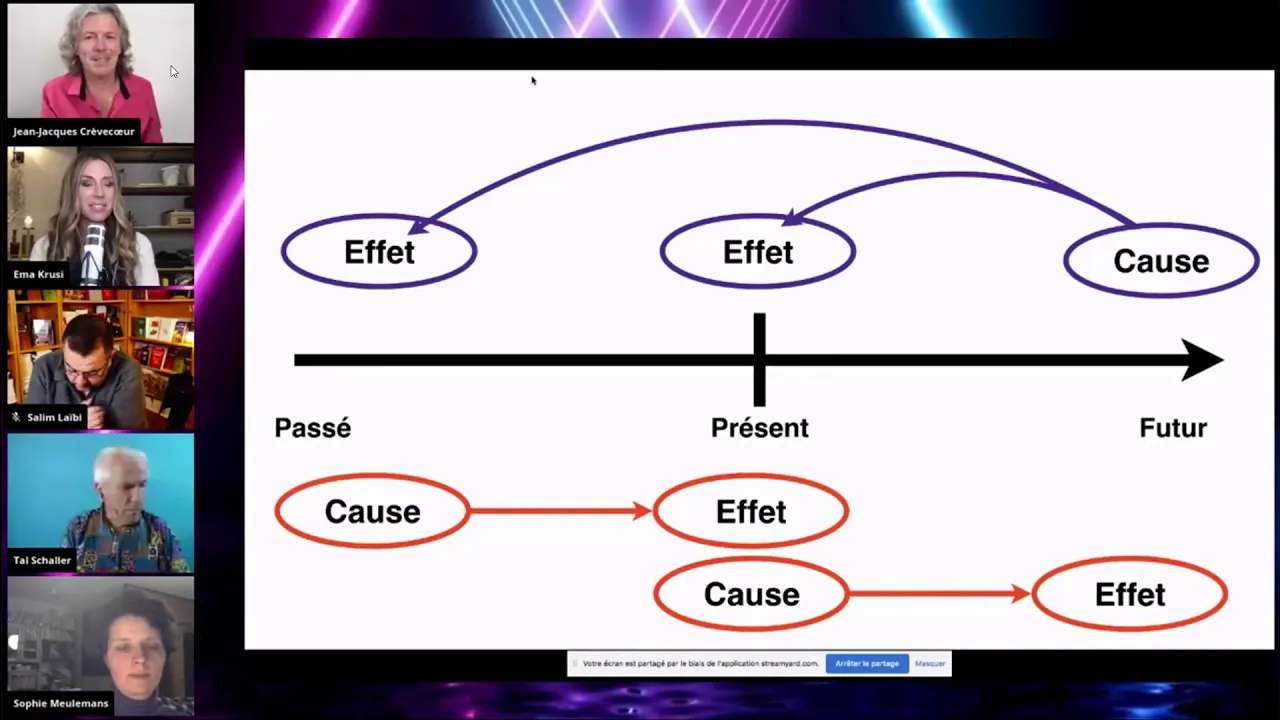
The classical conception of time is that time flows from the past through the present toward the future. In this materialist worldview, causes must necessarily precede their effects. For example, if something is dropped, the act of dropping it occurs before it breaks or potentially injures someone. This linear progression means that events in the past have effects in the present, and events in the present have effects in the future.
Click to watch →
En el Reloj del Universo: Abrazando el Tiempo Divino en Nuestras Vidas
114.1K
Linear time (chronological time or Chronos) is the common time concept taught in Western culture, which divides time into three distinct periods: past, present, and future. This linear perspective views time as a straight line with a beginning and an end, where the past is behind us, the future is ahead, and the present is the single point where we exist. This is the time concept that most people are familiar with and use in daily life.
Click to watch →
Todo sobre la Manipulación de la Línea Temporal. Master Class. Alucinante Material.(Fran Parejo).
8.5K
Linear time refers to a one-way street of events moving toward the future, with the past appearing fixed like stone. It is a product of the material universe and entropy, used in physical equations and simulations. Non-linear time refers to multiple pasts entangled with multiple futures, forming a three-dimensional temporal network with cross-interactions and feedback loops. Non-linear time is the habitat of non-human intelligences that operate outside three-dimensional physical space and therefore outside linear time.
Click to watch →

Time Management & How It Can Redefine Our Lives | Ammar Zubayr Ameen Bin Aminudin | TEDxYouth@KYUEM
454
Linear time is defined as a continued sequence of events that happens in an irreversible succession from the past through the present and into the future. This is the conventional understanding of time that most people accept, including the basic measurements such as 60 seconds in a minute, 60 minutes in an hour, and 24 hours in a day.
Click to watch →
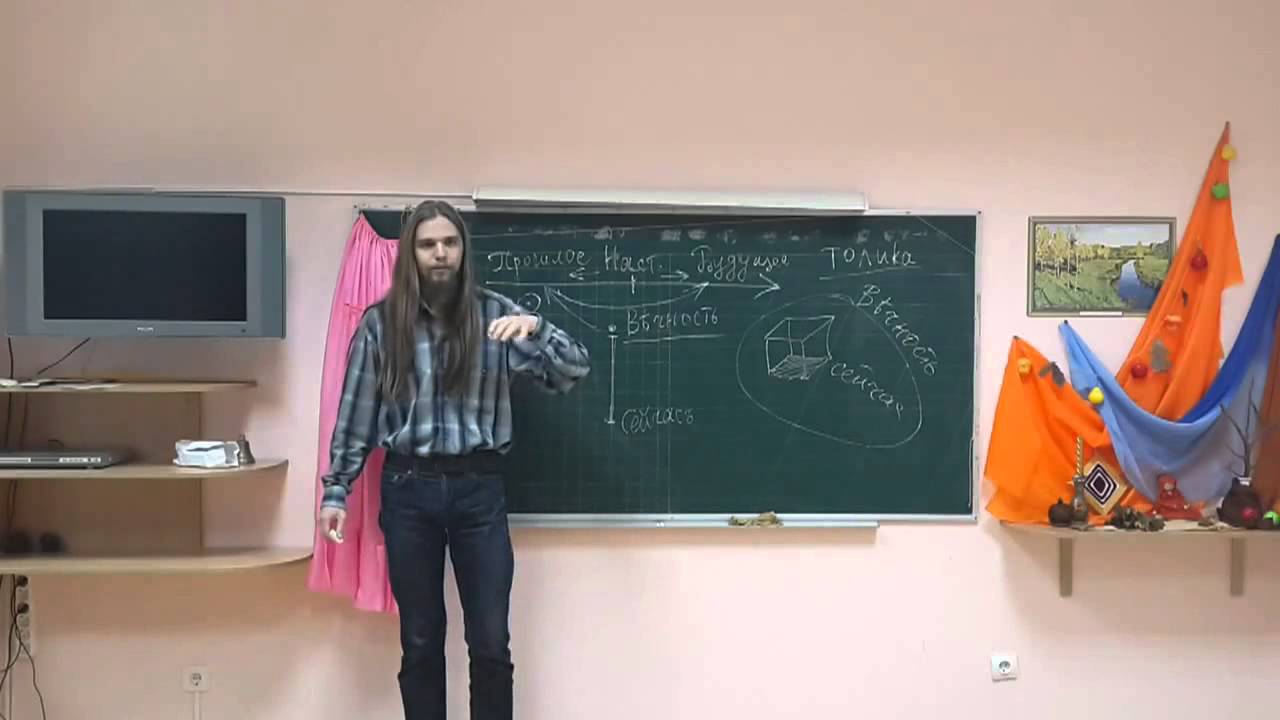
Мировосприятие Славян. Урок 6
3.8K
The linear model of time consists of three absolute quantities: past (what has been), present (the current moment), and future (what will be). In this model, causes of events are seen in the past, while effects are formed in the present for future events. However, this model has a critical flaw: the present moment is actually the smallest unit of time (called 'tolika'), yet the model treats it as equally significant to past and future, leading to a fundamental misunderstanding of time's nature.
Click to watch →
Deep Dive
The general definition of a logical paradox and how self-contradictory scenarios arise in philosophy.

Logic paradoxes
675
A logical paradox is a statement or situation that appears to contradict itself or create an impossible scenario when analyzed logically. These paradoxes challenge our understanding of logic and reasoning by presenting statements that seem to be both true and false simultaneously, or situations that cannot be resolved through normal logical analysis.
Click to watch →
Paradossi logici auto-referenziali
31K
A self-referential logical paradox is a statement or question that refers to itself in such a way that it generates a contradiction or paradox. These paradoxes may initially seem confusing or absurd, but they have profound applications in philosophy, semantics, computer science, and set theory. They reveal the logical and conceptual limitations of both language and mathematics, demonstrating that language and mathematics can 'stumble upon themselves' when they attempt to describe their own structure.
Click to watch →

the five kinds of paradox
3.3M
Logical contradiction paradoxes are situations where every possible explanation can be shown to be incorrect. These represent the primary definition of 'paradox' - statements or scenarios that cannot be meaningfully assigned a truth value because any attempt at resolution leads to contradiction. Key examples include the liar paradox ('This sentence is false'), the crocodile paradox, and the barber paradox. These paradoxes reveal fundamental limitations in logical systems and demonstrate how self-referential statements can break formal logic frameworks.
Click to watch →

How to resolve a paradox
57.7K
A philosophical paradox is defined as having two or more different arguments, each of which seems very logical or plausible to at least some people, but they contradict each other. This means they cannot all be correct simultaneously. Examples include Newcomb's Paradox (one-boxers vs two-boxers), the Sleeping Beauty problem (halfers vs thirders), and the Repugnant Conclusion, where multiple logically-sounding arguments lead to contradictory conclusions.
Click to watch →
![A Paradox-based Method for solving Contest Math problems. Summer of Math Exposition, 2021 [SoME1]](https://i.ytimg.com/vi_webp/Rxpd1h4EaeQ/maxresdefault.webp)
A Paradox-based Method for solving Contest Math problems. Summer of Math Exposition, 2021 [SoME1]
1.5K
A paradox is a statement or proposition that despite sound reasoning from acceptable premises leads to a conclusion that seems senseless, logically unacceptable, or self-contradictory. The liar paradox (Epimenides: 'All Cretans are liars') and the barber paradox (Bertrand Russell: 'The barber shaves all those and only those who do not shave themselves') are famous examples where contradictions arise.
Click to watch →
Deep Dive
An introductory understanding of Einstein's General Relativity, specifically the theoretical existence of Closed Timelike Curves (CTCs).

The Quantum Mechanics of Time Travel
270K
This section covers the theoretical foundations of closed timelike curves in general relativity. Kurt Gödel discovered in 1948 that Einstein's equations allow for closed timelike curves, visualized as coffee cup diagrams where time loops around handles. The interior of rotating Kerr black holes inevitably contains closed timelike curves. John Wheeler's interpretation proposed that there is only one electron moving both forward and backward in time, explaining identical particle properties through CPT symmetry.
Click to watch →
Seth Lloyd: Quantum Mechanics & Biology, Consciousness, AGI, Time | Hrvoje Kukina Podcast #46
11.7K
Closed timelike curves (time travel) exist in Einstein's general relativity - paths through spacetime that loop back to intersect themselves in the past. Kurt Gödel discovered these in the 1940s by finding that rapidly rotating massive objects warp spacetime so severely that paths become self-intersecting. Einstein was reportedly horrified by this implication.
Click to watch →

Einstein’s Time Paradox They Hid From You
208
Closed timelike curves are paths through spacetime that loop back on themselves, allowing an object to return to its exact starting point in both space and time. In 1949, mathematician Kurt Gödel discovered a solution to Einstein's field equations that permits such paths. This means walking in a straight line through the universe could result in returning to the previous Monday rather than the next day. The mathematics is rigorous and peer-reviewed, representing a fundamental feature of Einstein's general relativity rather than a loophole or quirk.
Click to watch →
30 Theories That Could Explain Time Travel - The Science And Philosophy Behind It
1.9K
Closed timelike curves are legitimate, if exotic, mathematical solutions that emerge directly from Einstein's theory of general relativity. A timelike curve is simply the path an object follows through the four-dimensional fabric of spacetime. In our normal experience, these paths always move forward in time, never looking back. But a closed timelike curve is a path that bends in such a way that it loops back to reconnect with its own past. It is a cosmic racetrack where the finish line is also the starting gate. Completing the lap means you arrive before the race even began. These curves appear in the equations that describe the space around a massively rotating black hole, a Kerr black hole, or in the theoretical framework of certain stable wormholes.
Click to watch →
Das verborgene Monster in Einsteins Mathematik — Schrödingers Warnung
889
General Relativity allows certain solutions called closed timelike curves—mathematical structures where spacetime is so strongly curved that a curve through spacetime returns to its own starting point. These are time travel solutions mathematically. In 1949, Gödel, mathematician and Einstein's friend at Princeton, showed that Einstein's equations allow an exact solution where the entire universe rotates and closed timelike curves exist everywhere. In Gödel's solution, every clock could be led back to its starting point. Einstein was deeply troubled by this, writing that Gödel's solution raises the question of whether the condition that causes must precede effects (causality) is fundamentally embedded in general relativity.
Click to watch →
Prerequisite Knowledge
- Concept 01The basic principle of causality, where a cause must always chronologically precede its effect.
- Concept 02The concept of linear time and how standard classical physics models the flow of events from past to future.
- Concept 03The general definition of a logical paradox and how self-contradictory scenarios arise in philosophy.
- Concept 04An introductory understanding of Einstein's General Relativity, specifically the theoretical existence of Closed Timelike Curves (CTCs).
Subsequent Learning
- Step 01The Novikov Self-Consistency Principle, which proposes that time travel is possible but self-contradictory actions are physically impossible.
- Step 02The Grandfather Paradox and how its threat of contradiction differs from the informational loop of the Bootstrap Paradox.
- Step 03The philosophical study of Ontological Paradoxes, analyzing where information or objects in a causal loop actually originate.
- Step 04Quantum mechanical approaches to time travel, such as the Many-Worlds Interpretation (multiverse theory) as a resolution to loops.
- Step 05The implications of causal loops on the metaphysical debates surrounding determinism, fatalism, and the existence of free will.
Time Travel Goal
Paradox Revealed
Urgent Solution
Creative Copying
Origin Question
Time Travel Goal
0:00Playing Section
- 1
Protagonist uses time machine to meet Beethoven in 18th-century Germany.
- 2
He expects to find the famous composer but learns Beethoven is unknown.
Hawking's Chronology Protection Conjecture
Proposed by physicist Stephen Hawking, the Chronology Protection Conjecture serves as a major scientific counterpoint to the physical possibility of causal loops and the bootstrap paradox. The conjecture posits that the laws of physics—specifically quantum mechanics and general relativity—actively prevent the creation of closed timelike curves, rendering macroscopic time travel impossible. According to Hawking, any attempt to create a time machine would generate a destructive feedback loop of vacuum fluctuations, destroying the path before a loop could form. This theory argues that nature inherently safeguards the timeline, upholding linear causality and ensuring that paradoxical scenarios like the bootstrap paradox are mathematically and physically impossible, rather than genuine challenges to free will.
Deep Dive
The Novikov Self-Consistency Principle, which proposes that time travel is possible but self-contradictory actions are physically impossible.

잠잘때 들으면 시간순삭!! 《시간여행 총정리》 50분 몰아보기!
928.7K
The Novikov Self-Consistency Principle proposes that time travel is possible but that events are self-consistent. If you travel back in time, you cannot change history because your actions were always part of history. A time traveler attempting to kill their grandfather would fail due to some unforeseen circumstance. This principle suggests that time travel creates a single, consistent timeline.
Click to watch →
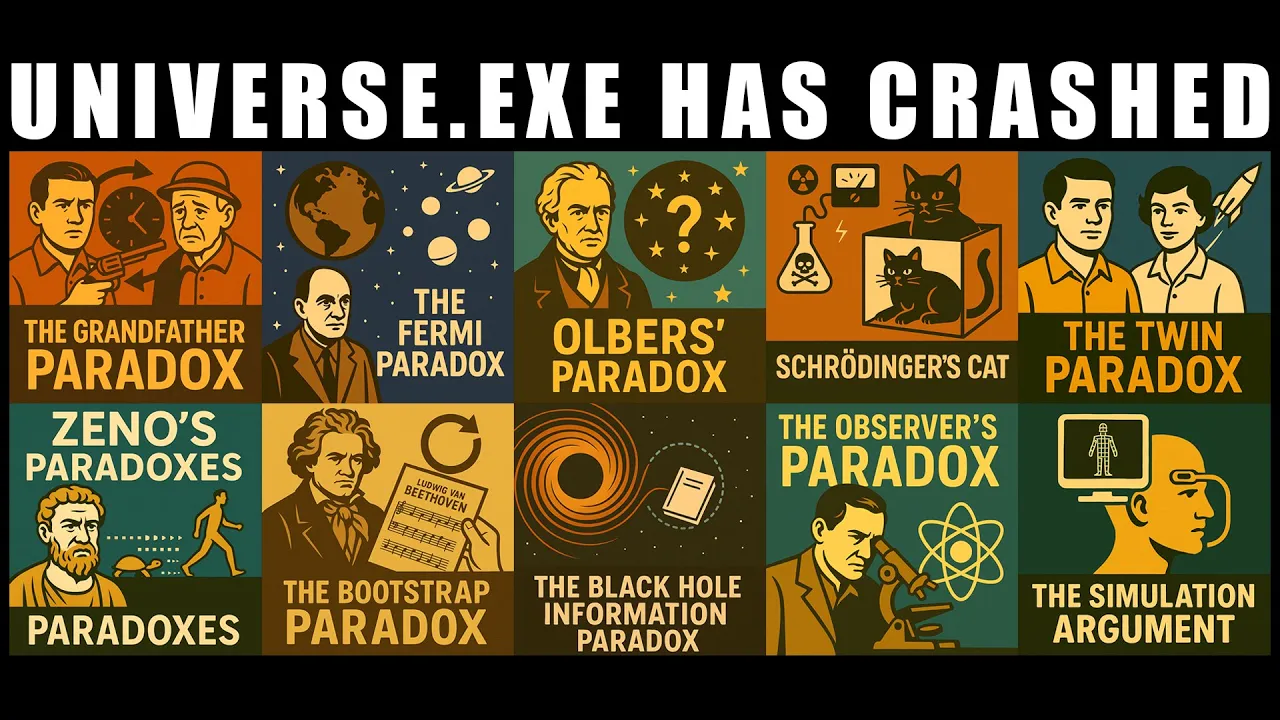
10 Scientific Paradoxes That Will Make You Question Reality
455K
The Novikov self-consistency principle, proposed by physicist Igor Novikov, states that the universe is pathologically self-consistent and paradoxes are not allowed. While time travel to the past may be possible, travelers are physically incapable of changing events in ways that create contradictions. The laws of physics would conspire to ensure the timeline remains intact—for example, a gun might jam, or the traveler might change their mind—making them a tourist rather than a god who can alter history.
Click to watch →
Alex СМОТРИТ: "БАК" УЖЕ ПРИНЯЛ ПОСЛАНИЕ ИЗ БУДУЩЕГО!
104.2K
Igor Novikov's principle states that if time travel is possible, only events that were always meant to happen can occur. The universe does not allow any contradictions—your grandfather cannot be killed because you never did kill him. Any action you take in the past was always part of history. Applied to time travel messages, this means that any information sent back can only reveal facts that were already true. You cannot use such a message to change your path or prevent events, because doing so would create a contradiction that the universe simply cannot allow.
Click to watch →
Как путешествия во времени ломают Вселенную
69.9K
Igor Dmitrievich Novikov proposed that time travel to the past is possible but that any actions taken by a time traveler must be consistent with the past. According to this principle, a time traveler cannot change events that have already occurred; they can only fulfill events that were always part of history. This would mean that any attempt to prevent an event would actually cause that event to occur.
Click to watch →

Esiste il libero arbitrio?
48.9K
The Predestination Model creates circular causality where time travel events are already determined. The Novikov Self-Consistency Principle states that time travel must be self-consistent—any attempt to change the past will fail because the traveler's actions were always part of history. This resolves paradoxes by making them impossible rather than allowing alternate realities. A traveler might attempt to kill their grandfather, but the universe would conspire to prevent it. The Bootstrap Paradox describes objects with no clear origin, like a book that a traveler finds, follows instructions to build a time machine, and then places back in the past, creating an infinite causal loop with no beginning or end.
Click to watch →
Deep Dive
The Grandfather Paradox and how its threat of contradiction differs from the informational loop of the Bootstrap Paradox.
Vivimos en el Interior de un AGUJERO NEGRO - Ciencia al Límite con Mariana Maus
95.8K
The Grandfather Paradox asks: if you travel back in time and kill your grandfather before he has children, you would never be born to travel back in time. One resolution is that time travel creates a new timeline or parallel universe rather than changing the original. The Bootstrap Paradox involves information or objects existing without origin - if a person learns a song from someone who learned it from them, the song has no original creator. Time travel may involve creating new timelines rather than changing existing ones.
Click to watch →

টাইম ট্রাভেল প্যারাডক্সগুলোর সমাধান! Time Travel Paradoxes : Solved! Seenjoy
12.3K
Time travel creates logical contradictions such as the Grandfather Paradox (where killing your grandfather prevents your own birth, creating a logical impossibility) and the Bootstrap Paradox (where information or objects exist without an origin, like learning Newton's Laws from a future version of yourself and teaching them to Newton). These paradoxes can be theoretically resolved through concepts like the 'invisible wall' (preventing paradox-causing actions) or the multiverse theory (where actions create alternate timelines rather than changing the original one).
Click to watch →

5 Paradoxos Temporais pra Pensar Antes de Dormir
78.9K
The Bootstrap Paradox, also known as the Information Loop Paradox, occurs when information or an object exists without an origin. For example, a person learns a secret password by telling it to themselves in the past, but they only learned it by telling it to themselves in the past. This creates an infinite loop where the information has no clear beginning or source. The paradox questions where the initial information came from, as it appears to have no origin point.
Click to watch →
What is the Grandfather Paradox? | Neil deGrasse Tyson Explains…
980.9K
The grandfather paradox is the fundamental paradox of time travel, which states that if you travel back in time and prevent your parents from meeting each other, you would never have been born. This creates a logical contradiction because if you were never born, you couldn't have traveled back in time to prevent their meeting in the first place.
Click to watch →

Grandfather Paradox #science #sciencefacts
1M
The Grandfather Paradox is a thought experiment in time travel that illustrates a logical contradiction: if a time traveler goes back in time and kills their grandfather before the grandfather's child (the traveler's parent) is born, then the traveler would never have been born to travel back in time in the first place, creating an impossible causal loop.
Click to watch →
Deep Dive
The philosophical study of Ontological Paradoxes, analyzing where information or objects in a causal loop actually originate.
Is Time Travel, Especially Into the Past Possible? | Matt Szydagis | TEDxSchenectady
803.2K
Ontological paradoxes arise when time travel creates closed loops where information or objects have no origin. For example, if someone travels back in time to give themselves homework, the homework has no source—it simply exists without being created. This is more problematic than ancestor-killing paradoxes because it violates fundamental principles of causality and information conservation in physics.
Click to watch →

How to Build A Time Machine - Paul Davies
255.9K
Causal loops occur when information or events exist without origin—knowledge appears from nowhere. Imagine reading a theorem in a future journal, then teaching it to a student who publishes it, which is what you originally read. Where did the information originate? This challenges rational notions of cause and effect. Scientists find such scenarios deeply troubling because they suggest informational chaos could exist in nature, undermining our understanding of a rationally ordered universe. Many physicists believe this implies time travel into the past is impossible.
Click to watch →

Главная тюрьма Вселенной: Почему человечество никогда не покинет Солнечную систему? | Документалка
3K
The ontological paradox (or bootstrap paradox) occurs when information or objects exist in a closed time loop without an origin. For example, if you travel back in time and give Einstein your completed theory of relativity, he publishes it, and you learn it from his book—yet no one originally created the theory. This paradox challenges the classical scientific view that every effect must have a cause.
Click to watch →

3 Time Travel Paradoxes!!
3.6M
The bootstrap paradox occurs when information or objects exist without ever being created, as their origin traces back to the future and their destination is the past. In this self-contained loop, something has no true beginning or end—it simply exists eternally in a closed time loop. Examples include Guru-Guru teaching Link the Song of Storms in Ocarina of Time, yet Guru-Guru learned it from Link after traveling back in time, creating an infinite loop where the song's origin cannot be determined.
Click to watch →

This Time Paradox Scares Scientists - And It's Not Looking Good!
246K
The ontological paradox, also known as the bootstrap paradox, describes an infinite cause-and-effect loop where information, objects, or even people exist without a discernible point of origin. In this scenario, an event or object is a key player in its own origin and couldn't exist without its later self. This creates a closed causal loop where the original source of information becomes impossible to identify because it was created by its own future version.
Click to watch →
Deep Dive
Quantum mechanical approaches to time travel, such as the Many-Worlds Interpretation (multiverse theory) as a resolution to loops.
The Quantum Mechanics of Time Travel
270K
Projective Closed Timelike Curves (P-CTCs) provide a quantum mechanical resolution to time travel paradoxes by using quantum post-selection and entanglement, unlike Deutsch's theory which requires maximum entropy states; in P-CTCs, when a photon attempts to interact with its past self, it fails to do so because the post-selection condition ensures self-consistency, as demonstrated in an experiment where photons were effectively sent a few billionths of a second backwards in time and found unable to kill their former selves.
Click to watch →
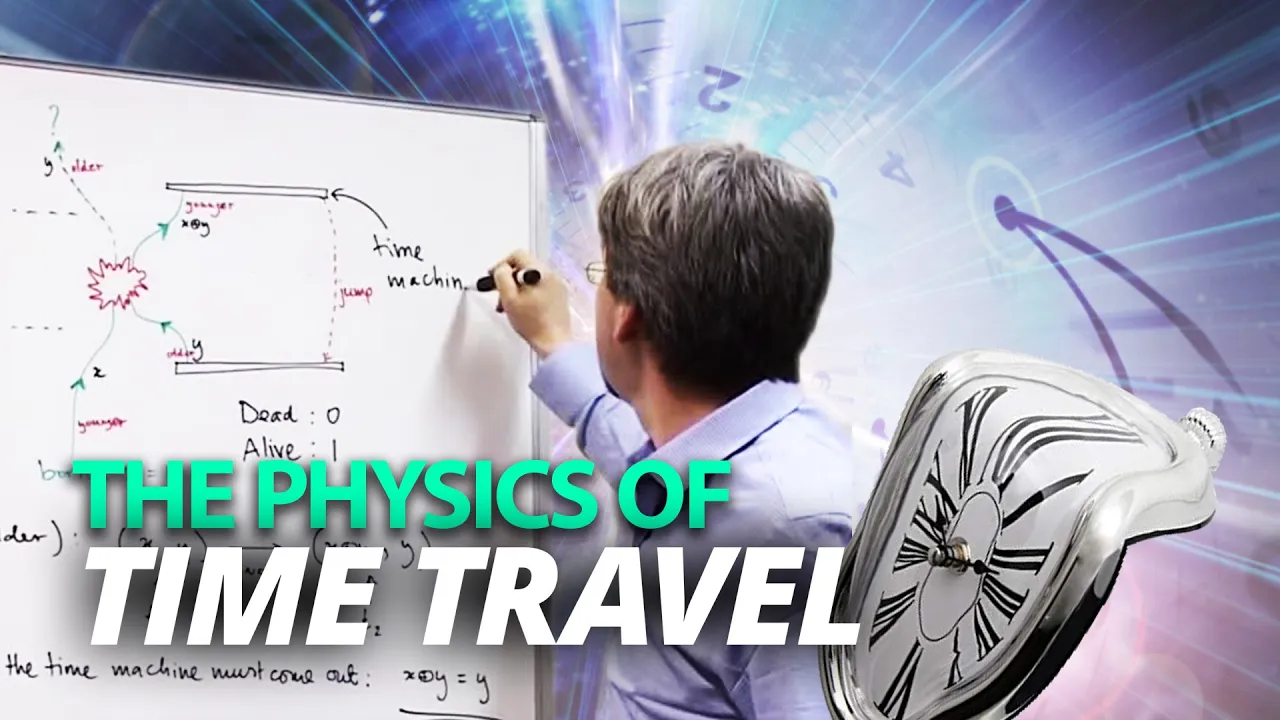
The physics of time travel, by Dr Pieter Kok
302.6K
The many worlds interpretation of quantum mechanics proposes that different branches of a superposition represent actual different universes. When traveling back in time and killing your older self, you don't create a paradox—you instead jump from one universe to another. This branching mechanism resolves time travel paradoxes by allowing events to occur without contradiction within any single timeline.
Click to watch →

Is It Possible to Build a Time Machine? With Paul Davies
77.1K
The many worlds interpretation of quantum mechanics proposes that every quantum event splits the universe into multiple parallel realities, each realizing different outcomes. This resolves time travel paradoxes by suggesting that changing history creates new universes rather than altering the original timeline. When a time traveler kills their grandfather, they create a universe where they never existed, while their original timeline remains unchanged. This view is now widely accepted among theoretical physicists, particularly in cosmology, as it reconciles quantum uncertainty with everyday certainty.
Click to watch →

time | soft spoken ASMR, weird facts
83.9K
In 1991, physicist David Deutsch proposed quantum time loops, officially known as closed timelike curves (CTCs). His approach was based on the many worlds interpretation of quantum mechanics, where a particle traveling to the past could jump into a parallel universe, avoiding paradoxes like the grandfather paradox. Later in 2010, physicist Seth Lloyd and his team suggested quantum mechanics itself might allow for a kind of time loop without needing parallel universes, using a quantum trick called post selection where only certain outcomes are kept while others are discarded.
Click to watch →
Заговор дантистов. Коняев и Воробьева, Перст Фомы #56
80.3K
Closed timelike curves (CTCs) are worldlines that loop back on themselves in spacetime, creating self-consistent but paradoxical loops. The bootstrap paradox occurs when an object or information has no clear origin, simply existing in a closed loop. To resolve these paradoxes, physicists proposed local censorship, which forbids trajectories that would violate causality. However, when quantum mechanics is applied to CTCs, entropy can decrease along the curve (classically forbidden), allowing systems to return to their initial quantum state. This makes time travel self-consistent, with the traveler not remembering being in a loop, effectively living in a repeating cycle without awareness of the repetition.
Click to watch →
Deep Dive
The implications of causal loops on the metaphysical debates surrounding determinism, fatalism, and the existence of free will.

The Bootstrap Paradox: Can Information Have No Origin?
360
The bootstrap paradox challenges determinism—the idea that the present fully determines the future. In causal loops, the future constrains the past as well as vice versa. Events are fixed by self-consistency requirements. Your choices are predetermined by the need to close the loop. Some interpret this as ultimate determinism stronger than classical physics; others see it as an illusion. Personal identity becomes problematic: if you meet your future self, are you the same person? The future you has experienced events you have not yet lived, changing them.
Click to watch →

An Overview of Metaphysics
119.3K
This section examines causation and its profound implications for human freedom. Causation is the relationship between entities in the universe, forming chains where causes precede effects. Determinism claims every event is preceded by some cause or set of causes - if every event has a cause, then every event must happen exactly as it happens. This challenges free will: if my decision to get tea was always determined by prior causes, then my sense of freely choosing is an illusion. The chain of causation extends back to events before my birth, making all decisions predetermined. This undermines moral and legal responsibility, since if my will is part of the cosmic chain, I wasn't free not to act.
Click to watch →

Causal Loop
1.8M
Causal loops create isolated sequences where each event causes the next, eventually returning to the starting point. This generates profound philosophical dilemmas: if everything repeats identically, can any choice be genuinely free? Individuals face the paradox of acting with apparent autonomy while lacking true decision-making power. The loop has no origin or escape, raising questions about whether our reality might be a repeating cycle. Memory asymmetry—remembering the past but not the future—provides a potential test for identifying loops. Wormholes offer an alternative time travel mechanism that doesn't create loops, instead serving as bridges between distinct space-time coordinates.
Click to watch →

Etica de Espinosa por Clovis de Barros
7.6K
A consequence of Spinoza's philosophy is that free will is an illusion. One has the illusion of free will because one cannot account for the complexity of relations one's body maintains. One cannot perceive all the effects the world produces on oneself, and therefore cannot perceive oneself as determined by the world. One does not understand why one wants what one wants, thinks what one thinks, and therefore thinks one chooses. Spinoza's perspective does not make sense to say 'I choose' because the 'I' is itself an illusion. What exists are matters and energies that relate and determine each other. There is no free will. However, there is also no fatalism—there is determinism without fatalism. Nothing is written anywhere, and there is no superior force organizing everything. Things simply are and are as they could only be. Chance is nothing more than ignorance of understanding the strictest lack of chance. When one does not know why a tree fell, one calls this chance. If one were all wise, chance would be banished from the world. As we are all ignorant, chance is present in the world not because there is no cause for what happens, but because we ignore it. Things happen as they happen.
Click to watch →

Determinism vs Fatalism vs Predeterminism - Understanding the Determinism vs Free Will Discussion
23K
Causal determinism holds that events are bound by causality such that prior states completely determine future events; predeterminism extends this by asserting all events are determined far in advance regardless of initial conditions; fatalism is a broader category including causal determinism, omniscience fatalism (where an all-knowing being determines our lives), and logical fatalism (where future events must be true or false, making free will impossible). While causal determinism has strong scientific support, predeterminism requires a final theory of everything, and theological fatalism lacks coherent arguments.
Click to watch →
Time Travel Goal
Paradox Revealed
Urgent Solution
Creative Copying
Origin Question
Time Travel Goal
0:00- 1
Protagonist uses time machine to meet Beethoven in 18th-century Germany.
- 2
He expects to find the famous composer but learns Beethoven is unknown.
Hawking's Chronology Protection Conjecture
Proposed by physicist Stephen Hawking, the Chronology Protection Conjecture serves as a major scientific counterpoint to the physical possibility of causal loops and the bootstrap paradox. The conjecture posits that the laws of physics—specifically quantum mechanics and general relativity—actively prevent the creation of closed timelike curves, rendering macroscopic time travel impossible. According to Hawking, any attempt to create a time machine would generate a destructive feedback loop of vacuum fluctuations, destroying the path before a loop could form. This theory argues that nature inherently safeguards the timeline, upholding linear causality and ensuring that paradoxical scenarios like the bootstrap paradox are mathematically and physically impossible, rather than genuine challenges to free will.
The basic principle of causality, where a cause must always chronologically precede its effect.
The concept of linear time and how standard classical physics models the flow of events from past to future.
The general definition of a logical paradox and how self-contradictory scenarios arise in philosophy.
An introductory understanding of Einstein's General Relativity, specifically the theoretical existence of Closed Timelike Curves (CTCs).
The Novikov Self-Consistency Principle, which proposes that time travel is possible but self-contradictory actions are physically impossible.
The Grandfather Paradox and how its threat of contradiction differs from the informational loop of the Bootstrap Paradox.
The philosophical study of Ontological Paradoxes, analyzing where information or objects in a causal loop actually originate.
Quantum mechanical approaches to time travel, such as the Many-Worlds Interpretation (multiverse theory) as a resolution to loops.
The implications of causal loops on the metaphysical debates surrounding determinism, fatalism, and the existence of free will.
391.3K views28.5Klikes1:00@timeywimeywhoOriginal Release: 2024-10-02
ludvic van Beethoven what's point of having a time machine if you don't get to meet your Heroes so off he goes to 18 century Germany but he can't find Beethoven anywhere no one's heard of him Beethoven literally doesn't exist this didn't happen by the way no this is called the bootstrap Paradox Google it the time traveler panics you can't bear the thought of a world without the music of Beethoven luckily he brought all of his Beethoven sheet music for ludvic to sign so he copies out all the conceras and the Symphonies and he gets them published he becomes Beethoven my question is this who put those notes and phrases together who really composed bin fifth
Up Next

27:13
Ancient Technologies and Inventions That Were Ahead of Their Time
@BeAmazed
2M views•2021-07-09

12:54
Triumph of Orthodoxy Icon: Byzantine Art & History Explained
@BenCallan
2.1K views•2024-08-06

9:49
FastAPI vs Flask vs Django: Choosing the Right Python Web Framework
@TechWithTim
302.5K views•2024-05-26

1:42
Game of Thrones Opening Credits: A Cinematic Analysis
@gameofthrones
46.3M views•2011-04-18
Related Study Plans & Knowledge Roadmaps
Structured learning paths in General & Interdisciplinary Studies
general-studies
Elevator Engineering: History, Physics & Cities
01From Hoists to Safety Brakes: The Dawn of Vertical Lift
02Hydraulic vs. Traction: The Engineering Physics of Elevators
03Modern Speed, Safety, and Algorithms
+ 2 more learning modules
12h5 modules
Explore Roadmap
general-studies
Rubber: Material Science, History & Geopolitics
01Origins of Natural Rubber & Mesoamerican History
02The Chemistry of Natural Rubber & Vulcanization
03The Geopolitics of the Rubber Boom & Colonization
+ 2 more learning modules
12h5 modules
Explore Roadmap
general-studies
Containerization: Evolution, Logistics & Trade
01Ancient Trade & Bulk Cargo: Amphorae to Barrels
02The Industrial Revolution & Cardboard Packaging
03The Containerization Revolution: Malcom McLean
+ 2 more learning modules
12h5 modules
Explore Roadmap
general-studies
Textile Tech: Evolution, Labor & Global Impact
01Pre-Industrial Textiles: Handloom & Cottage Industry
02Mechanization: The Spinning Jenny to the Power Loom
03The Factory System & Global Labor Transformation
+ 2 more learning modules
10h5 modules
Explore Roadmap