

![Explaining Musical Intervals As CLEARLY As I Possibly Can [MUSIC THEORY FUNDAMENTALS]](https://i.ytimg.com/vi_webp/m9GlB8tanNE/maxresdefault.webp)
![[sky光遇]音樂演奏教學(一)基本功!音程/原位三和弦/原位七和弦完整收錄](https://i.ytimg.com/vi/deRj22wGIj8/maxresdefault.jpg)
![[예배팀을 위한 작편곡 강의] 5강 - 코드 표기 기초 이론 (2)](https://i.ytimg.com/vi/0mZ91umqnnw/maxresdefault.jpg)






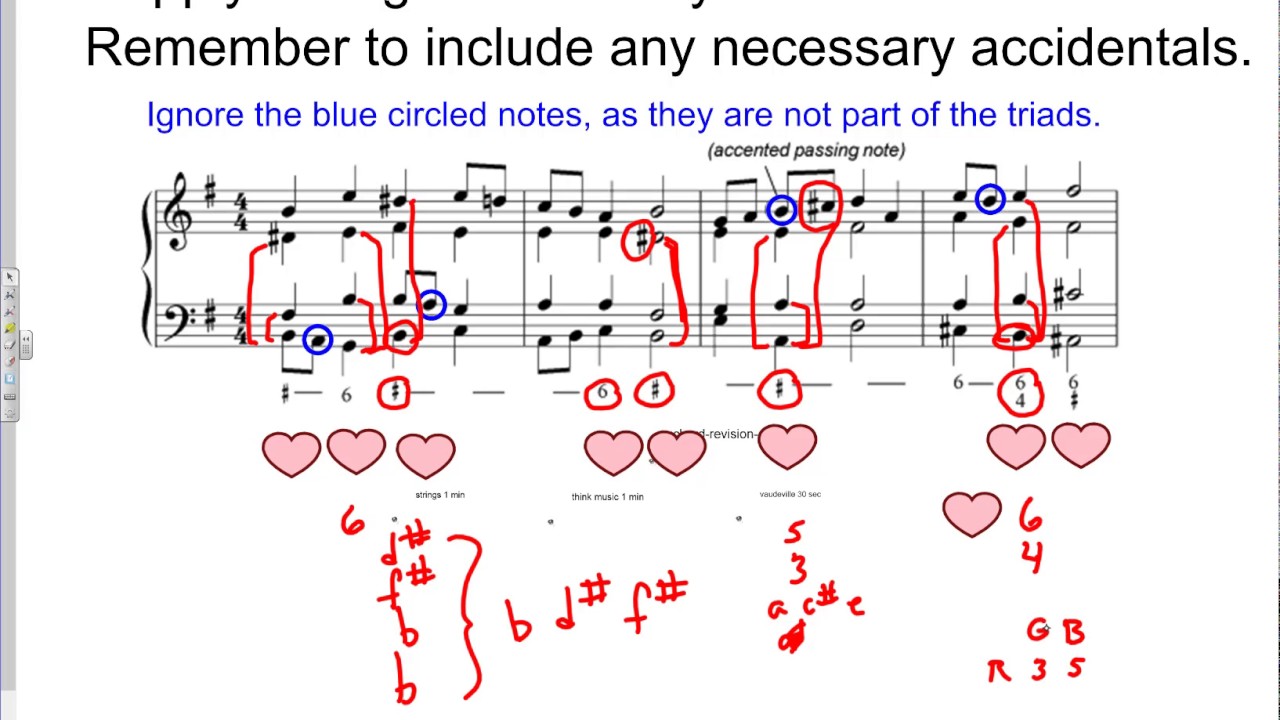




Figured bass is a shorthand notation system from the 17th-18th centuries that uses numbers and accidentals beneath a bass line to indicate intervals to be played above it, where '5' and '3' are assumed unless otherwise specified, and performers have discretion in voicing and octave placement; it represents generic interval sizes rather than specific chord qualities or functions, and while it doesn't specify chord roots or harmonic analysis, it remains valuable for historical performance and as an analytical tool when combined with Roman numerals.
Understanding Figured Bass: A Guide to Baroque Harmony
Added:Fluency in reading music notation, specifically in the bass clef.
Understanding of diatonic intervals (such as thirds, fifths, and sixths) and how to calculate them.
Knowledge of basic triad construction (major, minor, diminished) and standard chord inversions.
Familiarity with key signatures, accidentals, and basic tonal harmony.
Applying voice-leading rules (such as avoiding parallel fifths and octaves) to realize a four-part (SATB) texture.
Improvising and performing keyboard realizations of basso continuo in Baroque chamber music.
Analyzing Bach chorales and Baroque trio sonatas using a combination of figured bass and Roman numeral analysis.
Studying advanced chromatic harmony of the Baroque era, including suspensions, accented passing tones, and secondary dominants.
56.2K views1.6Klikes24:45Original Release: 2019-06-28
Hi everybody, and welcome back.
I'm Professor Seth Monahan, a guy who *actually* does music theory for a living, and this is the sixth video in my series on the basics of classical harmony and counterpoint.
The title of this video is "What is Figured Bass," and it actually falls into five parts.
First we're gonna ask what figured bass is.
We're gonna use figured bass to turn arcane symbols under a score into notes that we can hear.
Then we're gonna work backwards, talking about how we can take a given chord and turn it *into* figured bass.
We're gonna talk about the standard abbreviations used in figured bass.
We're gonna talk about how to alter notes—how to use notes that are not in the key.
And finally we're going to talk about motion above a stationary bass and how figure bass shows this.
But let's start with the very basics: what is figured bass?"
So let's start with a piece of music.
Here's the opening of Johann Sebastian Bach's Sonata in C "for flute and continuo."
Now the name, taken on its own, might suggest that this is a piece for two instruments: a flute, whose part is on the top, and a "continuo," whatever that is, whose music is on the bottom.
Now, I want you to listen to a recording of this passage and take stock of how many instruments you actually hear—and how what they're playing relates to the music on the screen.
(Which I remind you is the *entire* score; these are all the notes that Bach wrote.)
Now I'm probably not going out on a limb to assume you noticed that there was a FLUTE.
And you probably also heard a low string instrument playing the bass line; it's a historical instrument called a viola da gamba.
But if you listened carefully, I bet you also noticed someone playing *chords*—in this case on a baroque harpsichord.
Now, as it happens, the second two instruments are both reading from the bottom staff.
And if you'd wondered how on earth the harpsichord is knew what chords to play—because Bach sure didn't write any in the score—I might take a moment to point out the numbers and accidentals scattered at points beneath the staff.
Those symbols are called "bass figures," and their job is to tell people who play chordal instruments what notes to play above each bass note.
And together, the bass line and those numbers make up what's called figured bass.
(And as a little sidebar, we're now ready to understand that "continuo" isn't an instrument at all.
It's actually whatever group of instruments happens to be reading the figured base off that bottom staff.
The combination we just heard—a keyboard and a low string instrument—is probably the most common.
But others are totally possible—and it doesn't even have to involve more than one person.
Here's a recording where a gamba player actually handles the bass line *and* the chords.
So figured base is essentially a shorthand system for notating harmonies above a bass line.
And we see it mainly in 17th- and 18th-century accompaniment parts—very often with the instrument itself (as we just saw) not specified—it's simply anybody who can play chords to support the music we're going to make.
And the integers themselves—the numbers we see under the staff—represent INTERVALS to be played above the bass note.
So as a very simple example, here is a B with the integers "6" and "3" written underneath it.
The "6" tells the player to play a sixth above the bass—in this case it's G—and the "3" tells them to play a third above the bass—in this case D. So we have just realized a very simple figured base.
But here's the thing: the intervals are actually *not literal,* and what I mean by this is that we see a "6" and a "3" here, and they tell us to play a G and a D. But that G or D may be doubled or displaced by octaves.
And the exact voicing—the exact way that the D and G are played on the keyboard—is at the player's discretion.
So for instance, in playing the chord at the right I could do this...but if I wanted to I can also double the D at the octave and play that chord instead.
I could double the G as well and play this much richer chord.
I could decide that that thing on the top staff is way too wide for a human hand; I could drop the original D, so now the only D is not a third above the B—it's actually a third *plus an octave* above the B. That's totally fine.
And indeed, in many cases we'd be able to double the B as well.
So this would equally be a perfectly good realization of this figure bass.
Another critical thing to take note of here is that figured bass can give us ANY combination of notes—not just familiar chords.
As I mentioned in the last video, a lot of students who've learned a bit of theory associate figured bass with chord inversions and think that they always refer to a chord.
They don't.
Have a look on the right.
Now we're going to take a much more daunting set of figures: 7, 6, 5, 2.
So above the B that would be A as the 7th, G as the 6th, F# as the 5th, and C as the 2nd.
We've just made that chord with figured bass.
Whether or not that's a good idea of course is a different question.
But once again, we could decide to re-voice this.
We could, for instance, put the C and the F# up on top, giving us like something like this.
That's an equally valid way of realizing that very complicated figured bass.
Even if the original bass note have been down an octave, and all of the notes of our chord were more than an octave away from it, that would still be fine.
And while we're here, it's worth noticing all the information that figured based DOESN'T tell us.
It doesn't tell us anything about chord quality; it doesn't tell us how a given bunch of notes functions in a key, like a Roman numeral does.
It doesn't even tell us whether the notes were playing or technically part of a chord at all.
I'm not sure what chord that thing is; we could debate it, I suppose.
But the point is there's a reason for all of this: none of those concepts—chord roots, chord functions—existed at all when figured bass developed.
Ideas that we take completely for granted—like that every key has a certain number of chords, and these chords have a thing called a root, and the chords can be inverted—these ideas were all developed way after figured bass was made standard.
So you may be asking yourself: "well, if figured base is this antiquated way of doing things, why do we learn about it?"
Well obviously, if you're gonna play a historical continuo instrument—if you're the person playing that gamba in that recording of the flute sonata—you're gonna have to be able to read figured bass.
But why would garden-variety music students know or care about a shorthand system from 350 years ago?
Well, one reason is just historical curiosity.
If you're a curious, thoughtful musician, it's really fascinating to think that composers in Bach's time and before didn't think about harmony in terms of roots and inversions and chord qualities.
Amazingly, they thought instead in terms of figured bass and counterpoint.
We can broaden our minds just *trying* to think as they thought.
Maybe more importantly and more down-to-earth, we also learn figured bass because it's still in use—although mainly as an analytical tool.
Indeed, since we've already gotten a glimpse of how to read a figured bass, turning numbers into notes, we should now take a second to make sure that we can work in the opposite direction, turning notes back into figures.
So now we're going to ask "how do we take a given chord and figure out what the bass figures for it would be?"
We do this in two steps.
First, we reduce the chord to closed position *without changing the bass note.* And then we analyze the intervals above the bass.
So here's an F in a grand staff, and let's say those are the notes above it.
And let's say I ask you to analyze it.
And let's say you're Mozart.
So you're really good at this.
You're gonna look at that chord, you're gonna take stock of all the notes, you're gonna say "OK, above that F there's actually just a bunch of A's and D's..." So, reduced to closed position, you'd be taking this thing which has a bunch of A's and D's, and turning it into this closed position stack.
And then you'd analyze it from the intervals.
What you *wouldn't* do is reduce it further to a stack of thirds.
The key thing here is that you *leave the bass as it is,* and then once it's in closed position—as close as you can pack it without changing the bass—then you analyze the notes.
And in this case there's a third above the bass, A, and a sixth above the bass, D, meaning that you, Mozart, have just managed to figure out, amazingly, that this is a 6/3 chord.
So let's talk about some of the standard abbreviations used in figured bass.
Bass figures are usually abbreviated to avoid clutter, for the most part.
To be more specific: there's not usually an integer for each and every note an accompanist is supposed to play.
Some things are left understood.
And it's not entirely systematic, but there are some important patterns.
The most important thing is that intervals of a fifth ("5") and a third ("3") above the bass are ASSUMED, unless you're instructed otherwise.
So in the simplest situation: if you see a bass note—here's a C—with no figures at all, you're gonna play a fifth and a third above the bass.
So no figures actually means a 5/3 chord.
Or similarly: here's a note, and there's just a "7" written above it.
That doesn't mean you just play this with the seventh; what it means is that you play a seven *in addition* to a fifth and a three... giving us a Cmaj7 chord there.
Now, these intervals of a fifth and a third above the base can be *displaced* by the note one generic step above.
What does that mean?
Well, here there's a note with just a "6" written underneath it.
So what does that mean?
Well, this is in fact a 6/3 chord: the "6" tells us "put a sixth rather than a fifth above the bass."
So we have that...instead of this...So "6" actually means "6/3."
And similarly, here's a "4" written above a note.
What on earth is that?
That actually tells us "replace the 3 above the bass with a 4."
So here we have a 5/4 chord: that's a chord that jazz players would call a "sus chord."
We don't really have a name for that chord in Roman numeral theory.
So far all of our figured basses have given us notes that were in the key we were in already.
But sometimes you want notes that are *not* in the key.
So we have to ask: "how can we instruct a performer to alter notes using figured bass notation?"
Backing up a bit, let's just take stock of the fact that figured bass shows GENERIC sized intervals only— "generic size" meaning 5th, 3rd, 7th... not "major 7th," "perfect fifth," "diminished 3rd."
And so by default, because it only shows generic sizes, you just play the notes that are in the key.
OK: here are two figured basses.
What's the sam?
They're both a B-natural with 6/3 written underneath it.
But they're gonna give us different chords, because on the left we're gonna play that sixth and a third above the bass like this: it's a D-natural and a G-natural.
But because we always follow the key signature, on the right-hand side—same base note, same figure–but now we're gonna play D# and G#, because we're observing the key signature.
So that's the chord we get with the right hand one.
So before I talk about specific ways we indicate notes outside the key, I feel like I have to just mention: figured bass was a system that was not invented by any one person or in some laboratory in Germany somewhere.
It was cobbled together on an ad-hoc basis over generations, and it's not always systematic and doesn't always please us with how internally consistent it is.
But it is what it is; no one has ever modernized it.
We're still dealing with the same types of notations we had to 300 years ago.
So here's how we indicate notes outside the key: if there's an accidental prior to a number, you just apply the accidental to the corresponding note.
So if it says "#3" you put a sharp in front of the note that's a third above the bass.
If there's a SLASH through a number or a "+" after the numbe,r you raise the corresponding note by half-step.
This is where it gets a little weird.
And very often you'll see an accidental instead of a number—and when that happens, you modify the third above the bass using that accidental.
To see this in action, let's go back to our two chords that we had before.
Imagine that we're in this key—a 1-sharp key—but we want to play this chord, the chord that has the D# and the G# in it.
How would we do it?
Well, the way that would make the most sense and be most intuitive would just be to put accidentals before the integers: so "#6" would mean the sixth above the bass G should be sharp, and "#3" means the third above the bass should be sharp, D#.
This is intuitive; it makes sense.
This is actually, unfortunately, not how it would normally be notated.
Much more common would be the slash through the "6," showing us that the sixth above the bass is raised by half-step, and then the "#" all by itself, instead of the "3."
Remember, the sharp means "put this on the note that's a third above the bass."
So slash through a "6" plus "#" is the figure that will give us this chord: B, D#, G#, instead of B, D, G.
One more point about altering notes: accidentals in the bass voice—like on the actual bass line—don't change anything about how you realize the chord above it.
So the student who learns figured bass, feeling confident, they see this, they know that this is how they realize it, they feel great.
The composer adds a sharp to the B, and the students FREAK OUT.
Now they're wondering "Well do the upper voices now go up an extra note too?
Does the whole thing "sharpen" somehow?
No, not at all.
Whether it's a B, B#, Bb in the bass, B quintuple flat, you just realize the intervals' generic sizes according to the key.
So this is one of those rare instances where I'm gonna say "this is actually so simple you don't need to worry about it!"
So our last section is about motion above a stationary bass.
So until this point, we've assumed that figures and bass notes occurred in a kind of one-to-one ratio: for every bass note there would be one set of figures, whether or not it was implied or actually written out.
But in practice, we often see figures moving faster than the bass voice.
That's to say, sometimes the figures change while the bass remains the same.
What this indicates is that the upper voices are moving—usually by step— while the bass holds its note.
Here's a piece from about fifty years or so before the Bach flute sonata we heard earlier.
This is one of Arcangelo Corelli's church sonatas for two violins and continuo.
And as you can see, it's got a figured bass.
So as we listen I want you to follow along and spot the places where the figures change while the bass remains the same.
Hopefully you found two: one right at the beginning and one right at the end.
Let's look at the last one first.
Here Corelli has a "7" followed by a "6."
This means that while the C in the bass holds, the accompanist should play a seventh over the bass (B) on the first beat and then a sixth over the base (A) on the next beat.
Now, conveniently for us, Corelli often writes his figured basses so that the keyboardist will be doubling one of the violin lines.
And that's actually the case here.
Notice that by following the figures, the organist would be doubling a melody that's already in the first violin, which moves from B to A. In more modern types of notation we'd actually connect those two integers with a little horizontal line, to remind us that while these numbers represent notes above a base, together they form a linear segment of melody.
Now for reasons you don't need to know right now, the historical keyboardist would also have known to play a third above the bass, under both notes.
And that's in fact what the second violin is doing.
So I'll put that here in parentheses, since Corelli could have put it in.
And, once again, more modern editors might want to put a line here that extends all the way under the "6," to show us that that third above the bass is held the whole time while the other voice moves from a seventh to a sixth above the bass.
So let's look at the first set of figures in the piece—all of which unfold over an E in the bass.
As I mentioned already, moving figures above a bass typically indicate stepwise lines.
And I also mentioned that Corelli tends to write his figures so that you'll be following the instruments as they play their melodies.
That's exactly what happens here.
I want you to think about these four stacks of notes not as four stacks of two notes...but as *two strings of four notes.* OK?
I've zeroed out the bottom line here.
Think about this as Corelli telling us "over the E you're gonna play a fifth, a sixth, a fifth, and a fourth...and at the same time, while you're doing that, you're also gonna play a third, a fourth, a third, and a second.
And I hope the lines really bring that out.
And if we do that in rhythm, we have exactly what Corelli wrote for the violins.
Don't forget about this this business with figures moving over a bass note; this is gonna come back in a few videos, as we learn how to show non-harmonic tones moving over a given chord.
Just, for now, understand that the figures connected by lines remind us that there are melodies being indicated by the figured bass—which also happen to correspond to vertical intervals.
Now before we move on, I want to make one quick point about this example.
Notice here there's an unfigured bass note on the end of beat 2—that's the D. An accompanist in the 1680s would have understood that this very brief note on a weak beat wouldn't actually require a change of upper voices.
In other words, he or she would have understood that this quick-moving weak beat note is purely melodic in nature— one that didn't get its own chord.
We see this sort of thing regularly in figured basses: the performers simply supposed to *understand* that certain off-beat notes might be there just to give some activity and some melodic interest to the bass, but without requiring chords of their own.
So to wrap things up, I thought it might be helpful to go back to the Bach excerpt we started with, just to put everything we've learned to use.
So this is what we saw before, but now we're in a position to understand what all this means—specifically how to decode the various abbreviations.
You'll notice that in this particular figured bass, there are a lot of bass notes with no figures.
As we now know, every one of those is a 5/3 chord.
What's left?
Well, let's look at the G in the second bar: here we have a "4" moving to a "3," and that line is a modern editorial addition.
But a "4" moving to a "3"...we remember that a "5" and a "3" above the bass are assumed, and that the notes above those may displace them.
So what we're looking at here is actually a fifth above the bass, held while the "4" moves to "3."
So for that particular bass note G, we would play a D, and then the fourth above it (C) going to be a third above it (B).
So up till that point we have [PLAYS].
Looking ahead, there's a note in the bass with just a "6"; we recall that that's actually an abbreviation for a 6/3 chord.
So above that A, we would have the 6th (F) and the 3rd (C).
And if you look at the flute part, those are the notes the flute is playing.
Obviously Bach is going to be writing chords that work nicely with his beautiful melody.
So moving ahead here's an "8."
We haven't seen an 8 before.
It's actually an octave above the bass.
Well, Bach includes that to show that he wants an octave above the bass (F) to then move to E on the weak part of the beat.
Understood here are the fifth and the third that would be underneath that.
So it would sound like this.
Jumping ahead, here's our first accidental in the figures.
Remember this represents the note a third above the bass.
So here's another "8–7," so the fifth and the third are understood... but the third gets modified with a flat.
So it's G, flat "3" which is Bb (not coincidentally, that's note in the melody), a fifth which is D, and an "8–7" which would be G moving to F. So then our next chord has just a sharp.
That's gonna be a 5/3 chord with the sharp modifying the third.
And that's also our second-to-last chord as well.
The only one left is a "4" alone—a freestanding "4," which displaces the third above the bass.
The fifth is understood.
So it's actually a 5/4 chord, so altogether the figures played sound like this.
So I want to stress all this was just *understood* by the historical accompanist: he or she could look at these figures decode them at sight, and realize a full-fledged keyboard accompany with just this information.
Nothing was wanting.
Now, I say this because students in the modern era look at this, and to them it probably looks like "half of an analysis."
Contemporary students are very used to combining figured bass with Roman numerals, so that something looks like it's maybe missing here.
I should stress this is not an analysis of this passage!
These are instructions for performers to play notes.
Figured bass is not in itself analytical at all.
As I said at the outset it doesn't tell us a whole lot.
However: in our next video we're gonna start using figured bass in conjunction with Roman numerals, making for a very powerful analytical tool.
However, that's all for this video.
So thanks for tuning in, and I'll see you next time! you
Up Next
14:36
Rule of the Octave Explained: Baroque Harmony on the Spinet
@tobiascramm6364
15K views•2018-01-07

10:20
Mozart's Musical Dice Game Explained: History, Rules, & Fun
@webpianoacademy
5K views•2023-03-13

20:48
Keyboard Style Voice Leading in Classical Harmony | Lesson 14
@SethMonahan
22K views•2019-06-28
10:49
Understanding John Coltrane's Giant Steps: A Music Theory Analysis
@Vox
10.4M views•2018-11-12
Related Study Plans & Knowledge Roadmaps
Structured learning paths in Music Theory
music-theory
Composing Galant Music: Partimento & Schemata
01Foundations of Figured Bass and Keyboard Harmony
02The Rule of the Octave (Regola dell'Ottava)
03Galant Schemata: The Building Blocks of Form
+ 2 more learning modules
30h5 modules
Explore Roadmap
music-theory
Decoding Overtone Series: Tuning & Drone Music
01Acoustic Foundations: The Physics of the Overtone Series
02Tuning Systems: Equal Temperament vs. Just Intonation
03Microtonality and Spectralism: Beyond Standard Pitches
+ 2 more learning modules
24h5 modules
Explore Roadmap
music-theory
Impressionist Harmony: Scales, Planing & RPGs
01Foundational Music Theory: Keys, Intervals, and Seventh Chords
02Impressionist Color: Chord Planing and Parallel Harmony
03Whimsical Textures: Pentatonic Cascades and Whole-Tone Scales
+ 1 more learning modules
14h4 modules
Explore Roadmap
music-theory
Negative Harmony: Axis Reflection in Indie Pop
01Music Theory Foundations: Scales, Intervals, and Triads
02Functional Harmony and the Circle of Fifths
03Demystifying the Negative Harmony Axis Reflection
+ 2 more learning modules
16h5 modules
Explore Roadmap