














Voice leading is the art of connecting chords by weaving independent melodic lines together, with classical composers typically working with four voices; keyboard style notation (three voices in the right hand, one in the left) simplifies this process by focusing on outer voices and using predictable hand shapes (triad, dissonant, and open), making it more accessible for students while still allowing for musical creativity and avoiding contrapuntal errors like parallel fifths and octaves.
Keyboard Style Voice Leading in Classical Harmony | Lesson 14
Added:Understanding basic triad construction, including root position and inversions (first and second inversions).
Familiarity with Roman numeral analysis and basic diatonic harmonic progressions (such as I-IV-V-I).
Ability to identify musical intervals, particularly perfect fifths and perfect octaves.
Basic understanding of four-part vocal textures (Soprano, Alto, Tenor, Bass) and how voices are distributed.
Voice leading with dominant seventh chords (V7) and their resolutions to the tonic.
Realization of figured bass symbols in keyboard-style texture.
Introduction to chromatic harmony, including secondary dominants and modulation techniques.
Applying keyboard voice leading principles to practical chorale harmonization and keyboard improvisation.
22K views583likes20:48Original Release: 2019-06-28
Hey everybody; welcome back.
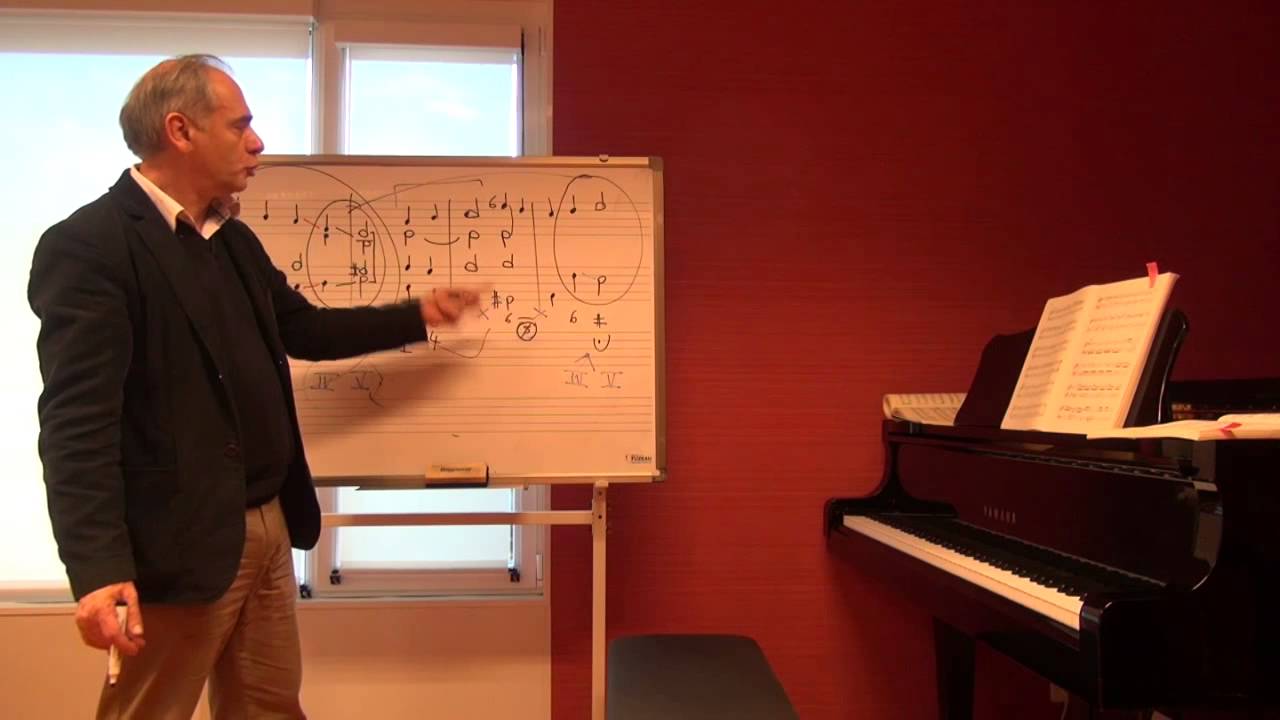
I’m professor Seth Monahan, and I'm glad you showed up for Video no. 14 in my series on classical harmony and counterpoint.
In this video, we’re gonna start to learn to connect chords to one another in the ways that classical composers did.
This is called the art of “voice leading.” And today we’ll be doing voice leading in a format that’s called "keyboard style."
But before we do anything, I want to make sure we understand what the term “voice” in “voice leading” actually refers to.
Now what it *doesn’t* refer to is anybody actually singing, necessarily.
The term “voice” here, rather, simply refers to one of the independent melodic lines that combines with others to form harmony.
This is really important.
If you’ve played a chordal instrument in some genre other than classical music—if you’ve played, say, rock guitar like I have—you might be used to thinking of “chords” as just a bundle of notes that you sorta play all at once, and then move on to the next one, without really asking how the notes in the first chord connect to the notes in the second chord.
Now there’s nothing wrong with that.
But you might be interested to know that classical composers thought of things differently.
They tended to understand harmony as the byproduct of multiple, relatively independent melodic lines.
And that’s why we call chord connection “voice leading”—because basically we’re learning how to make harmonies by weaving melodies together.
And as a rule, we’ll be working with four melodies—four “voices”—at once.
And if you’re wondering “why four—why not three, or five?” Well, on the one hand this was the pedagogical gold standard for centuries—this is sort of how it’s been done since the old days.
Which, in turn, reflects actual compositional practice.
If you think about this: if you’re a composer dealing in a style that uses mainly triads and seventh chords, you’re gonna need at least four notes at once, to be able to spell complete chords.
More than that won’t usually be necessary, and fewer than that actually makes it sort of hard to flesh out seventh chords, for instance.
So now that we know what “voices” themselves are, let’s talk about how we actually put them on the page.
The most common way of notating harmony in four voices is called chorale style.
Now again, we’ve gotta pause here for a quick definition.
“Chorales” were protestant hymn tunes, meant to be sung by church congregations.
And as such, they tended to use mostly stepwise motion; they had simple rhythms; and, crucially, they also tended to be harmonized in four parts—there was the melody, the bass line, and then two “inner” voices sandwiched between them.
So here is an instance of one of the most famous protestant chorale melodies, “Ein feste Burg” or “A mighty fortress.” This is actually written by Martin Luther himself, the father of the Protestant Reformation.
Here’s the tune.
Which you may recognize, even if you don’t happen to be Protestant.
And here’s how Bach harmonized two hundred years after Martin Luther wrote it.
Now, chorale-style harmony gets its name from the fact that it’s notated in the same characteristic way as a Protestant chorale—meaning, you put four voices on a grand staff, with stem direction helping us to see the individual voices.
More specifically, in chorale style, tenor and soprano lines are always stemmed upwards—you can that here—and, by contrast, basses and altos are always stemmed down.
This makes it very clear that the harmony we’re hearing can also be understood as four simultaneous, independent melodies.
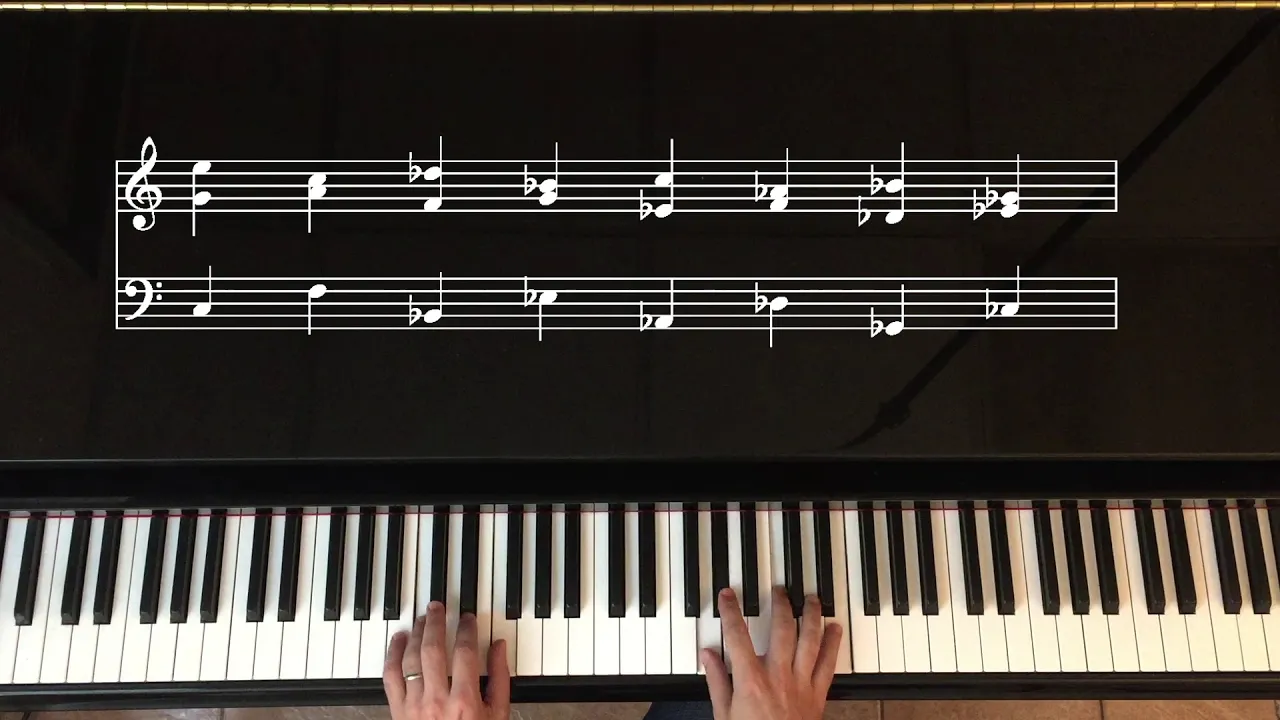
Now, an alternative to chorale-style voice leading is what’s called “keyboard style.” This is what I use in my teaching, and it’s what we’ll be using in these videos as well.
Here is “Ein feste Burg” arranged in keyboard style.
So what’s different?
Notice first, the notation.
Now we have three voices in the right hand, and only one in the left.
And in the right hand, the melody is stemmed up, but the other two voices are stemmed down.
And because it’s designed to be played on a keyboard—hence the name—each staff corresponds to one hand.
The right hand plays three notes, and the left plays only one.
Now what matters is not that they look different on the page.
What matters is that because of this layout, and its specific restrictions, keyboard style takes a step back, away from this conception of harmony as four fully independent voice.
And it invites us to think of harmony as more of a two-voice structure: a melody and a bass line, with inner voices providing a kind of “harmonic filler.” In other words, when we’re working in keyboard style, we’re going to think first in terms of two-voice counterpoint, as I’m showing here—melody and bass—and then we’ll add inner voices directly underneath each note of the melody, kind of “hanging down” from the melody, if you will, to be played with the same hand.
Now before we move on, I want to point out that “keyboard style” is actually nothing at all like most actual classical piano textures.
So don’t be confused on this.
point In real classical piano music, the textures change all the time, and we often find what seems to be fewer than four voices at once.
Here’s a piece I picked almost at random; it’s Mozart’s C-minor piano sonata.
This is the very opening of it.
As you listen, I want you to notice how often Mozart changes the number of active voices.
In the beginning, it’s basically just one voice, doubled in octaves.
Then, a couple of bars later, he moves into three and then four voices.
Not long after that, there’s a long passage that’s just in three voices, and then at the end, he only has two voices.
I’m not gonna explain how or why that is, but notice it as we listen.
However, keyboard style *does* bear a certain resemblance to some kinds of accompaniment textures in the classical style.
Here is the opening of Beethoven’s “Spring” sonata, which you might remember from Video 10.
When we listen to it, pay attention to how the piano part works.
It’s basically in keyboard style: there’s one voice in the left hand, and three voices in the right—although the three voices are connected into arpeggios.
If we just bundle the notes of each arpeggio together, we get something that looks exactly like keyboard style.
So, why do we like keyboard style?
Why pick this over chorale style.
Well, first because it lets us focus on outer voices—which are, to be perfectly honest, much, much more important than the inner voices in the classical style.
Chorale style, we might even say, paints a somewhat distorted picture, because chorale style treats all voices as equal and independent melodies—when in reality, that’s just not the case.
And, to be honest, it’s just much less overwhelming for students than managing the four independent voices of chorale style.
Keyboard style lets us still work with four voices.
But by placing the inner voices in a kind of secondary role, it just makes it easier to wrap one’s head around everything.
Another benefit is that because the upper three voices always lie very close together in keyboard style—remember, they’re all played by the right hand—you’re gonna find that your right hand falls again and again into one of just a very small number of “hand shapes” or finger arrangements.
And the familiarity of these makes working in this style a little bit easier.
(We’re gonna learn about them at the end of the video.)
And finally, one thing I like about keyboard style is that it makes it easier to see errors in the counterpoint, like parallel octaves, say, which we’re gonna touch on shortly.
Now this doesn’t come without trade-offs.
If you’re a harmony teacher like me, it’s kind of a bummer that keyboard style is much harder to sing from, because the lines aren’t fully independent and they’re really not laid out with the human voice in mind.
Specifically, if you try to sing from keyboard style, the tenors are gonna have to scream their heads off or go much higher than they’re physically able to sing.
It’s not ideal.
The other trade-off is that the lines themselves are just limited in their indepentence.
When chorale-style writing is done really artfully, each line gets an actual melody, that moves in interesting in satisfying ways.
Here’s a short chorale-style phrase from a Bach cantata; we heard this in Video 9.
I want you to listen to it sung first.
And then look at a keyboard-style arrangement.
Now, it sounds similar; but there are some important differences.
Because there are things that Bach is able to do with independent voices that you just can’t do in keyboard style.
Look especially at the tenor part, in the second bar.
It’s a wonderful part.
As the sopranos and altos go upward in parallel thirds, the tenor darts in the other direction, and eventually links up with the bass to do its own parallel thirds.
Here’s the tenor part alone.
And here it is with the bass line.
I’ve sung that, and it’s a really beautiful part to sing.
But that beautiful tenor line just has to go in the keyboard-style version, simply because the the human hand can’t do that thing with the different voices wedging in different directions at the same time.
Your hand would split in half.
So you have to make certain sacrifices.
So to sum up: I choose keyboard style because I think it’s more useful to students who are just starting learning this stuff.
But it’s also a bit mechanical and maybe a little bit artless—it doesn’t allow room for the kind of craft and creativity we see in expert chorale-style harmonization like Bach’s.
And that’s fine.
As the saying goes, “you have to start somewhere.” So now that you know what keyboard style looks like, and what it’s good for, let’s move on to the actual rules and guidelines for connecting chords.
First of all, as in all forms of classical voice leading, it’s important not to have parallel perfect fifths or perfect octaves between any two voices when you move from one chord to another.
Parallel perfect fourths are great; you can use them all the time.
But no parallel perfect fifths or octaves.
Second, you have to aim for complete chords; don’t just arbitrarily leave notes out of chords.
There will be some exceptions to this in later videos, we’ll get to those in due time.
And finally, as a general rule, you should aim for the smoothest possible connection between chords.
In other words, connect your chords with the least possible motion among voices.
If a voice can stay put, leave it where it is.
If other voices have to move, keep their motions fairly small—steps rather than leaps, small leaps rather than big leaps.
All else being equal, you should also try, when possible, move your hands in contrary motion—in other words, in opposite directions.
(Not necessarily away from each other—also toward each other.
Just not in similar motion.)
This is especially important if you’re gonna be connecting root-position chords lying a step apart.
So imagine we’re in E major, and we wanna go from a IV chord to a V chord.
So here, I’ve followed the “smoothest connection” rule, I said “AHA!
I can move everyone by step, in the same direction!” Unfortunately, this leads to a whole tangle of contrapuntal problems.
Look more carefully: this seemed like a good idea, initially, everyone moving the smallest possible distance.
BUT, there are parallel octaves between the middle voice in the right hand and the bass.
(We have A’s moving to B’s.)
And we also have parallel fifths against the bass, in the right-hand thumb: A and E to B and F#.
Can’t do it.
Now on the right, we’ve followed the contrary motion guideline, and notice how all the problems go away.
No bad parallels, and the connection is still pretty smooth.
One voice—the middle voice in the right hand—has to leap by third, but everyone else gets to move by step, and there are no contrapuntal problems.
So we like contrary motion for being less risky than moving everybody in the same direction.
Now, all this being said: you can disregard these last two guidelines for the sake of a good and interesting melody, provided you don’t break any other rules.
Let me show you.
Here is a bass line with harmonies indicated by Roman numerals and figures.
So we’re in A major, and the bass line is [PLAYS].
If we were to just realize this in keyboard style, with no concern for melody, we might get something like this.
It’s all the smoothest possible connections between the chords, with lots of contrary motion, and it’s, well, boring as sin.
Notice how the melody itself just noodles around on A and G#, with one, like, brave expedition down to F#.
It’s just extremely dull.
Now here’s a revised version.
Notice that I’ve changed things in the second half: now the melody dips as low as E and then rebounds up to A, and continues to move up all the way to C#.
Here’s the outer voices.
And here it is with harmony.
Now, I want you to notice: the voice leading into bar 3—across the barline there, where E goes up to A—is NOT what you’d call smooth.
At all.
There’s a lot of leadping But I haven’t broken any other rules, and it lets us have a much more lively, much more musical melody.
So that’s great.
I’d rather see this in student work than the boring version that noodles back and forth on A and G#.
So for now, I’d like to wrap up the video with a quick discussion of how your right hand will tend to sit on the keyboard in keyboard style.
Because if you’re doing things right, most chords will use only a few basic right-hand chord shapes.
There are 13 common ones, but we can simplify this even further by speaking of three broad families, all of which contain sort of “inversions” of the same shapes.
So, first of all, there are the “triad” handshapes, which are named because your right hand is gonna play a thing that looks like a triad.
That means it’ll either have two thirds, or maybe a third plus a fourth.
So you could do this thing that looks like a G-major triad, here—your right hand might lie like that.
Or, you might have a thir dwith a fourth on top.
Or the opposite—a third with a fourth beneath it.
Then there’s the “dissonant” family, which always puts your right hand in the shape of an incomplete seventh chord.
So at it’s tightest, this might be, say, a third with a second on top of it, as I’ve shown here—or its various inversions: a second and a fifth, or a third and a fifth.
Or the other tightest version would be a third on top with a second on the bottom, or its various permutations.
And finally, there’s the “open” style handshape, which is distinct in that it might have only two voices.
Notice here there’s just a fourth.
We could also have just a fifth; or maybe a fifth and a fourth stacked together, which spreads the right hand out for a full octave—which is about as wide as you’d want your right hand to sit in keyboard style.
You should never have a voicing that spans a ninth or a tenth, if you could even play it, which seems doubtful.
Now, if all this seems pretty abstract—we’re just talking about how the right hand is shaped—let’s look at the chorale we just used in the last slide to see these handshapes in action.
So if you look really carefully at the right hand, you’ll notice that most of the configurations are from the “triad” family.
In other words, for five of these nine chords, the right hand plays a thing that looks like a triad.
There are fewer instances of the “dissonant” handshape; but I’ve shown these here in red.
And in both cases, you’ve got a very closely-packed version: a third with a second underneath it, and a third with a second above it.
And as it happens, there’s only one instance of an “open” handshape.
That’s the fourth and a fifth stacked here together, which I’ve shown in yellow.
So these are instances of the three families of handshapes.
The last handshape, on the final chord, actually doesn’t fall into any of these categories.
But I’m using it here because of certain voice-leading rules about resolving V7.
We don’t know these yet.
But the point is that I want you to know the common handshapes, so you can notice if you’re using something that’s *not* one of the common handshapes.
Because it means either you’re following some particular rule that requires it—or something’s gone off track.
So your right hand should look fairly predictable in the way it lies during keyboard style.
My very last point has to do with these yellow handshapes, the “open” handshapes.
These shapes have one and only one application: we use them for the upper voices of a first-inversion triad.
And in many cases, they’re optional even in that regard.
It’s not like we *have* to use them with most first-inversion triads.
But we can.
And the reason we might use them, is that they end up saving you a lot of effort in certain circumstances—particularly, when first-inversion triads move by step.
So here’s a very common chord progression, realized in strict four-part keyboard style, and I’ve used blue type to highlight the fact that the second, third, and fourth chords are all first-inversion triads—viio6, I6, ii6—moving up by step.
So I’ll play the progression.
Now the progression sounds perfectly innocent.
But it’s actually really difficult to voice lead this in four parts, stritly.
Because as you’re moving up those three blue chords, you can’t have everyone move in parallel motion, because you’re gonna get illegal parallels.
So there’s all this kind of jostling you have do to, mostly here it happens in in the right-hand thumb.
Look: I move the right-hand thumb down to C, instead of up to E here, to avoid parallel octaves with the bass.
I leap it up to F instead of going up to D, because I’ve gotta avoid parallel octaves with the melody.
And then I move down in contrary motion to the E instead of up to G, because I need to avoid parallel octaves with the bass again.
It’s just a whole mess.
In situations like this, open handshapes can be a lifesaver.
Have a look at this alternate version of the same progression.
Here, over the 6/3 chords, I’ve used two-voice, “open” handshapes.
What ends up happening is that the voice leading is radically simplified.
Instead of the convoluted business on the top, now we just move the right hand in smooth, parallel fourths.
Now, the flip side of course is that you’re effectively creating a three-, rather than a four-voiced texture for some span.
That doesn’t mean it’s gonna sound bad or thin—or even that you’re gonna notice that it’s gone to only three voices.
Here’s how the revised version sounds.
Which is pretty similar to the original.
Now I should say: some theory instructors wouldn’t let their students do this.
Some people are very particular about four voices…you can’t just slip into three voices.
I do let my students do this.
Not only because it’s easier to voice lead, but also because it’s exactly what Haydn or Mozart or Beethoven would’ve done.
You’d never catch those composers messing around with the convoluted solution up on top.
They’d go into a three-voice texture and just zip just through it, no questions asked.
So if it’s good enough for them, it’s good enough for my students.
Now, I wanna stress: you can only do this—you can only slip into a three-voice texture—when you’re using open handshapes, and you can only use those handshapes when you’re using 6/3 chords.
But, there’s a time and a place for them, and if you remember that you can use them, it can save you a lot of trouble.
So at this point, if you’ve watched carefully, you should have all the general rules you’ll need for doing keyboard-style voice leading.
However, there are special voice-leading rules that apply only to specific chord progressions—most common of these is the V7 moving to I, which happens all the time in the classical style, and we’ll be learning all about that in our next video.
So see you then.
Up Next
5:00
Understanding Figured Bass: A Complete Guide
@12tone
94.3K views•2015-11-27

10:20
Mozart's Musical Dice Game Explained: History, Rules, & Fun
@webpianoacademy
5K views•2023-03-13
24:45
Understanding Figured Bass: A Guide to Baroque Harmony
@SethMonahan
56.2K views•2019-06-28
10:49
Understanding John Coltrane's Giant Steps: A Music Theory Analysis
@Vox
10.4M views•2018-11-12
Related Study Plans & Knowledge Roadmaps
Structured learning paths in Music Theory
music-theory
Composing Galant Music: Partimento & Schemata
01Foundations of Figured Bass and Keyboard Harmony
02The Rule of the Octave (Regola dell'Ottava)
03Galant Schemata: The Building Blocks of Form
+ 2 more learning modules
30h5 modules
Explore Roadmap
music-theory
Decoding Overtone Series: Tuning & Drone Music
01Acoustic Foundations: The Physics of the Overtone Series
02Tuning Systems: Equal Temperament vs. Just Intonation
03Microtonality and Spectralism: Beyond Standard Pitches
+ 2 more learning modules
24h5 modules
Explore Roadmap
music-theory
Impressionist Harmony: Scales, Planing & RPGs
01Foundational Music Theory: Keys, Intervals, and Seventh Chords
02Impressionist Color: Chord Planing and Parallel Harmony
03Whimsical Textures: Pentatonic Cascades and Whole-Tone Scales
+ 1 more learning modules
14h4 modules
Explore Roadmap
music-theory
Negative Harmony: Axis Reflection in Indie Pop
01Music Theory Foundations: Scales, Intervals, and Triads
02Functional Harmony and the Circle of Fifths
03Demystifying the Negative Harmony Axis Reflection
+ 2 more learning modules
16h5 modules
Explore Roadmap