




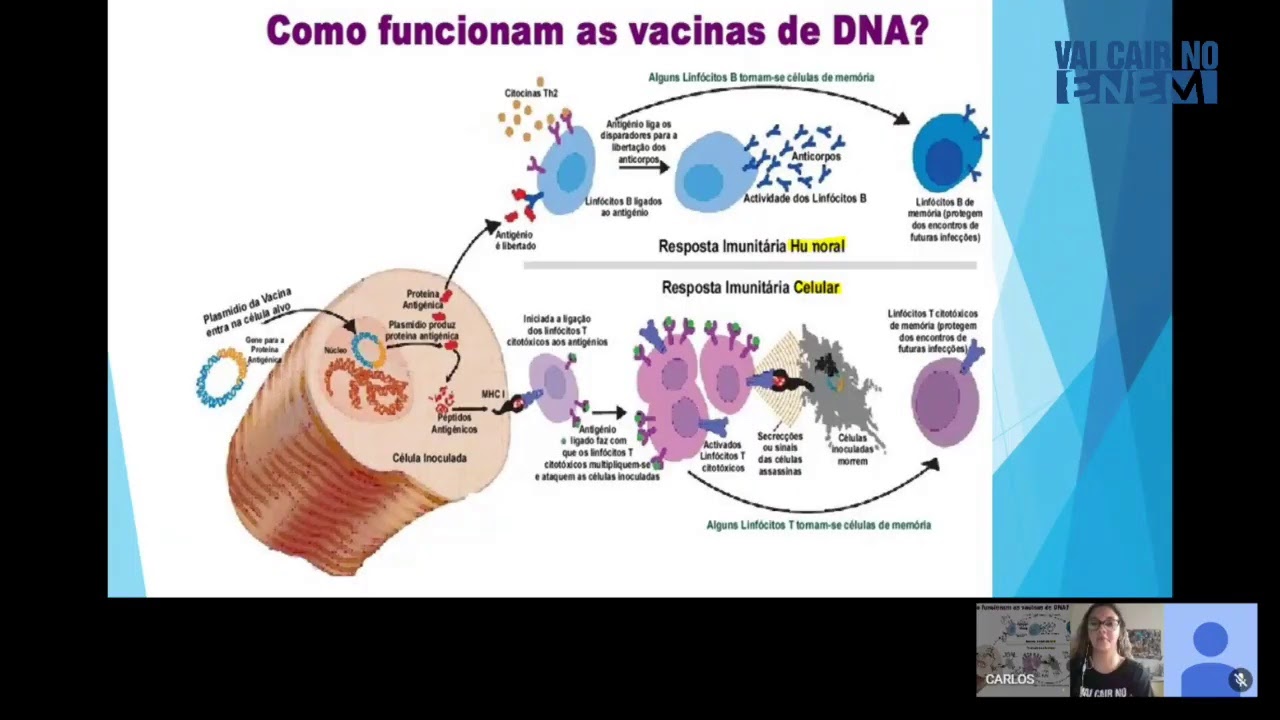











Messenger RNA (mRNA) is a cellular messenger that carries genetic instructions from the nucleus to ribosomes, where proteins are manufactured; unlike DNA, mRNA is unstable and degrades quickly, making it ideal for vaccines because it can instruct cells to produce harmless spike proteins that train the immune system without integrating into the cell's genetic material or causing infection.
mRNA Therapeutics: How Messenger RNA Vaccines Work
Added:The Central Dogma of Molecular Biology: The process of how DNA is transcribed into mRNA, and how mRNA is translated into proteins by ribosomes.
Basic Cell Anatomy: The function of ribosomes, the cytoplasm, and the cellular membrane in protein synthesis and uptake.
Fundamentals of the Immune System: Understanding what antigens and antibodies are, and how the body recognizes foreign substances.
Traditional Vaccine Mechanisms: How conventional vaccines (such as inactivated or weakened pathogens) introduce antigens to stimulate immune memory.
Lipid Nanoparticle (LNP) Delivery Technology: How scientists package fragile mRNA molecules to safely cross the cell membrane without degrading.
mRNA Therapeutics in Oncology: How mRNA technology is being developed to train the immune system to target and destroy cancer cells.
Rapid Vaccine Adaptation: The engineering pipeline for modifying mRNA sequences to quickly address emerging viral variants and mutations.
Comparative Vaccine Platforms: Analyzing the biological and logistical differences between mRNA, viral vector, and protein subunit vaccines.
4.8K views116likes4:52Original Release: 2023-04-07
in this video you're going to learn all about messenger RNA and how it's being used to develop Innovative therapies like vaccines I'm Dr Andrew Berg co-founder of sketchy a visual learning company used by medical students around the world and I'm Dr Chase feiger from austro Health Medicine can be complicated so we find it's easier to teach it with visual stories we'll use this medieval town to show how our cells normally function what happens when coronavirus infects our cells and how mRNA Therapeutics work to protect us from the devastating consequences of infection so you can see this town is encircled in walls these are to represent the cell membranes that surround and protect every cell in our body in this building here in the center is the nucleus so what's the nucleus and why is it important well let's hop inside to find out the nucleus acts as The Archives of the cell essentially a giant Library full of DNA which are these helical sculptures with glowing runes DNA contains the blueprints for all of the proteins that our cells create basically your proteins make you you but we have a problem the DNA blueprints are inside the nucleus but our protein manufacturing occurs outside of the nucleus and DNA never leaves the nucleus so to get the blueprint information from inside to outside we need a messenger introducing messenger RNA also known as mRNA and you can see these messenger monks are busy reading the DNA and then transcribing it onto these mRNA Scrolls the MRNA Messengers then exit the nucleus via this slide and then make their way to our protein manufacturers represented by this blacksmith who then translates the plans to build proteins these proteins range from structural components in the cell to Signal hormones that travel throughout the body this happens thousands of times per second in every cell in our body and what's critical to understand here is that mRNA can only leave the nucleus which is why we show them going down this slide and once it's out it can't get back in and just like these flimsy Scrolls here mRNA is unstable it degrades quickly and this can be from a matter of minutes up to a maximum of a few days whereas DNA remains intact throughout the life of the cell now that you know the normal function of our cell let's talk about what happens when your body gets infected with Coronavirus coronavirus has adapted to utilize specific proteins called Spike proteins these Spike proteins attach to our cells and allow it to penetrate our cell's defenses once inside the cell the viruses mRNA completely hijacks a cell's machinery and uses it to replicate its genetic material and make copies of itself these copies accumulate inside our cell until eventually they destroy the host cell pouring out as they go on to infect new cells in this way coronavirus can create billions of viral particles inside our body this cellular destruction causes the symptoms of fever inflammation and if severe enough can even lead to shock and death [Music] now that we know how our cells work and how viruses like coronavirus hijack our cells to spread infection let's shift our focus and talk about Therapeutics historically vaccines were formed from weakened or killed viral particles used to create an immune response these vaccines have saved countless lives but growing whole viruses in the lab can be costly and time consuming mRNA technology has been a major breakthrough allowing us to much more rapidly develop new vaccines to more quickly respond to new diseases all right so let's take a look at how this works the MRNA in vaccines has a coating that protects it and allows it to enter our cells and importantly this mRNA never enters our nucleus and so it never gets added to the DNA archival Library the vaccine mRNA doesn't last long it actually degrades completely within a few days but that's long enough for our protein blacksmiths to read the MRNA instructions and use them to create Spike proteins these Spike proteins are then presented outside of our cell and gives our immune system the ability to practice on harmless pieces of the virus basically we're making training dummies these archers are like our immune cells and they're practicing training their antibody arrows on these viral particles that way if one day coronavirus does try to invade they'll be ready and waiting
Up Next

1:34
mRNA Synthesis via IVT: A Step-by-Step Guide
@thermofisher
119.3K views•2022-11-02
14:12
Quantitative Real-Time PCR (qPCR): Principle, Method & Data Analysis
@animatedbiologywitharpan
129.2K views•2023-09-06
23:33
Microbial Degradation of Plastics: Biodegradation Pathways & Sustainability
@majeedhammad
2.9K views•2021-04-11
16:04
CRISPR and Genetic Engineering: How Gene Editing Works and Why It Matters
@kurzgesagt
30.5M views•2016-08-10
Related Study Plans & Knowledge Roadmaps
Structured learning paths in Biotechnology
biotechnology
AAV Production: Transfection, Prep & qPCR
01Introduction to Gene Therapy and AAV Biology
02Mammalian Cell Culture: Suspension HEK293 Cells
03Upstream Bioprocessing: Triple-Transfection Optimization
+ 2 more learning modules
18h5 modules
Explore Roadmap
biotechnology
Building Gut-on-a-Chip: PDMS, Cells & TEER
01Foundations of Microfluidics and Gut Anatomy
02Cleanroom Fabrication & PDMS Soft Lithography
03Epithelial Cell Culture and On-Chip Seeding
+ 2 more learning modules
26h5 modules
Explore Roadmap
biotechnology
Optimizing CFPS: E. coli Extract & Yield
01Fundamentals of Molecular Biology and Translation
02Introduction to Cell-Free Protein Synthesis (CFPS)
03Preparing E. coli Crude Lysate (The Extract)
+ 2 more learning modules
19h5 modules
Explore Roadmap
biotechnology
Haematococcus PBR: Design, Stress & Astaxanthin
01Biology and Life Cycle of Haematococcus pluvialis
02Bench-Scale Photobioreactor (PBR) Design and Engineering
03Culture Media Formulation and Inoculation
+ 2 more learning modules
15h5 modules
Explore Roadmap