
























![[🛑라이브] 탄소배출량을 알아야 감축이 보인다 : 국제통용 발자국 검증제도 A To Z](https://i.ytimg.com/vi/eVbgLjmV7AM/maxresdefault.jpg)
Nature has evolved organisms like bacteria, fungi, and insects that can break down plastics, inspiring bioengineers to develop powerful enzymes such as PETase and MHETase that can degrade polyethylene terephthalate (PET) plastic in hours rather than weeks, with companies like Carbios now commercializing enzymatic recycling technologies that could revolutionize how we manage plastic waste.
Can Enzymes Revolutionize Plastic Recycling? Exploring Biodegradation
Added:Basic polymer chemistry, including the molecular structure of common synthetic plastics (such as PET) and why their covalent bonds are highly resistant to natural decomposition.
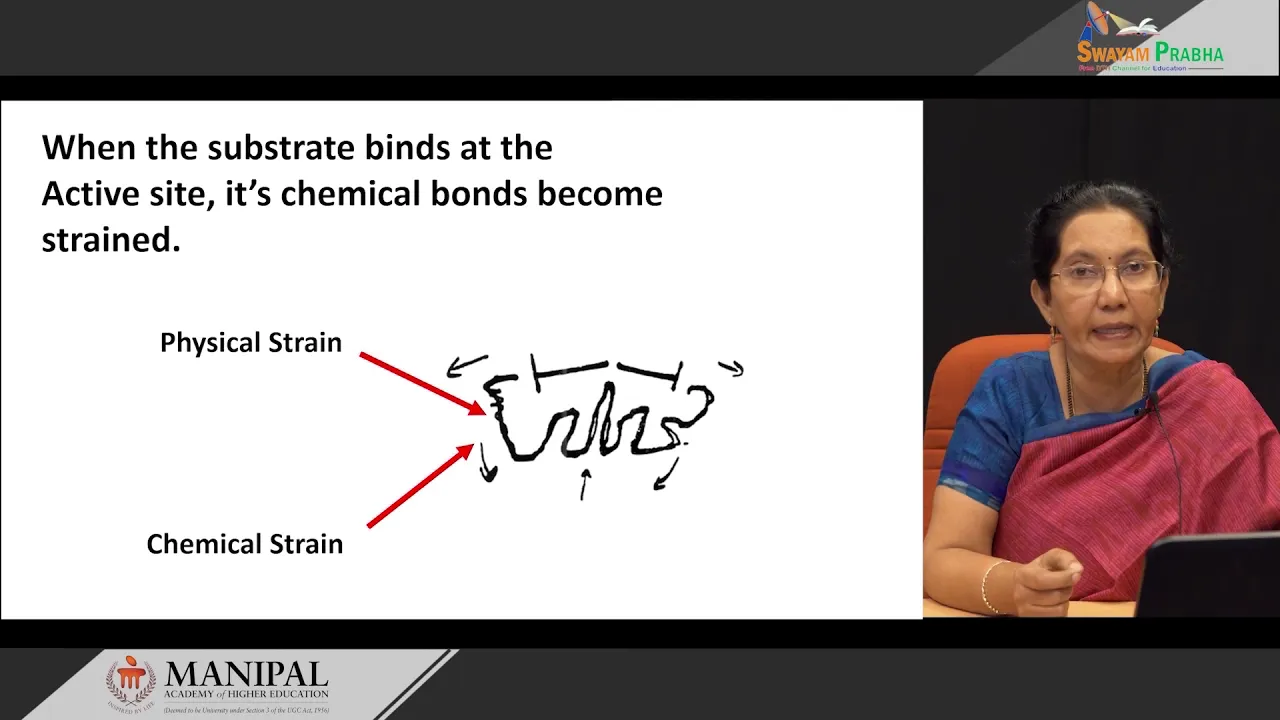
The fundamentals of enzymology, specifically how enzymes function as biological catalysts, including the concepts of substrate specificity and active sites.
The distinction between traditional recycling processes (mechanical and chemical) and biological degradation.
Introductory concepts in biotechnology, specifically how genetic modification and protein engineering can alter the function of enzymes and microorganisms.
The biochemistry of specific plastic-degrading enzymes, such as PETase and MHETase, and how directed evolution is used to enhance their thermal stability and reaction rates.
The engineering and economic challenges of scaling up enzymatic recycling from laboratory settings to industrial-scale bioreactors.
The principles of the circular economy and 'design for degradation,' where new polymers are designed alongside matching enzymatic recycling pathways.
Life Cycle Assessment (LCA) methodologies used to evaluate whether enzymatic recycling has a lower carbon footprint and environmental impact than virgin plastic production.
540.7K views23.9Klikes14:20Original Release: 2023-04-04
A portion of this video is brought to you by Surfshark.
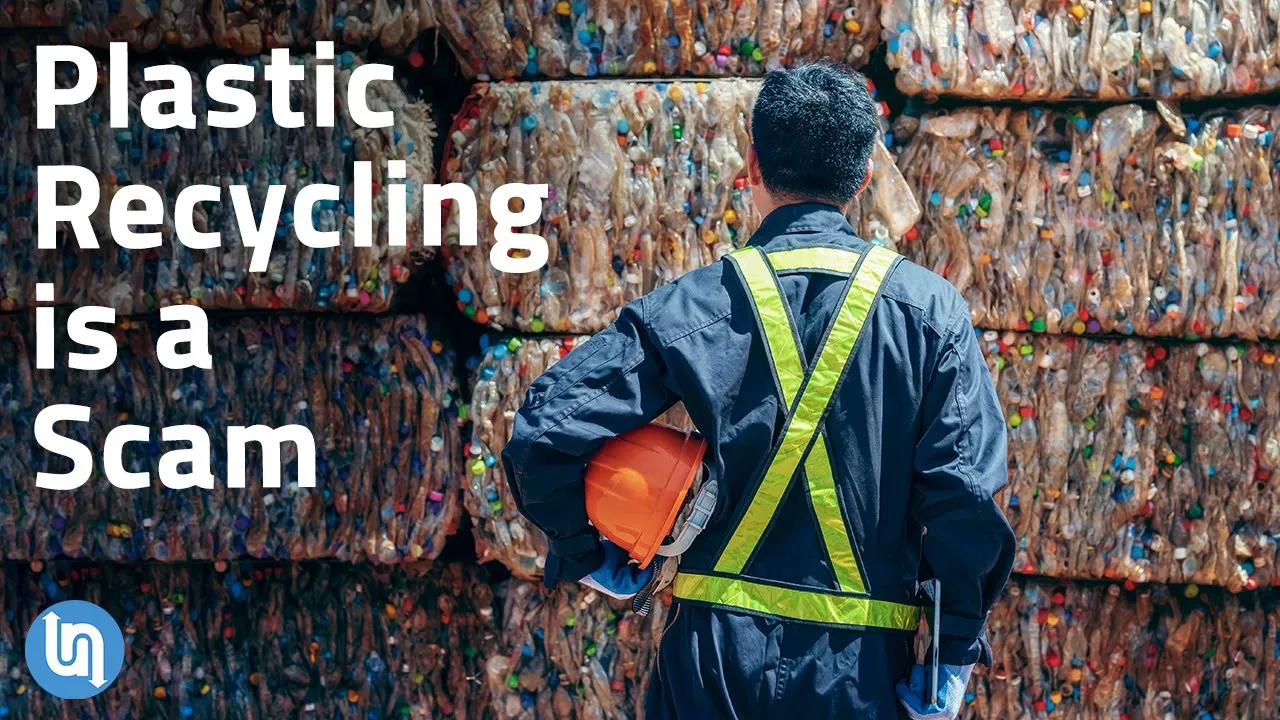
The vast majority of the world’s plastic isn’t recycled … and when it is, we spend more money to achieve less quality. It’s currently cheaper to keep producing newer plastics — at the much higher cost of human and environmental health.
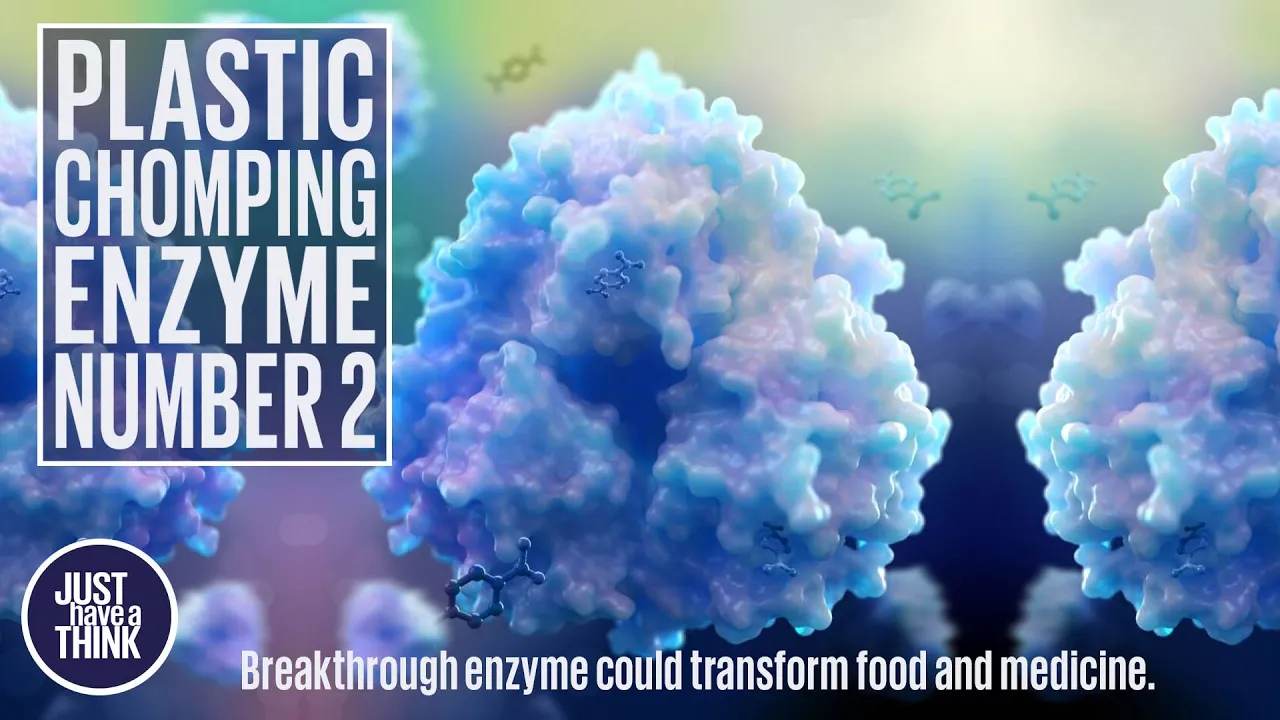
But nature has evolved in response. Several species of insects, bacteria, and fungi can break down plastics all on their own. By studying the enzymes that make this happen, bioengineers are realizing ways to degrade plastics that don't involve burning them or dousing them in chemical solvents. Going from taking weeks to break down plastics in early research to just hours recently.
And the momentum is building. One company has successfully developed an enzyme that doesn’t need industrial conditions to work, allowing consumers to add bioplastics to compost piles at home. We’re already living in a future where it’s possible to bury a yogurt cup with confidence, knowing it’ll disintegrate the same way the food scraps will. That’s a big difference from rinsing it out, tossing it into a bin, and hoping for the best.
How did researchers get us here? And does this mean we can have our plastics and eat them, too?
I’m Matt Ferrell … welcome to Undecided.
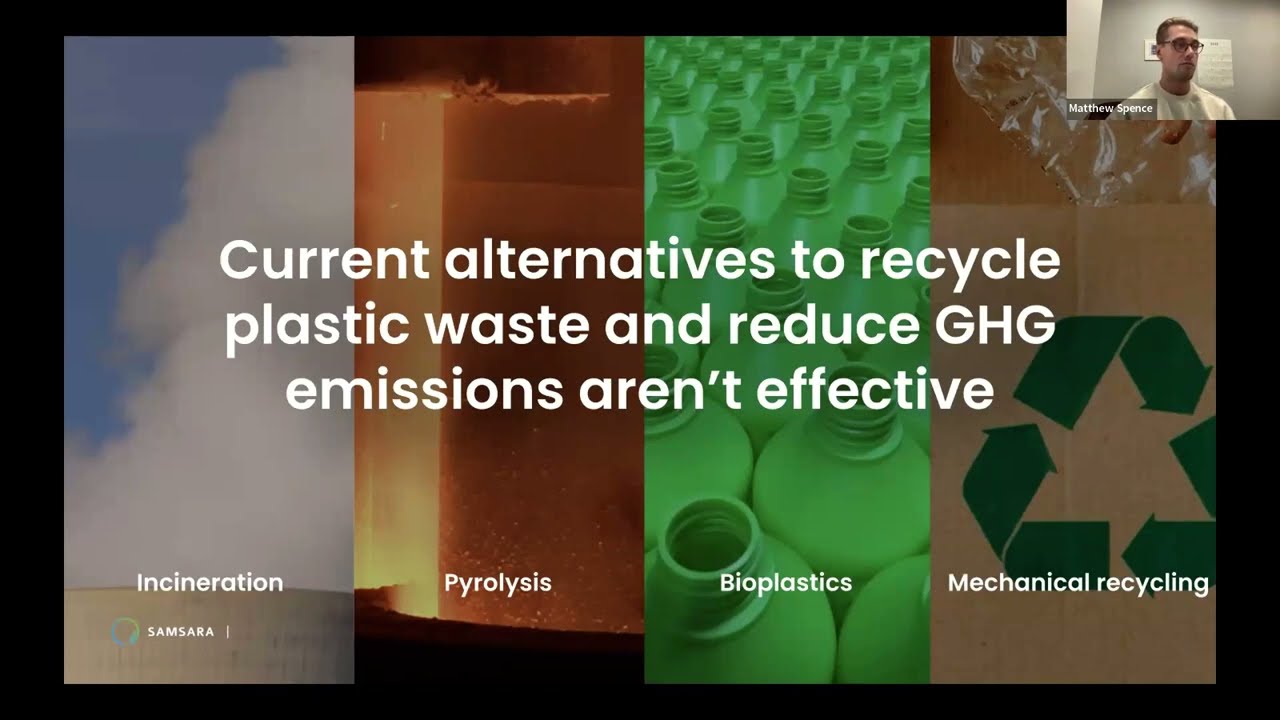
Well, we already know we’re eating our plastics — and by “we” I mean the entire planet. There’s no doubt about it: the accumulation of plastic in our water, air, and soil is an exponentially growing problem with consequences that we aren’t even fully aware of yet. In a previous video I broke down why the current plastic recycling process isn’t really a recycling process at all. It’s not practical or profitable, and the numbers don’t lie: A 2017 study estimates that only 9% of all the plastics humanity has ever created have been recycled. Meanwhile, 80% is either leaching toxins in a landfill or out disrupting ecosystems.
And with plastic appearing virtually everywhere, right down to our own organs, there’s mounting evidence that we really are what we eat. However, humans and animals aren’t the only organisms that consume plastic…one way or another. And this can be exploited for good.
With some species of insects, algae, fungi, and bacteria as inspiration, scientists have genetically engineered approaches to biorecycling and biodegradation that could someday be more viable than current recycling practices…like bioplastic that disappears into dirt.
Hold that thought, though. How did we ever come to that? It turns out nature might have been giving us hints all along. So, to explain how bioengineering has come this far, let’s work from the ground up. Scientists have actually been identifying species of microbes capable of digesting plastic as early as the ‘90s. Observations of several species of algae have revealed their capacity to live on the surfaces of multiple types of plastics and partially degrade them. We also know of at least 28 species of fungi that can feed on plastics as sources of carbon or energy.
It’s grub for grubs, too. The larval forms of beetles and moths, like mealworms, waxworms, and superworms, don’t seem to mind munching on polyethylene, or PE. That’s a promising adaptation considering that of the 400 million tons of plastics churned out each year, PE makes up the most of it. That’s stuff like shopping bags … the ones you always see “drifting in the wind” or “blowing down a highway alone.” Worms aren’t picky eaters, either. In a 2018 study, researchers from Stanford University and the University of Oklahoma found that baby beetles could eat both PE and mixtures of PE and polystyrene, or PS. PS is the foam-y kind: Think egg cartons, meat packaging, and insulation.
During a 2022 experiment, a team of researchers from the University of Queensland in Australia noticed that superworms can not only bore right through PS, but continue to function on an all-PS diet. That wasn’t great for their health — for us, it would be kind of like living off nothing but potato chips as a kid. Still, they did make it to adulthood alongside their bran-fed peers.
Bugs’ stomachs are so big on plastics because they’re full of secrets. Sure, worms chew their food, but it’s the chemical, not mechanical, action that really counts. The true stars of the show are the bacteria inside the insects’ gut biomes, which enable them to fully digest plastics. And it’s one bacterium in particular that’s kicked off a global rush to scout for similar species to use as genetic muses. You could say it’s the world’s most microscopic casting call.
And what better place to hunt for plastic-eating bacteria than at a plastics recycling center?
That’s where researchers from the Kyoto Institute of Technology and Keio University unearthed the bacterial breakout talent that started it all: in the sludge surrounding a bottle recycling site in Sakai, Japan.
The significance of this needs a little more context. According to a 2019 report by Plastics Europe, 40% of the global demand for plastics is for packaging.
Products like single-serving drinks, peanut butter, and detergent are typically packaged in containers made of polyethylene terephthalate, or PET. Among the many branches of the plastic tree, PET is the most abundant within the polyester group.
On top of this, the majority of PET is crystalline. This makes it notoriously “recalcitrant” — AKA just plain stubborn … like a typical 3 year old — so it’s much harder to degrade. The chemical recycling that does work is more expensive than creating new plastic from scratch, and mechanical recycling reduces PET’s value. As a result, PET is the most recycled of its plastic peers in the U.S., but only 31% of it. The European Union recycles about half.
When it comes to plastic bottles specifically, only about 14% are recycled around the world.
If only we had a flagellate hero to save the day. But what’s that on the ground? Is it a worm?
Is it a fungus? No — it’s Ideo-nella sakaie-nsis. With the power of two enzymes…and friendship…a community of bacteria can break down a thin film of PET.
The 2016 discovery of this very hungry bacterium was a cause for excitement, hope, and inspiration. But every superhero has a weakness, and in this case, it would be that I. sakainesis does its thing only when they’re held at a consistent temperature of 30 C (or 86 F). The process also takes six weeks, and that’s too slow for an industrial scale. Plus, the germ has its own Kryptonite. Its weapons of choice, the enzymes PETase and MHETase, are no match against crystalline PET, the most common kind.
We can do better than that though, right? When your weapons aren’t good enough, you upgrade them.
Before we get to that upgrade, I’d like to thank Surfshark for sponsoring this portion of today's video. I always recommend using a VPN when using public Wifi, but VPNs can be very useful even when you’re home. A lot of online services use some pretty sophisticated commercial tracking and machine learning to apply very targeted advertising... a VPN can protect you from some of that. SurfShark’s CleanWeb does a great job blocking ads, trackers, and malicious websites making it safer to use the internet even at home. And you can even make it look like your IP address is coming from a completely different country. This can come in handy if you want to stream a video that’s only available from a specific location. One of the best parts of SurfShark is that it’s easy to set up on all your devices, whether that’s iPhone or Android, Mac or PC. SurfShark is the only VPN to offer one account to use with an unlimited number of devices. Use my code to get 83% off plus 3 extra months for free. SurfShark offers a 30-day money-back guarantee, so there’s no risk to try it out for yourself. Link is in the description below. Thanks to Surfshark and to all of you for supporting the channel. So, back to the weapon upgrade.
Smart enzymes get spliced at the lab. And spliced they were. Multiple times. In fact, it was a double-mutant of PETase that took center stage in 2018 when an international collaboration of researchers accidentally engineered it to perform better than the original. The sequel to PETase works 20% faster. More crucially, it can gobble up PET with a crystallinity of roughly 15%. That’s about the same crystallinity you see in the bottles you get out of vending machines. For comparison, the natural PETase studied by the Japanese research team involved PET films with a crystallinity of about 1.9%.
As an added bonus, this new and improved PETase can also degrade an up-and-coming bioplastic derived from sugar, polyethylene furanoate (or PEF). But members of the research team, led by the University of Portsmouth in England and the US Department of Energy's National Renewable Energy Laboratory (NREL), didn’t want to stop there. They knew they could go further, concluding that while their results were encouraging, “the performance would need to be enhanced substantially.” How do you double-time a double-mutant? Where do you find clues on how to push past an enzyme’s limits? Have you tried the pile of leaves in the backyard? Because those are the humble origins of the next breakthrough. Plants have cuticles, too, and just like our own, they’re protective surfaces. The building blocks of this leafy skin are the all-natural twin polymers cutin and cutan.
The story goes that scientists identified leaf and branch compost cutinase, or LCC, within DNA sampled from a compost heap. As you might expect from its name, cutinase can break up cutin, and in 2012, scientists found that it could also snap PET like twigs. The problem is that like a lot of enzymes (and people), LCC doesn’t work well in high heat, and the target temperature for industrial recycling of PET is about 75 C, or 167 F. So, LCC hung out behind the curtain as an understudy for a while. I guess you could say it was a little too “green.” But now the pressure to evolve is on, and researchers are leaving no stone unturned.
In 2020, French researchers from the University of Toulouse examined the reaction rates of bacterial enzyme mutations, using LCC as one of its springboards. After studying over 200 variants, the team finally optimized the fastest iteration of PETase yet, clocking in a minimum 90% degradation over a mere 10 hours. And it’s not just efficient — it works comfortably at 72 C. This version of PETase also yields a lot of terephthalate, or TPA, which can then be reprocessed into PET that’s good as new. Emphasis on “good as new”: this means that the enzyme can produce recycled plastic with the same properties as factory-fresh.
The plot thickened a few months later, when researchers from the University of Portsmouth and NREL collaboration declared that they had done it again. By combining the capacities of PETase and MHETase the same way Ideo-nella sakaie-nsis does in nature, they boosted the speed of their 2018 mutation of PETase six times over.
More recently, researchers from the University of Texas at Austin threw their hat into the ring with yet another PETase that they call “functional, active, stable and tolerant,” or FAST. With five mutations under its belt, FAST-PETase stands out from the crowd with its range. It can work between 30 and 50 C and can officially degrade 51 different PET-based products in a week. In some cases, it only needs hours or days. The team has patented the method, and as of April 2022, it’s seeking out corporate partners for commercialization.
That brings us back to today, when it seems that science has a pretty strong grip on biodegrading PET. But whether these developments are substantial enough to make a dent in plastic waste is still questionable. Enzymes can require a variety of specialized conditions. Just among the PETases we’ve covered, each operated under different temperatures. And even if an enzyme can easily be integrated into industrial conditions, that infrastructure doesn’t exist yet. When simply making more is so cheap, it’ll probably be harder to break plastic production habits than the plastics themselves.
And PET is only one head on the plastic hydra. We’ve got a dizzying number of other forms to worry about. Something as seemingly simple as a handful of LEGO, for example, can involve up to at least 12 different plastics, all of which have been washing up on beaches for decades. The LEGO Group says it wants to work toward shifting to sustainably sourced plastic by 2030, though. It’s currently prototyping toy bricks made from recycled PET bottles.
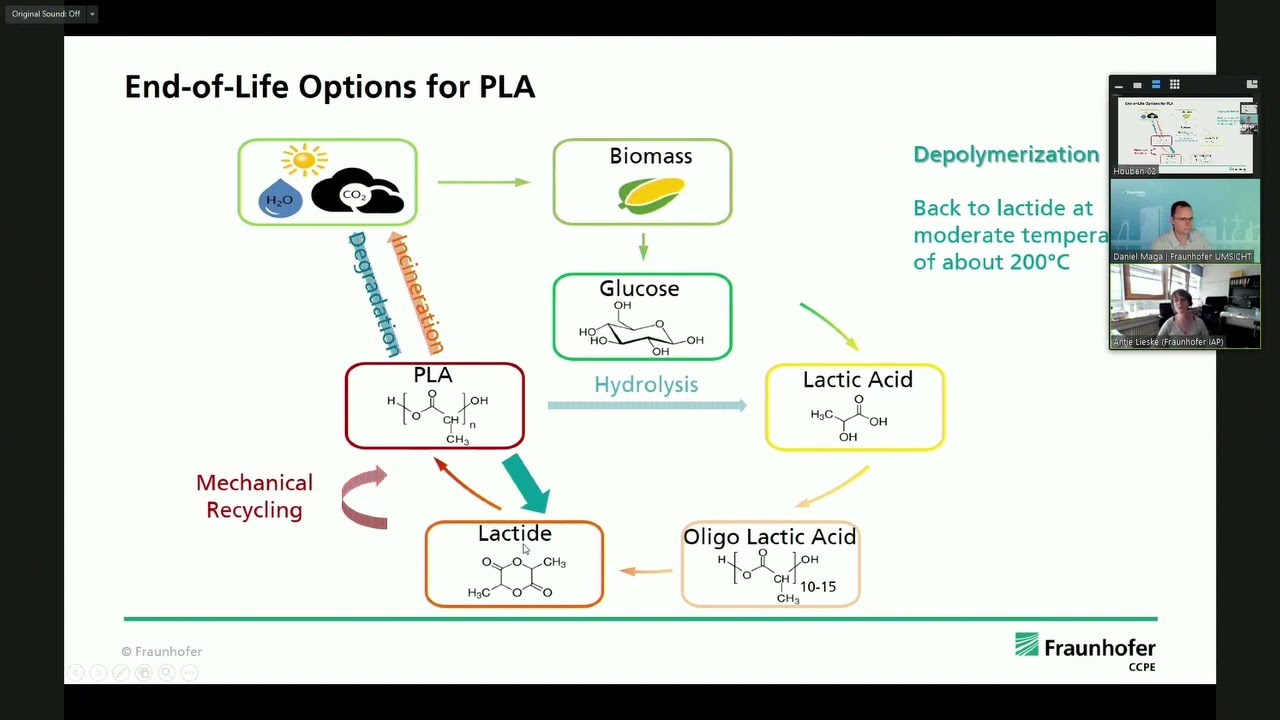
That's great and all, but world-changing technologies are difficult to implement at a commercial scale when solving any kind of problem. The good news is, though there’s no guarantee that enzymatic plastic degradation will become the norm, a few enzymes have already begun to prove their mettle out in the real world, with intriguing results. In 2014, the French company Carbios debuted an enzyme with the ability to degrade 90% of polylactic acid or PLA, a form of bioplastic, within 48 hours. Working in tandem with its subsidiary Carbiolice, Carbios achieved certification of the enzyme “Evanesto” as an additive for PLA packaging in 2020. Once incorporated into PLA products during manufacturing, Evanesto lets you compost anything from mulching film to coffee pods at room temperature, right at home.
The company claims that items made of PLA plastic will biodegrade in 255 days (or less), and because PLA is typically sourced from starches like corn or sugarcane, you don’t have to worry about any toxins or residue left behind. Its FAQ page even clarifies that you don’t have to waste water by washing out your yogurt cups before you throw them onto the compost heap.
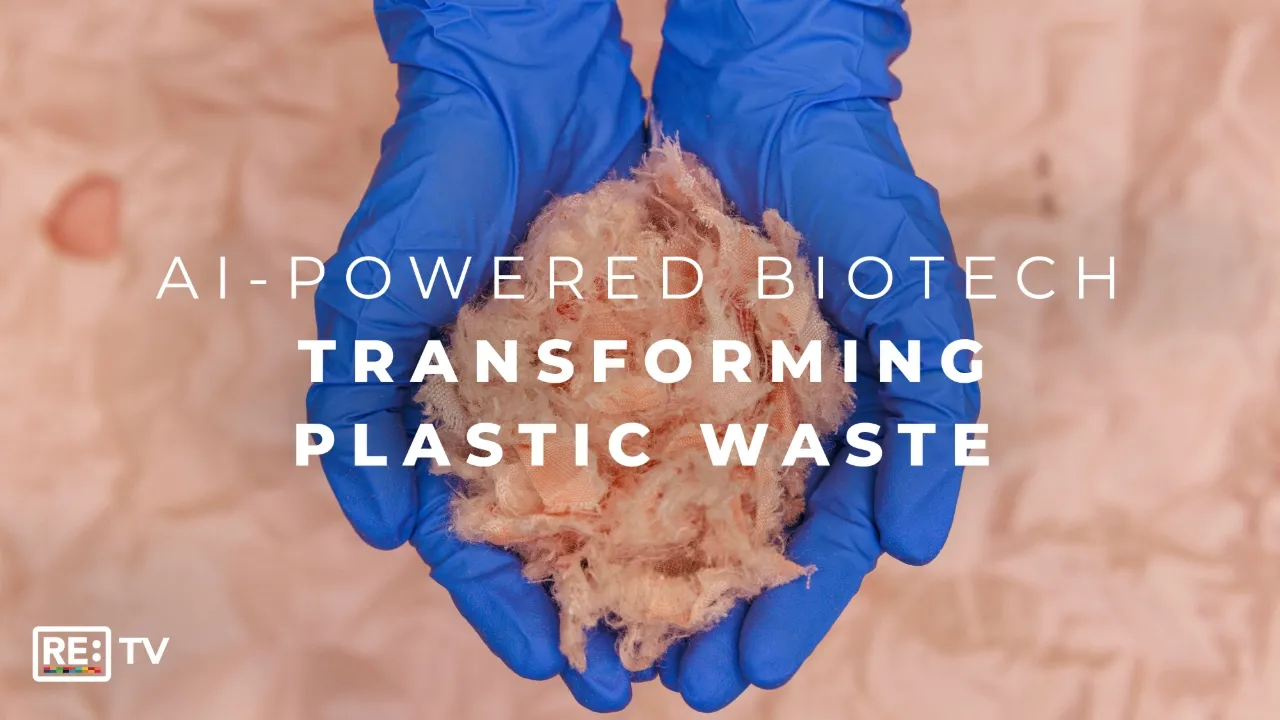
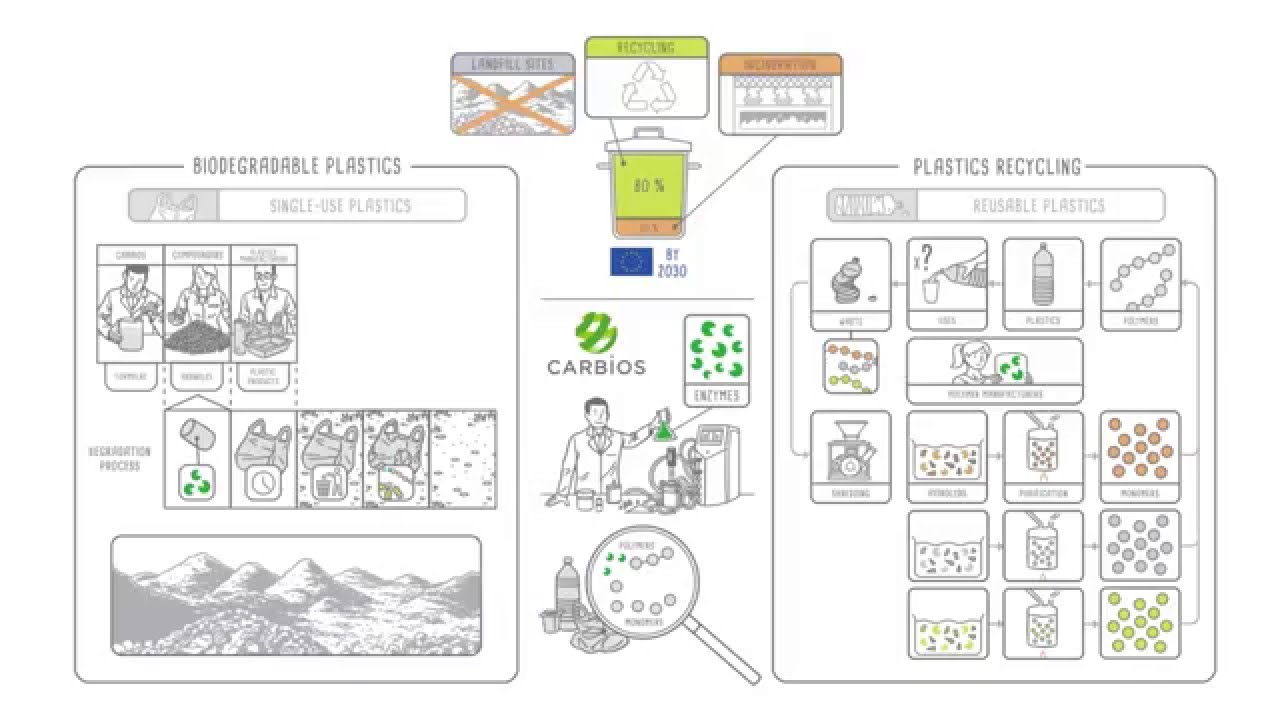
That’s not all. Since September 2021, Carbios has been in the pilot phase of commercializing its enzymatic PET recycling technology at a demonstration plant. Last month, the company announced the end of its CE-PET research project, which it says validated multiple processes at an industrial scale. Carbios managed to address both plastic and textile PET waste by producing bottles made entirely out of both. Interestingly, it also substantiated a method of producing white fiber from recycled PET waste, regardless of the original plastic’s color.
While not everyone in the plastics and petrochemical industries is optimistic about enzymatic recycling, Carbios has received funding from the French State, and the corporations behind several major brands have also jumped in, including L’Oréal, Nestlé, Pepsi, and Puma. The company plans to establish its first industrial plant in early 2025.
No matter who or what is eating plastic, figuring out how we clean up our mess is complicated. It’s clear that we can look to algae, fungi, plants, and bacteria for guidance on how to break plastics, but maybe we’re better off viewing them as examples of how to build plastics. Seaweed, mycelium fungus, and algae all have the potential to form our go-to materials someday. As ubiquitous as the plastic we’re familiar with is now, it hasn’t really been around for that long — and maybe it won’t have to much longer. Definitely some food for thought.
So do you think enzymes like this are the key to solving our plastic problem?
Jump into the comments and let me know. And be sure to check out my follow up podcast Still TBD where we'll be discussing some of your feedback. If you liked this video, be sure to check out one of these videos over here. Thanks to all of my patrons, who get ad free versions of every video, for your continued support. And welcome to new Supporter+ member Nick Salve. You're helping to reduce my dependence on YouTube to pay for producing these videos. And thanks to all of you for watching and commenting. I’ll see you in the next one.
Up Next
26:54
Emmanuelle Charpentier Nobel Lecture: CRISPR-Cas9 Genome Editing
@NobelPrize
127.2K views•2020-12-08
14:12
Quantitative Real-Time PCR (qPCR): Principle, Method & Data Analysis
@animatedbiologywitharpan
129.2K views•2023-09-06
23:33
Microbial Degradation of Plastics: Biodegradation Pathways & Sustainability
@majeedhammad
2.9K views•2021-04-11

16:04
CRISPR and Genetic Engineering: How Gene Editing Works and Why It Matters
@kurzgesagt
30.5M views•2016-08-10
Related Study Plans & Knowledge Roadmaps
Structured learning paths in Biotechnology
biotechnology
AAV Production: Transfection, Prep & qPCR
01Introduction to Gene Therapy and AAV Biology
02Mammalian Cell Culture: Suspension HEK293 Cells
03Upstream Bioprocessing: Triple-Transfection Optimization
+ 2 more learning modules
18h5 modules
Explore Roadmap
biotechnology
Building Gut-on-a-Chip: PDMS, Cells & TEER
01Foundations of Microfluidics and Gut Anatomy
02Cleanroom Fabrication & PDMS Soft Lithography
03Epithelial Cell Culture and On-Chip Seeding
+ 2 more learning modules
26h5 modules
Explore Roadmap
biotechnology
Optimizing CFPS: E. coli Extract & Yield
01Fundamentals of Molecular Biology and Translation
02Introduction to Cell-Free Protein Synthesis (CFPS)
03Preparing E. coli Crude Lysate (The Extract)
+ 2 more learning modules
19h5 modules
Explore Roadmap
biotechnology
Haematococcus PBR: Design, Stress & Astaxanthin
01Biology and Life Cycle of Haematococcus pluvialis
02Bench-Scale Photobioreactor (PBR) Design and Engineering
03Culture Media Formulation and Inoculation
+ 2 more learning modules
15h5 modules
Explore Roadmap