





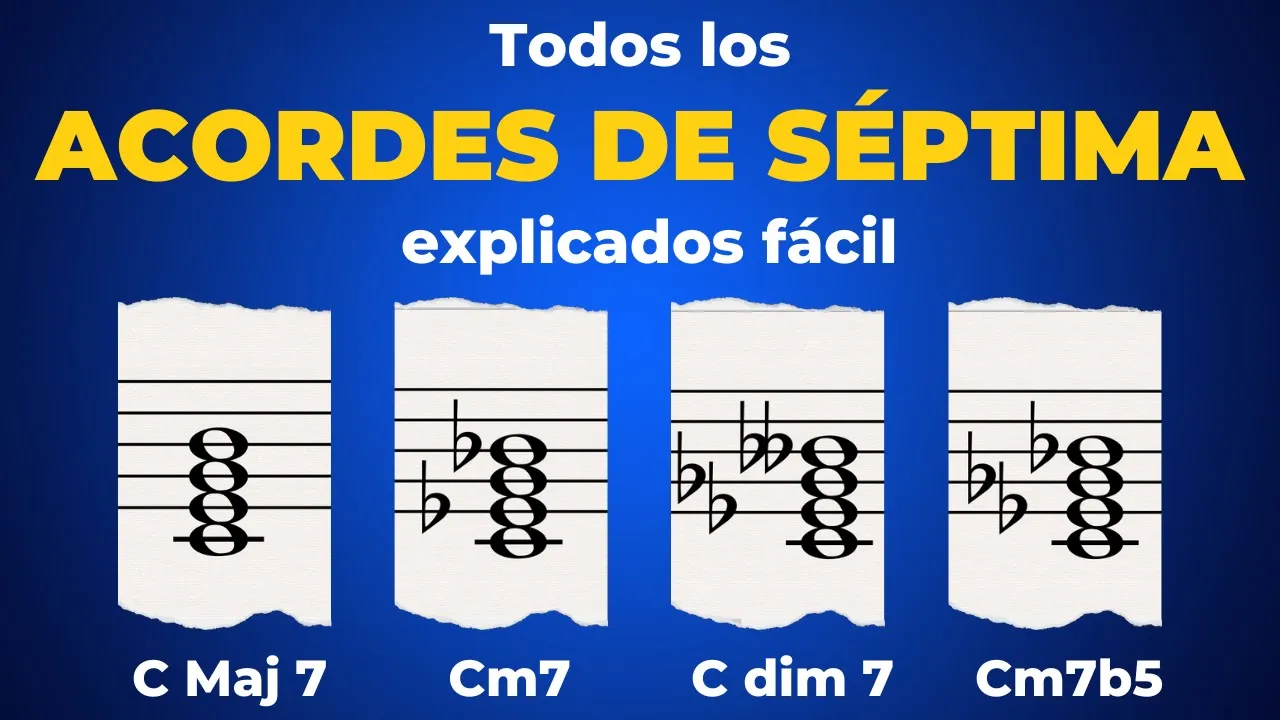

















The ii-V-I progression is the foundational harmonic structure in jazz music, consisting of three chords that move from the second degree (ii) to the fifth degree (V) to the first degree (I) of a key. In major keys, this translates to a minor 7 chord on the ii degree, a dominant 7 chord on the V degree, and a major 7 chord on the I degree (e.g., Dm7-G7-Cmaj7 in C major). In minor keys, the progression uses a half-diminished ii chord (ii°7), a dominant 7 V chord, and a minor tonic chord (e.g., Dm7♭5-G7-Cm in C minor). These progressions can be played using either four-note extended voicings or simpler three-note voicings for an authentic early jazz sound, and they typically follow either a short format (half-bar ii, half-bar V, full-bar I) or a long format (full-bar ii, full-bar V, two-bars I). The progression can also be applied to jazz standards like 'Autumn Leaves' by alternating between major and relative minor 251 sequences.
Mastering ii-V-I Jazz Chord Progressions: Autumn Leaves for Guitar
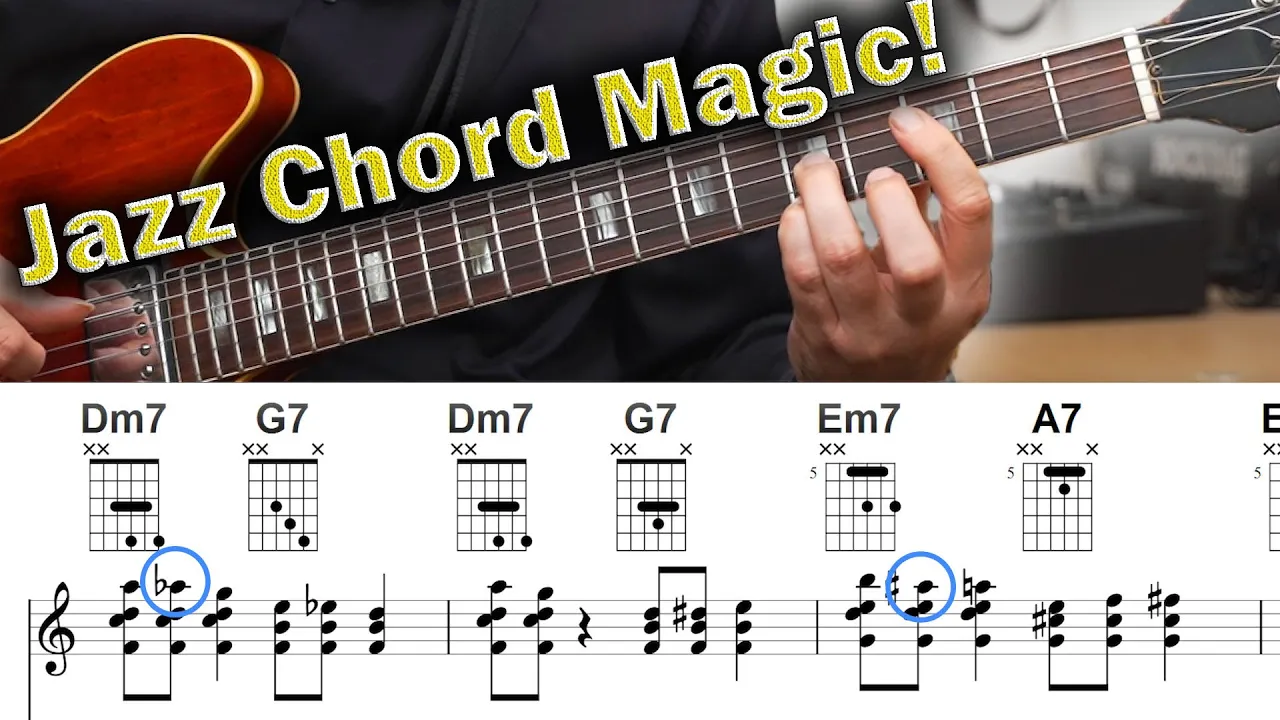
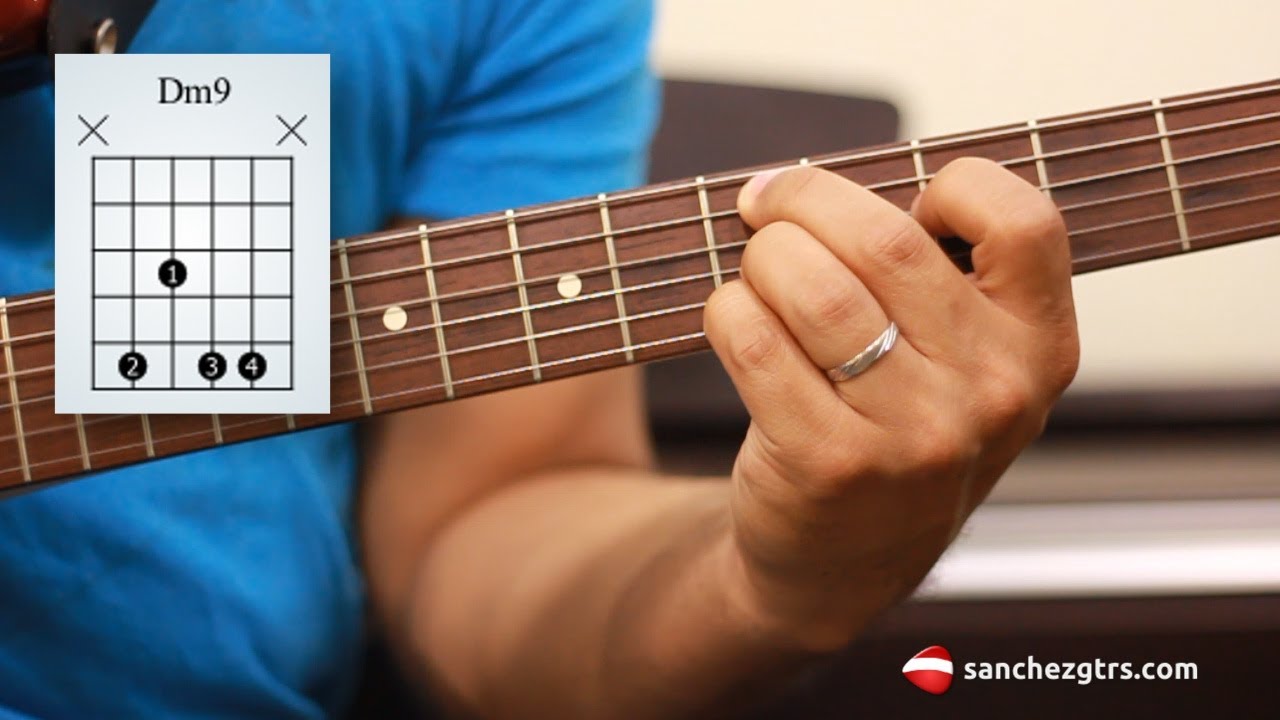
Added:[Music] [Music] [Laughter] [Music] Hey guys, welcome to the 251 survival guide. In this video, my goal is to just give you the basic starting point to get comfortable with your 251 progressions in major and minor keys. And we'll look at a couple of ways we can put them to work straight away. There will of course be many follow-up lessons to this one, taking it up to the next level each time, gradually making these things a little more complicated and a bit more filled out sounding, but we have to start somewhere. So, welcome to lesson one. So, we'll start in the key of C major, and we're looking for a 251. So, let's think about the chords that would make up the family of chords in the key of C major. Uh, the second chord would be a D minor. The fifth chord would be a G major, and the first chord would be a C major. In the world of jazz, we're likely to want to extend these straight off the bat. So, we're going to add a seventh to each one. So, D minor becomes D minor 7. And we'll go with all of the most common and perhaps predictable voicings that you're likely to find as a starting point. It's nice to start somewhere familiar, right? So, D minor 7 rooted on the A string.
I'm sure this is a familiar shape for most of you. Uh, then we need a G7 or G dominant 7 to give it the full name. We could just play this bar chord here, root on the E string, third fret. Uh, but let's modify this and make it a little more jazzy. You'll see why later on down the line. We can take the A string out of the equation and the top E out of the equation. And now what we'd be left with is this group of notes, the root, the flat 7, the third, and the fifth. And you can play this with your fingers or you can play it by hooking the thumb over for the root. I'm comfortable with both and I'd recommend you also get comfortable with both because you'll need them both for different things. So let's go for that.
That's our five chord. Now for the one chord, C major is going to become C major 7. And we're going to play this voicing. Again, very common. And you can bar the top string to bring the third fret in. But quite often you'll want to leave that string out. Sometimes if you're comping and strumming this, it's nicer to have the top note on the B string. It sort of gets in the way of the melody a little less. Okay, so to summarize our first step, 251 in the key of C major. D minor 7 is the two, G7 is the five, C major 7 is the one. Now, something that I always recommend that people do is look at turning these things into three note voicings. Not just because they're simpler to think about, but also because they're more common and a little more authentic to that early swing and trad jazz sound.
So, let's take this D minor 7 and look at another option. We could play this three note voicing here, rooted on the A string again. So, you've got the root, the flat three, and the flat 7. So, notice how we've left the five out. Now, the G7 three note voicing is as simple as taking the five out. That was on the third fret of the B string. So, now without that, we have this. So again, rooted on the low E string as it was before, but now even more slimmed back. The root, the flat 7, and the third. Then the C major 7. Root, third, 7. Really pretty voicing. Nothing wrong with this, but it's nice to have this option. And it allows us to add a little more movement because now we can drop that major 7 to a major 6th, for example, and get a little bit of variation going on. By the way, that little movement from major 7 to major 6 is very common and is always something that you can add when you're just sat on a static major chord. So now with those three note voicings, our 251 is perhaps one step more authentic. Also, it's easier to visualize what's going on intervalically.
[Music] So, both of our examples so far have had the two chord rooted on the A string, the five chord rooted on the E string, and the one chord rooted on the A string. Now, let's flip that all over.
So, the two chord is going to be rooted on the E string, the five will be rooted on the A string, and the one will be on the E string. Again, we'll start with just the most common voicings you're likely to find there, and then we'll trim them back into slightly more authentic three note voicings. So, D minor 7. Think about this bar chord here. Again, a very common bar chord form that comes from that E shape from the caged system. We're going to take away the fifth. So that means emitting the A string. And we're not going to bother with the top E string either. And now you've got this very common jazz voicing for a minor 7th. Root flat 7 flat 3 5. For the G7, we'll go with this. Probably the most common dominant seventh voicing you'll find off the A string for playing jazz. and for accompaniment especially. It's a nice one to strum. And for the C major 7, we're going to go with this. It's one that I'm sure you've seen before. And again, we can look at that as if it started its life as part of this big E-shaped C major 7 bar chord, but we emit the fifth and the duplicated root on the top string to just to trim the fat a little bit. And this is what we'd end up with. Now, make sure that in these sorts of voicings where we're emitting the A string, that you're not only picking around it finger style, but you're also blocking it so that when you want to strum the chord, you can do and you're not going to hear this open A string. Same goes for the D minor 7, of course, making sure that A string is truly dead. Same for the G7 down here. A string has to be dead, so you can strum it if you need to. So now we have our 251 in this location. D minor 7 rooted on the E string. G7 rooted on the A string. C major 7 rooted on the low E. So just like we did previously, let's now turn these shapes into three note voicings. Simple to do. Take this D minor 7 and simply remove the B string.
And now you've got this root flat 7 flat 3. Then for the G7, again, very simple. Take the shape that we had and just remove the B string. And now you've got your root, your third, and your flat 7. You can play this on the first three fingers or the last three. You'll need both as always. So practice both. For the C major 7, again, very simple. Just take the B string away. And what you've got left is this root 73. Now, I would recommend on this to use your second finger for the root. now just so that we can then easily like we did before drop that seven to a sixth for a little bit of color. So major 7 to major 6. So that would be two D minor 7 5 G7 C major 7 is the one. C6 is also the one just a slightly different color. Now as far as sequences go, there are two very common types of 251. There's the short 251 and a long 251. The short 251 is kind of what we've been doing so far, which is where you'd have half a bar of the two chord, half a bar of the five chord, and then a full bar on the [Music] one. The long 251 just doubles the length of all of that. So, you got a whole bar of the [Music] two, a whole bar on the five, and then two bars on the one.
[Music] So if you're thinking about the time spent on each chord in fractions, 25% of your allocated time is going to be on the two, 25% on the five, and then 50% on the one. So whether that's half a bar of two, half a bar of five, and then a whole bar on the one, or a full bar of the two, a full bar of the five, and two bars on the one, that allocation is the same either way. It's also worth mentioning that it's really good to practice these without necessarily having to resolve them to the one because quite often in jazz tunes especially, you'll get two fives where they don't go to the one. You'll have a 25 key change, two five key change, 251, that kind of thing. So do get comfortable with thinking just D minor 7 and G7. Don't always assume that you're going to go to the C major next. Okay.
So to summarize what we've done so far, we now understand exactly what a 251 is going to look like in the key of C major. And we understand that we have two common progression types. The short 251 and the long 251. The short 251 fits within the space of two bars. And the long 251 takes four bars to complete. As always, you can get hold of my very thorough lesson materials for this one at the links in the description. Quite a lot of pages involved in this one.
You've got the voicings themselves that we've just gone through, plus many more to come. Finger numbers on chord grids, tab notation, all of that stuff, plus example progressions, all tabbed out.
These will be in PDF and Guitar Pro formats. Okay, so that's major 251's done. Now, we need to figure out what the minor 251's all about. So to begin to understand this, we need to go all the way back to step one of our C major 251, D minor 7, G7, C major 7. And we understand that all of those chords contain notes from the C major scale, which is why all of that works in the key of C major. But now if we turn our C major scale into a C minor scale, the C natural minor or the C aolon mode, uh there's a couple of things we need to take into account.
Now, if we compare those two scales to figure out exactly what's changed, the root and the two were the same either way. But then we have a big change here.
Instead of the major third E, we now have the minor third, E flat. So, we're going to have to take that into account with our chords. What else has changed?
We still have the F and the G. They're the same. But then instead of an A, we had an A flat. Okay. So, we're going to have to factor that into our chord changes. And then what else? We had these two notes, right? You've got the flat 7 and the root instead of the major 7th in the root. So, a few things to take into account here. Okay. So, let's take our existing chords and make those adaptations and see what we end up with.
D minor 7. The D is fine because it's in both scales. The C is fine because it's in both scales. The F is fine because it's in both. But what about this A?
This needs to be flattened to A flat.
Now it suits the key of C minor, right?
Stays true to the parent scale. So now we have a D minor 7 flat [Music] 5. Now for the next chord, G7. The G is fine because it was in both scales. The F is fine because it was in both. The D is fine because it was in both. But this B is a problem. So that has to be flattened to B flat. Now you got G minor 7. Now, straight away, this is where we have a bit of an issue. If we're using the C natural minor as our way of harmonizing these chords, which is kind of what would be inferred when someone says we're in the key of C minor, the five chord would be a minor 7th, but we want this five chord to be a dominant 7th because it'll pull us to the resolving C minor chord in a much more dramatic and impactful way. So, we're going to break the rules a little bit here and go outside of the natural minor scale. Uh, we can think of this as actually now being part of the harmonic minor scale, which is kind of the thing that people are inferring when they're talking about minor keys in jazz.
Anyway, so instead of B flat, we're going to have the B natural, which gives us the harmonic minor and gives us the license to use a G dominant 7th here, still, just like in the major key, which is going to give us all that important tension that resolves beautifully to the C minor. Now, I understand that all of that sounds pretty convoluted, but to be honest, I can't think of a shorter way of describing it. Other than to say that really when people are talking about a minor key in jazz, they tend to mean harmonic minor as opposed to natural minor. Okay, so D minor 7 flat 5 is the two. G7 is still the five. Now for the one, C minor. That's a great starting point, just a plain C minor, not a C minor 7 because, as we've just discovered, C minor 7 would have a B flat in it. But our scale that we're now thinking of, the harmonic minor, has a B natural in it. So if you were going to extend this with anything, you might want to try chucking that natural seven in. Makes it sound a bit more jazzy, right? Or even better, the sixth. And you're getting some more authentic jazz sounds there. Playing the minor 7th as a tonic minor sound, you know, the one isn't really a great move to be fair. I mean, it's not completely out of the question, but it's something that I would try to avoid. So, in summary, I'd be thinking more C minor.
You know, just a good old plain C minor.
Don't feel like you've always got to extend these things and make them over complicated just for the sake of it.
Plenty of incredible players would opt for that as their tonic minor sound. But if you want to extend it, minor major 7 or minor 6 are great options. Okay, so let's take a deep breath and summarize our 251 in C minor.
D minor 7 flat 5 G7 C minor. That would be the short 251. Two beats, two beats, four [Music] beats. Now, let's look at the three note voicings of those. D minor 7 flat 5.
We're going to use the same one we had before because there was no five in it.
Either way, whether natural or flattened, this can work as both just a plain D minor 7 or a D minor 7 flat 5.
Pretty cool. G7, same as before, because that's unchanged anyway. So, you've still got the root, the flat 7, and the third. And now, an interesting one for the C minor. We're going to go C minor, major 7 to C minor 6. It's the equivalent of what we did before with the C major 7 to C6 except now instead of the major third E, we have the minor third E flat in both. Pretty dark sounding. Can take a bit of getting used to that. It's kind of like spice or olives. You know, you might not like those things when you first try them, but you get obsessed with them after a while and you start really getting that hunger pang for it.
You know, you want to hear these darker, more mysterious sounds because they create such a strong mood. So now a short 251 in C minor with three note [Music] voicings, suitably dark sounding. Now things will go quicker from here because we don't have to go through all of that explanation about the C harmonic minor versus the C natural minor. We'll just get straight up to this new position and find our equivalent voicings. So D minor 7 from before. Let's figure out where the fifth is so we can flatten it. It's the note on the B string. Now you've got your D minor 7 flat 5. Okay, the G7. Nothing's changing there. Still the same shape as before.
For the C minor, you've got a few options. C minor bar chord off the low E string or cut straight to the C minor 6, which would be my personal preference in this location. Tends to fall very comfortably under the fingers when you start moving these chords around. So, here's our short 251 in the key of C [Music] minor. And just like before, we can then make these three note voicings. Again, this D minor 7 is going to be common to both plain D minor 7 and D minor 7 flat 5 because this three note voicing omits the five anyway. G7, same as before, C minor major 7 to C minor 6. Same principle that we had down here.
You got the root, the seven, and the flat three, or the root, the six, and the flat three. That little bit of movement is always optional just to create a bit of interest on a static minor chord. So, in a moment, we're going to look at putting all the things we've just learned into a chord progression.
So, we've got some practical use for this stuff. But just before we do that, I just want to make it clear that again, there will be a series of follow-up lessons to this, taking the chord playing to the next levels with exotic extensions and substitutions and all that, but also a series of lead playing lessons looking at good ways to navigate playing over these changes. But just because I cannot resist it and because my looper is always plugged in and it's at my feet, let me just show you how effective it can be to play over these kinds of chords and how effortless melodies can be found when the chords themselves are so rich in personality.
[Music] beautiful progression that you can play over for hours and not get bored of it.
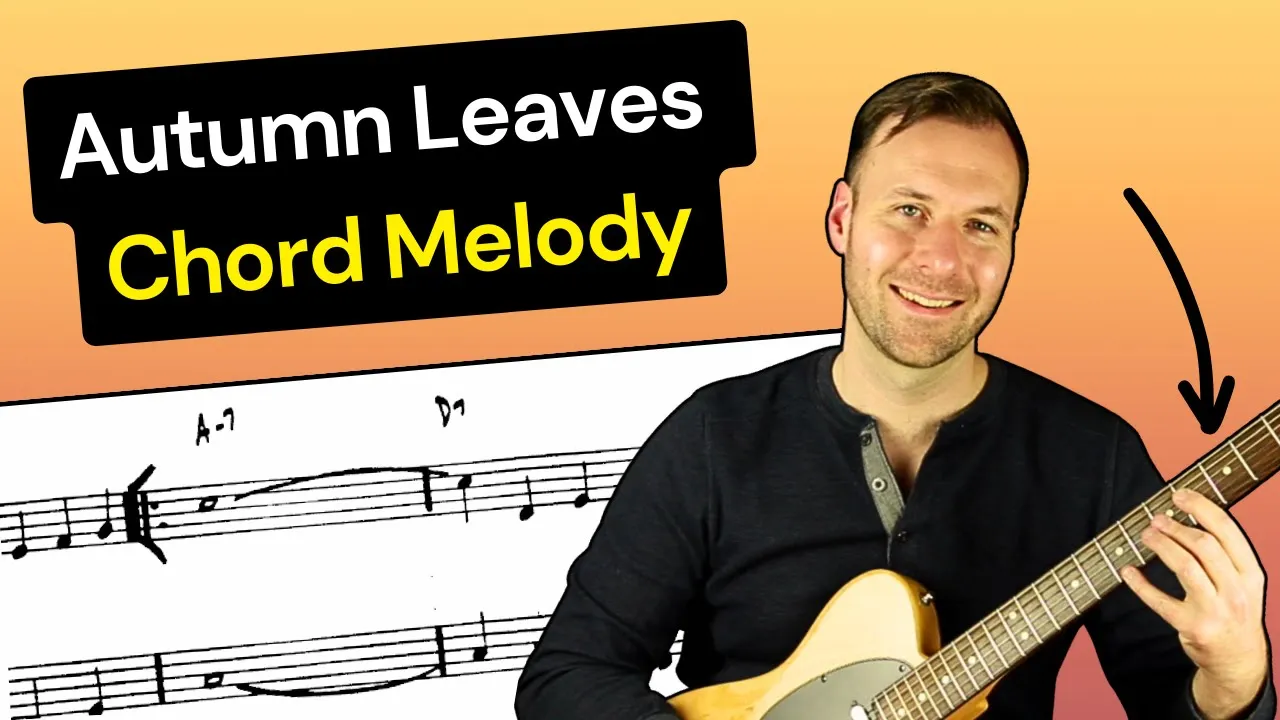
Okay, now let's look at putting all of these things into some kind of chord progression. Let's pick the jazz standard Autumn Leaves or at least some changes that are in the style of, if not exactly the same. Now, essentially a really easy way to look at Autumn Leaves is that most of it revolves around one kind of key center where you're going to do the major 251 followed by the relative minor 251. So, let's stay in the key of C just cuz that's where we've done all of our examples so far.
Although, I would recommend moving this stuff to other keys as soon as you can.
So, we're going to start with a long 251 in the key of C major.
[Music] So D minor 7, G7, C major 7, C major 6.
Now, there's nothing wrong with just doing quarter note strums like that.
It's very common in trad jazz, but let's change the feel of it just to keep things a bit more interesting. We're going to go 1 2 and 3 4 1 2 and 3 4 1 2 and 3 4 1 2 and 3 4. So we're playing on the one and the end of two. And the and of two, of course, is going to be heavily swung because we're playing swing music. Now, we need a 251 in its relative minor key. So, what's the relative minor in the key of C? A minor. 251 in A minor is going to look like this. B minor 7 flat 5, E7, A minor 6, or our other options there with the A minor major 7 or just a plain A minor.
All of it works. Now strip that back to three note voicings and you've got this B minor 7 E7. Let's go a minor major 7 and then for some movement A minor 6. So our first eight bars of Autumn Leaves are going to sound like this.
[Music] 251 in the key of C major and then a 251 in its relative minor key of A minor.
Now for our second time around, we're simply just going to reinstate the B string to those voicings. So D minor 7, G7, C major 7, C major 6, B minor 7 flat 5, E7, and then we'll go straight to A minor 6 this time. Okay? And then we're going to throw in a sneaky little passing chord.
We're going to make this a dominant 7 afterwards because that's the five of where we want to get to next. If we're looping around again, we need D minor.
A7 would be the five of that. So, it sets it up really nicely. Now, to be really thorough, we're going to go around the same sort of stuff again, but in our original sort of location down here. D minor 7, three note voicings.
G7, three note voicing, C major 7, C major 6, B minor 7. Getting some open string stuff going on here with the open D string. And then E7, two open strings involved. Passing chord here, just an E major triad, which I like. Although I've touched on that stuff quite a bit in my videos, especially my earlier ones on three note voicings, which I do recommend watching. By the way, just want to mention that when I'm playing this E7 and I'm looking for some movement to get me to the next chord, I can play an E major triad. That would be a first inversion. Let's nickname that our first inversion trick. In which case, we can think the same thing here when we want the A7.
That's going to lead us back to the start of the progression. There's your first inversion trick for that. Same voicings, right? It's just this looked different because it was in the open position leads you to D minor really nicely. Okay. So, as usual, we need to do a play through with the metronome.
I'm going to set it to 120 BPM and go through all of those changes. I'm also going to do that thing of removing beats one and three so that we can really feel the second beat and the fourth beat of the bar. Helps you really get into that pocket. 1 2 1 2 3 4 [Music] [Music] [Music] Now, I just want to mention that if you were truly playing Autumn Leaves rather than something that's just sort of in the style of Autumn Leaves, uh The most common thing that you're going to see that differs is simply this. 2 5 1. Now, when we go to the C major 6, you'll see a lot of people lift the bass note up a fourth to F. Look at what we end up with if we do that. F major 7. Pretty interesting. C major 6, F major 7. Very similar chords.
So, where we're doing this, you might also want to play around with going to the F major 7. Now, just to be really thorough, let me just point out exactly what that extra voicing was that I threw in at the end there. Um C major 7, I went to C major 6 afterwards.
Again, just for that little bit of color, but instead of three note voicings, where is easier to do when you do it within the full kind of chord shape, you have to stretch a little bit here. These can be some of the hardest stretches to to train your hand to do between the second and third finger, but well worth doing. Check out my video on the Barry Harris scale for a more in-depth look at those kinds of voicings.
So, that concludes our foundational level into the world of 251 progressions. I hope you found it useful and I hope you're going to pick out some jazz standards to apply these things to because unless you apply it musically, it's just going to disappear out of your memory as if it never happened. And by the time the second lesson drops, I'm sure you'll be more than ready for it.
So, do watch this space, make sure you subscribe to my channel, and please do hit the like button. Makes a huge difference. I was about to sign off there, but I realized I totally forgotten to do any tone talk. Um, so let me introduce you to my latest acquisition. This is a 1964 Gibson ES330. A very light and lively guitar.
Really inspiring to play and in great condition for its age. You know, just a few nicks on the back of the neck, but nothing major. Original pickups, the neck pickup especially, sounds so good.
Really fat, warm, and dynamic. I really like it. To be fair, the tuning pegs aren't the greatest. They're not very accurate, and they constantly slip. Um, so I'm looking for some repro tuning pegs. If anyone's got any knowledge on that stuff, let me know cuz I'm struggling to find the exact ones. And this is plugged straight into my 1964 Princeton reverb. So, matching years, in fact, I hadn't even thought of that.
That's pretty cool. Both from 1964. Good year for music that Hard Days Night by the Beatles came out.
Got a little bit of reverb on the amp and that's about it. Volume's at about six, treble and bass at four. Pretty standard settings for me really, right?
All right. So, with all of that said, you know what your job is, as well as like and subscribe, of course, is to practice these progressions and get them down. Uh, and I'll see you all for the next one. So, take care. Cheers.
Up Next

Music Theory: Secondary Dominants Explained – Guide
@EricHaugenGuitar
23.4K views•2021-09-24

Mozart's Musical Dice Game Explained: History, Rules, & Fun
@webpianoacademy
5K views•2023-03-13

Understanding Diatonic 7th Chords in Major Keys | Music Theory Tutorial
@GracieTerzian
54.7K views•2022-03-02
Understanding John Coltrane's Giant Steps: A Music Theory Analysis
@Vox
10.4M views•2018-11-12
Related Study Plans & Knowledge Roadmaps
Structured learning paths in Music Theory