

































Perfectly competitive markets achieve both productive efficiency (firms produce at minimum average total cost, where P = min ATC) and allocative efficiency (firms produce where marginal cost equals price, P = MC), because low barriers to entry force inefficient firms out and attract new competitors who drive prices down to the minimum efficient scale, while profit-maximizing behavior (MR = MC) naturally aligns production with socially optimal output levels.
Productive and Allocative Efficiency in Perfect Competition
Added:Understanding the characteristics of a perfectly competitive market structure, including price-taking behavior and homogeneous products.
Familiarity with short-run and long-run cost curves, specifically Marginal Cost (MC) and Average Total Cost (ATC).
Knowledge of the profit-maximization rule where Marginal Revenue equals Marginal Cost (MR = MC), and why P = MR for a competitive firm.
Basic concepts of welfare economics, specifically Consumer Surplus, Producer Surplus, and Total Social Surplus.
Analyzing efficiency losses (deadweight loss) in imperfectly competitive markets, such as Monopolies, Oligopolies, and Monopolistic Competition.
Exploring market failures, such as externalities and public goods, where competitive markets fail to achieve allocative efficiency.
Studying the long-run industry adjustment process (firm entry and exit) and its role in enforcing long-run productive efficiency.
Evaluating the impact of government policies (like taxes, subsidies, price ceilings, and price floors) on allocative efficiency and social welfare.
115.8K views696likes19:35Original Release: 2012-02-27
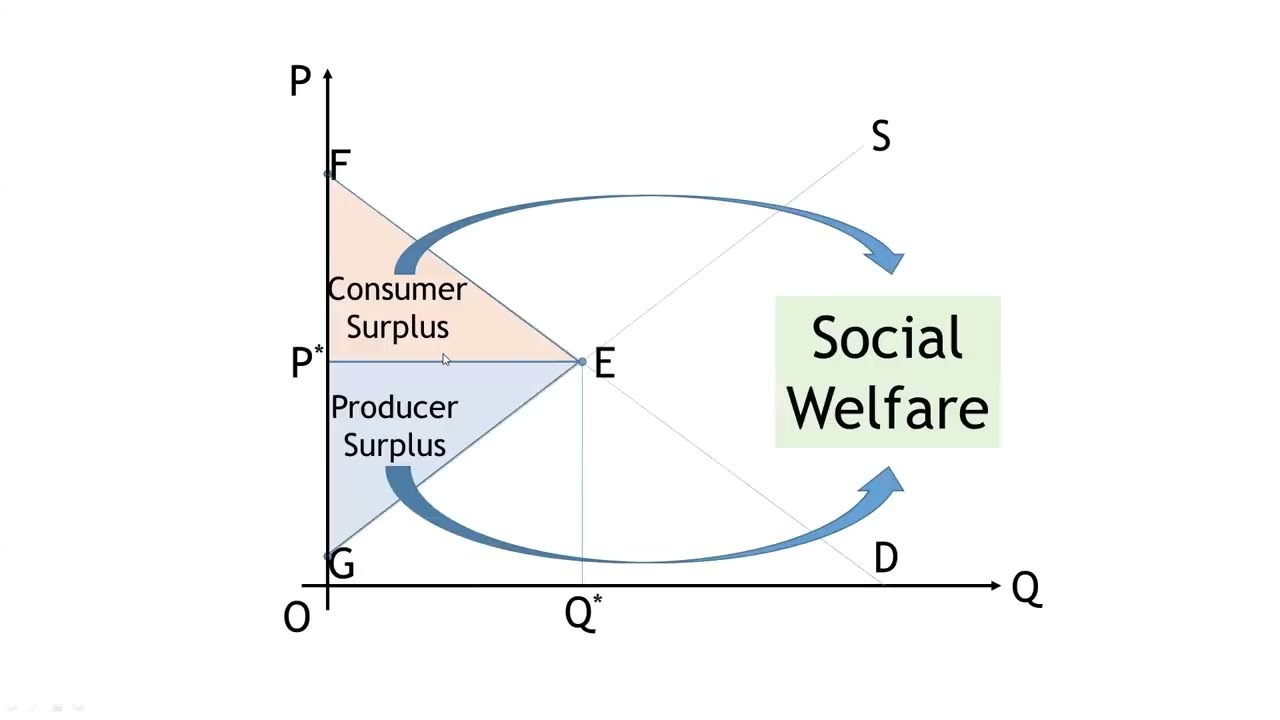
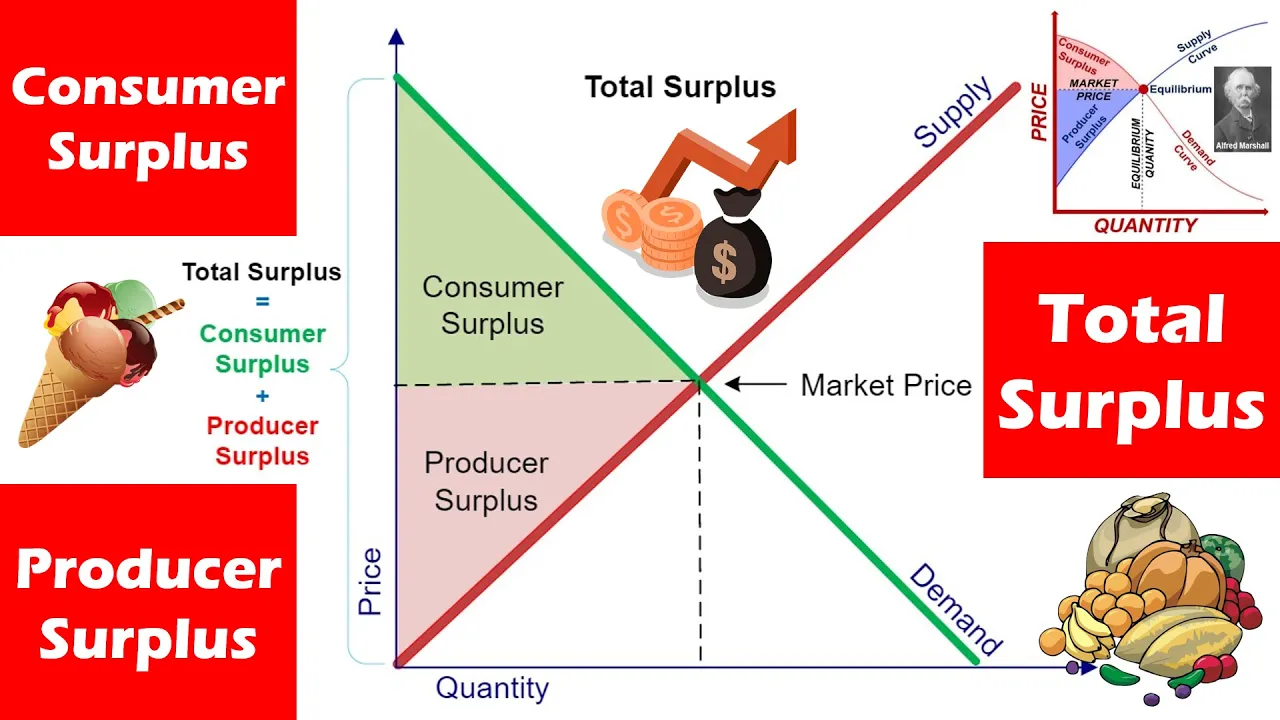
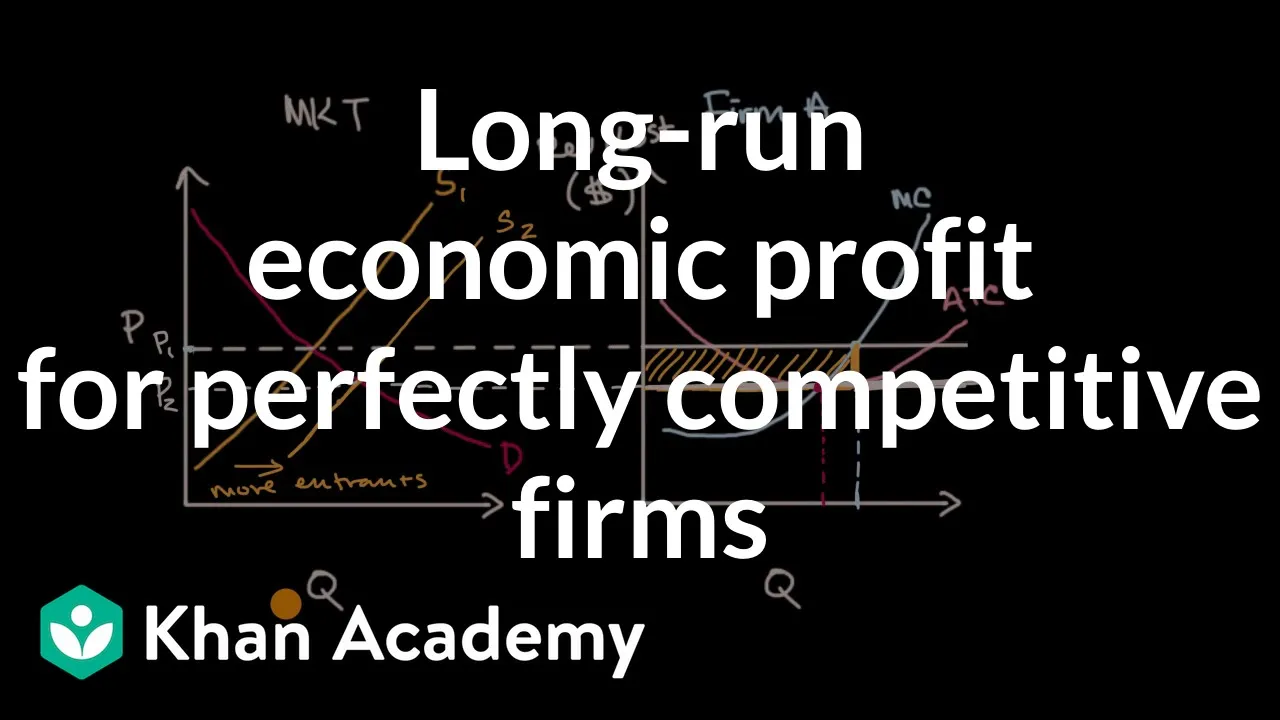
[Music] in this video lesson we're going to explore the concept of efficiency under perfect competition the question we will be answering today is what makes perfectly competitive markets and the firms that compete in such markets both productively and allocated lis efficient this is a concept that is used regularly in economics classes to describe the benefits of a competitive market over a less competitive market such as monopoly or oligopoly in order to understand what makes less competitive markets inefficient we first must understand what it is that makes perfectly competitive markets efficient so this video is probably the final video in our perfect competition section of the syllabus so if you haven't already make sure you go back and watch the preceding videos before this one under perfect competition before we can illustrate and explain what makes perfectly competitive markets efficient we first must define the two different measures of efficiency that we refer to in economics so let's begin with the easier type of efficiency to understand let's look at productive efficiency and come up with a clear definition of what it means to be productively efficient productive efficiency refers to the use of resources in the production of goods and services productive efficiency is achieved when firms produce their output in the least cost manner in other words firms must produce at their minimum average total cost earlier in the course we explained that the costs of firm faces are inversely related to the productivity of that firm's resources this means that when a firm is achieving its minimum average total cost the resources the firm employs are being used at their maximum efficiency nothing is going to waste when a firm is producing at its minimum average total cost so productive efficiency occurs when the price of a good is equal to the minimum average total cost in order to remain competitive in such a market firms must achieve their minimum average total cost so to determine whether a firm is achieving productive efficiency we must ask the question does the price of the firm's product equal the firm's minimum average total cost when looking at a perfectly competitive firm in its long-run equilibrium we can see that in fact price does equal minimum average total cost so if we look at our graph here and we zoom in on the equilibrium level of output that this firm will produce in the long run at its MC equals mr point this as you may recall is the profit maximizing level of output at this level of output we can see that the price is equal to the minimum average total cost if the price that this firm could sell its output for were any higher the firm would not have to produce at its productively efficient level of output for instance if the demand for this good were greater this firm would increase the quantity of output that it produced from QF to q1 now is this firm still achieving productive efficiency it is clear that it is not a firm in the short-run may not be achieving productive efficiency if the price at which you can sell its goods for is greater than the long-run equilibrium price the reason for that is that at this level of output q1 you can see that the firm is achieving an average total cost that is greater than the minimum average total cost how do I know that this point right here is greater than the minimum point on ATC well that's because we learned earlier in the course that the marginal cost curve intersects the average total cost curve at its lowest point therefore a q1 the firm is producing at a marginal cost that is greater than the minimum average total cost implying that the firm is no longer productively efficient so how do we know that a firm in perfect competition will always achieve its productively efficient level of output in the long the reason for that is that at mr1 which I've labeled here and d1 this market is not in its long-run equilibrium if the price that the firm could sell its output for was greater than its minimum average total cost then new firms would be attracted to this market increasing the market supply and driving the price down until it equals the minimum average total cost if economic profits are being earned in the short-run those profits will be eliminated in the long run and the price will fall forcing the firm to reduce its output back to the productively efficient level where P equals minimum ATC in fact all perfectly competitive firms will achieve productive efficiency in the long run due to the nature of competition itself low barriers to entry mean that anytime firms earn economic profits and are able to produce at a productively inefficient level of output new firms will be attracted to the market forcing the price back down forcing the existing firms to increase their productive efficiency until they have achieved their minimum average total cost at this point there is no way for this firm to become more efficient in its use of its resources it is producing at its lowest possible average total cost so that is productive efficiency we know that firms in perfectly competitive markets will be productively efficient because in the long run the price will equal the minimum average total cost in perfectly competitive markets but productive efficiency is only one measure of efficiency we also must ask the question what makes perfectly competitive markets allocative ly efficient so next we're going to define allocate of efficiency which is a little bit more complex of a concept than productive efficiency and then we're going to look at our diagram again and determine whether or not perfectly competitive firms and the markets in which they compete achieve allocated efficiency first let's define allocated efficiency this refers to a situation in which the quantity being produced in the market allows for the greatest level of total welfare meaning consumer and producer surplus possible an industry is allocated Li efficient if there is no way that consumer and producer surplus can be increased by changing the level of output now earlier in the course we explained that consumer surplus refers to the total well-being of consumers who were willing and able to pay a higher price than the equilibrium price of the good in the market graphically consumer surplus is indicated by the area of the triangle below the demand curve and above the equilibrium price in the market this triangle outlined in yellow represents the consumer surplus in our market in the graph on the Left producer surplus on the other hand referred to the total welfare of producers who were able to sell their product at a price greater than their cost of production in other words producers who would have been willing and able to sell their product at a lower price but instead are able to sell it at the higher price of PE graphically producer surplus is shown by the area below the equilibrium price and above the supply curve the area I'm outlining in blue in our graph on the left in our graph on the Left which shows a perfectly competitive market in its long-run equilibrium we can see that consumer and producer surplus are maximized the consumer surplus is the yellow triangle the producer surplus is the blue triangle now how do I know that a quantity of QE maximizes consumer and producer surplus well let's put a different quantity on here and see what the effect on consumer and producer surplus would be for example let's choose a quantity q1 and indicate the effect that a lower quantity would have on total consumer and producer surplus and therefore total welfare in this market if this industry we're only producing q1 units of output we can see that the demand for q1 is greater than the supply of q1 now earlier in the course we explained that the demand curve on a graph represents the marginal benefit of consumers in that market whereas the supply curve represents the marginal costs of producers in that market so at a quantity of q1 we can see that the marginal benefit is greater than the marginal cost in this industry this means that resources are under allocated towards this good at q1 society benefits more than it cost the producers of this good to produce the good we would all be better off if a greater quantity was produced if we produced at QE the marginal benefit would diminish due to the law of diminishing marginal utility we would see that the additional benefit consumers get from more and more output of this good would decline however the marginal cost would increase to producers due to the law of diminishing marginal returns producers marginal costs would rise and the two would converge on the equilibrium point so only right here at our equilibrium point is the marginal benefit enjoyed by consumers of the good equal to the marginal cost imposed on producers of the good this is the allocated Li efficient level of output so what would happen if production occurred at a level of output beyond QE wouldn't society be better off with more of everything you may think so however at some point if we look out here at q2 we can see that the cost to producers of achieving a quantity of q2 is greater than the benefit enjoyed by consumers of having the quantity q2 in other words this level of output is allocated Li in efficient because the marginal cost is greater than the marginal benefit Society has over produced the good at a quantity of q2 and society has under-produced the good at a quantity of q1 only at QE is society efficiently producing this good this is what we call the socially optimal quantity of output where marginal benefit equals marginal cost Society has achieved an allocated Li efficient or socially optimal level of output anything less than that and resources are under allocated towards the good anything more than that and resources are over allocated towards the good so looking back at our definition of allocated efficiency we can say that it is achieved when marginal benefit equals marginal cost now in a individual firm diagram there is no marginal benefit curve however there is a demand curve and demand represents marginal benefit in the individual firm diagram we can determine whether or not allocated efficiency is achieved by looking at whether the price equals the marginal cost in the long run so we can also say that when price equals marginal cost a firm is being allocated Li efficient so I'm going to clean up the graph here and we're going to do an analysis of allocated efficiency in both the market and the firm diagram here to explain why perfectly competitive firms are always allocated Li efficient let's look at our individual firm graph on the right what makes firms in perfectly competitive markets allocated Li efficient in other words why do firms in perfect competition produce where P equals MC that's what we're going to look at here does the marginal cost that the firm achieves equal the price which is a signal of marginal benefit notice that the demand curve for a perfectly competitive firms output is horizontal at the equilibrium price in the market so we can see this demand curve is also representing the marginal benefit that consumers get from the good being sold since an individual firm will always wish to produce where marginal revenue equals marginal cost we can also see that this is the allocated Li efficient of output because in perfect competition marginal revenue equals the price firms are price takers they can sell as much of this good as they want to at the equilibrium price for that reason that change in total revenue of increase in its output by one unit will always be the price the marginal revenue in other words is always equal to the price in perfect competition and in fact this is only true in perfect competition we will see that in other market structures the marginal revenue of a particular level of output is always lower than what the firm can charge for that unit of output therefore in other market structures allocated efficiency will not necessarily be achieved but in perfect competition because the marginal revenue equals the price and because firms will always wish to produce where marginal revenue equals marginal cost the result is price will always equal marginal cost under perfect competition now what if firms were not profit maximizers in perfectly competitive markets what if this individual firm chose to produce at a level of output less than its profit maximizing level for example at q1 if this were to occur we can see that this firm would no longer be maximizing its economic profits in fact it would be earning economic losses this is clearly not a desirable level of output for the individual firm and we can also see that the price is now greater than the marginal cost since marginal cost is right here and the price is still up here now why is this allocated Lea inefficient well if this firm were producing at a lower level of output and there were a thousand firms identical to this one in the market none of them producing at their profit maximizing level then in our market diagram there would certainly be an under allocation of resources towards this good we can see that if individual firms are producing at a quantity of q1 the total output in this market would be at a lower quantity as well less than QE so I'll put a point of q1 in our market diagram and let's see the effect that this lower level of output has on allocated efficiency in the market here we see that if the price of this good were PE yet the quantity that firms are producing that were q1 then the marginal benefit that consumers get of q1 is greater than the marginal cost imposed on producers at q1 the total sum of consumer and producer surplus is less than what is achievable if output were at QE this is an allocated Li in efficient level of output because total welfare is less than what it could be if output read a greater quantity total welfare q1 is equal to the green area in our graph on the left however if individual firms were producing at their profit maximizing level of output where the price equals the marginal cost there would be a gain in total welfare of the yellow triangle so only at QE is total welfare maximized if firms produce at any level of output besides where the price equals the marginal cost total welfare will be reduced in this market and we have to say that that therefore is allocated Li inefficient so q1 resources are under allocated towards this good Society would be better off with the greater quantity of output because total welfare the sum of consumer and producer surplus would be increased by the yellow triangle in our graph now if firms were to produce at a level of output beyond the profit maximizing level we would have the same problem if firms produced at q2 which is not their profit maximizing level you can see that the marginal cost is now much greater than the price resources are now over allocated in our market diagram we could put a point of q2 and show that too much would be produced in this market if firms did not produce at their profit maximizing level the marginal cost to the firms in the market is now greater than the marginal benefit enjoyed by consumers so allocated efficiency requires that firms produce where the price equals their marginal cost of production at any level of output greater or less than that quantity resources will either be over allocated or under allocated towards the production of the good in the market as a whole but since firms are interested in maximizing their profits they should always produce where marginal revenue equals marginal cost and since marginal revenue equals price under perfect competition this will also be allocated li efficient so this lesson went through two different types of efficiency productive efficiency which requires that firms will produce at their minimum average total cost in the long run and allocated efficiency which requires that firms will produce where their marginal cost equals the price of the good both of these conditions are met under perfect competition in the long run due to the fact that barriers to entry are very low if profits exist in firms are inefficient in the short run they will be forced to be efficient once again due to the entrance of new firms and the increased competition driving prices down to the minimum average total cost firms interested in maximizing their profits will always wish to produce where their marginal revenue equals their marginal cost which under perfect competition will always be where price equals marginal cost hence firms are both productively and allocated Li efficient in perfect competition in a later lesson we will examine less competitive market structures such as monopolistic competition oligopoly and monopolies and and illustrate what makes those market structures less efficient both productively and allocated Li than perfect competition
Up Next

13:32
Tariffs & Trade Wars: Economic Impact Explained by Ex-Trade Chief
@60minutes
1.9M views•2025-02-03

5:07
Impact of Yuan in Indo-Russian Trade Amid Sanctions
@WION
261.9K views•2022-07-01
12:31
Deadweight Loss Explained: Consumer & Producer Surplus
@JasonWelker
108K views•2016-09-07

113:18
The Age of Easy Money: Fed & Inflation | Full Documentary
@frontline
21.2M views•2023-03-15
Related Study Plans & Knowledge Roadmaps
Structured learning paths in Economics
economics
Sovereign Debt: Defaults, IMF & Restructuring
01Introduction to Sovereign Debt & Government Bonds
02Debt Sustainability & Credit Ratings
03Anatomy and History of Debt Crises
+ 2 more learning modules
12h5 modules
Explore Roadmap
economics
Market Design: Matching Theory & Gale-Shapley
01Introduction to Market Design and Price-Free Markets
02Two-Sided Matching & The Gale-Shapley Algorithm
03School Choice Systems and Mechanism Design
+ 2 more learning modules
10h5 modules
Explore Roadmap
economics
Impossible Trinity: Forex, Capital & Policy
01Introduction to Monetary Policy and Central Banking
02Exchange Rates and International Capital Flows
03The Mundell-Fleming Model
+ 2 more learning modules
8h5 modules
Explore Roadmap
economics
Healthcare Economics: Market Failures & Systems
01Introduction to Healthcare Markets and Market Failure
02Asymmetric Information and Adverse Selection
03Moral Hazard and Insurance Design
+ 2 more learning modules
12h5 modules
Explore Roadmap