A hostile work environment under anti-discrimination laws requires conduct that is sufficiently severe or pervasive to create an intimidating, hostile, or offensive atmosphere, meaning isolated incidents or isolated offensive remarks over time are generally insufficient unless they involve serious threats of violence or physical aggression.
Hostile Work Environment: Legal Definition Under Anti-Discrimination Law
Added:Deep Dive
Fundamentals of employment law and the foundational role of Title VII of the Civil Rights Act of 1964.

Basics of Employment Discrimination Law for Law Clerks
3.8K
Title VII is the cornerstone of federal employment discrimination law, prohibiting discrimination based on race, color, national origin, gender, and religion. Amended in 1972, 1978, and 1991, it covers virtually all employment practices including hiring, discharge, compensation, promotions, and work assignments. The law applies to private and public employers, labor unions, employment agencies, and joint employer operations. Key protections include: national origin discrimination extending to marriage, association, and educational affiliations; pregnancy discrimination covered by the Pregnancy Discrimination Act; and religious discrimination requiring employers to accommodate beliefs unless it causes undue hardship. The statute uniquely requires employers to accommodate religious observances while allowing religious organizations some exemptions for conduct inconsistent with their faith.
Click to watch →

intro to aPHR help. Title VII video one intro
1.1K
Title VII of the Civil Rights Act of 1964 establishes five protected classes that employers cannot discriminate against: race, color, religion, national origin, and sex (or gender). This foundational anti-discrimination law, enforced by the EEOC, serves as the basis for all other employment discrimination laws and is essential knowledge for HR professionals and students studying for the AP HR exam.
Click to watch →
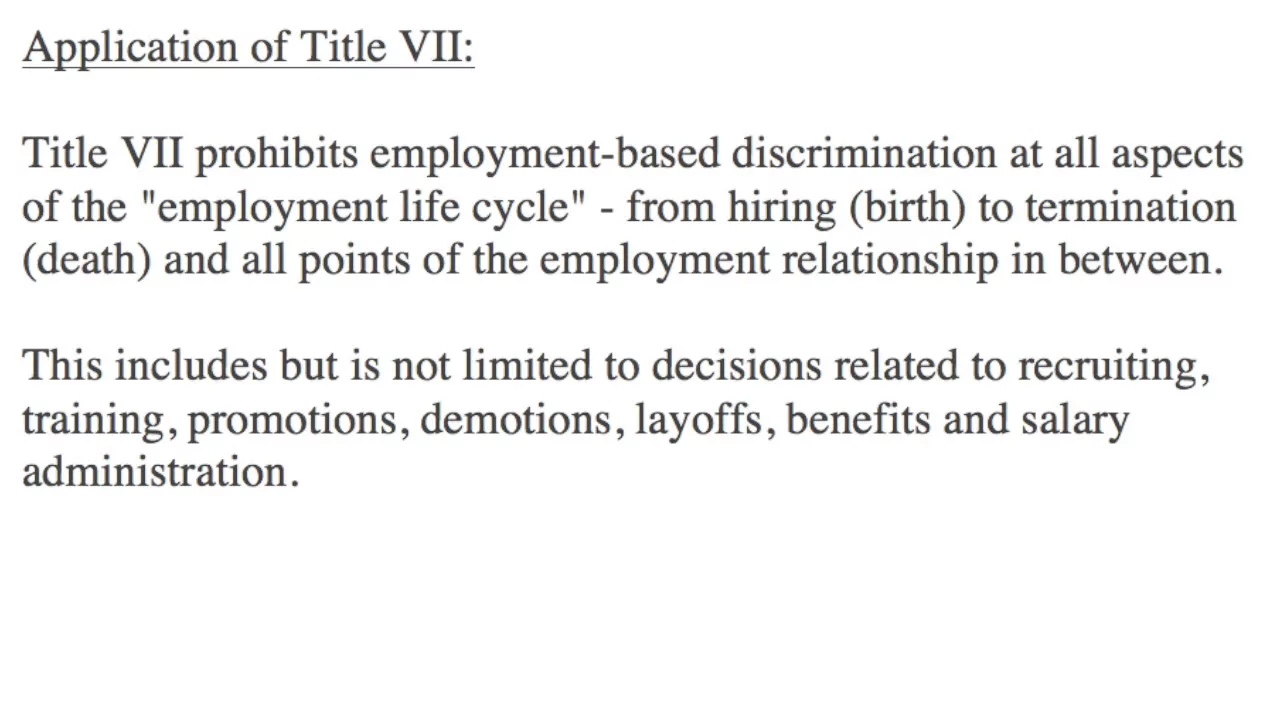
Title VII
526
Title VII of the Civil Rights Act of 1964 prohibits employment discrimination based on race, color, religion, sex, or national origin, covering all aspects of the employment relationship from hiring to termination, including recruiting, training, promotions, demotions, transfers, layoffs, benefits, and salary administration; it applies to employers with 15 or more employees, including federal, state, and local governments, private and public colleges and universities, employment agencies, and labor organizations, and prohibits both intentional discrimination and practices that appear neutral but have a discriminatory effect.
Click to watch →
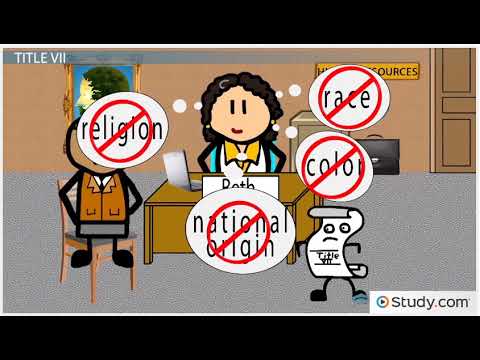
Civil rights act of 1964 and Title VII
13.5K
Title VII of the Civil Rights Act of 1964 prohibits employment discrimination based on race, color, sex, religion, or national origin for employers with 15 or more employees, covering hiring, pay, benefits, firing, promotions, demotions, and training, with the exception that bona fide job qualifications may justify otherwise prohibited criteria.
Click to watch →
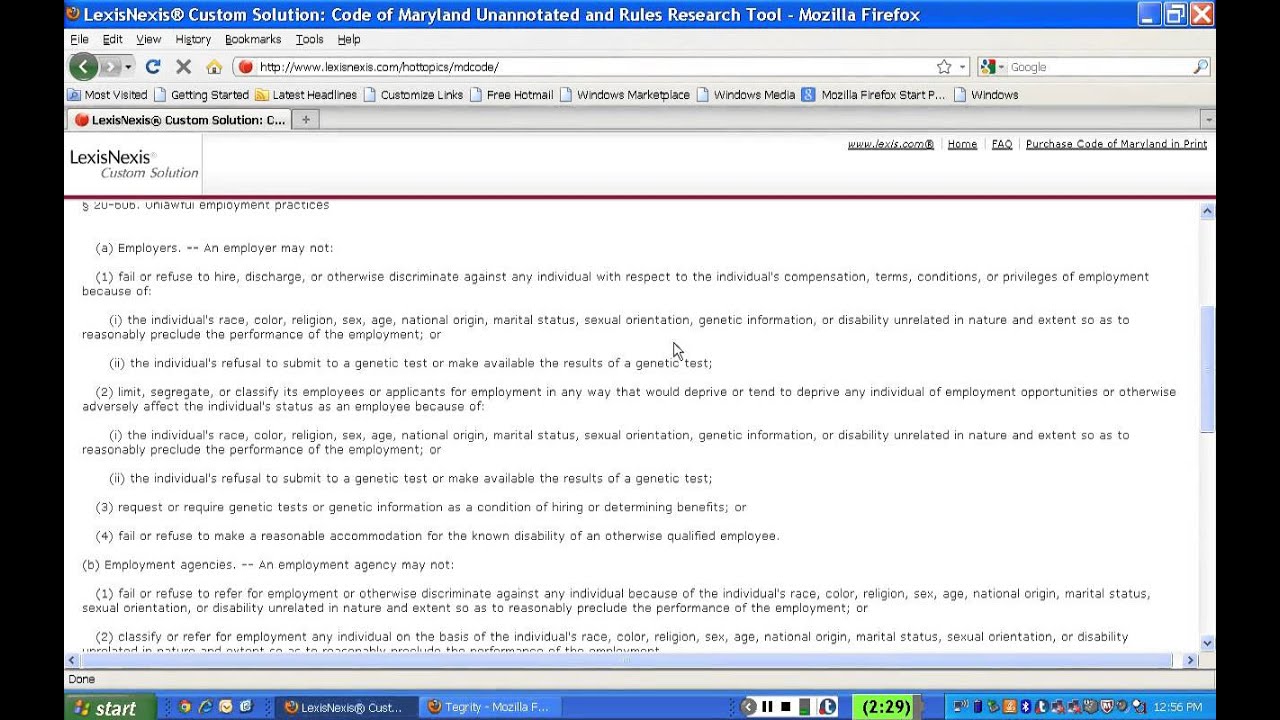
Title VII
183
Title VII is a federal law that prohibits employment discrimination based on five protected classes: race, color, religion, sex (including sexual harassment and pregnancy), and national origin; it covers three theories of discrimination—overt discrimination (explicit refusal to hire/fire based on protected characteristics), disparate impact (neutral policies that disproportionately harm protected groups), and disparate treatment (unequal treatment of protected class members)—and applies to employers with 15 or more employees, with remedies including back pay, attorney's fees, and damages capped between $50,000-$500,000, while states like Maryland provide additional protections for age, marital status, sexual orientation, genetic information, and disability.
Click to watch →
Deep Dive
The definition of protected classes, such as race, color, religion, sex, national origin, age, and disability.
HR Basics: Protected Classes
15.6K
A protected class is a group of people with a common characteristic legally protected from employment discrimination. Federal protected classes include race, color, religion, national origin, sex, age, disability, veteran status, genetic information, and citizenship. Title VII of the Civil Rights Act of 1964 prohibits discrimination in any employment aspect from hiring to firing. Race discrimination involves unfavorable treatment based on race or associated characteristics. Color discrimination targets skin color or complexion. Religious discrimination protects beliefs and moral convictions. National origin discrimination covers country of origin, ethnicity, or perceived background. Sex discrimination involves unfavorable treatment based on gender.
Click to watch →

Consumer Fair Housing Real Estate and Your Rights
127
A protected class is a person or group of people who are legally protected from being harmed or harassed because of a shared characteristic. Protected classes are created by federal, state, or local laws. Federal laws establish the following protected classes: race, color, religion, national origin, sex or gender, familial status, and disability.
Click to watch →
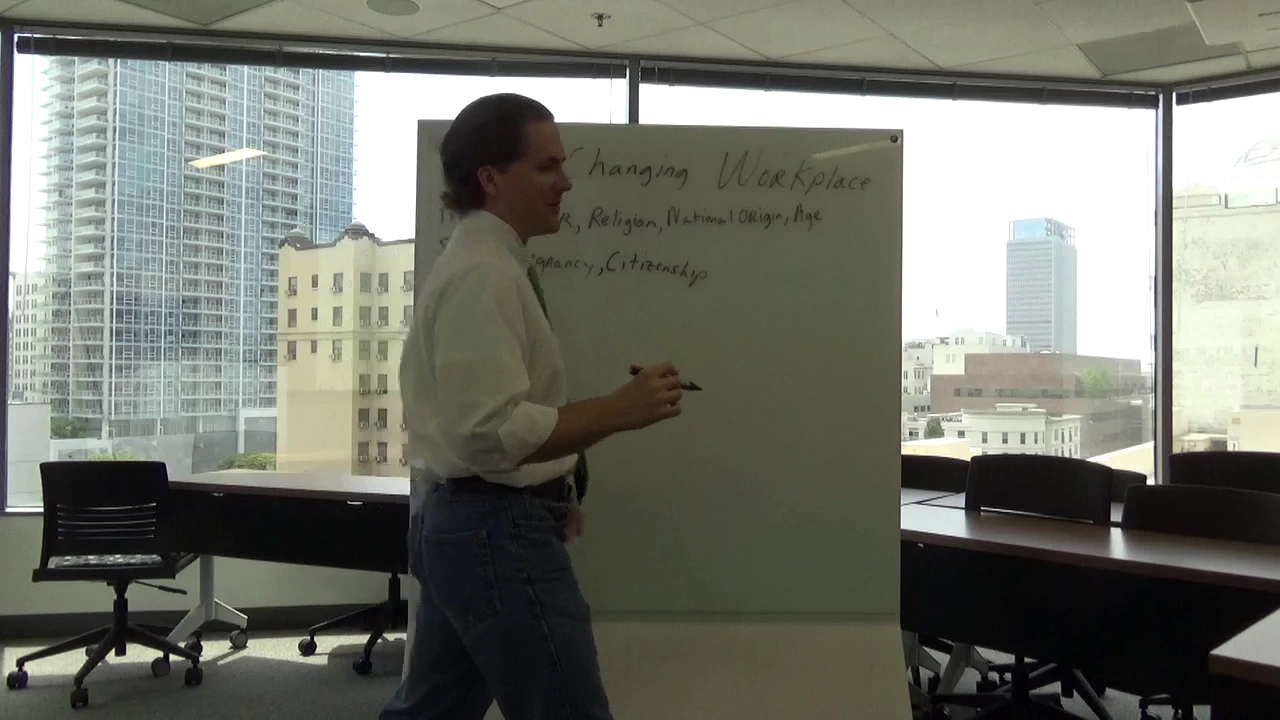
Protected Classes
714
Protected classes are characteristics that employers cannot legally discriminate against in employment decisions. These include race, color, religion, national origin, age, sex/gender, pregnancy, citizenship, family status, sexual orientation, disability, veteran status, and genetic information. Age discrimination remains prevalent despite legal protections, with misconceptions about older workers' ability to adapt to technology. Pregnancy discrimination includes not only refusing to hire pregnant individuals but also asking inappropriate questions about future pregnancies. Interview questions about birthplace, age, religion, or family status are illegal. These protections apply to all employment aspects including hiring, firing, promotions, and workplace treatment.
Click to watch →

Fair Housing Webinar Wednesday, November 18, 2015 9 48 59 AM
328
Race refers to groups united by common history, nationality, or geographic origin with inheritable physical characteristics like skin pigmentation and hair texture. Color specifically refers to skin color, covering everyone regardless of shade. National origin covers birthplace or ancestral origin. Religion protects both organized religions and non-believers, covering the person and their associates. Sex and gender discrimination includes discrimination against men, women, and LGBT individuals. Familial status covers families with children under 18 and pregnant women, regardless of custody arrangements.
Click to watch →
We Count! part 6
184.6K
Protected classes are categories of people who receive special legal protection from discrimination under civil rights laws. The 1964 Civil Rights Act established protected classes including African-Americans, women, and people with disabilities. Being part of a protected class means that discriminatory treatment based on membership in that group is legally prohibited, though it does not mean the group is explicitly named in every piece of legislation.
Click to watch →
Deep Dive
The legal distinction between 'quid pro quo' sexual harassment and general workplace harassment.
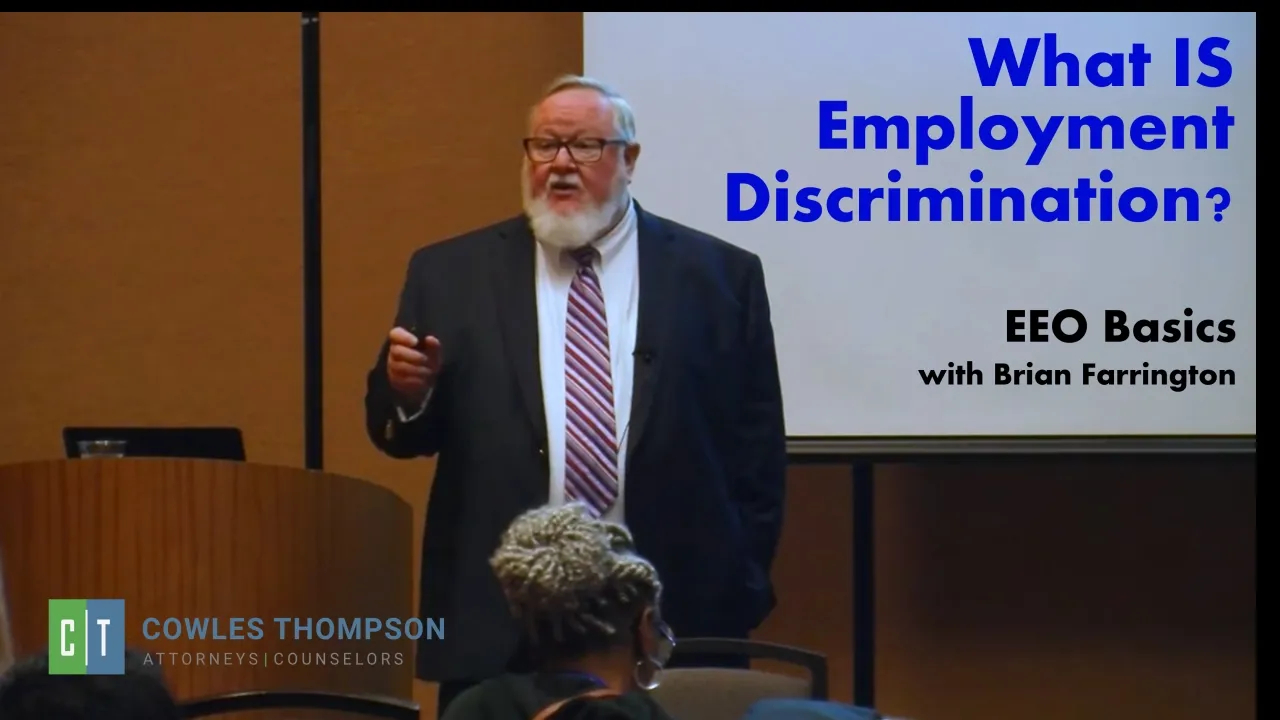
EEO (Equal Employment Opportunity) Basics with Brian Farrington
17K
Sexual harassment encompasses two distinct forms: quid pro quo (exchange of job favors for sexual conduct) creating strict employer liability regardless of policies, and hostile environment (unwelcome conduct creating intimidation) requiring conduct based on protected group membership that is either serious or pervasive. Courts apply an objective reasonableness standard, not subjective offense. Clinton v. Jones established that single incidents typically lack the severity or pervasiveness required. Third-party harassment by contractors or vendors also triggers employer liability. Prompt remedial action is essential to preserve defenses.
Click to watch →

Patrice O'Neal - Men & Women Working Together
160.7K
There are two main types of sexual harassment: quid pro quo harassment, where employment benefits are contingent on sexual favors, and hostile environment harassment, where unwanted sexual conduct creates an intimidating workplace. The speaker distinguishes between these types, noting that quid pro quo involves explicit quid pro quo arrangements while hostile environment harassment involves pervasive conduct that makes work conditions uncomfortable. The speaker argues that both types constitute harassment but may require different approaches to address.
Click to watch →

SEEO Part 2 Updated
160
Quid pro quo (this for that) is direct harassment where a person in power offers job benefits in exchange for sexual favors. Employers face strict liability if they knew or should have known about such conduct and failed to investigate. Hostile work environment involves repeated unwelcome conduct based on sex or gender that alters employment terms. Unlike quid pro quo, hostile environment harassment may need repetition unless the conduct is severe enough (like groping) that it doesn't require repetition. Petty slights and isolated incidents do not rise to unlawfulness unless they are serious occurrences.
Click to watch →
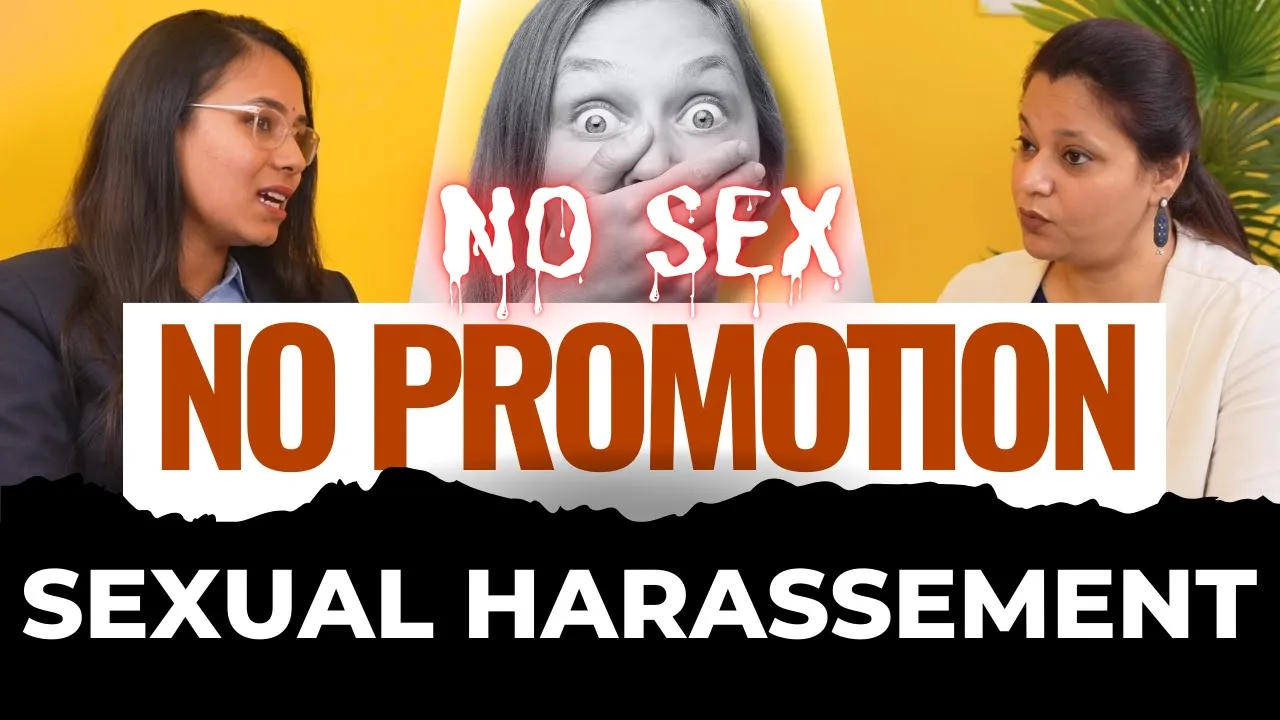
When Boss asks for SEXUAL FAVOURS | POSH Laws EXPLAINED | Prarthana's POV | E03 PART 1 | NVFA
810
This section distinguishes between two primary forms of sexual harassment: quid pro quo harassment and hostile work environment harassment. Quid pro quo harassment occurs when employment decisions (promotions, raises, job assignments) are conditioned on granting sexual favors, such as a manager promising advancement in exchange for sexual advances. Hostile work environment harassment occurs when persistent inappropriate conduct creates an intimidating, hostile, or offensive workplace atmosphere, regardless of whether specific employment decisions are involved. Examples include continuous unwanted attention, spreading malicious rumors about a person's character after refusal, or creating conditions so uncomfortable that an employee feels compelled to leave their position. Both forms violate fundamental workplace dignity and require organizational intervention.
Click to watch →

Sexual Harassment Prevention Training Part 2: Case Studies
698K
Quid pro quo sexual harassment occurs when someone with authority offers job benefits in exchange for sexual favors. The employer is exposed to liability because of its supervisor's actions. A person can be a target of sexual harassment even if they voluntarily engaged in sexual activity, as long as the activity was unwelcome. The offer to trade job benefits for sexual favors by someone with authority constitutes quid pro quo sexual harassment.
Click to watch →
Deep Dive
The objective vs. subjective legal standards, including the concept of the 'reasonable person standard' in tort and employment law.

WATCH | Justice Madlanga demands to know what facts led Andrea Johnson to invoke Section 27(b)
26.5K
The subjective test examines what was going on in a specific person's mind, focusing on their actual thoughts and beliefs. The objective test applies a reasonable person standard, testing how a hypothetical reasonable person with access to the same knowledge would view the situation. These are fundamentally incompatible approaches. Once the word 'reasonable' is introduced, it inherently moves toward an objective test. The reasonable person test is an objective standard that examines how a hypothetical reasonable person would view the situation based on available information.
Click to watch →

The Reasonable Person Standard
187.7K
Tort law generally applies an objective reasonable person standard when determining whether contact was harmful or offensive. Courts ask what a reasonable person would find offensive, not what the plaintiff subjectively felt. For example, a tap on the shoulder to ask directions would not be considered offensive by a reasonable person, so no liability exists even if the plaintiff was hypersensitive.
Click to watch →

What is the difference between a Subjective Test and an Objective Test in Law?
3.2K
In law, a subjective test examines a person's actual state of mind, beliefs, or knowledge, while an objective test uses the 'reasonable person' standard, analyzing what a hypothetical reasonable person would have thought or done in the same circumstances, making it a two-step process that compares hypothetical expectations against actual conduct.
Click to watch →
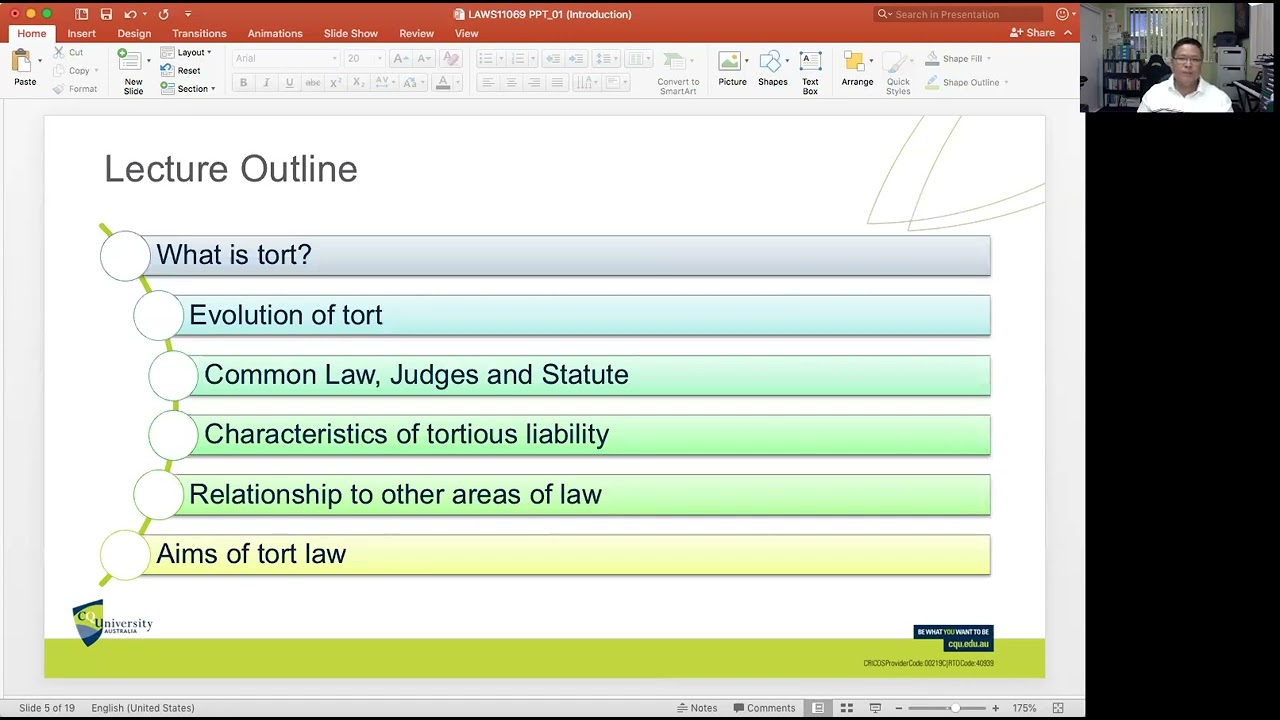
The Law of Torts: An Introduction (Lecture 1: LAWS11069)
8.6K
In tort law, fault is typically examined from the viewpoint of the reasonable person (originally 'reasonable man') rather than the subjective peculiarities of the wrongdoer or victim. The reasonable person standard is an objective standard based on what an ordinary person would do in any particular situation. This abstraction does not require prophetic vision or superhuman abilities—no reasonable person can foresee every detail. The standard represents a hypothetical objective person rather than requiring extraordinary foresight.
Click to watch →
Tripp v. Scott Emergency Commc’n Ctr., et al.
297
There is significant confusion in mental injury law about the distinction between subjective and objective standards. A subjective standard determines whether an event is traumatic based on the specific employment and what is normal for that particular job. An objective standard determines whether an event is traumatic based on what would shock a reasonable person in general. The Brown standard is often described as objective, but this terminology can be misleading. The key question is whether the standard should consider what is normal for the specific occupation or what would be traumatic for anyone. The Graves case from Wyoming discusses whether 'objective' refers to people within that specific employer, people employed in that area, or workers as a whole.
Click to watch →
Prerequisite Knowledge
- Concept 01Fundamentals of employment law and the foundational role of Title VII of the Civil Rights Act of 1964.
- Concept 02The definition of protected classes, such as race, color, religion, sex, national origin, age, and disability.
- Concept 03The legal distinction between 'quid pro quo' sexual harassment and general workplace harassment.
- Concept 04The objective vs. subjective legal standards, including the concept of the 'reasonable person standard' in tort and employment law.
Subsequent Learning
- Step 01The Faragher-Ellerth affirmative defense, which outlines how employers can establish a defense against liability for supervisor harassment.
- Step 02The administrative process of filing a workplace discrimination or harassment charge with the Equal Employment Opportunity Commission (EEOC).
- Step 03Analyses of landmark Supreme Court cases, such as Meritor Savings Bank v. Vinson and Harris v. Forklift Systems, Inc., which shaped modern harassment jurisprudence.
- Step 04Legal protections against workplace retaliation for employees who oppose or report unlawful harassment.
- Step 05Best practices for corporate HR departments regarding internal investigations, compliance training, and drafting effective anti-harassment policies.
Legal Hostility
OSHA vs Court
Immediate Action
Legal Hostility
0:01Playing Section
- 1
Defines hostile environment as severe or pervasive conduct.
- 2
One-off or isolated incidents rarely meet the legal threshold.
- 3
Workplace harassment requires a pattern of behavior, not isolated acts.
Critique of the "Severe or Pervasive" Standard as an Obstacle to Workplace Equality
While the legal definition of a hostile work environment relies on the "severe or pervasive" threshold to prevent frivolous lawsuits, many legal scholars and employee advocates argue this standard sets an unrealistically high bar for plaintiffs. Critics contend that the current jurisprudence often dismisses systemic, lower-level harassment (such as microaggressions or sporadic discriminatory remarks) because they do not individually meet the "severe" or "pervasive" legal thresholds. This can leave employees vulnerable to toxic work cultures that cause genuine psychological and professional harm but fall short of the statutory definition. Furthermore, feminist and critical race theorists argue that the "reasonable person" standard used to evaluate such conduct is often biased toward dominant societal groups, failing to account for how marginalized individuals experience cumulative workplace hostility. Consequently, critics advocate for reforming the standard to focus on the cumulative impact of harassment rather than requiring a high threshold of severity.
Deep Dive
The Faragher-Ellerth affirmative defense, which outlines how employers can establish a defense against liability for supervisor harassment.

Update and Discussion on Legal & Practical Issues, July 2, 2024
107
The Faragher-Eller defense is a defense available to employers under federal Title VII law for harassment claims. It applies when there was no tangible employment action against the plaintiff employee (no discharge, demotion, or suspension). The defense applies where the employer can demonstrate they exercised reasonable care to prevent and correct harassing behavior, and the employee unreasonably failed to take advantage of protective or corrective opportunities provided by the employer. The classic situation is where an employer had an established harassment prevention policy with a reporting mechanism, and the employee failed to use that mechanism to report harassment.
Click to watch →
Basics of Employment Discrimination Law for Law Clerks
3.8K
In Faragher v. City of Boca Raton and Eller v. City of Boca Raton (1998), the Supreme Court dramatically changed liability standards for sexual harassment. When sexual harassment by a supervisor with immediate or successively higher authority results in a tangible detrimental employment action (discharge, demotion, undesirable assignment), the employer is strictly liable even without knowledge of the harassment. If no tangible detrimental action results, employers have a two-prong affirmative defense: (1) showing reasonable care to prevent and promptly correct harassment through an effective anti-harassment policy made well-known to employees, and (2) establishing the plaintiff unreasonably failed to take advantage of that policy.
Click to watch →

Free webinar: Preventing and Addressing Sexual Harassment
593
Employers face vicarious liability for supervisor harassment under Burlington Northern & Santa Fe Railway Co. v. Ellerth (1998), meaning courts presume employers know about harassment by supervisors since supervisors represent the company. The affirmative defense allows employers to avoid liability only when no tangible employment action occurred. To succeed, employers must prove: (1) they exercised reasonable care to prevent harassment, and (2) took immediate corrective action upon awareness. They must also show employees unreasonably failed to report despite having procedures. If past responses to complaints were ineffective, courts are more likely to find employee failure to report was reasonable, undermining the defense.
Click to watch →

Basics of Employment Law for Law Clerks (Part 1)
2.2K
Under Faragher v. City of Boca Raton and Ellerth v. Asplundh Tree Expert Co. (1998), employers are strictly liable for harassment of any kind created by a supervisor with immediate or successively higher authority over the harassed employee, even if the employer has no knowledge of the harassment. If the harassment culminates in a tangible employment action (such as discharge, demotion, or undesirable assignment), the employer is liable with no defense available. If no tangible employment action is taken, the employer has an affirmative defense to liability.
Click to watch →

Vance v. Ball State University: Oral Argument - November 26, 2012
644
The Ellerth/Faragher affirmative defense framework creates different burdens depending on whether harassment comes from supervisors or coworkers. Supervisors with tangible employment authority face different scrutiny than those with limited control. The framework allocates burdens between employees and employers, with employees needing to prove harassment while employers can raise defenses. The debate centers on whether informal supervisors should face the same affirmative defense requirements as formal supervisors, affecting employer liability and victim remedies.
Click to watch →
Deep Dive
The administrative process of filing a workplace discrimination or harassment charge with the Equal Employment Opportunity Commission (EEOC).
Should You Sue?
122
The EEOC charge filing process involves: (1) submitting an inquiry through the EEOC's public portal, (2) scheduling a call or meeting with an investigator (which may be in person, over Zoom, or by phone), (3) providing documentation of the discriminatory experience, (4) the investigator determining whether there is enough evidence to file a charge, (5) drafting and signing the charge of discrimination, and (6) the charge being sent to the company. Having documents organized before this process is essential for success.
Click to watch →

Hostile Advances : The Kerry Ellison Story | Victor Garber | DRAMA | Full Movie in English
131.7K
The Equal Employment Opportunity Commission (EEOC) provides a formal process for filing workplace harassment complaints. The video shows Kerry's father advising her to file a complaint with the EEOC, explaining that they would notify the IRS and investigate the claim. This demonstrates that formal complaints to government agencies represent one avenue for addressing workplace harassment beyond internal organizational channels.
Click to watch →

Shaw v Smith College *LEGAL UPDATE* September 15, 2021
4.4K
Before filing a civil lawsuit for workplace discrimination under Title VII, individuals must first file a complaint with the Equal Employment Opportunity Commission (EEOC). Each state has its own state-level EEOC agency—in Massachusetts, this is the Massachusetts Commission Against Discrimination (MCAD). When a complaint is filed with the MCAD, it may be cross-filed with the federal EEOC. The respondent institution has a deadline to respond (typically 20 days, with possible extensions). The complainant can then request a right to sue letter to proceed to civil court. This process is mandatory before any civil lawsuit can be filed.
Click to watch →

EEOC Charge of Discrimination: Tips on Filing
13.1K
To assert federal employment discrimination rights under Title VII, ADA, or ADEA, individuals must first file a charge with the EEOC, which serves as a mandatory administrative prerequisite before pursuing court action; the filing process requires specific procedural steps including dual filing with both the EEOC and state agencies (such as the Florida Human Rights Commission), and explicitly stating intent to pursue remedies under both federal and state law, particularly the Florida Civil Rights Act, which offers broader damage remedies including uncapped compensatory damages compared to federal law's limited back pay and front pay provisions.
Click to watch →
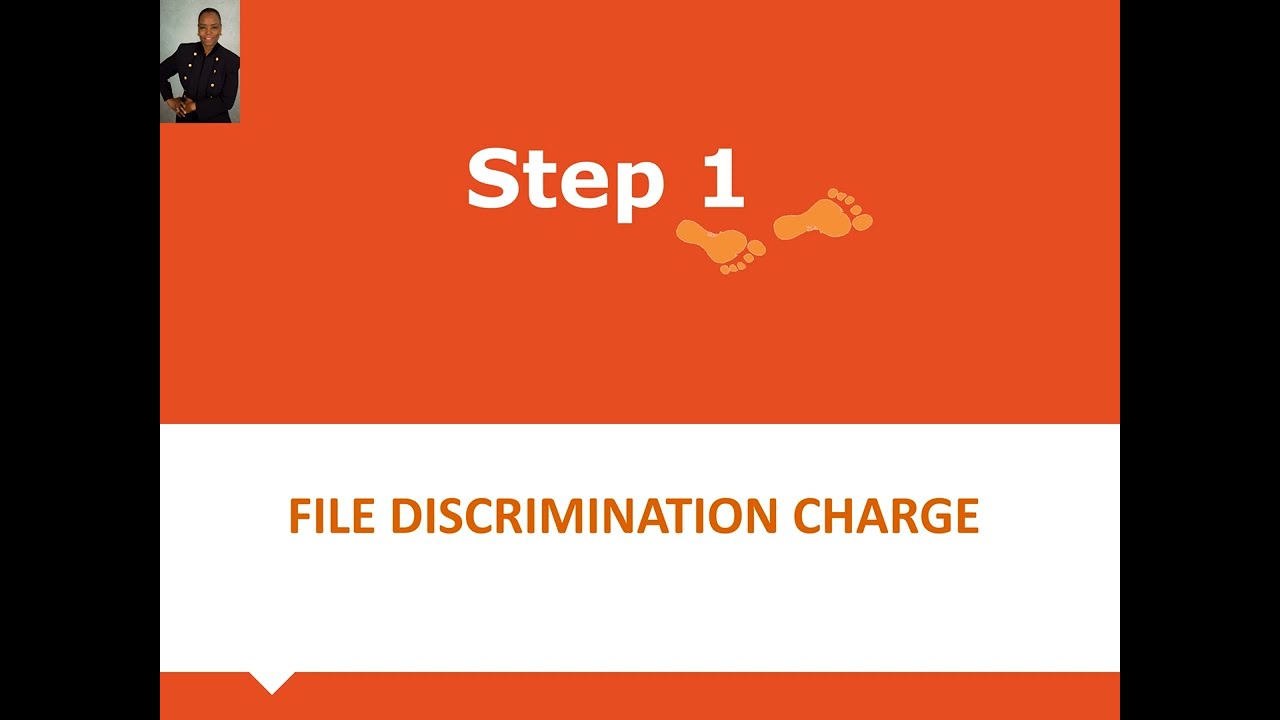
How to start the Employment Discrimination Law Suit. STEP 1. The EEOC Charge
595
To file an employment discrimination charge with the EEOC, complete the form by checking the EEOC box, providing personal information (name, address, DOB), employer details (name, employee count), specifying the type of discrimination (harassment, hostile work environment, etc.), listing the earliest and latest dates of discrimination, and citing the violated laws; the charge must be filed within 180 days of the discrimination (extendable to 300 days for some claims), and after filing, the EEOC investigates and issues a right to sue letter, which allows the claimant to file a lawsuit in federal court within 90 days of the letter's issuance.
Click to watch →
Deep Dive
Analyses of landmark Supreme Court cases, such as Meritor Savings Bank v. Vinson and Harris v. Forklift Systems, Inc., which shaped modern harassment jurisprudence.

Teresa Harris v. Forklift Systems
264
In Teresa Harris v. Forklift Systems (1993), the U.S. Supreme Court established that sexual harassment creates a hostile work environment protected under Title VII of the Civil Rights Act of 1964, reversing lower court decisions that required harassment to be 'severe' to be actionable; the Court held that any discrimination based on sex, including unwelcome verbal comments, constitutes prohibited discrimination regardless of whether the harasser intended harm.
Click to watch →

Sexual Harrassment in the Workplace FULL WEBINAR
503
Meritor Savings Bank v. Vinson (1986) is a seminal Supreme Court case on sexual harassment. A manager told an employee she would have to have sex with him to continue her employment. The employee engaged in a sexual relationship for over a year, then ended it. After ending the relationship, her performance evaluations declined and she was fired. The company argued it didn't know about the affair and that she willingly engaged in it. The Supreme Court ruled this was sexual harassment and the company was liable, stating that the manager's knowledge is imputed to the company and that the employee's willingness to engage in the affair does not excuse the harassment.
Click to watch →

Gillian Thomas: "Because of Sex: One Law, Ten Cases ..” | One to One
1.2K
Price Waterhouse v. Hopkins (1989) established that relying on sex stereotypes about appropriate female behavior is discriminatory, with the Supreme Court ruling that unconscious bias based on gender stereotypes violates Title VII. Meritor Savings Bank v. Vinson (1986) established the hostile work environment standard, recognizing that non-economic emotional trauma from sexual harassment constitutes illegal discrimination. Harris v. Forklift Systems (1993) addressed less severe harassment, establishing that if a reasonable person would find the environment abusive, the line is crossed. Most Title VII cases involved working-class women facing enormous hardships during multi-year litigation with modest financial settlements, yet plaintiffs described their struggles as worthwhile for advancing women's rights.
Click to watch →

Sexual harassment | Wikipedia audio article
9.1K
The Supreme Court's Meritor Savings Bank V Vinson (1986) established harassment as Title VII violation, triggering exponential case growth from 10 to 4,626 annual filings by 1995. The Civil Rights Act of 1991 expanded remedies to include compensatory and punitive damages. Allison V Brady (1991) replaced the reasonable person standard with the reasonable woman standard. Jensen V Eveleth Taconite Co (1991) established class-action possibilities. Kale V Sundowner (1998) extended liability to same-sex harassment without sexual motivation. Burlington Northern V White (2006) broadened retaliation standards. Reeves V CH Robinson (2010) established hostile environment liability for pervasive inappropriate conduct regardless of targeted individuals. Title IX prohibits sex discrimination in education programs receiving federal funds, with Franklin V Quinet (1992) allowing private citizens to recover damages for teacher-student harassment. Bethel V Fraser (1986) established schools' authority to discipline for inappropriate speech. 1997 regulations assigned liability when administrators showed deliberate indifference. Davis V Monroe County (1999) extended liability to peer-on-peer harassment.
Click to watch →

Harris v. Forklift Systems, Inc. (1993)
2.3K
In Harris v. Forklift Systems, Inc. (1993), the U.S. Supreme Court established that victims of workplace sexual harassment can recover personal injury damages for purely psychological injuries without requiring accompanying physical harm, thereby expanding the scope of compensable workplace misconduct claims.
Click to watch →
Deep Dive
Legal protections against workplace retaliation for employees who oppose or report unlawful harassment.

Tom Joyner calls for boycott of TV One? Why would he do that?
31.1K
Title VII of the Civil Rights Act protects employees who engage in activity in opposition to employment actions they reasonably believe to be unlawful, not just actions that are actually unlawful. This means that even if the harassment claim is not proven, the employee is protected from retaliation for reporting what they reasonably believed to be harassment.
Click to watch →

Dr. Santiago Salazar: Derecho Laboral y Tributario |Experiencias, anécdotas y creador de contenido⚖️
5.3K
Workers who formally report workplace harassment are protected by law. When a worker files a formal complaint through the workplace committee of coexistence or to their immediate supervisor, they receive 6 months of reinforced labor stability protection. During this period, the worker cannot be dismissed. If the employer retaliates by firing the worker for reporting harassment, the worker can seek reinstatement and additional compensation.
Click to watch →

Blizzard / Activision Sued by California over “Frat” Environment | The Emily Show Episode 95
50.5K
Retaliation against employees who report harassment or discrimination is illegal. Employers cannot discharge, expel, or otherwise discriminate against any person because that person has opposed practices forbidden under anti-discrimination laws or has filed a complaint, testified, or assisted in a proceeding. The lawsuit alleges that female employees were subjected to retaliation including being deprived of work on projects, unwillingly transferred to different units, and selected for layoffs after making complaints about harassment and discrimination.
Click to watch →

Caso Cerrado Special: most horrible bosses! | Telemundo English
171.5K
When employees refuse sexual advances or harassment, they may face retaliation in the form of reduced hours, decreased pay, or other adverse employment actions. Such retaliation may constitute additional harassment and provide additional legal grounds for claims. Employers have a responsibility to prevent retaliation against employees who report harassment or refuse unwelcome conduct.
Click to watch →

(보강) 직장 내 괴롭힘
150
Employers are prohibited from taking adverse actions against employees who report workplace harassment or are victims of harassment. This includes actions such as termination, demotion, or other unfavorable treatment. The law recognizes that retaliation against harassment victims can discourage employees from reporting harassment and creates a hostile work environment.
Click to watch →
Deep Dive
Best practices for corporate HR departments regarding internal investigations, compliance training, and drafting effective anti-harassment policies.
House Subcommittee on Workplace Safety and Respect 3/26/18
274
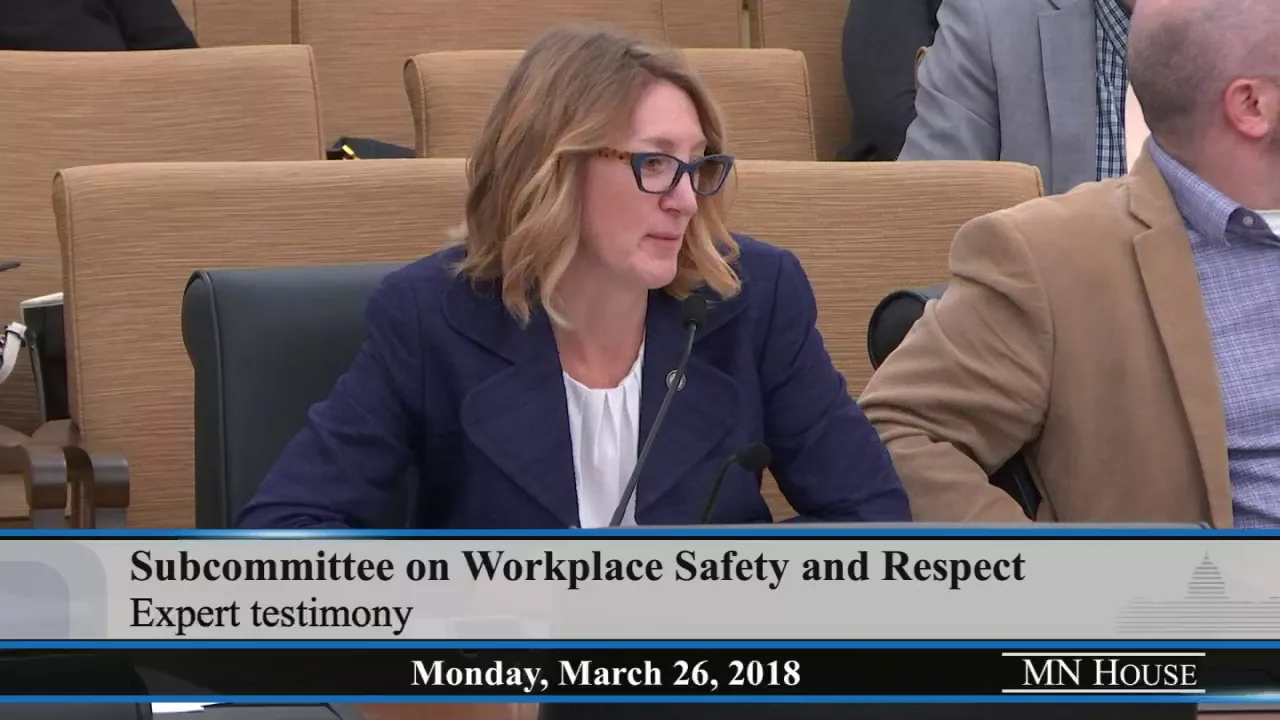
Effective harassment policies must create a culture where employees understand bad behavior will be taken seriously. Policies that are merely pieces of paper without enforcement are ineffective. Training should be in-person and conducted in small groups to encourage discussion. Training should call out employees who are not taking it seriously. Organizations should hire experienced trainers rather than those who may have conflicts of interest. Effective investigations should focus on finding the truth rather than creating theater. Investigators should talk to witnesses identified by the victim. Organizations should consider hiring outside investigators for high-level cases. Employees at all levels have an obligation to report harassment they witness, particularly those with management authority. Under the Human Rights Act, organizations can be liable when management-level employees know about harassment and fail to take action.
Click to watch →

CLE Institute 2021: Government Investigations Trends and Corporate Compliance Best Practices
184
Effective internal investigations require: anonymous reporting mechanisms with whistleblower protections; properly scoped investigations with appropriate teams rather than HR handling all matters; quick response with adequate resources; and tracking results for self-reporting benefits. Best practices include ensuring employees know reporting procedures, protecting whistleblowers, and implementing remedial action upon identifying problems. These principles apply broadly to regulated industries regardless of international footprint, addressing friction between local business practices and U.S. legal requirements.
Click to watch →

NR-1 e Saúde Mental no Trabalho: O Que Mudou, O Que Fazer e O Que Acontece Se Você Não Fizer
266
Companies must have a written anti-harassment policy that is not just a decorative statement. The policy must be documented, specify the company's approach to harassment prevention, and include procedures for handling complaints. Companies must implement anonymous reporting channels for harassment complaints, preferably internet-based and using certified third-party services. Companies must train both leadership and employees on psychosocial risks, including how to identify risks and how to approach struggling employees. A 4-hour training session is typically sufficient.
Click to watch →

Responding to Complaints of Harassment – How to Conduct an Effective Internal Investigation
388
Organizations must conduct thorough, impartial internal investigations of harassment complaints by following a systematic process that includes interviewing all relevant parties, gathering documentary evidence, analyzing credibility, determining appropriate corrective action, and communicating findings to involved parties, as this approach helps prevent legal liability and demonstrates commitment to maintaining a harassment-free workplace.
Click to watch →

"He Knew. He Did Nothing." Asmongold on Blizzard's Response Over Scandal
628.7K
Companies often implement anti-harassment training and diversity programs as part of their corporate compliance efforts. These programs include employee networks, speak-up campaigns, zero-tolerance policies for retaliation, and training on equality and diversity. The purpose of these programs is to demonstrate that the company is actively working against harassment and discrimination. However, the speaker suggests that these programs may not always be implemented because companies genuinely believe in them, but rather to provide plausible deniability and reduce legal liability when something bad happens. The speaker also notes that companies may claim fair compensation policies and equal opportunity, but these claims may not reflect reality.
Click to watch →
Legal Hostility
OSHA vs Court
Immediate Action
Legal Hostility
0:01- 1
Defines hostile environment as severe or pervasive conduct.
- 2
One-off or isolated incidents rarely meet the legal threshold.
- 3
Workplace harassment requires a pattern of behavior, not isolated acts.
Critique of the "Severe or Pervasive" Standard as an Obstacle to Workplace Equality
While the legal definition of a hostile work environment relies on the "severe or pervasive" threshold to prevent frivolous lawsuits, many legal scholars and employee advocates argue this standard sets an unrealistically high bar for plaintiffs. Critics contend that the current jurisprudence often dismisses systemic, lower-level harassment (such as microaggressions or sporadic discriminatory remarks) because they do not individually meet the "severe" or "pervasive" legal thresholds. This can leave employees vulnerable to toxic work cultures that cause genuine psychological and professional harm but fall short of the statutory definition. Furthermore, feminist and critical race theorists argue that the "reasonable person" standard used to evaluate such conduct is often biased toward dominant societal groups, failing to account for how marginalized individuals experience cumulative workplace hostility. Consequently, critics advocate for reforming the standard to focus on the cumulative impact of harassment rather than requiring a high threshold of severity.
Fundamentals of employment law and the foundational role of Title VII of the Civil Rights Act of 1964.
The definition of protected classes, such as race, color, religion, sex, national origin, age, and disability.
The legal distinction between 'quid pro quo' sexual harassment and general workplace harassment.
The objective vs. subjective legal standards, including the concept of the 'reasonable person standard' in tort and employment law.
The Faragher-Ellerth affirmative defense, which outlines how employers can establish a defense against liability for supervisor harassment.
The administrative process of filing a workplace discrimination or harassment charge with the Equal Employment Opportunity Commission (EEOC).
Analyses of landmark Supreme Court cases, such as Meritor Savings Bank v. Vinson and Harris v. Forklift Systems, Inc., which shaped modern harassment jurisprudence.
Legal protections against workplace retaliation for employees who oppose or report unlawful harassment.
Best practices for corporate HR departments regarding internal investigations, compliance training, and drafting effective anti-harassment policies.
42.6K views211likes5:03@LawlineCLEOriginal Release: 2017-10-18
[Music] in the OSHA safety manual it has a definition for what is considered intimidating now and here they use they use the phrase a hostile environment which for anyone who practices then what wig door LLP does which is hostile environment discrimination cases that's a that's a loaded phrase right there because the word hostile as used in anti-discrimination laws is not the way that just the average person would consider the use of hostile so for anti-discrimination laws you have to have an environment where the conduct is considered sufficiently severe or of such a repetitive and consistent nature that it's considered pervasive and so if it's severe or pervasive then generally that's enough to hold the employer accountable so what you can't have is a one-off situation or maybe over a two year period one co-worker says some fairly offensive things to a particular employee but and then that's it and so what happens is if it's just so let's say Billy says something really offensive to his coworker mark and but mark does nothing about it and doesn't tell anybody but then a year passes or even two years and Billy says the same thing again to mark the way the anti-discrimination laws have been interpreted unless it was a serious threat of violence like as if Billy put a noose over Marc's desk or something like that it's not going to be enough to create what's considered a hostile environment as that as that phrase is interpreted by courts I'll hear the OSHA definition has conduct that would frighten alarm or inhibit others so again physical I think everyone can agree that it's easy to have the to define those situations that cross the line when somebody's yelling shouting or there's such physical intimidation that you have one employee like literally getting close physically to another employee and shouting that would clearly be crossing the line I mean in most states potentially the the employee who's getting yelled at would have potential assault claims against the co-worker but that an employer wouldn't want to have to resort to a co-worker filing criminal charges against another co-worker and it would be a lot better if the employer had something written down and in place already that the employee could go to HR and say you know Billy just threatened me he threatened me with you know potential physical harm he said he might hit me if I do such and such and that the employer has in place already a protocol that Billy is going to have to report to HR and two or three people are going to review the situation and he's probably going to get written up and put on probation and if it happens again in X amount of days then without question he's terminated and I think that once you're into the realm of potential physical aggression that there's really no question that an employer is entitled to and should immediately terminate an employee who's engaging in that conduct [Music]
Up Next

5:30
Understanding Title VII of the Civil Rights Act of 1964
@GreggU
55.6K views•2017-01-17

4:27
US Secondary Sanctions Impact on EU Businesses and Blocking Legislation
@Bureauvandijk
1.6K views•2019-03-20

5:27
Forensic Phonetics: Speaker Identification in Legal Cases
@nptel-nociitm9240
539 views•2025-03-19

24:42
Police Interrogation Tactics: False Confessions & Legal Reform
@LastWeekTonight
7M views•2022-04-18
Related Study Plans & Knowledge Roadmaps
Structured learning paths in Law
law
Self-Defense Law: Imminence & Castle Doctrine
01Foundations of Self-Defense Law
02Imminent Threat & Reasonable Belief
03The Principle of Proportionality
+ 3 more learning modules
12h6 modules
Explore Roadmap
law
Defamation Law: First Amendment & Actual Malice
01Introduction to civil torts and the First Amendment
02Elements of Defamation: Libel and Slander
03Public Figures vs. Private Individuals
+ 2 more learning modules
8h5 modules
Explore Roadmap
law
Hearsay Rule: Trial Evidence & Exceptions
01Introduction to Trial Evidence & Courtroom Basics
02Demystifying Hearsay: The Core Definition
03Non-Hearsay: Exclusions Under FRE 801(d)
+ 3 more learning modules
14h6 modules
Explore Roadmap
law
Medical Malpractice: Law, Liability & Care
01Foundations of Tort Law and Civil Liability
02The Four Elements of Medical Malpractice
03Defining and Proving the Standard of Care
+ 2 more learning modules
12h5 modules
Explore Roadmap