











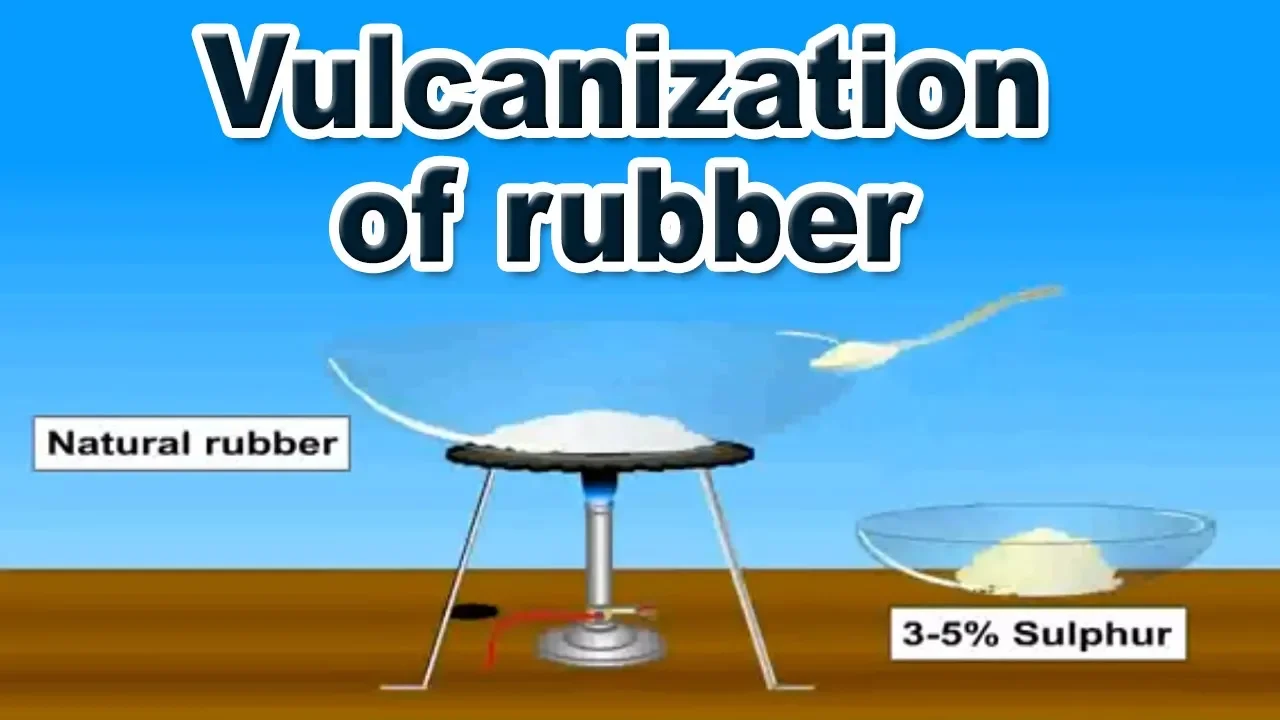






Natural rubber is a polymer called polyisoprene, consisting of approximately 1000 isoprene monomer units (2-methyl-1,3-butadiene) connected by single bonds with alternating double bonds. Raw natural rubber has significant disadvantages: it becomes sticky in summer, brittle in winter, and swells when exposed to oil. Vulcanization, invented by Charles Goodyear, addresses these limitations by treating natural rubber with 3-5% sulfur at 100-150°C, which forms cross-links (disulfide bonds) between polymer chains. This process transforms raw rubber into a stronger, more elastic, abrasion-resistant, and solvent-resistant material suitable for practical applications like tires.
Vulcanization & Natural Rubber | TN Class 12 Chemistry
Added:Basic concepts of polymers, including monomers, macromolecules, and the classification of polymers.
Structure and IUPAC nomenclature of conjugated dienes, specifically isoprene (2-methyl-1,3-butadiene).
Understanding of stereochemistry, particularly cis and trans isomerism, to understand why natural rubber is cis-1,4-polyisoprene.
Fundamental knowledge of chemical bonding, specifically covalent bonds, double bonds, and intermolecular forces.
Study of synthetic rubbers (elastomers) such as Neoprene, Buna-S, and Buna-N, and their preparation.
The chemistry and environmental impact of biodegradable polymers versus non-biodegradable polymers.
Industrial applications of vulcanized rubber, including how varying the percentage of sulfur alters the stiffness and properties of the material.
Advanced polymer analysis, focusing on mechanical properties like tensile strength, elasticity, and thermal degradation.
13.8K views0likes20:23Original Release: 2019-11-28
hello students vanakkam chemistry in everyday life in the topical and the natural rubber and vulcanization in the topic pathogen I made a video lopaka bottom right foster what is natural rubber but upper limb on the Tyrian did I break it well no the natural rubber yeah okay like a tachycardia there and our awareness synthetic rubber that is man-made Ripper layer so now my Indian didn't I'm a natural rubber cathedra in the video lopaka Purim but natural rubber now rubber tree Linden curricular rubber the natural rubber for a bird rely on the knob Eric Eric Eric Chula Robert relearn inimical or a disatrous upon others it is in a sticky milk like or substance when the Karakum other one another lab techs in solo say yeah mostly them but pathing and i am their rubber trees when the Burma I'm sorry Myanmar in a key Burma order name on the Myanmar Linda Marie countries LA I think Myanmar is the largest your upper producing country so anger under property law and the Taurus ishe plane is why shapeless we're on the bark Lebar clone on the merit order mark the man Avenue or a cut the cut a break at Pawnee future through anger sorrow mandatory resinous white color substance vanilla Varro so I the cap air when they'll at Texas either wonder undertake a kilo and then the bark love and the day or a container to catch in touch in a container seven the cut DeWitt ravana so in the resinous substance that is the latex in ago and the container la collect our brother Lottie wanna say it were a very contained look at per se termina so a decoder on the day either on the actual are 35% kita Roberto maybe 65% approximate assorted 35 to 40 percent to the 30 to 40 percent to them on the rubber comb remaining one day water on a Makita a rubber madonna so on there are better on the theory of achieve that is coagulate pani it is called coagulation of rubber rubber on the coagulate Bunny and the rubber on the Tania Perry cheered upon so are the Condor acetic acid or formic acid on the and the container lad pnina logitech agitate Nicola Cathy calla calla pop Athena cozinha Rotella and the rubber mat the palter in sapporo Murray up they didn't ship week neva reckon that rubber is called coagulated rubber I proudly end up and among a filter pan among the filtered bunny and the free trade and the solution declare the Kira discard pony to Vanga and a mailer Quran the solid substance on the coagulated Robert other one there none of machines could suppress bunny or the rubber sheets of Marty or the London in the tummy upon the moisture on the PO Gera PO garden I'm a moisture and it is several days gone the rubber sheet so open space let dry panduranga bring the moisture Purdue so a prick Eric is the natural rubber okay but in the natural rubber après number you spawn umbria d because it has some disadvantages remember who came on a disadvantages Martinez all right first one parting in a are there on the summer season rather naturally rubber on this it becomes sticky sticky not available and I do later winter season lop a teenager on the summer season winter season lapatinib day it becomes brittle brittle knobby rubber rafts freedom what does it remarried and when it comes into contact with the oil it swells up a being upon Ameri would be would be pulled it Mario yep Anna all you lot of contact Laura Marie if I in the mod rely here Cardinal a number we cannot use natural rubber as such a previous fauna Moodie mask and upon mudiad layer so they end up and along and I it is a reinforced or it is hardened or it is strengthened other cat demerit Salah mother the Kuwait will undergo a process and the processor number you know I'll tell you know right Erica unary number natural rubber order chemical composition amok etherion actual natural rebellion as I can our being a remote area no Syria so natural robbery and I'll carbine party night is actually a polymer app a polymer animal contain actual a polymer now Marie - and Athena it will give a big large molecule under molecule - Donna - alumna Polly - hello berry sold an ape the Mario rings in college for the money no matter an array a thousand drinks aluminum rings energy for man you know Mary thousand rings thank you he put the rings are a number correct panel above and then now go worry in the medical expert Lama Poonam da da da maré even upon given the Athena unit okay what every unit so I'm getting a breaching another worry you need them a per unit abut larger molecule Syria and I in given the patina nearly a thousand units okay but one one molecule either under monomer a plane so novo either when the polymer so low so in the Murray convert wanna know but London natural or the convert I ok but number synthetic on the convert ponder ponder Minh area conditions could occur window you can or such as pressure or a temperature or catalyst in the more conditions a number apply para para in the polymerization nautical herida right people either were the natural polymer yeah clearly here the rubber trailer in the rubber module polymer are upon the board over a single single unitary Erica green path Amla and the single single unit ah isoprene a bigger molecule earthy so it only another polymer poly isoprene rabbul izza isoprene order polymer sorry Polly a something written isoprene and Cabrini patina it is nothing but 2 methyl 1 3 buta or I'm sorry buta 1 3 dying so either a daughter named if I the name less the number easier solution will apology come to do pujita formula by heart penomet nominally anything easier the volume castor potala rumba easier but ye nah double bond okay died in her two double bonds Surya one Trina in the two double bonds order location at carbon 1 and carbon three Surya you don't either either either quickly but butanna parent compound and the parent compound four carbon atoms a metal even a substituent substituent at position to position to so eat dinner visi Angela number just named loved a curriculum so named a pocket area formula either the easy dinner thank you for formula either Amparo yeah do meth in first it died eat a run on a double bond put Surya a book in the die in anger K right in the double bond o carbon capital R Co correcta say the carrot you have single bond portal portal or not a Nathaniel kramarenko single molecules and isoprene are they appropriate for no he by the second position its to meth in opposite second position lower is ch3 by the one two three four Surya Eureka upper four carbon atoms are computer correct ugly you put them out of the name of its in the structure a potato if I own a bonds corridor then hydrogen which you fill part up or you put it in the bond Rica I'm going it brendi ch2 particular I put a Karbala Sathya to the border or four bonds on correcta if I am the carbon putting a one two three four so never we need not put any hydrogen here but in the carbon acquire upper one two three four right in the carpenter / 32 that is so so this is isoprene unit you find the rubble patina in the marine area a large number another yen per touch yen and a large number of isoprene units yet then in a market area so yen and put it on either low or not saying the polymerase are ye or I'll call him Eric code composite at the natural Yzerman natural rubber or poly isoprene you buy door now nominally and Kapoor every other so wouldn't even afford to cut up bracket booty end quote I put a character but it will put into the car now or an ollie unit did not connect pond up on Syria every easy partner so first you retail but start put a chain not a year could chain it another bracket putting in are you connected to put Mookie Amana my polymerase i repair straight chain lurker double bond single bond econo single bond double bond doc no okay yep are here in Gabon to potency he prefers to ch2 Porter double bond is single bond document CH single particle double bond side chain allowed to them side chain a single bond record I calculate the product but see inside chain I could have a patella okay use a double bond single bond CH do but might be Arthur you need a conduct pas de perón are they say the word unit breather either worried unit but next up I think I might be a second unit up a connection cog in the bond so ch2 potahto mark a double bond a single bond CH single bond double bond c CH three double bond a single bond CH to you did rend out the second isoprene unit Surya erectus is there a third molecule in a repeated Arkham polymer going to the chain when they connect our Emory Abu Patek Nomura video either art they know your interconnect product agave in the bond a thrombus ch2 Surya double bond on this single bond CH double bond single bond record double bond c CH three double bond rak'ahs single bond CH - okay you put on the nali nali poor london-uk the character cannot a moon a pot experiment rack okay so either third unit yella pergi you do meet Canyon in llama connected okay that is why it is a polymer sonar a connector thing a bracket party and Peru so this is natural rubber herida right deep a that was the carbon a in llama hydrogen in lava number very maybourne's forty the express front of peru as given in the book okay you pay a pretty narrow portland partner in that double bond a button of a man a project panic RV can be part of a movie you need to come Ethan a double-bond Rick a moon a double bond upper structure look moon and above all our male surrender layer up whatever so now on the moon in double bond another port another voting about signal the first in anger in this chart printer so Bernie in the Banda Surya in the bracketed Surya ch2 ch2 one leader thread in the point to the ch2 HEPA Arthur to get borned a button above me in the bond at ch2 after they make a single bond you double bottom elevate the form of a single bond every put on bond a button embark north of this double bond Surya double bond but to the Varnum oxygen about single bond so Becky Angelou after that a single bond didn't became the new orchid or a single bond Malibu no Janna yep a mile up or deny in the bundle double bond take a particular curve so next avoid a double bond sorry I put it up in the rebel burn what is each other are today in the body Surya up a single bond Kiran breather in the bond right after the single bond right after the third one third single word marijuana after the double but Bernard to the double bond or a Milan drew after the single bond Carroll il above with automatic a theorem Jelena borderland it is not a moon about it one two three after the double bond there of a key on the know one two three number a is your portal earlier Derrida right if I were you want it before en time Siena in the moral linkage in the reappoint agree you but I'm gonna see you're still up for developers clear about to cs3 okay double bond the canary so double bond a canary it's a CST number in the structural yeah they make carbon hydrogen economy Kapurthala up I end up on a pony who the bond of a dimension but so in the bond of day after the burn out the double bond a Gurkha door again so are the Camela I think under double bond a cap in any particular sorry over a ch3 forego gorilla bond but to the single bond directly or across LaPorta illustrator got a porter la crosse lopata for a structured parking taken a lark Olea different arguments so the double bond as a capillary very car but lower in a single bond so that at the double bond are the coupe in Eddie say the money so either the structure of isoprene okay yo Mookie amore amore vitiated the note wanna know in the CST Lampard Omari couldn't learn in your ch3 pre or ch3 Nia on the mother you know lemon yellow methyl substituted methyl substituent philipovna yellow ray st. lurking Surya vanilla memory would group over it in the side light silicon or top enough Surya Natura need the side look sorry up over a sailor latina other one this is a binson home Surya sis you another isoprene Lea Polly AIDS or a nurse or a la Marie I so printed them now you're in the poly isoprene so this is this poly isoprene Derrida right it is not the structure okay eople let us go to volcán ization right uh Patna sonamoo Nadya in the summer winter oil pattern on the natural rubber on the NIV or Murray quality another strength or aromatic them so in the processor on the vulcanization of inter-process bunny this not natural rubber is made stronger actual ah good ear upbringing or a scientist to the inventor either in the vulcanization invent but every are in patina shoreless goodyear niganda the rubber in the tire Carolyn I'm passing in her good ear I've been put upon a Goodyear brand actually Euro above Apertura with the mother and the Charla's Goodyear Goodyear being recycling and get bored learning adhara llama candy papa kala and an area psychic and either my tire tube karela codeine give alkalizing señor perdón I mean a boat could a panther Punga actual Arion Nana never the V Kirk Ribera strengthen control process the vulcanization in given the number natural rubber a no man upon a piranha strengthen pond a poor oh I should have natural rubber an event up under under Amina natural rubber is mixed with or treated with three to five percent sulfur and it is heated to 100 to 150 degree C upon a mechanic mechanic CARICOM 'no vulcanized rubber on the natural rubber either vulcanized rubber the vulcanized rubber another this poly isoprene upon the sis Paulie and a position solid layer a partner isoprene sis poly isoprene molecules molecules love Paul he murdered the vulcanized Arab Brenna it is a in a MOOC Emma pathing and I ended up in their self for order percentage them differ ago so I think more polka polka Robert with the hard Arkham Syria 30 percent Dakota number one they sell for at Pendragon upon their column area it becomes a stone like substance which is called ebo night right so in the Madhuri or elasticity lower string clinical rubber venom o Conda local other base bunny in the percentage of Robin phenomena a Decatur Medina Makkah balconies jariabek Caraco Marida so in the vulcanization say here's another novocaine dinella plus points a yellow agate a a beam putana stability Syria stable arc o one right now the other detention string the one the increase ago enzyme strength what are the elastic cargo it becomes elastic at the same time it will be strong okay after the fourth of this hardness circle and shift when they abrasion abrasion another day madam Surya abrasion resistant doubtless he kept Allah they enjoyed are they Syria are the Kurama finally it will be resistant to solvent action you know the very solvent lopata other than they mean apakah Marco so he they'll know that these properties will be attained after vulcanization after the vulcanization hundred the Quran the word karna and parting the reinforcing or strengthening natural rubbers on but upon her extinct he led the natural dobrica strength eel in the north Oh upper yeah when the natural rubber on the strength e llama in the muddy and a demerit slide cut the car away and then partner the double bond present in the natural rubber it causes it to be weak upon the number eight Purcell forsaken Allah by the sulfur here necessary in this arena it adds across the double bond upper yes yes Syria disulfide bonds a farm pond disulfide bonds a in the either or change regularly the a marine or chain going there in the chain you could not do in the cross-linked goodra the Dulce disulfide bonds on this pompano upper and the cell are the rubber in Agra it becomes more strong you know wandering across linkage one row on the cross linkages sulphide disulfide bond repo a plate becomes more strong it will have Denzel string the harder go day monitor and the abrasion-resistant Darko saying the very property is not a cappella Condon and then vulcanized rubber cat character oh so this is all about rubber on vulcanization hope you all understand thank you
Up Next

3:31
Natural vs Synthetic Rubber: Production and Properties
@HowItComesTogether
118 views•2025-08-29

34:36
Frances H. Arnold Nobel Lecture: Directed Evolution in Chemistry
@NobelPrize
109.5K views•2018-12-08
10:06
1H NMR: Determining Number of Peaks from Structure
@MSJChem
59.2K views•2017-04-06
17:31
Edible Water Bottles: A DIY Guide to Sodium Alginate Spherification
@ryan
10.5M views•2019-06-21
Related Study Plans & Knowledge Roadmaps
Structured learning paths in Chemistry
chemistry
Nanochemistry: Synthesis, Properties & Analysis
01Foundations of the Nanoscale
02Size-Dependent Physical & Optical Properties
03Synthesis Methods: Top-Down vs. Bottom-Up
+ 2 more learning modules
15h5 modules
Explore Roadmap
chemistry
Nuclear Chemistry: Decay, Meds & Fuel Cycle
01Introduction to Nuclear Structure and Radioactivity
02Decay Dynamics and Kinetics
03Radiation Interaction and Detection
+ 2 more learning modules
24h5 modules
Explore Roadmap
chemistry
Supramolecular Chemistry: Forces & Machines
01Foundations of Chemical Bonding and Intermolecular Forces
02Introduction to Host-Guest Chemistry
03Thermodynamics and Dynamics of Self-Assembly
+ 2 more learning modules
16h5 modules
Explore Roadmap
chemistry
Photochemistry: Excited States & Reactions
01Foundations of Light-Matter Interactions
02Molecular Orbitals and Electronic States
03Photophysical Processes and Jablonski Diagrams
+ 2 more learning modules
18h5 modules
Explore Roadmap