








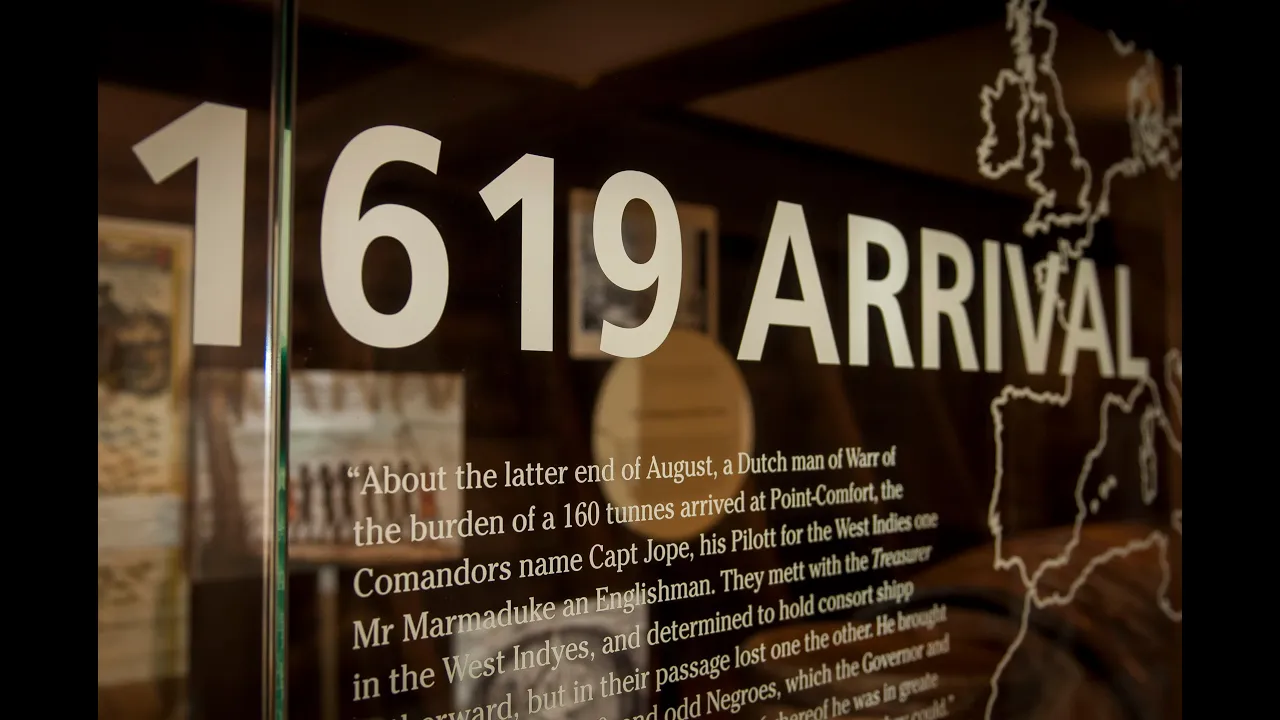










In 1619, approximately 20 Africans arrived in Virginia aboard the White Lion, marking the beginning of the transatlantic slave trade in English North America; these Africans came primarily from West Central Africa (Congo and Ndongo regions), having been captured during Portuguese military expeditions and transported through the brutal Middle Passage where an estimated 20-25% perished; their arrival initiated a system of racial slavery that would become foundational to American society, with Africans adapting their cultural practices—including foodways, music, and religious traditions—to create a creole culture that significantly shaped what would become distinctly American traditions, while simultaneously facing systemic discrimination that persists in various forms to this day.
1619: The Arrival of Africans and the Making of America
Added:>> From the Library of Congress in Washington D.C.
>> Travis Hensley: Good afternoon everyone.
My name is Travis Hensley.
I'm a program specialist here at the John W. Kluge Center.
Just a few quick announcements.
First of all, I'd like to ask you all to please put your phone on silent.
And I also want to let you know that this is being filmed for broadcast on CSPAN History TV and the Library of Congress' website.
It is my pleasure to introduce acting deputy librarian of Congress, Mark Sweeney.
[ Applause ] >> Mark Sweeney: Thank you, and good afternoon, and welcome to the Library of Congress.
It's my pleasure to welcome you to the Library's historic Thomas Jefferson Building and this afternoon symposium 1619 in the Making of America, which is being hosted by the John W. Kluge Center here at the Library of Congress.
The Kluge Center was founded in 2000 in order to foster the mutually enriching relationship between scholars and political leaders.
The Kluge Center attracts to Washington, the best minds available in the scholarly world.
Facilitates their access to the Library's rich, diverse and enduring source of knowledge.
And engages them in conversation with the US Congress and other political figures.
Today's symposium is being held in collaboration with the Middle Passage Project of the College of William and Mary, Norfolk State University and the Virginia Commonwealth's 2019 Commemoration.
Founded in 1995, the Middle Passage Project explores the history and memory surrounding the Transatlantic slave trade, its resounding effects on Africans in the Americas and its representation in literature, the humanities, art and history.
1619 was a pivotal year in America's history and marks the arrival of the first Africans to English North America, the establishment of the first permanent English colony in North America at Jamestown, Virginia, and the first representative legislative assembly in the new world with the founding of the House of House of Burgesses.
This symposium will explore the intricate encounters of Africans, Europeans and Native peoples during this significant period.
Who are the Africans that arrived in Jamestown in 1619?
Where did they come from?
What world did they bring with them?
What emerged from the Africans' engagement with indigenous Native American populations and their spiritual and cultural life ways?
And what is the enduring legacy of this encounter today?
So many questions that we can have answered, hopefully, today.
Today's program will promote historical accessibility to the meaning of 1619 and lay the groundwork for a national dialogue and renewed understanding of the major events that began 400 years ago.
Lastly, our curators here at the Library have prepared a special treat for you this afternoon.
They've assembled a display of treasures and historical items from the Library's collections related to the early Americas, and I invite you to explore them in the other room there after the program.
And now let me turn this over to today's convener, the 2015 Larsen Fellow in Health and Spirituality at the John W. Kluge Center and the director of The Middle Passage Project, Dr. Joanne Braxton.
Thank you.
[ Applause ] >> Joanne M. Braxton: Thank you for that warm welcome, Mark.
It's good to be here.
On behalf of The Middle Passage Project, the Joseph Jenkins Roberts Institute for Africana Studies at Norfolk State University International Programs, the Virginia Historical Foundation for the Humanities, the College of William & Mary's 1619 project initiative, our lemon project and the Nottoway Indian Tribe of Virginia and especially the 2019 Commemoration American Evolution.
I thank you for making us welcome here today at the John W. Kluge Center.
And we would also like to add our welcome, our warm welcome to everyone who has come out today, not only to hear, but to engage and participate in what we hope will be a transformative conversation.
I would like to give a special thank you to Travis Hensley of the Library of Congress Office of Scholarly Programs Kluge Center for seeing the significance of today's symposium and exhibition and supporting it with enthusiasm and gusto over a period of time.
[ Applause ] We all love Travis.
We hope that this conversation will lay the groundwork for a national dialogue and reinterpretation of major events that began in 1619 that would shape the contours and character of America today.
This event is part of a larger project of 2019 commemoration American Evolution that will bring programs, events and scholarly conversations to the Commonwealth of Virginia and the nation in the next two years as we examine 400 years of American history in Virginia.
Our speakers today are Professor Robert Trent Vinson of the College of William & Mary, Professor Cassandra Newby-Alexander of Norfolk State University, Chief Lynette Allston of the Nottoway Indian tribe of Virginia, Incorporated and myself, Joanne Braxton.
You have our bios in your program, so I will spare you reading the biographies.
Our presentations today will range from the scholarly and the historical to informed personal reflections.
And again, there will be a time for engagement as indicated on your program.
So, without further ado, I would welcome Robert Trent Vinson, my esteemed colleague.
[ Applause ] >> Robert Trent Vinson: Thank you, Dr. Braxton.
Thank you to the Kluge Center.
There are many, many thanks to give.
I have limited time, and academics are notoriously long-winded.
So I could take up all my time by giving thanks to everyone.
So, thank you to everyone.
So my job here is to talk a bit about the African background and the Transatlantic journeys of the 1619, 20 and odd Negroes that arrived at Point Comfort, Virginia.
Point Comfort, which is now Hampton.
Right near the fledgling Jamestown settlement in 1619.
Who were they?
Where did they come from?
And what was their experience?
What might their experience have been as best as we can reconstruct it?
In August 1619, a captive woman named Angela, part of those 20 and odd Africans that landed at Point Comfort, arrived traumatized, mentally, emotionally and physically, that endured a long journey of months from their homes in West Central Africa.
They likely came from the West Central African states of Congo and Ndongo.
If you take a look at the map to the left here, you'll see this region of West Central Africa, and you'll see Congo, and you'll also see Ndongo in this area here.
I hope everyone can see okay.
And you'll also notice the word Luanda, which will be the capital of a Portuguese colony called Angola.
So those are our three major points that I'll refer to.
Of course, the 1619 Africans were not the first time that Africans had arrived in the Western Hemisphere.
By the time Angela and her fellow captors had arrived, about 500,000 enslaved Africans had already gone on a transatlantic journey from the West Coast of Africa into the Americas, primarily in Spanish colonies in the Americas and the Portuguese colony of Brazil.
They came from densely settled urban towns.
Some came from rural villages where they would have raised agricultural crops like sorghum and millet.
Some might have tended livestock including cattle.
And interestingly enough, if you notice their names, Angela, Pedro, Peter, some featured Iberian and Christian names.
And that is indicative of the fact that in this area, particularly in Congo, there had been a longstanding engagement with Christianity and with Portugal.
Congo, in particular, was a strong political state that maintained close diplomatic, economic and cultural ties with Portugal.
With Portuguese Catholic missionaries and traders in Congo and Congolese royal ambassadors and other emissaries going to Portugal starting in the 15th century continuing through the 16th century.
By 1491, Congolese royalty declared Christianity to be a state religion.
But this was controlled by the Congolese.
So it's not an imposition by the Portuguese, but this was Congolese engaging in Christianity and using that to start Congolese-run Christian schools.
They were literate people who spoke the closely related languages of Kikongo and Kimbundu.
Some also spoke Portuguese.
And by 1595, the papacy in Rome had declared Congo to be its own Episcopal district, and its primary church became a cathedral.
Christianity also impacted in the state of Ndongo as well.
So, the names are indicative of this engagement with Christianity.
Now, though Congo had exported enslaved people to the African sugar-producing island of South Tome and West Africa, island off of West Africa and to Portugal itself, since the early 16th century, Portuguese military expeditions later in that same century against Ndongo and also Congo where the immediate circumstances had generated thousands of enslaved war captives including those that came in 1619.
As I mentioned, Portugal had established a small colony Angola in 1575, making it the first African area under European occupation during the early years of the Atlantic slave trade.
And this trade, of course, extends across the world, the transatlantic trade from 1502 until 1870.
This period of time when about 15 million Africans would have boarded ships, and about 12 million Africans would have arrived in the Americas.
Why the disparity of 15 million leaving Africa and 12 million arriving in the Americas?
The middle passage, right.
So an estimated 20 to 25% of those Africans boarding those ships in Africa did not make it to the other side, Angela and her fellow captives that arrived in Port Comfort with those who survived.
Now the Portuguese dynamic is important here because Angola became a launching point for Portuguese governors to initiate war, specifically to generate war captives.
Angolan-based Portuguese merchants held the asiento, a contract with the Spanish crown to deliver thousands of slaves, enslaved people I should say, to Spanish colonies.
So this combination of policy, Portuguese policy, to engage in war and a contract, a commercial contract, created a dynamic where warfare was deliberately used to generate war captives and enslaved people.
And now 1619 Africans were part of this dynamic.
The Portuguese governor in 1617, Luis Mendes de Vasconcellos Mendes was bent on conquests as the only means to get the numbers that he wanted, an estimated 9,000 to 12,000 annually.
In his reign from 1617 to 1621 over 50,000 Africans were exported from Luanda.
Over 150 slave ships left the Angolan port of Luanda, including our 1619 Africans.
Now in contrast to popular perceptions that African tribal wars were the cause of slave trading, it was these military expeditions of the Portuguese with mercenary militaristic Africans known as the Imbangala that drove these chaotic lawless conditions.
In this war context then, slavery became ubiquitous.
Slave economies developed as the buying and selling of enslaved people entered African regional commercial networks and slaves, not silver money, became the currency for all financial transactions and for political tribute paid by lesser states to more powerful states to whom they claimed allegiance to.
These enslaved Africans like Angela, deeply traumatized by the circumstances of their enslavement, their forced separation from family and friends and the stripping of their societal identities.
Imagine, all of who you are, connected to all the people that you love, no longer matters.
That you are reduced, dehumanized, to be a unit of labor.
Imagine then that at the point of capture, which could be hundreds of miles in the interior, you are already starting a type of middle passage even before you step foot on a ship.
Because quite often, the point of capture during this point of the Atlantic slave trade could be in the interior of Africa.
And you could be marched to the coast over hundreds of miles and be sold over and over again with different owners before you even get to a ship.
And then imagine Angela and her fellow captives boarding that ship and being in the holds of these slave ships.
And perhaps being raped, women, children and sometimes men, raped.
Imagine being chained to the holds where there is nowhere to go to the bathroom.
Imagine for the first time being on an ocean.
Many Africans had never seen the ocean much less been on a ship.
And dealing with the seasickness that comes with that and having to wallow in your excrement and your vomit.
And dealing with a disease that runs rampant in the holds.
Dysentery was a major killer.
And in the age of wind and sail, when you had to rely on the winds and the currents to make it across the ocean, that journey could take months.
And you could run out of food.
And already in a weakened state, if you are perceived to be one of the diseased or one of the ones who are too weak to make it across, you'd be thrown overboard where the sharks that had learned to follow these ships would eat you.
Imagine that experience for Angela and her fellow captives that might have dealt with some of this.
We do know that Angela was one of 350 enslaved people loaded onto the San Juan Bautista, a Portuguese slaving ship, leaving Luanda, bound for the Spanish colony in Veracruz, Mexico.
That was supplying the numbers needed in that asiento.
In Veracruz, they would have joined a growing slave population that included plantation workers and personal servants.
But, they didn't make it to Veracruz, as we know.
They made it to Point Comfort.
So what happened?
In route to Veracruz, the San Juan Bautista stopped in Jamaica, selling 24 children.
And there were many children on these voyages.
And they were exchanged for needed supplies.
Perhaps the San Juan Bautista was running low on supplies.
Now just a few days away from Mexico, the San Juan Bautista was boarded by two English privateers, The White Lion, The White Lion was carrying a Dutch license to wage war on the pirate ships, and The Treasurer.
And those two ships took cargo off of the San Juan Bautista and about 60 enslaved people with them, including Angela and our 20 and odd Negroes, or Africans.
In late August 1619, the White Lion arrived in the Virginia settlement that was encroaching upon Native American territories.
Trading their 20 and odd Negroes for victuals.
This is the [inaudible] record food.
Angela and approximately 28 other captive Africans arrived on The Treasurer four days later after The White Lion.
But The Treasurer had sailed on to a second English colony of Bermuda, where most were sold, including Angela.
But in February 1620, Angela and a handful of other original captives from the San Juan Bautista found themselves once again boarding The Treasurer where they landed back in Virginia.
And she and her fellow captives from West Central Africa were most, if not all, of the 32 Africans recorded in Virginia's May 1620 census.
As I conclude, passing through Imbangala, Portuguese, Dutch and English hands, the experience of Angela and her fellow captives foreshadowed major themes in Africa and the Atlantic world.
The Portuguese colony of Angola reflected an early example of intensifying slave rating and slavery in Africa and deepening European economic interests that would lead indirectly to European colonialism, of virtually all of Africa, nearly three centuries later.
Luanda, the port from which Angela and the 20 and odd Africans came would be the export site for 1.3 million other captives over the entire Atlantic slave trade period.
More than any other African port.
Angela's story also provides a glimpse of the increased Atlantic world presence of not just the Spanish and the Portuguese, but particularly of the Dutch and the English and the soon to be French who are moving beyond just pirating Portuguese and Spanish ships for their riches gained from slavery, but to establish their own colonies in the Western Hemisphere.
And Jamestown was part of that early effort.
England would be the largest slave trading nation in the 18th century.
To these erstwhile pirates and aspirant colonists, Angela and other enslaved people would be critical in generating untold wealth for new societies that were race-based, that developed racial caste systems, echoes of which we still live with today.
Despite common perceptions that enslaved Africans came almost exclusively from West Africa, and many did, Angela's story illuminates the fact that most of the 500,000 African women, men and children that arrived in the Americas by 1619 came from West Central Africa.
It was these West Central Africans like Angela that were the chartered generations, those first generations of Africans and the largest force migration in world history that laid the foundation for the African diaspora and the Americas.
Thank you for listening.
[ Applause ] >> Cassandra Newby-Alexander: Good afternoon.
My colleague has beautifully laid out the foundation.
And I'm going to talk about the rest of the story.
I'm going to take you, not from the West or Central African coastlines, but rather to Virginia, to the first place where America began.
That beginning in 1619 with the arrival of the 20 and odd Negroes aboard the English ship White Lion, people of African descent became a permanent cultural and political fixture in America.
For the first century, the vast majority of the Africans coming to Virginia were from Central and West Africa.
Subjected to a kind of forced acculturation that accompanied their enslavement, Africans adapted over time.
This, however, did not imply that they divested themselves of their African culture.
Instead, they infused America's evolving customs with art, music, culinary practices, trading systems, agricultural and architectural techniques and language, creating a creole society that became the foundation of an emerging American culture.
And though initially small in number, these first-generation Africans helped define even the concepts of freedom and liberty because of their ongoing demand for inclusion and civil rights.
Through this effort, they helped establish an international definition of freedom.
Indeed, as the past 400 years will attest, Africans and their descendants embarked on a quest to restore their humanity and to be recognized as true American citizens.
After Africans began arriving in the Virginia colony, many of the English officials became these first owners of these people.
Their plantations, as you can see on this map that is a map created by Smith in the early part of the 17th century.
And I want you to pay attention to this because this kind of takes our vantage point, our viewpoint, and changes it.
It shifts it.
Our viewpoint is like this.
But the map takes it and moves it that way.
Because when you see the Chesapeake, the Chesapeake is usually, in our maps, depicted almost north and south.
But this one actually moves it almost to an east-west direction.
And that is because that was the vantage point of the first people.
It shows their trade and their connections.
And that's why the first Africans, when they arrived, the English when they arrived, the settled on the same lands and oriented themselves in the same way as many of the Native peoples who established the towns and cities in Virginia.
So these plantations that the English gravitated towards and created for themselves were located on one of the 18 to 19 prime sites, so along the James River.
Starting between April of 1619 and 120, the early Africans were concentrated in these areas, James City, Elizabeth City and Suri [phonetic] Counties.
In these early years, the Africans who appeared in the records typically were listed along with their owners and often with only a first name, belying their status in the colony, even during these critical foundational years.
According to the Virginia muster records of 1624, 1625, 21 Africans lived in the colonized area of Abraham Percy's plantation, now known as Flowerdew Plantation or Flowerdew Hundred.
Only four out of the 11 people mentioned were mentioned by name.
So the rest of the people didn't even have an identity as a human being.
Well, those four people included Anthony, Williams, John and another Anthony.
If you notice, they lacked a last name, a surname, a name that would give them civil rights because it would recognize them as human beings.
In the township of Jamestown, there were three Africans who were listed with only one listed by name, and that name was misspelled.
The woman's name was Angela, and yet, they listed her as Angelo.
Angela was the first African woman documented.
She was forcibly brought into the Virginia colony, as you heard earlier, on this ship, The Treasurer.
She was listed as the property of Captain William Pierce.
She was referred to as quote, that Negro woman who raised pigs.
Angela was probably working with Pierce's wife, Joan, to maintain a three two four-acre garden.
Another Angolan brought into the colony was named Edward.
Identified as living on a plantation called Necoland [phonetic].
The owner was Richard Kingsmill.
Four other Angolans lived on the Bennett Plantation, Peter, Anthony, Francis and Margaret.
While two others lived at Elizabeth City, which is now Hampton, with Captain William Tucker.
And their names, Anthony and Isabella.
And reportedly, Anthony and Isabella who were married has a child in 1624 that they named after Captain William Tucker, who interestingly, became the child's godfather, thereby protecting that child's status.
Francis Payne was enslaved by William Eltonhead [phonetic], but by 1655, he was listed as a free man with a wife and children.
And he actually owned land on Cherrystone Creek, located on the eastern shore.
Emmanuel Drigues [phonetic] or Rodrigues, was listed as the property of Captain Francis Pott in 1645.
And while it is unclear when he became free, he was part of a minority of Africans who gained their freedom, securing 145 acres of land on the eastern shore on King's Creek in North Hampton County.
Similarly, William Harmon, who was transported to the Virginia colony and enslaved in 1662 to William Kendall in North Hampton County, again, on the eastern shore, was freed six years later in 1668, and he was listed in the records along with is wife, who interestingly, was listed with both a first and last name, Jane Gossell [phonetic].
And he was listed as raising cattle on the eastern shore.
So while there were some whose status changed from enslaved to free, the vast majority of these early Africans were locked in a system of perpetual servitude within the American colonies' first slaving zone.
Even so, Africans successfully adapted their labor and [inaudible] and traditions to this new environment with responsibilities that included agricultural production, cooking, construction and household management.
It was during these early years that African food and culinary practices were incorporated into the Virginia colony.
For example, the Virginia house was an adapted architectural model that English colonists began constructing, similar to the shotgun houses you see commonly in the South.
Unlike the English houses that were designed to retain heat and limit airflow throughout the house, the Virginia houses were constructed to do just the opposite because of the warm temperatures and the humid environment.
In early Virginia, northern Native American foods such as corn, squash, pumpkin and beans, were integrated into the English diet.
These foods intersected with the culinary traditions that the English introduced into America that included pigs and cattle, chicken and sheep, wheat, flour, onions, carrots and a variety of greens and beans.
They also introduced sweet potatoes and white potatoes to the colonies through this Atlantic trade.
When the Africans were brought into the American colonies, many of their native plants accompanied them aboard these ships, including black-eyed peas, okra, yams, peanuts, watermelons, sesame seeds, cassava, kola nuts, and lima beans.
And because Africans were brought into the colonies and lived and worked in the households of some of the most prominent planters, the same planters, by the way, responsible for transporting supplies into the colony and establishing the cultural tone, they were tasked with these cooking duties.
Historian Donna Gabaccia argued, and I quote, "It was African slaves' central position as producers and processors of food that allowed them to leave their own special mark."
It was in the Central and West African areas, or I should say it was the Central and West Africans who laid the foundations for the cuisine that we know today as southern cooking.
Which infused dishes with hot pepper and spices, millet, peanuts and sweet potatoes.
For example, as they mixed fried okra with rice and black-eyed peas using slow cooking techniques to produce dishes like gumbo and peanut soup, their African culinary practices altered the way the English and Native Americans consumed food.
Culinary Historian Jessica Harris observed that food traditions provide a historical roadmap for American society.
Because the foods we eat hold symbols and meaning that connects us with our ethnic origins and shared creole past.
America's colonial cookbooks reflected the creolization of foods and food ways while simultaneously erasing or making invisible the contributions of the people who created those food ways and customs to begin with.
Scholar Alisha Cromwell noted that the challenge, therefore, is "studying the silences" of how Africans contributed to the evolution of American culture.
Religious expression of these 17th century Africans, as Rebecca Goetz's 2012 groundbreaking work, The Baptism of Early Virginia noted, how Africans in Virginia used religion as the vehicle by which they individually and collectively expressed their voice.
During the colonial period, many sought to retain elements of their African customs and manners to the frustration of whites who regarded their refusal to assimilate as indicators of their heathenism and inferiority.
Yet, these 17th century Africans came armed with the knowledge of ecclesiastical and theological rules called from their knowledge of Catholicism because of their contact with the Portuguese.
For a short period, Africans were even able to use baptism practices and the legal protections that came from godparents as pathways to freedom and a way to build community networks.
Thus, the American colonial period was replete with examples of how Africans infused their various cultural practices into the overall culture that was evolving during these early years, impacting everyone, not just those within their community, but the entire community of Virginia and later of America.
Religion, music, food ways, customs, oral traditions, language and art became uniquely American because of the African.
Patent jubah [phonetic] which was the beating of the hands on the thighs and the stomping of the heels of the feet to produce percussion music.
Fiddle and banjo music became the traditional entertainment forms among Africans and African-Americans.
And because these individuals were the primary musicians, especially in Virginia, they impacted the way that everyone in the colony and later in the nation saw music, heard music, felt music.
These kinds of musical practices were the most popular and most highly in demand.
The intersection of countless African ethnicities through the transatlantic slave trade journey and in the American crucible created a new form of culture that combined these traditions with those of the English and Native peoples.
And while these new practices and traditions that were influenced so effectively by primarily these enslaved Africans that culture as African-American novelist Ralph Ellison noted was, "more than the sum of this brutalization."
Instead, acknowledging the impact of Africans in the formation of American's culture, is an affirmation of life and the attitudes of those who became part of the American experience.
And for those Africans in American, the infusion of their cultures into the American landscape while assimilating and acculturating meant that they were an important part of transforming, mutating and even creating a unique hybrid culture that we call American.
Thank you.
[ Applause ] >> Lynette Lewis Allston: First, thank you to Dr. Braxton and to the Library of Congress for allowing me to give you all the Native perspective on early Virginia.
From the arrival of the English in 1607 until the 1619 arrival of Africans and European women, the world of the Native people of Virginia was drastically altered.
The clash of cultures brought disruption of lifestyle, loss of oral tradition and language, assault of manifest destiny on spiritual and religious practices, resulting in prejudice and death.
The challenge in explaining how the Native population felt about the arrival of new people is to make my 21st century unselfish view of living in the early 17th century because Native people transferred information from generation to generation through oral tradition.
Much of that information has been lost.
The sources of written accounts from early times in Virginia are found in personal writings such as diaries and in the collection of statutes and laws that were created by those who arrived at Jamestown.
Through time, much has been written about the early times in Virginia by people who have offered their analysis and perspective, their speculation and their imagination to address their views of the events.
In most cases, the people who wrote about life in Jamestown in the 17th century were not altruistic in their accounts.
They were people who had more to gain than to give.
Was the first reaction by the Native tribes that these newcomers are here to harm?
Did their curiosity about the first Europeans and then Africans overcome fear?
Long before 1619, indigenous communities were accustomed to the arrival of persons from far away.
Usually, these travelers were indigenous people from other locales coming for trade, and they were of similar skin color.
They spoke languages that at least some words could be understood.
They came, they socialized, they traded, and they left to come again another time.
These new visitors who came by ships looked different, spoke an unknown language and brought with them curiously different goods.
Were they like the others here to trade and depart?
Or did they have a different motive?
In short order, it became obvious that this group of strangers who brought no women with them in the first phase were different from previous visitors.
Native curiosity was tempered by an awareness of danger and soon turned to unease.
Unease turned to fear, and fear turned to loathing.
By 1619, the reality of conflict was a part of living with the presence of people who exhibited cultural biases and invasive socioeconomic goals.
Within a short time of arriving in Jamestown, the colonists were engaged in the cycle of attacks and reprisals by the paladin tribes who saw the reality that the arrival of these new people was an invasion.
Just 12 years after the arrival of the strangers in 1607, the tribes saw the coming of more unfamiliar arrivals, Africans, and finally a few European women.
The attack on the Native population was not only physically with weapons and disease, there was also a cultural attack with religion, education, gender roles, forced apprenticeships on Native children, forced indenture, slavery and loss of identity through paper genocide.
With the establishment of the colonial government in 1619 and the meeting of the House of Burgesses, the direction for defining race and class and separation began.
Statutes at large, laws of Virginia began the process of creating barriers and restrictions on those who were viewed by Angelo men as being subordinate.
This new societal strata enhanced the evolution of interaction between Native people, Africans, women and the indentured population.
Some of that interaction was natural and voluntary, and some was coerced.
The laws of Virginia show that English mindset towards Natives with citations, even in the index of laws that created references that say savages, "see Indians."
The threat of quasi slavery was ever present.
In 1655, there's a law that states if Indian parents bring their children in as hostages, then choose the persons to care for their children.
They will not be used as slaves.
But we will do our best to bring them into Christianity, civility and the knowledge of necessary trades.
Now this may sound like a benevolent idea, but in reality, it is a method of acculturation.
Also, in 1655, it was deemed "a great scandal to Christianity, rendering religion contemptable to buy an Indian.
Yet, selling an Indian, who had committed an infraction, was acceptable.
As stated in a 1660 decision that resulted from an accusation of damages done on English property and states if they, the Indians, do not comply then so many as the court think fit, shall be apprehended and sold into a foreign country to satisfy the award.
Through a series of violent confrontations, subsequent documents that the colonial government labeled as treaties, traditional Native cultural patterns of trade, travel and even selection of leadership, was transformed.
Methods were instituted to control traditional indigenous leadership structure.
We read historical documents which label various Natives as chiefs, queens, kings, headmen, without realizing that title terms were generated by the colonists.
As an example, in 1663, the colonial statute stated the Indians shall not have the power within themselves to elect or constitute their own chief commander.
But the present honorable governor and his successors shall authorize such person.
By the time of Nathanial Bacon's oddly-named rebellion in 1676, those who fought could keep a captured Native as a reward for assisting and attacking the Occaneechi.
Field historians have acknowledged that Nathanial Bacon's primary objective was to disrupt one of the largest pre-Anglo trading centers near present-day Clarksville, Virginia.
By decimating the Occaneechi, Bacon was positioning himself and other Anglos to control a major historical indigenous trade route.
Accurate history is filled with unpleasant realities.
And I acknowledge this because a segment of my own tribe, the Nottoway, assisted Bacon in the slaughter of the Occaneechis.
If we seek historical reconciliation, we must be open to addressing immoral ambiguity and unpleasantries.
There was an ongoing and everchanging list of early laws on anti-miscegenation, birth of mixed-race children, trade with Natives, Natives traveling through land appropriate by colonists and more.
The most obvious and sensitive issue is disparate consideration of racial intermarriage.
The way we looked, the visual appearance of the Native population, had much to do with the attraction for interaction between Natives and Africans.
An example of appearances provided in the 1700s diary of William Bird.
Bird visited the Nottoway great town during his travels to survey the border between Virginia and North Carolina.
Bird described the Nottoway as people of mahogany skins and the copper colored ones of Nottoway town.
He described the Nottoway this way long before an extensive intermarriage with Nottoway with either Europeans or Africans.
Over time, the Nottoway did intermarry with Europeans and Africans.
We can assume that there was an inclination of people of darker skin tones who were viewed and had to act, and were acted upon as subordinate to establish common bonds for safety and survival.
To that end, the Nottoway tribe who lived in the 1700s were living on 40,000 acres of reservation land, provided safe haven for segments of displaced tribes.
Escaped slaves and runaway indentures, also found save haven on that reservation.
At the time that Bird was surveying the Virginia North Carolina dividing line, the Weyanoke Tribe had been removed from its territory from the James River.
In a deposition of Henry Briggs in 1711, Briggs states that the Weyanoke live on Wyocake [phonetic] on the Nottoway River and have paid the Nottoway much peak to live there.
At the same time, segments of other tribes, including Meherrin, Nansemond and Tuscarora came to live with the Nottoway.
The Nottoway 40,000-acre reservation was a buffer against Anglo conflicts with the Tuscarora who were stridently resistant to colonial usurpation of their land.
The Nottoway reservation was in present day South Hampton and Sussex County in Virginia.
With the loss of territory, some Virginia natives were able to survive by living on reservation, and others became servants and laborers on land that was once their own.
In the 19th century, the Nottoway took allotments of reservation land and became individual landowners.
Yet, as individual landowners, we were subject to taxes.
And if we did not pay those taxes, we were subject to involuntary indenture.
1619 was the pinnacle marker for racial and gender discrimination laws that compounded and impacted Native identity into the 20th century.
Native people traditionally had a balanced view of gender roles and the importance of women.
Native women were involved as decision makers in tribal structure.
As time passed, Native identity was transitioned to other designations based on skin color.
In Virginia, paper genocide systematically categorized Natives as people of color and erased Native identity on census records and legal documents.
The Racial Integrity Act of 1924 in its implementation by Walter Plecker as head of the Bureau of Vital Statistics for Virginia mandated that there were only two races in Virginia, white and colored.
The Racial Integrity Act remained until 1967, when the US Supreme Court in Loving versus Virginia found the law prohibiting interracial marriage to be unconstitutional.
A subsequent change in Virginia law restored identity and allowed birth certificates of Virginia tribal members to be corrected.
In today's world, I remind citizens of my tribe, including one that's sitting on the front row over here, that the Nottoway Indian Tribe of Virginia, that our first family were Native people.
And that anyone else who came along simply joined us, and that made us who we are today.
Thank you.
[ Applause ] >> Joanne M. Braxton: Thank you Trent, Cassandra and Lynette, and I am last.
Today I'm going to speak about just a very small part of my work here at the Kluge Center.
And my larger project on African-American spirituality and health is on view under the title At the Crossroads of Spirituality and Health on the Kluge Center website.
So, today's talk is red-black, spirit medicine in the Chesapeake.
Origins of the Weyanoke, 1619 to the present.
And this slide show is just going to run while I talk.
Because there's so much information, you can't possibly do justice to it in a few minutes.
The slides will help.
Many of these are from professional photographers of Faith Charity Nelson and also Valena Dismukes.
Also Allan Alston and Rebecca Parker, who are here, contributed some of the slides.
And you'll see one image by Rose Paliton [phonetic], the artist who is sitting in the front row.
And if you can't tell who that is, just look to the front row and there is someone who looks most decidedly like an artist.
So welcome, dear friend, Rose.
Red Black Spirit Medicine.
This story is personal and at the same time representative of the spiritual journey of many persons of mixed triracial or red-black heritage.
Perhaps for me, it begins in my childhood in Prince George's County, Maryland.
On the banks of a stream that fed the Anacostia River.
Long before I ever thought about being a scholar of African-American literature and culture.
When I was a child, we lived in a house in the woods just on the banks of Indian Creek.
The boundary between our black and mixed-race community and another world.
A world that was largely white.
But throughout this region in the time before there was a beltway, there were communities like ours with tightly interwoven kinship relations.
My father taught me how to cup my hands to drink from a metal bucket or clear spring.
How to set traps for rabbits and how to find the North Star.
The older men moved like shadows in and out of the forest, emerging with squirrel, rabbits and occasionally other game.
I roamed the woods and wetlands, watchful for water moccasins and dangerous sinkholes.
We farmed the land growing corn, beans, squash and occasionally melon.
We caught and cooked the eels from Indian Creek, frying them up in hot grease to eat with hominy and succotash.
In the spring, my father's mother would prepare a physic of pokeweed, a poisonous plant that I learned to pick before its purple berries formed.
And Dad would head down into Southern Maryland with my mother's Gus and butler cousins for the spring herring run.
Dad and Cousin Amos Gus caught lots of herring, and they salted them down and preserved in a barrel.
Only later did I learn that the food practices of my family, such as the salting of herring and the growing of the three sisters were tangible signs of the cultural interaction of red and black people.
My mother's mother was a red-brown woman who could heal ailments with plants from the forest.
This she learned from her grandmother, Nana, who as my grandmother told me, had long black hair, hair long enough to sit on.
From my paternal grandmother, I learned about my great-great grandfather Peyton Harrison, Black and Indian who came up from Virginia.
He told my grandmother that his people were some of the Jamestown Africans.
Sometimes, as I roam through the woods or dug clay from the stream bank, I did wonder where the Indians for whom Indian Creek was named had gone.
But then my mind would return to the present and the pending threat of integration, which had not yet occurred but was looming over us.
In those days, colored children from Southern Prince George's County came all the way up into Lakeland to attend our Colored Lakeland School.
No one was black back then.
We were all Colored with a capital C. Call somebody Black, you're going to start a fight.
Those proctored [phonetic] children, they didn't associate with us much.
We thought they were strange with their straight hair and their standoff ways.
Only recently did I learn that many of the proctors now self-identify as Piscataway Indians.
And only when urban renewal conspired to take what I thought of our land there on Indian Creek did I begin to appreciate the convergence of things I had seen and the stories I had heard.
It was these stories of my ancestors in the Chesapeake that fueled my desire to learn more about the Weyanoke, both as a scholar and as a symbolic descendant.
In time, I learned that Weyanoke is at once a people, a place or places and incorporated association and ritual ground where the collective historical trauma of colonialism.
The enslavement of black and Native people and the trauma of separation and exclusion gets repaired through collective healing prayers, music, ritual and the intentional coming together of persons prepared to celebrate red-black connections.
The name Weyanoke itself means sassafras, a medicinal tree used for healing purposes by indigenous people transported Africans and European colonists alike.
And today, the Weyanoke Association is first and foremost a site of healing.
The Chesapeake or Great Shellfish Bay was the site of the Weyanoke Plantation in Virginia, where the first Africans in the English Americas lived in community dating from 1619.
Transported to the Chesapeake region through Point Comfort, near present-day Hampton and from thence to Jamestown and from there on to the Weyanoke Plantation named for the indigenous people who lived nearby, the 1619 Angolan Africans began their lives in close proximity to an Algonquian-speaking people whose ancestors had been in the region for at least 1,600 years before the English colonizers arrived.
The Africans learned to hunt and fish with the Weyanoke, lighting fires in their canoes at night to warm their hands and to attract fish.
There were many similarities between the indigenous read people and the transported Africans.
Each was subjected to "colonialism, social disorder and upheaval for hundreds of years and to being called savages.
The object of this immense and intense culture interaction and it's resultant degradation is the Weyanoke Association website points out, was to take the red man's land and use the black man's labor to work that land."
On the positive side, the indigenous Native American people and Africans alike had oral traditions that allowed for the preservation of ancestry and records.
And the conveying of identity and knowledge through the cultivation of deep listening skill and respect for the elders.
These were skills that could spell the difference between physical survival and annihilation.
As folkways had the power to give direction and guidance from ancestral knowledge, even when no ancestor was physically present.
And in many ways, the Africans' spirituality and cosmology may have been compatible with that of their original indigenous hosts, along with their musical traditions and practices of midwifery or biology and other forms of traditional healing.
Both peoples had priests, conjurers, diviners and midwives.
Each had a closeness and an interdependent relationship to the land.
By following the language of the way that black and red people are described in colonial Virginia laws, it is possible to see how ideas of race changed over time and were used as tools to divide two people who had much in common.
As documented by Arica Coleman in her award-winning book, That the Blood Stay Pure, African-Americans, Native-Americans and the predicament of identity in Virginia, relations between indigenous persons and persons of African dissent in Virginia have often been troubled with Virginia's Racial Purity Act disrupting relationships among individuals, families, churches and tribes.
Today, the Weyanoke Association founded by Hugh and Anita Herald in 1999 on the 380th anniversary of the landing of Africans in Virginia has become a site of memory and spiritual healing for those simultaneously remembering, navigating and reconciling with this rich and complicated past.
When I speak of red-black spirit medicine, I am speaking of medicine that originates with red or black people that is good for black-red people, or anyone else who needs the physical, emotional or psychological care that red-black spirit medicine can provide.
Think of it as complementary care for the body, mind and spirit.
Think of it as redress, to use Saidiya Hartman's term, or soul repair for the intersecting layers of violence and historical trauma and spirit murder, to borrow from the work of Nell Painter and later Kelly Brown Douglas.
The work of Jack Saul has shown that collective trauma is often best addressed in community with others.
That is what the Weyanoke Association achieves in their annual coming together gatherings and powwows.
The healing may attract physical health, excuse me, may impact physical health or just the spirit.
I felt that healing personally when Hugh Harrell poured a fresh pot of sassafras tea, and we sat down in a home rich with art and ritual objects from both African and indigenous culture.
And Anita Harrell read a poem called It isn't Identity Politics.
Here's the poem.
I am Anita Harrell.
I am Moon Dancer.
I am the daughter of Allene [phonetic] Davis Alan.
I am the daughter of Annie Miles Davis Heron.
I am the great-granddaughter of N.E. [phonetic] Smith Miles.
I am the great-great granddaughter of Lavenia Smith.
Because of them, I am Shoshone.
Because of them, I am loved.
Because of them, I am strong.
Because of them, I am who I say I am.
I am Moon Dancer.
I am Anita Harrel.
Who are you?
And then she said, if you use a blood quantum approach, you are essentially committing suicide, end quote.
Hugh, a descendant of many generations of Charles City County red-blacks agrees.
He says, we've been doing what we've been doing because we had to.
There's no emphasis in local schools on teaching children their history.
Anita added, I know Erica started her work, this is Dr. Arica Coleman, I know Erica started her work after coming to one of our gatherings.
There's an alignment with the ancestors.
Things happening beyond our control, end quote.
Each year, on the second Saturday in August, to coincide with the anniversary of their arrival of the first Africans in Virginia, the Weyanoke Association sponsors the Coming Together Festival, the Lincoln legacy of Native and African-Americans.
To embark on a journey to a Weyanoke Coming Together Festival, one must leave physically the spaces and places of colonization and go into the wilderness, up into the woods in Charles City County or Surry County into historically red and black spaces.
One leaves Richmond, the capital of the Confederacy or colonial Williamsburg, literally and historically the colonial capital.
From Williamsburg, one drives west on Route 5 past Weyanoke Plantation where Yardley hid most of the 19 Angolan Africans who were imported illegally into Jamestown in 1619.
And then on past Berkley Plantation where Benjamin Harrison traded extensively with indigenous people.
And some Weyanoke people lived in houses on that Harrison property.
There, on the Weyanoke Peninsula, just five miles from the place where the indentured Africans formed their first community.
In fact, many of the Coming Together gatherings have been held as the Harrison National Fish Hatcheries, part of the original Harrison Estate, which keeps the historical continuities tight.
To go to Coming Together, one travels through greenspaces and through symbolic geography and psychic landscapes to become removed, sheltered and inoculated.
To claim and be reclaimed.
Once arrived, the healing can begin in ways large and small in spaces where the mind can begin to be decolonized, and everyone is invited to break bread and enjoy the transcendent rhythms of sacred drums, healing songs and chants, processions honoring the ancestors and dancing.
The protocol of Coming Together includes both African and Native elements.
Everyone is welcome.
But one must be intentional about the choice to make the journey to go there.
Walking in a Weyanoke procession and hearing the transcendent rhythms of two cultures can be a powerful source of reconnection and renewal.
Especially for one who has read in black roots.
There is medicine in the knowledge shared, in the smudging, in the libations, in the prayers, in the food, in the belonging.
For me, the Who's Afraid of Black Indians poems, talk about a slip.
For me, the Who's Afraid of Black Indians poems of Weyanoke Association member Shonda Buchanan are restorative.
Not unlike the narrative medicine I've taught at William & Mary and Eastern Virginia Medical School, there is more medicine in the photographs of Faith Charity Nelson and Valena Dismukes and in the paintings of Rose Paliton and the pottery of Lynnette Allston.
Beyond this, Anita Harrell has taken her healing rituals into her work as a family system's constellations therapy facilitator, and similar therapies were recently employed in a Braxton Institute advanced training seminar for 100 helpers and healers seeking training in moral injury and collective healing in September 2017.
African-American and Native-American healers have access to knowledge, culture and power when we stand in our own medicine and our own truth.
I conclude with a prayer from the Weyanoke Association website.
We give thanks to the Creator for each new day.
We give thanks to the ancestors who watch over us.
We give thanks to our Mother Earth who sustains us.
We give thanks to our brothers and sisters, the plants and animals, who give our lives so that ours may continue.
We give thanks to the people who've work, care and love nourish us.
We give thanks that [inaudible] and Turtle Island meet in us.
We give thanks to the Creator for all of these gifts.
May they be transformed into positive thoughts, careful and kind words, appropriate and effective deeds.
Aho [phonetic], [Foreign Language] Amen.
>> Aho.
>> Joanne M. Braxton: Aho.
Thank you.
[ Applause ] I'm going to shift now to our panel discussion mode.
There's no graceful way to pick up index cards.
Before we get started, I would like to acknowledge the presence of Nancy Rodriguez and Uri [phonetic] Mulligan from Commemoration 2918, American Evolution.
Would you please stand up?
[ Applause ] Thank you for your support of this program.
Dr. Newby-Alexander, we began working on our collaborative 2019 commemoration efforts in preparation for the 400th anniversary of 1619 way back in 2012 when we collectively convened the first 1619 and Making of America conference at Norfolk State University.
Since that time, we have constituted ourselves as a learning community, a kind of think tank for revisiting the discussion of 1619 and its impact and significance in American history.
So our team has been working on this for years.
Why?
>> Cassandra Newby-Alexander: You know, it is a difficult story.
What we have to do is deconstruct the way in which we see our nation's history.
The center of the story has focused on the European descendants.
And everyone else has been left out or completely ignored.
And so we brought together not only scholars but people in the community to tell a different story.
To tell a story that's really who we are.
And we started with asking the question, who are we really?
And all you have to do is peel back the layers of your own family's history and legacy to know that the story you tell your children is not the real story.
You tell the good.
You tell the part of that story that makes you proud, that makes you feel like you have ownership.
But our story is much more complex.
And so in retelling a story, in pulling all the different layers out, the need to be removed, and putting into that narrative what really needs to be there, it takes a while.
And as you can see even in today's politics, people are afraid of that story.
But that's the story that makes us strong.
That's the story that makes us unique.
That should be the story that makes us proud.
>> Joanne M. Braxton: Thank you.
In connection with the original 2012 1619 and the Making of America conference at Norfolk State, I interviewed Dr. Maya Angelou, and I'd like to bring her into the room with us right now.
I asked why should 1619 be on our minds as we face forward into the 400th anniversary of the arrival of Africans and women in the English colony of Virginia?
What are the enduring questions raised by this pivotal moment in time?
And now, I'm quoting Dr. Maya Angelou who said, "We have an old saying that has become a cliché and that is, you can't know where you're going unless you know where you've been.
It is imperative," she said, "that all Americans recognize the imprint of the first Africans brought here and the first white women brought here in bondage.
I'm trying to say that the word slavery and the term enslavement has lost so much of its weight, until the people mouth the words without realizing what they're saying, what they're calling up.
When you read the history of the enslavement, the hundreds of years of enslavement, it's too dreadful to have even been included in Alex Haley's phenomena the book Roots and the television phenomena Roots in which I," Maya Angelou "played Kunta Kinte's grandmother.
Too bizarre.
Too horrible," she says.
"And yet, we have to face it or we will never get rid of this blight of racism and guilt and hate which assembles in our race in the 21st century."
Panelists, do you agree with Dr. Angelou?
Why or why not?
What do you feel are the enduring questions raised by 1619 for those of us still here in 2018?
Is 2019 another pivotal moment?
How can having access to the past, and in particular, 1619, help us understand the present?
>> Who first?
>> Joanne M. Braxton: Dr. Vinson.
>> Robert Trent Vinson: I'll take a stab at that.
Let's see.
So, 2019 is the 400th anniversary of 1619, which we're talking about.
And so it gives a chance to talk about Jamestown and to put it into context in terms of the world.
Because on some level, Jamestown and the context of the Atlantic slave trade was peripheral.
I already mentioned 500,000 Africans had already come across the water.
Only 6% of Africans coming across the water actually came to what became the United States.
The vast majority, over 90%, went to South America, Central America and the Caribbean.
Yet, what developed starting from Jamestown was ultimately by 1860, the largest slave society in world history, four million enslaved people, right.
And we have to deal with that dynamic of how it was that a system of slavery that has been a global phenomena, it's in all the ancient societies, became so heavily race-based.
And the system of slavery which has a classic component, right, appropriating labor to generate profit for someone else, included a racial component now to create this kind of racial caste system that in many ways survived slavery in a legal sense.
And so Jamestown gives us a chance to reflect and shift the narrative, because if we look at 1619 and we go to 1865, that's 246 years of slavery, which is more years than of freedom in this country.
And then if you look at those years of freedom, the great majority of that time, over 100 years, is Jim Crow.
So when we talk about Jamestown being the beginning of democracy, that's from the perspective of propertied white men.
Democracy is a rather new thing in America I would argue.
I would argue that we might have to start thinking about democracy perhaps with the Voting Rights Act of 1965.
And even then, it's a fragile thing as we've come to know.
So we have the largest prison population in world history as well.
And we know those who are branded as felons, even after they've served their time and paid their debt to society, still very difficult to get their voting rights back and other rights as well.
So 2019 gives us a moment to reflect on where we are in America and where America is in the world.
That's the best I can do with such a deep question.
>> That's the best you can do?
[ Applause ] >> Lynnette Lewis Allston: Well, I want to chime in on that, because in Native America, we deal with what we call historical trauma.
And it's the mindset, the things that we have carried with us through the generations that control how we interact with people, what we say, what we are afraid to say.
Because we feel we, we're the lowest of the low.
That was what 1619, 1607 began to do to our culture was make us afraid of who we are.
So that historical trauma is still something we're dealing with.
We are just beginning to talk about our history, our perspective.
And it is a revelation.
It is an opportunity to release, and we look forward to the 2019 to let us have a voice at the table to talk more about our perspective.
[ Applause ] >> Cassandra Newby-Alexander: So I will chime in as well.
One of the things that I, I'm going to compare this to, if you visit a plantation anywhere in the South in America, you hear the story of a handful of people who own the plantation, their lives, their traumas, what they ate, what they wore, whether they died, whether they had diseases.
But you don't hear anything about people who made sure that that plantation thrived, survived, produced the goods.
You don't hear about the trauma that those individuals endured.
You don't hear about the work that went into creating this plantation that thrived.
You don't read about how these were the individuals who actually built, or constructed the buildings, planted the fields, maintained the economic integrity of that particular plantation.
For you, the visitor, they are invisible.
They are the side story that you don't even really get to hear.
And so going back 400 years is critical to the survival of our country.
Because we have created such a false narrative of who we are.
We've created, sustained and held on with both hands this lie about America.
This lie about how the English arrived and bam, there was this gorgeous creative, incredible nation that sprang out of nothing.
With no one else's help but the handful of English who first arrived and their descendants.
That's the narrative that you hear.
But that is a lie.
And so it is critical that we go back and not only deconstruct that lie but tell you why the truth is far more important and far more of a guide to who we can be for the future.
And so, you know, in history, sometimes it takes distance from a certain event for us to really begin to want to face our pain.
And today, in today's society, you have a number of psychologists and sociologists who are now studying this posttraumatic stress disorder that many people of African and Native descent have been experiencing for the past 400 plus years in this society.
Many people talk about, well, why aren't African-Americans thriving like all these other immigrants coming to this country?
Well, none of the other immigrants have to go through an ongoing process that African-Americans went through.
So it comforts us to blame the victim for their own victimization and to ignore the realities of our society.
We talk about the poverty and the alcoholism of the Native peoples, but we don't talk about how we put many of them on land that not even a tumbleweed survives on.
And so we, this is the time.
This is the time when America can look back and begin to reconcile itself with its own truth.
[ Applause ] >> Joanne M. Braxton: A couple more questions before we open it up to everyone.
Chief Allston, you used a term that may be unfamiliar to many folk, and that term is paper genocide.
Would you please explain what paper genocide means?
>> Lynette Lewis Allston: Well, over time, identity is lost.
Within our tribe, we find people on census records and early on listed IND, Indian.
But over time, that IND changed to mulatto, MU.
Or in some instances, it was changed to white.
And in other instances, it was changed to black.
And then we go to the point that it's either a W or a C. You've effectively erased an entire culture just by changing the markings on a piece of paper.
The census takers who came to visit would look at someone and just say oh, I think this is what this person looks like, and that's what I'm going to call them.
And so, identity was lost.
I referred to the 1924 Racial Integrity Act, which was the final blow on negative culture.
Interesting enough, there's something in there called the Pocahontas exception, which if you happen to be a certain percentage of Indian, you could still claim your European heritage.
But it was because you connected back to Pocahontas.
So that's also part of this identity issue.
But that is also something that affects our Native population because we are afraid to admit we have some segments of our native community, are afraid to admit that we are made up of multiple ethnic or racial background.
And paper genocide led us down that road, and we are happy now that we're able to reverse that cycle.
>> Joanne M. Braxton: Thank you.
Well, we're just getting started here.
And each of us here on this stage is involved in some continuing project or projects that will serve the commemoration of 1619.
We'll give you a few examples.
The Middle Passage Project is compiling a digital database and interactive map and exhibition charting the movements and religious practices of Weyanoke people, Native American and other Native Americans, as well as African people in Virginia.
And this will include the collection of plant-based healing practices, medicinal uses of herbs and so forth.
This database will expand opportunities for collaborative research by new and emerging scholars in the field.
So that's something that's already underway at William & Mary.
Trent, what else is happening at William & Mary?
>> Robert Trent Vinson: Well at William & Mary, November 2019, the exact date is November 5th through the 10th, November 5th through the 10th, 2019, is we're hosting a major conference dealing with the implications of 1619 going forward.
It is bringing together a group of scholars and lay people.
The organization is called the Association for the Study of the Worldwide African Diaspora.
Shorten that to ASWAD.
It's the major professional organization for those who study Africa and the African diaspora.
We're all coming from all over the world descending on Williamsburg to William & Mary to engage in reflections on 1619 from Jamestown, but also in the wider black world.
So that, mark your calendars, November 5th through the 10th, 2019.
>> Joanne M. Braxton: And we're anticipating about 900 scholars.
Is that right?
>> Robert Trent Vinson: About 900 scholars, perhaps even 1,000 if you all show up.
>> Joanne M. Braxton: Cassandra, what's happening at Norfolk State?
>> Cassandra Newby-Alexander: Norfolk State University is going to continue its 1619 Making of America series by having a summit.
This would be an international opportunity for us to livestream a conference, a series of discussions, by scholars throughout the country and throughout the world, talking about exactly what we talked about today, which is, what happened beginning in 1619, and how are we where we are today if we trace it back to that magical moment, that important moment.
And by magical I don't mean oh, this is just glorious.
But this magical important moment in our history where things changed, and they changed much more rapidly than we could ever imagine today.
So, Norfolk State University is going to be the host to the 1619 Making of America summit.
It is, we are doing this in collaboration with the 2019 Commemoration Commission from Virginia, American evolution, to really help our nation to begin to confront these issues.
We will have nationally-known scholars, speakers and others who will participate.
We will also have breakout sessions where we will livestream this and connect with not only other scholars but with young people throughout the country.
And so this will be September 26th and 27th, and on the 28th we will have an actual tour to take people to these early sites.
So I hope you'll mark your calendar and stay in our area from September all the way through November.
>> Robert Trent Vinson: Hang out.
>> Cassandra Newby-Alexander: To participate in all of these wonderful events.
And also to help us this year September 14th and 15th as well as September 16th, we're having a graphic novel contest and competition also in concert with the 2019 commemoration commission.
Why? Because we want young people who are interested, who will read a graphic novel to actually begin to hear this story about what actually began in 1619.
And it will be a contest in which not only graphic artists and novelists and illustrators will be judging this contest, but we would have historians there looking over the narratives to ensure that this is accurate history.
That their storylines will follow the correct line so that we can get this story out to the nation and to the world.
>> Joanne M. Braxton: So, it may be at Norfolk State.
It may be at William & Mary, but you can be sure that all of the folk on this stage will be involved in supporting the events you've just heard about and programs you've just heard about.
So we're going to take a few questions from the audience.
But then we're going to come around at the end to answer one last question panel members, and I want them to know what that question is in advance while they're fielding other questions.
And that is, what is the most significant thing you would like for others to take away from today's symposium.
So we'll come back to that.
Questions.
Please.
>> Hi. Hi everybody.
Is this working?
>> Joanne Braxton: Give her a hand.
Get that.
>> It's working there?
Okay, great.
Hi, my name is Nichelle Smith, and I'm with USA Today.
I have a couple of questions that might be really obvious to some here in terms of History, but I'm beginning to see, as I'm reading up on 2019 the use of the phrase enslaved Africans rather than slaves.
So I wanted you guys to explain as I go forth for terminology in terms of how to cover it why you're using that phrase.
>> Joanne Braxton: This folk were not born slaves.
They had to be made into slaves.
There are these places along the coast, especially in West Africa, and I've seen quite a few of them.
And if you'd like to visit them without going there, you can go to the Middle Passage Project page on William & Mary dot edu website, and you can see Elmina and Cape Coast.
Some of these folks were marched mercilessly from the interior.
Maybe a third of the people who started out on the journey to the sea didn't make it.
Some would be yoked together.
People would be yoked in cockles.
People whose health was not good or was failing might be left in the bush to die.
Small children might be considered liabilities.
They might be left in the bush to die.
But a day before, they may simply have been taking a walk in the woods.
You could have been taking a walk in the woods somewhere near what is present day Accra today with a loved one, and one of you could be taken to Elmina.
One of you could be taken to Cape Coast.
One of you would go to a Portuguese territory.
One of you would go to an English territory.
And you have a first cousin in Brazil while you're in Jamestown.
So, so many times the faces seem similar.
And when those people left through those doors of no return, some of which were about 15 inches wide, too narrow for you to go through forward, just straight forward.
They would have to march side-by-side to be able to go through the door.
And most frequently, they were taken out at night because when they would see the coast of their nation falling away in the distance in the daylight, some of them would just stop breathing.
And they refused to be made into slaves.
And if you would go to Elmina, also, you would see there's a door.
There are two doors actually.
If you were to stand in the Dutch reform chapel in Elmina, which is directly over the women's dungeon, and you would look out, you would see two doors.
They were for punishment.
One was for Europeans who infringed upon some crime while they were there.
And the others were for Africans who refused to be made into slaves.
Over that a door there is a skull and crossbones.
And they would put as many as four or five people int hat room at a time, these Africans who refused to be made into slaves.
And no one came out of that door until everyone in that room was dead.
You don't have to believe my story.
You can check it out.
It is so utterly and shockingly true.
And the photographs of those locations are available to you for viewing.
So, it's to acknowledge the humanity of individuals as human beings, with, we would presume, inalienably human rights.
>> Hello. Thank you, Dr. Braxton.
It's been wonderful.
I'm a student at Montgomery College under Vincent Intondi, fantastic teacher of African-American history.
Also, I volunteer in the Young Reader's Center downstairs.
Yay. Yay, kids.
I was very interested to hear you reference Nell Irvin Painter's concept of Soul Murder, and I hadn't heard of the other scholar who you said had developed -- >> Joanne M. Braxton: Kelly Brown Douglas.
>> Kelly?
>> Joanne M. Braxton: Brown.
>> Brown Douglas.
>> Joanne M. Braxton: Douglas.
>> And how is she elaborated on the concept?
>> Joanne M. Braxton: She talks about it in the use of specific cases.
I think she talks about people who have been summarily murdered or executed without due process of law.
And she may have referred specifically to the case of Eleanor Bumpurs as an example.
Eleanor Bumpurs, some of us will recall, was an elderly woman in New York City who didn't have, had fallen $50 short or something like that on her rent.
And the police came.
There was a conflict, and she ended up dead.
And this has happened too many times.
So it's not just a question of what happens to the person's body.
It's a question of what happens to their spirit.
And we have to think really about the young people who survive physically these traumatic events but walk away with invisible wounds that are not unlike the wounds that someone would sustain on a battlefield.
The walking wounded.
Is that making sense?
But you will be able to find more precise and abundant references by consulting her directly.
And the other panelists are available to field questions as well, so feel free to direct questions toward them.
>> Hi, my name is Jama Kelvey [phonetic], and I wanted to just mention one thing bout paper genocide.
I'm quite worried about it coming up in 2020.
You referenced the census.
And there's a real danger for all of us to be succumbed or to have paper genocide happen because the census is in real danger, as I think you all know.
So I wanted to mention that.
Professor Vinson, congratulations at William & Mary has its first woman president.
>> Robert Trent Vinson: Yes.
>> Yes indeed.
[ Applause ] Yes indeed.
Very happy, because she's coming from my alma mater, Smith College.
So I'm very happy about that.
I wanted to address my question to you though.
I was really struck, this is a statistic I had never heard before about the low percentage of the African enslaved people who were taken to Jamestown or North America as opposed to South America.
And then you mention, of course, that this American South became the largest slaveholding society in the world.
Can you, this is a very, a question that you could write and probably have written thousands of books on, but why, what conditions made North America the place for the largest slaveholding society as opposed to South America?
>> Robert Trent Vinson: Right.
That's a big broad question that I can give you the short answer is that slaveholders in South America, Central America and the Caribbean basically made a calculus that it was cheaper simply to keep importing enslaved Africans.
And so literally, you know, folk coming into the Caribbean [inaudible] since the average lifespan after arriving in the Caribbean, and these are people in their prime, their high teens, early 20s.
The average lifespan of survival was seven years.
And we're talking about a population that's about two-thirds male.
So those two dynamics are simply, it's cheaper just to work them to death, work them to death, work them to death, and we'll just import more, right.
And the gender imbalance meant that there was a constant, constant influx of more people coming in.
So that was why the numbers were so much higher.
So that was the center of the gravity for the slave trade.
By contrast, North America was really a type of backwater.
And so the way that Angela and her fellow captors made it to Jamestown was really an accident of history, right.
They were on their way to the epicenter, in this case, Mexico.
And because of those two ships, they were rerouted, right.
And so ultimately, and then the United States banned the importation of enslaved people in 1807, even though there was some illegal activity going on as late as 1859, short footnote.
But the dynamic there was natural reproduction became the preferred method if you would, right.
And so in that time, we have tremendous growth.
Right. In this way too, we have to look at the Louisiana Purchase as an important event as well.
That doesn't happen without the Haitian Revolution, right.
That's the first thing to say.
When Napoleon loses Santa Mon [phonetic], the largest slave-producing island for them.
That becomes Haiti.
Essentially, he has less of a need for French North America.
And he's trying to finance his wars in Europe.
And so he sells what becomes the Midwest United States from Louisiana to Canada for $15 million in the Louisiana Purchase.
So Jefferson declares this as an empire for liberty, right, double the size of the United States.
It really becomes an empire for slavery because there's a second middle passage that happens where a million people and slave people move from states like Virginia to places like Louisiana, Mississippi, Alabama.
So doubling the size of the United States also doubled the size of slavery.
And so we had more territory now, right.
So that is why we get the US South becoming the large slave society in world history.
Okay? You're welcome.
>> Thank you.
Hello. I'm very interested in what you all have had to say about collective trauma in history and the need to dispel false narratives.
And I was wondering what any of you might have to say about the possibility of reparations playing a role in that, not just for African-Americans but also potentially Native Americans with removal and if you feel that could play a role, how such a conversation could even be begun.
>> Cassandra Newby-Alexander: I'll take a stab at that one.
What is interesting to me is whenever you hear the term reparations, reparations for formerly enslaved people and their descendants, the nation seems to collectively just go into trauma themselves.
America has a real problem with acknowledging its role, its guilt in sustaining even our Constitution, sustaining and perpetuating and protecting slavery.
Most people are not taught that the original Constitution protected one piece of property, enslaved people.
For the rights of those who were the slaveholders.
Because the Fugitive Slave Act, the three-fifths compromise, all of these things that were in the original Constitution gave federal protection to slavery.
And Virginia, of course, was the largest state that had the largest population of enslave people.
In fact, for a long time, Virginia had the largest population.
That's kind of a duh, right, because it was the first colony.
And all these people that Dr. Vinson talked about being transported to the lower South, most of them were from Virginia, and yet, as thousands of people were transported beginning in the early 1900s to the lower South, the population in Virginia of Africans and African-Americans sustained itself.
The reproduction was high because of the kinds of crops that were being produced, the kinds of industries, so much so that the primary industry in Virginia by the 1820s and 30s was the domestic slave trade.
That is what Virginia made most of this money from.
And so everything went into creating more enslaved people and making sure that they survived to be part of this domestic slave trade.
And so when we talk about reparations, a lot of people focus in on what happened to enslaved people and how their labor was used for a long time.
But I actually argue that reparations really should be after 1865, after the 13th Amendment, after the 14th Amendment when African-Americans whose rights as human beings was now federally recognized that the states and federal government continued to deprive them of their property, of their civil rights.
They began to redline them.
They began to make them pay more money than white Americans for their property, for their schools, even though their schools were supposed to be equally funded, or at least funded by property taxes.
They weren't.
In the 1940s, the Journal and Guide, which was a black-owned newspaper operating out of Norfolk, Virginia, published an expose showing that Virginia systematically took between 2 and $30,000 a year from all of the counties and cities in which African-Americans were located.
This is money that African-Americans were paying in taxes to go to their schools, and they were redirecting that money to the white schools.
So we're not even talking about paying somebody for labor.
We're talking about real dollars that were supposed to go to one thing, and they were put to something else.
So reparations is an important way to start reinfusing our communities and our society with money that should be there, should have been there from the beginning.
I'm at Norfolk State University, a historically black college, or what they call black college and university.
And Norfolk State University was underfunded according to the Virginia governmental formula for 75 years.
For 75 years.
And Virginia settled that underfunding for $10 million, for 75 years of underfunding.
What can you do with $10 million?
And I'm not talking about $10 million in 1870 money.
I'm talking about $10 million in the latter part of the 20th century dollars.
You can't even construct part of a building with $10 million.
So reparations to me has been seen when it comes to people of color as a giveaway.
That everybody would get a dime.
But that is not what reparations is all about.
It is restoring what was taken, what was forcefully illegally taken.
And how you restore is really, really should be the discussion line, not whether or not it should be restored but how.
And the way in which it can be restored can help really enhance our nation.
[ Applause ] >> Joanne M. Braxton: So, I've been given the high sign by those above me.
And I'd like to close by reflecting myself on the question.
What is the most significant thing you would like others to take away from today's symposium.
I would like you to reflect on today's panel and the questions that have just started to surface as an opening of moral space for a conversation about many kinds of repair.
Soul repair, material reparations, and just a thought about what it means to be an American and how we became Americans.
So this space is open now, and we're going to do our best to hold it open through 2019.
Please join us.
Thank you.
[ Applause ] >> Travis Hensley: On behalf of the Kluge Center and the Library of Congress, I'd like to thank all of our participants, all of you for coming and, you know, especially Dr. Braxton.
She's been a pleasure to have with the center, and we're going to be sad to see her go.
So once again, thank you.
[ Applause ] So, now we have both a reception for you all and then a display of items from the Library of Congress' collections.
You cannot take any food or drink into the display.
My interns are well-trained.
So again, I'd just like to thank you all for coming, and please go enjoy.
Thank you.
[ Applause ] >> This has been a presentation of the Library of Congress.
Visit us at loc.gov.
Up Next

Origins of the Spanish Civil War: Political Polarization and Conflict
@LookBackHistory
67.9K views•2024-03-25

The Great Schism of 1054: Causes and Consequences
@SacredCathedrals
113.5K views•2026-02-19

Origins & Collapse of the Preclassic Maya in the Mirador Basin
@loc
495.5K views•2014-07-31
Understanding the Cold War: Superpower Conflicts and the Road to Détente
@OverSimplified
46.1M views•2019-01-24
Related Study Plans & Knowledge Roadmaps
Structured learning paths in History