











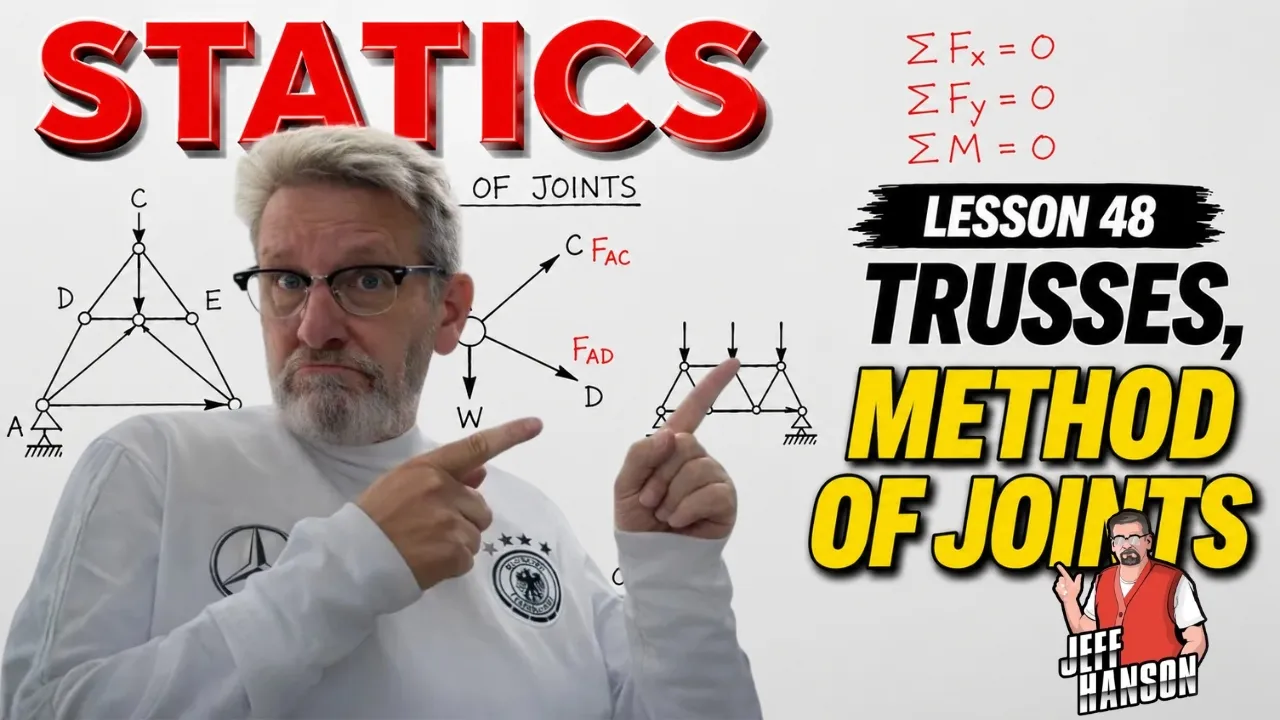












The method of joints is a systematic approach to analyze truss structures by solving for member forces through equilibrium analysis at each joint, starting with finding support reactions using ∑Fx=0, ∑Fy=0, and ∑M=0, then sequentially analyzing joints with only two unknown forces while assuming all forces are in tension (positive values confirm tension, negative values indicate compression).
Truss Analysis Using Method of Joints (Part 1) | Structural Engineering
Added:Fundamentals of static equilibrium, specifically the equations where the sum of forces and sum of moments equal zero in a 2D plane.
Concepts of vector mechanics, including resolving force vectors into their horizontal and vertical components using basic trigonometry.
How to construct and interpret Free Body Diagrams (FBDs) for both entire structures and individual particles.
Calculating external support reactions (such as pins and rollers) for statically determinate structures.
The basic definition of a truss, including the assumptions of two-force members and loads applied exclusively at the joints.
The Method of Sections, which is used to calculate forces in specific internal members of a truss more efficiently than the Method of Joints.
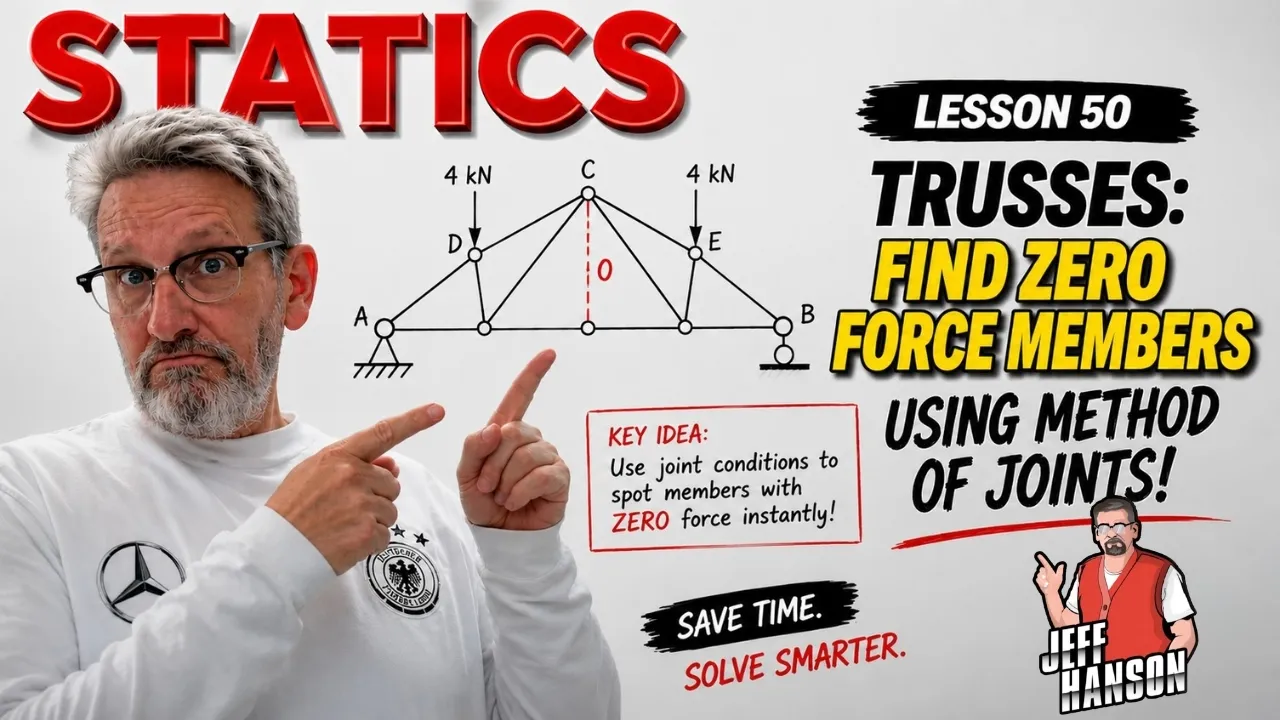
Techniques for identifying zero-force members by inspection to rapidly simplify truss analysis.
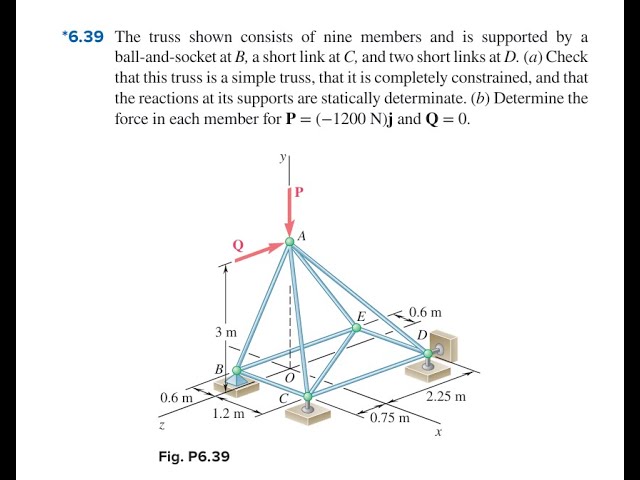
Analysis of space trusses (three-dimensional truss systems) using 3D vector algebra.
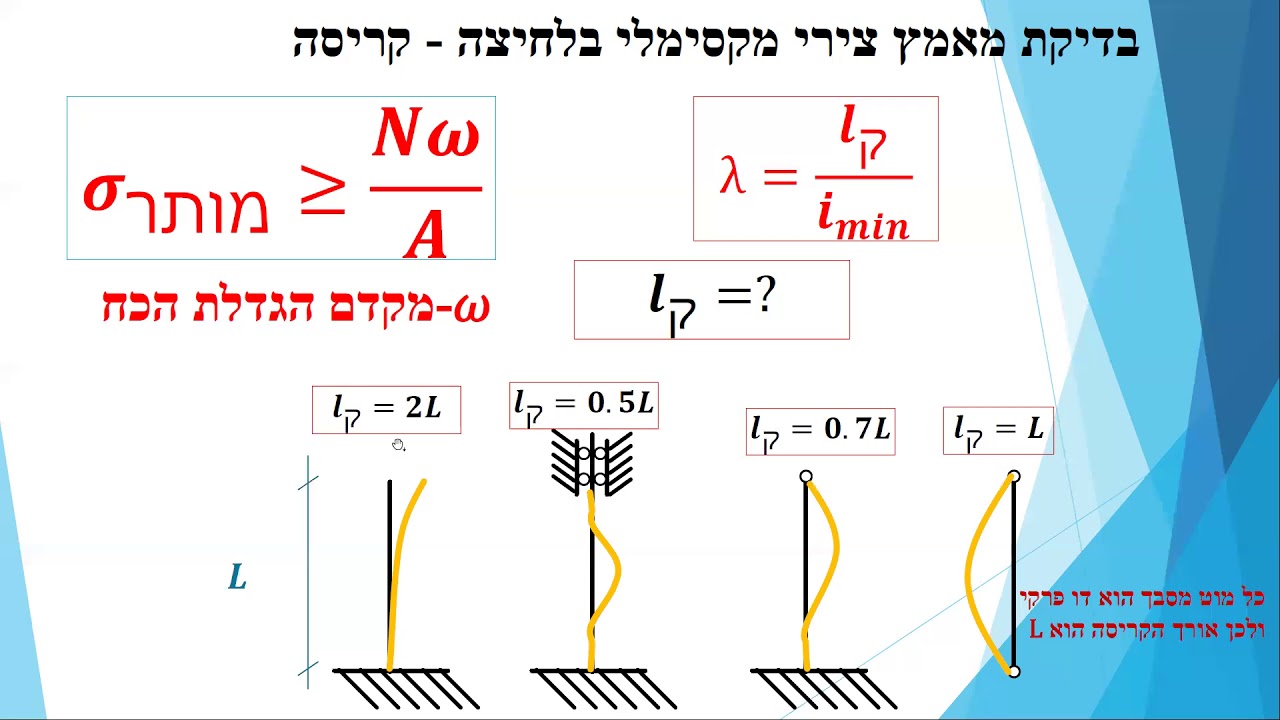
Structural design principles for truss members, focusing on the differences between tension and compression behavior (such as buckling).
An introduction to statically indeterminate trusses and the methods used to analyze them, such as the unit load method or stiffness method.
818.7K views2.7Klikes9:13Original Release: 2009-12-02
Hello everyone. Welcome to this uh video tutorial on how to solve um uh truss or how to analyze a truss using the method of joints.
Let's look at the question.
Okay, this is the example. Determine the force in each member of the PR bridge truss shown above.
State whether the member is in tension or in compression. So we have this truss and we need to determine each force in each member of the truss. So that's a total of 1 2 3 4 5 6 7 8 9 10 11 12 13 members and we have to state whether the force in the member is in tension or in compression.
Okay, we will start uh with finding the reactions at the supports. A and H.
Let's do that first.
At A, we have a hinge and the reactions should be Ax and A Y. We have a roller at H and we have a reaction of HY going upwards.
So, uh how to find the reactions? We find the summation of the forces in the X and that set to zero. And we find the summation of the force in of the in the y direction and that should equal to zero as well. And we need to sum of the moments about the point and that should equal to zero. If we do the summation of the forces in the x direction, we'll end up having ax equals to zero. There are no external forces that act in the x direction. So the reaction in the x direction should equal to zero.
Now we'll do the uh summation of the force in the y direction. We'll have a y - x - 6 + hy will equal to zero. Or simply we can write it a y + hy = 12.
And that should give us the first equation.
The third equation is the summation of the moment about a point. Okay. Uh the total of uh the total number of unknowns we have in this problem is three. That's a y, hy and ax.
We already got a value for ax which is zero. Now we'll try to eliminate one of these unknowns by using the third equation. And how do we do this? Simply let's try to take the summation of the moments about a point where one of the forces a y or hy passes through it. I chose a. So I take the summation of the moments about point a.
The summation of the moments about point A will equal to hy times the distance from h to a which is 3 + 3 + 3 + 3 that's 12.
And the rotation or the direction would be positive moment if the direction is counterclockwise. That's just an assumption.
Okay. So, hy * 12 that's a positive.
Then plus this plus is just the summation here. Then we have the force 6 multiplied by 3 + 3 is 6.
So this force is going this way which is negative because it's opposite to whatever we assumed here.
So that's the negative sign right here.
Okay. The last force which is 6 konton times this distance which is 3 m. And that would give us a negative rotation.
Again this force is rotating this way which is opposite to whatever we assumed here.
Now if I solve this equation I'll end up having hy = 4.5 kons.
And if I substitute this value back into equation one, I'll end up having a y equ= 7.5.
And that's how we find these three reactions.
Okay. Um now we're ready to start picking the joints we will be using.
Let's try to do this.
Yeah, we have um so many joints in uh in this truss. We have A, B, C, D, E, F, G, H. That's a total of eight joints. The trick in picking a joint is very simple.
First, we have to pick a joint that has only two members with unknown forces.
For example, if I pick joint C right here, we'll have three members. C E C B and C A that's a bad choice but if I chose A joint A that's two members A C and AB that's perfect plus it's going to be very helpful if the joint I chose would have an external force with a known magnitude let's say ax or a y in this case ax of course it's going to be zero and a y is 7.5 so it's a choice to start with either A or H.
I started with A.
So we have the joint A and we need to assume the following.
First we draw the joint.
Second we draw the members that's AB and AC.
And I will assume that the forces are in tension in these two members. If my assumption is correct and my number is positive one of these members the forces I mean in the uh uh the members let's let's see let's say we have AB and I did the calculations and everything and I got a positive value for AB that means my assumption is correct and the force is in tension in AB and if I of course if I got a negative that means the force is in compression Okay. So, draw the joint, draw the members and draw the arrows pointing away from the joint. Third, we will add the external force to our joint.
Now in order for me to apply the equations of equilibrium that's sigma fx and sigma y all of my forces should be either along the x or the y. So all I do is just resolve the ab force for example to its components.
So the components of the forces as shown right here. It's 4 over 5 * AB. That's the y component. And the x component is 3 over5 ab.
And of course AC is already resolved.
It's it has only one component which is uh along the x direction the positive x and the 7.5 the reaction ay is acting along the positive y. So now I'm ready to use my equilibrium equations. Let's do the sigma fx. We have AC, that's the AC, plus 3 over5 AB, that should equal to zero. So that's my first equation. Second equation would be 7.5 + 4 over 5 AB and that's equal to zero.
It's right here.
From this equation, I can solve for AB and I'll get a negative value, which means I assumed it in I assumed the force to be in tension. Now it's in compression.
Now I take this value and substitute it back in equation one and I get a value of AC equals to 5.63.
This way I already solved for the members AC. the forces in the members AC and AB.
[Applause]
Up Next

6:04
Balsa Wood Selection Guide for Control Line Model Wings
@t.j.v4695
242 views•2026-02-08
30:32
Ultrasonic Transducers: Resonant Frequency Measurement and Horn Design
@imajeenyus42
229.9K views•2017-02-22
54:16
Polymer Environmental Degradation: Mechanisms & Stabilization
@iit
1.8K views•2012-07-10
33:39
How a Student's Question Saved a NYC Skyscraper from Collapse
@veritasium
22.8M views•2025-04-26
Related Study Plans & Knowledge Roadmaps
Structured learning paths in Engineering
engineering
Building Acoustic Levitators: Physics & Arduino
01The Physics of Sound and Standing Waves
02Piezoelectric Transducers and H-Bridge Drivers
03Arduino Programming: Generating 40 kHz Signals
+ 2 more learning modules
14h5 modules
Explore Roadmap
engineering
Building Peltier Cloud Chambers: Particle Tracks
01Cosmic Rays & Cloud Chamber Physics
02Thermoelectric Cooling (TEC) Fundamentals
03Custom Liquid-Cooling Loop Design
+ 2 more learning modules
18h5 modules
Explore Roadmap
engineering
Yagi-Uda Antennas: Modeling, Build & VNA Test
01Introduction to RF and Antenna Fundamentals
02Yagi-Uda Antenna Design Principles
03Antenna Modeling and Simulation in 4NEC2
+ 2 more learning modules
18h5 modules
Explore Roadmap
engineering
ECG Monitor Design: Op-Amps, Filters & Noise
01Electronics & Breadboard Basics
02Op-Amps and Instrumentation Amplifiers
03Bioelectricity and ECG Fundamentals
+ 2 more learning modules
18h5 modules
Explore Roadmap