In Rhode Island v. Innis (1980), the U.S. Supreme Court established that Miranda warnings are not required when police-citizen conversations occur in non-interrogative contexts; the Court defined 'interrogation' as any words or actions by police intended to elicit an incriminating response, and held that Innis was not subjected to interrogation or its functional equivalent because officers had no way of knowing their conversation would elicit an incriminating response, thereby allowing his confession to be admissible despite the absence of Miranda warnings.
Understanding Rhode Island v. Innis: Miranda Rights & Interrogation
Added:Deep Dive
The landmark Supreme Court ruling in Miranda v. Arizona (1966) and the fundamental requirement of Miranda warnings.
![Miranda v. Arizona [SCOTUSbrief]](https://i.ytimg.com/vi_webp/_XkcoGwxEvg/maxresdefault.webp)
Miranda v. Arizona [SCOTUSbrief]
90.8K
Miranda v. Arizona (1966) is the landmark US Supreme Court case that established the requirement for police to read suspects their constitutional rights before custodial interrogation, including the right to remain silent, the warning that statements can be used against them, the right to an attorney, and the assurance of appointed counsel if needed; this decision added an additional layer of protection beyond existing voluntariness rules by creating a specific exclusionary rule that makes confessions inadmissible unless these warnings are properly administered, thereby ensuring suspects' Fifth Amendment rights against self-incrimination are protected during police interrogations.
Click to watch →
How LAW & ORDER distorts your rights
817.7K
In 1966, the Supreme Court decided Miranda v. Arizona in a 5-4 decision, holding that for the Fifth Amendment right against self-incrimination to function in society, law enforcement officials must inform suspects in custody of their rights. This landmark case changed policing forever and is one of the most famous parts of the American criminal justice system. Miranda warnings advise suspects of two things: their right to silence and their right to legal counsel. Any statements made without being notified of these rights are inadmissible in court.
Click to watch →

Miranda v. Arizona: The Supreme Court Decision and the Miranda Warning
2.1K
In the landmark 1966 Supreme Court case Miranda v. Arizona, the Court unanimously ruled (5-4) that criminal suspects must be informed of their Fifth Amendment right against self-incrimination and Sixth Amendment right to counsel before police interrogation, creating the familiar Miranda warning that levels the playing field in interrogation rooms by giving suspects a tool to stop questioning until they can consult with an attorney.
Click to watch →

10 True Crimes That Changed American Laws Forever
97.5K
The Miranda warning, created after Ernesto Miranda's 1963 arrest for kidnapping and sexual assault, requires all arresting police officers to inform subjects of their rights: the right to remain silent, the right to have a lawyer present, and the warning that any statement can be used against them in court. Miranda was initially convicted based on his confession but later won his appeal, leading to the landmark Supreme Court ruling that established these protections for all criminal suspects.
Click to watch →

Miranda v. Arizona: Understanding the Right to Remain Silent
1.1M
In 1966, the U.S. Supreme Court ruled in Miranda v. Arizona that police must inform criminal suspects of their rights before questioning, including the right to remain silent, the warning that statements can be used against them, the right to an attorney, and the assurance of appointed counsel if they cannot afford one; this decision established that without these warnings, any incriminating statements would be inadmissible in court, fundamentally changing criminal procedure by creating clear safeguards against coercive interrogation practices.
Click to watch →
Deep Dive
The Fifth Amendment of the U.S. Constitution, specifically the clause protecting citizens against self-incrimination.
THE 5TH AMENDMENT AND SELF-INCRIMINATION
3K
The Fifth Amendment to the U.S. Constitution protects citizens from self-incrimination by prohibiting compelled testimony against oneself; individuals have the right to remain silent during police interrogations and court proceedings, and any statements made voluntarily under pressure may be deemed involuntary and inadmissible in court, as established through landmark Supreme Court cases including Miranda v. Arizona (1966).
Click to watch →
What Is the 5th Amendment?
178.9K
The Fifth Amendment to the United States Constitution protects individuals against self-incrimination. This is commonly referenced in legal contexts when someone invokes their right to remain silent, as exemplified by the phrase 'I plead the fifth.'
Click to watch →

Right Against Self-Incrimination
3.1K
The Fifth Amendment to the United States Constitution contains a clause that limits the government's power to obtain incriminating statements from individuals. Specifically, it states that no person shall be compelled in any criminal case to be a witness against himself. This constitutional protection ensures that individuals cannot be forced to provide evidence that could be used against them in criminal proceedings.
Click to watch →

The Bill of Rights | Street Smarts | PragerU Kids
2.9M
The Fifth Amendment protects citizens from being compelled to incriminate themselves. This includes the right against self-incrimination and protection from being tried twice for the same crime (double jeopardy).
Click to watch →

Clueless Cops Violate His 4th Amendment Rights
4.2K
The Fifth Amendment to the United States Constitution protects citizens from being compelled to incriminate themselves. This includes the right to remain silent and the protection that anything a person says or does will not be used against them in a criminal proceeding. Citizens can invoke this right during police encounters to avoid providing information that could be used against them.
Click to watch →
Deep Dive
The legal definition of 'custody' and how it differs from voluntary interactions with law enforcement.

Police Give Entitled Veteran a Lesson He Won’t Forget
118.3K
Voluntary custody occurs when an individual cooperates with police and allows themselves to be taken into custody. Involuntary custody occurs when police take an individual against their will. Once in custody, individuals have fewer rights to refuse police commands, and the custody becomes legally binding.
Click to watch →
What You Should Know About Police Interactions
3.2K
Custody is the third level of police interaction on the spectrum. It occurs when a person is brought in and their freedom is significantly restrained, and they are being held to answer for a charge. This represents a significant escalation from detention.
Click to watch →

SSC GD Exam Review 2026 | SSC GD Hindi Special Practice Set 18 | SSC GD Hindi Expected Questions
65.2K
In legal terminology, 'custody' (कस्टडी) refers to the temporary detention or holding of a person by authorities for their protection or for the purpose of investigation. When someone is placed in custody, they are held in a secure location to prevent harm to themselves or others. This is different from arrest (formal taking into custody) or imprisonment (long-term detention).
Click to watch →
BNSS: Custody with Landmark Cases | Bharatiya Nagarik Suraksha Sanhita | Pranjal Singh
7.1K
Custody refers to the detention of a person by law enforcement after an arrest, during which the individual is not free to leave and is under the control of authorities. This detention is conducted to facilitate investigation and prevent the accused from absconding or tampering with evidence. The key elements are: (1) it occurs after arrest, (2) it restricts the person's freedom of movement, and (3) it is under the control of law enforcement authorities.
Click to watch →
TYLER ROBINSON CASE: DID BARON COLEMAN PROVE THE DISCORD MESSAGES ARE FAKE?
3.1K
In criminal law, custody is defined as the state where a person is not free to go. When someone is placed in custody, they are no longer free to leave and are typically about to undergo custodial interrogation. This distinction is crucial because it triggers specific legal protections, including the requirement for law enforcement to read Miranda rights before questioning.
Click to watch →
Deep Dive
The Exclusionary Rule and how illegally obtained confessions or evidence are suppressed in criminal trials.
25 Legal Loopholes That Defy Common Sense
39.1K
Under the exclusionary rule, evidence collected in violation of the Constitution usually cannot be used in court. If police break into a home without a valid search warrant and find drugs or a weapon, judges will typically toss that evidence. Without it, prosecutors might have no case, and defendants can walk free. The same principle applies to statements—if officers fail to give Miranda warnings before interrogation, any confession that follows is usually inadmissible. The regulation exists to discourage misconduct by law enforcement, but the side effect is that guilty people sometimes go free.
Click to watch →

The Exclusionary Rule - What Is It and How Does It Work? Criminal Defense Attorney Marc J. Victor.
757
The exclusionary rule is a judicial creation, not a constitutional mandate, developed by the Supreme Court to deter Fourth, Fifth, and Sixth Amendment violations. Evidence obtained unconstitutionally cannot be used at trial. However, the rule does not apply to grand jury proceedings, probation violations, or civil cases. States were initially free to adopt the rule, but after Mapp v. Ohio, it became mandatory nationwide. The rule's primary purpose is to remove the incentive for police misconduct by excluding illegally obtained evidence from criminal trials.
Click to watch →

Exclusionary Rule
412
The exclusionary rule is a judicially created remedy that makes evidence obtained in violation of constitutional rights (Fourth, Fifth, and Sixth Amendments) inadmissible in criminal trials, serving to deter police misconduct while balancing law enforcement needs; it applies to physical evidence, identification evidence, and confessions but does not apply in grand jury proceedings, civil cases, parole hearings, or at the sentencing stage, and while it generally only applies to law enforcement under federal law, some states like Texas extend it to all persons.
Click to watch →

THE REVEALING TS-82 - ROADMAP TO THE BRADY BUNCH #idaho4
15.2K
The exclusionary rule is the legal principle that evidence obtained in violation of constitutional rights, such as an illegal search or seizure, must be excluded from trial. If the judge determines the evidence was obtained unlawfully, or if the basis for the search was established through false testimony, the motion to suppress will likely be granted. The typical remedy for a successful motion to suppress is the exclusion of that specific evidence from being used at any subsequent trial. If the suppressed evidence is crucial, such as a confession or physical evidence, the prosecution might have no choice but to dismiss the charges.
Click to watch →

They Set Him Up For The PERFECT Lawsuit!
787.4K
After Mr. Black refuses to identify himself, officers place him under arrest and search his pockets, finding drugs and drug paraphernalia. The video explains that if a court determines the arrest was not supported by probable cause, the drugs and paraphernalia would be suppressed under the exclusionary rule as the product of an unconstitutional search and seizure. This rule prevents evidence obtained in violation of the Fourth Amendment from being used in prosecutions.
Click to watch →
Prerequisite Knowledge
- Concept 01The landmark Supreme Court ruling in Miranda v. Arizona (1966) and the fundamental requirement of Miranda warnings.
- Concept 02The Fifth Amendment of the U.S. Constitution, specifically the clause protecting citizens against self-incrimination.
- Concept 03The legal definition of 'custody' and how it differs from voluntary interactions with law enforcement.
- Concept 04The Exclusionary Rule and how illegally obtained confessions or evidence are suppressed in criminal trials.
Subsequent Learning
- Step 01The 'functional equivalent' test established in Rhode Island v. Innis to determine if police conduct constitutes interrogation.
- Step 02The distinction between express questioning and subtle psychological ploys by law enforcement.
- Step 03Subsequent developments in Fifth Amendment law, such as the 'public safety exception' in New York v. Quarles (1984).
- Step 04How undercover police operations interact with Miranda rights, as explored in Illinois v. Perkins (1990).
- Step 05The modern requirements for explicitly invoking or waiving Miranda rights under Berghuis v. Thompkins (2010).
Arrest & Pressure
Court Ruling
Arrest & Pressure
0:04Playing Section
- 1
Suspect arrested for murder after robbery gone wrong.
- 2
Police exploit fears about weapon safety to coax a confession.
- 3
Miranda rights read but suspect chooses to speak anyway.
The Dissenting View and the 'Subtle Coercion' Loophole
Critics and the dissenting justices in Rhode Island v. Innis argue that the majority's ruling weakened Miranda protections by creating a loophole for "subtle coercion." Justice Marshall, in dissent, argued that the officers' conversation about a disabled child finding the weapon was a classic psychological ploy designed to appeal to the suspect's conscience, which was highly likely to elicit an incriminating response. Justice Stevens contended that "interrogation" should encompass any police statement that a reasonable observer would see as designed to elicit information, regardless of whether the police could foresee the suspect's specific reaction. Legal scholars criticize the Innis "functional equivalent" test for being overly restrictive and subjective. By ruling that such indirect psychological pressure does not constitute interrogation, critics argue the Court allowed law enforcement to bypass Miranda safeguards, undermining the Fifth Amendment protection against self-incrimination.
Deep Dive
The 'functional equivalent' test established in Rhode Island v. Innis to determine if police conduct constitutes interrogation.

Rhode Island v. Innis Case Brief Podcast (Full Audio)
105
In Rhode Island v. Innis (1980), the U.S. Supreme Court established that police conduct constitutes 'interrogation' under the Fifth Amendment not only when officers ask direct questions but also when their words or actions are reasonably likely to elicit an incriminating response from a suspect who has invoked their right to remain silent or requested an attorney; this 'functional equivalent test' requires courts to assess whether a reasonable officer would know their conduct might produce an incriminating response, thereby extending Miranda protections to indirect psychological tactics used by law enforcement.
Click to watch →

Criminal Law I - Interrogations - Part II
271
Interrogation is defined as express questioning or its functional equivalent. Express questioning is straightforward—police asking direct questions. Functional equivalent refers to words or actions by police, other than those normally attendant to arrest and custody, that the police should know are reasonably likely to elicit an incriminating statement. Rhode Island v. Innis illustrates this: police discussing a missing gun in a grocery store was not interrogation. In Brewer v. Williams, police delivered a 'Christian burial speech' to a suspect about a missing child, telling him they would stop to locate the body on their way to court. The Supreme Court ruled this was a functional equivalent of interrogation because police should have known their actions were reasonably likely to elicit an incriminating statement. Since the suspect had requested counsel and Sixth Amendment rights had attached, police could not deliberately elicit incriminating statements absent a waiver.
Click to watch →
2017 Moot Court Internal Competition
4.8K
In Rhode Island v. Innis (1980), the Supreme Court established that police conduct constitutes interrogation for Miranda purposes if it is reasonably likely to elicit an incriminating response. The Court held that any words or actions by police that they should know are reasonably likely to produce an incriminating response constitute interrogation. This standard requires courts to consider what a reasonable officer would know based on the circumstances, not just what the officer actually knew or intended.
Click to watch →

Waukesha's Sue Opper Prosecuting The Case Against Matthew Pahl - Pretrial Hearing
1.9K
This segment analyzes whether police conduct constitutes the functional equivalent of questioning. The functional equivalent includes statements or actions by police that are reasonably likely to elicit an incriminating response. This includes not only direct questions but also comments or actions that might prompt a suspect to talk about the alleged crime. If police make statements that are not likely to elicit an incriminating response, those statements are not considered interrogation. The court must determine whether the police conduct was reasonably likely to elicit an incriminating response before applying Miranda protections.
Click to watch →

Rhode Island v Innis (1980)
902
In Rhode Island v. Innis (1980), the U.S. Supreme Court ruled that police officers' conversation within earshot of a suspect, even when the suspect is not directly questioned, does not constitute interrogation under the Fifth Amendment; a suspect's voluntary statement made after hearing such a conversation is admissible if the suspect understood their Miranda rights and chose to speak anyway.
Click to watch →
Deep Dive
The distinction between express questioning and subtle psychological ploys by law enforcement.
![Travis Fowler [Lurch] Interrogation Analysis (Part 2)](https://i.ytimg.com/vi_webp/xOqH5szcLlM/maxresdefault.webp)
Travis Fowler [Lurch] Interrogation Analysis (Part 2)
32K
Investigators may use subtle questioning techniques to elicit information without directly confronting subjects. The video shows how officers ask about pornography involving minors in a way that appears casual but is designed to observe the subject's reaction and potentially obtain incriminating admissions.
Click to watch →
ANWALT WARNT Wenn die Polizei dein Auto durchsucht — SAG DAS
661
Police use a psychological technique: they ask 'Wem gehört das Auto?' first because it is a low-threshold question that sounds like 'Where are you from?' or 'What is your profession?' Most people answer automatically because it seems harmless. However, it is a trap. The correct response is either no answer or a counter-question. Ask yourself: 'Am I being accused, or do I need to answer this question?' The safest response is polite silence or clear refusal to answer.
Click to watch →
🚩PSYCHOPATH Red Flags - Body Language Signals ft. Robert Durst & Erin Caffey
1.2M
Interrogation approaches are psychological ploys used to get suspects to talk. These include direct questioning, offering incentives (cookies, ice cream, or other rewards), creating emotional responses (fear, pride), using repetition, establishing rapport, and creating futility. These approaches work best when combined together rather than used in isolation, as they create a narrative that allows the suspect to become the hero of their own story.
Click to watch →
LAWYER: Police Lies & Dumb Questions — 10 Best Responses to Protect Yourself
168
Police officers are trained interrogators who use psychological techniques developed over decades of criminal justice research. Every question asked during an initial police encounter is engineered to achieve one of three objectives: (1) get you to admit knowledge of a crime, (2) get you to make a statement that can be used against you, or (3) get you to waive your rights without even realizing you're doing it. Understanding this helps you recognize that seemingly casual questions are actually strategic tools designed to build a case against you.
Click to watch →

The Chase (Radio) 1952 Iron Curtain Express
158
Direct, confrontational questioning can be an effective interrogation technique that may cause subjects to reveal information they would otherwise conceal. The speaker deliberately uses a 'subtle as a kick in the teeth' approach to startle the subject into a slip of the tongue, demonstrating that psychological pressure can sometimes break down carefully constructed facades.
Click to watch →
Deep Dive
Subsequent developments in Fifth Amendment law, such as the 'public safety exception' in New York v. Quarles (1984).

New York v. Quarles
287
In New York v. Quarles (1984), the U.S. Supreme Court established that law enforcement officers may ask questions and obtain statements from suspects without first reading Miranda rights when there is a reasonable concern for public safety, such as when a weapon is present and could be accessed by others; the Court ruled that the officer's question about the gun's location was admissible because ensuring everyone's safety takes precedence over the Fifth Amendment's self-incrimination protections in emergencies.
Click to watch →

Chapter 8 Self Incrimination
287
The public safety exception allows police to ask questions without Miranda warnings when there is an immediate threat to public safety. In New York v. Quarles (1984), the Court held that finding a gun before mirandizing a suspect was justified because public safety concerns outweighed constitutional rights. This exception has been applied broadly to guns, bombs, diseases, and other dangers. Constitutional analysis employs multiple tests: Miranda applies to express questioning, the deliberate elicitation test provides broader protection once formal proceedings begin, and due process offers the most general protection. Waivers of Miranda rights can be express (clearly stating they know their rights and choose to give them up) or implied (through conduct). Waivers must be voluntary, knowing, and intelligent, considering factors like English comprehension, familiarity with the criminal justice system, intelligence level, physical condition, education, presence of counsel, mental condition, intoxication, and age.
Click to watch →

Emergency Exception to Miranda Rule!? New York v. Quarles
921
In New York v. Quarles (1984), the U.S. Supreme Court established a public safety exception to the Miranda rule, holding that police may ask accusatory questions of a handcuffed suspect without first administering Miranda warnings when there is an immediate threat to public safety, such as when a dangerous weapon is present; the Court determined that the need to protect public safety outweighs the prophylactic protection of the Fifth Amendment privilege against self-incrimination in such emergency circumstances.
Click to watch →

Swords Of Reason Debate: Warrantless Surveillance - Necessary Protection Or Tyranny?
154
The affirmative argues that warrantless surveillance is justified in the interest of national security. National security is the bedrock of any sovereign nation's survival, and without it, privacy rights become hollow luxuries. The Constitution was never intended as a suicide pact, and even sacred amendments bend under existential pressure. The NSA's PRISM program disrupted over 50 terrorist plots worldwide, and Section 702 of the FISA Amendments Act has been used to thwart cyber attacks from state actors like China and Russia. Critics claim invasion of privacy, but this is a false dichotomy—warrantless surveillance targets metadata and foreign communications, not casual emails of law-abiding citizens. The Fourth Amendment has built-in exceptions: the border search exception (United States v. Ramsay, 1977), the exigent circumstance doctrine (Warden v. Hayden, 1967), and the special needs exception (Vernonia School District v. Acton, 1995). The Fifth Amendment also yields to necessity through the required records doctrine (Shapiro v. United States, 1948) and the public safety exception (New York v. Quarles, 1984). Robust oversight exists through Congressional review, FISA courts, independent inspectors general, and minimization procedures. The Constitution adapts to changing circumstances, and neither the Fourth nor Fifth Amendment is absolute. The affirmative argues that warrantless surveillance has proven efficiency, with at least 50 cases where Section 702 stopped terrorist attacks. The courts have agreed that they have the right to take that information without a warrant, and it is already happening now. Multiple times over the last decade, mass events could have been stopped had warrantless surveillance been utilized. Even though warrants couldn't be obtained to stop criminals from doing acts, they wouldn't have had to arrest. They could have detained and gathered more intelligence to stop events from happening. The argument is that the emotional appeal for privacy outside of one's home through digital means should not prevent saving lives. If information is put out into the ether, it is out in the ether and is no longer in one's home. That signal, message, or digital information has left and traveled through lines. At that point, there is no reasonable expectation of privacy on that information.
Click to watch →
New York v. Quarles (1984) Overview | LSData Case Brief Video Summary
413
In New York v. Quarles (1984), the Supreme Court established that public safety concerns can override Miranda requirements, allowing police to ask questions about dangerous situations without providing Miranda warnings; however, once warnings are given, subsequent questions about related matters remain admissible.
Click to watch →
Deep Dive
How undercover police operations interact with Miranda rights, as explored in Illinois v. Perkins (1990).
25 Tricks Cops Don't Want You To Know
1.2M
In serious cases, police sometimes plant undercover officers or informants right next to you—in jail cells, on the street, or even at work. In Illinois v. Perkins (1990), the court decided that Miranda rights don't apply when a suspect unknowingly speaks to an undercover officer. This is sneaky because you don't see it coming. The rule is: if you've been arrested or caught up in something serious, don't discuss anything with anyone you don't absolutely trust. Additionally, if someone in your circle gets into trouble, police might offer them a deal to wear a wire, forward texts, or report what you say. In Hoffa v. United States (1966), the Supreme Court made it clear that sharing something willingly, even with a friend who's secretly an informant, is fair game.
Click to watch →

BREAKING REBECCA & JAKE HARO PRESS CONFERENCE! THE JUDGES BETRAYAL OF CAROLINA AND FAKE CONFESSIONS?
14.3K
The Illinois v. Perkins case established that statements made to undercover agents believed to be fellow inmates can be used in court without Miranda warnings, provided the suspect is unaware they are speaking with law enforcement. This ruling allows law enforcement to place undercover officers in jail cells to gather evidence without triggering constitutional protections, fundamentally changing how undercover operations are conducted in criminal investigations.
Click to watch →
Smart Tricks That Will Change Your Life
27.5K
In serious cases, police sometimes plant an undercover officer or informant right next to you—in a jail cell, on the street, or even at work. You might think you're venting to another regular person, but every word is passed straight back to the cops, and it's perfectly legal. In Illinois v. Perkins 1990, the court decided that Miranda rights do not apply when a suspect unknowingly speaks to an undercover officer. If you've been arrested or caught up in something serious, don't discuss anything with anyone you don't absolutely trust.
Click to watch →

21 Jump Street with TimotheeReacts | Canadians First Time Watching | Movie Reaction & Review
153.6K
Undercover police operations involve officers infiltrating criminal organizations by assuming false identities. In this case, officers pose as high school students to investigate drug dealers. Miranda rights are constitutional protections that must be read to criminal suspects before interrogation, including the right to remain silent and the right to an attorney. Failure to properly inform suspects of their rights can result in evidence being inadmissible in court.
Click to watch →
Police Get Confession with Undercover Cellmate and Fake Lineup VIOLATES Miranda Rights
213
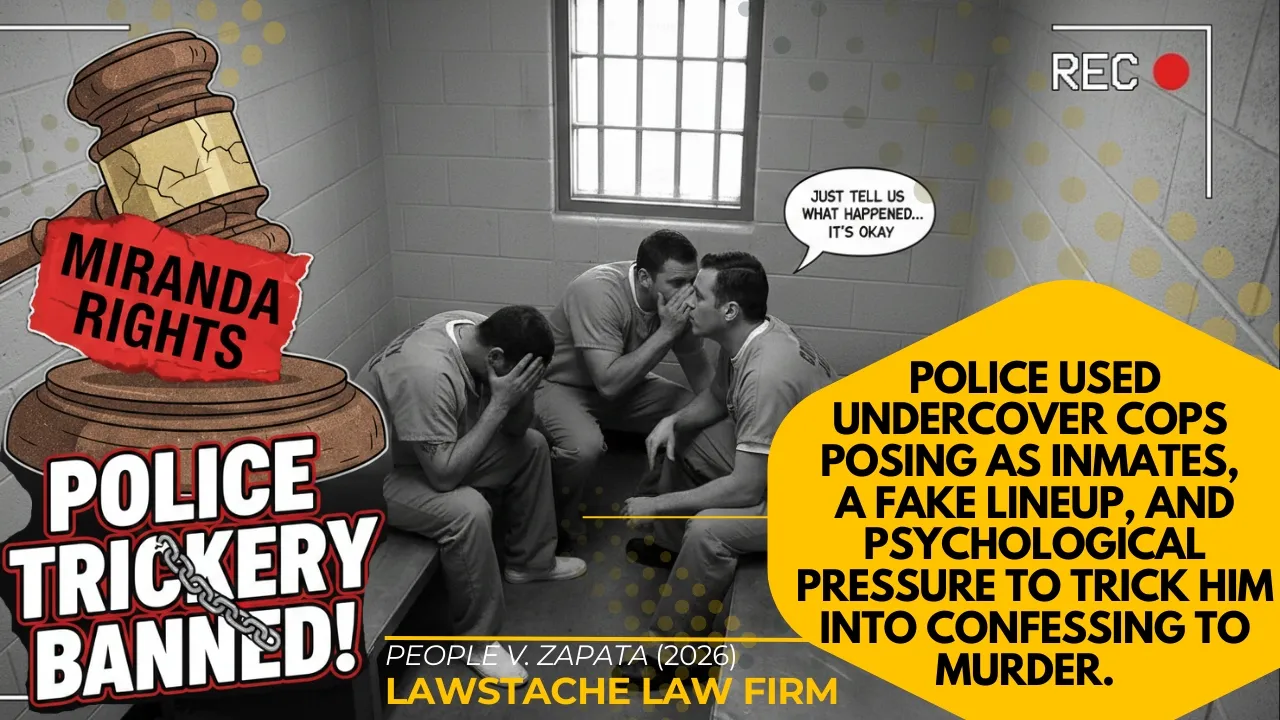
In People v. Zapata (2026), the California Court of Appeal ruled that police cannot use undercover agents and coercive tactics to circumvent Miranda rights after a suspect invokes their right to counsel, establishing that known police officers actively stimulating conversations with undercover agents to elicit confessions violates constitutional protections even during Perkins operations.
Click to watch →
Deep Dive
The modern requirements for explicitly invoking or waiving Miranda rights under Berghuis v. Thompkins (2010).

If Cops Ask: "Where You Headed?" - Say THIS Simple Phrase (Might Get You Out Of Jail)
45.2K
Berghuis v. Thompkins, 2010, ruled that the invocation of your right to remain silent has to be unambiguous. The moment you voluntarily start answering questions again, you have waived it. Davis v. United States, 1994, established that a hedged, softened, casual response is treated as no invocation at all. He did not trick you into a confession—he waited, dropped the temperature, asked one soft human question, and let your instinct to be polite finish the job.
Click to watch →

SUPREME COURT: Say These 2 Words and Police Have to Let You Go — Before You Answer Any Questions!
1.3K
Berghuis v. Thompkins (2010) addressed what happens when someone knows they have the right to remain silent but does not explicitly invoke it. The Supreme Court held that simply staying quiet or not answering is not sufficient to invoke the right to remain silent. To actually stop police questioning, one must affirmatively, explicitly invoke the right by saying so clearly and out loud. Silence can be interpreted as ambivalence, and officers can continue questioning, with statements made after extended silence still being admissible.
Click to watch →
![Supreme Court Landmark Case [Miranda v. Arizona]](https://i.ytimg.com/vi/9GY1kahjPkw/maxresdefault.jpg)
Supreme Court Landmark Case [Miranda v. Arizona]
860
In Berghuis v. Thompkins (2010), the Supreme Court held 5-4 that suspects must make unambiguous statements to invoke Miranda rights; mere silence does not count as invocation. This narrowed Miranda protections. Current proposals suggest updating Miranda: requiring police to videotape interrogations to protect innocent suspects, allowing continued questioning after unambiguous invocation, and creating exceptions for terrorism suspects. Some scholars argue Miranda's constitutional status prevents meaningful reform, as it cannot be easily modified through legislation. The Roberts Court has continued refining Miranda, reflecting ongoing tensions between suspect protections and police effectiveness. The trend toward state-level regulation reflects recognition that detailed police conduct rules are better handled through legislative processes responding to specific local conditions. Advances in technology (body cameras, smartphones) have changed policing, making it harder for police to engage in untransparent conduct. The fundamental tension between protecting innocent suspects from false confessions and enabling police to solve crimes remains unresolved.
Click to watch →
LAWYER: SAY THIS When Cops Use The "Reid Technique" Against You
291.6K
Miranda rights are real but only protect suspects if they choose not to waive them. Under current Supreme Court standards, failing to affirmatively exercise Miranda rights can be seen as an implied waiver. Silence alone is not always safe - under Bergus v. Tompkins, choosing to stay silent rather than explicitly invoking the right to remain silent allows cops to use that silence against you. Similarly, under Selenus v. Texas, voluntarily answering some questions and then falling silent on a specific question means the silence can be used against you. You must specifically invoke your rights out loud.
Click to watch →
![[Landmark Cases] Right to Remain Silent: Berghuis v. Thompkins](https://i.ytimg.com/vi/6QTYdbeHJ78/maxresdefault.jpg)
[Landmark Cases] Right to Remain Silent: Berghuis v. Thompkins
3.3K
Under Miranda v. Arizona, a defendant's Fifth Amendment right to remain silent can be waived implicitly through their conduct during police interrogation, not just through explicit statements. The Supreme Court in Berghuis v. Thompkins (2010) held that a defendant must invoke their right to remain silent unambiguously, and that answers to police questions during custodial interrogation can themselves constitute an implied waiver of the right to remain silent, provided the defendant understood their rights and the waiver was knowing, intelligent, and voluntary. The Court emphasized that the prosecution bears the burden of proving that any waiver occurred, and that state courts' factual determinations are entitled to deference unless objectively unreasonable.
Click to watch →
Arrest & Pressure
Court Ruling
Arrest & Pressure
0:04- 1
Suspect arrested for murder after robbery gone wrong.
- 2
Police exploit fears about weapon safety to coax a confession.
- 3
Miranda rights read but suspect chooses to speak anyway.
The Dissenting View and the 'Subtle Coercion' Loophole
Critics and the dissenting justices in Rhode Island v. Innis argue that the majority's ruling weakened Miranda protections by creating a loophole for "subtle coercion." Justice Marshall, in dissent, argued that the officers' conversation about a disabled child finding the weapon was a classic psychological ploy designed to appeal to the suspect's conscience, which was highly likely to elicit an incriminating response. Justice Stevens contended that "interrogation" should encompass any police statement that a reasonable observer would see as designed to elicit information, regardless of whether the police could foresee the suspect's specific reaction. Legal scholars criticize the Innis "functional equivalent" test for being overly restrictive and subjective. By ruling that such indirect psychological pressure does not constitute interrogation, critics argue the Court allowed law enforcement to bypass Miranda safeguards, undermining the Fifth Amendment protection against self-incrimination.
The landmark Supreme Court ruling in Miranda v. Arizona (1966) and the fundamental requirement of Miranda warnings.
The Fifth Amendment of the U.S. Constitution, specifically the clause protecting citizens against self-incrimination.
The legal definition of 'custody' and how it differs from voluntary interactions with law enforcement.
The Exclusionary Rule and how illegally obtained confessions or evidence are suppressed in criminal trials.
The 'functional equivalent' test established in Rhode Island v. Innis to determine if police conduct constitutes interrogation.
The distinction between express questioning and subtle psychological ploys by law enforcement.
Subsequent developments in Fifth Amendment law, such as the 'public safety exception' in New York v. Quarles (1984).
How undercover police operations interact with Miranda rights, as explored in Illinois v. Perkins (1990).
The modern requirements for explicitly invoking or waiving Miranda rights under Berghuis v. Thompkins (2010).
636 views7likes3:25@madisonelick9475Original Release: 2013-10-25
breaking news local man thomas ennis was arrested for a murder of a taxi driver in a robbery that went wrong after giving the location of the shotgun used as a murder weapon innis claimed that his fifth amendment rights were violated a re-enactment has been made for viewers understanding get up as soon as you are under arrest you have the right to remain silent and that anything you say and will be used against you in a court of law you have the right to consult with an attorney to have that attorney present during questioning and that if you cannot afford an attorney one will be provided to you i'm not talking until i have a lawyer that's up to you well that sucks what if somebody found the shotgun and hurt themselves yeah what if a little kid finds it that would suck imagine that little sally blew her brains out thinking it was a toy ah stop for the love of god i'll tell you where it is you are aware of your miranda rights right yes yes i know let me just show you where the gun is we are now waiting outside the supreme court for the decision case we are just being informed that it's a 6-3 ruling in the supreme court world that the miranda warnings were not necessary as the conversation has been taken place of the police officers for more we'll go inside the courthouse where chief justice warren berger is giving his final comments blah blah blah blah blah blah blah blah blah oh hi we are talking about interrogation today we have defined interrogation as any words or actions on the part of the police intended to elicit an incriminating response innis was not subject to this interrogation or its functional equivalent as the officers have no way of knowing whether or not their conversation would elicit an incriminating response from enemies therefore be pronounced and as guilty as charged today we're on oh we're on thanks for joining us at mac one news at the speed of sound go staring madison and crystal as the police
Up Next

1:05
Understanding When Miranda Rights Apply in Criminal Cases
@LawOfficeofAdamPollack
152 views•2026-01-03
523:53
Young Thug YSL Trial: Legal Arguments on RICO Evidence and Confrontation Clause Issues in Court
@11Alive
13.7K views•2024-05-16
5:27
Forensic Phonetics: Speaker Identification in Legal Cases
@nptel-nociitm9240
539 views•2025-03-19

24:42
Police Interrogation Tactics: False Confessions & Legal Reform
@LastWeekTonight
7M views•2022-04-18
Related Study Plans & Knowledge Roadmaps
Structured learning paths in Law
law
Hearsay Rule: Trial Evidence & Exceptions
01Introduction to Trial Evidence & Courtroom Basics
02Demystifying Hearsay: The Core Definition
03Non-Hearsay: Exclusions Under FRE 801(d)
+ 3 more learning modules
14h6 modules
Explore Roadmap
law
Medical Malpractice: Law, Liability & Care
01Foundations of Tort Law and Civil Liability
02The Four Elements of Medical Malpractice
03Defining and Proving the Standard of Care
+ 2 more learning modules
12h5 modules
Explore Roadmap
law
H-1B Visa: Rules, Requirements & Process
01Introduction to US Immigration and the H-1B Visa
02Employee Eligibility and Specialty Occupations
03Employer Sponsorship & Labor Condition Application (LCA)
+ 2 more learning modules
6h5 modules
Explore Roadmap
law
WTO Dispute Settlement: Rules, Panels & Cases
01Introduction to the WTO and Global Trade Rules
02The Dispute Settlement Understanding (DSU)
03The Dispute Lifecycle: Consultations and Panels
+ 2 more learning modules
9h5 modules
Explore Roadmap