



![AP Psychology Unit 1 Review [Everything You NEED to Know]](https://i.ytimg.com/vi_webp/4yvfd8aoUBc/maxresdefault.webp)









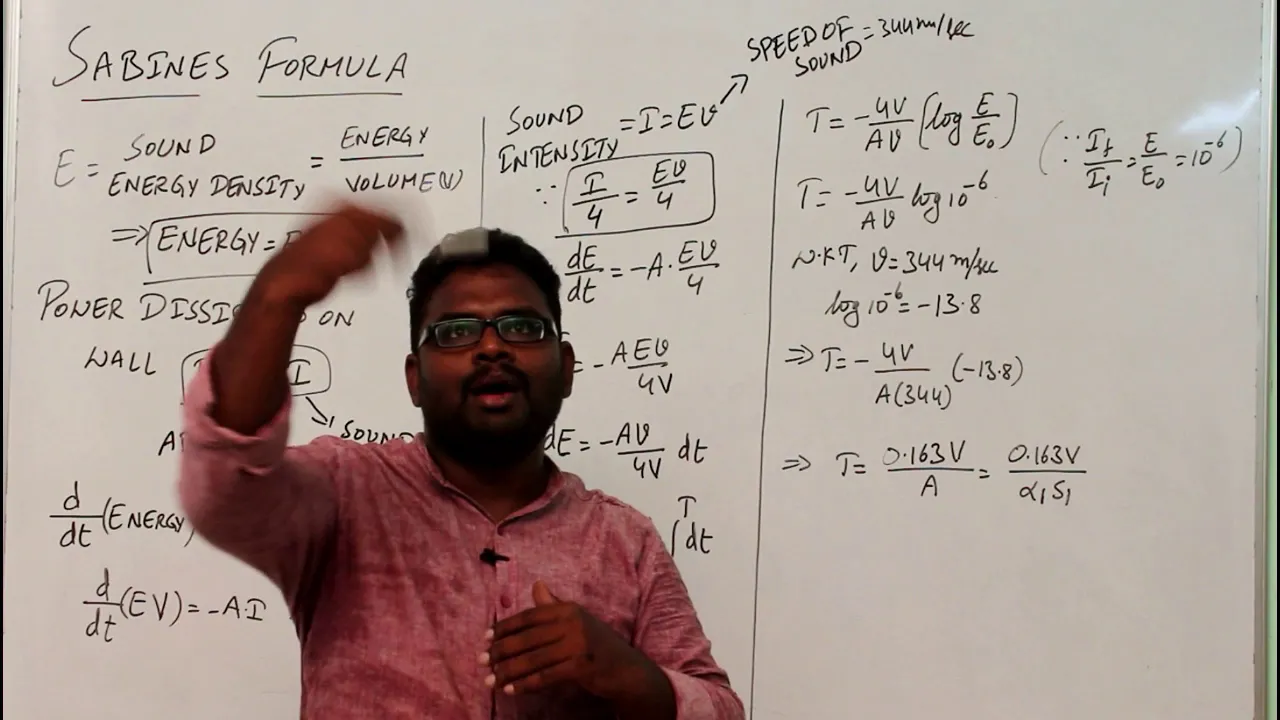








Reverberation time (RT60) is the time taken for sound to decay by 60 decibels in an enclosed space, calculated using Sabine's formula: RT60 = 0.161 × V/A, where V is the room volume and A is the effective absorbing area (product of surface area and absorption coefficient). The absorption coefficient measures the fraction of sound energy absorbed by a material, while the effective absorbing area accounts for multiple surfaces with varying absorption properties.
Reverberation Time and Sabine's Formula | Acoustics Tutorial
Added:Understanding of basic wave mechanics, including sound wave propagation, frequency, wavelength, and sound intensity.
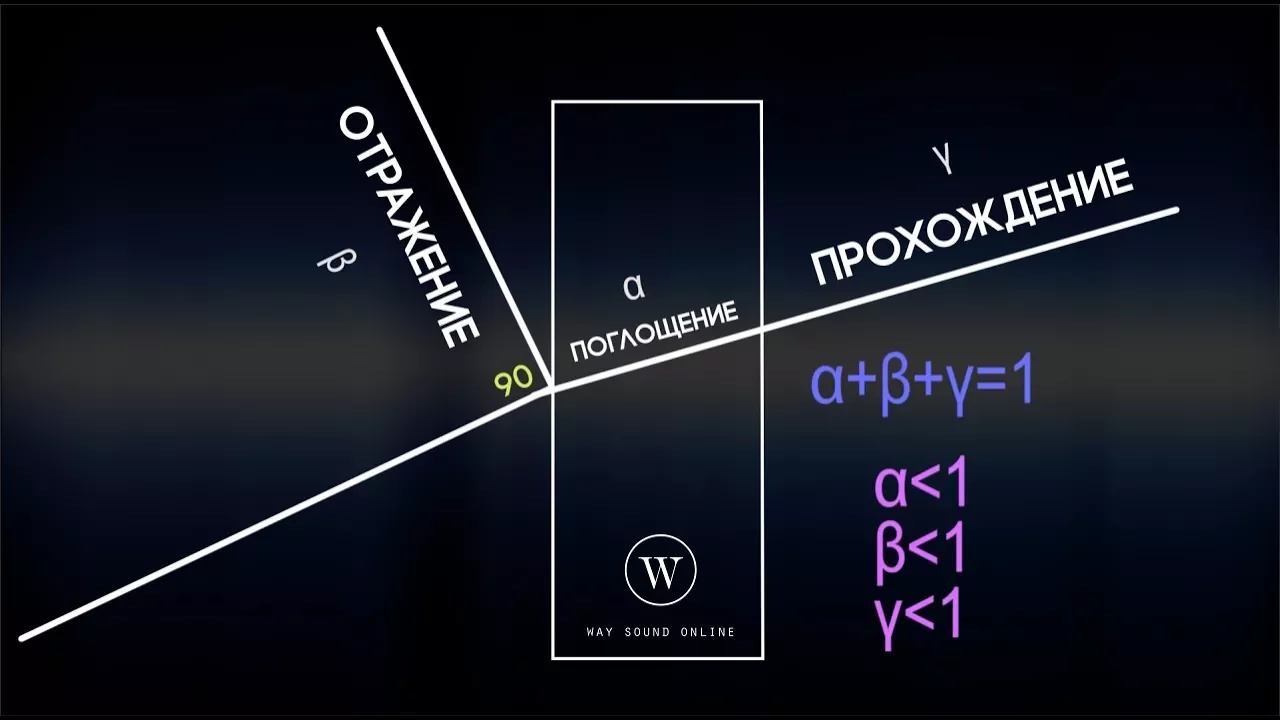
Familiarity with the concepts of sound reflection, transmission, and absorption at material boundaries.
Basic knowledge of calculus, particularly first-order differential equations, to follow the derivation of Sabine's formula.
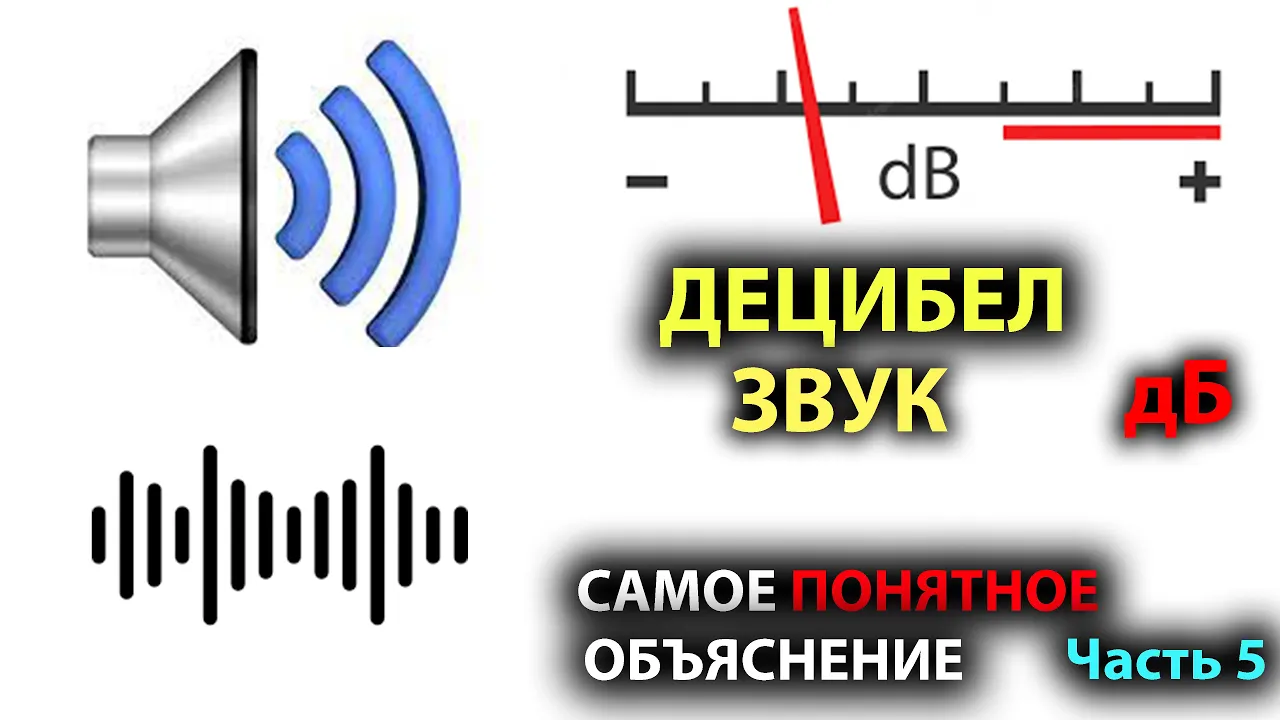
Definition of sound energy density and the decibel (dB) scale for measuring sound pressure levels.
Limitations of Sabine's formula in highly absorptive spaces and the study of alternative models like Eyring's formula.
Practical architectural acoustics design, including optimizing reverberation time (RT60) for concert halls, lecture theatres, and recording studios.
Methods for experimental measurement of reverberation time using impulse responses or interrupted noise methods.
Advanced noise control engineering, including the selection and placement of specialized acoustic treatments and resonators.
48.5K views427likes8:31Original Release: 2016-09-22
So now we'll start with the final chapter acoustics and ultrasonics.
Let us take a look at the first subtopic reverberation time and Sabine's formula.
First of all, what is acoustics?
Acoustics is the science which deals with the study of all the mechanical waves. However, in this chapter, we would be mainly focusing on sound waves and also ultrasound in the next part.
Now, let's see what does it mean by reverberation and reverberation time.
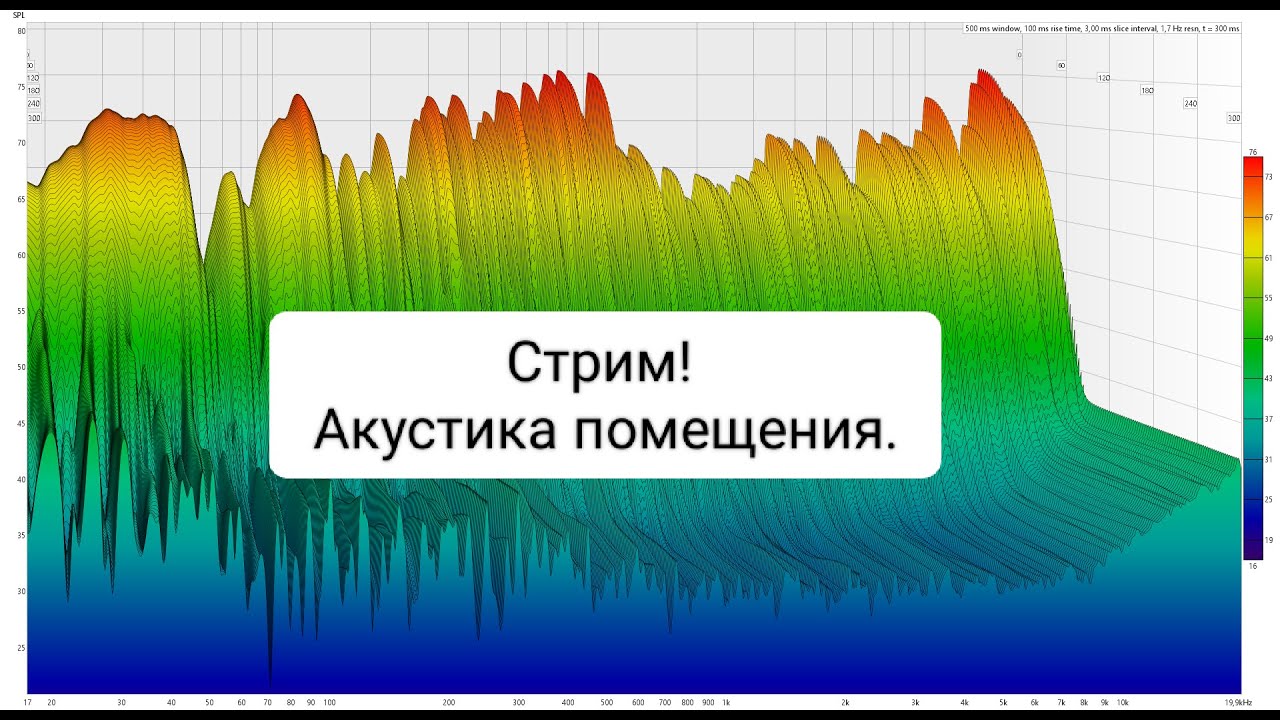
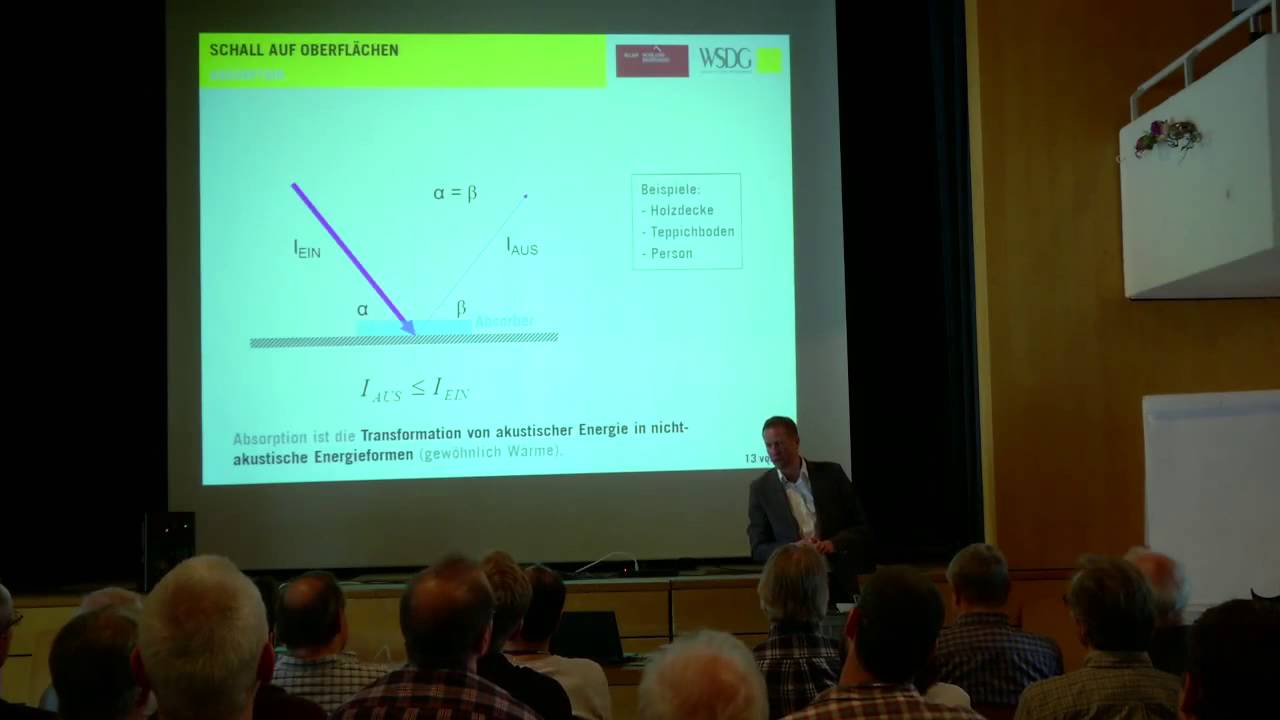
Reverberation is a collection of reflected sound waves from the surfaces of the enclosure. Now let's say a singer begins to sing a particular note at this particular time and that note ends at this particular time. Now ideally the sound should stop at this particular time. However, since this node has been produced in an enclosed space, some of the sound energy still remains inside the room and that energy decays gradually with time.
Now the time taken for that node to decay below a minimum audible level is called reverberation time.
Now most widely used definition is the time taken for that note to drop by 60 decibb and it is denoted by RT60.
So to sum up reverberation is the persistence of sound. It is due to the collection of reflected sounds from the surfaces in an enclosure.
Now the definition for reverberation time which I found in the Mumbai University textbook was this. However, if you search the internet, you will see that the most popular definition is this particular one which is the time taken for a signal to drop by 60 decibel.
In order to avoid reverberation, we use sound absorbing materials.
And absorption coefficient tells us how good is that material in absorbing sound. It is the a part of sound energy which is being absorbed by that material. Now the definition goes like this. It is the ratio of energy of sound absorbed by the surface to the total sound energy incident on the surface.
Now suppose we have a surface from which the sound is reflected and that surface has the absorption coefficient A and total area as S.
Then the effective absorbing area is defined as the product of absorption coefficient and the total surface area.
Now this is actually saying that out of the total area s only a m²ared of area is absorbing the sound energy whereas the rest of the area is reflecting the energy. Hence the name effective absorbing area. Suppose you have multiple reflecting surfaces having different surface area and different absorption coefficient.
Then the effective absorbing area is given by this formula. You just have to multiply the surface area for first material with its respective absorption coefficient.
add it with the surface area of the second material and multiply it with its own respective absorption coefficient and so on and you will get the effective absorbing area.
Now the phenomena of reverberation was studied extensively by professor Sabin and he gave us this formula.
He said that the reverberation time is directly proportional to the volume of the room and inversely proportional to the effective absorbing area. Now this is quite logical because more the effective absorbing area less will be the reflection and less will be the reverberation.
So this is pretty much logical.
Now K is the proportionality constant and it is found out to be 0.161.
Please make a note of this. This is very important and will be used in many numericals.
Now let's take a look at the first numerical.
This is very easy and the formula which you see here you have learned this in previous years. This is extremely easy but it is asked several times in past few years. So we'll just do this as an exercise.
You can pause this video and try this for yourself.
Okay. I'm sure that many of you have got the answer. Let's see what the question asks.
they have given the change in intensity of of the sound waves as 1,000 times its original intensity.
So you have this particular ratio of final intensity to the initial intensity as 1,000.
you have to convert this in decibel scale and for that you need to use this formula.
Now in this formula you already have the value for I upon I just need to plug this in and you will get the answer the change in intensity is 30 decibel.
It's very easy and also asked many times in the exams.
There is high chance that you will get a numerical of this type in your exams.
This is the second type of numerical which can be asked from this particular topic.
Why don't you pause this video and try it for yourself.
Okay. So let us look at the solution.
They have given the volume of the room.
They have also given the reverberation time and you also have the sound absorbing surface as 750 square m. This is not an effective absorbing area. This is the total area. So what do we have here? We have volume which is V, reverberation time which is T and the surface area which is S.
And we are asked to find out the average absorption coefficient.
Seems pretty easy. Let's see. Now I have listed down the data and the formula to be used is Sabin's formula. Of course, we need to modify it a little.
Let's see how.
First of all, they have not given us the effective absorbing area.
So, we will substitute that as a into s.
Now we can take a on the left hand side and t on the right hand side. Now all these values are given. You just substitute them and find the answer.
And the answer you will get is 0.513.
Have you got it right?
So that's all for this topic. I will see you next time. Bye-bye.
Up Next

18:26
Ultrasound Physics and Instrumentation for Residents
@myfamilydoc
6.6K views•2013-06-23

12:53
21cm Hyperfine Transition in Neutral Hydrogen: Radio Astronomy Basics
@AaronRobertParsons
12.4K views•2011-10-13

32:32
NMR Spin Physics I: Zeeman Effect, Resonance Condition & Larmor Frequency
@nptel-indianinstituteofsci8064
2.3K views•2024-01-17

27:14
Entropy and the Second Law of Thermodynamics Explained
@veritasium
27.5M views•2023-07-01
Related Study Plans & Knowledge Roadmaps
Structured learning paths in Physics
physics
Nuclear Physics (Decay, Fission & Reactors)
01Atomic Structure and the Binding Force
02Radioactive Decay and Half-Life
03Nuclear Fission Mechanics and Chain Reactions
+ 2 more learning modules
12h5 modules
Explore Roadmap
physics
Soft Matter (Polymers, Colloids & Rheology)
01Foundations of Soft Matter & Thermal Forces
02Polymer Physics and Macromolecules
03Colloids, Surfactants, and Self-Assembly
+ 2 more learning modules
38h5 modules
Explore Roadmap
physics
Analytical Mechanics: Lagrangian & Hamiltonian
01Mathematical Foundations: Calculus of Variations
02From Newtonian Mechanics to Constraint Dynamics
03The Principle of Least Action & Lagrangian Mechanics
+ 3 more learning modules
28h6 modules
Explore Roadmap
physics
General Relativity (Spacetime & Cosmology)
01Foundations of Relativity: Special Relativity
02The Geometry of Spacetime: Equivalence Principle & Curvature
03Einstein's Field Equations: The Mathematics of Gravity
+ 2 more learning modules
55h5 modules
Explore Roadmap