


















![[Rob Mathers] Environmental Degradation Trends of Plastic Debris in Seawater](https://i.ytimg.com/vi/c0cKygq-jHg/maxresdefault.jpg)
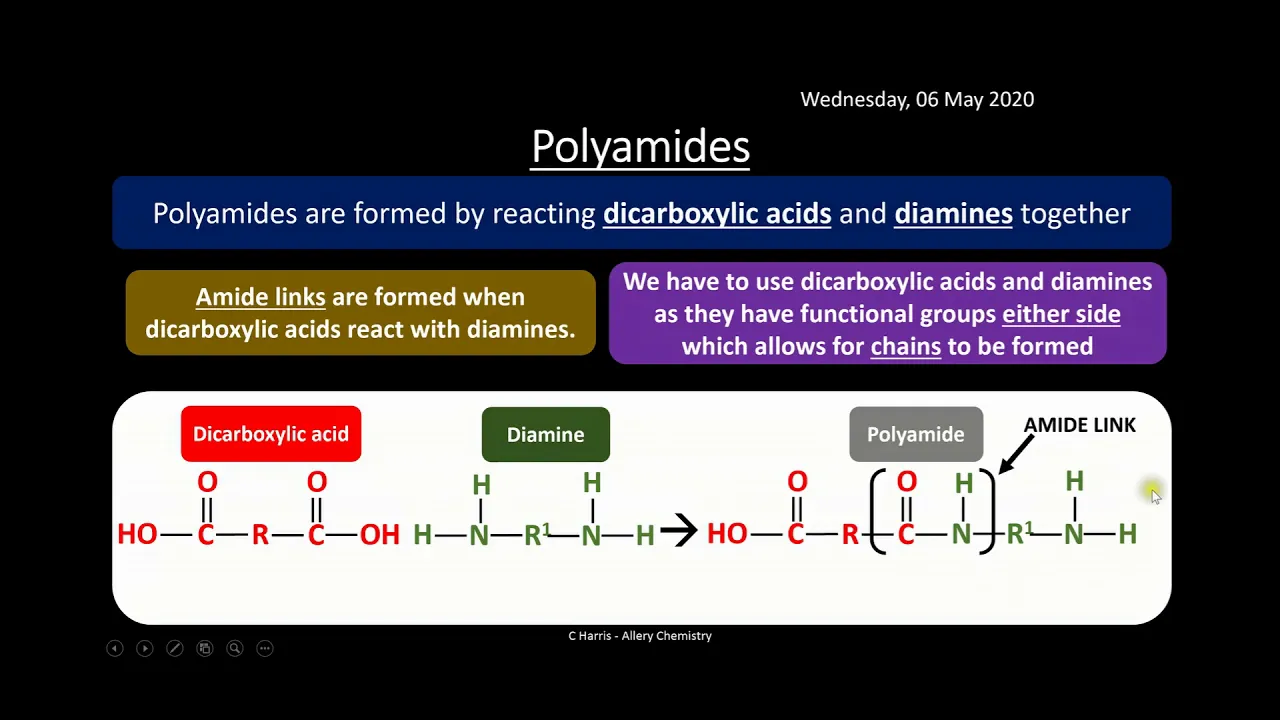
A polymer becomes biodegradable when it contains ester or amide linkages that can undergo hydrolysis, allowing water molecules to break the polymer chains into smaller monomer units; this process can occur through hydrolysis (chemical reaction with water), biological degradation by bacteria and fungi, or physical breakdown from sunlight and abrasion, though achieving biodegradability often requires compromising other desirable material properties.
Polymer Biodegradability: Hydrolysis of Polyesters & Polyamides | IB Chemistry
Added:Understanding of condensation polymerization, specifically how polyesters and polyamides are synthesized from monomer units with the elimination of water.
Familiarity with key organic functional groups, particularly ester (-COO-) and amide/peptide (-CONH-) linkages, including their polar bonds.
Basic knowledge of chemical hydrolysis reactions, where water is used to cleave chemical bonds.
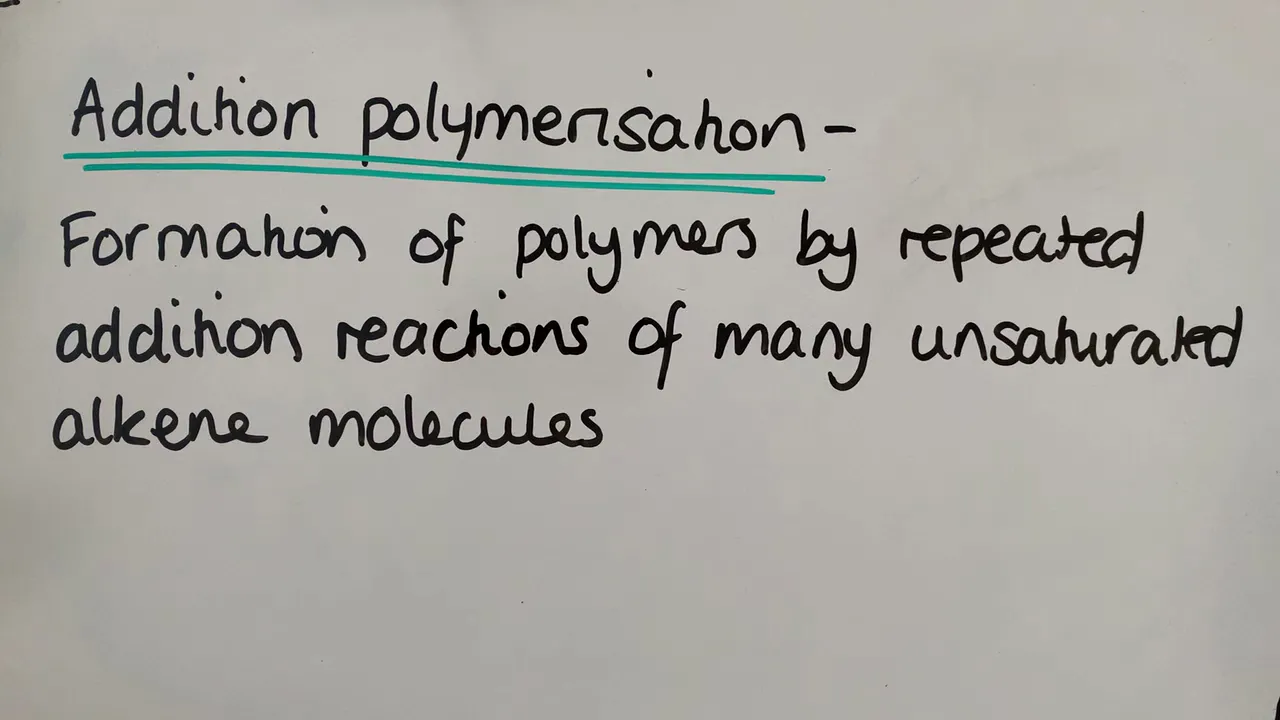
The distinction between addition polymers (such as polyethene) and condensation polymers, especially regarding backbone stability and reactivity.
Exploration of enzymatic vs. non-enzymatic hydrolysis, detailing how microbes secrete specific enzymes to accelerate polymer degradation in nature.
Analysis of environmental impact and green chemistry, comparing the life cycle and degradation rates of bioplastics (like PLA) to traditional petroleum-based plastics.
Advanced biomedical applications of biodegradable polyesters and polyamides, such as bioresorbable sutures, scaffolds for tissue engineering, and targeted drug delivery systems.
Methods for controlling polymer degradation rates, such as copolymerization, adjusting crystallinity, or blending with hydrophilic/hydrophobic additives.
1.3K views23likes3:59Original Release: 2024-03-03
ah a molecule and some zombies can I hydroly get the zombies to react with water no I can't so they're probably not biodegradable the plastic here is polylactic acid I've actually just joined two of them on almost together it has that Esther linkage and that is what makes it vable to hydrolysis it will react to water eventually and that will biodegrade the plastic so what happens waterers H2O the hydrogen will stick on there and the O from the water on the other side now when you make a polyester you generate water and when you destroy a polyester you add the water back on again hydrolysis that is my 3D printer and I'm currently printing a Von Newman probe I wonder if we're ever going to make one of those look it up if you don't know what it is back to the zombies I'm going to hydrolize those dirty de there is a zombie sitting on a load of plastic chairs and a big plastic container pile it's been attacked by fungi which can also destroy plastic and the sun rising there sunlight especially UV can also degrade plastic and cause it to fail well essentially these polymers or Plastics have to have a vulnerability so in chemistry it's hydrolysis which means they'll react with water eventually that might take a while biological they could be tasty for some bacteria or fungi for example to eat or physical so sunlight has enough energy to break some chemical bonds and the ultraviolet light especially higher energy or slow abrasion which is for example a bottle just being constantly smashed against the seashore by the by the waves it's probably going to be a compromise if you want your plastic to be biodegradable you're probably going to lose some properties that you want for example I'd imagine that you'd have to keep them quite a quite dry environment if they if they could hydrolyze and let's look at this hydrolysis so essentially the hydrolysis and breaking up the polyester or the polyamides uh into smaller units those are both soci polymers so that's a polymer that when it's produced also produces a small extra molecule normally water looking at polylactic Acid that's the one for 3D printers I've got two repeating units there uh and so let me show you what would happen if water came along the water the hydrogen would go on there and the O would go on there and now I've regenerated the carboxilic acid part of the monomer on one side and I've regenerated the alcohol part on the other all righty PCL is the new fangled uh polymer that's going to be on the market soon uh in increasing increasing numbers so I'm going to put a hydrogen in there and I'm going to put an o in there again that's hydrolysis adding water move that over a little bit a polyamide a NYL 2 nylon 6 is a is a poly amide there's the amide linkage there and again just hydrolysis I'm going to knock that out knock that out pop in a hydrogen pop in an O I've regenerated the carboxylic acid again and over here I've regener uh I've regenerated the amine oh that's not as hard as I thought it was going to be and we're done
Up Next
4:51
Chemical Food Preservation Methods: Preservatives & Additives
@sciencebehindfoods
9.1K views•2021-06-16
83:56
Biocatalysis and Catalysis in Islatravir Synthesis | Merck Webinar
@SCIwheresciencemeetsbusiness
675 views•2020-10-08
4:43
Why Are Transition Metal Complexes Coloured? | IB HL Chemistry
@ibchemvids
61.6K views•2014-11-15

17:31
Edible Water Bottles: A DIY Guide to Sodium Alginate Spherification
@ryan
10.5M views•2019-06-21
Related Study Plans & Knowledge Roadmaps
Structured learning paths in Chemistry
chemistry
Nuclear Chemistry: Decay, Meds & Fuel Cycle
01Introduction to Nuclear Structure and Radioactivity
02Decay Dynamics and Kinetics
03Radiation Interaction and Detection
+ 2 more learning modules
24h5 modules
Explore Roadmap
chemistry
Supramolecular Chemistry: Forces & Machines
01Foundations of Chemical Bonding and Intermolecular Forces
02Introduction to Host-Guest Chemistry
03Thermodynamics and Dynamics of Self-Assembly
+ 2 more learning modules
16h5 modules
Explore Roadmap
chemistry
Photochemistry: Excited States & Reactions
01Foundations of Light-Matter Interactions
02Molecular Orbitals and Electronic States
03Photophysical Processes and Jablonski Diagrams
+ 2 more learning modules
18h5 modules
Explore Roadmap
chemistry
Coordination Chemistry: Bonding & Properties
01Introduction to Transition Metals and Ligands
02Crystal Field Theory (CFT) and Geometry
03Magnetic Behavior and Spin States
+ 2 more learning modules
14h5 modules
Explore Roadmap