







![8. Att analysera med hjälp av matematik [Grundkurs i nationalekonomi: Mikroekonomi]](https://i.ytimg.com/vi/xWGqyLxPaHg/maxresdefault.jpg)







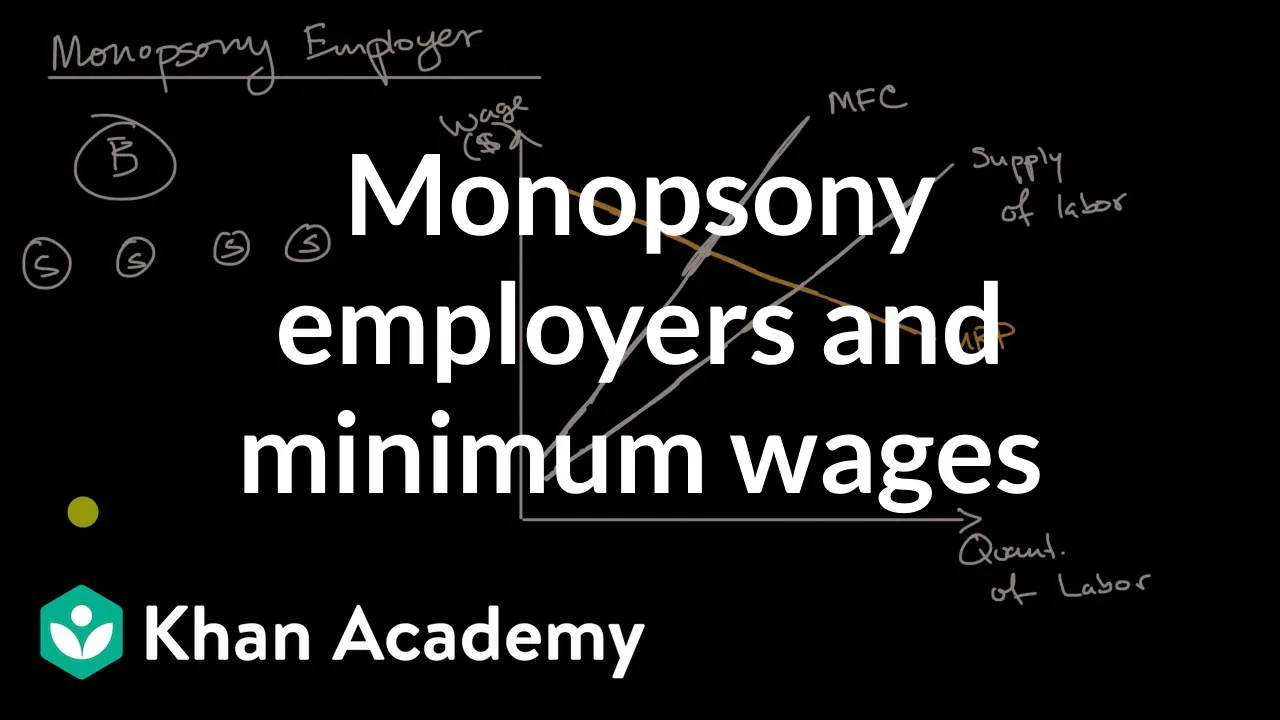
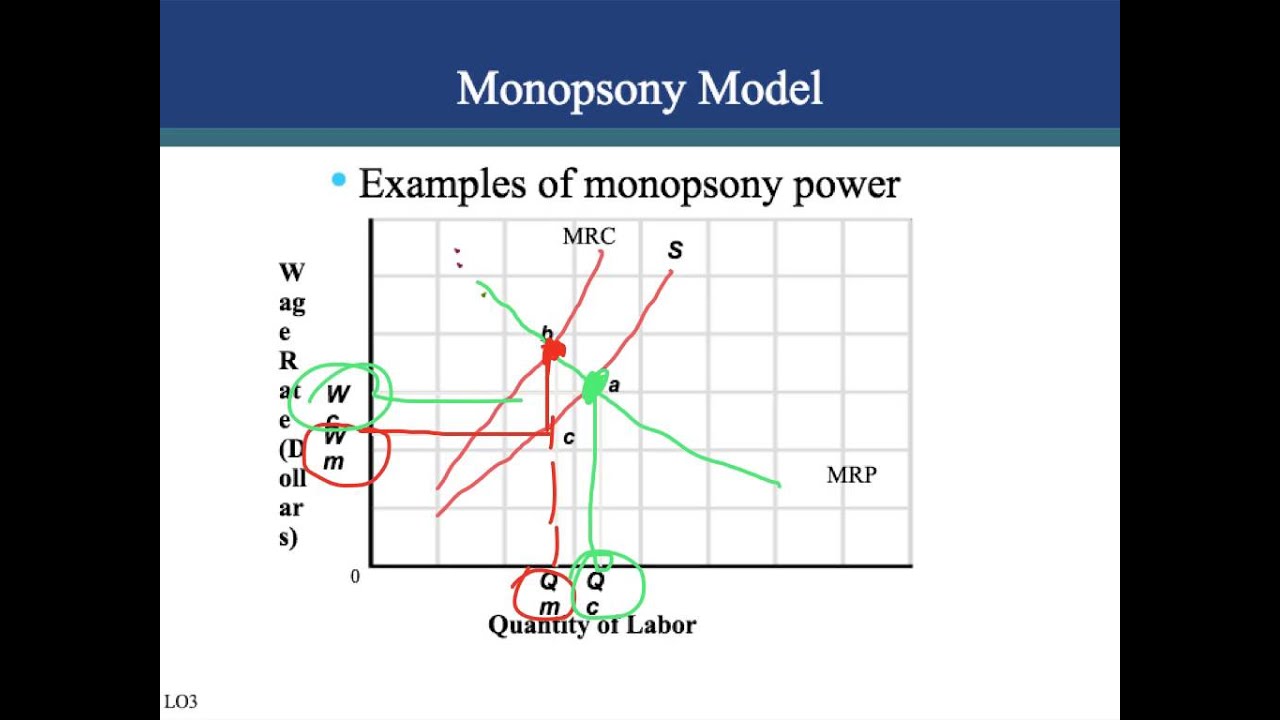


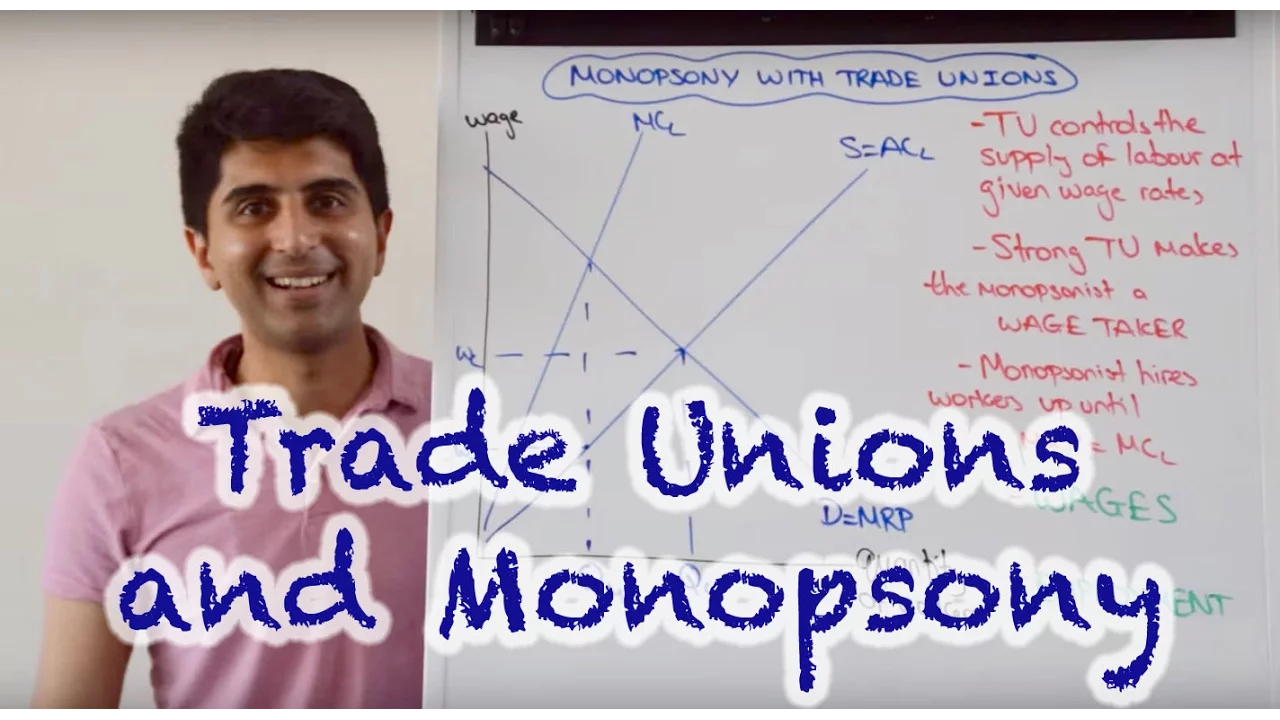





In a monopsony market, the equilibrium wage and employment level are determined by setting the marginal cost of labor (MC) equal to the marginal revenue product of labor (MRPL), where MC is derived from the inverse labor supply curve and MRPL represents the labor demand curve; specifically, MC equals twice the slope of the inverse labor supply curve, and solving MC = MRPL yields the equilibrium employment level, which is then substituted back into the inverse labor supply equation to find the equilibrium wage.
Monopsony Equilibrium Wage and Employment | Labor Market Analysis
Added:The fundamentals of labor supply and demand in a perfectly competitive labor market.
The concept of Marginal Revenue Product of Labor (MRPL) and how it represents a firm's demand for labor.
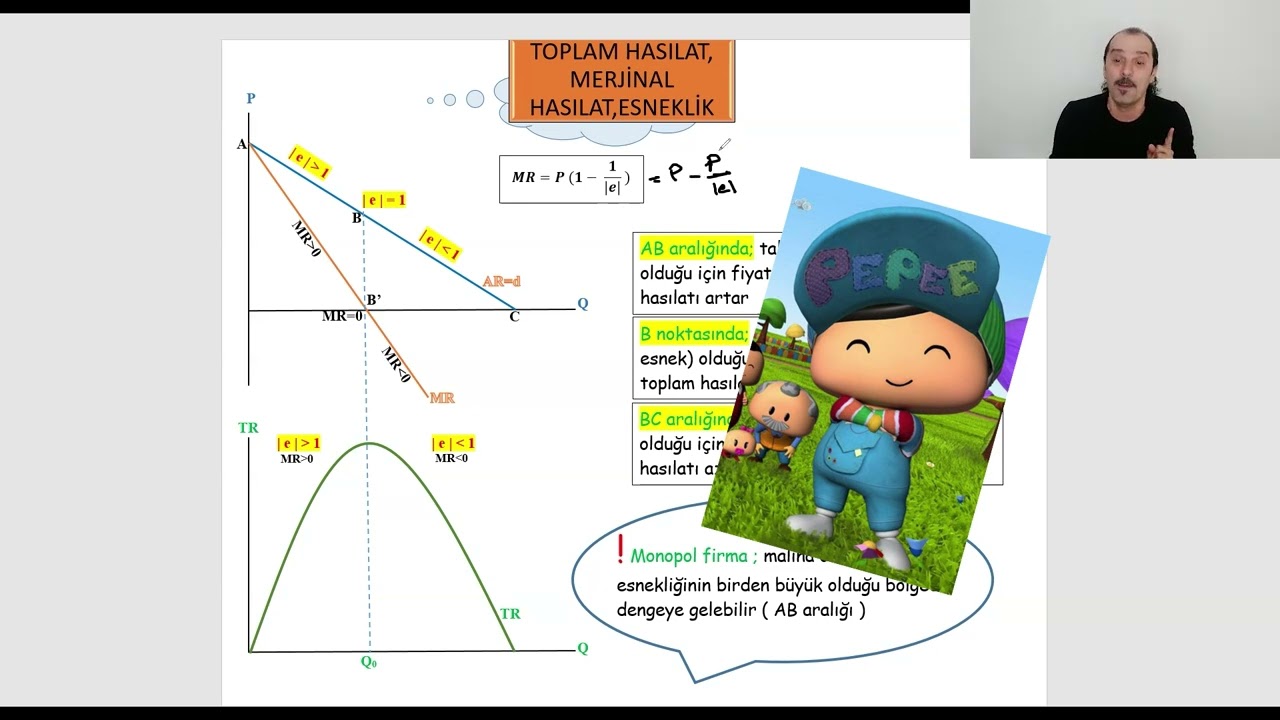
Basic monopoly theory in product markets, specifically the mathematical relationship between price, total revenue, and marginal revenue.
Algebraic proficiency in solving systems of linear equations and understanding inverse supply and demand functions.
Analyzing the welfare effects and deadweight loss associated with monopsony power compared to perfect competition.
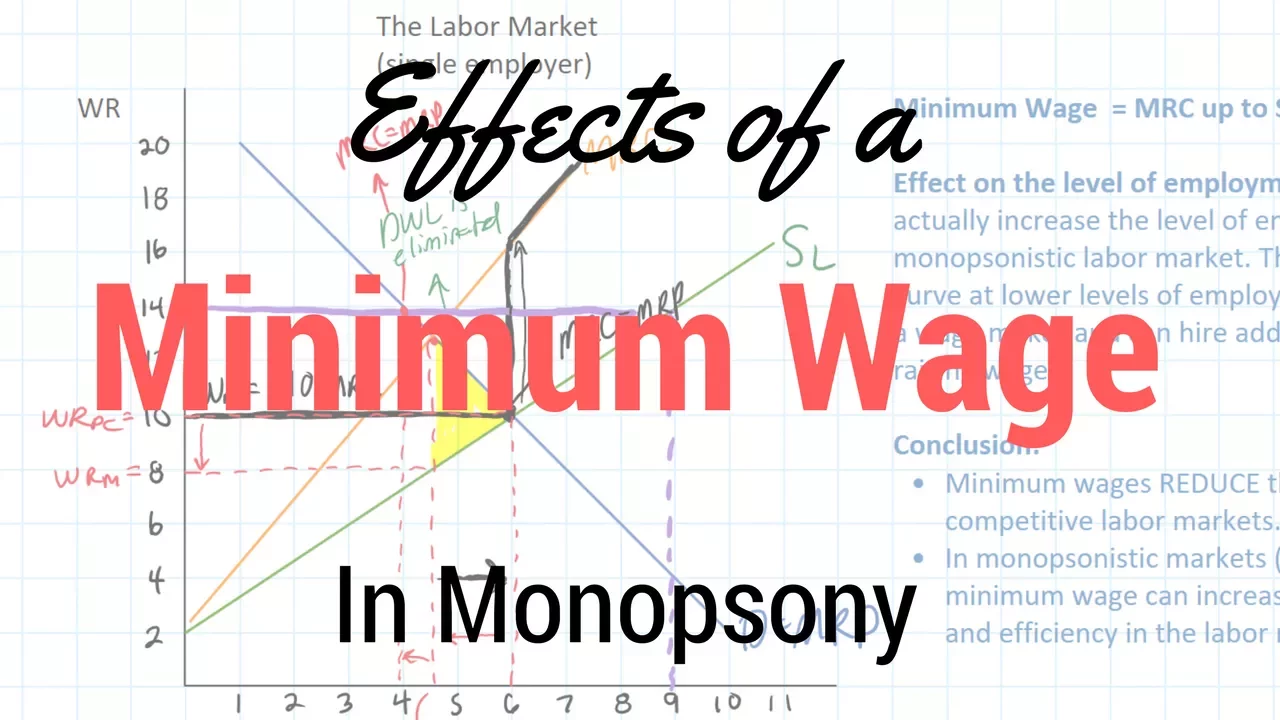
The theoretical and practical effects of introducing a minimum wage in a monopsonistic labor market.
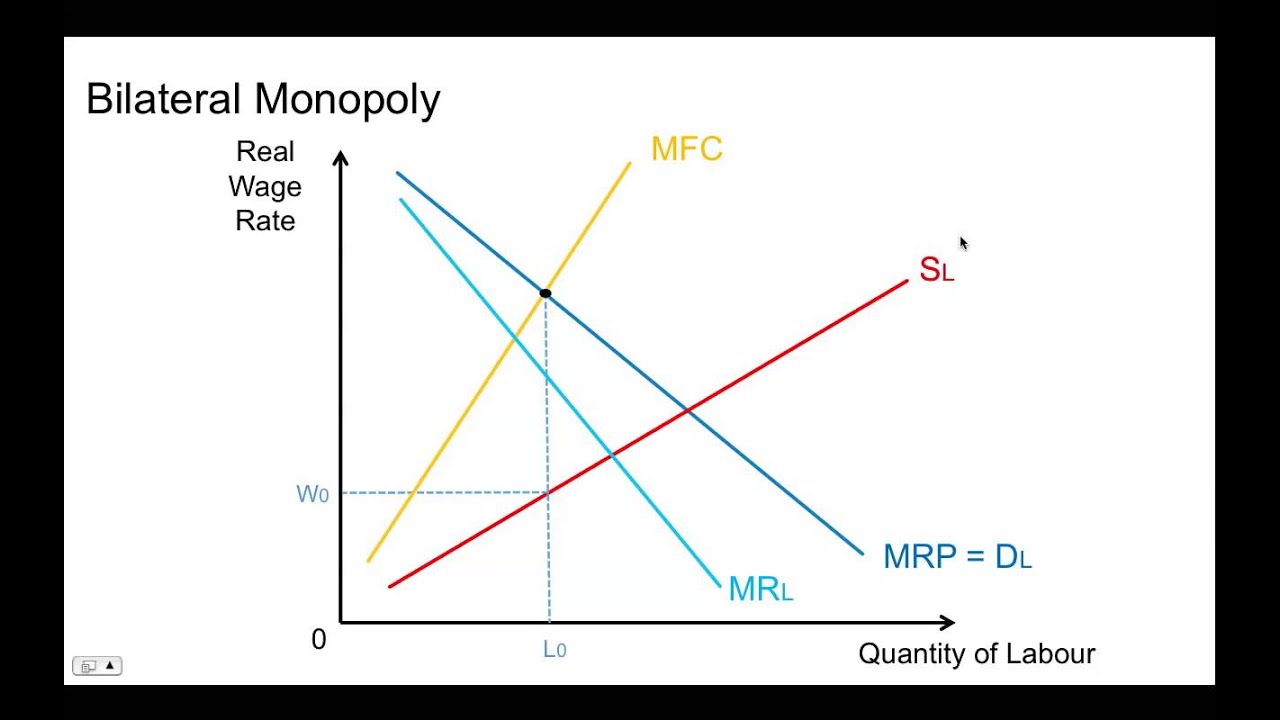
Bilateral Monopoly models, examining the market outcome when a monopsonist employer faces a monopolistic labor union.
Real-world applications and empirical case studies of monopsony power, such as in professional sports leagues, agricultural markets, or localized healthcare systems.
20.3K views215likes6:45Original Release: 2014-11-14
hello today I'm gonna talk about monopsony imagine this monopsony faces a labor supply curve given by the following equation and the monopsonist labor demand curve is given by 60 - W what we want to do is find a monopsonist equilibrium wage and employment level the first thing to do is solve for each one of these equations solve for W so I'm gonna take this labor supply equation and solve it for W now if you do that you're gonna get W equals five plus 2l dropping the superscript on s just for simplification so I took this above equation I just solved it for W I'm going to do the same thing for the demand equation just solve that for W and we get the wage W equals 60 - L and again I'm ignoring the D here just for simplicity this equation here is technically known as the inverse labor supply equation and the equation over here on the right is the inverse labor demand equation this equation the inverse labor demand is also the disagree yet here the the marginal revenue product of labor as you might recall that the labor demand curve is nothing more than the marginal revenue product of labor or some books might call it the value of the marginal product VMP so that's the demand side what we want to do now on the supply side of the market is we want to solve for the marginal cost of labor we want to solve for the marginal cost of labor add assist abbreviate that MC subscript out some books we'll call the marginal cost of labor some of your professors might call it marginal expenditure marginal expenditure some might call it the marginal expense of labour so there's a number of different words that are used to explain the concept that we're gonna look at here in a second so with marginal expense of labor being another common one okay so how do we get the marginal cost of labour or marginal expenditure whatever you want to call it we're gonna get that from the firm's variable cost equation the firm's variable cost I'll call it VC or some books might call a total variable cost so the firm's variable cost is nothing more than the wage times a units of labour W times L what we're gonna do is we're gonna substitute this v plus 2l in for W and the variable cost equation so variable cost equals 5 plus 2l and that's all multiplied done through by L so just simplifying we got an equation for the variable cost to get the marshal cost of labor we're going to take the derivative of the variable cost equation with respect to labor and we just simply get 5 plus 4 L so the marginal cost of labor or marginal expense of labor is 5 plus 4 L this is an important equation for us one little hint here is that the marshal cost of labor function is going to look almost exactly like your inverse labor supply function notice that this is 5 plus 4 L and our inverse labor supply function was 5 plus 2 L the only difference being is that the marginal cost of labor has a slope that is twice as steep so given that this is 2 this is going to be 4 so you don't have to in the future you don't have to really go through all these steps to derive the marginal cost of labor so just as an example if somebody said the inverse labor supply equation was w equals 10 say plus 1.5 L the marginal cost of labor is just going to be 10 plus 2 times 1.5 or 3 out okay so that's what it'll simplify down to okay the next thing we want to do is we want to solve for the equilibrium level of employment let me get some space here so the monopsonist is going to hire workers up until the point where the marginal cost of labour marginal cost of labour equals the marginal revenue product inverse labor demand whatever you want to call it which is just a 60 minus L equation so taking our 5 plus 4 ow five plus four L setting that equal to the inverse labor demand equation which is sixty minus L and now solving for L the monopsonist will hire love and workers that monopsonist will hire love and workers to get the wage what is a wage that but the monopsonist is going to pay its workers we're going to take this result and plug it back into the inverse labor supply equation so the the monopolist monopsonist wage is gonna be five plus two times eleven or twenty seven dollars so that's how you solve a monopsonist problem I hope you found this video helpful
Up Next

13:08
Efficiency Wage Theory: Employment, Wage Discrimination, and No-Shirking Model
@drgaonkargopalakrishnam9183
6.2K views•2020-05-26

5:07
Impact of Yuan in Indo-Russian Trade Amid Sanctions
@WION
261.9K views•2022-07-01

11:09
Economics of Insurance: Expected Utility & Fair Premiums
@EconomicsinManyLessons
124K views•2014-05-09

113:18
The Age of Easy Money: Fed & Inflation | Full Documentary
@frontline
21.2M views•2023-03-15
Related Study Plans & Knowledge Roadmaps
Structured learning paths in Economics
economics
Sovereign Debt: Defaults, IMF & Restructuring
01Introduction to Sovereign Debt & Government Bonds
02Debt Sustainability & Credit Ratings
03Anatomy and History of Debt Crises
+ 2 more learning modules
12h5 modules
Explore Roadmap
economics
Market Design: Matching Theory & Gale-Shapley
01Introduction to Market Design and Price-Free Markets
02Two-Sided Matching & The Gale-Shapley Algorithm
03School Choice Systems and Mechanism Design
+ 2 more learning modules
10h5 modules
Explore Roadmap
economics
Impossible Trinity: Forex, Capital & Policy
01Introduction to Monetary Policy and Central Banking
02Exchange Rates and International Capital Flows
03The Mundell-Fleming Model
+ 2 more learning modules
8h5 modules
Explore Roadmap
economics
Healthcare Economics: Market Failures & Systems
01Introduction to Healthcare Markets and Market Failure
02Asymmetric Information and Adverse Selection
03Moral Hazard and Insurance Design
+ 2 more learning modules
12h5 modules
Explore Roadmap