

![[KU OCW] 박광태 경영통계 140917](https://i.ytimg.com/vi/Mmb3HhxRXsY/hqdefault.jpg)










![[Choice Under Uncertainty] | Part 3 | Risk Aversion | Risk Premium | Certainty Equivalence | 37 |](https://i.ytimg.com/vi/ZNr1HZyOTbk/maxresdefault.jpg)
![(M5E12) [Microeconomics] Certainty Equivalence and Risk Premium](https://i.ytimg.com/vi_webp/Bem5kR0zu0M/maxresdefault.webp)









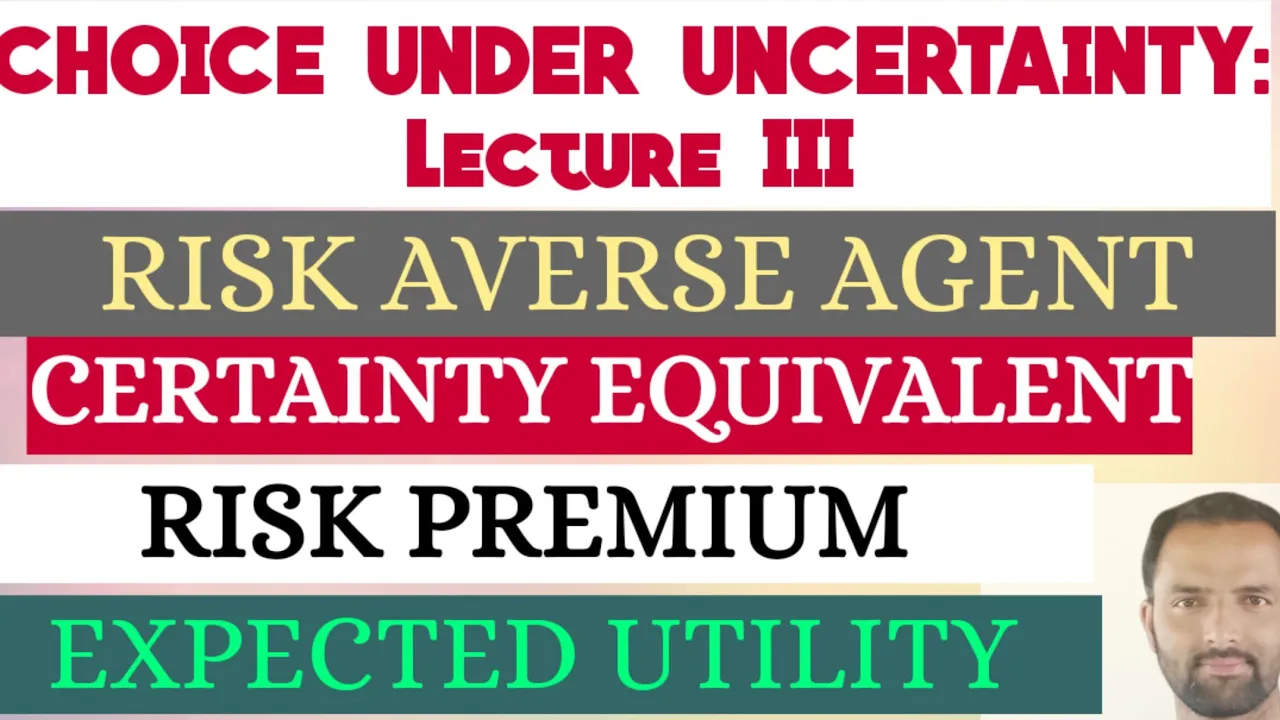
In insurance economics, expected utility helps analyze risk preferences: a risk-averse individual will pay more than the actuarially fair premium (calculated as probability × loss size) for full coverage insurance, as demonstrated by a golfer with utility U=√W who would pay up to $190,000 for $1 million coverage despite the fair premium being only $100,000, because the guaranteed wealth of $900,000 provides higher utility than facing the gamble.
Economics of Insurance: Expected Utility & Fair Premiums
Added:Basic probability theory and the calculation of expected values (probability-weighted averages).
The concept of utility functions and consumer preference theory in microeconomics.
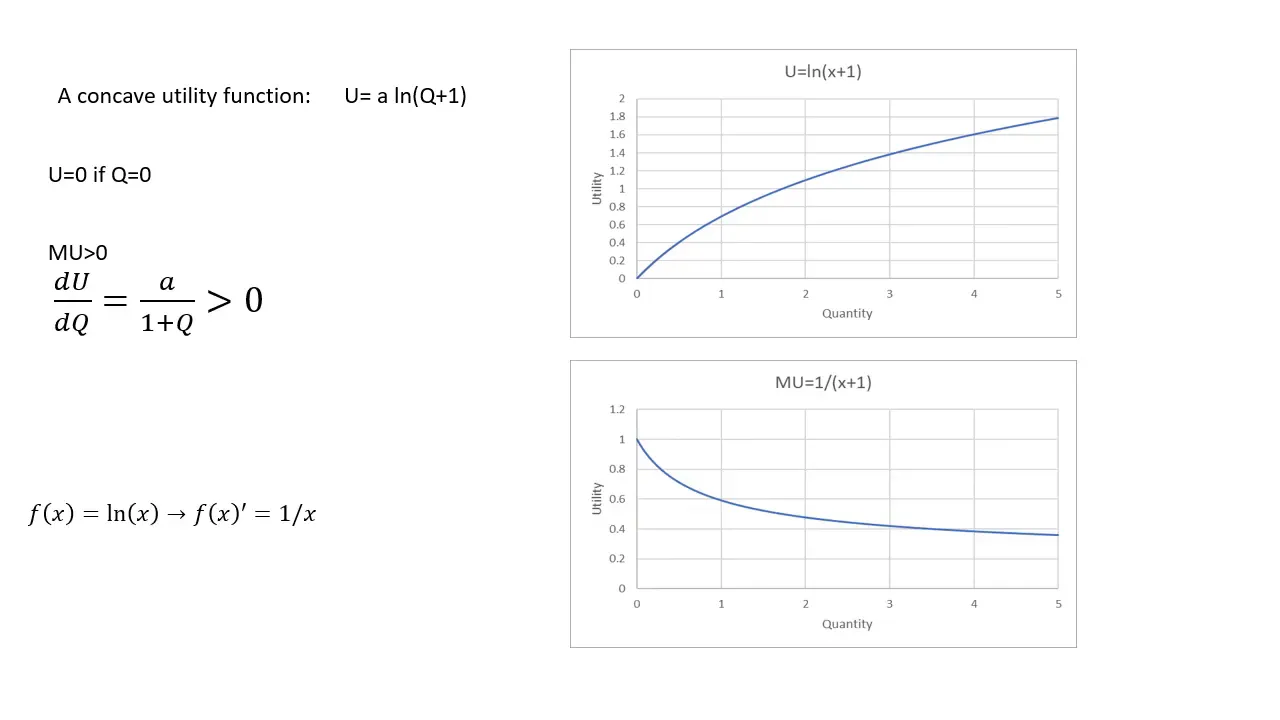
The principle of diminishing marginal utility and its mathematical representation (concave functions).
An introductory understanding of decision-making under conditions of risk versus certainty.
How to calculate the 'Certainty Equivalent' and the maximum risk premium an individual is willing to pay.
The Arrow-Pratt measures of risk aversion (coefficient of absolute and relative risk aversion).
Asymmetric information in insurance markets, specifically the concepts of Moral Hazard and Adverse Selection.
The economics of optimal insurance contract design, including the role of deductibles and co-payments.
124K views981likes11:09Original Release: 2014-05-09
hi in this presentation we're going to look at the economics of insurance suppose we have a golfer with the utility function U equals the square root of w w is going to represent the golfer's wealth the golfer will earn a million dollars if healthy but there's a 10% probability that the golfer gets injured and will earn nothing so let's answer some problems here let's start with a clean slide utility equals the square root of wealth we want to find expected utility first expected utility equals the probability that the golfer is healthy the probability the golfer is healthy multiplied by the utility of healthy this then is going to be added to one minus the probability that the golfer is healthy which is just a probability that the golfer is injured times the utility if injured so in our problem there's a 90% probability that the golfer will be healthy so that's 0.9 if the golfer golfer is healthy he will earn a million dollar let's evaluate the utility function at a million dollar okay so that's the first part of this the next part is the there's a probability that golfer will be injured which is just 1 minus. n or as we said in the previous slide just 10% and the utility if injured well if injured the golfer earns nothing so wealth is zero and if we were to solve this we're going to get 900 so the expected utility for the golfer is 900 okay let's answer another question let's find the actually Fair insurance policy the actu fair insurance policy okay for we can assume full coverage here that is if the golfer gets injured his insurance policy will pay him back the size of his loss which is $1 million so an actual inur Fair insurance policy is just going to be the probability of loss times the size of the loss so in our problem the probability of the loss in this case the golfer is injured is just 10% the size of the loss is that the golfer loses $1 million so an actual lay actual L Fair insurance policy would charge this golfer $100,000 the golfer would pay an insurance premium of $100,000 if the golfer got injured he would get $1 million the size of his loss okay the let me go to a clean slide next question we could answer is uh suppose the golfer does buy a full uh coverage insurance policy at an actually Fair premium okay so let's again let me repeat that suppose a golfer were to purchase a full coverage insurance policy at an act act Fair insurance premium what would be his expected utility okay so we want to find the expected utility if the golfer were to get insurance coverage so Let's uh do the following if the golfer is healthy he's going to earn $1 million but we're going to assume he bought an insurance policy that he paid $100,000 for an actually Fair policy that would leave him at the end of the year at $900,000 if the golfer gets injured the golfer get gets injured he won't make any money playing golf so that's zero he still has to pay the premium but the good news is he gets back the size of his loss which is $1 million I'll just write 1 mil okay so that's the insurance reimbursement insurance reimbursement so here doing the math he's left with $900,000 so regardless if he's healthy or injured the golfer is going to have the same amount of wealth at the end of the year let's calculate his expected utility with insurance so expected utility with insurance okay so there's a 90% probability that he'll be healthy how much wealth will he have $900,000 okay we're plugging $900,000 into that utility function remember the utility function is just the square root of wealth that 900,000 is coming from up here there's a 10% chance he'll be injured in which case the insurance policy will kick in giving him a million dollars but after subtracting the insurance premium he'll have 900,000 taking the square root of that just evaluating utility function at that we're going to be left here with 948 point and rounding up to the nearest 10th.
7 so one thing to note here is that this golfer is risk averse this golfer gets a higher level of utility from a guaranteed $900,000 than facing a gamble or risk with an expected value of $900,000 okay so this is what it means to be risk averse okay one other question we could look at is something about maximum willingness to pay what is a golfer's maximum willingness to pay for full coverage insurance okay let me do this on a clean slide okay so we're looking at maximum willingness to pay here oops maximum willingness to pay for full coverage insurance it's best if I present this in a graph and then from there that'll help inform our math go put wealth here utility here's a utility function for the golfer that's $1 million there this is going to be the expected utility cord should connect to two dots this is going to be 900,000 we found this value here at 900 that's the expected utility of the gamble the gamble being there's a 10% probability you'll get injured and then we calculated the utility here if you were just guaranteeing yourself $900,000 a year by buying a insurance coverage at an actual L Fair premium this was it's going to be whatever this value is here minus W star so how do we get W star well our utility function looks like that and we're going to plug 900 into the utility function and we're going to solve for w squaring both sides we get 810,000 that's our W star in this case plugging that in here 1 million minus 810,000 gives a 190,000 that is the most that this golfer would pay for an insurance claim that would cover his $1 million an insurance policy that would cover his $1 million loss and you'll notice here that that is the most you'd be willing to pay and as I said that's 810,000 now right that value W star notice that he would get the same amount of utility going into the year facing the gamble he could be healthy could be injured or he could guarantee himself an income of 810,000 if he paid a policy of 190,00 000 okay so that is the economics of insurance
Up Next
21:45
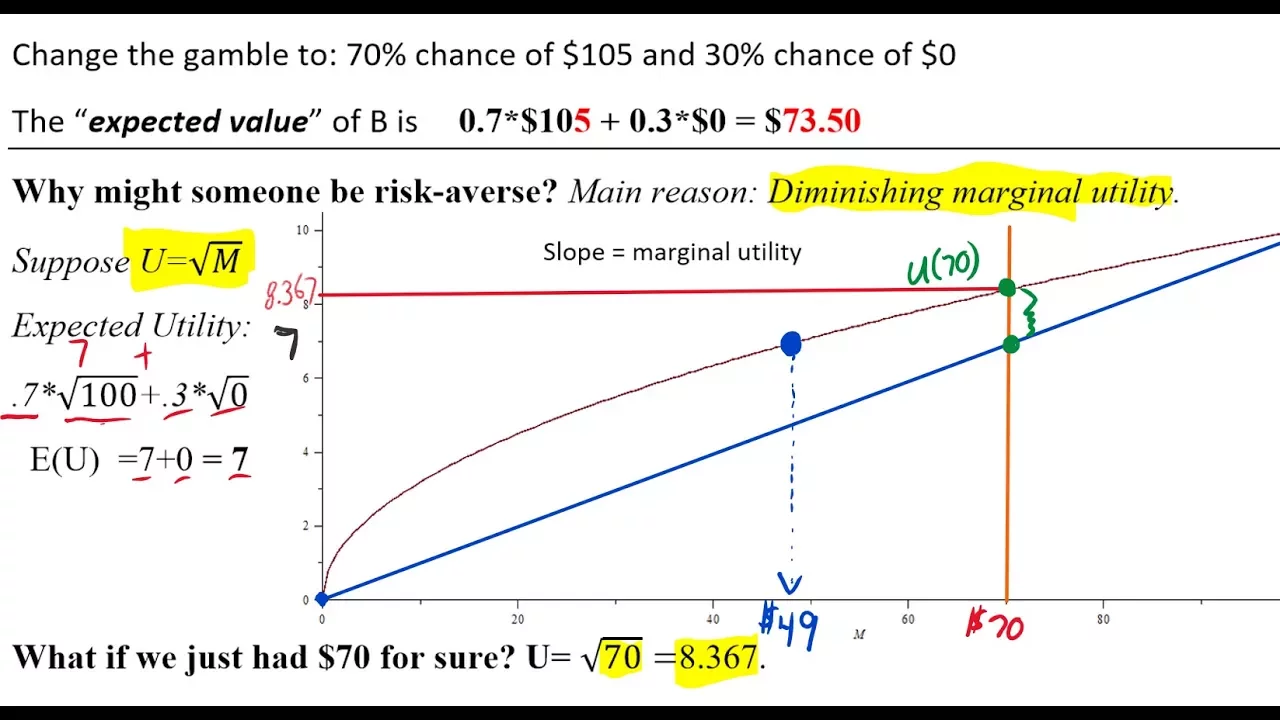
Risk Aversion & Expected Utility: Insurance & Arrow-Pratt Measures
@BurkeyAcademy
158.3K views•2017-11-24

5:07
Impact of Yuan in Indo-Russian Trade Amid Sanctions
@WION
261.9K views•2022-07-01

6:45
Monopsony Equilibrium Wage and Employment | Labor Market Analysis
@EconomicsinManyLessons
20.3K views•2014-11-14

113:18
The Age of Easy Money: Fed & Inflation | Full Documentary
@frontline
21.2M views•2023-03-15
Related Study Plans & Knowledge Roadmaps
Structured learning paths in Economics
economics
Sovereign Debt: Defaults, IMF & Restructuring
01Introduction to Sovereign Debt & Government Bonds
02Debt Sustainability & Credit Ratings
03Anatomy and History of Debt Crises
+ 2 more learning modules
12h5 modules
Explore Roadmap
economics
Market Design: Matching Theory & Gale-Shapley
01Introduction to Market Design and Price-Free Markets
02Two-Sided Matching & The Gale-Shapley Algorithm
03School Choice Systems and Mechanism Design
+ 2 more learning modules
10h5 modules
Explore Roadmap
economics
Impossible Trinity: Forex, Capital & Policy
01Introduction to Monetary Policy and Central Banking
02Exchange Rates and International Capital Flows
03The Mundell-Fleming Model
+ 2 more learning modules
8h5 modules
Explore Roadmap
economics
Healthcare Economics: Market Failures & Systems
01Introduction to Healthcare Markets and Market Failure
02Asymmetric Information and Adverse Selection
03Moral Hazard and Insurance Design
+ 2 more learning modules
12h5 modules
Explore Roadmap