













A new proposal by Soliman et al. suggests that combining a 99-meter-wide space starshade (a giant umbrella that blocks starlight) with the European Extremely Large Telescope (ELT) could finally enable direct imaging of Earth-like exoplanets, which have been too faint and too close to their stars for current telescopes to detect despite over 6,000 exoplanets having been discovered.
Directly Imaging Exoplanets with a Giant Star Shade
Added:The concept of exoplanets and the traditional indirect methods used to detect them, such as the transit method and radial velocity.
The astronomical 'contrast problem,' which refers to the extreme difference in brightness (often 10 orders of magnitude) between a host star and its orbiting planets.
Basic principles of wave optics, specifically the diffraction of light and how it creates glare and Airy disks that obscure faint nearby objects.
The fundamental purpose and scale of Ground-Based Extremely Large Telescopes (ELTs) and how their aperture size affects angular resolution.
The orbital mechanics and precise formation-flying technologies required to keep a space-based starshade aligned with a ground-based telescope over tens of thousands of kilometers.
Exoplanet spectroscopy and the scientific methods used to analyze filtered planetary light for biosignatures like oxygen, methane, and water vapor.
The mechanical engineering and material science challenges of folding, launching, and perfectly unfurling a 99-meter structural 'flower' in space.
Comparative study of alternative high-contrast imaging technologies, such as internal coronagraphs and extreme adaptive optics (ExAO).
1.2K views185likes16:56Original Release: 2026-06-04
We have found over 6,000 exoplanets, planets orbiting other stars out there in the universe. We've studied the atmospheres of some of them. We've mapped their temperatures, detected storms raging on them, and even found water vapor in the atmospheres of some of them. But here's the thing that keeps us astrophysicist up at night. It's the fact that we've still not yet managed to take a direct image of an Earthlike planet. Despite all of our recent advancements in telescopes, building them ever bigger and bigger, the direct detection and imaging of exoplanets can still only give us images of massive Jupiter-like planets orbiting really far out from their stars. Why? Because it's just really hard to do. Stars are so incredibly bright that they drown out the very faint reflected light that comes off their planets. It's like trying to detect someone holding up their phone with their torch on standing next to a stadium flood light from miles away. But a brand new paper by Solomon and collaborators has proposed a new way of doing this in the most sci-fi way possible. Not with a bigger telescope or a better camera, but with a giant 99 m wide space umbrella. The technical term is star shade. And the idea is that you block out the light from the star so that you have a hope of detecting the very faint light of the planet next to it. So in this video, we're going to dive into this new research and the idea of a star shade and chat first about why we can't directly image earthlike exoplanets yet. Then second, how a giant star shade could help. Third, why Solomon and collaborators think this could now work. And then finally, how does this compare to what other telescopes are doing? like NASA's Habitable Worlds Observatory that also wants to image Earthlike exoplanets, but in a different way. But before we dive into all of that, you all saw how I had an amazing time on my trip to Joshua Tree National Park last month where I enjoyed some beautifully dark night skies. Now, the planning for that trip was made so much easier thanks to all of the new features on Opera, the sponsor of this week's video. I am one of those people that will just constantly keep opening new tabs on my internet browser.
So much so that it just becomes impossible to find anything. So I think my favorite feature of Opera by far is the tab islands. You know, I can group all my Airbnb options in one island. I can then group the recommendations for hikes I found in another and then keep it all separate for my research on what I'll be able to see in the night sky when I'm there in another island. I can collapse and expand them. I can name them and even choose different colors for each one. I've also found Opera's split screen feature so helpful as well.
Like I can have a star chart open on one side while I look at a list of Messier objects. I can see from Joshua Tree on the other. I can even split the screen into four. So I can have my research notes and like the weather forecast open at the same time. Plus, I'm very easily distracted by other apps. So as soon as I swipe away from my browser window, my attention is gone. So, I love the fact that I can control my music without interrupting my browsing with Opera's detachable player. I can pop this anywhere inside or outside the browser window. But by far the most useful feature is Opera AI, which has just had an upgrade so that it's smarter, more powerful, and faster. It can help you find sources for information that you read on the web, which is so useful when I'm doing research for my latest night sky news videos. You don't even need to open another tab or have an Opera account to use Opera AI. It's all inbuilt and free. So download Opera today using the link in the description down below. A big thanks again to Opera for sponsoring this video. And now let's start with why can't we directly image earthlike exoplanets yet. Right, to understand this I need to get across to you just how incredibly difficult this is. And obviously at its simplest, it just boils down to the fact that stars give out light and planets don't. We can only see the moon and the planets of the solar system in the sky because they reflect the sun's light back to us. But the giant Jupiter is still 9 million times fainter than the sun. And Earth is over a billion times fainter than the sun. So taking an image of even a Jupiterized planet, never mind an Earthlike planet around a star many light years away, is incredibly difficult. Because to detect such a faint light from the planet, you have to take a really long exposure where you leave the telescope open to detect light. But then what happens is you end up detecting too much light from the star and it saturates those pixels of your image that then bleed over into the neighboring pixels which is where you'd expect to find the planet. That's why the majority of exoplanets are found indirectly either through the transit method where we wait for a planet to pass in front of its star and we detect the dip in the stars brightness or by watching whether a star wobbles due to the pull of a planet's gravity that's orbiting it. So if instead we want to directly detect exoplanets, take an image of a star and reveal its star system, then we have to get a little bit clever and use something like a coronagraph. Something inside the telescope itself which blocks the light of the star before it reaches the detector. We can then expose for a really long time to detect the faint reflected light of the planet. Hubble has a coronagraph as does the James Webb Space Telescope JWST. And both of those telescopes have managed to directly image exoplanets before. Hubble's even managed to image the same planets multiple times that we can actually make a time lapse of them orbiting around their stars. But every planet that we've managed to do this for so far have been absolutely huge. All of them have been more massive than Jupiter. And each of those planets orbits their star further out than Saturn orbits the sun in the solar system. Often they're also found around really young stars, which means the planet is also young. It's just formed, so it's still hot from that formation. It's glowing with its own heat in infrared light, which makes it easier to spot, at least with the James Web Space Telescope. An Earthlike planet, though, old, cool, and rocky, orbiting much closer into its star, is a completely different kettle of fish.
It's much too faint and far too close in to its star for our current generation of telescopes with their coronagraphs to be able to detect. So what do we do? One idea is that we ditch the coronagraph entirely and break out the big space umbrella. Which brings me to part two.
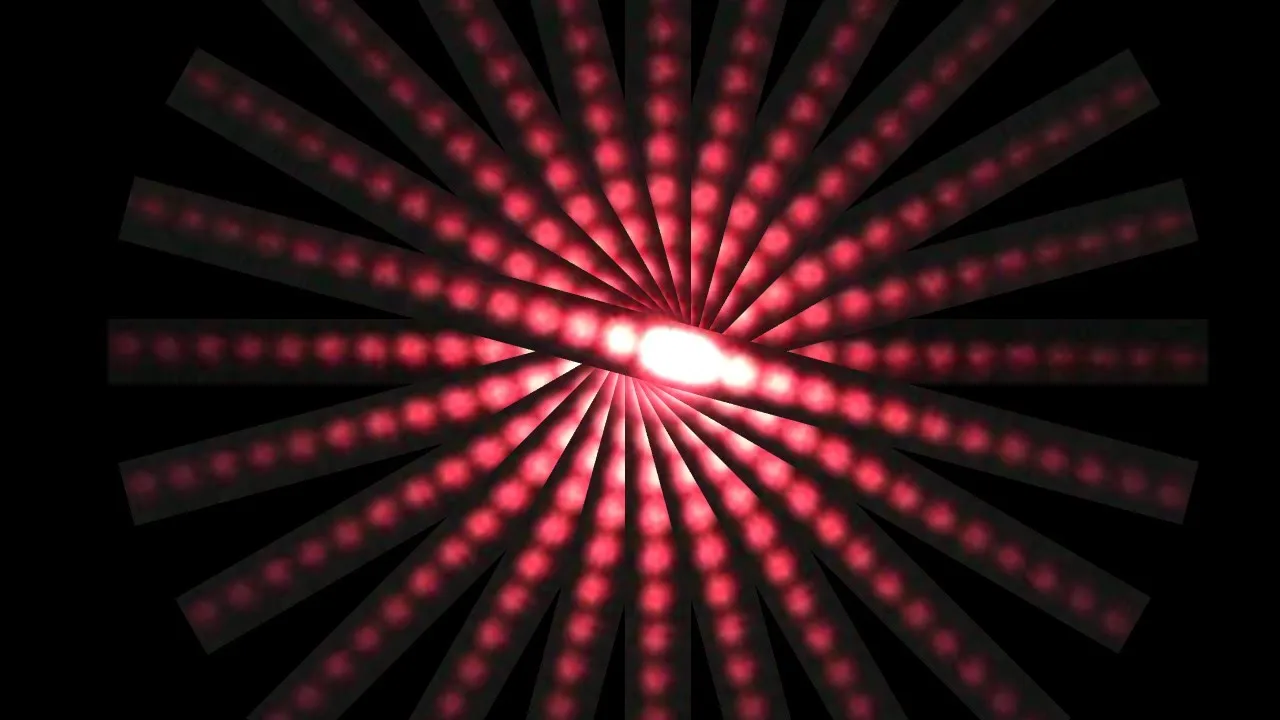
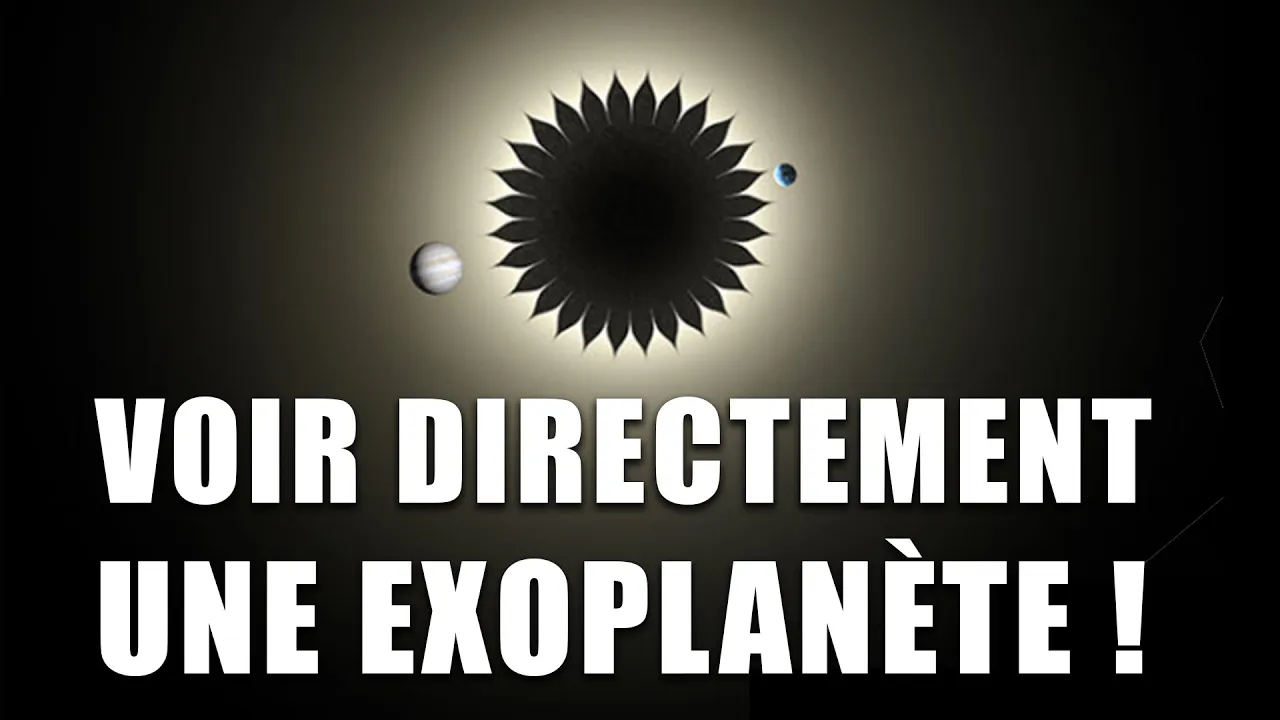
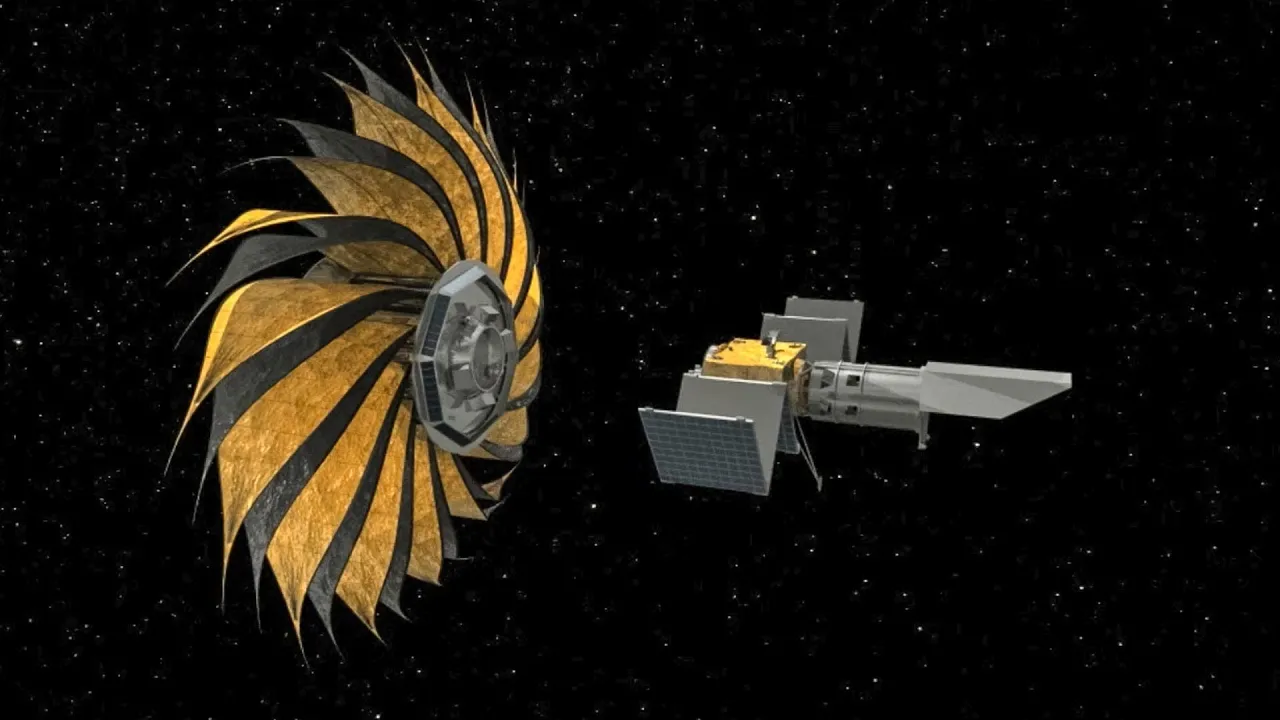
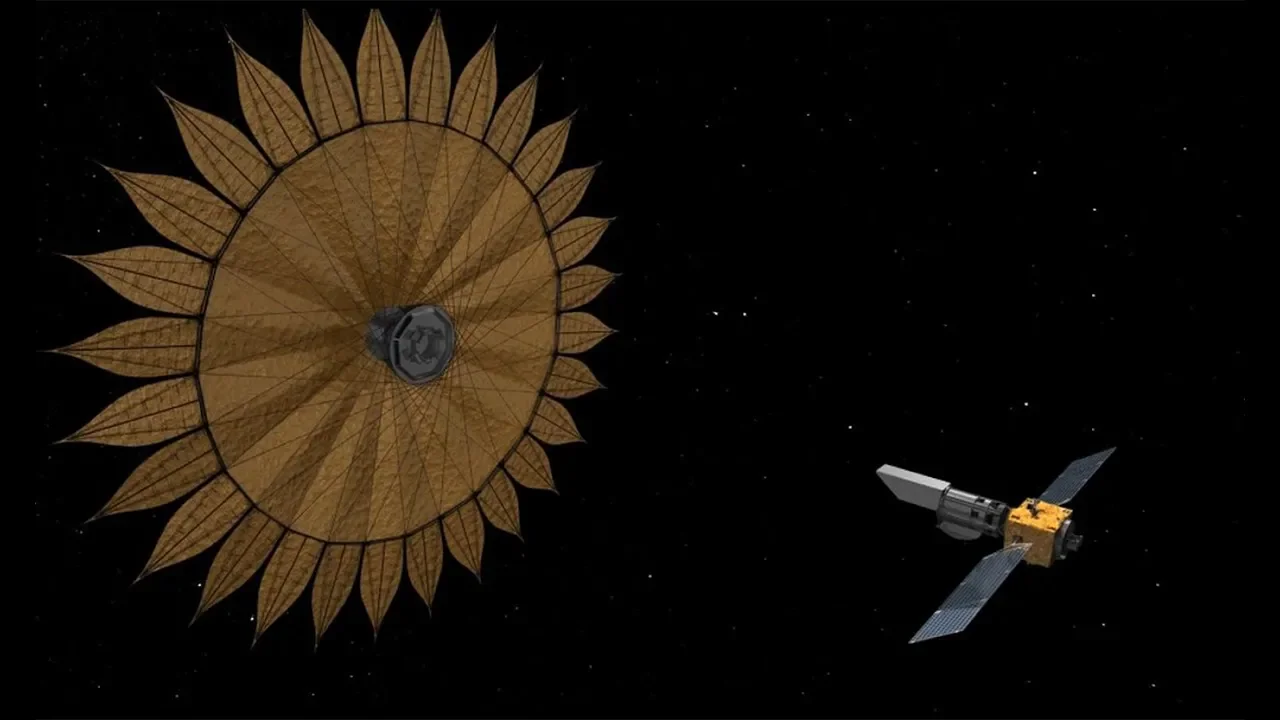
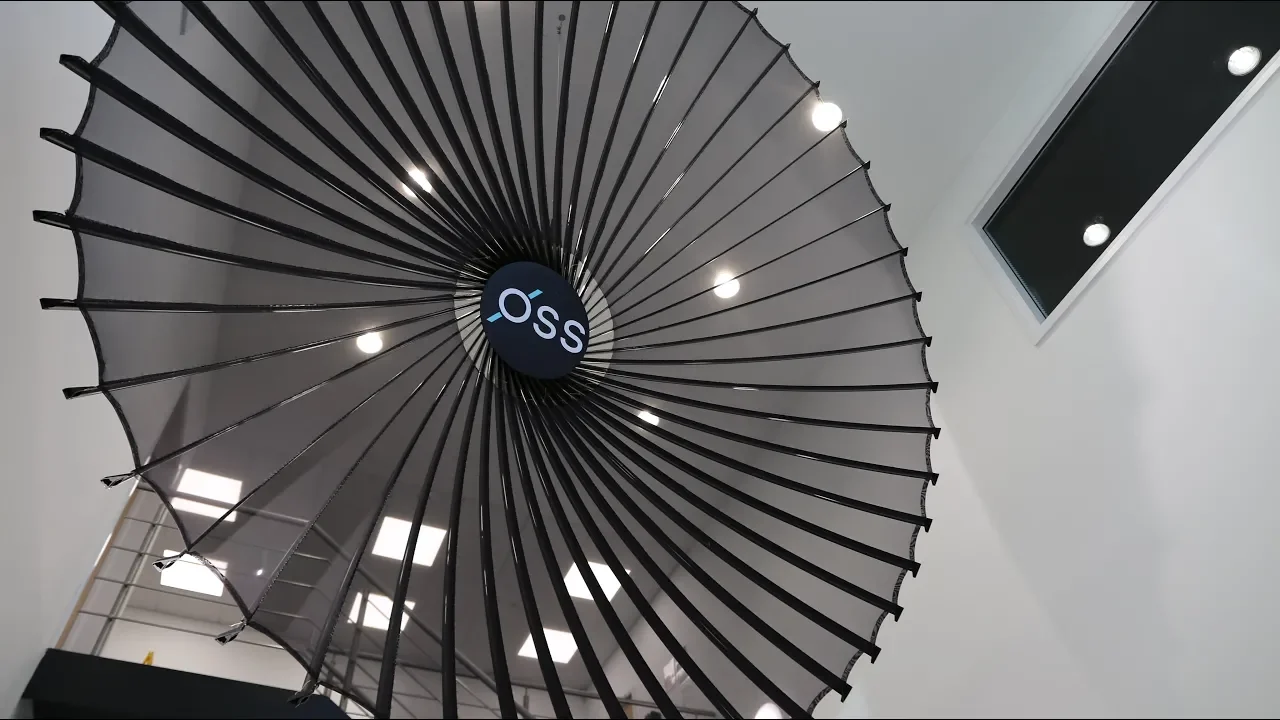
How could a giant star shade in space help us detect Earthlike exoplanets? So the idea is instead of putting a small mask inside a telescope up in space, you put a giant mask up in space and combine it with a telescope on the ground. NASA are now funding the development of a giant star shade known as the hybrid observatory for Earthlike exoplanets or hoe. first proposed by Mather and collaborators in 2019. And the plan is for it to be a whopping 99 m in diameter. For context, JST's sunshield is the size of a tennis court, and that's only 21 m wide. And that was an engineering marvel that it unfolded without any issues up in space. This star shade would be five times wider than that and come with its own set of headaches. But it's also not just a perfect circle shape. It's a flower shape with a 50 m wide central region that's ringed by 48 petals each 24 1/2 m long. That shape is really important because it will minimize the amount of light that actually leaks from behind the mask, at least compared to how much light leakage you get with a coronagraph. The light will bend around the petals shape. But what'll happen is that it'll actually meet up and interfere with itself so that it cancels itself out in the same way that noiseancelling headphones work to cancel out nearby sounds. Now, don't worry about, you know, looking up at the stars at night and seeing a patch blocked out by a giant space umbrella because this thing is going to orbit the Earth at about half the distance to the moon. And at that distance, what you can do is angle it so precisely that it can cast a single star shadow onto an observatory on the ground. And what's really cool about this is that you can design it so that the shadow actually forms above the Earth's atmosphere, which means that the star light is blocked before that weak signal from the reflected light of the planet even passes through the Earth's atmosphere. And it's the atmosphere that's really scuppered attempts to directly image exoplanets from the ground before. And it's why we tend to use space telescopes with coronagraphs to do this. The Earth's atmosphere smears out the light in your images.
Think about turbulence on an airplane and you shaking because you're going through a patch of rough air. Light from very distant objects also passes through that rough air and gets smeared out.
It's quite literally why we sing Twinkle, Twinkle, Little Star. What it means is that any faint signals especially just get smeared out and lost in the noise unless you can correct for the smearing that the atmosphere does.
That is what's known as adaptive optics.
You fire lasers into the atmosphere to record what happens to the tiny laser dot and then subtract those effects off the image to get the sharp crispness back. And this is why groundbased telescopes are now starting to contend with space-based telescopes, especially because we can build a much bigger telescope on the ground than we can fit into a rocket and launch into space. And the bigger the telescope, the fainter the thing that you can see and the smaller the thing that you can see as well. You have the resolution to be able to split out two separate objects that are very close together that otherwise with a smaller telescope would just blur together. So, there's lots of excitement for the European Southern Observatory's extremely large telescope, the ELT, which is under construction in Chile and set to come online in 2030. It has a mirror to collect light that's 39 m across. That's over six times bigger than JST's mirror. Combine that light collecting and resolving power with the new technologies of adaptive optics to correct for the atmosphere and all of a sudden taking a direct image of an Earthlike planet starts to sound possible. At least if you have a way to block the starlight which brings me to part three. Why Solomon and collaborators think this could actually work. Now, so Solomon and collaborators ran some simulations to investigate whether combining the star shade design with the ELT gives you the contrast that you need to be able to detect the very faint light from a planet a billion times fainter than its star, but also the resolution you need to be able to separate that planet out when it's orbiting very close in to its star like the Earth does. That's what this plot shows. You've got the separation of the planet and the star on the horizontal axis and then the contrast, the difference between the star and planet brightness on the vertical axis. The blue and orange lines show what the ELT combined with the star shade would be capable of detecting at different wavelengths of light. And then the yellow dot there on the edge shows the properties Earth would have to someone about 30 light years from the sun. The fact that those blue and orange lines are below that yellow dot means that the ELT in a star shade should easily be able to image an Earthlike exoplanet.
And you can see that in the simulated images that Solomon and collaborators have generated as well of what the solar system would look like if it was 55 light years away and imaged with the ELT. In this star shade, you can see Venus, Earth, Mars, Saturn, Jupiter were all detected around the masked light of the star. But those of you who've been following me for a while might remember that NASA is also planning to do something similar with the Habitable Worlds Observatory, its next generation telescope, the follow-up to Hubble and JWST that's set to launch in the 2040s.
Which brings me finally to part four.
How does this compare to what other telescopes are doing? Because yes, JWST has a coronagraph that's breaking records. It's still not capable of imaging an Earthlike exoplanet. And one of the limitations there is because it has a static coronagraph. It can't adapt to correct for the bleed of light from the star. However, the Roman Space Telescope, which NASA is set to launch in late 2026, will have the first active coronagraph, meaning it can achieve contrasts that are 100 to a thousand times better than what JWST or Hubble can currently do. But Romans still fall short by over an order of magnitude of achieving the contrast needed to image an Earthlike exoplanet. Plus, Roman has a mirror like Hubble's at 2.5 meters wide. So, it won't have the resolution needed to image a planet close into its star to really be an Earthlike planet around a sunlike star. Those are really the ones that we care about that should be in the habitable zone and might have the conditions for life. That's why NASA is also planning for the Habitable Worlds Observatory in the 2040s. And the plan is for HWO to be a 6 m wide telescope with what's known as an IFU to collect the light. An IFU is where you take an image in each wavelength of light. Or you can think of it as a spectrum or a rainbow of light in every single pixel in your image. That's great because that means we won't just directly detect exoplanets that they're there, but we'll also be able to study their atmospheres through the fingerprints that molecules leave behind on the reflected light. To do that for Earthlike planets though, NASA is going to have to aggressively develop coronagraph technology to get down to the contrast needed to detect an Earthlike exoplanet. So realistically, HWO is a couple of decades away. But what Solomon and collaborators argue is that the ELT in combination with a star shade can perform better than the targets that have been set for HWO, at least for nearby stars. And that's just because of the sheer size of the ELT at 39 m wide compared to HWO's planned 6 m.
And a Star Shade is going to be a lot cheaper than HWO to develop and launch and maintain as well. So, it's likely that we can start directly imaging Earthlike exoplanets a lot sooner than waiting for HWO. So, is a giant space umbrella a no-brainer then? Well, maybe.
But the catch is you've got to develop it so that you can then fold it up so it will fit into a very narrow rocket so that you can launch it into space and then it will unfold without any human supervision and hope everything goes off without a hitch. We had to do this with Jris T and it's mirror and sunshield unfolding. had us all in a right tizzy.
But at least we know that we can do something that is engineeringly similar.
So whether it is a giant space umbrella or the habitable world's observatory that gets us there first, I don't think we're that far away from a direct image of an Earthlike exoplanet orbiting around a sunlike star. Maybe a decade or so, at least. That is if this NASA's star shade concept continues to get funding despite the continued threats to cut NASA's science budget. So, I really hope this giant space umbrella star shade does go ahead because even just one image of an Earthlike exoplanet orbiting another star in our galaxy would be absolutely incredible. I mean, don't get me wrong, the image itself won't look that incredible because the faint planet light will just end up being a little fuzzy smudge of a few pixels, but that's what us astronomers absolutely live for. A fuzzy smudge is where science happens, but in a different way.
There's a chinook going over. I will wait. the the like double blade thing just makes like such like a bass rumble that I always think it's gonna come across on the mic.
It's really loud.
It's going to be crossing.
It's actually rumbling things on my shelves now.
Up Next
25:58
4 Future Space Telescopes NASA Proposes for the 2030s
@LaunchPadAstronomy
476.7K views•2020-06-13
61:17
First Billion Years of the Universe with the Square Kilometre Array
@iaaudc
121 views•2022-05-26
16:40
JWST Finds Evidence for First Stars in Universe
@DrBecky
243.6K views•2024-04-04
6:10
Gamma-Ray Bursts: Cosmic Snipers Explained | Astronomy
@kurzgesagt
15M views•2016-07-31
Related Study Plans & Knowledge Roadmaps
Structured learning paths in Astronomy
astronomy
Reionization: Pop III Stars, IGM & 21cm Line
01Foundations of Cosmology & the Early Universe
02Population III Stars & Cosmic Dawn
03Physical Mechanisms of Reionization
+ 2 more learning modules
17h5 modules
Explore Roadmap
astronomy
Planetary Rings: Dynamics, Roche & Resonances
01Foundations of Gravity and Orbital Mechanics
02Tidal Forces and the Roche Limit
03Structure, Composition, and Collisions
+ 2 more learning modules
10h5 modules
Explore Roadmap
astronomy
Asteroseismology: Stellar Waves, Ages & Cores
01Foundations of Stellar Astrophysics & Wave Mechanics
02Stellar Oscillation Modes: P-modes and G-modes
03Mathematical Framework of Asteroseismology
+ 2 more learning modules
35h5 modules
Explore Roadmap
astronomy
Adaptive Optics: Physics, Engineering & Control
01Foundations of Wave Optics and Wavefronts
02Atmospheric Turbulence & Optical Distortion
03Wavefront Sensing Technologies
+ 3 more learning modules
35h6 modules
Explore Roadmap